Obama’s Economic Reduction Plan

Private Equity vs. Government Redistribution

– By: Larry Walker, Jr. –

“A farmer went out to sow his seed. As he was scattering the seed, some fell along the path, and the birds came and ate it up. Some fell on rocky places, where it did not have much soil. It sprang up quickly, because the soil was shallow. But when the sun came up, the plants were scorched, and they withered because they had no root. Other seed fell among thorns, which grew up and choked the plants. Still other seed fell on good soil, where it produced a crop—a hundred, sixty or thirty times what was sown. He who has ears, let him hear.” ~ Matthew 13:3-9

For many, the American Dream consists of the hope of freeloading off of the good fortune of others for their entire lives. Yet for some, the dream is comprised of one day saving enough capital to invest in a business of their own. And for a few, the dream is to one day save enough to invest through a private equity group. For those aspiring towards business ownership, sometimes a little help is needed, and that help, in many instances comes though private equity firms.

So why would anyone dream of investing in a private equity firm? Well one big reason is that under current law, around 58% of the profits realized by private equity firms are taxed as long-term capital gains rather than as ordinary income. Long-term capital gains are currently taxed at the maximum rate of 15%, while ordinary income is taxed as high as 35%. The lower tax rate on long-term capital gains helps to compensate for the opportunity cost of investing for the long haul, and also enables a greater portion of the profits to be reinvested into the next venture, which can ultimately lead to the accumulation of a great deal of wealth.

Another reason many dream of investing in private equity groups is because they feel a calling to help fellow Americans reach their dreams. Unlike bloated, deficit-financed, short-sighted, big government wealth redistribution schemes, private equity is good for America. However, if the carried interest (the long-term capital gains earned through investing in private equity) were to suddenly be taxed at the same rates as ordinary income, then there would no longer be an incentive to invest in long-term private business endeavors.

Private equity firms fund and co-manage thousands of private businesses in the United States, employing millions of American workers, and these businesses are dependent upon stable long-term investments. If big government takes away the incentive to save and invest in long-term endeavors, then there will be no long-term investment. It simply won’t be worth the risk. And without long-term private equity investment, thousands of businesses, millions of jobs and the American Dream will be choked out of existence.

Carried Interest vs. Ordinary Income

Ordinary income is mostly comprised of net business income, fixed compensation, interest, dividends, rents, royalties, and short-term (less than a year) capital gains. Unlike ordinary income, there is greater risk involved with long-term (more than a year) capital investments. Private equity firms typically make investments over a 3 to 7 year term. The risk of tying up capital savings for many years is that the investment might be lost entirely, or may not return any profit at all. So is carried interest the same as ordinary income? Centuries of sound and settled tax policies say no. But Barack Obama, a novice, with no business experience, and a track record of failed economic policies; and Warren Buffett, a retiring billionaire, who has profited from lower taxes on carried interest during his lifetime, say yes. So who’s right, centuries of proven economic science, or 32 months of butt kissing and B.S.?

The Obama-Buffett Rule presumes that carried interest is the same as ordinary income and should be taxed at ordinary income tax rates of up to 35%, instead of at capital gains rates of up to 15%. The contention that the profits earned through long-term capital investment, which involves placing previously taxed income at risk through investing in risky business ventures, which employ hundreds of thousands of American workers, and which help drive the American economy, should be taxed at the same rate as fixed compensation, such as wages earned from labor, is quite a leap. The problem with Obama’s latest Socialist twist is that unlike fixed compensation, which is properly taxed as ordinary income, carried interest, garnered through private equity investments, only rewards general partners if, at the end of the term, the fund actually results in a net gain.

To break this down further, you have on the one hand wage earners, who work 40 hours per week, get paid weekly (or semi-monthly), consume most of their pay, and have taxes withheld from each paycheck. And on the other hand, you have private equity partners who work on a project for 3 to 7 years, expending capital and sweat equity, aiding in the employment of thousands of tax paying workers, helping make tax paying businesses profitable, and ultimately hoping to, at the end of the term, regain their investment along with a handsome profit. So is carried interest the same as ordinary income? Is all income created equal? Is Capitalism the same as Socialism? Do words still have meaning?

Private Equity in Action

Within the State of Georgia there are approximately 30 private equity firms, which have invested an estimated $26 billion in Georgia-based companies, which back approximately 340 private companies, which employ more than 175,000 U.S. workers. If more capital is diverted away from private equity investments, through errant tax policies, and instead invested in tax-free securities or some other jurisdiction, then where will the capital to fund these Georgia businesses come from? It’s not likely to come from banks, which are currently paying investors taxable interest of between .01% and 1.0% on savings. And it’s not likely to come from the federal government which is currently $14.7 trillion in debt. Thus, when private equity capital is finally taxed out of existence, there will be no capital, and most of these 340 companies will cease to exist, along with 175,000 jobs.

In the State of Illinois there are approximately 137 private equity firms, which have invested an estimated $72.9 billion in Illinois companies, which back approximately 450 private companies, which employ more than 350,000 workers in the U.S. The State Employees’ Retirement System of Illinois had nearly $525 million invested in private equity as of June 30, 2008, about 5 percent of the System’s total pension fund portfolio of more than $11.4 billion. And as of June 30, 2009, the Illinois’ Teachers Retirement System had $2.34 billion invested in private equity, about 8.2 percent of TRS’ total portfolio of nearly $29 billion. Are the billions of dollars that Illinois pension funds invest in private equity firms any more or less important than any other American citizen’s savings? I think not. If the government takes away the incentive of private equity partners, then where will this capital go? If you say, “To the Banks”, again you err. If you say, “Directly into businesses”, then who will oversee and manage these investments, the government? Yeah, right, just like Solyndra.

It’s Math!

And then there’s this hogwash about wealthy people paying lower tax rates than middle income earners. Does anyone really believe this? All you have to do is glance over at one of our “progressive” tax rate schedules, to know that’s not the case. Since our tax rate structure is “progressive”, the rates increase along with income. One’s combined tax rate is never the same as their bracket rate. In other words, you may be in a 25% bracket, but that doesn’t mean you’ll fork over 25% of your taxable income. As you can see below, married couples with ‘ordinary taxable income’ of $25,000 pay a tax of 11.6%, those with $50,000 pay 13.3%, and those with $100,000 pay 17.2%; while married couples with ‘ordinary taxable income’ of $250,000 pay a tax of 24.0%, those with $1,000,000 pay 32.0%, and those with $10,000,000 pay 34.7%.

In terms of dollar amounts, on the low-end, 11.6% of $25,000 translates into $2,900, while on the high-end, 34.7% of $10 million works out to around $3.5 million. So is paying $2,900 in taxes greater than or equal to paying $3.5 million? It’s math! One must also consider that five times out of ten, that $2,900 liability gets magically turned into a tax refund of up to $8,000, as nearly half of all American workers are either not liable for any income tax whatsoever, or fall into the negative category. So perhaps the words “fair share” could be more appropriately expressed as “unfair and not-shared”.

From Taxing the Rich

Although it may seem fair for Obama and Buffett to compare a private equity partner with $10,000,000 of carried interest, to a married couple with taxable wages of $100,000, it’s really not. It’s like comparing oranges to apples. Although the wage earning couple will pay federal taxes of 17.2% versus the carried interest earners 15.0%, in the end, the couple will have paid a total of $17,250 in taxes, versus $1,500,000 for the private equity partner. So is $17,250 greater than $1,500,000? “It’s math!”

The real difference is that a private equity partner may then turn around and reinvest most or all of the remaining $8,500,000 into the same company that the married couple works for, thus enabling them to continue their very employment. In terms of economics, the multiplier effect on private equity investment generates many times the tax revenue paid by the partner himself. Just add up the taxes collected on all the additional wages, salaries and business profits he helps to generate. But if that capital be muzzled, the result will be less free-enterprise and even higher levels of unemployment. Thus, while earning a salary is productive, it’s nowhere near as productive as carried interest. Perhaps there’s a reason why some of our tax policies are the way they are! “It’s math!”

If Obama and Buffett really wanted to compare apples to apples, then they would be comparing a married couple with carried interest income of $10,000,000, to a couple with long-term capital gains income of $10,000,000. Each will pay $1,500,000 in taxes. So is fairness still an issue? The truth is that no American is prevented from saving his or her own money and investing in activities generating similar capital gains. Anyone can do it, and will reap an equal reward — a maximum 15% long-term capital gains tax. But if the government ever takes away this incentive, or begins to discriminate against certain forms of long-term gains, then you can kiss the American Dream goodbye.

Government Subsidies vs. Private Equity

If the government steps in and confiscates a larger chunk of the profits earned by private equity firms, then there will be that much less capital to reinvest in new acquisitions. And what will the government do to make up the shortfall? Will the government invest in and manage new enterprises? Perhaps, the federal government will subsidize more companies like Solyndra, but then who gets the ‘return on subsidy’ (ROS), if and when the government is successful? Will every taxpayer get an equal slice of the pie? That’s highly doubtful. More than likely, the money will simply be absorbed into the federal government’s irresponsible $1.3 trillion per year budget deficits, or into its $14.7 trillion national debt, or used to pay unemployment compensation, or to dole out more food stamps, neither of which will create new jobs. In other words, the money will be pilfered and consumed rather than invested in viable job creating enterprises. And we all know that America needs more jobs, not more debt, unemployment compensation and food stamps.

Private equity investors fund American businesses which employ millions of American workers. By investing in non-public companies they typically hold their investments with the intent of realizing a return within 3 to 7 years. Shouldn’t there be some reward for committing previously taxed income for 3 to 7 years, in order to help businesses grow, and to enable employment for millions of workers, with no guarantee of a profit let alone return of the original investment? I say, yes. Obama and Buffett say, no. Where they err in their quest for “fairness” is in that 42% of the profits earned by private equity investors are already taxed at ordinary tax rates, while just 58% represents carried interest. They also fail to realize that such profits are typically reinvested back into the cash account to fund the next acquisition. You would think that at least Buffett would understand this concept, since most of his earnings have been likewise reinvested.

Hell No!

With Obama’s brand of math, one would surmise that if the government could just confiscate the $1.4 trillion in annual private savings, and use it to pay the $1.4 trillion of annual government deficits this would somehow bring about “balance”. But all it would really bring about is a permanent state of depression, mass government dependency, and even greater deficits once the government runs out of other people’s money. And considering that the best the federal government could possibly do, by confiscating additional tax revenue, is to immediately absorb it into its irresponsibly amassed $14.7 trillion in accumulated deficits, over $4 trillion of which was squandered by Obama himself, the answer to the request for more revenue is still, “Hell No”. Cut spending, stop squandering the tax dollars we’re already paying, and stop regurgitating the same old lies over and over again.

Although the federal government does employ a couple of million workers, about 59% of the money used to pay them is already confiscated from taxpayers, while the other 41% is merely borrowed from the Federal Reserve Bank and from countries like China. Every dime taken away from private investors and spent by the government is a dime taken away from private businesses and private sector workers. Once the point of no return was breached, back in 2010, there was no longer enough personal income to cover the amount of federal debt, on a per capita basis, and if this is not corrected soon, it will lead to the death of the American Dream. If there is already not enough income to pay the government’s debt, then why is Obama begging for higher taxes? When there is nothing left but government, then what? Will the government pay everyone a subsidy of say $50,000, and then proceed to levy a 100% tax on everyone in order to fund itself into infinity? Isn’t this exactly where Obama’s plan leads?

The failure of Obamanomics can be summed up in a few short phrases: If it produces jobs, tax it. If it keeps producing jobs, regulate it. And when it stops producing jobs, subsidize it. Thus Obama’s plan for deficit reduction, like his Jobs Act, is just another gimmick leading to economic reduction, job destruction, government dependence, poverty and the end of the American Dream. Obama gave it his best, but his best just wasn’t good enough for America. Hey Obama, “Hell no, and good riddance.”

*** BTW – Raising the tax rate on carried interest from 15% to 35% would result in a 133.33% tax hike, or to 39.6% would equal a 164.0% hike, just in case anyone is still considering this madness. ***

“There is a limit to the taxing power of a State beyond which increased rates produce decreased revenue. If that be exceeded intangible securities and other personal property become driven out of its jurisdiction, industry cannot meet its less burdened competitors, and no capital will be found for enlarging old or starting new enterprises. Such a condition means first stagnation, then decay and dissolution. There is before us a danger that our resources may be taxed out of existence and our prosperity destroyed.” ~Calvin Coolidge (Address to the General Court beginning the 2nd year as Governor of Massachusetts January 8, 1920)

References:

Private Equity Info

Private Equity Growth Capital Council

Related:

The Problems with Raising Taxes on Carried Interest, Part II
Obama’s Failed Jobs Subsidy | 99 Weeks

“Government does not solve problems; it subsidizes them.” ~Ronald Reagan

– Policies Have Consequences

– By: Larry Walker, Jr. –

Since 1948, the average duration of unemployment in the United States, has rarely exceeded twenty weeks. In fact, up until February of 2009, the average had only exceeded twenty weeks for a total of 8 out of 721 months. To be specific, the average exceeded twenty weeks for five months consecutively in 1983, for the month of January 1984, and for two non-consecutive months in 2004. But since February of 2009, the month after Barack Obama’s inauguration; the average duration of unemployment has exceeded twenty weeks for his entire 29 month term. But more significantly, the average has doubled under his Hope & Change regime. The average duration of unemployment has skyrocketed from 19.9 weeks in January of 2009 to 39.9 weeks through June of 2011. So what’s up with that?

From Average Weeks Unemployed

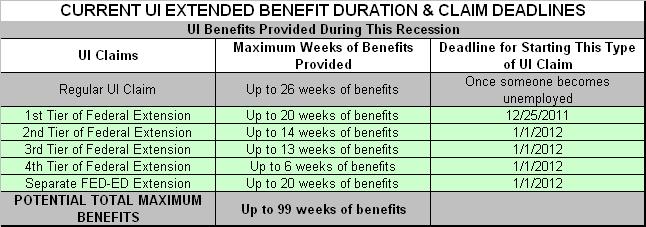
I am reminded of the old Chinese Proverb, “Give a man a fish and you feed him for a day. Teach a man to fish and you feed him for a lifetime.” It may also be deduced that to borrow a fish and give it to a man, is to impoverish oneself; and that a nation borrowing and giving a ton of fish to men for 99 weeks will in time bankrupt itself. Of course it doesn’t get any better when one proffers to steal and give away the fish. For one thing, you can’t give away what you don’t have. And of equal importance, the act of extending unemployment benefits for 99 weeks actually does more to discourage, rather than encourage, employment. Can anyone dispute the end result?

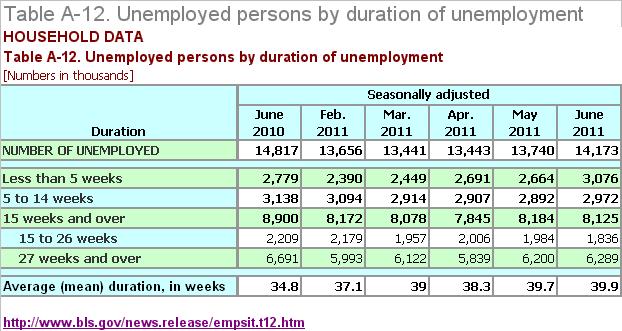
If you take a look at Table A-12 (above), from the Bureau of Labor Statistics latest report, two items stand out. First of all, the officially counted number of unemployed persons, per Household Data, increased from 13.7 million in May to 14.2 million by June of 2011 (a fact overlooked by many). Secondly, the average duration of unemployment increased from 34.8 weeks in June of 2010 to 39.9 weeks by June of 2011. As you may recall, the recession officially ended in June of 2009, so what’s causing this? The unintended consequences themselves dispute Obama’s errant theory that, extending unemployment benefits for up to 99 weeks would help the unemployed find ‘good’ jobs. No one can deny the outcome.

It was back in July of 2010, after signing a bill extending unemployment benefits to 99 weeks, when Barack Obama said, After a partisan minority used procedural tactics to block the authorization of this assistance three separate times over the past weeks, Americans who are fighting to find a good job and support their families will finally get the support they need.” Excuse me, but I fail to see how an extension of unemployment benefits could ever be used as a tool for landing any kind of job. Exactly how does that work? As evidenced by the end result, not very well. And although unemployment benefits may help to support a family, when I was on unemployment for two weeks (many years ago), after having been furloughed by the federal government, it didn’t take any longer than that for me to figure out that my family of five could not survive on an unemployment check. So what did I do? I got religion, and found another job. “Finding a job is a full-time job.” ~Unknown

“Keep on asking, and you will receive what you ask for. Keep on seeking, and you will find. Keep on knocking, and the door will be opened to you.” ~Matthew 7:7

I recently spoke with an acquaintance, who stated that he was going to have to get back to work soon, because the $1,200 per month check he had been getting for the past two years was about to run out. I thought for a minute, and then put two and two together. What he was saying was that he really wasn’t trying very hard while the unemployment checks were coming in. But as soon as the government-subsidy to not work came near an end, he knew he would have to get off of his behind and do what, for the past two years, he had no incentive to do. He also indicated during this dialogue that he had been doing some self-employed work on the side, using the government handout as a backstop. I’ve overheard a number of other people saying that they were working full-time jobs while continuing to collect unemployment checks as well, a behavior which I strongly condemn.

But this is really the government’s own fault. A government-funded, deficit-financed, subsidy to not work will always be respected for exactly what it is – free-money, carelessly doled out by a lackadaisical, sugarcoating, and weak-kneed Administration. It’s nothing more than an act of cold-blooded kindness. The act of extending unemployment benefits to 99-weeks has produced exactly what such a program should – an increase in the average duration of unemployment. If the big-time, millionaire, POTUS had an ounce of honesty; he would admit that you can’t support a family on an unemployment check, and that extending unemployment benefits doesn’t help anyone find a ‘good’ job. What sounds kind isn’t necessarily true. It is rather the threat of losing governmental assistance which produces the swift kick in the rear, necessary to inspire action.

When I took public transportation half way across town for four months, to a minimum wage job, to push a mop and empty trash cans, often standing at a bus stop in the pouring rain, I complained to no man. With simple faith in God, and a belief that He helps those who help themselves, it dawned on me one day that, ‘it really didn’t matter what I did for a living’. ‘If I showed up everyday, and performed my job to the best of my ability, promotion would come from above.’ And promotion did come, and in short order. Government has never been the solution to my problems, but for many unemployed persons today, government is the problem.

I have wondered at times how many people are really just lying around thinking that their lives would be so much better if only millionaires and billionaires would contribute more of their money to the federal government. If you listen to Obama’s rhetoric long enough, you would think that there is a whole class of envious people sitting around somewhere dwelling on this thought, every waking day. But hopefully it’s just him. Whatever happened to words of encouragement?

“Industry, thrift and self-control are not sought because they create wealth, but because they create character.” ~Calvin Coolidge

There was a day when I found myself jobless, homeless and broke. I didn’t have an unemployment check, or any other kind of governmental subsidy. When I checked into the local homeless center for a week (a center that I still donate to today), I wasn’t sitting around wishing I had someone else’s money. To the contrary, I was engaged in doing whatever I had to do to get out of there, and to get back on my feet. Pulling yourself up by your own bootstraps used to be thought of as a noble feat, and in my view it still is. After all, doesn’t God help those who help themselves? Yeah, I went through some hard times, and worked some low paying, back-breaking, temporary jobs. But within three years of utter destitution, I had a good paying managerial job; good enough to buy a modest home, a car, to get married, and to move on to the next level. I haven’t looked back since.

So how much is the federal government squandering on this failed, so called, jobs program? Well, per the President’s own 2012 historical budget, federal spending on unemployment compensation reached a record high of $166.2 billion in 2010, eclipsing the previous record of $127.6 billion in 2009. Prior to this, the old record of $57.4 billion was set in 2003. And in case you’re wondering, total spending on unemployment in 2007 and 2008 was $35.3 billion and $45.6 billion, respectively. So not only has Obama’s misguided policy doubled the average duration of unemployment, but it has exceeded the previous spending record by 189%. Chalk up two more historical, extraordinary accomplishments for Obama.

From Average Weeks Unemployed

If I was engaged in the battle to reduce government spending, the first thing I would do is cut unemployment back to the traditional 26-week benefit. If government wants to reduce the number of unemployed, the best thing it can do is get out of the way. That’s right! There are jobs available now, but people are not going to take them until the government pacifier is withdrawn. I thank God for every back-breaking, low paying, non-unionized job I ever had. To be blunt about it, if you are an adult, and can’t find work within 26 weeks, in the United States of America, it’s not because there aren’t any jobs, it’s because you’re not trying. I tell that to my children, who are all working now, and I will say it to anyone who has ears.

“Go to the ant, you hater of work; give thought to her ways and be wise.” ~Proverbs 6:6

Here are some more words of wisdom that will stick with me for the rest of my days: “Do what you don’t want to do, and don’t do what you want to do.” | “Grow up or die.” | “If you don’t work, you don’t eat.” | “Get in where you fit in.” | “Good planning and hard work lead to prosperity, but hasty shortcuts lead to poverty.” ~Proverbs 21:5

What? You don’t like this? Too bad! It’s time we had leaders who tell the people what they need to hear, and not what they want to hear. It’s time to take our ideals back. It’s time to restore integrity. It’s time to judge men and women by the content of their character. It’s time to get government out of our way and off of our backs. It’s time for another shellacking. It’s time for the community destabilizer to shape-up, or ship-out.

“Government’s view of the economy could be summed up in a few short phrases: If it moves, tax it. If it keeps moving, regulate it. And if it stops moving, subsidize it.” ~Ronald Reagan

References:

http://thehill.com/blogs/on-the-money/801-economy/134443-unemployment-benefits-extension-in-tax-cut-deal-only-goes-so-far

http://www.edd.ca.gov/Unemployment/Federal_Unemployment_Insurance_Extensions.htm

http://www.bls.gov/news.release/empsit.t12.htm

http://data.bls.gov/pdq/SurveyOutputServlet

http://www.gpoaccess.gov/usbudget/fy12/xls/BUDGET-2012-TAB-5-1.xls

Link to Data:

Data Tables

Images

Obama on Jobs: Created 0, Lost 2.5 Million

Jobs Created, Saved, Recovered or Just Lost?

~ By: Larry Walker, Jr. ~

Hours after the White House received a disappointing jobs report, Barack Obama told autoworkers at a Chrysler Fiat Plant in Ohio that, “Even though the economy is growing, even though it’s created more than 2 million jobs over the past 15 months, we still face some tough times. We still face some challenges. There are still some headwinds that are coming at us. Lately, it’s been high gas prices that have caused a lot of hardship for a lot of working families. And then you have the economic disruptions following the tragedy in Japan.”

So his latest excuses are high gas prices, and the tragedy in Japan, neither of which were a problem for Obama when the March and April jobs reports were more favorable. First of all, Japan was hit with a tsunami on March 11, 2011, and the crisis over there has nothing to do with job creation or economic growth in the United States. Secondly, gasoline prices have been on the rise since February of 2009, primarily due to a decline in the value of the dollar. And the decline in the value of the dollar is primarily due to the federal government’s padding of the money supply to cover its out-of-control spending.

On the same day, the Italian automaker Fiat SpA agreed to purchase the U.S. Treasury’s remaining 6 percent interest in Chrysler for $500 million. This gives Fiat a 52 percent stake, otherwise known as the controlling interest, in Chrysler. Although Obama has spoken negatively of US companies that open plants overseas, he just sold the taxpayer bailed-out automaker to Italy. Nice going chief.

Even more troubling is Obama’s statement regarding jobs. He said that the economy has “created more than 2 million jobs over the past 15 months”. Which economy was that, the global economy, or the U.S. economy? According to data provided by the U.S. Bureau of Labor Statistics, the economy has lost nearly 7 million jobs since the recession began in December of 2007, and 2.5 million of those jobs have been lost since February of 2009. Did I miss some sort of fundamental transformation of the definition of words, or something?

A more appropriate statement by Obama would have been to say to autoworkers at the old Chrysler Plant that, “I’m sorry I sold you guys out to an Italian automaker, but what can I say, we needed the money. The economy has shrunk further under my presidency. Even though the recession officially ended in June of 2009, the economy has lost around 2.5 million jobs since I became president, which brings the total number of jobs lost since the recession began, in December of 2007, to around 7 million. I now understand that I have been leading this nation in the wrong direction, so my plan is to bring in a new group of advisors who have a better understanding of how the American economy works.” But instead, what we heard was more of the same.

Perhaps Obama would do well to heed the words of Abraham Lincoln who once stated, “I am a firm believer in the people. If given the truth, they can be depended upon to meet any national crisis. The great point is to bring them the real facts.” Obama has yet to bring us the real facts. Everything he says is biased in a way to make it appear as though he has accomplished something great, when in reality his policies are not even capable of fostering economic growth.

Created, Saved, or Recovered?

The word ‘created’ means to originate. Jobs are created when new jobs are added on top of existing ones. After a jobs market goes into recession (a period of sustained job losses), it enters into a state of recovery in which jobs that were lost are recovered. Once the jobs that were lost have been recovered then any additional jobs added are considered to have been created.

The word ‘saved’ means to preserve or guard from injury, destruction, or loss. Jobs are saved when they are prevented from being lost such as through the automotive industry bailouts. If one can prove that (x) number of jobs would have been lost but for some kind of intervention, then one can make the case that those jobs were indeed saved.

Then we come to that elusive word ‘recovered’. The word recovered means to get back, regain, or to return to a normal condition. Since the Great Recession began in December of 2007, the U.S. economy has lost nearly 7 million jobs. Once those 7 million jobs have been recovered, and only then, can Obama, or any other politician, start talking to us about the number of jobs created.

The Real Facts

To be precise, since the recession began, we have lost 6,493,000 according to the Bureau of Labor Statistics (BLS) Household Data, or 6,940,000 according to BLS Establishment Data. And that’s including Obama’s alleged creation of “more than 2 million jobs in the last 15 months”. In reality, the economy has merely recovered 1,081,000 jobs in the last 15 months according to BLS Household Data, or 1,797,000 according to BLS Establishment Data, neither of which exceeds 2 million. And further, since February of 2009, the month after Obama’s inauguration, the economy has lost a total of 2,422,000 per BLS Household Data, or 2,520,000 per BLS Establishment Data. In other words, we are a long way from a jobs recovery, and a lot further away from job creation.

From Employment Statistics May 2011

As indicated in the chart below, per BLS Table A-1, when the recession began in December of 2007, there were 4,659,000 American workers not counted as part of the labor force who wanted jobs, and another 7,664,000 who were counted as part of the labor force and unemployed, bringing total number of unemployed persons to 12,323,000. As of May of 2011, there were 6,227,000 American workers not counted as part of the labor force who wanted jobs, and another 13,914,000 who were counted as part of the labor force and unemployed, bringing total number of unemployed persons to 20,141,000. That means there are 20,141,000 Americans, or 7,818,000 more than the pre-recession level, literally sitting on the sidelines waiting for “change you can believe in”.

From Employment Statistics May 2011

As indicated in the chart below, per BLS Table B-1, at the beginning of the recession 137,963,000 Americans were employed. By February of 2009, the number had fallen to 132,837,000. When the recession ended, in June of 2009, the number had fallen further to 130,493,000. As of May of 2011, the preliminary number of employed Americans stands at 131,043,000. No matter how you slice it, not one job has been created during the Obama presidency. Although it’s true that some jobs have been recovered since the trough, the number of jobs has declined by 2,520,000 since Obama’s inauguration.

From Employment Statistics May 2011

References:

Images, Data 2, Data 3

Jobs, Jobs, Overthrow Libya

BLS: Jobs Growth

The Summer of Plan B

~ By: Larry Walker, Jr. ~

The summer of 2010 was supposed to have been the ‘Summer of Recovery’, but since that failed the Obama Administration has moved on to Plan B, the ‘Summer of Death and Destruction’. Notice how quickly the Obama Administration changes the topic when its achievements go awry. It’s almost like they thought, “Hey our economic policies are failing, so let’s turn to some controversial international topic to divert attention.” “I know, let’s bomb Libya, and point the finger at other allies.” Or, “Hey Osama’s been laid up in that Pakistani safe house long enough, let’s go over there and shoot him to take attention away from our failed economic policies.” But not so fast, let’s stick to tracking the success or failure of the Obama Administration’s economic policies. We’ll review his international policy mishaps later, when its fruits come to bear.

Jobs Growth since the End of the Great Recession

According to the National Bureau of Economic Research, the Great Recession, the longest of any recession since World War II, began in December of 2007 and ended in June of 2009. So where are we today?

From Jobs April 2011

When the recession ended in June of 2009, the American economy had a total of 130,493,000 jobs, and through the end of last month had a total of 131,028,000. That’s an increase of 535,000 jobs over the last 22 months, or average growth of just 24,318 jobs per month since the ‘recovery’ began. It can also be said that the economy has added 768,000 jobs since December of 2010, when the “Tax Relief, Unemployment Insurance Reauthorization, and Job Creation Act of 2010” was signed into law on December 17, 2010. In effect, an average of 192,000 jobs per month have been added since Conservatives won back the House of Representatives, effectively derailing the Obama Administration’s failed economic policies.

Analytically, any and all jobs growth realized by the American economy since the end of the great recession has come since the December 2010 legislation was signed into law. Thus, all of the Obama Administration’s efforts prior to December of 2010 amount to nothing more than a waste of time and trillions of dollars in deficit-financed government spending. All the jobs growth added since the end of the Great Recession can be attributed directly to conservative economic policies. But we’re not quite out of the woods.

Looking backwards, the American economy had a total of 131,660,000 jobs at the end of April of 2000, versus 131,028,000 in April of 2011. Thus, Americans currently have 632,000 fewer jobs than we had eleven years ago. In addition, since the number of jobs peaked at 137,996,000 in January of 2008 (a record high), we are currently 6,968,000 jobs shy of the pre-recession level. Under the conservative growth rate of 192,000 jobs per month, the jobs market would recover to pre-recession levels within 36 months; while under the Obama Administration’s growth rate of 24,318 jobs per month, recovery would take 24 years. With the U.S. population growing at an annual rate of 1%, or by roughly 3 million per year, you can see that we have a long way to go.

To conclude, conservative economic policies are at least on the right track, although they need to be ratcheted up. Meanwhile the Obama Administration has in effect admitted its domestic economic policy failures and has resorted to bombing a former third-world ally into oblivion. It’s a good diversion, but it won’t win the ill-advised Obama a second term. It’s time to finish the job. It’s time to send Obama packing.

Sources:

Business Cycle Dating Committee, National Bureau of Economic Research

Establishment Data, Bureau of Labor Statistics

Link to Original Spreadsheet

Payroll Tax Cut Forsakes the Poor

None and Done

Obama’s Phantom Tax Cut

– By: Larry Walker, Jr. –

When Barack Obama signed what was touted by the mainstream media as the middle-class cut bill on December 17, 2010, it was praised as a historic measure which would extend tax cuts for families at every income level, renew jobless benefits for the long-term unemployed and enact a new one-year cut in Social Security taxes that would benefit nearly every worker who earns a wage.

But first of all, extending last year’s tax rates actually didn’t do anything for anybody (i.e. nothing gained, nothing lost). Secondly, renewing jobless benefits for the long-term unemployed was simply the price we had to pay for a failed $887 billion economic stimulus program. Thirdly, and to the point of this blog post, as far as the one-year cut in Social Security taxes, exactly what does the term “nearly every worker” mean?

Well, just two months after its enactment, tens of thousands of American’s are beginning to find out. Many are noticing that their paychecks are actually smaller than they were last year, while others are seeing just an extra dollar or two per month. In fact, the only ones actually receiving the full 2% payroll tax cut are those making over $70,000 per year. Those making under $20,000 per year are actually ingesting a tax hike.

In an effort to determine why so many folks are complaining, we compared Internal Revenue Service Publication 15, (Circular E) Employer’s Tax Guide, for tax year 2010 to the 2011 publication. Then we created a spreadsheet to compare the differences. What we discovered is that in 2010 the amount of federal income tax withheld from paychecks was lowered, to compensate for the $400 Make Work Pay Credit. But with the expiration of the credit at the end of 2010, income tax withholding tables have been readjusted back to pre-stimulus levels. This adjustment in income tax withholding rates has completely negated the Social Security tax cut for the poor, and greatly reduced its effect on those with moderate incomes.

On its face, the new law lowers the amount of Social Security tax withheld from all paychecks from 6.2% to 4.2%, however not all paychecks are affected equally. Had this tax cut been implemented on its own, it would have been a good thing for all wage earners; however due to the corresponding expiration of the Make Work Pay Credit, the end result favors those making over $70,000 per year, and discriminates against those who earn less. The word on the street is that Obama’s 2% Social Security tax cut is just one more in a series of lies emanating from the White House. If we could impeach a POTUS for lying (or ignorance), Obama would have been impeached 10 times over.

The following calculations are based on the IRS’s monthly percentage method tables for single taxpayers (Table 4). If you’re not convinced, you may always visit www.irs.gov, search for Publication 15, and make your own assessment. But if you don’t want to go through all of that trouble, you can simply compare your latest payroll tax report, or pay stub, to one from last year.

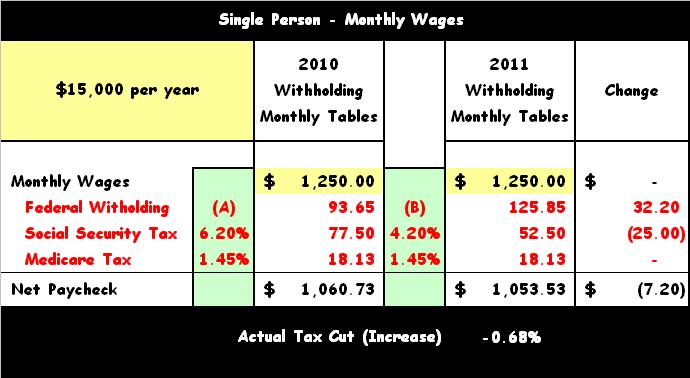
As the table above displays, rather than receiving a tax cut, those making $15,000 per year, or less, are actually receiving at least a 0.68% payroll tax hike. Although this may not have been the Democrat’s intent, this is what he delivered.

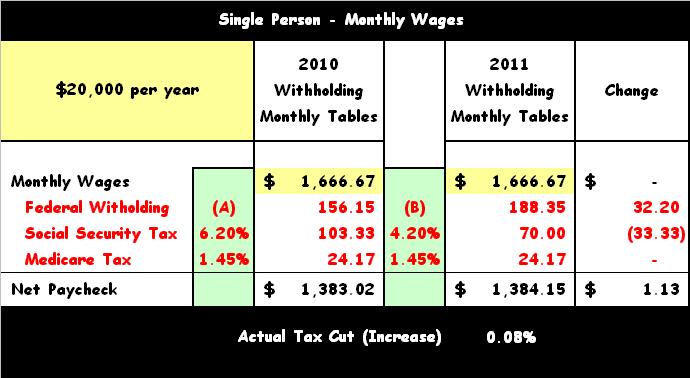
According to the table above, those making exactly $20,000 per year are receiving a mere 0.08% tax cut. Wow, that’s a whole $1.13 in tax savings each and every month, leaving many on Main Street in shock and awe. Since those making under $20,000 all got a tax hike, those whose lives have been improved by a buck a month must be so proud of their Democrat saviors.

The next table (above) reveals that although those making $30,000 per year received a bona fide tax cut, it is effectively only 0.88%, or $17.80 per month. I suppose $17.80 per month, which equals $213.60 per year, will have some impact on the economy, but not likely much.

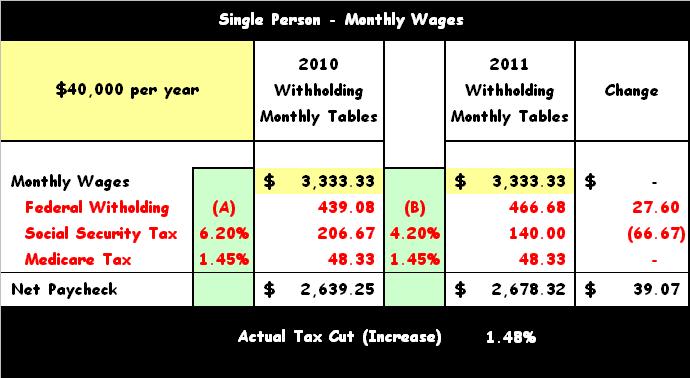
The table above shows that those making $40,000 per year are receiving a 1.48% tax cut. Although it’s not a full 2.0%, the extra $39.07 per month can at least be banked, or perhaps donated to the poor and needy.

As the table above exhibits, those making $50,000 per year are receiving a 1.74% tax cut. Now we’re talking real money, a whole $55.73 per month, although perhaps this would have been more appropriately directed toward those making less than $20,000.

The table above affirms that those making $60,000 per year are now taking home a 1.92% tax cut. It’s getting there, although it’s not quite 2%, an extra $72.40 per month can at least buy some extra food, or pay a bill. Then again, if you’re lucky enough to still have a job paying $60,000 per year under the present regime, how important is an extra $72.40 per month?

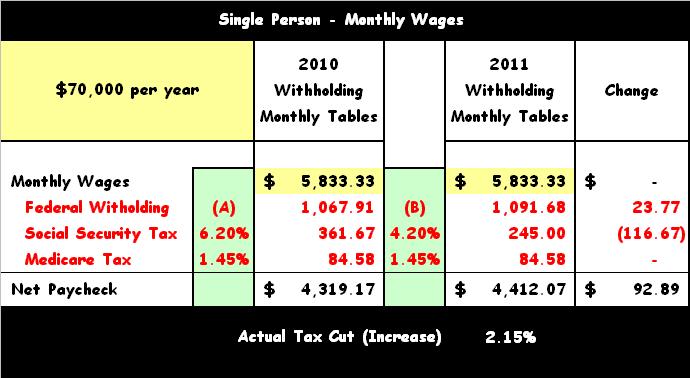
Finally as exposed in the last table (above), those making $70,000 per year are picking up the full 2% tax cut and then some (actually 2.15%), a savings of $92.89 per month. The percentage of taxes saved tops out at about the 2% level with the monthly dollar amount continuing to advance up to the $106,800 cap on Social Security wages.

In conclusion, those who needed a diminutive tax cut the least are receiving it the most. It all goes to show that in spite of a far left-wing progressive like Obama, “The rich keep on getting richer while the poor get poorer.” While other countries like China directed payroll tax cuts toward employers, you know, the ones who can actually provide jobs and a real boost to an economy, Obama has blown his 3rd and final chance to get it right. Three strikes and you’re out! Perhaps our next POTUS will be one who not only takes the time to read the bills presented for signature, but one who is actually capable of understanding cause and effect. Obviously, the present White House occupant is a wash. Obama is ‘one and done’, but in terms of American jobs, this could be more effectively expressed as ‘none and done’.

References:

Blindsided | White House Fiscal Lunacy

Back in the Ditch

2016 GDP vs. National Debt

– By: Larry Walker, Jr. –

We will not be adding more to the national debt.” ~ Barack Obama ~

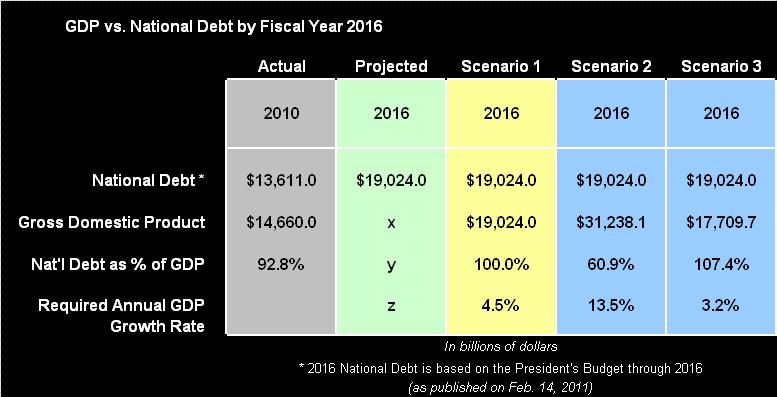
Say what? You must mean that you will not be adding more to your national debt, because I know that I certainly won’t be adding to the national debt, so you need to take the we out of that statement buddy. The real question is how are you going to pay back the trillions of dollars that you have already squandered? And here’s another riddle – What will the U.S.A.’s gross domestic product (GDP) need grow to by the year 2016 in order to keep pace with the present White House occupant’s irrationally exuberant spending spree? And based on the answer to that question, at what annual rate must our economy grow?

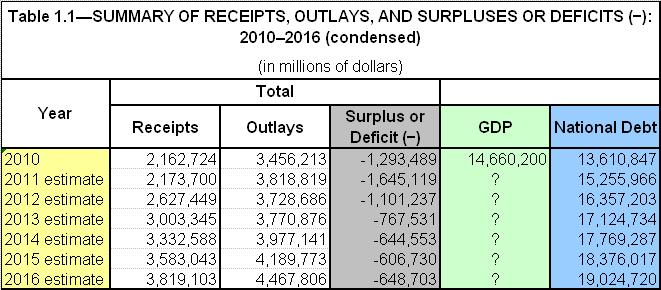
If we add the inexperienced CEO’s 2011 to 2016 projected annual budget deficits to fiscal year 2010’s ending national debt balance of $13.6 trillion, then the national debt will equal $19.0 trillion by the year 2016. And you call that “not adding more to the national debt”? So is this guy a pathological liar, or what?

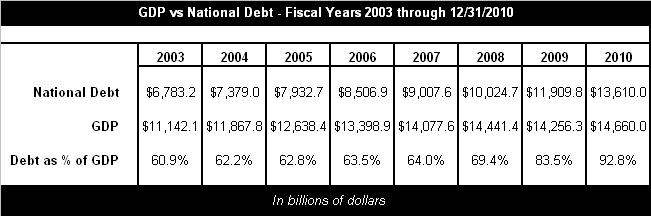
At the end of 2010, the Bureau of Economic Analysis (BEA) reported that gross domestic product (GDP) for the year was $14.6 trillion. So depending on the rate of economic growth over the next 6 years, the national debt may sooner or later exceed GDP. Although even the present White House occupant once stated that the national debt is unsustainable, the question is – as juxtaposed to what? If we take a look back to the days when our debt was sustainable, when the economy was growing at roughly 5% per year with low unemployment, such as in 2003, we will discover that the debt-to-GDP ratio back then was 60.9%. So the question is what do we need to do in order to reduce our debt-to-GDP ratio from its present level of 92.8% back down to 60.9%?

In Scenario #1 (below) we will determine the rate of economic growth necessary in order for GDP to equal our projected debt by the year 2016. In Scenario #2 we will discover the rate of economic growth needed to return to a more healthy debt-to-GDP ratio of 60.9%. Finally, in Scenario #3 we reveal what the debt-to-GDP ratio will be by 2016 if GDP maintains its present growth rate of 3.2% per annum.

Scenario #1 – The budget to nowhere

Gross domestic product must grow from $14.6 to $19.0 trillion in order to equal the National Debt by 2016. In other words, GDP must maintain an average sustained growth rate of 4.5% per year, over the next 6 years, in order to achieve a debt-to-GDP ratio of 100%. This represents ‘the budget to nowhere’. Although, the Bureau of Economic Analysis reports that GDP grew at the rate of 3.2% in the 4th quarter of 2010, as you can deduce, this will not be sufficient to reach the current White House occupant’s pitiful goal of a 100% debt-to-GDP ratio.

Scenario #2 – Back to sanity

In order to return to the more prosperous 2003 debt-to-GDP ratio of 60.9%, GDP must grow at a sustained annual rate of 13.5% over the next 6 years. How likely is this? In order to achieve such a rate of growth, our economy would need to expand at the pace of an emerging market economy, a feat which is hardly doable. This is precisely why the Debt Commission recently stated that we will never grow our way out of this fiscal disaster.

Scenario #3 – Your new reality

Finally, if GDP maintains the present annual growth rate of 3.2%, then our debt-to-GDP ratio will have reached 107.4% by 2016. Welcome to reality, and to a future of bonded labor. This doesn’t look like winning the future to me, it looks more like a donkey in a quagmire.

Conclusion

The present White House occupant’s budget plan leads to disaster. What most of us wanted to hear was a plan for paying off the debt which he alone has run up over the last two years, not more debt evasion. Face it, there is only one way out of this mess. The first thing we need to do is to derail all of this administration’s reckless spending initiatives. Secondly, government spending must be cut, slashed, and cut again. And finally, we must get this fiscally bankrupt pathological liar out of the White House, by any means necessary. By any means necessary. And as far as who will be the next POTUS; throw a dart. While I am not certain about who it will be, I definitely know who will be packing up at the end of 2012, if not sooner.

Sources:

http://www.whitehouse.gov/sites/default/files/omb/budget/fy2012/assets/hist01z1.xls

http://www.bea.gov/newsreleases/national/gdp/2011/xls/gdp4q10_adv.xls

http://www.treasurydirect.gov/NP/NPGateway

Obama: The Era of Flimflam Economics, Part III

Transformation

Jobs Inheritance Mantra

By: Larry Walker, Jr.

Every time I turn on the news I hear the same sob story, whether it’s Obama, Geithner, Biden, Pelosi, Reid, a left-wing congressperson, or some low level administration official, they all repeat the same Democrat mantra (give or take a few thousand Americans), “We inherited an economy that was losing 700,000 jobs a month.” “We inherited an economy that was losing 750,000 jobs a month.” “We inherited an economy that was losing 800,000 jobs a month.” “Aum – Bush bad, Obama good”. I’m so sick of it that I decided to pull the Bureau of Labor Statistics historical archive to see for myself. Where did they come up with these numbers? Why does it keep growing? Does anyone ever refute the bull…, excuse me, lies? And better still, who cares?

Based on the facts, unemployment didn’t really fall off a cliff until Obama won the election, in November of 2008. That’s when everything went to hell in a hand basket. And where are we today? Other than a few gains in March, April and May of 2010, in large part due to the hiring of around 500,000 temporary census workers, there’s not much to be proud of. The unemployment rate stood at 9.5%, last month, essentially the same as it was in May of 2009. So much for the “Recovery Summer”.

The truth is that in September of 2008 the economy lost (-159,000) jobs which was 89% worse than the previous month’s loss of (-84,000). Then in October of 2008 we lost (-240,000) jobs which was 51% worse than September. Then once Obama was elected, in November 2008, we lost (-533,000) jobs, an increase of 122% over October, and then we lost another (-524,000) in December. Was it just a coincidence that the economy fell off a cliff as soon as Obama won the election? I think not.

The greatest declines in employment occurred as soon as Obama won the election (and really as soon as took the lead in the polls).

August 2008 -84,000

September 2008 -159,000

October 2008 -240,000

—————————-

November 2008 -533,000

December 2008 -524,000

January 2009 -598,000

February 2009 -651,000

March 2009 -663,000

April 2009 -539,000

May 2009 -345,000

June 2009 -467,000

I’m sorry, but I don’t see where Obama inherited an economy that was losing 700,000 to 800,000 jobs per month. Sorry, but the facts don’t support the mantra. The sad truth is that once Obama won the election it was his questionable – identity, qualifications, philosophy, intentions and relations that did the greatest harm to the economy. And even if it turns out to be true, who cares. Who needs a leader who’s constantly making excuses?

I don’t remember President G. W. Bush, or President R. W. Reagan ever complaining about what they inherited from the previous administration, they just did their jobs, gave us some relief through tax cuts, and then things turned around. Somebody needs to stop whining, chanting, and making up numbers – and just do their jobs. Cut taxes, cut spending, then sit down and shut up. If you can’t handle that, then resign.

You may review the archived Employment Situation Reports available from the Bureau of Labor Statistics and decide for yourself.

If you’re not part of the solution, you’re part of the problem. And if all you can do is make excuses, then you’re not part of the solution.

[Revised on 9/5/2010 – Chopped down to emphasize the point about: Who cares? Stop making excuses and deal with reality. Obama was a threat to the economy long before his official election date, and people simply cut their losses and fled as he came into power. Things will get better the day he leaves office.]

Obama: The Era of Flimflam Economics, Part II

Too Much Stimulus

Untimely and Proven to Fail

By: Larry Walker, Jr.

Near the end of 2007, prominent economists began advising the federal government that the economy was heading into a recession. They also mistakenly advised that the recession could be avoided if the government were able to implement some kind of economic stimulus program. In order to work successfully, such a stimulus needed to be large, targeted, and timely. Tax refund checks needed to reach taxpayers in a matter of weeks not months. Economists must have forgotten that they were dealing with the federal government.

Recessions are a normal part of the business cycle. The U.S. has averaged a recession about once every five years since WWII. Although economists have gotten better at predicting business cycles, it’s fairly clear that no one has ever been able to sidestep a recession. Avoiding a recession is like trying to stop an oncoming hurricane, when you see it coming you get out of the way, wait for the storm to subside, and then focus on recovery.

An economic stimulus package was proposed in January of 2008, in order to avert the recession. Although a similar stimulus plan had been attempted in 2001, and failed to prevent a recession, Congress was compelled to it try again. By the time the checks reached taxpayers, in April of 2008, it was too late, the recession had commenced.

In February of 2009 President Obama enacted a second stimulus plan. What was that about? Was he trying to prevent something that had already occurred? The Obama stimulus plan occurred more than a year after it was originally called for. By the time Congress passed Obama’s stimulus plan, the economy was well in the midst of recession. The only purpose of an economic stimulus is to avert a recession. Once an economy is in recession, a whole new set of policies is required. As of this month, around nineteen months after Obama’s first failed stimulus program, and nearly 2 1/2 years after Bush’s tardy attempt, Obama is still talking about a stimulus plan. Isn’t this just economic flimflam?

It should be obvious by now that stimulus programs don’t work in the real world. Although the classroom theory is plausible, the federal government is not an efficient vehicle for carrying one out. What should also be obvious is the type of recovery policies that work, once a recession has occurred. The 2003 Bush Tax Cuts and the 1983 Reagan Tax Cuts were effective tools in creating economic expansions following severe recessions.

If the goal is to grow the economy, create jobs, and increase tax revenues, then tax cuts are the way to go. However, if the goal is to flush trillions of borrowed dollars down the drain by attempting something that’s untimely and proven to fail, then maybe that’s Obama’s fate. Obama’s first stimulus plan was untimely and proven to fail, a kind of Flimflam Economics. And even today, he is talking about another economic stimulus program. Again, is Obama trying to prevent something which has already occurred? Does Obama really have the best interests of America at heart?

Stimulus: The Need for Speed

In a January 20, 2008 Dow Jones News article entitled, “The Need for Speed”, it was stated that, “A plan out of Washington to stimulate the flagging US economy may be a day late, but it certainly isn’t a dollar short.” Two days earlier, President George W. Bush called for fast tax relief for individuals and tax incentives for businesses that would total up to $150 billion.

Economists said that would be enough of a jolt to have a notable impact on growth, if done right and quickly. Bush said the tax relief for consumers could be a “shot in the arm to keep a fundamentally strong economy healthy.” Bush’s rough draft proposal highlighted the US economy’s big problem: the consumer.

“Americans could use this money as they see fit: to help meet their monthly bills, cover higher costs at the gas pump or pay for other basic necessities,” the president said.

Bush wasted no time announcing the rescue plan after getting a firm nod of approval Thursday from the country’s pre-eminent economic policymaker, Fed Chairman Ben Bernanke. The central bank chief said he would approve of such a fiscal stimulus plan so long as it was “timely” and implemented “decisively” and “quickly.”

The need for speed in such a plan is no doubt important, as Bernanke pointed out Thursday. If Congress dilly-dallies on the matter, rebate checks may not arrive to consumers in time to fortify the weak economic growth that is likely to continue throughout 2008.

Lakshman Achuthan, managing director of the Economic Cycle Research Institute in New York, said the fiscal plan essentially calls for “throwing a ‘money wrench’ into the system.” That plan, he said, can be successful, but he said rebate checks need to start arriving in “the next few weeks.”

Democrat Congress Drags Feet

Now scroll forward to a March 21, 2008, Financial Week article entitled, “U.S. can’t avoid recession, says influential forecaster”. The subtitle reads, “Economic Cycle Research Institute claims economy ‘on a recessionary course’; blames Congress for tardy rebate checks.”

Mr. Achuthan argued that this recession could have been averted had Congress considered “innovative ways” to get tax rebates into consumers’ hands sooner. (The rebates still have not begun to reach taxpayers). “Following a presidential initiative, Congress passed a tax rebate package with unusual speed, as officials noted that time was of the essence,” he wrote, “but they were content to let the rebates start reaching consumers several months later.”

Choosing Recession

Moving forward to an April 21, 2008, Forbes article entitled, “Choosing Recession”, Lakshman Achuthan and Anirvan Banerji stated, “This recession was actually avoidable as recently as several weeks ago.” They added, “The 2008 recession guarantees many months of job losses that will boost foreclosures and feed the credit crisis. But if fiscal stimulus had reached consumers quickly, it would have forestalled a recession, helping to stabilize the housing market. Such a soft landing would have bought some breathing room in which to resolve the credit crisis until the lagged effect of monetary policy kicked in.”

They continued, “Policy makers seemed to get the urgency. In January, Treasury Secretary Hank Paulson declared that “time is of the essence.” House Speaker Nancy Pelosi spoke of “timely, targeted and temporary” stimulus, and the administration and Congress enacted a tax rebate package with exemplary speed. The fatal flaw was their willingness to allow a delayed delivery of the stimulus. It was as if the medics had arrived and taken a quick decision to administer CPR–but in a few months rather than a few seconds.”

Stimulus Arrives Late

Later, an April 28, 2008 report on CNN Money summed it up, in an article entitled, “U.S. can’t avoid recession, says influential forecaster”. Tax rebates had started to arrive in bank accounts. But many economists we’re doubtful that they would keep the economy from recession. The stimulus package was to give rebates to about 130 million Americans, at a cost of more than $110 billion. Married taxpayers earning $150,000 or less were to receive up to $1,200, while single taxpayers earning under $75,000 would get up to $600. But it was too late.

“This will not avert a recession, because it is too late,” said Lakshman Achuthan, the managing director of the Economic Cycle Research Institute. “For this to have kept us out of what was an avoidable recession, it needed to happen a couple of months ago, in January or February.”

Obama’s Plan: A Year Late and $900 Billion Short

Months later appeared a November 22, 2008 article by NPR entitled, “Obama Offers Plan to Revive Economy“. The author lead with, “President-elect Barack Obama set out plans for an ambitious economic stimulus that would create 2.5 million jobs by January 2011”.

“We’ll put people back to work rebuilding our crumbling roads and bridges, modernizing schools that are failing our children, and building wind farms and solar panels, fuel-efficient cars and the alternative energy technologies that can free us from our dependence on foreign oil and keep our economy competitive in the years ahead,” he said.

In the same November 22, 2008 NPR article, business and economics historian John Steele Gordon stated that, “the New Deal didn’t end the Great Depression, World War II did.” He added that “building bridges and painting schools won’t provide a quick fix.” He was right. The Great Depression lasted from 1929 until 1945, or around 15 years, and it didn’t end through the action of any clever government policy.
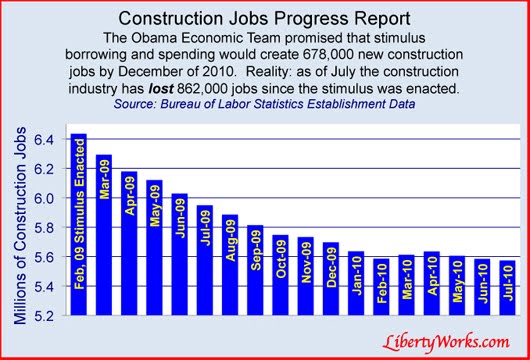
According to Liberty Works, the Obama Economic Team promised that stimulus borrowing and spending would create 678,000 new construction jobs by December of 2010. However, by July of 2010, the construction industry had actually lost 862,000 jobs.

Tax Cuts Work

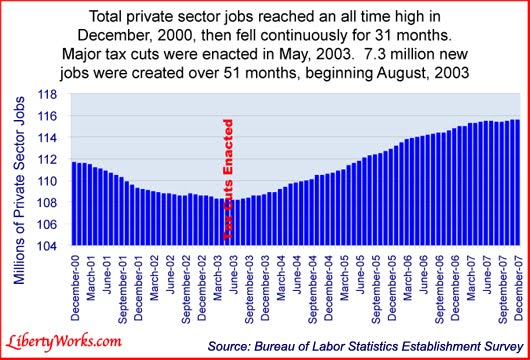
During the 2001 economic recession, the government attempted an economic stimulus in the form of tax rebates (similar to the 2008 rebates), but it likewise failed. Then finally in May of 2003, the Bush tax cuts were enacted. The tax cuts were responsible for the creation of 7.3 million new jobs beginning in August of 2003 and lasting through the end of 2007. Tax cuts are the only proven method for bringing an economy out of recession. The deeper the tax cut, the greater the expansion.

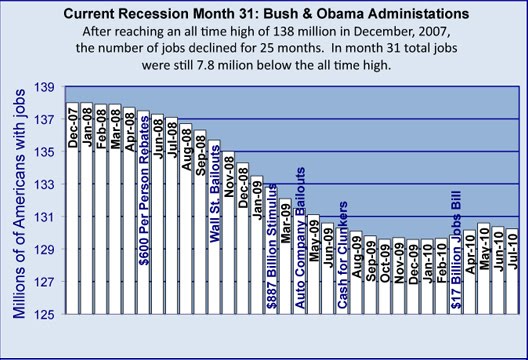
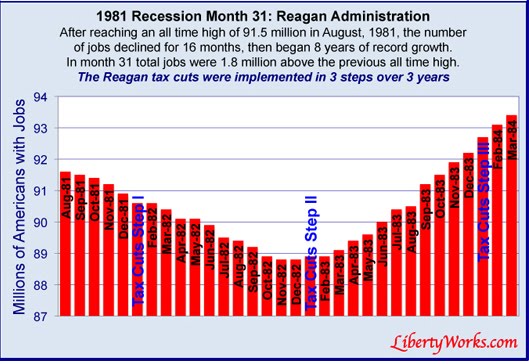
As the website Liberty Works so aptly reminds us, “President Obama and the Democrat Congress have implemented a series of measures that defy the lessons of past recessions”, especially that of 1981, which was by some measures worse than this one.

The chart above shows, “the job market recovery is faltering at best, after 31 months of Bush/Obama policies. There are 8 million fewer Americans now employed than in December, 2007.”

The results in the second chart (above), speak for themselves. “Reagan’s policies turned the job market around after 16 months of losses. The Reagan economy grew continuously for 90 months, creating a total of 21 million new jobs, or a 24% increase in the number of Americans who were employed.”

You’ve Been Flimflammed

If the goal is to grow the economy, create jobs, and increase tax revenues, then tax cuts are the way to go. However, if the goal is something more sinister, then one must brainwash their constituents into believing that ‘tax cuts cause recessions’. The Bush tax cuts brought us through another successful business cycle. Then the housing bubble burst, credit markets froze, and we fell back into recession. But tax cuts didn’t cause the recession. I don’t mind cutting Bush to pieces where warranted, and I was doing just that in 2007/08, but to say that the Bush tax cuts didn’t work because you disagree with his foreign policy is ignorant.
Whether or not the recession could have been avoided is highly doubtful due to the severity of the housing bubble and credit crisis. Yet if you listen closely, a year ago Obama was saying the recession was caused by the ‘lack of affordable health insurance’, and today he’s saying that it was caused by the ‘Bush tax cuts’. I suppose next he’ll be saying the recession was caused by whatever supports the legislation du jour.

It’s sinister enough to take advantage of a crisis in order to pass an unwanted legislative agenda. It’s entirely another matter to purposefully prolong a crisis to the detriment of every American: black, white, red, yellow, and brown; Democrat, Republican, and Independent. In fact, Obama’s looking more and more like another FDR. In FDR’s policies prolonged Depression by 7 years, UCLA economists calculate, you will find the following quote: “We found that a relapse isn’t likely unless lawmakers gum up a recovery with ill-conceived stimulus policies.”

Congress needs to cut spending, and cut taxes, now. If you’re not part of the solution, you’re part of the problem.

Obama: The Era of Flimflam Economics, Part I

Flimflammer in Chief

Economic Flimflam – Deceptive Nonsense

By: Larry Walker, Jr.

Down here on Main Street, while company X is waiting for person Y to pay their past due bill, company X is cutting back on everything it can, and borrowing money to fill the void. When person Y finally gets that stimulus money and pays their debt, company X will use the money to payback what was borrowed. Company X is not aggressively pursuing new business out of fear of attracting more deadbeat customers, but instead is focused on downsizing and preserving trusted relationships. Company X is now practicing sound business policy (i.e. fiscal responsibility). After nearly two years of being flimflammed, we find that demand has not been sparked, and that not one new job has been created.

Theory P – Temporary Stimulus Drives the Economy (False)

Rationale: If we give 150 million taxpayers a $400 annual tax credit for working, they will go out and spend it, which will spark additional demand, which will in turn fuel an economic recovery. Once the demand begins, Joe the widget maker will start getting a flood of calls for his product and will hire new employees, and buy new equipment as he expands his operation. So next we will need to make loans available for small businesses so they can prepare for the massive expansion. Problem solved. Government stimulus works, right? Wrong.

In Reality – When the government gives a $400 annual tax credit to a person who is broke, in debt, behind on bills, about to lose a job, or behind on their rent (or house note), it won’t be spent on anything new. It will be either saved, used to pay a debt, expedited to pay a past due bill, eaten, drank or smoked.

Under theory P, when the federal government gives a little extra money to person Y, person Y will go out and buy a new car, or a new house, or I-Pad, or something to help the economy. One problem is everyone knows that what the government is promoting is just a tiny, temporary fix. Lets get real, it’s not like person Y is going to get an extra $400 per month, which would possibly pay a car note. Instead, person Y is receiving an extra $33.33 per month (money that normally goes towards income taxes), and $33.33 per month doesn’t go very far in 2010 (it’s amazing that millionaire, Washington elitists don’t understand this). The clincher is that a stimulus, by its nature, is only temporary. Sure, tax credits were provided in 2009 and 2010, but will be capped off by a massive tax increase in 2011. The proposed tax increase will likely be at least double the pathetic stimulus.

‘As the government giveth, so the government taketh away.’

The other part of theory P involves making loans available for small businesses. The loans will theoretically be used to keep the doors open, and to meet payroll while small businesses wait on the massive flood of demand that’s sure to come. The only problem is that the demand came and went with the stimulus checks. So company X is reluctant to commit collateral for additional loans (loans that it may not be able to repay). So the government is encouraging small businesses to take the loans anyway. “Take a chance,” they say. “Hire some people, spend some money, add another location, get things moving and surely the demand will come.” In response, businesses have cut back more, and layoffs persist.

Theory C – Permanent Tax Cuts Do Drive the Economy (True)

Rationale: Under this theory taxes are cut permanently, and incentives are provided for business investment. Let’s give person Y an extra $400 per month, permanently, and see what happens. At the same time, let’s give business X a large incentive to invest and expand. What happens?

The Reality – Initially, person Y will pay off any past due bills, but within a few short months may go ahead and purchase that new car, or a new home, or an I-Pad (or two). Company X will begin to see real sustained demand, and will begin to hire and to think about expansion. With more people working, and with multiples of increased demand, the flame will have been kindled, and recovery will have begun. Tax revenues will increase as the economy grows, and as 15 million unemployed begin to become productive members of society.

The Flimflam Guys – Now, in step the flimflam guys (Krugman, Obama, Geithner, Greenspan, Reid, Pelosi and company) claiming that such a huge tax cut will only add to the current budget deficit.

After adding $2.7 trillion to the federal debt over the past two years and achieving nothing, now these geniuses want to complain about the deficit? Shut the hell up. Sorry but we’re not buying it this time. You had your shot and you failed. Those guys that you call the ‘party of no’, you know, the ones who have offered, “Not one new idea,” told you about ‘theory C’ before you flushed our money down the toilet and you mocked them. Now I guess you have to choose between eating crow, and sending the economy into an endless spiral of debt, inflation and higher taxes.

‘If you can’t stand the crow, just add a little more of Krugman’s Flimflam Sauce.’

The smart money’s on Theory C. Tax cuts work, but they will only work, if you cut spending on everything else across the board, and this is exactly what needs to happen. Cut out the wasteful spending, and give us a real tax cut.

The Progressive Slide to 2020 | GDP vs. Debt

2020 GDP vs. National Debt

By: Larry Walker, Jr.

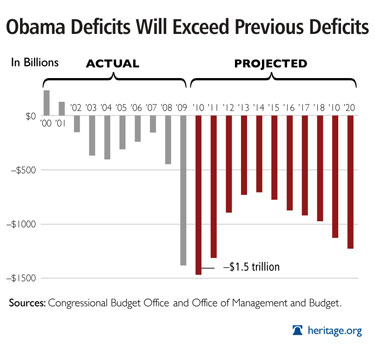
The question of the day is what will the USA’s Gross Domestic Product (GDP) need grow to by the year 2020 in order to keep pace with the Progressive’s ruinous spending? And based on the answer to that, at what annual rate should our economy be growing?

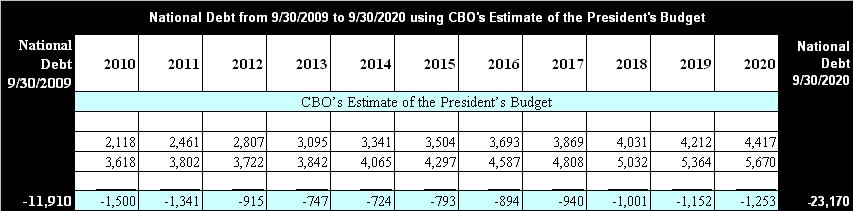
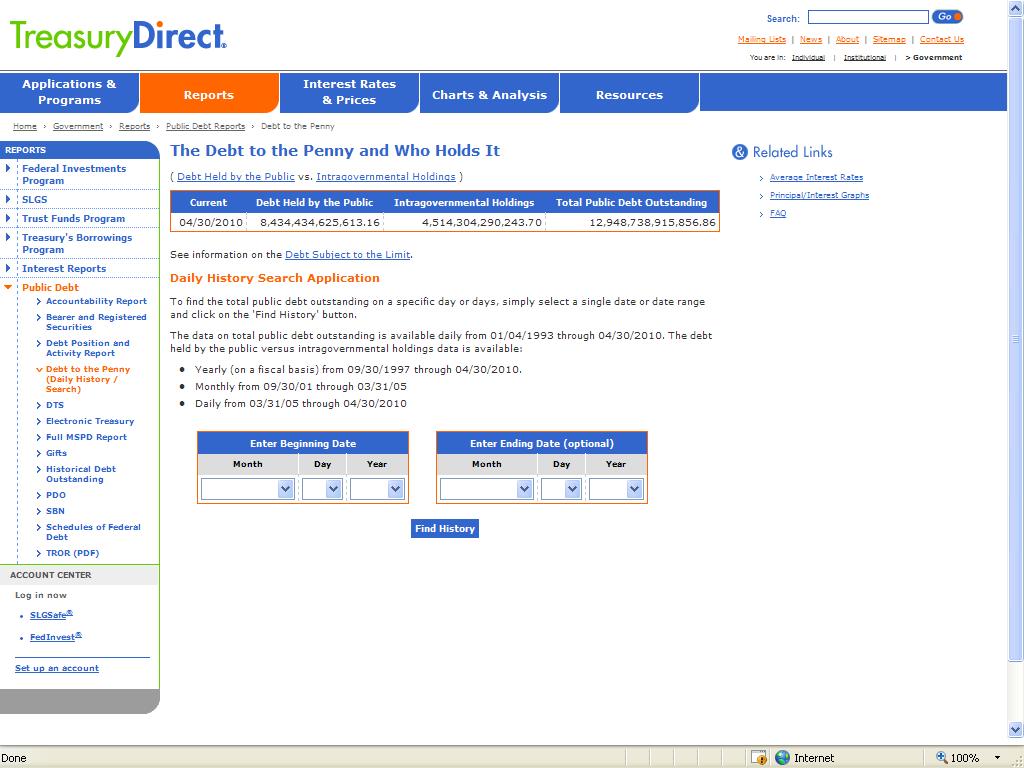
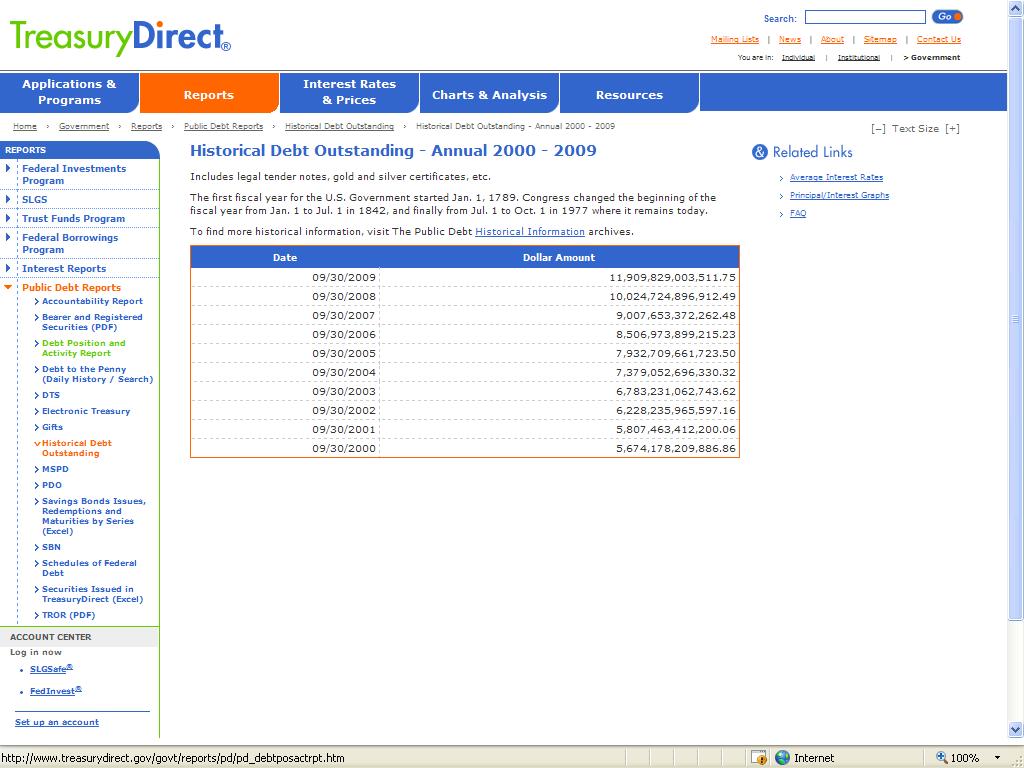
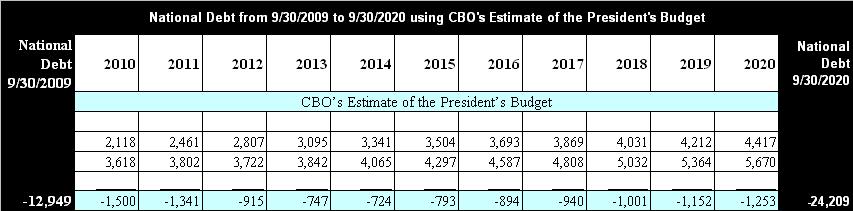
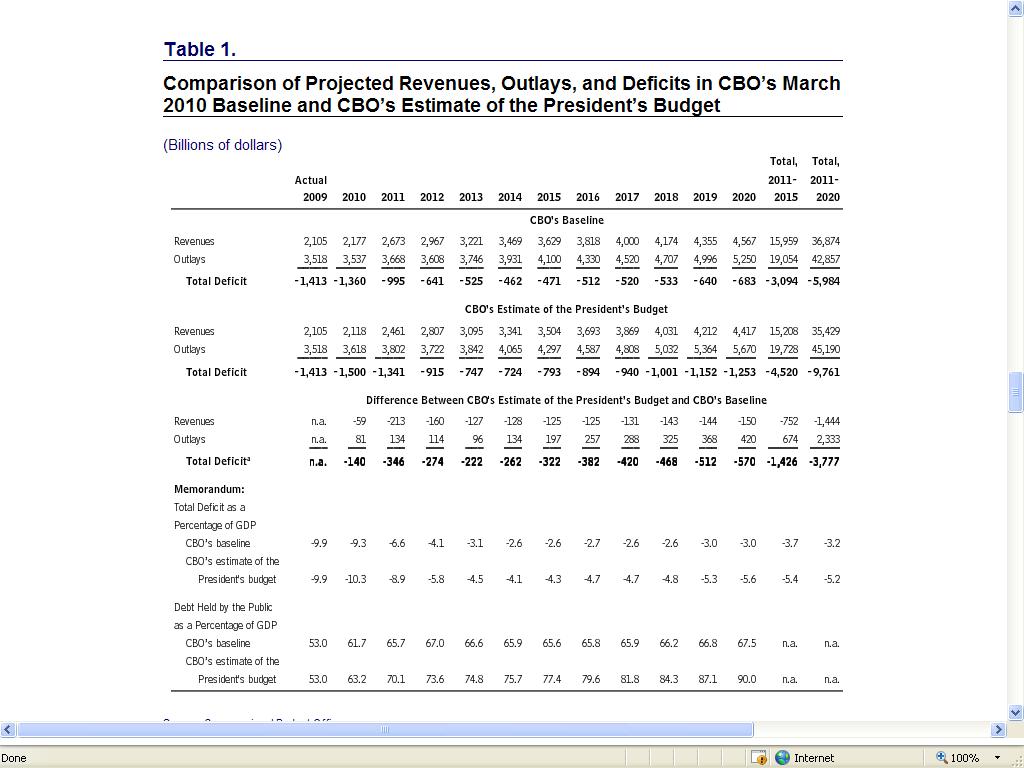
If we add the CBO’s 2010 to 2020 projected estimate of the president’s budget deficit to the current national debt of $12,948.7 billion (as of 4/30/2010), then the National Debt will total $23,170.0 billion by the year 2020.

click to enlarge

click to enlarge

click to enlarge

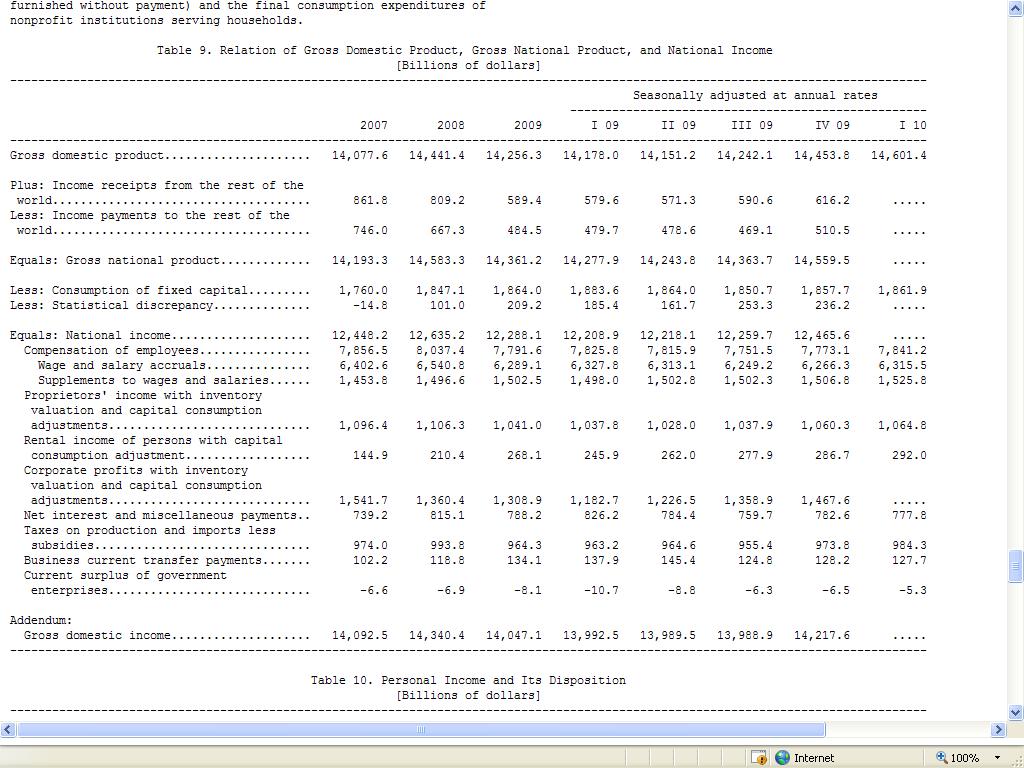
As of the end of the 1st quarter of 2010, based on the Bureau of Economic Analysis (BEA’s) latest preliminary estimate, GDP is averaging $14,601.4 billion annually.

click to enlarge

Depending upon the rate of growth of our economy over the next 11 years, our National Debt will exceed GDP, sooner or later. We know that even the Progressive’s say that our National Debt is unsustainable, but the question is just how unsustainable? If we take a look back to the days when our debt was sustainable and the economy was growing at roughly 5% per year with low unemployment, for example 2003, we will discover that our Debt to GDP ratio was 60.9%.

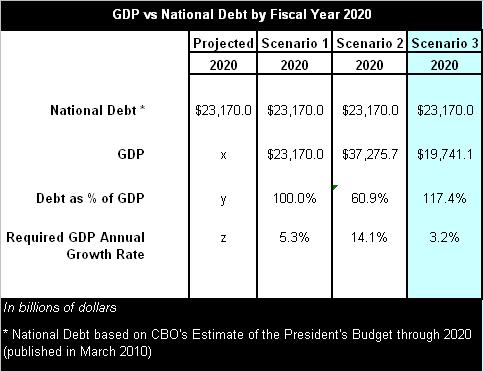
Scenario #1, below, determines the rate of growth necessary in order for GDP to match our projected debt by the year 2020. Scenario #2 determines the rate of growth needed in order to return to the 2003 debt-to-GDP ratio of 60.9%. Finally, Scenario #3 reveals what the debt-to-GDP ratio will be by 2020 if GDP maintains its current pace.

click to enlarge

Scenario #1 – The road to nowhere

GDP must grow from $14,601.4 to $23,170.0 billion in order to equal the National Debt by 2020. In other words, GDP must maintain an average sustained growth rate of 5.3% per year for the next 11 years, in order to achieve a Debt to GDP ratio of 100%. This represents ‘the road to nowhere’. Although, per the BEA, GDP grew at a rate of 3.2% in the first quarter of 2010, as you can see, this will not be enough to reach the destructive Progressive goal of a 100% debt-to-GDP ratio.

Scenario #2 – The way back to 2003

In order to return to the more prosperous 2003 Debt-to-GDP ratio of 60.9%, GDP must grow at a sustained annual rate of 14.1% for the next 11 years. In order to achieve such a rate of growth, our economy would have to grow at the pace of an emerging market, a feat which is clearly impossible for an industrialized nation. This is precisely why the president’s debt commission has stated publicly that, we will never grow our way out of this ‘man-made disaster’.

Scenario #3 – The Hellenistic toboggan slide

If GDP maintains its present annual growth rate of 3.2%, then by the year 2020 our debt-to-GDP ratio will reach 117.4%. Welcome to the Progressive Utopia. Welcome to the Republic of Greece.

Conclusion

The end of the Progressive trail leads to Greece. What you are seeing in Greece today is precisely where Progressive ideology will take us. Prepare for riots, violence, chaos, class warfare, and national bailouts. If that’s what you want, then support Barack Obama, and his Progressive entourage, and vehemently defend all of their policies. But, if this is not where you want to be in 2020, then identify and support true fiscal conservatives. Join with independents and moderates, and let’s elect responsible mainstream leaders who will lead us out of the wilderness, through sound fiscal policy, and free-enterprise solutions. It’s time to put the Progressives in their place: prison.

Sources:

http://www.bea.gov/newsreleases/national/gdp/2010/txt/gdp1q10_adv.txt

http://www.treasurydirect.gov/govt/reports/pd/histdebt/histdebt_histo5.htm

http://www.treasurydirect.gov/NP/BPDLogin?application=np

http://www.cbo.gov/ftpdocs/112xx/doc11231/frontmatter.shtml

click to enlarge

click to enlarge