Charts: Unemployment Rate vs. Size of Labor Force

– Courtesy of Liberty Works

* The following charts track the unemployment rate and the size of the labor force. *

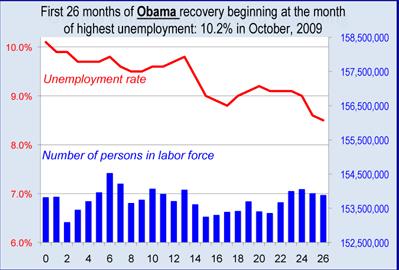
The chart above shows that over the first 25 months of the current recovery the unemployment rate has declined from 10.1% to 8.5% while the size of the labor force is virtually unchanged even though the working age population has grown.

Since the beginning of 2008 the working age population has grown by 7.2 million people.  Yet the labor force which is normally about two-thirds of the working age population has shrunk over the same period by 49,000.

Thus, 4.8 million men and women who should be included in the unemployment rate calculation as both in the labor force and unemployed are not counted at all because they have become too discouraged to look for jobs.

If those men and women were included in the unemployment rate calculation the December rate would have been 11.3%, higher than any time since 1940.

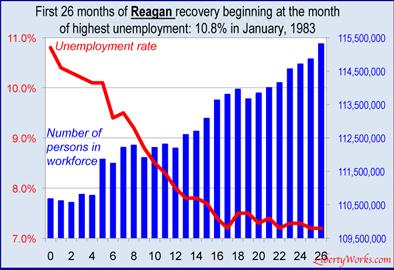
The second chart above tracks the first 25 months of the Reagan recovery of the 1980s. President Reagan inherited a sick economy and a deep recession that by most measures was worse than what President Obama inherited.  As the chart shows, the unemployment rate soared even higher but then there was a steep drop even as the labor force grew by 4.3 million!  People did not give up looking for jobs during the Reagan boom because there was robust growth in the economy and employers were creating hundreds of thousands of jobs every month.

[…]

There is a potential downside that could blow up Obama’s propaganda campaign. If the “good news” about the unemployment rate encourages several million people to come back into the labor force and seek jobs, the number officially classified as “unemployed” will increase and the unemployment rate will tick back up as the November election approaches.

Read the full story at – Liberty Works

Labor Force Contraction with Obama

– And other hidden truths

– By: Larry Walker, Jr. –

On January 7, 2012, Barack Obama boasted, “We’re moving in the right direction. We have made real progress.” Then he went on to exaggerate that, “Altogether more private sector jobs were created in 2011 than any year since 2005.” Naturally, such jovial assertions propelled many left-wing moonbats back to work today, if you can call blogging false claims such as that ‘Obama created more jobs in one year than Bush did in eight’, and other malarkey, work. It’s funny that these same cherry-pickers never attempt to match wits when it comes to the national debt. We all know that Obama has borrowed $1.0 trillion more in 3 years, than Bush did in eight, but I digress. So let’s examine Obama’s latest victory on the jobs front, for what it really represents.

Are we heading in the right direction?

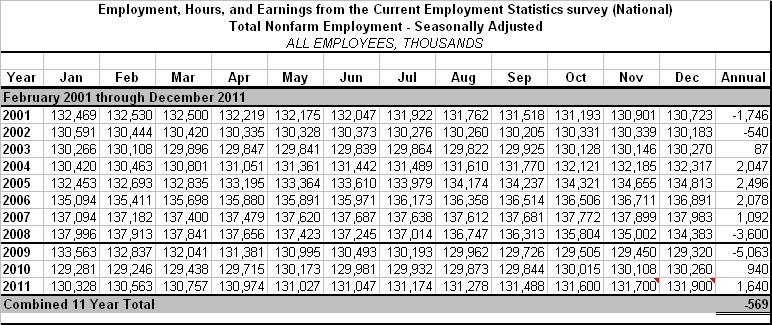
To find out, we took a closer look at the official data published yesterday by the Bureau of Labor Statistics (BLS). According to Table B-1, Establishment Data, the American economy has lost a total of -569,000 non-farm jobs since January of 2001. So in terms of jobs growth, what is factual is that not one new net job has been realized over the last 11 years (see table below). So are we headed in the right direction? I am reminded of a quote from the movie “2012” – “When they tell you not to panic, that’s when you run.”

Zooming in a little closer, we can see that -1,663,000 jobs have been lost since February of 2009, the month after Obama’s inauguration (see table below). So although 1,640,000 jobs were gained in the year 2011, and 940,000 in 2010, long forgotten by Obama are the -4,243,000 jobs that were lost during his first year in office. Granted, the fact that the economy is no longer losing jobs is a good thing, but it doesn’t necessarily mean we are heading in the right direction. One would have to examine a number of other factors in order to make that affirmation, such as the recent downgrade to the U.S.A.’s credit rating, and the 333% growth in government debt over Obama’s first three years.

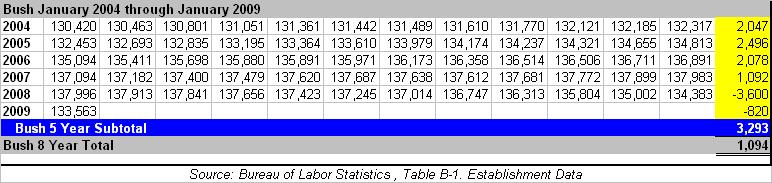
By comparison, George W. Bush, who also inherited a recession from his predecessor, suffered total job losses of -2,199,000 by the end of his third year in office (see table below), while Obama lost -1,663,000 during his first three years (see table above).

So for starters, it is incorrect to state that any jobs have been created since Obama became president, because net jobs have been lost (not gained). Therefore, a more fair and balanced statement would be that, ‘during their first three years in office, Obama lost -536,000 fewer jobs than Bush’. Now as far as I’m concerned, that’s hardly worth breaking out the caviar and champagne. What it really means is that in comparing both presidents up to this point in their terms, Obama is less of a loser than Bush. But two losers don’t make a winner.

Were more jobs created in 2011 than in any year since 2005?

Next, since Obama remarked that ‘more jobs were created in the year 2011 than in any year since 2005’, we must verify his claim. Actually this is not true, as you can see in the table below. The facts show that in 2004, 2005, 2006, and 2007 the economy produced total jobs growth of 2,047,000, 2,496,000, 2,078,000, and 1,092,000 jobs, respectively. So although it may have been correct to state that more net jobs were realized in 2011 than in any year since 2006, because 2,078,000 were realized in 2006, while 1,092,000 were attained in 2007, versus 1,640,000 in 2011, pulling the year 2005 out of a hat was a stretch.

“It is hard to believe that a man is telling the truth when you know that you would lie if you were in his place”.  ~ Henry Louis Mencken

Aside from twisting the truth, all that this really means is that fewer net jobs were realized in 2007, 2008, 2009, and 2010 than in 2011. So what? The recession officially ended in June of 2009, and now finally, two and a half years later, Obama beat what are essentially recessionary benchmarks. Congratulations! But what about the -3,600,000 jobs that were lost in 2008? And the -5,063,000 that were lost in 2009? It’s as if a tiny accomplishment, cherry-picked from an arbitrary year, isolated from the rest of recent history, has the power of changing that very history. Sure thing chief!

In the end, over Bush’s eight-year term, from February of 2001 through January of 2009, a total of 1,094,000 net jobs were realized; while during Obama’s first three years in office, from February of 2009 through December of 2011, a total of -1,663,000 net jobs have been lost. So that means Obama must gain another 2,757,000 jobs before his left-wing moonbats can boast of even equaling what they consider to be the miniscule accomplishment of George W. Bush. Good luck with that, since you’ve got less than 12 months to get there.

Omitting Marginally Attached and Discouraged Workers

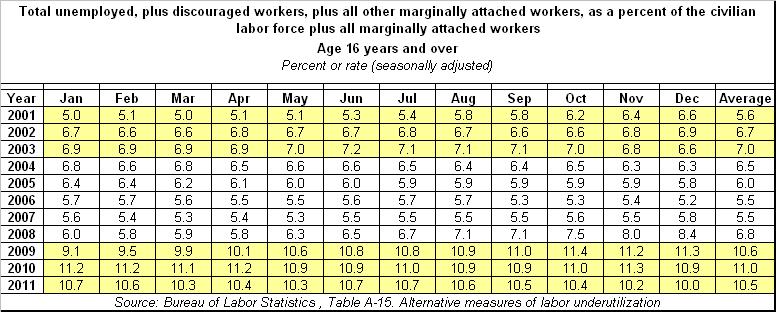
Now we will turn attention to the unemployed, and the uncounted, marginally attached and discouraged workers. You will note in the data from BLS Table A-15, Alternative Measures of Labor Utilization, (below) that during Bush’s first three recessionary years, the percentage of unemployed, plus marginally attached and discouraged workers averaged between 5.6% and 7.0%. You can also see that during Obama’s first three years, the rate has jumped to an average of between 10.5% and 11.0%. In fact, as of December 31, 2011, a larger percentage of Americans are unemployed, discouraged, or marginally attached to the labor force than at anytime since 1994 (when the statistic was first measured). So does this hidden fact somehow back up the words, “we are moving in the right direction”? Only if the direction Obama is espousing entails enslaving millions more to lives of perpetual government dependency. We’ve seen brighter mornings.

The Shrinking Labor Force

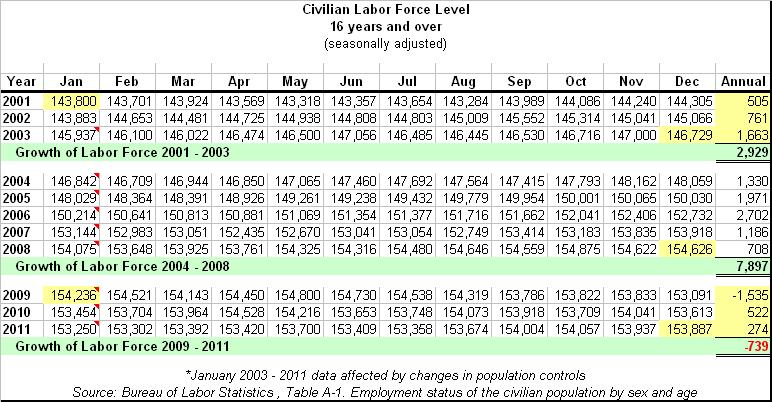
Finally, the data from BLS Table A-1, Employment Status of the Civilian Population by Sex and Age, (below) shows the number of Americans counted as part of the civilian labor force, from 2001 through 2011. We can see that during Bush’s first three years, the civilian labor force grew by 2,929,000. In contrast, the labor force has contracted by -739,000 during Obama’s first three years. So is this good, or bad? Well, since the population is growing by 1.2% each year, a contracting labor force means that a smaller proportion of the populace is working to support a larger group of retirees, unemployed, and those who have dropped out of the labor force. So I would say this isn’t exactly “morning in America”.

As you can see, the labor force grew from 143,800,000 at the end of January 2001, to 154,236,000 by January of 2009, for an increase of 10,436,000 workers over the eight-year period immediately preceding Obama. So while the labor force was expanding by an annual average of 1,304,500 new entrants before Obama, it has suddenly declined by an average of -246,333 workers per year since January of 2009. So as Obama has been out golfing, vacationing and as he now celebrates his grand achievement, better than 1,000,000 Americans have fallen through the cracks during each of his three years in office. These are either not working, not currently looking for work, or have permanently given up looking. They are not counted in the official December unemployment rate.

Most of the electorate understands that as the size of the labor force shrinks, the unemployment rate declines. But is anyone really paying attention? Since this massive decline in the civilian labor force is a verifiable fact, it’s not surprising that the Obama Administration, and much of the propagandist media have chosen to ignore it.

The Bottom Line: Obama has lost a total of -1,633,000 net jobs since he entered office. Not one new net job has been gained since the year 2007. The percentage of unemployed, plus marginally attached and discouraged workers stands at 10.5% as of December 2011, versus an average of 5.5% to 7.0% during the prior eight years. The civilian labor force has contracted by -739,000 workers since January of 2009, for an average loss of -246,333 per year, versus average growth of 1,304,500 per year in the eight years prior to Obama. So perhaps, Obama’s latest fabrication isn’t all it’s cracked up to be.

Related:

Obama’s lost labor force – NetRight Daily

Civilian Employment to Population Ratio Lowest Since Carter / Early Reagan … And Flat-lined! Employment Misery Index Increasing! – Confounded Interest

So Now, It’s ‘Recovery Winter’!! – Joshua Pundit

Obama’s Fraudulent Unemployment Rate – Liberty Works

Off Grid Solutions 2: The Adjustable Principal Mortgage

~ By: Larry Walker, Jr. ~
My previous advice proffered the simple concept of a Mortgage in-Kind Exchange. If you didn’t like that notion, perhaps you will like this one. An Adjustable Principal Mortgage is a solution that would allow a mortgage company to temporarily write down the principal amount of a mortgage to an amount comparable to the contracts original debt ratio, and subsequently make adjustments every third year as home prices fluctuate. Once the value of the home equals or exceeds its original cost, no further adjustments are required. Neither the length of the loan or its interest rate is adjusted, nor may monthly principal and interest payments ever exceed the original amount.
An Adjustable Principal Mortgage would spread risk equally between mortgagor and mortgagee. When housing prices return to normal, both the lender and homeowner will have met their objectives; for the former a trustworthy return on investment and the latter a reasonable debt ratio. If housing prices continue to slump, mortgage companies and their investors will lose an amount comparable to the decline in value of the underlying asset, while homeowners losses are likewise mitigated. The value of all mortgage backed securities will be known at any point in time, rather than the present state of uncertainty. The idea is modeled after the Biblical proverb of the unrighteous steward.
The Unrighteous Steward ~ Luke 16:1-9
(1) “There was a rich man who had a manager, and this manager was reported to him as squandering his possessions. (2) “And he called him and said to him, ‘What is this I hear about you? Give an accounting of your management, for you can no longer be manager.’ (3) “The manager said to himself, ‘What shall I do, since my master is taking the management away from me? I am not strong enough to dig; I am ashamed to beg. (4) ‘I know what I shall do, so that when I am removed from the management people will welcome me into their homes.’ (5) “And he summoned each one of his master’s debtors, and he began saying to the first, ‘How much do you owe my master?’ (6) “And he said, ‘A hundred measures of oil.’ And he said to him, ‘Take your bill, and sit down quickly and write fifty.’ (7) “Then he said to another, ‘And how much do you owe?’ And he said, ‘A hundred measures of wheat.’ He said to him, ‘Take your bill, and write eighty.’ (8) “And his master praised the unrighteous manager because he had acted shrewdly; for the sons of this age are more shrewd in relation to their own kind than the sons of light. (9) “And I say to you, make friends for yourselves by means of the wealth of unrighteousness, so that when it fails, they will receive you into the eternal dwellings.”
It’s purely a matter of survival for homeowners, bankers, investors, the U.S. economy, and the nation as a whole. The unrighteous steward did what he had to do to survive. Presently, no one in the United States is doing anything to address the underwater vortex threatening to destroy the livelihood of millions of American homeowners. To date, the actions taken by both government and the private sector have done nothing to avert a looming global economic collapse and worldwide depression.
The Problem
Jane is a 50 year old Georgia resident. She is married with two children. Jane purchased her home six years ago for $333,333. She initially made a down payment of $33,333 and took out a 30-year / 5% fixed rate mortgage of $300,000. She currently has an outstanding mortgage balance of $270,290, and the appraised value of her home has fallen to $150,000. If she were to sell the home today, she would incur a loss of $183,333, which is not deductible for tax purposes. Jane is not in default and can afford her mortgage payments, but one of the things bothering her is that her debt ratio, which started out at 0.90, has risen to 1.80. A debt ratio is calculated by dividing the amount of mortgage debt by the value of the home. A debt ratio of less than 1.0 is considered healthy, while a debt ratio greater than 1.0 is indicative of a loan at risk of default.
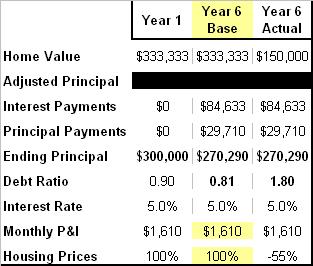
Jane feels cheated. By the sixth year, her debt ratio would have been 0.81, but for the decline in the value of her home. Her blood especially boils when she reads stories about homeowners cutting deals with lenders to stay in their houses literally for free, or of others who are in default yet have remained in their homes even after missing a year or two of payments. Jane has a bad, bad feeling that home prices won’t be improving within her lifetime, and fears that she may be foolishly throwing her money away. She would love for her mortgage company to reduce the principal balance of her loan, but that’s probably not going to happen, at least not until after a foreclosure.
So I will pose the same questions that I did last time, even though some of you took issue. “Does it make sense for Jane to sit there, stuck in a home that she can’t sell or refinance; making a payment every month on what she knows is a bad investment?” “Would you continue to invest $333,333 in an asset that you thought would be worth less than half in the future?” Although housing prices may rise over time, they didn’t reach their previous peak overnight, and life is finite. Jane is 50 years old, and doesn’t have another 30 years to waste. Since Jane doesn’t qualify for a loan modification, what options does she have? Presently, there doesn’t appear to be any solution other than to close her eyes, mask her feelings, keep paying, and go down with the ship.
Solution: The Adjustable Principal Mortgage
An Adjustable Principal Mortgage would allow the mortgage company to agree to temporarily write down the principal amount of a mortgage to an amount comparable to the contracts deemed debt ratio, and subsequently allow the principal to be adjusted every third year as home prices fluctuate. Once the value of the home equals or exceeds its original value, no further adjustments are required. Each time the principal is reset, it is re-amortized over the number of years remaining in the original term. The home is re-appraised at the end of each third year, and a new principal amount is calculated based on the ending debt ratio, multiplied by the current value of the home. At the end of the original term, any remaining balance is cancelled and the debt is considered paid in full.
The home may not be sold until its value equals or exceeds its original cost, without incurring a prepayment penalty. The penalty is calculated by subtracting the amount of all principal payments made to date, from the amount of debt owed prior to commencement of the Adjustable Principal Mortgage. In other words, anyone who opts out early will not be able to escape without having to make up the difference between the original debt and the adjusted principal. When the value of the home equals or exceeds its original cost, the homeowner may sell without penalty, paying off the balance at that time.
How it Works
A home appraisal is required at the beginning of the term, and every third year thereafter. At the end of the sixth year, Jane’s home had a fair market value of $150,000 based on a 55% decline in value. That being the case, the principal amount of the loan is written down to what Jane’s debt ratio would have been in that year had her home not declined in value. In this case, had the home not lost value, Jane’s debt ratio would have been 0.81 (see ‘Year 6 Base’ in the table above). The principal amount of the loan is thus reset to $121,631 (150,000 * 0.81) [see note regarding rounding at the end]. Not only is the principal reset to $121,631, but the loan is re-amortized over a 24 year period (the original 30-year term minus the first 6 years). This results in a monthly principal and interest payment of $726 for the next three-year period.
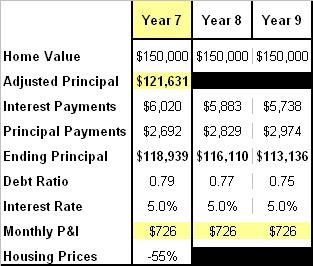
Jane feels better already. There is no longer any reason to doubt. With her monthly payments reduced from $1,610 to $726, she now has an extra $884 to save or spend, both of which will help out her family and the ailing economy either way. At the end of the ninth year, Jane’s debt ratio is a healthy 0.75, and a new home appraisal is required. The new appraisal concludes that the home has increased in value by 50% to $225,000. Thus, the principal will be increased in the subsequent year.
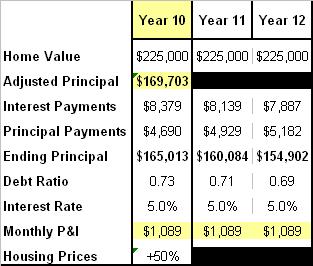
In the tenth year, the principal is raised to $169,703. This is calculated by multiplying Jane’s ninth year ending debt ratio of 0.75 by $225,000 (the current value of the home). The loan is then re-amortized over the remaining 21 years, resulting in a monthly principal and interest payment of $1,089 for the next three years.
Although Jane would not be allowed to sell without incurring a prepayment penalty, she can see on paper that by the end of the twelfth year her debt ratio has declined to 0.69 with roughly $70,000 in home equity. Jane doesn’t mind the increased monthly payment because it is still lower than her original payment of $1,610, and because it was fairly determined based on the value of her home. At the end of the twelfth year the required appraisal determines that the home has increased in value by another 25% to $281,250, so the principal must rise again.
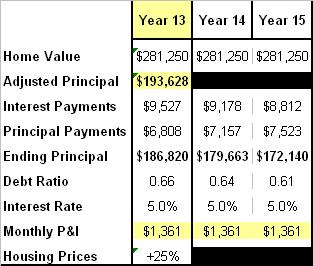
Since Jane’s debt ratio at the end of the twelfth year was 0.69, and the appraised value is now $281,250, the principal amount of the loan is stepped-up to $193,628 (0.69 * $281,250). The loan is re-amortized over the remaining 18 years resulting in a monthly payment of $1,361 for three years. Once again, Jane doesn’t mind the increase because she now has almost $110,000 in home equity, plus she is still paying less than her original payment.
The required home appraisal at the end of the fifteenth year results in another 20% increase in valuation, making the home worth more than its original cost. Since the terms of an Adjustable Principal Mortgage cap any increase in valuation to the home’s original cost, the new mortgage principal is limited to $204,018. This is calculated by multiplying the debt ratio of 0.61 at the end of the fifteenth year by $333,333 (the original cost of the home).
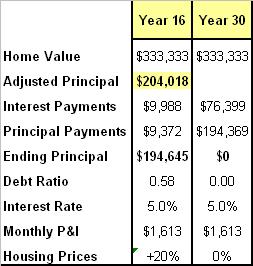
In the sixteenth year, Jane’s adjusted loan principal of $204,018 is re-amortized over the remaining 15 years, resulting in monthly principal and interest payments of $1.613. Jane doesn’t mind this at all because her payments are essentially the same as they were under the original loan, plus she now has over $138,000 in home equity. The biggest bonus is that because her home has returned to its original value, Jane may now sell it free and clear at any time. If Jane keeps the home and it maintains an equal or greater value over the remaining 14 years, her monthly payments will remain $1,613, and her debt ratio will continue to decline.
In the example above, Jane is a winner. If I were her, I would quit while I was ahead by selling the home in the sixteenth year, but that’s her call. If she remains in the home for the full 30-year term, and if existing home prices continue to rise, Jane will have reached her original objective. Now let’s see what happens to the mortgage company.
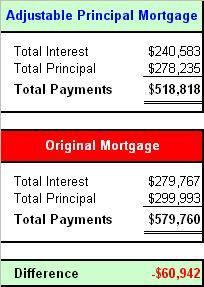
With an Adjustable Principal Mortgage, at the end of the 30-year term, the mortgage company will have earned $240,583 in interest income and will have recovered $278,235 of the original $300,000 principal. The reason that the principal repayments are short by $22,000 is because the mortgagor shrewdly wrote off a portion of the loan in order to keep the homeowner happy. The mortgage company still receives $218,818 over and above its original investment.
In comparison, had the terms of the original loan been fulfilled, the mortgage company would have received $279,767 in interest and the full amount of the principal. Overall the lender has given up $60,942 in interest and principal payments in order to help out a borrower whose underlying asset had declined by 55% in the sixth year of the contract. The alternative would be to risk foreclosure and an immediate loss, most likely in excess of $120,290 with the additional loss of interest income. In this respect, both the lender and borrower are winners.
Goals / Terms
  1. Temporarily reduce the principal amount of underwater mortgages to the product of the homeowner’s target debt ratio and the home’s current market value.
  2. Require a new home appraisal at the end of each three-year cycle.
  3. Re-amortize the loan over the remaining life of the original term every third year.
  4. Reset the principal amount of the loan every third year based on the homeowner’s ending debt ratio times the new appraised value.
  5. The original length of the loan may not be increased.
  6. The original interest rate remains fixed at the original rate and may not increase.
  7. The value of the home may not exceed its original cost, for purposes of adjusting the loan principal.
  8. Monthly principal and interest payments may not substantially exceed the amount of the original contract. Substantial is defined as meaning within $10 per month.
  9. The homeowner may sell the home at any time, however if it is sold before reaching a valuation equal to its original cost, the homeowner will incur a prepayment penalty. The prepayment penalty is calculated by subtracting the amount of all principal payments made to date, from the amount of debt owed prior to commencement of the Adjustable Principal Mortgage. (Exceptions may apply where reasonable cause exists.)
  10. Once the value of the home equals or exceeds its original cost, the homeowner may sell without penalty, only required to payoff the balance of the Adjusted Principal Mortgage.
Benefits / Costs
Lenders – By implementing the Adjustable Principal Mortgage lenders would potentially eliminate foreclosure losses such as may occur in the example above, multiplied millions of times over. If every underwater borrower decided to walk away tomorrow, it would spell the end of the mortgage industry, the end of the U.S. economy, and a sustained global depression. The costs of home appraisals, origination, and processing fees are passed on to homeowners. Although lenders will recover less than the amount stated in their original contracts, the amount forgone will be entirely based on how quickly home prices rebound, while failure to act would be catastrophic.
Homeowners – Borrowers will have a renewed confidence in the housing market. They will also receive the benefit of lower mortgage payments while their houses are underwater, allowing them to save or spend money that they otherwise would not have. This will result in an extraordinary amount of economic stimulus, at no cost to taxpayers. Homeowners will be responsible for the cost of home appraisals, loan processing and origination fees. Such fees may be paid for preferably out of pocket, or added to the principal.
The Economy – The resulting increase in economic activity will mean restoration of jobs for loan officers, administrative assistants, accountants, real estate appraisers, and others. By reducing the number of foreclosures, abandonments, and short sales, the housing market will improve. As real estate prices begin to stabilize and then increase, home builders and real estate agents will also return to work. Under a capitalist system there are winners and losers. Without changes everybody loses, but by taking action, by spreading the risk and by making the system fair, everyone’s a winner.
“And I say to you, make friends for yourselves by means of the wealth of unrighteousness, so that when it fails, they will receive you into the eternal dwellings.”
It’s time to implement solutions designed to solve real problems. While politicians have wasted time covering the loses of some private sector risk takers, lambasting others, and imposing more restrictive regulations, it has never once occurred to them to propose a real solution. Meanwhile, as private sector lenders have been mired in Congressional hearings, attacked with new regulations, and in many cases forced to accept government bailouts, they have likewise not taken time to resolve the real problem.
Note: All figures are rounded up to the nearest value. The approximation above is not intended to be a cure-all, it’s just an idea.

Data: Original Workbook
Off Grid Solutions | Mortgage in-kind Exchange

~ By: Larry Walker, Jr. ~

The first step in any recovery is acknowledging the problem. The second step is having faith that a power greater than oneself can restore sanity. Joe purchased his home four years ago for $300,000. He currently has an outstanding mortgage balance of $270,000. The appraised value of his home has fallen to $150,000. If he sells it for $150,000 today, he will eat a loss of $150,000 which is not deductible for tax purposes. Joe can afford his mortgage payments and has not missed any. Since he doesn’t qualify for a loan modification, what options does he have?
For one, he can continue to pay off the $270,000 debt, plus interest, on a home which has lost 50% of its value, thus incurring more than a $150,000 loss spread over time. Or if he finds this distasteful, he can simply walk away from the home and let the bank and the wizards of DC deal with it. Other than that he really doesn’t have many options. I say he doesn’t have many options, because I know some folks who have already walked away from their homes, renting them out to others while they rent elsewhere, with the idea of dumping them for a loss if things don’t improve in a couple of years.
Does it make sense for Joe to sit there, stuck in a home that he can’t sell or refinance; making a payment every month on what he knows is a bad investment? Would you invest $300,000 in something that you thought would be worth half in the future? Although housing prices may increase over time, they didn’t get to where they were overnight, and life is finite. Joe is 50 years old and doesn’t have another 30 years to waste. So what can the government or private sector do for Joe?
Solution: The Mortgage in-kind Exchange
One of the things eating away at Joe everyday is that he sees House B, a bank owned foreclosure which had an original cost of $600,000, still has an appraised value of $300,000, but has a selling price of just $150,000. Joe would love to purchase House B but he is not able to get out of his current mortgage without incurring a $150,000 loss. Joe would have to come up with a $120,000 payment to get out of his present mortgage, plus make a down payment on the bank owned home, which would make him even worse off.

A Mortgage in-kind Exchange is a unique idea that would allow Joe to sell his home for a loss and rollover the remaining $120,000 loan balance into a more valuable home. It would allow Joe to purchase House B for $150,000 with a $270,000 mortgage. House B would have an appraised value of $300,000 and a mortgage debt of $270,000, thus making Joe whole.
How it works – Joe is allowed to hold an option to purchase House B for a small earnest money deposit of $1,000 which will take the home off the market for up to a year giving him time to sell his old home. If the old home doesn’t sell within a year, Joe may either extend the option by making another deposit, or forfeit.
Benefits and costs – Joe would be better off by being allowed to purchase a more valuable home for the same amount owed on his underwater home. The banks would be better off because they will have reduced their REO inventories without incurring as big of a loss. The economy will improve by allowing faithful homeowners a chance to improve their personal debt-to-equity ratios. Housing prices will improve by removing homes selling for less than fair value from the market. The cost to taxpayers would be zero.
The banks can get involved by matching up faithful homeowners with qualified properties. The government can get involved by getting out of the way, and encouraging the free market to push solutions rewarding those who deserve it the most.
***Revised***

Upside Down In America

~ By: Larry Walker, Jr. ~

Obama’s economic theory appears to be a hodgepodge of both supply-side and demand-side theory based primarily on a belief that if the government rewards special interest groups who vote for the chief executive’s political party, then said party will get re-elected.

In other words, Obamanomics is nothing more than a selfish power play. Missing from its objectives are the goals of economic growth and wealth creation. Inherent in its objective is the idea that there is already enough wealth in the nation to divide many times over until everyone is on an equal playing field. Once met, this objective will lead to the end of all economic activity in the United States.

Obamanomics is a theory that works best if the employees of an automaker are its only customers. It also works well if unionized school teachers are the only taxpayers within their respective school districts. In other words, Obamanomics works if the same money earned by an entity’s employees is reinvested in full back into the same entity. If giving incentives to employees is better than giving them to employers, then Obamanomics has nailed it. One can only wonder why those gosh darned employees aren’t hiring more workers.

For example, the Obamanomics version of auto industry bailouts was made with the assumption that if the government helped automakers, then they would produce more and better quality cars which someone would buy, thus returning the industry to profitability. What the theory failed to consider was that the reason American automakers were facing bankruptcy was due to the lack of demand, not supply. It wasn’t that U.S. automakers weren’t producing enough, or the right cars, it was that no one was buying them. And why did the demand for automobiles suddenly come to a screeching halt?

Upside Down

There’s a lot of talk these days about the decline in housing prices, but what does that really mean at a personal level? What are its effects on the economy as a whole? I’ll tell you how I feel about it.

Every waking day, I feel as though I’m mortgaged to the hilt, which is, through no fault of my own, a fact. It’s not a good feeling knowing that it will take many, many years, if ever, for the value of my home to return anywhere close to the amount I owe. What this does to me psychologically is make me not want to spend a dime on anything other than bare necessities.

Everything is basically on hold until my personal debt-to-equity ratio returns to a healthy level. This spills over into decisions I make for the business. ‘If it ain’t broke, don’t fix it.’ That means purchasing a new vehicle, new equipment, new appliances, or for that matter anything related to the house is out of the question.

Wants are out of the question; needs are the priority. They say, “Cheer up, live a little, go out and spend some money and don’t worry about it so much.” I say, ‘Mind your own blanking business.’ For me, until this situation is corrected I will continue to live below my means, and if you mess with me, you do so at your own risk.

Meanwhile, the U.S. government continues to spend us all into oblivion, thus assuring that if I ever do get my head above water again, the government will be there to make sure I drown. What politicians don’t realize is that none of their spending has done anything to improve the personal debt-to-equity ratio of any American, but has rather destroyed that of the entire nation.

As politicians from both major parties stare hopelessly into the abyss on a daily basis, none of them seem to have a clue as to how to fix the real problem. Some politicians have become so discouraged that they have resorted to exhibitionism, while others have convinced themselves that the way back is through incurring more debt. It doesn’t get any more delusional than, “We have to spend more to keep from going broke.” While many have chosen the path of insanity, that’s not the way for me.

Let’s face facts, when the amount of ones debt exceeds a healthy level (a debt-to-equity ratio of 0.5 to 1.5 being deemed healthy) there are only two ways out. (A) Reduce all unnecessary expenditures to a bare minimum applying the savings toward debt reduction. (B) File for bankruptcy and make a fresh start.

Some have chosen the latter, while I choose the former. Others don’t own a home and thus have no idea what I’m even writing about, which is the dilemma of most politicians. Most politicians don’t feel as though they own the national debt, and they plan on being long gone before any tough decisions have to be made. However, most of them will find themselves long gone by November of next year, if a serious effort isn’t undertaken soon.

It doesn’t take three years to solve America’s most pressing problem. I made my decision as soon as the crisis hit. There are only two options: A or B. No. Increasing income taxes on an upside down citizenry, increasing the amount of government regulations upon them, and imposing new health insurance mandates will not solve the real problem.

It’s time to fix the problem of this era. It’s time to pass a budget. It’s time to pay down the national debt. It’s time to reduce the size of government. It’s time to end excessive government regulation. It’s time to overthrow an unconstitutional government mandate. It’s time to make a decision, or get out of Dodge.

“If you’re not part of the solution, you’re part of the problem.”

Obama on Jobs: Created 0, Lost 2.5 Million

Jobs Created, Saved, Recovered or Just Lost?

~ By: Larry Walker, Jr. ~

Hours after the White House received a disappointing jobs report, Barack Obama told autoworkers at a Chrysler Fiat Plant in Ohio that, “Even though the economy is growing, even though it’s created more than 2 million jobs over the past 15 months, we still face some tough times. We still face some challenges. There are still some headwinds that are coming at us. Lately, it’s been high gas prices that have caused a lot of hardship for a lot of working families. And then you have the economic disruptions following the tragedy in Japan.”

So his latest excuses are high gas prices, and the tragedy in Japan, neither of which were a problem for Obama when the March and April jobs reports were more favorable. First of all, Japan was hit with a tsunami on March 11, 2011, and the crisis over there has nothing to do with job creation or economic growth in the United States. Secondly, gasoline prices have been on the rise since February of 2009, primarily due to a decline in the value of the dollar. And the decline in the value of the dollar is primarily due to the federal government’s padding of the money supply to cover its out-of-control spending.

On the same day, the Italian automaker Fiat SpA agreed to purchase the U.S. Treasury’s remaining 6 percent interest in Chrysler for $500 million. This gives Fiat a 52 percent stake, otherwise known as the controlling interest, in Chrysler. Although Obama has spoken negatively of US companies that open plants overseas, he just sold the taxpayer bailed-out automaker to Italy. Nice going chief.

Even more troubling is Obama’s statement regarding jobs. He said that the economy has “created more than 2 million jobs over the past 15 months”. Which economy was that, the global economy, or the U.S. economy? According to data provided by the U.S. Bureau of Labor Statistics, the economy has lost nearly 7 million jobs since the recession began in December of 2007, and 2.5 million of those jobs have been lost since February of 2009. Did I miss some sort of fundamental transformation of the definition of words, or something?

A more appropriate statement by Obama would have been to say to autoworkers at the old Chrysler Plant that, “I’m sorry I sold you guys out to an Italian automaker, but what can I say, we needed the money. The economy has shrunk further under my presidency. Even though the recession officially ended in June of 2009, the economy has lost around 2.5 million jobs since I became president, which brings the total number of jobs lost since the recession began, in December of 2007, to around 7 million. I now understand that I have been leading this nation in the wrong direction, so my plan is to bring in a new group of advisors who have a better understanding of how the American economy works.” But instead, what we heard was more of the same.

Perhaps Obama would do well to heed the words of Abraham Lincoln who once stated, “I am a firm believer in the people. If given the truth, they can be depended upon to meet any national crisis. The great point is to bring them the real facts.” Obama has yet to bring us the real facts. Everything he says is biased in a way to make it appear as though he has accomplished something great, when in reality his policies are not even capable of fostering economic growth.

Created, Saved, or Recovered?

The word ‘created’ means to originate. Jobs are created when new jobs are added on top of existing ones. After a jobs market goes into recession (a period of sustained job losses), it enters into a state of recovery in which jobs that were lost are recovered. Once the jobs that were lost have been recovered then any additional jobs added are considered to have been created.

The word ‘saved’ means to preserve or guard from injury, destruction, or loss. Jobs are saved when they are prevented from being lost such as through the automotive industry bailouts. If one can prove that (x) number of jobs would have been lost but for some kind of intervention, then one can make the case that those jobs were indeed saved.

Then we come to that elusive word ‘recovered’. The word recovered means to get back, regain, or to return to a normal condition. Since the Great Recession began in December of 2007, the U.S. economy has lost nearly 7 million jobs. Once those 7 million jobs have been recovered, and only then, can Obama, or any other politician, start talking to us about the number of jobs created.

The Real Facts

To be precise, since the recession began, we have lost 6,493,000 according to the Bureau of Labor Statistics (BLS) Household Data, or 6,940,000 according to BLS Establishment Data. And that’s including Obama’s alleged creation of “more than 2 million jobs in the last 15 months”. In reality, the economy has merely recovered 1,081,000 jobs in the last 15 months according to BLS Household Data, or 1,797,000 according to BLS Establishment Data, neither of which exceeds 2 million. And further, since February of 2009, the month after Obama’s inauguration, the economy has lost a total of 2,422,000 per BLS Household Data, or 2,520,000 per BLS Establishment Data. In other words, we are a long way from a jobs recovery, and a lot further away from job creation.

From Employment Statistics May 2011

As indicated in the chart below, per BLS Table A-1, when the recession began in December of 2007, there were 4,659,000 American workers not counted as part of the labor force who wanted jobs, and another 7,664,000 who were counted as part of the labor force and unemployed, bringing total number of unemployed persons to 12,323,000. As of May of 2011, there were 6,227,000 American workers not counted as part of the labor force who wanted jobs, and another 13,914,000 who were counted as part of the labor force and unemployed, bringing total number of unemployed persons to 20,141,000. That means there are 20,141,000 Americans, or 7,818,000 more than the pre-recession level, literally sitting on the sidelines waiting for “change you can believe in”.

From Employment Statistics May 2011

As indicated in the chart below, per BLS Table B-1, at the beginning of the recession 137,963,000 Americans were employed. By February of 2009, the number had fallen to 132,837,000. When the recession ended, in June of 2009, the number had fallen further to 130,493,000. As of May of 2011, the preliminary number of employed Americans stands at 131,043,000. No matter how you slice it, not one job has been created during the Obama presidency. Although it’s true that some jobs have been recovered since the trough, the number of jobs has declined by 2,520,000 since Obama’s inauguration.

From Employment Statistics May 2011

References:

Images, Data 2, Data 3

Jobs, Jobs, Overthrow Libya

BLS: Jobs Growth

The Summer of Plan B

~ By: Larry Walker, Jr. ~

The summer of 2010 was supposed to have been the ‘Summer of Recovery’, but since that failed the Obama Administration has moved on to Plan B, the ‘Summer of Death and Destruction’. Notice how quickly the Obama Administration changes the topic when its achievements go awry. It’s almost like they thought, “Hey our economic policies are failing, so let’s turn to some controversial international topic to divert attention.” “I know, let’s bomb Libya, and point the finger at other allies.” Or, “Hey Osama’s been laid up in that Pakistani safe house long enough, let’s go over there and shoot him to take attention away from our failed economic policies.” But not so fast, let’s stick to tracking the success or failure of the Obama Administration’s economic policies. We’ll review his international policy mishaps later, when its fruits come to bear.

Jobs Growth since the End of the Great Recession

According to the National Bureau of Economic Research, the Great Recession, the longest of any recession since World War II, began in December of 2007 and ended in June of 2009. So where are we today?

From Jobs April 2011

When the recession ended in June of 2009, the American economy had a total of 130,493,000 jobs, and through the end of last month had a total of 131,028,000. That’s an increase of 535,000 jobs over the last 22 months, or average growth of just 24,318 jobs per month since the ‘recovery’ began. It can also be said that the economy has added 768,000 jobs since December of 2010, when the “Tax Relief, Unemployment Insurance Reauthorization, and Job Creation Act of 2010” was signed into law on December 17, 2010. In effect, an average of 192,000 jobs per month have been added since Conservatives won back the House of Representatives, effectively derailing the Obama Administration’s failed economic policies.

Analytically, any and all jobs growth realized by the American economy since the end of the great recession has come since the December 2010 legislation was signed into law. Thus, all of the Obama Administration’s efforts prior to December of 2010 amount to nothing more than a waste of time and trillions of dollars in deficit-financed government spending. All the jobs growth added since the end of the Great Recession can be attributed directly to conservative economic policies. But we’re not quite out of the woods.

Looking backwards, the American economy had a total of 131,660,000 jobs at the end of April of 2000, versus 131,028,000 in April of 2011. Thus, Americans currently have 632,000 fewer jobs than we had eleven years ago. In addition, since the number of jobs peaked at 137,996,000 in January of 2008 (a record high), we are currently 6,968,000 jobs shy of the pre-recession level. Under the conservative growth rate of 192,000 jobs per month, the jobs market would recover to pre-recession levels within 36 months; while under the Obama Administration’s growth rate of 24,318 jobs per month, recovery would take 24 years. With the U.S. population growing at an annual rate of 1%, or by roughly 3 million per year, you can see that we have a long way to go.

To conclude, conservative economic policies are at least on the right track, although they need to be ratcheted up. Meanwhile the Obama Administration has in effect admitted its domestic economic policy failures and has resorted to bombing a former third-world ally into oblivion. It’s a good diversion, but it won’t win the ill-advised Obama a second term. It’s time to finish the job. It’s time to send Obama packing.

Sources:

Business Cycle Dating Committee, National Bureau of Economic Research

Establishment Data, Bureau of Labor Statistics

Link to Original Spreadsheet

Obama: The Era of Flimflam Economics, Part III

Transformation

Jobs Inheritance Mantra

By: Larry Walker, Jr.

Every time I turn on the news I hear the same sob story, whether it’s Obama, Geithner, Biden, Pelosi, Reid, a left-wing congressperson, or some low level administration official, they all repeat the same Democrat mantra (give or take a few thousand Americans), “We inherited an economy that was losing 700,000 jobs a month.” “We inherited an economy that was losing 750,000 jobs a month.” “We inherited an economy that was losing 800,000 jobs a month.” “Aum – Bush bad, Obama good”. I’m so sick of it that I decided to pull the Bureau of Labor Statistics historical archive to see for myself. Where did they come up with these numbers? Why does it keep growing? Does anyone ever refute the bull…, excuse me, lies? And better still, who cares?

Based on the facts, unemployment didn’t really fall off a cliff until Obama won the election, in November of 2008. That’s when everything went to hell in a hand basket. And where are we today? Other than a few gains in March, April and May of 2010, in large part due to the hiring of around 500,000 temporary census workers, there’s not much to be proud of. The unemployment rate stood at 9.5%, last month, essentially the same as it was in May of 2009. So much for the “Recovery Summer”.

The truth is that in September of 2008 the economy lost (-159,000) jobs which was 89% worse than the previous month’s loss of (-84,000). Then in October of 2008 we lost (-240,000) jobs which was 51% worse than September. Then once Obama was elected, in November 2008, we lost (-533,000) jobs, an increase of 122% over October, and then we lost another (-524,000) in December. Was it just a coincidence that the economy fell off a cliff as soon as Obama won the election? I think not.

The greatest declines in employment occurred as soon as Obama won the election (and really as soon as took the lead in the polls).

August 2008 -84,000

September 2008 -159,000

October 2008 -240,000

—————————-

November 2008 -533,000

December 2008 -524,000

January 2009 -598,000

February 2009 -651,000

March 2009 -663,000

April 2009 -539,000

May 2009 -345,000

June 2009 -467,000

I’m sorry, but I don’t see where Obama inherited an economy that was losing 700,000 to 800,000 jobs per month. Sorry, but the facts don’t support the mantra. The sad truth is that once Obama won the election it was his questionable – identity, qualifications, philosophy, intentions and relations that did the greatest harm to the economy. And even if it turns out to be true, who cares. Who needs a leader who’s constantly making excuses?

I don’t remember President G. W. Bush, or President R. W. Reagan ever complaining about what they inherited from the previous administration, they just did their jobs, gave us some relief through tax cuts, and then things turned around. Somebody needs to stop whining, chanting, and making up numbers – and just do their jobs. Cut taxes, cut spending, then sit down and shut up. If you can’t handle that, then resign.

You may review the archived Employment Situation Reports available from the Bureau of Labor Statistics and decide for yourself.

If you’re not part of the solution, you’re part of the problem. And if all you can do is make excuses, then you’re not part of the solution.

[Revised on 9/5/2010 – Chopped down to emphasize the point about: Who cares? Stop making excuses and deal with reality. Obama was a threat to the economy long before his official election date, and people simply cut their losses and fled as he came into power. Things will get better the day he leaves office.]

Obama: The Era of Flimflam Economics, Part II

Too Much Stimulus

Untimely and Proven to Fail

By: Larry Walker, Jr.

Near the end of 2007, prominent economists began advising the federal government that the economy was heading into a recession. They also mistakenly advised that the recession could be avoided if the government were able to implement some kind of economic stimulus program. In order to work successfully, such a stimulus needed to be large, targeted, and timely. Tax refund checks needed to reach taxpayers in a matter of weeks not months. Economists must have forgotten that they were dealing with the federal government.

Recessions are a normal part of the business cycle. The U.S. has averaged a recession about once every five years since WWII. Although economists have gotten better at predicting business cycles, it’s fairly clear that no one has ever been able to sidestep a recession. Avoiding a recession is like trying to stop an oncoming hurricane, when you see it coming you get out of the way, wait for the storm to subside, and then focus on recovery.

An economic stimulus package was proposed in January of 2008, in order to avert the recession. Although a similar stimulus plan had been attempted in 2001, and failed to prevent a recession, Congress was compelled to it try again. By the time the checks reached taxpayers, in April of 2008, it was too late, the recession had commenced.

In February of 2009 President Obama enacted a second stimulus plan. What was that about? Was he trying to prevent something that had already occurred? The Obama stimulus plan occurred more than a year after it was originally called for. By the time Congress passed Obama’s stimulus plan, the economy was well in the midst of recession. The only purpose of an economic stimulus is to avert a recession. Once an economy is in recession, a whole new set of policies is required. As of this month, around nineteen months after Obama’s first failed stimulus program, and nearly 2 1/2 years after Bush’s tardy attempt, Obama is still talking about a stimulus plan. Isn’t this just economic flimflam?

It should be obvious by now that stimulus programs don’t work in the real world. Although the classroom theory is plausible, the federal government is not an efficient vehicle for carrying one out. What should also be obvious is the type of recovery policies that work, once a recession has occurred. The 2003 Bush Tax Cuts and the 1983 Reagan Tax Cuts were effective tools in creating economic expansions following severe recessions.

If the goal is to grow the economy, create jobs, and increase tax revenues, then tax cuts are the way to go. However, if the goal is to flush trillions of borrowed dollars down the drain by attempting something that’s untimely and proven to fail, then maybe that’s Obama’s fate. Obama’s first stimulus plan was untimely and proven to fail, a kind of Flimflam Economics. And even today, he is talking about another economic stimulus program. Again, is Obama trying to prevent something which has already occurred? Does Obama really have the best interests of America at heart?

Stimulus: The Need for Speed

In a January 20, 2008 Dow Jones News article entitled, “The Need for Speed”, it was stated that, “A plan out of Washington to stimulate the flagging US economy may be a day late, but it certainly isn’t a dollar short.” Two days earlier, President George W. Bush called for fast tax relief for individuals and tax incentives for businesses that would total up to $150 billion.

Economists said that would be enough of a jolt to have a notable impact on growth, if done right and quickly. Bush said the tax relief for consumers could be a “shot in the arm to keep a fundamentally strong economy healthy.” Bush’s rough draft proposal highlighted the US economy’s big problem: the consumer.

“Americans could use this money as they see fit: to help meet their monthly bills, cover higher costs at the gas pump or pay for other basic necessities,” the president said.

Bush wasted no time announcing the rescue plan after getting a firm nod of approval Thursday from the country’s pre-eminent economic policymaker, Fed Chairman Ben Bernanke. The central bank chief said he would approve of such a fiscal stimulus plan so long as it was “timely” and implemented “decisively” and “quickly.”

The need for speed in such a plan is no doubt important, as Bernanke pointed out Thursday. If Congress dilly-dallies on the matter, rebate checks may not arrive to consumers in time to fortify the weak economic growth that is likely to continue throughout 2008.

Lakshman Achuthan, managing director of the Economic Cycle Research Institute in New York, said the fiscal plan essentially calls for “throwing a ‘money wrench’ into the system.” That plan, he said, can be successful, but he said rebate checks need to start arriving in “the next few weeks.”

Democrat Congress Drags Feet

Now scroll forward to a March 21, 2008, Financial Week article entitled, “U.S. can’t avoid recession, says influential forecaster”. The subtitle reads, “Economic Cycle Research Institute claims economy ‘on a recessionary course’; blames Congress for tardy rebate checks.”

Mr. Achuthan argued that this recession could have been averted had Congress considered “innovative ways” to get tax rebates into consumers’ hands sooner. (The rebates still have not begun to reach taxpayers). “Following a presidential initiative, Congress passed a tax rebate package with unusual speed, as officials noted that time was of the essence,” he wrote, “but they were content to let the rebates start reaching consumers several months later.”

Choosing Recession

Moving forward to an April 21, 2008, Forbes article entitled, “Choosing Recession”, Lakshman Achuthan and Anirvan Banerji stated, “This recession was actually avoidable as recently as several weeks ago.” They added, “The 2008 recession guarantees many months of job losses that will boost foreclosures and feed the credit crisis. But if fiscal stimulus had reached consumers quickly, it would have forestalled a recession, helping to stabilize the housing market. Such a soft landing would have bought some breathing room in which to resolve the credit crisis until the lagged effect of monetary policy kicked in.”

They continued, “Policy makers seemed to get the urgency. In January, Treasury Secretary Hank Paulson declared that “time is of the essence.” House Speaker Nancy Pelosi spoke of “timely, targeted and temporary” stimulus, and the administration and Congress enacted a tax rebate package with exemplary speed. The fatal flaw was their willingness to allow a delayed delivery of the stimulus. It was as if the medics had arrived and taken a quick decision to administer CPR–but in a few months rather than a few seconds.”

Stimulus Arrives Late

Later, an April 28, 2008 report on CNN Money summed it up, in an article entitled, “U.S. can’t avoid recession, says influential forecaster”. Tax rebates had started to arrive in bank accounts. But many economists we’re doubtful that they would keep the economy from recession. The stimulus package was to give rebates to about 130 million Americans, at a cost of more than $110 billion. Married taxpayers earning $150,000 or less were to receive up to $1,200, while single taxpayers earning under $75,000 would get up to $600. But it was too late.

“This will not avert a recession, because it is too late,” said Lakshman Achuthan, the managing director of the Economic Cycle Research Institute. “For this to have kept us out of what was an avoidable recession, it needed to happen a couple of months ago, in January or February.”

Obama’s Plan: A Year Late and $900 Billion Short

Months later appeared a November 22, 2008 article by NPR entitled, “Obama Offers Plan to Revive Economy“. The author lead with, “President-elect Barack Obama set out plans for an ambitious economic stimulus that would create 2.5 million jobs by January 2011”.

“We’ll put people back to work rebuilding our crumbling roads and bridges, modernizing schools that are failing our children, and building wind farms and solar panels, fuel-efficient cars and the alternative energy technologies that can free us from our dependence on foreign oil and keep our economy competitive in the years ahead,” he said.

In the same November 22, 2008 NPR article, business and economics historian John Steele Gordon stated that, “the New Deal didn’t end the Great Depression, World War II did.” He added that “building bridges and painting schools won’t provide a quick fix.” He was right. The Great Depression lasted from 1929 until 1945, or around 15 years, and it didn’t end through the action of any clever government policy.

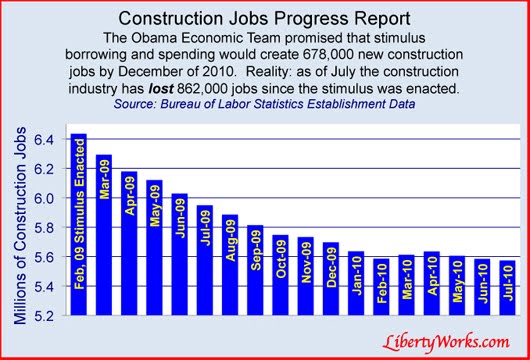
According to Liberty Works, the Obama Economic Team promised that stimulus borrowing and spending would create 678,000 new construction jobs by December of 2010. However, by July of 2010, the construction industry had actually lost 862,000 jobs.

Tax Cuts Work

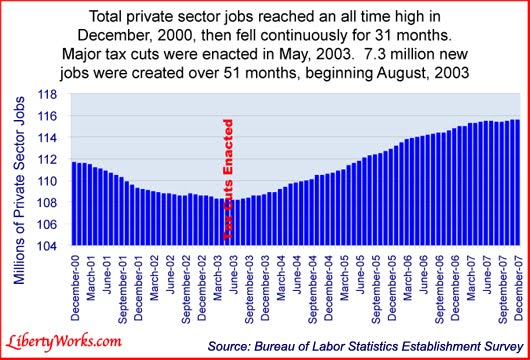
During the 2001 economic recession, the government attempted an economic stimulus in the form of tax rebates (similar to the 2008 rebates), but it likewise failed. Then finally in May of 2003, the Bush tax cuts were enacted. The tax cuts were responsible for the creation of 7.3 million new jobs beginning in August of 2003 and lasting through the end of 2007. Tax cuts are the only proven method for bringing an economy out of recession. The deeper the tax cut, the greater the expansion.

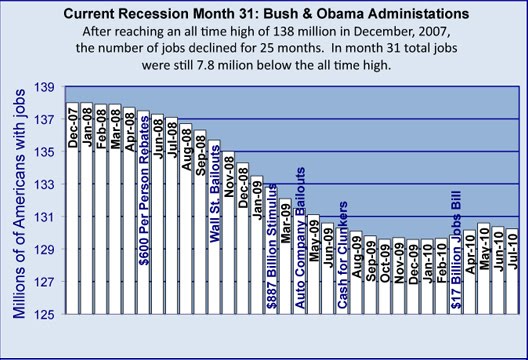
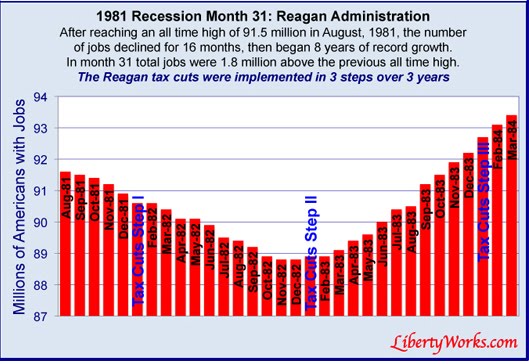
As the website Liberty Works so aptly reminds us, “President Obama and the Democrat Congress have implemented a series of measures that defy the lessons of past recessions”, especially that of 1981, which was by some measures worse than this one.

The chart above shows, “the job market recovery is faltering at best, after 31 months of Bush/Obama policies. There are 8 million fewer Americans now employed than in December, 2007.”

The results in the second chart (above), speak for themselves. “Reagan’s policies turned the job market around after 16 months of losses. The Reagan economy grew continuously for 90 months, creating a total of 21 million new jobs, or a 24% increase in the number of Americans who were employed.”

You’ve Been Flimflammed

If the goal is to grow the economy, create jobs, and increase tax revenues, then tax cuts are the way to go. However, if the goal is something more sinister, then one must brainwash their constituents into believing that ‘tax cuts cause recessions’. The Bush tax cuts brought us through another successful business cycle. Then the housing bubble burst, credit markets froze, and we fell back into recession. But tax cuts didn’t cause the recession. I don’t mind cutting Bush to pieces where warranted, and I was doing just that in 2007/08, but to say that the Bush tax cuts didn’t work because you disagree with his foreign policy is ignorant.

Whether or not the recession could have been avoided is highly doubtful due to the severity of the housing bubble and credit crisis. Yet if you listen closely, a year ago Obama was saying the recession was caused by the ‘lack of affordable health insurance’, and today he’s saying that it was caused by the ‘Bush tax cuts’. I suppose next he’ll be saying the recession was caused by whatever supports the legislation du jour.

It’s sinister enough to take advantage of a crisis in order to pass an unwanted legislative agenda. It’s entirely another matter to purposefully prolong a crisis to the detriment of every American: black, white, red, yellow, and brown; Democrat, Republican, and Independent. In fact, Obama’s looking more and more like another FDR. In FDR’s policies prolonged Depression by 7 years, UCLA economists calculate, you will find the following quote: “We found that a relapse isn’t likely unless lawmakers gum up a recovery with ill-conceived stimulus policies.”

Congress needs to cut spending, and cut taxes, now. If you’re not part of the solution, you’re part of the problem.

Obama: The Era of Flimflam Economics, Part I

Flimflammer in Chief

Economic Flimflam – Deceptive Nonsense

By: Larry Walker, Jr.

Down here on Main Street, while company X is waiting for person Y to pay their past due bill, company X is cutting back on everything it can, and borrowing money to fill the void. When person Y finally gets that stimulus money and pays their debt, company X will use the money to payback what was borrowed. Company X is not aggressively pursuing new business out of fear of attracting more deadbeat customers, but instead is focused on downsizing and preserving trusted relationships. Company X is now practicing sound business policy (i.e. fiscal responsibility). After nearly two years of being flimflammed, we find that demand has not been sparked, and that not one new job has been created.

Theory P – Temporary Stimulus Drives the Economy (False)

Rationale: If we give 150 million taxpayers a $400 annual tax credit for working, they will go out and spend it, which will spark additional demand, which will in turn fuel an economic recovery. Once the demand begins, Joe the widget maker will start getting a flood of calls for his product and will hire new employees, and buy new equipment as he expands his operation. So next we will need to make loans available for small businesses so they can prepare for the massive expansion. Problem solved. Government stimulus works, right? Wrong.

In Reality – When the government gives a $400 annual tax credit to a person who is broke, in debt, behind on bills, about to lose a job, or behind on their rent (or house note), it won’t be spent on anything new. It will be either saved, used to pay a debt, expedited to pay a past due bill, eaten, drank or smoked.

Under theory P, when the federal government gives a little extra money to person Y, person Y will go out and buy a new car, or a new house, or I-Pad, or something to help the economy. One problem is everyone knows that what the government is promoting is just a tiny, temporary fix. Lets get real, it’s not like person Y is going to get an extra $400 per month, which would possibly pay a car note. Instead, person Y is receiving an extra $33.33 per month (money that normally goes towards income taxes), and $33.33 per month doesn’t go very far in 2010 (it’s amazing that millionaire, Washington elitists don’t understand this). The clincher is that a stimulus, by its nature, is only temporary. Sure, tax credits were provided in 2009 and 2010, but will be capped off by a massive tax increase in 2011. The proposed tax increase will likely be at least double the pathetic stimulus.

‘As the government giveth, so the government taketh away.’

The other part of theory P involves making loans available for small businesses. The loans will theoretically be used to keep the doors open, and to meet payroll while small businesses wait on the massive flood of demand that’s sure to come. The only problem is that the demand came and went with the stimulus checks. So company X is reluctant to commit collateral for additional loans (loans that it may not be able to repay). So the government is encouraging small businesses to take the loans anyway. “Take a chance,” they say. “Hire some people, spend some money, add another location, get things moving and surely the demand will come.” In response, businesses have cut back more, and layoffs persist.

Theory C – Permanent Tax Cuts Do Drive the Economy (True)

Rationale: Under this theory taxes are cut permanently, and incentives are provided for business investment. Let’s give person Y an extra $400 per month, permanently, and see what happens. At the same time, let’s give business X a large incentive to invest and expand. What happens?

The Reality – Initially, person Y will pay off any past due bills, but within a few short months may go ahead and purchase that new car, or a new home, or an I-Pad (or two). Company X will begin to see real sustained demand, and will begin to hire and to think about expansion. With more people working, and with multiples of increased demand, the flame will have been kindled, and recovery will have begun. Tax revenues will increase as the economy grows, and as 15 million unemployed begin to become productive members of society.

The Flimflam Guys – Now, in step the flimflam guys (Krugman, Obama, Geithner, Greenspan, Reid, Pelosi and company) claiming that such a huge tax cut will only add to the current budget deficit.

After adding $2.7 trillion to the federal debt over the past two years and achieving nothing, now these geniuses want to complain about the deficit? Shut the hell up. Sorry but we’re not buying it this time. You had your shot and you failed. Those guys that you call the ‘party of no’, you know, the ones who have offered, “Not one new idea,” told you about ‘theory C’ before you flushed our money down the toilet and you mocked them. Now I guess you have to choose between eating crow, and sending the economy into an endless spiral of debt, inflation and higher taxes.

‘If you can’t stand the crow, just add a little more of Krugman’s Flimflam Sauce.’

The smart money’s on Theory C. Tax cuts work, but they will only work, if you cut spending on everything else across the board, and this is exactly what needs to happen. Cut out the wasteful spending, and give us a real tax cut.