Manipulation 101: The Real Unemployment Rate

* Fake it until you make it. *

* By: Larry Walker, Jr. *

The following passage is from my last post, “Labor Force Contraction with Obama – And other hidden truths” :

“Most of the electorate understands that as the size of the labor force shrinks the unemployment rate declines. But is anyone really paying attention? Since this massive decline in the civilian labor force is a verifiable fact, it’s not surprising that the Obama Administration and much of the propagandist media have chosen to ignore it.”

Okay, I confess that I was begging the question. I am fully aware that most of the population doesn’t have a clue as to how the unemployment rate is calculated, and that a healthy subset could probably care less. So in this post I will explain in more detail how, as the size of the labor force contracts, the official unemployment rate declines.

First, here are a few key definitions, which are shown in more detail at the bottom of this post.

  1. The term “non-institutional civilian population” includes persons 16 years of age and older residing in the 50 States and the District of Columbia who are not inmates of institutions (for example, penal and mental facilities, homes for the aged), and who are not on active duty in the Armed Forces.

  2. The term “labor force” includes all persons, in the non-institutional civilian population, classified as employed or unemployed.

  3. And the term “not in labor force” includes persons aged 16 years and older, in the civilian non-institutional population, who are neither employed nor unemployed.
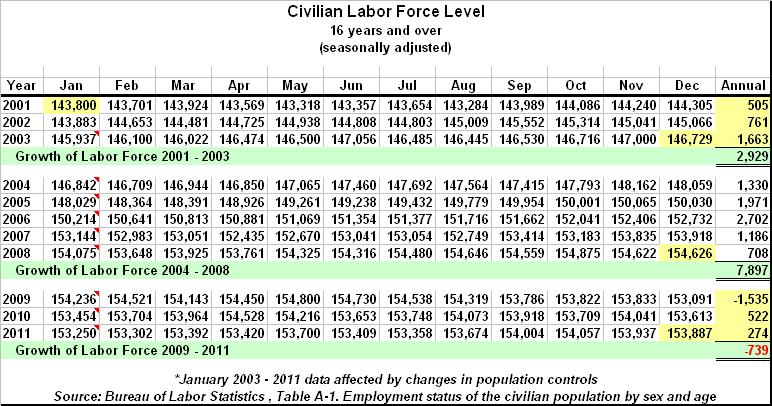
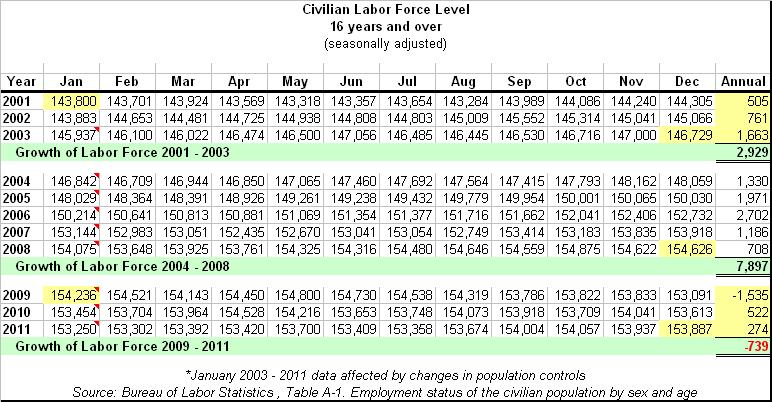
The table above shows the number of Americans counted as part of the labor force, from 2001 through 2011. It does not include those considered, “not in labor force”. You can see that during Bush’s first three years in office, although the economy was in recession, the labor force grew by 2,929,000 (on a seasonally adjusted basis). In contrast, the labor force has contracted by 739,000 during Obama’s first three years.

The dilemma posed by a declining labor force is that the non-institutional civilian population has continued to grow by approximately 1.1% each year. So in reality, the labor force didn’t only decline by 739,000 workers over the last three years (on a seasonally adjusted basis), but rather a total of 6.5 million workers dropped out (on a non-adjusted basis). What this means is that a smaller proportion of the populace is working to support a much larger cluster of retirees, unemployed, and those who have dropped out of the labor force.

As you can see, the labor force grew from 143,800,000 at the end of January 2001, to 154,626,000 by December of 2008, for an increase of 10,826,000 workers over the eight-year period immediately preceding Obama. The labor force was expanding by an annual average of 1,353,250 new entrants prior to 2009. But since January of 2009, the labor force has declined by an average of -246,333 workers per year. However, in the macro sense, the real employment situation is dramatically worse.

When the declining labor force is compared with growth of the civilian non-institutional population, as shown in the table below, it is clear that a total of 6.5 million Americans have dropped out of the labor force during Obama’s three years in office. This is the sum of the amounts highlighted in yellow (below). It is the difference between annual changes in the civilian non-institutional population, minus annual changes in the labor force. It represents the annual increase in the working age population, who are not being counted as part of the labor force.
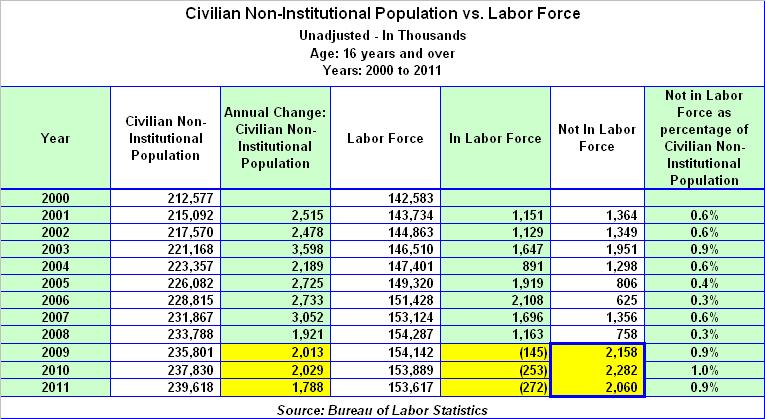
For example, in 2009, the civilian non-institutional population grew by 2,013,000, yet the labor force declined by 145,000, resulting in 2,158,000 persons who should have, but did not enter the labor force. In effect, they dropped out. In 2010, the civilian non-institutional population grew by 2,029,000, yet the labor force declined by 253,000, resulting in 2,282,000 more persons who should have, but did not enter the labor force. Then in 2011, the civilian non-institutional population grew by 1,788,000, yet the labor force declined by another 272,000, resulting in 2,060,000 more persons who should have, but did not enter the labor force.

In effect, there have been no new entrants to the labor force in the past three years, as 670,000 existing workers dropped out (on an unadjusted basis), and all 5,830,000 potential new entrants fell by the wayside. Overall, 6.5 million working age persons have dropped out of the labor force under Obama. Is this change you can believe in?

The massive decline of new entrants to the labor force, which is shown in the table above, and graphically in the chart at the top, directly impacts the unemployment rate, making the employment situation appear better than it actually is. How so?

First, we must understand how the unemployment rate is calculated. The unemployment rate is calculated by dividing the number of unemployed persons by the size of the labor force:

[ (A) Total Unemployed / (B) Labor Force = (C) Unemployment Rate ]

Thus, the official unemployment rate of 8.5%, as reported by the Bureau of Labor Statistics in the January 6, 2012, Employment Situation Report, is calculated as follows:
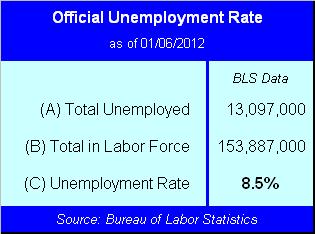
[ 13,097,000 / 153,887,000 = 8.5% ]

What this means is that, at the end of the year 2011, 13,097,000 persons were officially unemployed, out of a labor force totaling 153,887,000. And so 13,097,000 divided by 153,887,000 equals the unemployment rate of 8.5%. So how could this result have been manipulated? Why, that’s easy.

Manipulation 101

“There are three kinds of lies: lies, damned lies and statistics.” ~ Mark Twain

First of all, it is a fact that not everyone who is actually unemployed is officially counted as such. In fact, according to the Bureau of Labor Statistics, millions of Americans of working age, who are not working, are excluded from the official calculation.

Mathematically, what this means is that they have been removed from both the numerator and denominator of the equation (i.e. from both the number of unemployed and size of the labor force). Those eliminated from the official unemployment equation are classified as, “Not in the Labor Force.

A subset of those not included in the labor force is referred to as “marginally attached”. The marginally attached are persons not in the labor force who want and are available for work, and who have looked for a job sometime in the prior 12 months (or since the end of their last job if they held one within the past 12 months), but were not counted as unemployed because they had not searched for work in the 4 weeks preceding the survey. Discouraged workers are a subset of the marginally attached.

When it comes to manipulating the unemployment rate, the main question is: What happens when an equal number of persons are subtracted from both the number of unemployed and the labor force? To answer this, let’s look at an example in the table below.
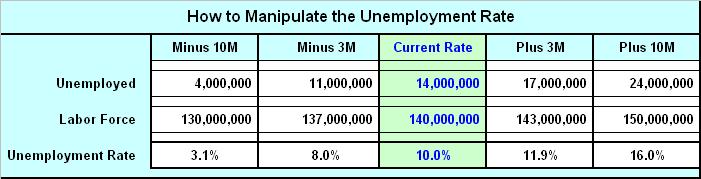
Starting in the middle of the chart, let’s assume that there are 14,000,000 unemployed persons out of a labor force totaling 140,000,000. That would make the unemployment rate 10.0%. Are you with me so far?

Now, let’s remove 3,000,000, from the labor force, and see what happens. Moving one column to the left, you will note that the unemployment rate falls to 8.0%, or by 2.0 percentage points, as 3,000,000 people are removed. That’s a decline of 20%. Wow! That was easy.

If we were to remove 10,000,000 from the labor force, we would get an even more dramatic result. Moving two columns left of center; you will notice that the unemployment rate falls even farther, to 3.1%, or by 6.9 percentage points, as 10,000,000 people are removed. That’s a decline of 69.0%.

Just to add some perspective, it works both ways. Moving one column to the right, you can see that the addition of 3,000,000 to the labor force causes the unemployment rate to rise to 11.9%, or by 1.9 percentage points (an increase of 19.0%). And finally, the addition of 10,000,000 to the labor force causes the unemployment rate to rise by 6.0 percentage points, or to 16.0% (an increase of 60.0%).

So it may be stated that, the act of removing workers from the labor force causes the unemployment rate to decline. It is also evident that an expanding labor force, in which new workers are unable to find work, should cause the unemployment rate to rise. Another fact is that classifying more workers as “not in the labor force” causes a greater percentage decline in the unemployment rate, than the percentage increase realized by allowing a natural expansion of the labor force. Got it?

Therefore, when the unemployment rate is higher than desired, all one has to do is remove a few million workers from the labor force, and voilà, “We are moving in the right direction.”

Now I’m not necessarily saying that the Obama Administration purposefully manipulated the unemployment rate, but since the Bureau of Labor Statistics is a governmental agency, run by a presidential appointee, it’s highly probable. I’m just saying that I no longer have faith in the Bureau of Labor Statistics’ ability to remain impartial. Perhaps going forward the functions of this agency, as well as others, should be factored out to private non-partisan concerns.

What’s the real unemployment rate?

The Bureau of Labor Statistics (BLS) itself admits that among those it has subtracted from a labor force, several million actually want to work. So I ask you this, If an individual is not working, but desires to have a job, is he (or she) not essentially unemployed? I say, “Yes”, but the BLS says, “No”. So is this a material issue, or is it diminimus? In other words, how many people are we really talking about?

Well, let’s turn to Bureau of Labor Statistics – Table A-38, Persons not in the labor force by desire and availability for work, age, and sex (below). To be precise, as far as BLS methodology goes, as of December 31, 2011, a staggering 87,212,000 working age Americans were not counted as part of the labor force. Among these, it is reported that 81,077,000 do not want a job, and that another 6,135,000 actually want to work.

To reiterate, in my book, if someone wants a job and doesn’t have one, that person is unemployed and should be counted as such. What’s the point of calculating an unemployment rate, which doesn’t include all persons who are unemployed?

Regarding those included or excluded from the labor force, here are a couple of important items to note:

  1. First of all, the BLS only surveys around 60,000 households per month in order to come up with these figures. So as far as we know, the number of unemployed persons who want to work, but are not counted as part of the labor force, could be much greater than what’s being reported.

  2. Secondly, according to Footnote No. 1, in Table A-38 (above), not everyone reported as wanting or not wanting to work is asked. Wait, so not everyone is asked? You know the old saying, “Never assume.”

So, in light of the fine print, the entire sampling outcome is at best grossly inaccurate, and at worst subject to outright manipulation.

From Table A-38, we can see that 6,135,000 workers, not counted as part of the labor force, actually want to work. So what would happen if we added them back into the labor force? Well, let’s run it and see.

In the table below, when the 6,135,000 workers are added back to the labor force, and rightfully counted as unemployed, the unemployment rate jumps from 8.5% to 12.0% (an increase of 41.2%). Is a deviation of 41.2% of material importance? I would think so.
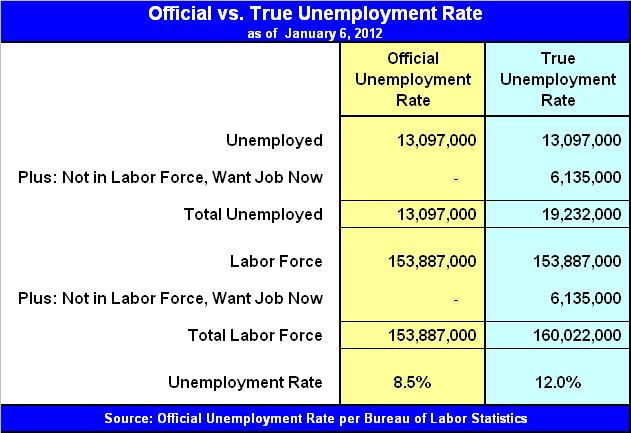
I would contend, that based on BLS data, the true unemployment rate is closer to 12.0%. But at the same time, since only a small sample is surveyed, who’s to say that a large portion of the other 81,077,000 working age individuals, not counted as part of the labor force, don’t want jobs? Did anyone bother to ask them? No. So the actual unemployment rate could easily be much greater than 12.0%. Are you still with me?

In the table below, I have calculated the maximum unemployment rate. That is to say, what it would be if all 87,212,000 working age individuals, not presently included as part of the labor force, were included. When we count them all, the maximum unemployment rate jumps to 41.6%.

You laugh? Well, I’m not laughing. So, based on information published by the federal government, the actual unemployment rate is somewhere between 12.0% and 41.6%. That leaves a lot of room for play, as the lowest the rate can possibly go is 0.0%, and the highest 41.6%. [By the way, the maximum rate doesn’t include those considered to be employed who, for all practical purposes, really aren’t (see the definition of “Employed”, below).]
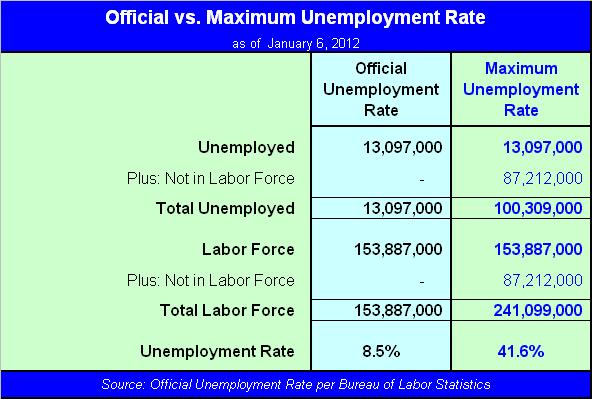
Disregarding the Bureau of Labor Statistics sampling assumptions, the methodology of which you may find at http://www.bls.gov/, for all we know, a larger segment of the population is becoming homeless, generationally dependent, or permanently unemployable. I believe that there are several million more unemployed Americans, who want to work, than we are being told.

In my entire life-time, neither the Bureau of Labor Statistics nor the Census Bureau has ever called upon me to participate in one of these monthly, 60,000 household employment surveys. So who are they calling? How can they call someone who doesn’t have a phone? Where do these numbers really come from? From what I can tell, that’s classified information. Have they ever called you?

So while Obama tells us on the one hand, “We’re making progress,” in reality, all that’s happened is that a larger segment of society has given up any hope of ever having a job. Based upon the job killing policies of his Administration, I would say this is more likely to be the case today, than at any time in U.S. history. So this is progress? And now Obama wants another term to, “finish the job.” I think we’re already finished; the baby boom implosion will take care of the rest.

The Bottom Line: The official unemployment rate is misleading, and can be easily manipulated. By simply removing two or three million persons from the labor force (a little here, a little there), one can easily trim a couple of percentage points off of the official unemployment rate, and then declare that the economy is improving.

Since the beginning of 2009, the net result of Obama’s anti-success rhetoric, coupled with the most reckless deficit-spending record in U.S. history, has been an increase of 6.5 million workers who are no longer counted as part of the labor force. And on top of this, the economy has lost 1.7 million jobs, since February of 2009. The real unemployment rate isn’t 8.5%, it’s somewhere between 12.0% and 41.6%, perhaps even higher, depending upon one’s perspective.

In light of this reality, I find Obama’s statement, “We are moving in the right direction,” to be most absurd. Come on man! But on the brighter side, there is a tremendous opportunity for a new Administration to step in, in 2013, and show the Socialists, Progressives, and Communists who have taken over the Democrat Party, and the delusional fakers and wannabe’s in the White House, who are on their way out of power, what the “right” direction genuinely looks like. Godspeed!

Definitions:

  • Labor force (Current Population Survey) – The labor force includes all persons classified as employed or unemployed in accordance with the definitions contained in this glossary.

  • Civilian non-institutional population (Current Population Survey) – Included are persons 16 years of age and older residing in the 50 States and the District of Columbia who are not inmates of institutions (for example, penal and mental facilities, homes for the aged), and who are not on active duty in the Armed Forces.

  • Employed persons (Current Population Survey) – Persons 16 years and over in the civilian non-institutional population who, during the reference week, (a) did any work at all (at least 1 hour) as paid employees; worked in their own business, profession, or on their own farm, or worked 15 hours or more as unpaid workers in an enterprise operated by a member of the family; and (b) all those who were not working but who had jobs or businesses from which they were temporarily absent because of vacation, illness, bad weather, childcare problems, maternity or paternity leave, labor-management dispute, job training, or other family or personal reasons, whether or not they were paid for the time off or were seeking other jobs. Each employed person is counted only once, even if he or she holds more than one job. Excluded are persons whose only activity consisted of work around their own house (painting, repairing, or own home housework) or volunteer work for religious, charitable, and other organizations.

  • Unemployed persons (Current Population Survey) – Persons aged 16 years and older who had no employment during the reference week, were available for work, except for temporary illness, and had made specific efforts to find employment sometime during the 4-week period ending with the reference week. Persons who were waiting to be recalled to a job from which they had been laid off need not have been looking for work to be classified as unemployed.

  • Not in the labor force (Current Population Survey) – Includes persons aged 16 years and older in the civilian non-institutional population who are neither employed nor unemployed in accordance with the definitions contained in this glossary. Information is collected on their desire for and availability for work, job search activity in the prior year, and reasons for not currently searching. (See Marginally Attached Workers.)

  • Marginally Attached Workers (Current Population Survey) – Persons not in the labor force who want and are available for work, and who have looked for a job sometime in the prior 12 months (or since the end of their last job if they held one within the past 12 months), but were not counted as unemployed because they had not searched for work in the 4 weeks preceding the survey. Discouraged workers are a subset of the marginally attached. (See Discouraged Workers.)

  • Discouraged Workers (Current Population Survey) – Persons not in the labor force who want and are available for a job and who have looked for work sometime in the past 12 months (or since the end of their last job if they held one within the past 12 months), but who are not currently looking because they believe there are no jobs available or there are none for which they would qualify.

Link to Chart Data: Google Docs
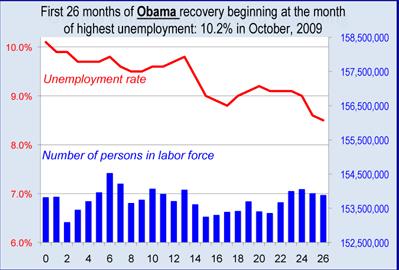
Charts: Unemployment Rate vs. Size of Labor Force

– Courtesy of Liberty Works

* The following charts track the unemployment rate and the size of the labor force. *

The chart above shows that over the first 25 months of the current recovery the unemployment rate has declined from 10.1% to 8.5% while the size of the labor force is virtually unchanged even though the working age population has grown.

Since the beginning of 2008 the working age population has grown by 7.2 million people.  Yet the labor force which is normally about two-thirds of the working age population has shrunk over the same period by 49,000.

Thus, 4.8 million men and women who should be included in the unemployment rate calculation as both in the labor force and unemployed are not counted at all because they have become too discouraged to look for jobs.

If those men and women were included in the unemployment rate calculation the December rate would have been 11.3%, higher than any time since 1940.

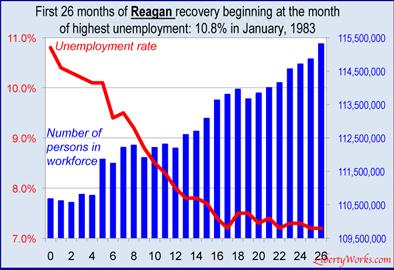
The second chart above tracks the first 25 months of the Reagan recovery of the 1980s. President Reagan inherited a sick economy and a deep recession that by most measures was worse than what President Obama inherited.  As the chart shows, the unemployment rate soared even higher but then there was a steep drop even as the labor force grew by 4.3 million!  People did not give up looking for jobs during the Reagan boom because there was robust growth in the economy and employers were creating hundreds of thousands of jobs every month.

[…]

There is a potential downside that could blow up Obama’s propaganda campaign. If the “good news” about the unemployment rate encourages several million people to come back into the labor force and seek jobs, the number officially classified as “unemployed” will increase and the unemployment rate will tick back up as the November election approaches.

Read the full story at – Liberty Works

Labor Force Contraction with Obama

– And other hidden truths

– By: Larry Walker, Jr. –

On January 7, 2012, Barack Obama boasted, “We’re moving in the right direction. We have made real progress.” Then he went on to exaggerate that, “Altogether more private sector jobs were created in 2011 than any year since 2005.” Naturally, such jovial assertions propelled many left-wing moonbats back to work today, if you can call blogging false claims such as that ‘Obama created more jobs in one year than Bush did in eight’, and other malarkey, work. It’s funny that these same cherry-pickers never attempt to match wits when it comes to the national debt. We all know that Obama has borrowed $1.0 trillion more in 3 years, than Bush did in eight, but I digress. So let’s examine Obama’s latest victory on the jobs front, for what it really represents.

Are we heading in the right direction?

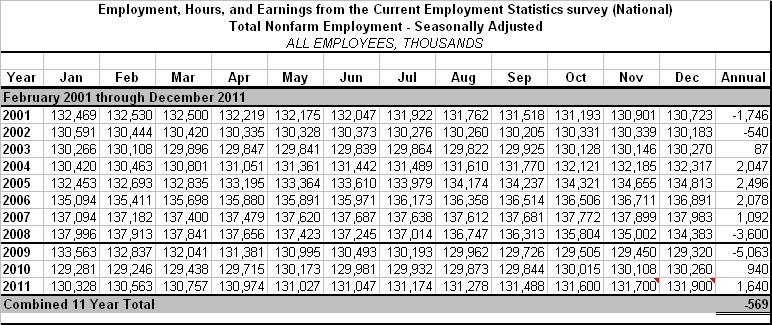
To find out, we took a closer look at the official data published yesterday by the Bureau of Labor Statistics (BLS). According to Table B-1, Establishment Data, the American economy has lost a total of -569,000 non-farm jobs since January of 2001. So in terms of jobs growth, what is factual is that not one new net job has been realized over the last 11 years (see table below). So are we headed in the right direction? I am reminded of a quote from the movie “2012” – “When they tell you not to panic, that’s when you run.”
Zooming in a little closer, we can see that -1,663,000 jobs have been lost since February of 2009, the month after Obama’s inauguration (see table below). So although 1,640,000 jobs were gained in the year 2011, and 940,000 in 2010, long forgotten by Obama are the -4,243,000 jobs that were lost during his first year in office. Granted, the fact that the economy is no longer losing jobs is a good thing, but it doesn’t necessarily mean we are heading in the right direction. One would have to examine a number of other factors in order to make that affirmation, such as the recent downgrade to the U.S.A.’s credit rating, and the 333% growth in government debt over Obama’s first three years.

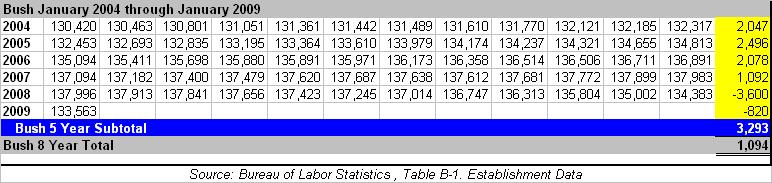
By comparison, George W. Bush, who also inherited a recession from his predecessor, suffered total job losses of -2,199,000 by the end of his third year in office (see table below), while Obama lost -1,663,000 during his first three years (see table above).

So for starters, it is incorrect to state that any jobs have been created since Obama became president, because net jobs have been lost (not gained). Therefore, a more fair and balanced statement would be that, ‘during their first three years in office, Obama lost -536,000 fewer jobs than Bush’. Now as far as I’m concerned, that’s hardly worth breaking out the caviar and champagne. What it really means is that in comparing both presidents up to this point in their terms, Obama is less of a loser than Bush. But two losers don’t make a winner.

Were more jobs created in 2011 than in any year since 2005?

Next, since Obama remarked that ‘more jobs were created in the year 2011 than in any year since 2005’, we must verify his claim. Actually this is not true, as you can see in the table below. The facts show that in 2004, 2005, 2006, and 2007 the economy produced total jobs growth of 2,047,000, 2,496,000, 2,078,000, and 1,092,000 jobs, respectively. So although it may have been correct to state that more net jobs were realized in 2011 than in any year since 2006, because 2,078,000 were realized in 2006, while 1,092,000 were attained in 2007, versus 1,640,000 in 2011, pulling the year 2005 out of a hat was a stretch.

“It is hard to believe that a man is telling the truth when you know that you would lie if you were in his place”.  ~ Henry Louis Mencken

Aside from twisting the truth, all that this really means is that fewer net jobs were realized in 2007, 2008, 2009, and 2010 than in 2011. So what? The recession officially ended in June of 2009, and now finally, two and a half years later, Obama beat what are essentially recessionary benchmarks. Congratulations! But what about the -3,600,000 jobs that were lost in 2008? And the -5,063,000 that were lost in 2009? It’s as if a tiny accomplishment, cherry-picked from an arbitrary year, isolated from the rest of recent history, has the power of changing that very history. Sure thing chief!

In the end, over Bush’s eight-year term, from February of 2001 through January of 2009, a total of 1,094,000 net jobs were realized; while during Obama’s first three years in office, from February of 2009 through December of 2011, a total of -1,663,000 net jobs have been lost. So that means Obama must gain another 2,757,000 jobs before his left-wing moonbats can boast of even equaling what they consider to be the miniscule accomplishment of George W. Bush. Good luck with that, since you’ve got less than 12 months to get there.

Omitting Marginally Attached and Discouraged Workers

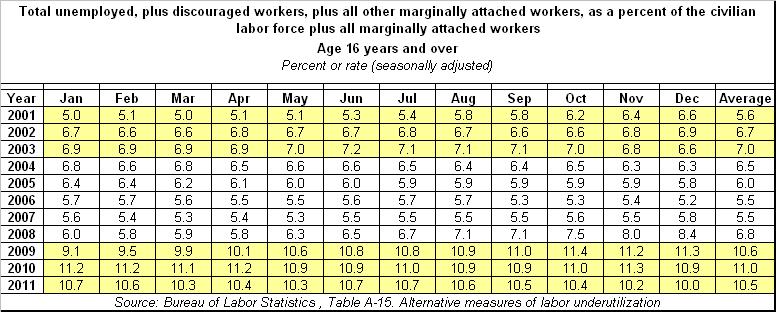
Now we will turn attention to the unemployed, and the uncounted, marginally attached and discouraged workers. You will note in the data from BLS Table A-15, Alternative Measures of Labor Utilization, (below) that during Bush’s first three recessionary years, the percentage of unemployed, plus marginally attached and discouraged workers averaged between 5.6% and 7.0%. You can also see that during Obama’s first three years, the rate has jumped to an average of between 10.5% and 11.0%. In fact, as of December 31, 2011, a larger percentage of Americans are unemployed, discouraged, or marginally attached to the labor force than at anytime since 1994 (when the statistic was first measured). So does this hidden fact somehow back up the words, “we are moving in the right direction”? Only if the direction Obama is espousing entails enslaving millions more to lives of perpetual government dependency. We’ve seen brighter mornings.

The Shrinking Labor Force

Finally, the data from BLS Table A-1, Employment Status of the Civilian Population by Sex and Age, (below) shows the number of Americans counted as part of the civilian labor force, from 2001 through 2011. We can see that during Bush’s first three years, the civilian labor force grew by 2,929,000. In contrast, the labor force has contracted by -739,000 during Obama’s first three years. So is this good, or bad? Well, since the population is growing by 1.2% each year, a contracting labor force means that a smaller proportion of the populace is working to support a larger group of retirees, unemployed, and those who have dropped out of the labor force. So I would say this isn’t exactly “morning in America”.

As you can see, the labor force grew from 143,800,000 at the end of January 2001, to 154,236,000 by January of 2009, for an increase of 10,436,000 workers over the eight-year period immediately preceding Obama. So while the labor force was expanding by an annual average of 1,304,500 new entrants before Obama, it has suddenly declined by an average of -246,333 workers per year since January of 2009. So as Obama has been out golfing, vacationing and as he now celebrates his grand achievement, better than 1,000,000 Americans have fallen through the cracks during each of his three years in office. These are either not working, not currently looking for work, or have permanently given up looking. They are not counted in the official December unemployment rate.

Most of the electorate understands that as the size of the labor force shrinks, the unemployment rate declines. But is anyone really paying attention? Since this massive decline in the civilian labor force is a verifiable fact, it’s not surprising that the Obama Administration, and much of the propagandist media have chosen to ignore it.

The Bottom Line: Obama has lost a total of -1,633,000 net jobs since he entered office. Not one new net job has been gained since the year 2007. The percentage of unemployed, plus marginally attached and discouraged workers stands at 10.5% as of December 2011, versus an average of 5.5% to 7.0% during the prior eight years. The civilian labor force has contracted by -739,000 workers since January of 2009, for an average loss of -246,333 per year, versus average growth of 1,304,500 per year in the eight years prior to Obama. So perhaps, Obama’s latest fabrication isn’t all it’s cracked up to be.

Related:

Obama’s lost labor force – NetRight Daily

Civilian Employment to Population Ratio Lowest Since Carter / Early Reagan … And Flat-lined! Employment Misery Index Increasing! – Confounded Interest

So Now, It’s ‘Recovery Winter’!! – Joshua Pundit

Obama’s Fraudulent Unemployment Rate – Liberty Works

Obamacare’s Deadweight Loss

Why you should repeal it right away!

By: Larry Walker, Jr.-

“The most important single central fact about a free market is that no exchange takes place unless both parties benefit.” ~Milton Friedman –

Failure to repeal Obamacare by January of 2013 will result in deadweight losses in the American economy. Although static revenue believers contend that the federal government will be able to line its pockets through a new source of revenue, inefficiency will occur in the private sector causing the loss of existing and future jobs, a decline in income tax revenues, less private sector health insurance coverage, and fewer business expansions. In fact, many small businesses will be left with lower revenues, after paying the so called shared responsibility penalty, causing them to either price themselves out of the market, downsize, or shutter, depending on market conditions.

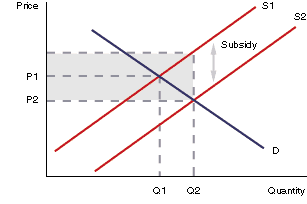
What is Deadweight Loss? – It’s an economic term which represents the costs to society created by market inefficiency. Deadweight loss can be applied to any deficiency caused by an inefficient allocation of resources. Price ceilings (such as price controls and rent controls), price floors (such as minimum wage and living wage laws) and taxation are all said to create deadweight losses. Deadweight loss occurs when supply and demand are not in equilibrium. To see how deadweight loss occurs with Obamacare, let’s use an expanded real world example.

TEA, Inc. is a small Georgia based parts assembly plant with 50 full-time employees, not including its single owner. The company doesn’t provide health insurance for its employees due to a low profit margin, as doing so would impair its ability to continue as a going concern. However, the owner wants to expand in order to increase profits through horizontal integration. The company’s pre-tax net profit is projected to be $150,000 for each plant it operates, and each plant is expected to employ 50 full-time employees. Prior to the passage of Obamacare, TEA Inc.’s owner had planned on opening a second plant in 2012 and a third in 2013 creating an additional 100 jobs, but this misguided legislation has pretty much killed that dream. How’s that?

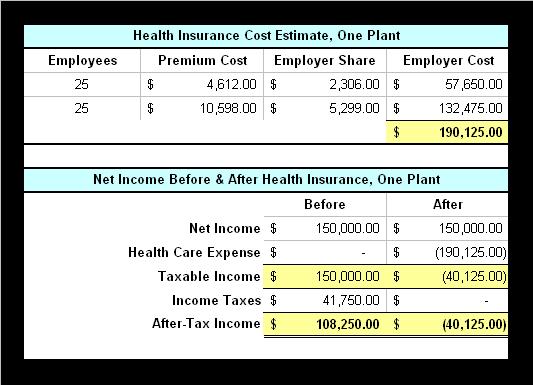
Well, since TEA, Inc. already has 50 full-time employees, it will be required by Obamacare to either provide and pay for at least half the cost of health insurance for its employees in 2014, or pay a penalty of $2,000 on each (excluding the first 30). In analyzing the financial impact, TEA, Inc. determines that 25 of its employees will require family plans, and 25 will require self-only plans. TEA, Inc. expects the ratio of family versus self-only plans to remain about the same as it expands. In examining the average cost of small group premiums within the Georgia market, it is known that self-only plans cost an average of $4,612, and family plans cost $10,598 (see Obamacare’s Effect on Small Business).

Single Plant Option

Prior to Obamacare, with its one existing plant, TEA, Inc. would have net income of $150,000, would pay federal income taxes of $41,750, and would be left with after-tax income of $108,250 (see table below). Assuming all things are equal, by 2014 when TEA, Inc. is mandated to provide health insurance at its existing plant, its health care expense will be $190,125 leaving it with a $(40,125) net operating loss, and no federal income tax liability. Since this is out of the question TEA, Inc. will be forced to either reduce its number of full-time employees to below 50, or pay a shared responsibility penalty (i.e. Health Care Tax).

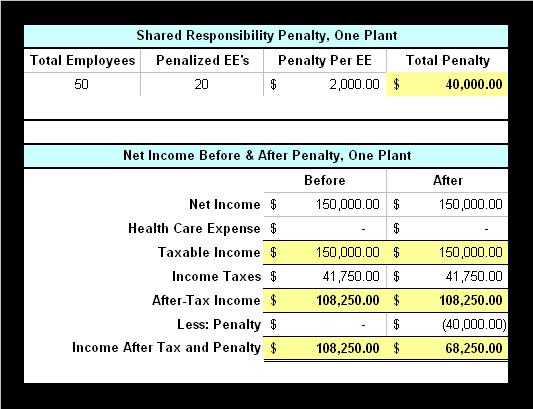
Since TEA, Inc. cannot afford to comply with the play portion of the “play or pay rules”, if it does not reduce its workforce before 01/01/2013, then by 2014 it will be forced to pay a shared responsibility penalty of $40,000 ($2,000 per person on 20 of its 50 employees). Since the shared responsibility penalty is not deductible for tax purposes, TEA, Inc. will still have taxable income of $150,000, will pay federal income taxes of $41,750, and will have after-tax income of $108,250. However, after paying the shared responsibility penalty, the company will be left with just $68,250 or $40,000 less than it would have had before Obamacare (see table below). What will TEA, Inc. do? Its owner only has 14 months to decide, because the penalty will apply in 2014 if TEA, Inc. still has 50 or more full-time employees in the year 2013 (see Obamacare’s Effect on Small Business).

Options: If TEA, Inc. reduces its current workforce by one full-time equivalent employee, it can avoid paying the $40,000 penalty in 2014, but it must eliminate that position before the end of 2012, due to the twelve month look-back rule contained in Obamacare’s fine print. By doing so, TEA, Inc. will save the amount of one employee’s wages, less the increase in applicable federal taxes, and will avoid paying the $40,000 shared responsibility penalty, making the company better off. Unfortunately, this might be the best option available under the circumstances. So far, the deadweight loss is one full-time job.

Two Plant Option

If TEA, Inc. opts to push ahead and open the second plant, prior to Obamacare it would have net income of $300,000, would pay federal income taxes of $100,250, and would be left with after-tax income of $199,750. Assuming all things are equal, in 2014 when TEA, Inc. is mandated to provide health insurance at its old and new plant, its health care expense will be $380,250 leaving it with a net operating loss of $(80,250), and no federal income tax liability (see table below). Since this is out of the question TEA, Inc. will be forced to either forgo its expansion plans and not provide the additional 50 jobs, or pay the shared responsibility penalty (i.e. Health Care Tax).

Since TEA, Inc. cannot afford to comply with the play part of the “play or pay rules”, if it proceeds with the expansion, then by 2014 it will be forced to pay a shared responsibility penalty of $140,000 ($2,000 per person on 70 of its 100 employees). Since the shared responsibility penalty is not deductible for tax purposes, TEA, Inc. will still have taxable income of $300,000, will pay federal income taxes of $100,250, and will have after-tax income of $199,750. However, after paying the penalty, the company will be left with just $59,750 or $140,000 less than it would have had before Obamacare (see table below).

It’s worth noting that even after doubling its profits, TEA, Inc. would be left with less money — $59,750, than it would have had with just the one plant — $68,250. Again, what will TEA, Inc. do? Its owner only has 14 months to decide, because the penalty will apply in 2014 if TEA, Inc. has 50 or more full-time employees in the year 2013 (see Obamacare’s Effect on Small Business). The best option appears to be to not open the second plant, and to reduce the number of full-time employees at the initial plant by one. Thus, the deadweight loss has increased to 51 full-time jobs.

Three Plant Option

If TEA, Inc. decides to trust in “hope and change” and moves ahead with adding yet a third plant, pre-Obamacare it would have net income of $450,000, would pay federal income taxes of $153,000, and would be left with after-tax income of $297,000 (see table below). Assuming all things are equal, in 2014 as TEA, Inc. is mandated to provide health insurance at all three plants, its health care expense will be $570,375 leaving it with a $(120,375) net operating loss, and no federal income tax liability. Since this is impossible, TEA, Inc. will be forced to either forgo its expansion plans and not provide the additional 100 jobs, or pay the shared responsibility penalty (i.e. Health Care Tax).

Since TEA, Inc. cannot afford to comply with the play aspect of the “play or pay rules”, if it proceeds with its expansion plans, then by 2014 it will be forced to pay a shared responsibility penalty of $240,000 ($2,000 per person on 120 of its 150 employees). Since the shared responsibility penalty is not deductible for tax purposes, TEA, Inc. will still have taxable income of $450,000, will pay income taxes of $153,000, and will have after-tax income of $297,000. However, after paying the shared responsibility penalty, the company will be left with just $57,000 (see table below).

It’s notable that even after tripling in size, TEA, Inc. would be left with less money –- $57,000, than it would have had with just two plants –- $59,750, and even less than it would have had with just the one plant –- $68,250. Again, what will TEA, Inc. do? Its owner only has 14 months to decide, because the penalty will apply in 2014 if TEA, Inc. has 50 or more full-time employees in the year 2013 (see Obamacare’s Effect on Small Business).

The best option for TEA, Inc. appears to be to forget about opening a second and third plant, and to reduce the number of employees at its existing plant. By doing so, TEA, Inc. will be able to maintain its present after-tax net income of $108,250, plus the savings achieved by eliminating a job, which yields the optimal result. Thus, in this real-life scenario, the deadweight loss created by Obamacare is 101 full-time jobs. In addition, 49 full-time employees are left without health insurance, and by 2014 will be forced to either pay a tax or secure their own health insurance coverage. Failure to repeal Obamacare means that this entrepreneur’s dreams of expansion will be destroyed, and 101 potential employees will be left on the sidelines. Obamacare will impose unnecessary deadweight losses upon the American economy, which will be multiplied many times over.

Forcing the free-market to accept and live with market inefficiency just doesn’t work out so well in a free market society. Any so called Jobs Bill which doesn’t immediately repeal this irresponsibly enacted, job killing, legislation isn’t a jobs bill at all. In my humble opinion, the Patient Protection and Affordable Care Act (PPACA) should be repealed right away. You should repeal it, right now! Be sure to sign the White House Petition to Repeal Obamacare. You must sign by 10/22/11. “Live free or die.”

Obama’s Economic Reduction Plan

Private Equity vs. Government Redistribution

– By: Larry Walker, Jr. –

“A farmer went out to sow his seed. As he was scattering the seed, some fell along the path, and the birds came and ate it up. Some fell on rocky places, where it did not have much soil. It sprang up quickly, because the soil was shallow. But when the sun came up, the plants were scorched, and they withered because they had no root. Other seed fell among thorns, which grew up and choked the plants. Still other seed fell on good soil, where it produced a crop—a hundred, sixty or thirty times what was sown. He who has ears, let him hear.” ~ Matthew 13:3-9

For many, the American Dream consists of the hope of freeloading off of the good fortune of others for their entire lives. Yet for some, the dream is comprised of one day saving enough capital to invest in a business of their own. And for a few, the dream is to one day save enough to invest through a private equity group. For those aspiring towards business ownership, sometimes a little help is needed, and that help, in many instances comes though private equity firms.

So why would anyone dream of investing in a private equity firm? Well one big reason is that under current law, around 58% of the profits realized by private equity firms are taxed as long-term capital gains rather than as ordinary income. Long-term capital gains are currently taxed at the maximum rate of 15%, while ordinary income is taxed as high as 35%. The lower tax rate on long-term capital gains helps to compensate for the opportunity cost of investing for the long haul, and also enables a greater portion of the profits to be reinvested into the next venture, which can ultimately lead to the accumulation of a great deal of wealth.

Another reason many dream of investing in private equity groups is because they feel a calling to help fellow Americans reach their dreams. Unlike bloated, deficit-financed, short-sighted, big government wealth redistribution schemes, private equity is good for America. However, if the carried interest (the long-term capital gains earned through investing in private equity) were to suddenly be taxed at the same rates as ordinary income, then there would no longer be an incentive to invest in long-term private business endeavors.

Private equity firms fund and co-manage thousands of private businesses in the United States, employing millions of American workers, and these businesses are dependent upon stable long-term investments. If big government takes away the incentive to save and invest in long-term endeavors, then there will be no long-term investment. It simply won’t be worth the risk. And without long-term private equity investment, thousands of businesses, millions of jobs and the American Dream will be choked out of existence.

Carried Interest vs. Ordinary Income

Ordinary income is mostly comprised of net business income, fixed compensation, interest, dividends, rents, royalties, and short-term (less than a year) capital gains. Unlike ordinary income, there is greater risk involved with long-term (more than a year) capital investments. Private equity firms typically make investments over a 3 to 7 year term. The risk of tying up capital savings for many years is that the investment might be lost entirely, or may not return any profit at all. So is carried interest the same as ordinary income? Centuries of sound and settled tax policies say no. But Barack Obama, a novice, with no business experience, and a track record of failed economic policies; and Warren Buffett, a retiring billionaire, who has profited from lower taxes on carried interest during his lifetime, say yes. So who’s right, centuries of proven economic science, or 32 months of butt kissing and B.S.?

The Obama-Buffett Rule presumes that carried interest is the same as ordinary income and should be taxed at ordinary income tax rates of up to 35%, instead of at capital gains rates of up to 15%. The contention that the profits earned through long-term capital investment, which involves placing previously taxed income at risk through investing in risky business ventures, which employ hundreds of thousands of American workers, and which help drive the American economy, should be taxed at the same rate as fixed compensation, such as wages earned from labor, is quite a leap. The problem with Obama’s latest Socialist twist is that unlike fixed compensation, which is properly taxed as ordinary income, carried interest, garnered through private equity investments, only rewards general partners if, at the end of the term, the fund actually results in a net gain.

To break this down further, you have on the one hand wage earners, who work 40 hours per week, get paid weekly (or semi-monthly), consume most of their pay, and have taxes withheld from each paycheck. And on the other hand, you have private equity partners who work on a project for 3 to 7 years, expending capital and sweat equity, aiding in the employment of thousands of tax paying workers, helping make tax paying businesses profitable, and ultimately hoping to, at the end of the term, regain their investment along with a handsome profit. So is carried interest the same as ordinary income? Is all income created equal? Is Capitalism the same as Socialism? Do words still have meaning?

Private Equity in Action

Within the State of Georgia there are approximately 30 private equity firms, which have invested an estimated $26 billion in Georgia-based companies, which back approximately 340 private companies, which employ more than 175,000 U.S. workers. If more capital is diverted away from private equity investments, through errant tax policies, and instead invested in tax-free securities or some other jurisdiction, then where will the capital to fund these Georgia businesses come from? It’s not likely to come from banks, which are currently paying investors taxable interest of between .01% and 1.0% on savings. And it’s not likely to come from the federal government which is currently $14.7 trillion in debt. Thus, when private equity capital is finally taxed out of existence, there will be no capital, and most of these 340 companies will cease to exist, along with 175,000 jobs.

In the State of Illinois there are approximately 137 private equity firms, which have invested an estimated $72.9 billion in Illinois companies, which back approximately 450 private companies, which employ more than 350,000 workers in the U.S. The State Employees’ Retirement System of Illinois had nearly $525 million invested in private equity as of June 30, 2008, about 5 percent of the System’s total pension fund portfolio of more than $11.4 billion. And as of June 30, 2009, the Illinois’ Teachers Retirement System had $2.34 billion invested in private equity, about 8.2 percent of TRS’ total portfolio of nearly $29 billion. Are the billions of dollars that Illinois pension funds invest in private equity firms any more or less important than any other American citizen’s savings? I think not. If the government takes away the incentive of private equity partners, then where will this capital go? If you say, “To the Banks”, again you err. If you say, “Directly into businesses”, then who will oversee and manage these investments, the government? Yeah, right, just like Solyndra.

It’s Math!

And then there’s this hogwash about wealthy people paying lower tax rates than middle income earners. Does anyone really believe this? All you have to do is glance over at one of our “progressive” tax rate schedules, to know that’s not the case. Since our tax rate structure is “progressive”, the rates increase along with income. One’s combined tax rate is never the same as their bracket rate. In other words, you may be in a 25% bracket, but that doesn’t mean you’ll fork over 25% of your taxable income. As you can see below, married couples with ‘ordinary taxable income’ of $25,000 pay a tax of 11.6%, those with $50,000 pay 13.3%, and those with $100,000 pay 17.2%; while married couples with ‘ordinary taxable income’ of $250,000 pay a tax of 24.0%, those with $1,000,000 pay 32.0%, and those with $10,000,000 pay 34.7%.

In terms of dollar amounts, on the low-end, 11.6% of $25,000 translates into $2,900, while on the high-end, 34.7% of $10 million works out to around $3.5 million. So is paying $2,900 in taxes greater than or equal to paying $3.5 million? It’s math! One must also consider that five times out of ten, that $2,900 liability gets magically turned into a tax refund of up to $8,000, as nearly half of all American workers are either not liable for any income tax whatsoever, or fall into the negative category. So perhaps the words “fair share” could be more appropriately expressed as “unfair and not-shared”.

From Taxing the Rich

Although it may seem fair for Obama and Buffett to compare a private equity partner with $10,000,000 of carried interest, to a married couple with taxable wages of $100,000, it’s really not. It’s like comparing oranges to apples. Although the wage earning couple will pay federal taxes of 17.2% versus the carried interest earners 15.0%, in the end, the couple will have paid a total of $17,250 in taxes, versus $1,500,000 for the private equity partner. So is $17,250 greater than $1,500,000? “It’s math!”

The real difference is that a private equity partner may then turn around and reinvest most or all of the remaining $8,500,000 into the same company that the married couple works for, thus enabling them to continue their very employment. In terms of economics, the multiplier effect on private equity investment generates many times the tax revenue paid by the partner himself. Just add up the taxes collected on all the additional wages, salaries and business profits he helps to generate. But if that capital be muzzled, the result will be less free-enterprise and even higher levels of unemployment. Thus, while earning a salary is productive, it’s nowhere near as productive as carried interest. Perhaps there’s a reason why some of our tax policies are the way they are! “It’s math!”

If Obama and Buffett really wanted to compare apples to apples, then they would be comparing a married couple with carried interest income of $10,000,000, to a couple with long-term capital gains income of $10,000,000. Each will pay $1,500,000 in taxes. So is fairness still an issue? The truth is that no American is prevented from saving his or her own money and investing in activities generating similar capital gains. Anyone can do it, and will reap an equal reward — a maximum 15% long-term capital gains tax. But if the government ever takes away this incentive, or begins to discriminate against certain forms of long-term gains, then you can kiss the American Dream goodbye.

Government Subsidies vs. Private Equity

If the government steps in and confiscates a larger chunk of the profits earned by private equity firms, then there will be that much less capital to reinvest in new acquisitions. And what will the government do to make up the shortfall? Will the government invest in and manage new enterprises? Perhaps, the federal government will subsidize more companies like Solyndra, but then who gets the ‘return on subsidy’ (ROS), if and when the government is successful? Will every taxpayer get an equal slice of the pie? That’s highly doubtful. More than likely, the money will simply be absorbed into the federal government’s irresponsible $1.3 trillion per year budget deficits, or into its $14.7 trillion national debt, or used to pay unemployment compensation, or to dole out more food stamps, neither of which will create new jobs. In other words, the money will be pilfered and consumed rather than invested in viable job creating enterprises. And we all know that America needs more jobs, not more debt, unemployment compensation and food stamps.

Private equity investors fund American businesses which employ millions of American workers. By investing in non-public companies they typically hold their investments with the intent of realizing a return within 3 to 7 years. Shouldn’t there be some reward for committing previously taxed income for 3 to 7 years, in order to help businesses grow, and to enable employment for millions of workers, with no guarantee of a profit let alone return of the original investment? I say, yes. Obama and Buffett say, no. Where they err in their quest for “fairness” is in that 42% of the profits earned by private equity investors are already taxed at ordinary tax rates, while just 58% represents carried interest. They also fail to realize that such profits are typically reinvested back into the cash account to fund the next acquisition. You would think that at least Buffett would understand this concept, since most of his earnings have been likewise reinvested.

Hell No!

With Obama’s brand of math, one would surmise that if the government could just confiscate the $1.4 trillion in annual private savings, and use it to pay the $1.4 trillion of annual government deficits this would somehow bring about “balance”. But all it would really bring about is a permanent state of depression, mass government dependency, and even greater deficits once the government runs out of other people’s money. And considering that the best the federal government could possibly do, by confiscating additional tax revenue, is to immediately absorb it into its irresponsibly amassed $14.7 trillion in accumulated deficits, over $4 trillion of which was squandered by Obama himself, the answer to the request for more revenue is still, “Hell No”. Cut spending, stop squandering the tax dollars we’re already paying, and stop regurgitating the same old lies over and over again.

Although the federal government does employ a couple of million workers, about 59% of the money used to pay them is already confiscated from taxpayers, while the other 41% is merely borrowed from the Federal Reserve Bank and from countries like China. Every dime taken away from private investors and spent by the government is a dime taken away from private businesses and private sector workers. Once the point of no return was breached, back in 2010, there was no longer enough personal income to cover the amount of federal debt, on a per capita basis, and if this is not corrected soon, it will lead to the death of the American Dream. If there is already not enough income to pay the government’s debt, then why is Obama begging for higher taxes? When there is nothing left but government, then what? Will the government pay everyone a subsidy of say $50,000, and then proceed to levy a 100% tax on everyone in order to fund itself into infinity? Isn’t this exactly where Obama’s plan leads?

The failure of Obamanomics can be summed up in a few short phrases: If it produces jobs, tax it. If it keeps producing jobs, regulate it. And when it stops producing jobs, subsidize it. Thus Obama’s plan for deficit reduction, like his Jobs Act, is just another gimmick leading to economic reduction, job destruction, government dependence, poverty and the end of the American Dream. Obama gave it his best, but his best just wasn’t good enough for America. Hey Obama, “Hell no, and good riddance.”

*** BTW – Raising the tax rate on carried interest from 15% to 35% would result in a 133.33% tax hike, or to 39.6% would equal a 164.0% hike, just in case anyone is still considering this madness. ***

“There is a limit to the taxing power of a State beyond which increased rates produce decreased revenue. If that be exceeded intangible securities and other personal property become driven out of its jurisdiction, industry cannot meet its less burdened competitors, and no capital will be found for enlarging old or starting new enterprises. Such a condition means first stagnation, then decay and dissolution. There is before us a danger that our resources may be taxed out of existence and our prosperity destroyed.” ~Calvin Coolidge (Address to the General Court beginning the 2nd year as Governor of Massachusetts January 8, 1920)

References:

Private Equity Info

Private Equity Growth Capital Council

Related:

The Problems with Raising Taxes on Carried Interest, Part II

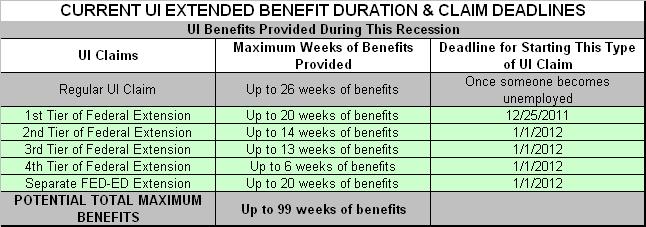
Obama’s Failed Jobs Subsidy | 99 Weeks

“Government does not solve problems; it subsidizes them.” ~Ronald Reagan

– Policies Have Consequences

– By: Larry Walker, Jr. –

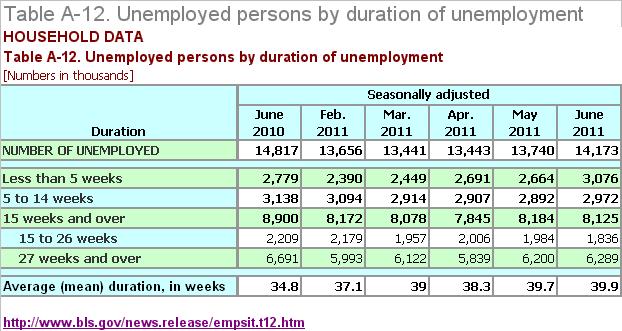
Since 1948, the average duration of unemployment in the United States, has rarely exceeded twenty weeks. In fact, up until February of 2009, the average had only exceeded twenty weeks for a total of 8 out of 721 months. To be specific, the average exceeded twenty weeks for five months consecutively in 1983, for the month of January 1984, and for two non-consecutive months in 2004. But since February of 2009, the month after Barack Obama’s inauguration; the average duration of unemployment has exceeded twenty weeks for his entire 29 month term. But more significantly, the average has doubled under his Hope & Change regime. The average duration of unemployment has skyrocketed from 19.9 weeks in January of 2009 to 39.9 weeks through June of 2011. So what’s up with that?

From Average Weeks Unemployed

I am reminded of the old Chinese Proverb, “Give a man a fish and you feed him for a day. Teach a man to fish and you feed him for a lifetime.” It may also be deduced that to borrow a fish and give it to a man, is to impoverish oneself; and that a nation borrowing and giving a ton of fish to men for 99 weeks will in time bankrupt itself. Of course it doesn’t get any better when one proffers to steal and give away the fish. For one thing, you can’t give away what you don’t have. And of equal importance, the act of extending unemployment benefits for 99 weeks actually does more to discourage, rather than encourage, employment. Can anyone dispute the end result?

If you take a look at Table A-12 (above), from the Bureau of Labor Statistics latest report, two items stand out. First of all, the officially counted number of unemployed persons, per Household Data, increased from 13.7 million in May to 14.2 million by June of 2011 (a fact overlooked by many). Secondly, the average duration of unemployment increased from 34.8 weeks in June of 2010 to 39.9 weeks by June of 2011. As you may recall, the recession officially ended in June of 2009, so what’s causing this? The unintended consequences themselves dispute Obama’s errant theory that, extending unemployment benefits for up to 99 weeks would help the unemployed find ‘good’ jobs. No one can deny the outcome.

It was back in July of 2010, after signing a bill extending unemployment benefits to 99 weeks, when Barack Obama said, After a partisan minority used procedural tactics to block the authorization of this assistance three separate times over the past weeks, Americans who are fighting to find a good job and support their families will finally get the support they need.” Excuse me, but I fail to see how an extension of unemployment benefits could ever be used as a tool for landing any kind of job. Exactly how does that work? As evidenced by the end result, not very well. And although unemployment benefits may help to support a family, when I was on unemployment for two weeks (many years ago), after having been furloughed by the federal government, it didn’t take any longer than that for me to figure out that my family of five could not survive on an unemployment check. So what did I do? I got religion, and found another job. “Finding a job is a full-time job.” ~Unknown

“Keep on asking, and you will receive what you ask for. Keep on seeking, and you will find. Keep on knocking, and the door will be opened to you.” ~Matthew 7:7

I recently spoke with an acquaintance, who stated that he was going to have to get back to work soon, because the $1,200 per month check he had been getting for the past two years was about to run out. I thought for a minute, and then put two and two together. What he was saying was that he really wasn’t trying very hard while the unemployment checks were coming in. But as soon as the government-subsidy to not work came near an end, he knew he would have to get off of his behind and do what, for the past two years, he had no incentive to do. He also indicated during this dialogue that he had been doing some self-employed work on the side, using the government handout as a backstop. I’ve overheard a number of other people saying that they were working full-time jobs while continuing to collect unemployment checks as well, a behavior which I strongly condemn.

But this is really the government’s own fault. A government-funded, deficit-financed, subsidy to not work will always be respected for exactly what it is – free-money, carelessly doled out by a lackadaisical, sugarcoating, and weak-kneed Administration. It’s nothing more than an act of cold-blooded kindness. The act of extending unemployment benefits to 99-weeks has produced exactly what such a program should – an increase in the average duration of unemployment. If the big-time, millionaire, POTUS had an ounce of honesty; he would admit that you can’t support a family on an unemployment check, and that extending unemployment benefits doesn’t help anyone find a ‘good’ job. What sounds kind isn’t necessarily true. It is rather the threat of losing governmental assistance which produces the swift kick in the rear, necessary to inspire action.

When I took public transportation half way across town for four months, to a minimum wage job, to push a mop and empty trash cans, often standing at a bus stop in the pouring rain, I complained to no man. With simple faith in God, and a belief that He helps those who help themselves, it dawned on me one day that, ‘it really didn’t matter what I did for a living’. ‘If I showed up everyday, and performed my job to the best of my ability, promotion would come from above.’ And promotion did come, and in short order. Government has never been the solution to my problems, but for many unemployed persons today, government is the problem.

I have wondered at times how many people are really just lying around thinking that their lives would be so much better if only millionaires and billionaires would contribute more of their money to the federal government. If you listen to Obama’s rhetoric long enough, you would think that there is a whole class of envious people sitting around somewhere dwelling on this thought, every waking day. But hopefully it’s just him. Whatever happened to words of encouragement?

“Industry, thrift and self-control are not sought because they create wealth, but because they create character.” ~Calvin Coolidge

There was a day when I found myself jobless, homeless and broke. I didn’t have an unemployment check, or any other kind of governmental subsidy. When I checked into the local homeless center for a week (a center that I still donate to today), I wasn’t sitting around wishing I had someone else’s money. To the contrary, I was engaged in doing whatever I had to do to get out of there, and to get back on my feet. Pulling yourself up by your own bootstraps used to be thought of as a noble feat, and in my view it still is. After all, doesn’t God help those who help themselves? Yeah, I went through some hard times, and worked some low paying, back-breaking, temporary jobs. But within three years of utter destitution, I had a good paying managerial job; good enough to buy a modest home, a car, to get married, and to move on to the next level. I haven’t looked back since.

So how much is the federal government squandering on this failed, so called, jobs program? Well, per the President’s own 2012 historical budget, federal spending on unemployment compensation reached a record high of $166.2 billion in 2010, eclipsing the previous record of $127.6 billion in 2009. Prior to this, the old record of $57.4 billion was set in 2003. And in case you’re wondering, total spending on unemployment in 2007 and 2008 was $35.3 billion and $45.6 billion, respectively. So not only has Obama’s misguided policy doubled the average duration of unemployment, but it has exceeded the previous spending record by 189%. Chalk up two more historical, extraordinary accomplishments for Obama.

From Average Weeks Unemployed

If I was engaged in the battle to reduce government spending, the first thing I would do is cut unemployment back to the traditional 26-week benefit. If government wants to reduce the number of unemployed, the best thing it can do is get out of the way. That’s right! There are jobs available now, but people are not going to take them until the government pacifier is withdrawn. I thank God for every back-breaking, low paying, non-unionized job I ever had. To be blunt about it, if you are an adult, and can’t find work within 26 weeks, in the United States of America, it’s not because there aren’t any jobs, it’s because you’re not trying. I tell that to my children, who are all working now, and I will say it to anyone who has ears.

“Go to the ant, you hater of work; give thought to her ways and be wise.” ~Proverbs 6:6

Here are some more words of wisdom that will stick with me for the rest of my days: “Do what you don’t want to do, and don’t do what you want to do.” | “Grow up or die.” | “If you don’t work, you don’t eat.” | “Get in where you fit in.” | “Good planning and hard work lead to prosperity, but hasty shortcuts lead to poverty.” ~Proverbs 21:5

What? You don’t like this? Too bad! It’s time we had leaders who tell the people what they need to hear, and not what they want to hear. It’s time to take our ideals back. It’s time to restore integrity. It’s time to judge men and women by the content of their character. It’s time to get government out of our way and off of our backs. It’s time for another shellacking. It’s time for the community destabilizer to shape-up, or ship-out.

“Government’s view of the economy could be summed up in a few short phrases: If it moves, tax it. If it keeps moving, regulate it. And if it stops moving, subsidize it.” ~Ronald Reagan

References:

http://thehill.com/blogs/on-the-money/801-economy/134443-unemployment-benefits-extension-in-tax-cut-deal-only-goes-so-far

http://www.edd.ca.gov/Unemployment/Federal_Unemployment_Insurance_Extensions.htm

http://www.bls.gov/news.release/empsit.t12.htm

http://data.bls.gov/pdq/SurveyOutputServlet

http://www.gpoaccess.gov/usbudget/fy12/xls/BUDGET-2012-TAB-5-1.xls

Link to Data:

Data Tables

Images

Saving Our Way to Prosperity

Yes. You Can.

– By: Larry Walker, Jr. –

According to Barack Obama, “We can’t simply cut our way to prosperity.” Prior historical references: None. Upon hearing such an absurd statement, and being of the homo economicus persuasion, my first instinct is to define what it means to me, and then to determine whether it has any relevance in my life. If we are honest, we must each define what the word prosperity, or rich, means to us. Only after we have defined its meaning are we able to chart a course.

In the WikiHow.com article, “How to get rich,” there are seven steps, the first of which is to define the word “rich.” Obviously it means different things to different people. According to Obama, the word rich means making more than $250,000 per year. A more formal definition of prosperity is “to be fortunate or successful, especially in terms of one’s finances.” For others it means achieving a certain level of prestige, or being able to afford a comfortable retirement, neither of which necessarily involves making $250,000 in a year. How would you define prosperity?

Homo Economicus

The term Homo economicus, or Economic human, is the concept in some economic theories of humans as rational and narrowly self-interested actors who have the ability to make judgments toward their subjectively defined ends. My definition is that men and women are primarily interested in making judgments which will improve their own economic condition. My goal is not to be a millionaire, although that would be nice. My goal is to be able to meet my obligations in life and to remain self-sufficient upon retirement.

In John Stuart Mill’s work on political economy, in the late nineteenth century, he further defined this economic man as “a being who inevitably does that by which he may obtain the greatest amount of necessaries, conveniences, and luxuries, with the smallest quantity of labor and physical self-denial with which they can be obtained.” I have to admit that my goal is also to get the most out of life with the least possible amount of labor, but that’s not exactly how it’s been working out. I work much too hard. What’s your goal?

Yes. You can.

Notice that Obama uses the words, “we and our”, as in, “We can’t simply cut our way to prosperity.” Exactly what does that mean? The last time I checked, “we” wasn’t responsible for paying my bills. Actually, you and I just might be able to cut our way into relative prosperity. But I don’t believe that the federal government can tax and spend us into a utopian paradise. If this were possible, wouldn’t we already be there?

Returning to “How to Get Rich,” the 4th Step is entitled, Delay Gratification, under which we find the following guidance on the path to prosperity:

  1. Are you spending money on things that won’t get you rich?

  2. Are you sticking with a job that doesn’t make that much money to begin with?

  3. In order to get rich, you’re going to have to give up some of the things you enjoy doing now, so that you can enjoy those things without restriction later. For example, you might like having free time, so you give yourself a few hours a day to do nothing. But if you were to invest those few hours into getting rich, you could work towards having 20 years of free time (24 hours a day!) with early retirement. What can you give up now in exchange for being rich later?

  • Cut expenses
  • Get a job that pays more or get a promotion
  • Downgrade or give up your car
  • Downgrade your apartment or house
  • Reallocate your spare time

Although there is an element of truth in the statement, “we can’t cut our way to prosperity”, the fact is that you and I can, individually. The act of cutting, or reducing, my personal expenses causes me to save money. So to cut means the same as to save. By substituting the word ‘cut’ with ‘save’ in Obama’s original comment; what he is really saying to me is that, “We can’t simply save our way into prosperity.” Why, that’s preposterous! It’s as if he is implying that I should empty my emergency fund and retirement savings, spend it all today, and I will be magically ushered into prosperity. But if I did that, then I would be forced to borrow huge sums of money when ready to invest in furtherance of my dreams. But this won’t work out too well, especially since banks normally require a down payment.

The 5th Step in How to Get Rich is entitled, Save Money. It states, “You’ve heard the phrase “It takes money to make money.” So start socking away the extra money you’re making now that you’ve delayed gratification as outlined previously. After all, what’s the point in giving up the stuff you like if you have a hole in your pocket? Start building a “get rich fund” at the bank. Always pay yourself first. This means before you go and blow your pay check on a new pair of shoes or a golf club you don’t need, put money aside in to an account that you don’t touch.” This makes much more sense to me than the idea of squandering my savings, as implied by Obama. So for me, yes, I can save my way into relative prosperity, and so can you. The federal government could do the same, after paying off its massive $14.4 trillion debt, that is. This ought to be Obama’s goal. Yes. You can.

No. Government Can’t.

He jabbers on, “We need to do what’s necessary to grow our economy; create good, middle-class jobs; and make it possible for all Americans to pursue their dreams.

There he goes with that “our” stuff again. We need to do what’s necessary to grow our economy. That sounds appealing, but fortunately my economy is not yours, and yours is not mine. My economy is comprised of my household, my family, my business customers, vendors, lenders, employees and other obligations. I don’t know where Obama is coming from, but there is one way that the federal government could help to grow my economy, and that would be to stop taking as much of my hard earned money in taxes. That would help quite a bit. If I didn’t have to pay any taxes at all, my economy would be doing pretty well. Try that one on for size! If the government concentrated more on how to take less of my money, then my economy would improve, and so would yours. This simply requires cutting the size of government.

Next, he says that we need to create good, middle class jobs. What exactly is a good, middle class job? Does it require picking up a shovel? The idea of having a good, shovel-ready, middle class job doesn’t exactly mesh with prosperity, at least not in my book. Thanks but no thanks. I don’t really want a middle class job; I would rather have more freedom and prosperity. I don’t believe that group effort is required in job creation. I believe that one economic man can create many jobs. In fact, the true economic man is going to need a lot of help upon reaching his own prosperity. He’s going to need employees, suppliers, accountants, attorneys, financial planners, housekeepers, gardeners, service people, travel agents, retailers, restaurants, auto dealers, gas stations, chauffeurs, etc. It seems to me that Obama’s goal should be to inspire more economic men and women, and greater prosperity, rather than higher taxes, and more mundane, government-manufactured, temporary, shovel-ready, middle class jobs.

Finally, Obama says that we need to make it possible for all Americans to pursue their dreams. But all that’s required here is freedom. Are we not free? As long as I am free, I can do anything, and so can you. Nothing can stop me from pursuing my dreams, yet my dreams are not yours, and yours are not mine. Maybe your dream is to manufacture a product, while mine is to provide a good quality affordable service. Someone else’s dream might involve freeloading off of the toil of others. Just as the word prosperity means different things to different people, our dreams are not all the same. “We hold these truths to be self-evident, that all men are created equal, that they are endowed by their Creator with certain unalienable Rights, that among these are Life, Liberty and the pursuit of Happiness.” The federal government didn’t give these rights to me, and it can’t take them away. You sir, cannot spend our way into life, liberty, and the pursuit of happiness, they are the gift of God.

The bottom line: Yes we can save our way to prosperity. That’s how it works in this Universe. It takes money, to make money. Here are a few more steps we can follow along the path to prosperity. Step 1: Cut discretionary government spending back to 1996 levels. Step 2: Force the federal government to start making principal payments against its debt. Step 3: Abolish every new governmental regulation established since January of 2009. Step 4: Vote against Barack Obama and his queer notions about the economy.

Want Tax Hikes? Push the Reset Button

Cut Government Spending Back to 1996

– By: Larry Walker, Jr. –

Dialing the top income tax bracket back 15 years without a reciprocal cut in government spending does nothing to preempt the debt bubble. However, if the Golfer in Chief and his inept cohorts remain stuck on reinstating those bygone tax rates, then all taxpayers must necessarily stand as staunchly fixated on cutting the size of discretionary government spending, back to 1996 levels if necessary. Those not willing to regress on government spending really need to stop kidding themselves into believing the silly notion of resurrecting 15 year old tax brackets as a serious solution. If you are confounded, then more than likely you have never heard of inflation, don’t purchase goods and services with your own money, and lack the skills required to balance a simple checkbook. In other words, those who don’t comprehend would better serve the public by resigning from government and returning to their own ruinous private lives.

The fallacy of anointing $250,000 as the top tax bracket of the 21st Century is actually based on 20th Century income tax tables. What worked in 1996 won’t work today. What Barack Obama and fellow democrat party residue from the last shellacking are really talking about is reimposing the top income tax brackets of 1996, which applied some 15 years ago. Omitted from this quandary are two key factors: inflation and the level of discretionary government spending in 1996.

  1. Inflation – As far as personal income, $250,000 in 2011 had the same buying power as $175,085 in 1996. And $250,000.00 in 1996 has the same buying power as $356,969.06 in 2011. Annual inflation over this period was 2.40%. Thus $250,000 isn’t what it used to be.

  2. Discretionary Government Spending – Discretionary spending in 1996 was $532.7 billion compared to the 2012 budget estimate of $1,340.3 billion ($1.3 trillion). If they want us to acquiesce to 1996 tax brackets, then shouldn’t the government backtrack to 1996 discretionary spending as well?

In terms of both inflation and discretionary government spending, the budgeted 2012 discretionary spending level of $1,340.3 billion had the same buying power as $938.6 billion in 1996. And the $532.7 billion actually spent in 1996 has the same buying power as $760.6 billion today. If democrats insist on hiking taxes on those making over $250,000, then a simple compromise would be for them to agree to cut discretionary government spending by $579.7 billion in 2012 ($1,340.3 minus $760.6). This would bring both government spending and income tax rates in line with the late 20th century. But the right thing to do under Obamanomic theory is to simply return to actual 1996 discretionary spending. This requires cutting the federal budget by $807.6 billion, as shown below.

From General

This means cutting National Defense by $463.9 billion, International Affairs by $46.1 billion, General Science, Space and Technology by $15.3 billion, Energy by $10.2 billion, Natural Resources and Environment by $19.2 billion, Agriculture by $2.9 billion, Commerce and Housing Credit by $557 million, Transportation by $3.5 billion, Community and Regional Development by $14.2 billion, Education, Training, Employment and Social Services by $66.8 billion, … etc…

Don’t worry about who gets hurt or rewarded, just cut it, and then tell governmental agencies, “Here’s your budget, now you figure out how best to spend it.” Problem solved. Next question!

“Knowledge is an inherent constraint on power.” ~ Thomas Sowell

“Collecting more taxes than is absolutely necessary is legalized robbery.” ~ Calvin Coolidge

References:

http://www.dollartimes.com/calculators/inflation.htm

http://www.gpo.gov/fdsys/pkg/BUDGET-2012-TAB/xls/BUDGET-2012-TAB-8-7.xls

Point of No Return | National Debt Tops Personal Income

Warning - No Return

~ By: Larry Walker, Jr. ~

For the first time since World War II, the National Debt of the United States has exceeded personal income, on a per capita basis. The point of no return was breached in 2010, during Barack Obama’s second year in office, and the derangement continues to spin hopelessly out of control. This means that every dollar earned by an American citizen is now owned by the federal government, and then some. That’s right, the average annual income of most working-class Americans now belongs to the federal government. The warning of Thomas Jefferson has come to pass, “A government big enough to give you everything you want, is big enough to take away everything you have.”

Meanwhile, no senators voted for Barack Obama’s 2012 budget when it came up for a vote in the Senate on Wednesday. A procedural vote to move forward on the president’s plan failed 0 – 97, proving that Obama is basically a lame duck president, with no viable plan for resolving the government-manufactured fiscal crisis.

Historical Per Capita National Debt, Personal Income and GDP

In the year 1929, per capita personal income was $697, while each citizen’s portion of the national debt was $139. The federal government’s debt represented just 16.3% of gross domestic product, and 19.9% of personal income. Although not incurring any national debt at all would have been ideal, the percentage of debt to personal income was at least somewhat bearable back in the day; but this was about to change for the worse.

From Point of No Return

The point where a citizen’s per capita share of the national debt exceeded personal income first occurred at the height of World War II. In 1944, per capita personal income was $1,199, while each citizen’s share of the national debt reached $1,452. At the time, the national debt represented 91.5% of gross domestic product and 121.1% of personal income, on a per capita basis. Per capita national debt would continue to exceed personal income through the end of 1950, five years after the end of the war.

From Point of No Return

The point of no return was decisively breached in the year 2010 (see chart above). Although per capita personal income had grown to $40,441, each citizen’s portion of the national debt soared to $43,732. The national debt represented 92.5% of gross domestic product and 108.1% of personal income, on a per capita basis. The situation has worsened through the end of the first quarter of 2011 with per capita personal income of $41,486, versus per capita national debt of $45,782. Through March of 2011, the national debt now represents 95.1% of gross domestic product and 110.4% of personal income, on a per capita basis.

[In contrast, at the end of 2008 per capita personal income stood at $40,469, while each citizen’s share of the national debt was $32,886. In 2008, the national debt represented 69.8% of GDP and 80.9% of personal income, on a per capita basis. Although the United States government was dangerously close in 2008, it had not yet surpassed the point of no return.]

This might not be as big of a deal if the United States ever paid down its debt, but I can only find six years since 1929 where this actually occurred – 1930, 1947, 1948, 1951, 1956, and 1957. There is no chance of fiscal recovery with a president who, in the face of financial disaster, dares to submit a budget containing multi-trillion dollar per year deficits into the future. Until the right leadership is in place, you, I, our children and our grandchildren can look forward to living in a nation which basically owns us. Is this the same Republic that we inherited from our forefathers? I think, not.

Barack Obama has taken this nation in precisely the wrong direction; he has taken us beyond the point of no return. Yet there is still hope, but such hope, of necessity, lies beyond the realm of partisan politicians. Faith without works is dead. This isn’t World War II. It’s time to dramatically reduce the federal government’s footprint. It’s time to cut government spending. It’s time to lower (not raise) the debt ceiling. Tomorrow will be too late.

References:

Rejected! Senate Votes Unanimously To Ignore Obama’s Budget

Treasury Direct: Historical Debt Outstanding – Annual

Treasury Direct: Debt to the Penny through 3/31/11

Bureau of Economic Analysis: Table 7.1. Selected Per Capita Product and Income Series in Current Dollars (A)

Data Tables:

From Point of No Return

Link to All Data Tables and Charts

Link to Original Excel Spreadsheet

Payroll Tax Cut Forsakes the Poor

None and Done

Obama’s Phantom Tax Cut

– By: Larry Walker, Jr. –

When Barack Obama signed what was touted by the mainstream media as the middle-class cut bill on December 17, 2010, it was praised as a historic measure which would extend tax cuts for families at every income level, renew jobless benefits for the long-term unemployed and enact a new one-year cut in Social Security taxes that would benefit nearly every worker who earns a wage.

But first of all, extending last year’s tax rates actually didn’t do anything for anybody (i.e. nothing gained, nothing lost). Secondly, renewing jobless benefits for the long-term unemployed was simply the price we had to pay for a failed $887 billion economic stimulus program. Thirdly, and to the point of this blog post, as far as the one-year cut in Social Security taxes, exactly what does the term “nearly every worker” mean?

Well, just two months after its enactment, tens of thousands of American’s are beginning to find out. Many are noticing that their paychecks are actually smaller than they were last year, while others are seeing just an extra dollar or two per month. In fact, the only ones actually receiving the full 2% payroll tax cut are those making over $70,000 per year. Those making under $20,000 per year are actually ingesting a tax hike.

In an effort to determine why so many folks are complaining, we compared Internal Revenue Service Publication 15, (Circular E) Employer’s Tax Guide, for tax year 2010 to the 2011 publication. Then we created a spreadsheet to compare the differences. What we discovered is that in 2010 the amount of federal income tax withheld from paychecks was lowered, to compensate for the $400 Make Work Pay Credit. But with the expiration of the credit at the end of 2010, income tax withholding tables have been readjusted back to pre-stimulus levels. This adjustment in income tax withholding rates has completely negated the Social Security tax cut for the poor, and greatly reduced its effect on those with moderate incomes.

On its face, the new law lowers the amount of Social Security tax withheld from all paychecks from 6.2% to 4.2%, however not all paychecks are affected equally. Had this tax cut been implemented on its own, it would have been a good thing for all wage earners; however due to the corresponding expiration of the Make Work Pay Credit, the end result favors those making over $70,000 per year, and discriminates against those who earn less. The word on the street is that Obama’s 2% Social Security tax cut is just one more in a series of lies emanating from the White House. If we could impeach a POTUS for lying (or ignorance), Obama would have been impeached 10 times over.

The following calculations are based on the IRS’s monthly percentage method tables for single taxpayers (Table 4). If you’re not convinced, you may always visit www.irs.gov, search for Publication 15, and make your own assessment. But if you don’t want to go through all of that trouble, you can simply compare your latest payroll tax report, or pay stub, to one from last year.

As the table above displays, rather than receiving a tax cut, those making $15,000 per year, or less, are actually receiving at least a 0.68% payroll tax hike. Although this may not have been the Democrat’s intent, this is what he delivered.

According to the table above, those making exactly $20,000 per year are receiving a mere 0.08% tax cut. Wow, that’s a whole $1.13 in tax savings each and every month, leaving many on Main Street in shock and awe. Since those making under $20,000 all got a tax hike, those whose lives have been improved by a buck a month must be so proud of their Democrat saviors.

The next table (above) reveals that although those making $30,000 per year received a bona fide tax cut, it is effectively only 0.88%, or $17.80 per month. I suppose $17.80 per month, which equals $213.60 per year, will have some impact on the economy, but not likely much.

The table above shows that those making $40,000 per year are receiving a 1.48% tax cut. Although it’s not a full 2.0%, the extra $39.07 per month can at least be banked, or perhaps donated to the poor and needy.

As the table above exhibits, those making $50,000 per year are receiving a 1.74% tax cut. Now we’re talking real money, a whole $55.73 per month, although perhaps this would have been more appropriately directed toward those making less than $20,000.

The table above affirms that those making $60,000 per year are now taking home a 1.92% tax cut. It’s getting there, although it’s not quite 2%, an extra $72.40 per month can at least buy some extra food, or pay a bill. Then again, if you’re lucky enough to still have a job paying $60,000 per year under the present regime, how important is an extra $72.40 per month?

Finally as exposed in the last table (above), those making $70,000 per year are picking up the full 2% tax cut and then some (actually 2.15%), a savings of $92.89 per month. The percentage of taxes saved tops out at about the 2% level with the monthly dollar amount continuing to advance up to the $106,800 cap on Social Security wages.

In conclusion, those who needed a diminutive tax cut the least are receiving it the most. It all goes to show that in spite of a far left-wing progressive like Obama, “The rich keep on getting richer while the poor get poorer.” While other countries like China directed payroll tax cuts toward employers, you know, the ones who can actually provide jobs and a real boost to an economy, Obama has blown his 3rd and final chance to get it right. Three strikes and you’re out! Perhaps our next POTUS will be one who not only takes the time to read the bills presented for signature, but one who is actually capable of understanding cause and effect. Obviously, the present White House occupant is a wash. Obama is ‘one and done’, but in terms of American jobs, this could be more effectively expressed as ‘none and done’.

References: