Obama’s Tax Fallacy III

WH Rubbish

More White House Rubbish

– by: Larry Walker, Jr. –

Does keeping the current tax rates in place constitute a tax cut? No. Only a reduction in current tax rates could be considered a tax cut. Keeping the current tax rates on one group, while raising tax rates on another, constitutes a net tax hike (i.e. 0 + 1 = 1). That’s just common sense. Let’s face the facts; there are really only five logical possibilities:

  1. Lower Tax Rates on Everyone = Tax Cut

  2. Raise Tax Rates on Everyone = Tax Hike

  3. Maintain Current Tax Rates on Some + Raise Tax Rates on Others = Net Tax Hike

  4. Maintain Current Tax Rates on Everyone = No Change

  5. Raise Tax Rates on Some + Cut Tax Rates on Others = It Depends*

Net Tax Hike

Let’s focus on number three, which seems to be Obama’s solution. To raise tax rates on a few is to raise them on everyone. For example, let’s say that we have a two-person society, of limited resources, composed of Joe the employee, and Joe the employer. If tax rates are left alone on Joe the employee and raised on Joe the employer what will happen? Joe the employer will either have to cut back on expenses, one of which is Joe the employee’s wages, or raise prices in order to maintain the status quo. Either reaction will curtail economic growth. This drag on the overall economy will decrease the amount of income earned, and the amount of taxes paid by both Joe’s. Of course there are other possibilities, one of which would be for Joe the employer to fire Joe the employee, and move his operations to another country, one that has lower wage demands, which leaves Joe the ex-employee totally dependent on the State. The point is that the imposition of a net tax hike will have negative consequences.

One Economy

While Obama has neatly dissected the American economy into classes based on annual income, our economy is actually one. There is no lower class, middle class or upper class America; there is just one United States of America. It doesn’t matter whether you are a doctor, lawyer, accountant, CEO, manager, teacher, or wage earner; we are all interconnected. We all rely on the products and services of one another. To increase tax rates on one is to raise them on all, to cut tax rates on one is to lower them on all.

Defining the Problem

Now, since Obama has come up with a solution, the question we need to ask ourselves is, what is the problem? Are we looking for a way to grow the economy and to create jobs? Or, are we looking for a way to reduce the federal budget deficit? If the goal were to grow the economy and create jobs, then the logical solution would be to implement across the board tax cuts. Under number five* (above); a tax cut would imply cutting taxes by more than they are raised; otherwise only number one will suffice.

However, if the objective is to reduce the federal budget deficit, then tax policy alone will not suffice. The reason that tax policy will not solve our budget woes is that our budgetary problem is comprised of two variables: revenues and expenditures. The main reason for the present imbalance is expenditures. In fiscal year 2010, the federal government spent around $1.6 trillion more than its revenues. So can this problem be solved through implementing a $1.6 trillion tax increase? Not hardly. We already know that drastic spending cuts are required.

It has already been proven time and again that the act of lowering tax rates has the effect of broadening the tax base and increasing revenues. It has also been proven repeatedly that increasing tax rates has the opposite effect. A recent example would be the NY cigarette tax. As the NY Post reported, “Sales of taxed cigarettes have plummeted a staggering 27 percent statewide since the highest cigarette tax in the nation took hold in July.” So did over a quarter of NY smokers quit smoking? Not exactly, they simply started buying cigarettes outside of the state. So the plan to increase revenues by raising cigarette taxes actually wound up creating a budget shortfall.

We already know that a tax increase will not spark economic growth or aid in job creation; only a tax cut will suffice. It is also clear that a tax increase won’t solve the budget dilemma. So why is Obama stuck on number three? What problem is he trying to solve? There is only one logical possibility: wealth redistribution (i.e. class warfare). Is this really where we should be focused at this moment in time? I say no. To me this is just a bunch of rubbish (i.e. partisan trash talk).

Certainty

Lowering tax rates would begin a new era of growth, like I personally experienced between the years 2003 through 2006, while a tax hike will only cause further cutbacks. Maintaining current tax rates would have one benefit, and one alone: certainty. Small business owners, such as myself, are just not able to function under the present cloud of unusual uncertainty. My experience this year has been that where I should have concrete answers, I have none. Most of my advice, and all of my decisions regarding asset acquisitions are on the shelf. It’s probably too late to change anything for 2010, but there’s always next year. However, there won’t be any definite decisions until there is certainty. And for me, certainty means stability. In other words, a temporary fix or patch won’t cut it. I’m holding out for a clearly defined long-term plan, such as W’s 10-year tax plan.

If I have to endure any more partisan rubbish from the White House, I will explode. I don’t think I can bear listening to another two years of partisan campaign trash. One and done son. One and done. For God’s sake, repeal the AMT, and either cut tax rates now, or extend the current rates, and then work on the out-of-control spending problem next year. These are the only logical options.

Fiscal Commission: Tax Reform I

Review of Tax Reform Proposals

By: Larry Walker, Jr. –

I am in agreement with the Fiscal Commission’s goals on tax reform. Although the details are a little vague, it’s clear to me that Option 1 is probably out of the question, Option 2 is promising, and Option 3 is pretty much a joke. I think that those who have discounted this initial ‘draft’ report at face value are doing the commission a disservice. And as far as the Trash Talker In Chief, who has already started spouting off without even reading it, I have nothing but contempt for the comments I heard today out of South Korea.

I personally had a falling out with President Bush, when he put together a special commission on the War, and then proceeded to ignore everything they said. So I hope that someone in Washington takes this commission seriously and implements some of their more excellent ideas (the right ones). If not, there will probably be another major falling out.

Of course, the following tax reform proposals go along with proposed cuts in spending. I am just looking at the tax aspects today, but as long as spending is cut as proposed, there is hope of some kind of compromise on taxes. I think we do need to simplify our tax code and lower tax rates however, our main problem right now is spending. Thus, spending reform should occur prior to any type of tax reform, and of course the repeal of Obamacare is number one on that list. At the top of the tax reform list today is passing another patch for the AMT, and extending the 2010 tax rates for another couple of years. There’s no time to waste on partisan trash talk.

My likes and dislikes are below in blue type, and a link to the original report is at the bottom.

Comprehensive Tax Reform

Goals:

  • Lower Rates
  • Simplify the Code
  • Broaden the Base
  • Cut Spending in the Tax Code (Tax Expenditures)
  • Improve Compliance (Tax Gap)
  • Make America the Best Place in the World to Start and Grow a Business
  • Reduce the Deficit

I have no problem at all with the commissions outline of goals for comprehensive tax reform. I think they are in agreement with what every fiscal conservative has been chiming for decades.

Option 1: The Zero Plan

  • Consolidate the tax code into three individual rates and one corporate rate
  • Eliminate the AMT, Pease, and PEP
  • Eliminate all $1.1 trillion of tax expenditures
  • Dedicate a portion of savings to deficit reduction and apply the rest to reduce all marginal tax rates
  • Add back in any desired tax expenditures, and pay for them by increasing one or all of the rates from their zero-expenditure low

Option 1: The Zero Plan

*Note: All options set aside $80 billion for deficit reduction and treat capital gains and dividends as ordinary income. Rates based on very rough static estimates. No behavioral effects are assumed. Magnitude of tax expenditures estimated broadly.

Although I like the idea of lowering the tax brackets and consolidating them down to the three, and having one lower rate for corporations, the elimination of all tax expenditures is problematic. Having survived through a household with four young children, I have empathy for parents of young children. Between day care, food, medical, and the extra running around that parents deal with, it would be right to extend the child tax credit. Although it wasn’t there in my day, it would have given us some badly needed relief.

I am however not a fan of the EITC (earned income tax credit). I think the EITC discourages people from being all that they can be, and instead keeps them locked within a certain range of income. So the EITC can be dumped.

I agree with repealing the AMT (alternative minimum tax), in fact, we ought to just go ahead and do that right now. And I agree with repealing the limitations on itemized deductions (Pease), and personal exemptions (PEP).

I disagree with taxing dividends and capital gains at ordinary rates. I think we should encourage investment by extending more favorable tax rates to investment income.

I would like to see the continuation of deductions for mortgage interest, property taxes, state and local income taxes, and charitable contributions.

I am in favor of keeping deductions for retirement contributions such as IRAs and SEPs which are not addressed in this summary.

Thus, Option 1 falls short of the mark because by the time one adds back all the desirable tax expenditures, we’re right back where we started. However, Option 2 is more appealing.

Option 2: Wyden-Gregg Style Reform

Individual Tax Reform

  • Repeal AMT, PEP, and Pease
  • Establish 3 rates –15%, 25% and 35%
  • Triple standard deduction to $30,000 ($15,000 for individuals)
  • Repeal state & local tax deduction, cafeteria plans, and miscellaneous itemized deductions
  • Limit mortgage deduction to exclude 2nd residences, home equity loans, and mortgages over $500,000
  • Limit charitable deduction with floor at 2% of AGI
  • Cap income tax exclusion for employer-provided health care at the amount of the actuarial value of FEHBP standard option
  • Modify and repeal several other tax expenditures
  • Dedicate portion of savings to deficit reduction

Again, the repeal of the AMT, PEP, and Pease are most desirable, fundamental to both options and should be done now, today.

I like the idea of having just the three tax brackets.

The tripling of the standard deduction is very appealing. It would take the place of the mortgage interest deduction for many, allow non homeowners a higher deduction, and not impair those with larger mortgages (under $500K). I think limiting the mortgage deduction on 2nd homes and mortgages over $500K is prudent. Why are we subsidizing 2nd homes anyway?

I’m OK with the limitations on charitable contributions, and the employer health care exclusion.

I don’t know what is meant by ‘repealing several other tax expenditures.’ The commission needs to be more specific.

Corporate tax reform

  • Reduce corporate tax rate to 26%
  • Permanently extend the research credit
  • Eliminate and modify several business tax expenditures, including:
    • Domestic production deduction
    • LIFO method of accounting
    • Energy tax preferences for the oil and gas industry
    • Depreciation rules
  • International tax reform including a territorial system

The corporate tax reform ideas seem reasonable, but of course more detail is required.

Option 3: Tax Reform Trigger

  • Call on Finance and Ways & Means Committees and Treasury to develop and enact comprehensive tax reform by end of 2012
  • Put in place across-the-board “haircut” for itemized deductions, employer health exclusion, and general business credits that would take effect in 2013 if reform is not yet enacted
  • Haircut would limit proportion of deductions and exclusions individuals could take to around 85%* in 2015. Similarly, corporations would only take some proportion of their general business credits
  • Set haircut to increase over time until tax reform is enacted

*This is a very rough estimate of the haircut necessary to reduce the deficit by $80 billion in 2015

Option 3 is absolutely out of the question. Throwing tax reform back into the hands of politicians virtually assures that nothing will be accomplished for another 40 years. The use of the word ‘trigger’ pretty much sums it up. Who’s going to pull it?

Source: http://www.fiscalcommission.gov/news/cochairs-proposal

Obama on ‘Getting Stuff Done’

Stuff?

Too Busy Talking Trash to Lead

By: Larry Walker, Jr.

What happens when you spend years trying to persuade people, yet they are not persuaded? What happens when you try to instill confidence, yet only raise doubt? What happens when you try to bring people together, yet they become more divided? What happens when you attempt to set a tone, yet the tone you set is one of deafness? And what happens when you attempt to make an argument that the people can understand, and they understand it, yet they reject it? You get fired.

Barack Obama on 60 Minutes said, “You know, I think that over the course of two years we were so busy and so focused on getting a bunch of stuff done that we stopped paying attention to the fact that leadership isn’t just legislation. That it’s a matter of persuading people. And giving them confidence and bringing them together. And setting a tone. And making an argument that people can understand. And I think that we haven’t always been successful at that. And I take personal responsibility for that. And it’s something that I’ve got to examine carefully as I go forward.”

You can bet that voters will be carefully examining Obama’s leadership skills as we go forward. As far as getting a ‘bunch of stuff done’, now the task at hand is figuring out how to undo all of it without further damage to the nation. The major tax is whether Obama will be able to admit his failures, and work with others to correct his misconceptions. And speaking of taxes, how long will it take Obama to make that decision? Has he learned any lessons? We are watching and waiting.

One lesson that Obama has yet to learn is that, whether he is speaking from the Oval Office, in India, or on the campaign trail, he speaks on behalf of all Americans. When Obama trashes ½ of America, he is trashing all Americans. As Obama moves forward with his attempts to divide employee against employer, brother against sister, and child against parent, he risks an even greater backlash: total and complete rejection. Grow up or depart.

Leadership Quotes

“Management is doing things right; leadership is doing the right things.” ~ Peter F. Drucker

“Delegating work works, provided the one delegating works, too.” ~ Robert Half

“The very essence of leadership is that you have to have vision. You can’t blow an uncertain trumpet.” ~ Theodore M. Hesburgh

“The best executive is the one who has sense enough to pick good men to do what he wants done, and self-restraint to keep from meddling with them while they do it.” ~ Theodore Roosevelt

“Effective leadership is not about making speeches or being liked; leadership is defined by results not attributes.” ~ Peter Drucker

“You don’t lead by hitting people over the head – that’s assault, not leadership.” ~ Dwight D. Eisenhower

Definitions

Stuff: ideas of little value: trash

Trash: something worth little or nothing: as
a : junk, rubbish
b : (1) : empty talk : nonsense (2) : inferior or worthless writing or artistic matter (as a television show); especially : such matter intended purely for sensational entertainment (3) : trash talk

Translation

‘I was so busy talking trash that I forgot what I was supposed to be doing.’

Lesson

Leadership isn’t about talking trash.

References: President Obama on 60 Minutes: ‘Leadership Isn’t Just Legislation’

Stimulus: How China Created 22 Million Jobs While Obama Squandered 3.3 Million

Keys to success

Why Obama’s Stimulus Failed

By: Larry Walker, Jr.

China.org recently reported that China’s economic stimulus created 22 million jobs over the past two years. During same time frame, the Obama Administration’s economic stimulus plan lost 3.3 million jobs. The Chinese government’s two-year stimulus package cost an estimated $595.4 billion, while the Obama Administration squandered an estimated $887 billion.

What China got right, and what the Obama Administration did wrong.

The Goal

First, the Chinese government put the focus on jobs growth, with a goal of reaching full employment. The Obama Administration simply sought to create 3.5 million jobs, which is pathetic considering that 15 million Americans are unemployed.

The Target

Second, China focused on helping businesses retain jobs by allowing them to defer social insurance payments. The Obama Administration focused on demonizing businesses, while allowing a social security tax credit directly to what they referred to as the “middle class”. The “Make Work Pay” credit amounted to an annual subsidy of $400 per year ($30 per month, or $1.50 per day) for the average working person. The Obama Administration also implemented an Economic Recovery Credit of $250 per year, which was paid directly to retired persons. Out of the $887 billion squandered on Obama’s stimulus plan; only around 13% ($116 billion) was allocated between these programs. Although one might be able to live off of $1.00 to $1.50 per day in China, it doesn’t work like that in America. On top of this, if jobs growth were the goal, it would have made more sense to stimulate employers, rather than workers and retired persons.

The Timing

Third, the Chinese government cut the rate of social insurance contributions and provided certain social insurance subsidies for businesses. The Obama Administration, after doing virtually nothing to help businesses for all of 2009, finally woke up. After having lost 3.9 million jobs by the end of 2009 (link), the Administration finally pushed for the “Hire Act”, but not until February of 2010. Although the “Hire Act” allows a tax credit for the employer’s portion of social security taxes on new employees, the catch is that businesses have to hire new employees who can demonstrate that they have been unemployed for at least 60 days. Unfortunately, the Obama Administration has failed, to this day, to do anything to help employers retain their existing workforce. The Obama Administration has failed by doing too little, too late.

The Result

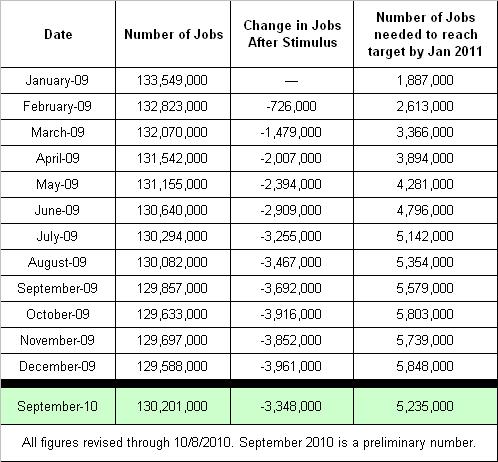
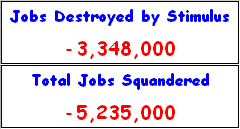
In addition to creating 22 millions jobs, the Chinese government claims to have helped 1.6 million businesses, and to have saved 60 million jobs. The Obama Administration’s stimulus plan was supposed to save 1,613,000 jobs in addition to creating 1,887,000 jobs, but since it actually resulted in the loss of 3,348,000 jobs, it will now take the creation of 5,235,000 jobs, by January of 2011, to reach the original target (reference).

Revised: Stimulus Job Tracker

Revised: Stimulus Jobs Created or Saved - Click to Enlarge

Multiple Choice Questions (choose one):

Who creates jobs in America?

A. Retired Persons
B. Working Persons
C. Businesses
D. None of the Above

When job creation is the goal, whom should an economic stimulus target?

A. Retired Persons
B. Working Persons
C. Businesses
D. None of the Above

How much longer will the American people stand for an arrogant and incompetent government?

Reference: China’s economic stimulus creates 22 million jobs

Minus 6.8 Million: Harry Reid’s Record on Jobs

Fired Up and Ready to Go

Reid’s Record on Jobs

*By: Larry Walker, Jr.*

Harry Reid says, “I think it is my job to create jobs and I’ve done my best.” Really? That was your best?

Harry Mason Reid is the senior United States Senator from Nevada and a member of the Democrat Party. He was first elected to the Senate in 1986, and was re-elected in 1992, 1998, and 2004, and is currently seeking a fifth term in 2010. Reid has served as the 24th Senate Majority Leader since January 4, 2007. Before his election to the Senate, Reid was a member of the United States House of Representatives, representing Nevada’s 1st congressional district from 1983 to 1987. Altogether, Reid has been a part of Washington D.C. for 28 years.

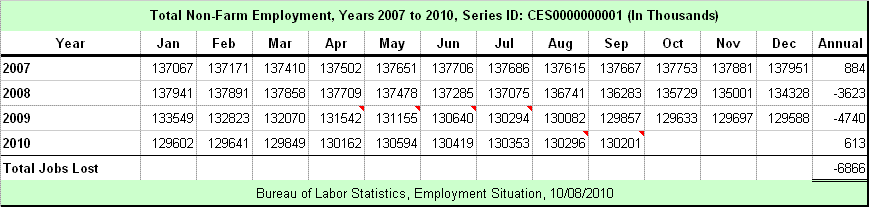
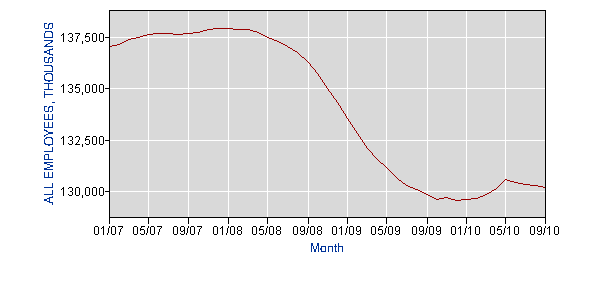
As far as Reid’s record on job creation, since the time he became the Senate Majority Leader our economy has shed 6.8 million jobs. Let’s check the record:

Total Non-Farm Employment 2007 to 2010

Total Non-Farm Employment 2007-2010 (click to enlarge)

Chart: Bureau of Labor Statistics through 10/8/10

Total Non-Farm Employment, 2007-2010

So Harry Reid thinks it’s his job to create jobs, and he says he’s done his best. And from the time Reid became the Senate Majority Leader, our economy has lost a total of 6,866,000 jobs. If job creation is Harry’s job, and that was the best he could do, then perhaps it’s time to hand over the keys.

Is job creation even part of a Senator’s job description?

During their October 14th debate, Sharron Angle answered, “Once again, Harry Reid: It’s not your job to create jobs.”

She continued, “I believe my job is to create the policies that will encourage the private sector to do what they do best.”

And then Angle hit the nail on the head, “We need to get back to work. The way we do that is by encouraging the private sector to do what they do best. Employers are in a cloud of uncertainty and they’re holding back $2 trillion that they would like to invest in jobs … They have lost confidence because of things like Obamacare.”

When Harry Reid loses on Tuesday, he will have effectively fired himself.

Addendum: Nancy Pelosi was sworn in as the 60th Speaker of the House at the same time that Reid became Senate Majority Leader, on January 4, 2007.

References:

http://www.cbsnews.com/8301-503544_162-20019697-503544.html

http://en.wikipedia.org/wiki/Harry_Reid

http://stats.bls.gov/webapps/legacy/cesbtab1.htm

Georgia’s Proposed Constitutional Amendments and Referendum

No on Amendments, Yes on Referendum [UPDATED]

By: Larry Walker, Jr.

Someone called me on Friday and asked for my opinion on Georgia’s proposed Constitutional Amendments and its statewide referendum. I told him that I had not yet formed an opinion but would be doing so over the weekend. Well, here it is.

No on Amendment 1 [PASSED – BOO!]

Allows competitive contracts to be enforced in Georgia courts.

“Shall the Constitution of Georgia be amended so as to make Georgia more economically competitive by authorizing legislation to uphold reasonable competitive agreements?”

What it means: The amendment addresses non-compete agreements that prohibit a former employee from doing the same job for a different company for some period of time after leaving the first company.

Why am I voting no? The state legislature passed a law in violation of the Georgia Constitution and is now pushing for a Constitutional Amendment to validate its mistake. My interpretation: Do you want more government regulation in the private sector? Hell no.

No on Amendment 2 [NOT PASSED – GOOD!]

Adds a $10 tag fee on private passenger vehicles to fund statewide trauma care expansion.

“Shall the Constitution of Georgia be amended so as to impose an annual $10.00 trauma charge on certain passenger motor vehicles in this state for the purpose of funding trauma care?”

What it means: An estimated $80 million a year would be raised from auto registration fees and would be constitutionally earmarked to stabilize and expand the state’s trauma care network.

Why am I voting no? Because, this is nothing more than a tax hike. I would rather see the legislature find ways to cut spending on other programs to fund trauma care. My interpretation: Do you want your taxes raised through a Constitutional amendment, since we are not able to raise them through normal legislation? Hell no.

No on Amendment 3 [NOT PASSED – GOOD!]

Allows the state to execute multiyear contracts for long-term transportation projects.

“Shall the Constitution of Georgia be amended so as to allow the Georgia Department of Transportation to enter into multiyear construction agreements without requiring appropriations in the current fiscal year for the total amount of payments that would be due under the entire agreement so as to reduce long-term construction costs paid by the state?”

What it means: It allows the Georgia DOT to resume its practice of spreading the cost of major, multi-million dollar road projects over a number of years. The constitution currently requires the state to have all the money in hand before a contract can be signed.

Why am I voting no? Because, this policy would allow the state to spend more money than it has. It virtually assures that additional tax hikes will be required in the future. Voting yes, would allow the state to spend more money than it has in its budget. My interpretation: Do you want the state to go into debt to fund transportation projects? Hell no.

No on Amendment 4 [PASSED – BOO!]

Allows the state to execute multiyear contracts for projects to improve energy efficiency and conservation.

“Shall the Constitution be amended so as to provide for guaranteed cost savings for the state by authorizing a state entity to enter into multiyear contracts which obligate state funds for energy efficiency or conservation improvement projects?”

What it means: This is essentially the same concept as Amendment 3, applied to projects that would retrofit state facilities with energy- or water-conservation systems.

Why am I voting no? Because, this policy would allow the state to spend more money than it has. It virtually assures that additional tax hikes will be required in the future. Voting yes, would allow the state to spend more money than it has in its budget. My interpretation: Do you want the state to go into debt to fund energy efficiency or conservation improvement projects? Hell no.

No on Amendment 5 [PASSED – BOO!]

Amendment 5 would allow owners of industrial zoned property to choose to remove industrial designation from their property.

“Shall the Constitution of Georgia be amended so as to allow the owners of real property located in industrial areas to remove the property from the industrial area?”

What it means: The amendment affects only specific industrial areas in Chatham and Jeff Davis counties that were created via statewide constitutional amendments.

Why I am voting no? I do not reside in either of the two affected counties. I could therefore care less. My interpretation: Do we need a Constitutional Amendment just to help out a few folks in two Georgia counties? Hell no.

Yes on Statewide Referendum [PASSED – YAAA!]

Provides for inventory of businesses to be exempt from state property tax.

“Shall the Act be approved which grants an exemption from state ad valorem taxation for inventory of a business?”

What it means: The referendum would eliminate the state levy on business personal property. The exemption would be on items such as inventory, furniture and fixtures, office supplies, and office equipment.

Why am I voting yes? Because, I have always felt that it was wrong for the state to charge businesses an annual tax on office furniture, office supplies, inventory and equipment, when the business had already paid sales tax on the same. My interpretation: Do you want to stop paying annual taxes on items that you have already paid sales tax on? Hell yes.

Tracking the 5.2 Million Jobs Obama Squandered

“We have a system that increasingly taxes work and subsidizes nonwork.” ~ Milton Friedman

 By: Larry Walker, Jr.

 “Tracking the 3.5 million jobs Obama will save or create.” That was the title of a blog post, last updated on January 8, 2010, on a website named Understanding The Market – Capire Il Mercato. In a note, the author, Cole Kendall stated, “I will make the calculations in a way that provides a “best case” to the Obama team.” Since Mr. Kendall decided to give up on his tracking operation at the end of 2009, I decided to finish it off.

Using the same criteria as originally outlined by Obama’s (now former) economic team, jobs are defined by counting the total non-farm employment, from Table B-1 of the Bureau of Labor Statistics, “Employment Situation Report” (seasonally adjusted).

Instead of boring you with the month-by-month 2010 data, I went ahead and cut to the chase, skipping from December of 2009, where Mr. Kendall left off, to September of 2010, the latest data available from the 10/08/2010 report.

Following is an excerpt from the original blog post, followed by the revised tracker, and a brief analysis:

In an earlier essay I tried to explain President Obama’s notion of saving or creating jobs. The stimulus plan bill was passed by both houses of Congress last night and the final plan was a bit smaller than the earlier version, so the President now asserts that the plan will save or create 3.5 million jobs.

This post will track the 3.5 million jobs. There are a number of ways to measure jobs in the US. Some people work several different jobs at a time while others change employers frequently, so measuring jobs is not as simple as it might seem. There was a cartoon from the Clinton era showing the President speaking at a dinner that he had created 8 million jobs and an overworked waiter thinking that he had three of them. Obama’s economic team define jobs as use the payroll data (see here for their original report).

Just before the stimulus bill passed the Department of Labor issued a report (see here). The number of people working (see Table B1, about 2/3 of the way down, with the heading “Establishment Data”) was 134,580,000 (seasonally adjusted). This is a preliminary measure and will be revised next month and probably revised again in a year. Using the Obama team methodology, without the stimulus bill employment would be expected to fall by around 1,613,000 jobs during the next two years so that without the stimulus bill we would expect employment to be 132,967,000 in January 2011.

With the revised estimate of 3,500,000 jobs “saved or created”, employment should be 136,467,000, creating 1,887,000 in addition to the 1,613,000 jobs saved.

The table below will be updated with every new employment release to see how jobs have changed. The first column is the actual number of payroll jobs starting with the month before the stimulus plan passed; the second column is the total change in employment since the month when the stimulus plan passed and the third column shows the gap remaining of jobs to be “created” in order to reach the target.

Revised: Stimulus Job Tracker

Revised: Stimulus Jobs Created or Saved - Click to Enlarge

The conclusion is pretty grim, and certainly doesn’t mesh with what Obama has been saying out on the campaign trail. The sad truth is that instead of creating 3.5 million jobs since the stimulus plan was passed, it has resulted in the loss of 3.3 million jobs. Since the stimulus plan was supposed to save 1,613,000 jobs in addition to creating 1,887,000 jobs, and since it actually resulted in the loss of 3,348,000 jobs, it would now take the creation of 5,235,000 jobs, by January of 2011, to reach the original target.

I don’t know what you call this, but I call it a failure. It’s so bad that most people simply stopped tracking it. So do we need another stimulus plan, or another Congress, Senate, and ultimately President? I don’t think it helps having Obama roam around the country making false claims in an effort to re-elect the same folks who screwed this up. The thought of $887 billion of deficit-financed spending flushed down the drain doesn’t bode well for those who supported it.

You can fool some of the people all of the time, and all of the people some of the time, but you can not fool all of the people all of the time. ~ Abraham Lincoln (R-IL)

Sources:

http://stats.bls.gov/news.release/empsit.t17.htm

http://stats.bls.gov/webapps/legacy/cesbtab1.htm

http://understandingthemarket.com/?p=63

Table B-1 Data: Total Non-Farm Employment (Seasonally Adjusted):

http://stats.bls.gov/webapps/legacy/cesbtab1.htm

BLS Table Revised 10/8/2010

Chart Per BLS 10/8/2010

National Debt: A National Disgrace

Shovel Ready Debt

Who drove us into this ditch, again?

*By: Larry Walker, Jr.* [updated]

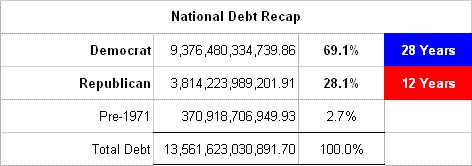
In the United States, the total debt outstanding as of September 30, 2010, stood at $13,561,623,030,891.70. It’s interesting to note that over the past 40 years, 69.1% of this debt is attributable to Democrat led congresses, and only 28.1% to Republicans. If we agree that the National Debt has reached the crisis level, then the question we must ask ourselves is, “Whom do I trust?” And before I go further, let me point out that I am neither a Republican nor a Democrat. I am a member of the Give Me The Damn Keys Back Party. No, actually I am a member of America’s Independent Party (AIP). Now, let’s check the record.

1971 to 1977 [Democrat Debt $249,514,293,050.07]

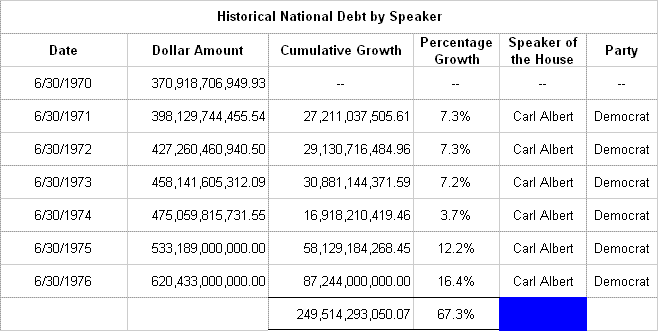
Carl Bert Albert represented Oklahoma’s 3rd congressional district as a Democrat for 30 years. He served as the 54th Speaker of the United States House of Representatives from 1971 to 1977. During his six-year term as Speaker, Mr. Albert added $249,514,293,050.07 to the national debt, which represented an increase of 67.3%.

1977 to 1987 [Democrat Debt $1,504,869,616,658.42]

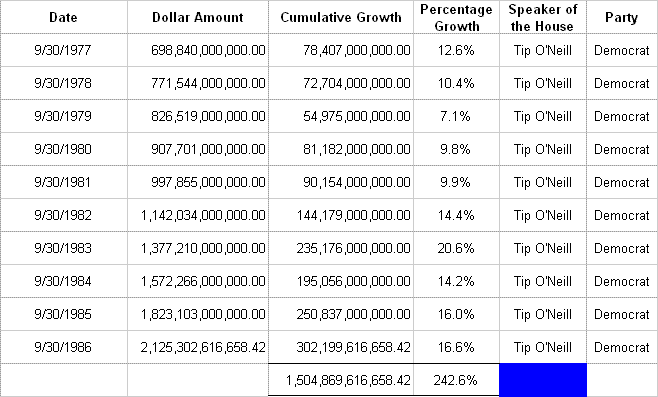
Thomas Phillip “Tip” O’Neill, Jr. represented the 8th and 11th congressional districts of Massachusetts as a Democrat for 34 years. He served as the 55th Speaker of the House from 1977 until his retirement in 1987, making him the second longest-serving Speaker in U.S. history. During his ten-year term as Speaker, Mr. O’Neill added $1,504,869,616,658.42 to the national debt, which represented an increase of 242.6%.

1987 to 1989 [Democrat Debt $732,128,343,528.90]

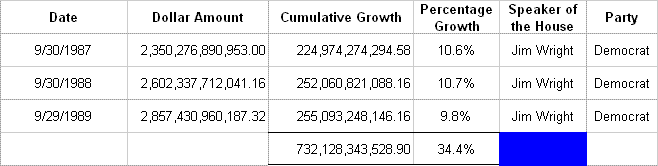
James Claude Wright, Jr., usually known as Jim Wright, represented the 12th congressional district of Texas as a Democrat for 34 years. He served as the 56th Speaker of the House from 1987 to 1989. During his three-year term, he added $732,128,343,528.90 to the national debt, which represented an increase of 34.4%.

1989 to 1995 [Democrat Debt $1,835,318,949,826.00]

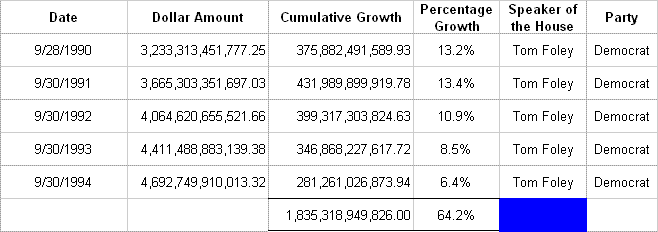
Thomas Stephen Foley represented Washington’s 5th congressional district as a Democrat for 30 years. He served as the 57th Speaker of the House from 1989 to 1995. During his five-year term as Speaker, Mr. Foley added $1,835,318,949,826.00 to the national debt, which represented an increase of 64.2%.

1995 to 1999 [Republican Debt $833,443,098,884.30]

Newton Leroy “Newt” Gingrich represented Georgia’s 6th congressional district as a Republican for 20 years. He served as the 58th Speaker of the House from 1995 to 1999, ending 40 years of the Democrat Party being in the majority. During his four-year term as Speaker, Mr. Gingrich added $833,443,098,884.30 to the national debt, which represented an increase of 17.8%.

1999 to 2007 [Republican Debt $2,980,780,890,317.61]

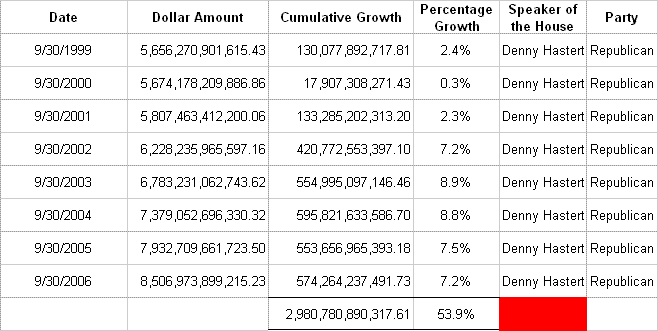
John Dennis “Denny” Hastert represented Illinois’s 14th congressional district as a Republican for 20 years. He served as the 59th Speaker of the House from 1999 to 2007. During his eight-year term as Speaker, Mr. Hastert added $2,980,780,890,317.61 to the national debt, which represented an increase of 53.9%.

2007 to 2010 [Democrat Debt $5,054,649,131,676.47]

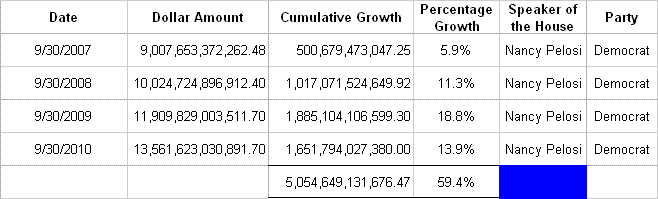
Nancy Patricia D’Alesandro Pelosi has represented California’s 8th congressional as a Democrat for 23 and one-half years. She has served as the 60th Speaker of the House since January 4, 2007. During her four-year term as Speaker, Mrs. Pelosi has added $5,054,649,131,676.47 to the national debt, which represents an increase of 59.4%.

Recap

Democrats have controlled the Congress for 28 of the last 40 years. Over this 40 year span, Democrat led congresses have added $9,376,480,334,739.86 to the national debt, which represents 69.1% of the total debt outstanding (as of 09/30/2010). In comparison, Republican led congresses have added $3,814,223,989,201.91 to the debt, which represents 28.1% of the total outstanding. In contrast, Nancy Pelosi is responsible for adding a grand total of $5,054,649,131,676.47, or 53.9% of the Democrats debt, and 37.3% of the total debt outstanding, in just four years.

During their 12 years of majority control, Republicans, Gingrich and Hastert added an annual average of $317,851,999,100.16 to the national debt. In contrast, in her short four-year term, Nancy Pelosi has added an annual average of $1,263,662,282,919.12. What Nancy Pelosi has done to this country in the last four years is nothing short of a national disgrace.

The question is which party do you trust to put a cap on our debt crisis: Democrat, Republican, or Independent?

Addendum: Harry Reid was sworn in as the 24th Senate Majority Leader at the same time that Pelosi became Speaker of the House, on January 4, 2007.

_______________

U.S. Constitution – Article 1 Section 7: “All bills for raising Revenue shall originate in the House of Representatives; but the Senate may propose or concur with Amendments as on other Bills.”

References:

http://www.treasurydirect.gov/govt/reports/pd/histdebt/histdebt.htm

http://en.wikipedia.org/wiki/Speaker_of_the_United_States_House_of_Representatives

MythBuster II: Has Obama Created More Jobs Than Bush?

Hmmm!

In Search of Private Sector Jobs

By: Larry Walker, Jr.

Without question, the majority of private sector jobs created in 2010 were created in the Service Sector. Understanding precisely where is quite revealing. After my last blog post, I received the following comments, from a blogger known as Patriot01: “Ever notice that they never say what KIND of jobs they’ve allegedly “created”? And I’d like an itemized list of the jobs “saved”………wouldn’t you?” Well, of course I would, wouldn’t you? Are you ready?

Education and Health Services

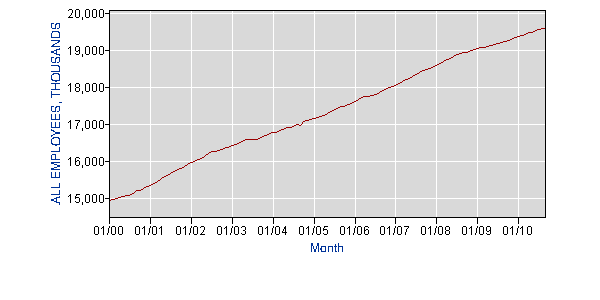
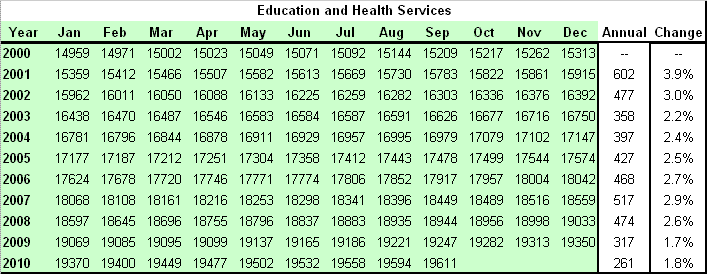
Drilling down into the numbers, we found that most of those jobs were created in the Education and Health Services sub-sector. Yet when we analyzed this sector, we found that job growth has been fairly constant, even throughout the recession. In fact, you can call this a recession proof sector (graph and table below).

Series Id: CES6500000001
Seasonally Adjusted
Super Sector: Education and health services
Industry: Education and health services
NAICS Code: –
Data Type: ALL EMPLOYEES, THOUSANDS

Education and Health Services

Under President Bush, job growth in this sub-sector averaged 465,000 jobs per year, even during the worst of the recession. So far under Obama, annual job growth in this sub-sector is averaging around 332,000. So although the industry has been virtually recession proof, the number of jobs created under Obama is on the decline.

Under President Bush a total of 3,720,000 jobs were added to this sub-sector during his eight-year term. And so far under Obama a total of 578,000 jobs have been created. In terms of percentages, during the Bush years the sub-sector grew at an average of 2.8% annually, while under Obama average job growth has cooled to 1.7%.

So does this look like anything remotely close to proof of the absurd statement that, “Obama created more jobs in 2010 than Bush did in eight years?” Not hardly. But there’s more.

Employment and Temporary Help Services

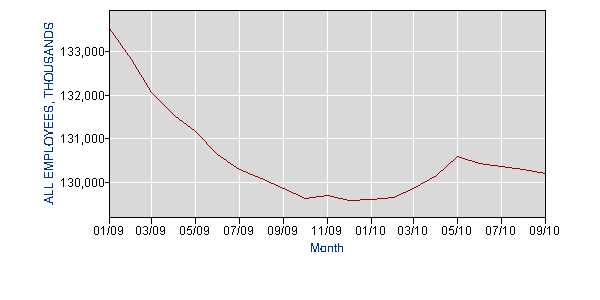
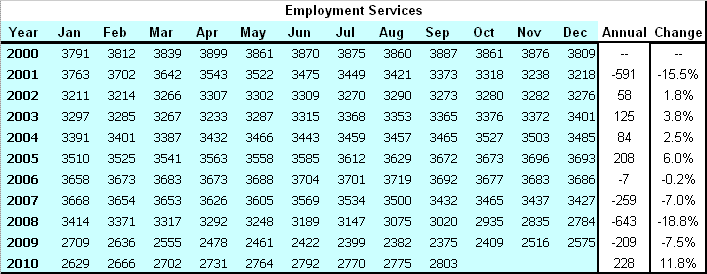
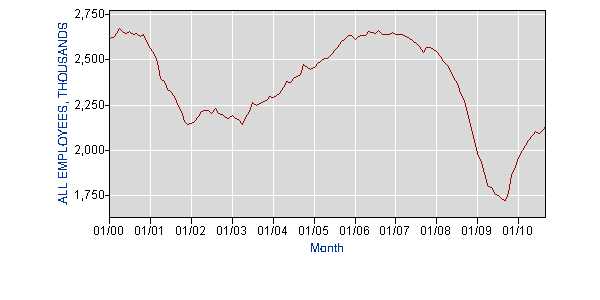
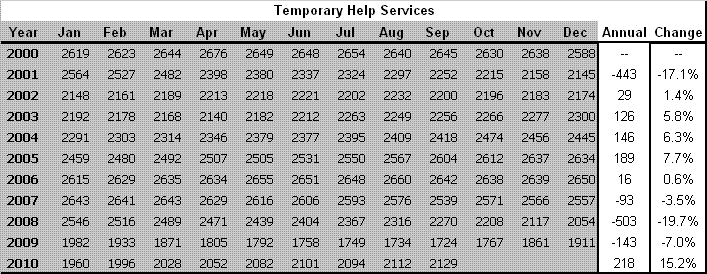
The other sub-sectors where we discovered job growth in 2010 were Employment Services, and more specifically Temporary Help Services. So far this year, we have recovered 228,000 jobs in Employment Services, and out of those, 218,000 were under the sub-category of Temporary Help Services (graphs and tables below). Add these to the 261,000 jobs created in the, recession proof, Education and Health Services sector, and together they account for 489,000 jobs “created” in the last nine months, or basically the whole enchilada.

Series Id: CES6056130001
Seasonally Adjusted
Super Sector: Professional and business services
Industry: Employment services
NAICS Code: 5613
Data Type: ALL EMPLOYEES, THOUSANDS

Employment Services

Series Id: CES6056132001
Seasonally Adjusted
Super Sector: Professional and business services
Industry: Temporary help services
NAICS Code: 56132
Data Type: ALL EMPLOYEES, THOUSANDS

Temporary Help Services

Busted Again!

So there it is, Obama’s greatest feat to-date is that he has managed to slow job growth in the Education and Health Services sector, which has always been recession proof; and he has only managed to recover jobs in the Temporary Help Services sub-sector. And this, his cohorts call a great success? Those of us who are rationally-minded beg to differ.

We wonder how long our economy can sustain itself through providing temporary job search services, especially when the type of jobs people want no longer exist. Meanwhile, our non-existent Goods-Producing sector has hemorrhaged 6,524,000 jobs over the last 10 years, and nothing is being done about it. Where are those jobs? In China.

Charts and Tables from the Bureau of Labor Statistics, Establishment Data, Table B-1 (here).

MythBuster: Has Obama Created More Jobs Than Bush?

Hmmm!

Rational or Ridiculous

by: Larry Walker, Jr.

So the latest spin by the left-wing media and the White House is to repeat the following mantra, “Obama created more jobs in 2010 than Bush did in eight years.” However, how much sense does it make to compare an arbitrary nine-month period for Obama to a full eight-year term? Well none, none at all, at least not within the realm of rational human thought. For those of us who are rationally-minded, we will begin with the month that Obama took office, and compare his full term to-date with whomever.

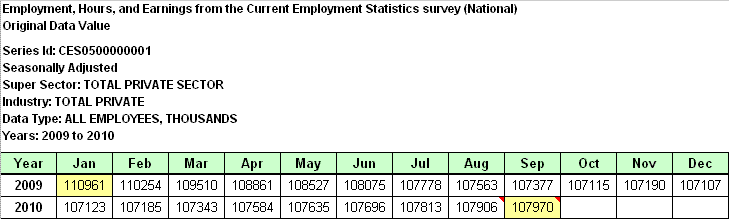
Turning to the Bureau of Labor Statistics (BLS), when we added up the total number of private sector jobs created during Obama’s short twenty one month tenure, we found that a total of 2,991,000 jobs had been lost (110,961,000 – 107,970,000). Oops!

Private Sector Jobs 2009/2010

Total Private Sector Employment (Bureau of Labor Statistics)

Private Sector Job Growth (Loss)

Busted!

Although I too could cherry-pick and find periods where private sector job growth was up by 4 or 5 million under Bush, I choose to remain among the rational. Needless to say, private sector job growth was at least slightly positive over Bush’s eight-year term, while under Obama, the words – worst track record in history – come to mind.

Is there no shame?

Also see: Tracking the 3.5 Million Jobs Obama Saved or Created and Deceptive Claim from Obama & The Democrats or Obama’s New Reality: Black Unemployment