Obsolete Government Programs, Part 1 | FICA

My Roots, circa 1918

“Free at last! Free at last! Thank God Almighty, we are free at last!” ~ MLK, Jr.

~ By: Larry Walker, Jr. ~

Are Social Security Benefits an Inalienable Right? ~

The Federal Insurance Contributions Act (FICA) is codified at Title 26, Subtitle C, Chapter 21 of the United States Code. The FICA tax is a United States payroll (or employment) tax imposed by the federal government on both employees and employers to fund Social Security and Medicare —federal programs that provide benefits for retirees, the disabled, and children of deceased workers. Social Security benefits include old-age, survivors, and disability insurance (OASDI); Medicare provides hospital insurance benefits. The amount that one pays in payroll taxes throughout one’s working career is indirectly tied to the social security benefits annuity that one receives as a retiree. Some folks claim that the payroll tax is not a tax because its collection is tied to a benefit. The United States Supreme Court decided in Flemming v. Nestor (1960) that no one has an accrued property right to benefits from Social Security. [1]

There has been a temptation throughout the program’s history for some people to suppose that their FICA payroll taxes entitle them to a benefit in a legal, contractual sense. That is to say, if a person makes FICA contributions over a number of years, Congress cannot, according to this reasoning, change the rules in such a way that deprives a contributor of a promised future benefit. Under this reasoning, benefits under Social Security could probably only be increased, never decreased, if the Act could be amended at all. Congress clearly had no such limitation in mind when crafting the law. Section 1104 of the 1935 Act, entitled “RESERVATION OF POWER,” specifically said: “The right to alter, amend, or repeal any provision of this Act is hereby reserved to the Congress.” Even so, some have thought that this reservation was in some way unconstitutional. This is the issue finally settled by Flemming v. Nestor. [1]

In this 1960 Supreme Court decision Nestor’s denial of benefits was upheld even though he had contributed to the program for 19 years and was already receiving benefits. Under a 1954 law, Social Security benefits were denied to persons deported for, among other things, having been a member of the Communist party. Accordingly, Mr. Nestor’s benefits were terminated. He appealed the termination arguing, among other claims, that promised Social Security benefits were a contract and that Congress could not renege on that contract. In its ruling, the Court rejected this argument and established the principle that entitlement to Social Security benefits is not a contractual right. [1]

So did you think that Social Security Benefits were an inalienable right? Think again.

Times Have Changed: Social Security is Obsolete

The Center on Budget and Policy Priorities states that three-quarters of taxpayers pay more in payroll taxes than they do in income taxes. The FICA tax is considered a regressive tax on income (with no standard deduction or personal exemption deduction) and is imposed (for the years 2009 and 2010) only on the first $106,800 of gross wages. The tax is not imposed on investment income (such as rents, interest and dividends). As a side note, the Earned Income Credit was enacted in 1975 to “offset the burden of social security taxes and to provide an incentive to work”. More recently the Making Work Pay Credit of 2010 and the 2% Payroll Tax Cut of 2011 were enacted with a redundant goal: “to offset the burden of social security taxes”. Why are Social Security taxes deemed to be so over-burdensome?

Perhaps Social Security has outlived its usefulness. In the 1930s, the New Deal introduced Social Security to rectify the following three problems: retirement, injury-induced disability, or congenital disability. It introduced the FICA tax as the means to pay for Social Security. Following are some of the difficulties that existed for working-class Americans prior to the Great Depression, countered with modern day private-sector innovations meant to address the same.

  • The U.S. had no federal-government-mandated retirement savings; consequently, for those people who had not voluntarily saved money throughout their working lives, the end of their work careers was the end of all income.

But times have changed. Prior to the Great Depression there weren’t many incentives in place to encourage saving towards retirement, nor were there as many options available as there are today. Nowadays employers, employees and the self-employed can choose between numerous retirement plans not limited to the following:

  1. Defined-Benefit Plans

  2. Defined-Contributions Plans

  3. 401(k) Plans

  4. 403(b) Plans

  5. Individual Retirement Accounts (IRAs)

  6. Roth IRAs

  7. Qualified Insurance Annuities

  8. Simplified Employee Pension’s (SEP)

  9. Savings Incentive Match Plan for Employees (SIMPLE)

This isn’t 1933 anymore. The time to end Social Security is now. Since we are able to choose between so many pre-tax options which result in the deferral of income taxes until the funds are withdrawn, why are we still stuck on pouring good money down a bad hole? By now, everyone knows that any surplus once heralded by the Social Security Trust Fund has been confiscated and comingled into the government’s general fund. And we all know that the government’s general fund is more than a whopping $14 trillion in the hole. If working folks and their employers weren’t chained by the bonds of mandatory contributions to Social Security we would be living on easy street.

If we were not forced to pay this mandatory tax of 6.2% (12.4% for the self-employed) on earned income up to the limit of $106,800, we would be able to save a greater portion of our own money into the modern retirement vehicles mentioned above. Loosing employers from burdensome payroll taxes will likewise allow them to provide a greater portion of benefits to employees. However, with government-run Social Security literally robbing us of our retirement savings, and ‘investing’ it in the abyss of debt and irresponsibility, known as Washington, DC, there is little leftover for most Americans to save. In fact, if every dollar of Social Security tax paid on my behalf since I began working had instead been invested in the S&P 500 Index; I would now be a millionaire. But since I haven’t had any choice in the matter, I may just have to settle for the paltry poverty level rations offered by Social Security. What’s worse is that thanks to Social Security, on the day that I die the government-squandered fruit of my labors will go with me.

  • The U.S. had no federal-government-mandated disability income insurance to provide for citizens disabled by injuries (of any kind—work-related or non-work-related); consequently, for most people, a disabling injury meant no more income (since most people had little to no income except earned income from work).

Nowadays, most employers offer mandatory and voluntary disability insurance plans through legitimate insurance companies. Likewise, all employers are required to provide Workers Compensation. Many of us would be able to afford our own portable disability insurance plans were we loosed from the bands of the FICA Act.

  • There was no federal-government-mandated disability income insurance to provide for people unable to ever work during their lives, such as anyone born with severe mental retardation.

Nor is there any such government-mandated disability income insurance today, the key word being insurance. Who in their right mind believes that the federal government provides insurance? If the federal government wants to provide real insurance for persons in need, then the responsible thing to do would be to pay for private-sector insurance policies, on behalf of those in need.

Social Security is an idea that has outlived its usefulness. It’s time for the United States to begin weaning itself off of Social Security. Let’s stop pretending that we are living in 1933. We have options in the 21st Century that didn’t exist in the 20th, but our options are severely constrained by the bonds of old stale ideas. Although it’s doubtful whether Social Security ever served its original purpose, it is indisputable that times have changed. In the 1930’s Americans had no safety net, today we know that we must provide for our own retirement security. However, the amount we are able to save is limited by the amount of money being confiscated from our earnings to cover past obligations. Get a clue. Three-quarters of all taxpayers pay more in payroll taxes than income taxes. Do you get it? It’s time for this to change. It’s time to phaseout Social Security. The age of federal government mandated retirement looting is over.

References:

[1] http://www.ssa.gov/history/nestor.html

http://en.wikipedia.org/wiki/Federal_Insurance_Contributions_Act_tax#cite_note-4

We Are All Billionaires Now

Big Words Small Mind

Tax Breaks for Millionaires and Billionaires ~

“But we cannot afford $1 trillion worth of tax cuts for every millionaire and billionaire in our society.” ~ Barack Obama

~ By: Larry Walker, Jr. ~

The Class Warfare Instigator in Chief (CWIC) has been railing against wealth. People who have saved up for retirement, or who were fortunate enough to acquire assets which have appreciated substantially are not impressed. Anyone with half a brain knows that a millionaire (or billionaire) is an individual whose net worth is equal to or exceeds one million (or one billion) units of currency. Net worth refers to an individual’s net economic position. It is calculated by adding the value of all of ones assets minus the value of all of their liabilities. Being a millionaire or billionaire has nothing to do with an individual’s annual taxable income. So when politicians, such as Obama, speak of tax breaks for millionaires and billionaires, do they even know what they’re talking about?

In the United States of America, we don’t pay income taxes based on the value of our net worth. We pay income taxes based on the amount of income earned or produced annually. So where exactly are these so called tax breaks for millionaires and billionaires? I contend that they don’t exist, namely because as I just stated; individuals are not taxed based on their net worth.

At the last count, there were just 412 billionaires in the United States. So the next time Obama refers to “billionaires”, it would be more appropriate for him to refer to them as “the 412 billionaires”. When one studies the IRS’ Statistics of Income reports, the top 400 annual incomes reported on tax returns in 2007 averaged just under $138 million, far short of a billion. Word twisting politicians, namely Obama, would have us believe that there are people making billions of dollars per year, but that’s simply not true. In reality, only 400 households were fortunate enough to report average annual incomes of around $138 million. And as stated, only 412 Americans have a net worth of over a billion dollars. According to the Spectrum Group there were 7.8 million millionaires in the United States in 2009. However, according to a Taylor Nelson Sofres report, half of all millionaire households in the US are headed by retirees.

Good luck to Democrats in first identifying tax breaks that benefit people with net worth’s of over $1 million (or $1 billion). They don’t exist. And secondly, since more than half of millionaire households are headed by retirees, most likely the only taxable income they receive is from pensions and investment income (a healthy chunk of that being tax-exempt). So does Obama want to raise taxes on grandpa? You mean to say that when people work hard all their lives and save up more than a million dollars for retirement, now that they have become millionaires they are evil and deserve to pay higher taxes? Get out of town, literally.

So is Obama talking about increasing taxes on investment income? Is he talking about doing away with tax-exempt interest? Does he want to get rid of the favorable capital gains rates? Does he intend to impose a tax based on unearned income (the amount of equity a citizen has in assets on a given date)? Or is he talking about re-imposing confiscatory death taxes? Say what you mean, and mean what you say, otherwise shut the hell up. It’s time to stop inciting envy, strife and class-warfare. On the other hand, if all Obama is trying to say, and rather poorly, is that he wants to lower the top tax bracket down to $250,000 and raise marginal tax rates to 39.6% above that amount (i.e. return to the 1993 tax rate schedules), then he should just continue to say that like a broken record until his demise.

I think I understand what Obama is really saying. What he’s saying to me is that since $250,000 is to $1 billion as $25,000 is to $100 million, if you make $25,000 per year, you’re a billionaire. Got it? That seems to be how Obama, sleepy Joe, and the 143 Democrats in Congress see it. With 535 members of Congress, and only 143 of them Democrats, how are they controlling this conversation anyway? After all, there are 311,174,158 citizens, only 412 billionaires, 7.8 million millionaires, and a mere 145 delusional Democrats in DC. Perhaps one of these 145 simpletons can list for the public all of the alleged tax breaks for millionaires and billionaires. I will attempt to identify a few of them presently.

Alternative Minimum Tax (reference)

The Alternative Minimum Tax attempts to ensure that anyone who benefits from certain tax advantages pays at least a minimum amount of tax. The AMT provides an alternative set of rules for calculating your income tax. In general, these rules should determine the minimum amount of tax that someone with your income should be required to pay. If your regular tax falls below this minimum, you have to make up the difference by paying alternative minimum tax.

Tax laws provide tax benefits for certain kinds of income and allow special deductions and credits for certain expenses. These benefits can drastically reduce some taxpayers’ tax obligations. Congress created the AMT in 1969, targeting higher-income taxpayers who could claim so many deductions they owed little or no income tax. Because the AMT is not indexed for inflation, a growing number of middle-income taxpayers are discovering they are subject to the AMT.

You may have to pay the AMT if your taxable income for regular tax purposes plus any adjustments and preference items that apply to you are more than the AMT exemption amount.

The AMT exemption amounts are set by law for each filing status. For tax year 2010, Congress raised the AMT exemption amounts to the following levels:

  • $72,450 for a married couple filing a joint return and qualifying widows and widowers;

  • $47,450 for singles and heads of household;

  • $36,225 for a married person filing separately.

  • The minimum AMT exemption amount for a child whose unearned income is taxed at the parents’ tax rate has increased to $6,700 for 2010.

Do the AMT exemption amounts (above) look like they’re targeting millionaires and billionaires to you? It doesn’t look that way to me. Not unless, like I said from the beginning, “we are all billionaires”. So just what kind of items can trigger the AMT? Here are a few.

Personal Exemptions – What? Believe it or not, personal exemptions contribute to AMT liability. The exemptions you claim for yourself, your spouse and your dependents are not allowed when calculating alternative minimum tax. It’s pretty rare (though not impossible) to see a tax return where someone had to pay AMT solely because of their exemptions, but the more exemptions you claim, the more likely it is that you’ll have AMT liability.

Standard Deduction – What? Some 70% of American taxpayers claim the standard deduction (rather than itemizing). The standard deduction isn’t allowed under the AMT. Usually this isn’t a problem because the AMT generally hits people with higher incomes, and these people are more likely to claim itemized deductions. Yet it’s worth noting that a deduction that’s so widely used can contribute to AMT liability.

State and Local Taxes – What? If you itemize, there’s a good chance you claim a deduction for state and local tax, including property tax, income tax and sales tax. These deductions are not allowed under the AMT. If you live in a place where state and local taxes are high, you’re more likely to be subject to the alternative minimum tax.

Interest on Second Mortgages – The AMT allows a deduction for interest on mortgage borrowings used to buy, build or improve your home. If you borrowed against your home for some other purpose, the interest deduction isn’t allowed under the alternative minimum tax.

Medical Expenses – The AMT allows a medical expense deduction, but it’s more limited than the deduction under the regular income tax. If you claim an itemized deduction for medical expenses, part or all of it will be disallowed when you calculate your alternative minimum tax.

Miscellaneous Itemized Deductions – Certain itemized deductions are available if your total deductions in this general category add up to more than 2% of your adjusted gross income. Among the items here are unreimbursed employee expenses, tax preparation fees and many investment expenses. You can’t deduct these items under the AMT, though. A large deduction in this category could lead you to pay alternative minimum tax.

Various Credits – Some of the credits that are allowed when you calculate your regular income tax aren’t allowed when you calculate your AMT. The more credits you claim, the more likely it is that you’ll end up paying alternative minimum tax. Fortunately, Congress has extended relief for the “personal credits” in recent years.

Well, the AMT certainly doesn’t constitute a tax break for millionaires and billionaires. Heck, we’ve barely breached the $75,000 mark if married ($50,000 if single) and most of the main tax breaks have already dissipated. Next!

Retirement Contributions Credit Limitation (reference)

You may be eligible for a tax credit if you make contributions to an employer-sponsored retirement plan or to an individual retirement arrangement. If you make eligible contributions to a qualified IRA, 401(k) and certain other retirement plans, you may be able to take a credit of up to $1,000 or up to $2,000 if filing jointly. The credit is a percentage of the qualifying contribution amount, with the highest rate for taxpayers with the least income. However, income limits apply to individuals with a filing status and income of the following amounts:

  • Single, married filing separately, or qualifying widow(er), with income up to $27,750

  • Head of Household with income up to $41,625

  • Married Filing Jointly, with incomes up to $55,500

So if you’re single and make more than $27,750 you can forget about this tax credit. It doesn’t appear that we’ve tapped into those elusive tax breaks for millionaires and billionaires yet. So let’s try again.

Earned Income Tax Credit Limitation (reference)

The Earned Income Tax Credit or the EITC is a refundable federal income tax credit for low to moderate income working individuals and families. Congress originally approved the tax credit legislation in 1975 in part to offset the burden of social security taxes and to provide an incentive to work. When EITC exceeds the amount of taxes owed, it results in a tax refund to those who claim and qualify for the credit.

Tax Year 2010 maximum credit:

  • $5,666 with three or more qualifying children

  • $5,036 with two qualifying children

  • $3,050 with one qualifying child

  • $457 with no qualifying children

Earned Income and adjusted gross income (AGI) must each be less than:

  • $43,352 ($48,362 married filing jointly) with three or more qualifying children

  • $40,363 ($45,373 married filing jointly) with two qualifying children

  • $35,535 ($40,545 married filing jointly) with one qualifying child

  • $13,460 ($18,470 married filing jointly) with no qualifying children

  • Investment income must be $3,100 or less for the year.

So much for tax breaks for millionaires and billionaires. There don’t appear to be many real breaks for folks making even $50,000 per year. Shall we try again?

Mortgage Interest Limitation (reference)

Interest deductions on home mortgages are limited. The law allows taxpayers to deduct interest on two categories of indebtedness secured by their residences. Acquisition indebtedness is used to acquire, construct, or substantially improve a residence, and cannot exceed $1,000,000. Home equity indebtedness is any debt other than acquisition indebtedness and cannot exceed $100,000.

So if you are lucky enough to be able to borrow more than $1 million on a mortgage, you cannot deduct any mortgage interest for the amount above $1 million. And if you have a home equity loan of more than $100,000, the amount of interest you can deduct is not allowed for the amount above $100,000. This doesn’t look like a tax break for millionaires and billionaires either. Surely there must be a humongous tax break for rich folks with children.

Child Tax Credit Limitation (reference)

The Child Tax Credit is for people who have a qualifying child under the age of 17. It is in addition to the earned income credit, if you even qualify for that. The maximum amount you can claim for the credit is $1,000 for each qualifying child. However, you must reduce your child tax credit if your modified adjusted gross income (AGI) is above the amount shown below for your filing status.

  • Married filing jointly – $110,000.

  • Single, head of household, or qualifying widow(er) – $75,000.

  • Married filing separately – $55,000.

So if you’re married with children and have income of more than $110,000, you don’t get the full $1,000 child tax credit. Oh well, this isn’t a tax break for so called millionaires and billionaires. Maybe if you borrow a ton of money to invest in a graduate degree you’ll get a huge tax break.

Student Loan Interest Limitation (reference)

You can claim up to $2,500 of student loan interest you paid as an above-the-line tax deduction on Form 1040. What? Does the government even have any idea that some people are paying upwards of $4,000 – $10,000 in student loan interest per year? And do they understand that an above-the-line tax deduction on $2,500 can at the most save an individual or couple 25-28% of the maximum amount? So if you’re married and pay $7,000 in student loan interest, you’ll receive a tax break amounting to between $250 and $700 depending on your tax bracket.

But if your income is too high, you won’t get any break at all. You can take this deduction only if your modified adjusted gross income (AGI) is less than: $75,000 if single, head of household, or qualifying widow(er); or $150,000 if married filing jointly. Oh well, we could go on and on, but so much for that theory.

Conclusion

No one pays income tax based on their net worth. We pay income taxes based on the amount of income we earn or produce each year. The simplistic act of raising the top marginal tax rate from 35% to 39.6%, and lowering the top tax bracket down to $250,000 won’t bring in an extra dime from millionaires and billionaires. Although it will take some money out of the pockets of small businesses, families and other hard working Americans, it will leave true millionaires and billionaires unscathed. There’s a dearth of tax breaks for anyone making more than $75,000 per year, and marginal tax rates are already way too high across the board, so Obama’s comments are simply absurd. Perhaps one of the other 144 Democrat Party simpletons in DC can list for us all of the alleged tax breaks for millionaires and billionaires. But until then, I’m going to have to ask you to muzzle it. Otherwise, prepare to give up your remaining 145 seats.

It’s not the 412 billionaires that worry me; it’s the federal government, $14 trillion in debt, with its hand in my pocket. That makes me queasy.

PUBLIC-sector Union Fallacy II | Capitalizing on Ignorance

Union Lap Dogs

“Before making a donation to any organization, be sure to review how it spends its money.”

~ By: Larry Walker, Jr. ~

The American Federation of Teachers, AFL-CIO of Madison, Wisconsin (AFT-WISC) is a tax exempt organization which is primarily funded by union dues paid by its mostly state and local government employee members. In the fiscal year ended June 30, 2009, AFT-WISC took in 91.5% of its revenue or a total of $3,358,143 from membership dues. On its latest Form 990, Return of Organization Exempt from Income Tax, while all of the revenue reported was identified as having been related to its exempt purpose, none of its expenditures were reported as such. So just how much of this money was actually used to improve the lives of its members?

According to page 10 of its latest Form 990 tax return, none of the $3,808,451 of expenditures was related to its exempt purpose. In fact, AFT-WISC spent $2,369,114, or 70.5% of member’s dues, on salaries, pensions, other benefits and payroll taxes for its 44 employees. Furthermore, due to reckless management, AFT-WISC posted a net loss of $(137,113) for fiscal year 2009. Union dues will therefore most likely increase in the near future.

In fiscal year 2009, AFT-WISC paid its president, Bryan Kennedy, total compensation of $164,781. The only problem with this is that he was only paid $56,913 in fiscal year 2008, leaving some to wonder what would justify a 190% pay raise in a year when the organization suffered a net loss. While Mr. Kennedy celebrated a $107,868 pay hike, AFT-WISC members were left bloodied by a $(137,113) net loss.

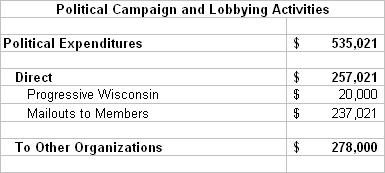
Aside from compensating its own employees, AFT-WISC squandered a total of $535,021 on political campaigns and lobbying activities. Among these activities, $20,000 was contributed to Progressive Wisconsin; $237,021 was spent on mailings containing information about legislative and electoral issues, and get out the vote events such as town hall meetings and phone banks; and the remaining $278,000 was sent to other organizations.

It appears that the difference between this particular union and a political party is very slim. Other than communicating a tiny bit of information to the public about issues affecting its members, AFT-WISC’s main accomplishments appear to be: (1) an ability to collect money from its members, (2) to compensate its own employees, (3) to support progressive organizations, (4) and to persuade people to vote for the candidates of its choosing. AFT-WISC, like most other public-sector employee unions, functions more like a political party than an association dedicated to the needs and concerns of its members. Teachers and public employees are free to join the political party of their choosing, and to direct their money to whomever they choose. So why do they need a middle-man? Public employees should be ashamed. Substituting a middle-man to make political choices for them is the antithesis of freedom and democracy.

Perhaps instead of jumping through hoops whenever the union bell tolls, teachers and other public servants should pay more attention to where their union dues are going. Then and only then will the rest of society believe you are more than just feeble lap dogs. As for the American Federation of Teachers, AFL-CIO of Madison, Wisconsin… it’s “Not Just No, But HELL NO!”

Reference:

http://www2.guidestar.org/organizations/39-0963086/american-federation-teachers.aspx#

PUBLIC-sector Union Fallacy I

Union Nazis

Where Solidarity Ends

~ By: Larry Walker, Jr. ~

Thank God for Governor Walker and the Wisconsin legislature. Clearly there is a line of demarcation between the rights of public-sector and private-sector workers. Patrick J. Wright, a director of the Mackinac Center Legal Foundation, breaks it down in his latest post, Public-Sector Bargaining Privileges Are Not Inalienable Rights.

Mr. Wright concludes with, “the power of government employee unions in collective bargaining necessarily amounts to power over the people themselves, therefore the people’s representatives must periodically scrutinize that power and curb excess. Why that’s pure natural law, and if you stop to think about it, just plain old common sense. But perhaps public-sector union donors and their supporting dunderheads need a less sophisticated explanation. What follows is an uncomplicated lesson in fiscal logic, just for you:

Point #1 – If you work for a state, local or federal government agency, and your employer’s treasury is tapped, you are most likely a part of the problem. Job security eludes you.

Point #2 – If you’re going around spouting off that a certain governmental entity isn’t broke, and you’re not one of its top executives, then you might not know what in the hell you’re talking about. Your beliefs are based on conspiracy, not facts.

Point #3 – If you have a government job paying 40% more than the private sector, with Cadillac benefits, then you’re not likely one who’s losing their home and going through financial hell. You’ve been brainwashed.

Point #4 – If you’re having $1,000 per year in union dues deducted automatically from your paycheck and sent to your government masters (politicians), and now complain about having to pay more toward pension and health costs, you might be better off dumping that worthless union. Perhaps union dues are a luxury you can ill afford.

Point #5 – If you think that private citizens exercising their right to trim some of the liberties that government workers take with their money is a form of class warfare, then which class are you – government or the people? You’re confused.

Point #6 – If you think that the way to effectively engage in political debate is by marching in mobs and shouting in unison, “shame, shame, shame…,” you might be mentally ill. You need a check up from the neck up.

To summarize, if you are still offended by the law that was just passed in Wisconsin, then :

  • Job security eludes you,

  • Your beliefs are based on conspiracy rather than facts,

  • You’ve been brainwashed,

  • Union dues are a luxury you can ill afford,

  • You are confused, and

  • You need a mental health check up.

Well, if that’s the case, then you better check yourself before you wreck yourself. If the glove fits, you must admit. My recommendation: Quit that cushy government gig and get a real job. And as far as private-sector unions supporting public-sector unions in so-called solidarity; can you say, “brainwashed“. Sorry but I can’t ride with you on that bucket of bolts. Sometimes you just have to surrender and face reality. Public-sector unions are the enemy of both private-sector unions, and of we the people.

Public sector – The area of the nation’s affairs under governmental rather than private control.

Private sector – The area of the nation’s economy under private rather than governmental control.  

References:

http://supreme.justia.com/us/431/209/case.html

http://www.mackinac.org/14734

http://www.mackinac.org/13741

Vaporizing PUBLIC Employee Unions

Ray-Gun

Hasta La Vista!!!

” Wisconsin is not broke. “ ~ Some Rich Fat Guy ~

Whatever rich fat guy, but who asked you anyway. The election is over. You lose, we win.

~ By: Larry Walker, Jr. ~

While state and local government employee unions (aka. public unions) clutch desperately to what they falsely perceive to be a God-given right to organize, pro football players are planning to de-unionize. You see, the National Football League Players Association (NFLPA) has legal options under federal law, while state and local government workers have none. Public workers exist to serve the public, and are compensated from tax dollars, not from profits earned in the private sector.

“The National Labor Relations Act or Wagner Act (P.L. 74-198, 49 Stat. 449, codified as amended at 29 U.S.C. § 151–169) is a 1935 United States federal law that limits the means with which employers may react to workers in the private sector who create labor unions, engage in collective bargaining, and take part in strikes and other forms of concerted activity in support of their demands. The Act does not apply to workers who are covered by the Railway Labor Act, agricultural employees, domestic employees, supervisors, federal, state or local government workers, independent contractors and some close relatives of individual employers.”

As for NFL players, decertifying the union means firing the NFLPA as their bargaining agent, which will prevent NFL owners from locking out the players when the existing collective bargaining agreement expires. Any lockout at that point would be a violation of federal antitrust law. Decertifying will also allow individual players to sue the NFL and their respective teams. The tactic has worked before, resulting in NFL players gaining free agent rights.

On the other hand, state and local government servants in Wisconsin and other states don’t have this option or any others. You see, public servants are not covered by federal labor relations laws. They have only been allowed to unionize under state laws granting them make-believe rights. In reality, all it would take to completely do away with public employee unions is a determined state house majority, duly elected by a base of overburdened taxpayers. And that’s where things stand. Hasta la vista!

AFTER HAVING DONE ALL STAND! ~ Eph 6:10-20

BTW: The word fat was directed at Moore in the sense of his reasoning being “practically nonexistent” (i.e. a fat chance).

Public Union Membership in Numbers

Eating Dots

~ By: Larry Walker, Jr. ~

In terms of raw numbers, local government union members stand to be crushed, or perhaps just eaten. There are roughly 14 million unemployed Americans who would love to have local government service jobs, minus collective bargaining. Perhaps the media should poll the unemployed. The bottom line is that it’s better to be gainfully employed than unemployed. Advice to local government employed union members: Work with your duly elected government officials, or kiss your jobs goodbye.

Out of 124 million Americans who are still employed (excluding the incorporated self-employed), only 14.7 million (or 11.9%) are members of unions.

Total Non-Union vs. Union Employees

Out of the 14.7 million union members, 7.6 million (or a majority of 51.8%) are government employees.

Government Sector Union Members

Out of the 7.6 million government employees who are members of unions, 4.7 million (or a majority of 61.3%) are local government employees, while 1.9 million (or 25.8%) are state government employees.

State & Local Government Union Members

Out of 124 million Americans who are still employed (excluding the incorporated self-employed), only 4.7 million (or just 3.8%) are local government employed union members.

Local Government Union Members

In terms of numbers, local government employed union members, those who are complaining the most, only represent 3.8% of all American workers (excluding the incorporated self-employed), 3.0% of the roughly 151 million American taxpayers, and 1.5% of the total population. We believe there is more empathy among Americans for the 9.0% of the labor force who are unemployed, and the millions more who have dropped out of the workforce, than there is for local government employed union members. In other words, the pink slips are in the mail.

“Every goodbye makes the next hello closer.” ~ Anonymous Unemployed

Related: Union Label : Owned by China & Liberty VS Union Power

Reference: U.S. Bureau of Labor Statistics

Table 3. Union affiliation of employed wage and salary workers by occupation and industry (Jan. 21, 2011 Report)

Table 3. Union affiliation of employed wage and salary workers by occupation and industry (Historical Data)

Union Label | Owned by China

Owned by China

When ‘Made In China’ Isn’t Enough ~

“Every once and awhile you need to get out on the streets and get a little bloody when necessary.” ~ Rep. Mike Capuano (D-Ma.) ~

Made in China wasn’t enough, now union minions want to be owned by China as well. ~

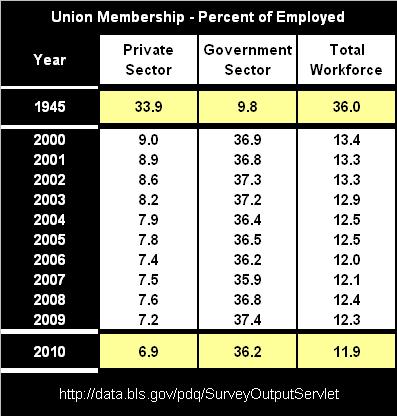
So far all I see is a bunch of snot-nosed, deficit-financed, government employed, union slugs spewing nonsense, but not one drop of blood. Hey union guys, this isn’t 1945, except maybe in terms of the National Debt. Back in the day, American unions used to fight so-called greedy capitalists for higher pay, greater benefits, and better working conditions, but that was then, and this is now. Today, almost all union members are government employees. What’s up with that? Who are these guys fighting against? Can American taxpayers who pay your salaries really be equated to the so-called ‘robber barons’ of the past? I don’t think so. Most of us are just fighting for survival. By us, I mean the other 88.1% of the workforce who are not union members. When a small minority (11.9% of loud-mouthed, snot-nosed, whiny, union cry babies) can impose its will upon the majority (88.1% of responsible, hard-working, non-union juiced, taxpayers) – that’ll be the day. Good luck with that fight.

Back in 1945, almost 36% of American workers were represented by unions, but according to the U.S. Bureau of Labor Statistics, that number had dwindled to just 11.9% by the end of 2010. Although there has been a noted increase in the number of public employee unions since the 1960s, the decline in private-sector union membership has been most telling. If union membership was worth its weight in dues, then most of the goods that America purchases today wouldn’t be stamped “Made in China”.

Union Membership Plummets

At the height of union popularity in the 1940s, only about 9.8% of government slugs were represented by unions, versus 33.9% of private sector workers. However, by the end of 2010, those proportions had flipped. Today 36.2% of public workers are represented by unions while private sector union membership has plummeted to a mere 6.9%. The U.S. Bureau of Labor Statistics most recent survey indicates that union membership in the U.S. has fallen to just 11.9% of the total workforce.

I’m sorry, but all of you public union slugs need to shut the hell up and accept what we decide. We don’t work for you; you work for us.

References:

Obamarail | The Bullet Train to Bankruptcy

Train Wreck at Eschede

Or death, whichever comes first

– By: Larry Walker, Jr. –

From January through November of 2010, the Federal Railroad Administration received some 8,050 reports of injuries and deaths among railroad workers, rail passengers and people crossing tracks in vehicles or on foot. Yet, while several Republican governors (namely Scott Walker of Wisconsin and John Kasich of Ohio) have turned their backs on Obama’s irrationally exuberant spending binge, including his envisioned high-speed rail system, Transportation Secretary Ray LaHood said the administration would press forward in a “patchwork fashion” if necessary. In other words – Safety, Supply and Demand, and Cost-Benefit be damned. Who cares what the citizens or governors want; LaHood, Biden and Obama know what’s best for all of us, right? I know, I know, “we can’t afford not to spend money that we don’t have.” Yeah, whatever!

Rail Safety?

As stated above, during the first eleven months of 2010 there were 8,050 reports of injuries and deaths among railroad workers, rail passengers and people crossing tracks in vehicles or on foot. So in an effort to improve safety, the federal government is proposing to increase rail speeds from 60 to 80 miles per hour, to speeds of more than 200 mph. If it takes a 100 car freight train travelling 55 miles per hour over 1 mile to stop, one can only imagine how long it takes a passenger train travelling over 200 mph.

In the famous Eschede rail disaster (pictured above), the train was only travelling at 125 mph, yet by the time a passenger was able to report that a wheel had fallen off, within seconds the train derailed leaving 101 persons dead and 88 injured. You may find a detailed listing of pre-1950 through January-2011 railroad accidents here. It appears that instead of addressing the current dilemma, the administration has once again taken the high road to solving imagined 23rd Century problems.

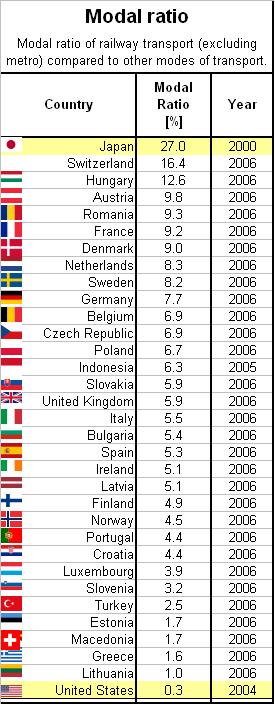
Modal Ratio - click to enlarge

Demand / Benefit

Rail usage statistics reflect not only the “popularity” of rail travel (for example, in Japan) but also the geography of the country. “For instance, the United Kingdom is a relatively small, densely populated country where many more short journeys are made compared to a larger, much less densely populated country such as the United States. To gauge the true importance of rail travel, the number of journeys (however short or long) needs to be calculated.

By this method one finds that the number of intercity rail journeys per year in the United States per inhabitant is so small as to be almost immeasurable. The U.S. figure is approximately 0.08 journeys per inhabitant per year, compared with the United Kingdom’s figure of 17.54 journeys per person. These statistics imply that Britons use the train 219 times more than Americans.

So while perhaps high-speed rail would be important in counties like China, Japan, and the United Kingdom it will have very little impact in the United States. In other words, there is very little demand for intercity rail transportation in the U.S., in spite of the administration’s delusional scheme. Where I come from, that’s not exactly a smart strategy.

Investing any money in any venture which lacks enough demand to recover said investment, along with a reasonable profit, is just plain foolish. While the U.S. has a population of roughly 305,000,000, the National Association of Railroad Passengers (NARP), a Washington, DC based lobbyist, can only boast in membership of approximately 23,500, representing a whopping 0.0077% of Americans.

—————–

Supply / Cost

According to a May 2009 report in the Business Insider, a true national high-speed rail network would cost more than $500 billion. California is attempting to build a true high-speed rail line between San Francisco and Los Angeles capable of top speeds of 220 miles per hour and average speeds of 140 miles per hour. The environmental analysis report for the California high-speed rail had projected costs of $33 billion for just 400 miles. Meanwhile, the Midwest Rail Initiative had projected costs of $7.7 billion for 3,150 miles of moderate-speed rail. That’s $82 million per mile for true high-speed rail (partly because the California project goes through some mountains) and only $2.4 million for moderate-speed rail.

All things being equal, high-speed rail will cost 10 to 12 times more than moderate-speed rail. Knowing this, the administration’s idea is to press forward in a “patchwork fashion” (i.e. Spend $53 billion here and there to get it started, and then beg for more cash every year). I guess it would be nice if we had an extra $500 billion to burn, and even nicer if there was any real demand to support the plot. But, maybe there’s a way to make this all work out after all.

Mandatory Ridership

Perhaps like Obamacare, Obamarail could be funded by requiring every citizen to purchase a ‘mandatory’ seasonal rail pass. The government could even implement another “cash for clunkers” program, but this time when you bring in the old gas-guzzler for crushing, you get a discount on season rail passes. And if you are uncooperative, refusing to participate in the government’s mandatory rail program, you would pay a tax (but they would just call it a penalty). The government could even make the case that mandatory rail travel is covered under the Commerce Clause, because unless everyone buys a ticket, travel by high-speed rail would be cost prohibitive for the 0.0077% who really need to ride.

The IRS could then be called upon to implement the enforcement portion by requiring that a unique national rail ticket number be entered on everyone’s income tax return. And to put the icing on the cake, the CBO could make wildly unsubstantiated claims about how Obamarail will save the nation trillions of dollars over the next century, or some nonsense. Yeah, well, I have an idea about how to save trillions of dollars in the future too. My idea involves not squandering the next $53 billion in present value dollars – today, but as stated above, “who cares what the citizens want”.

The Bullet Train to Nowhere

When this despotic patchwork is complete, only then will we know whether it worked, but first, we have to squander $500 billion on Obamarail in order to find out. Imagine a nation where workers are able to take ‘shovel ready jobs’ hundreds of miles from home, to return once or twice per year via high-cost, oops, I mean high-speed rail, and you have China. The contention is that $53 billion is such a small price to pay for another patchwork adventure in government-side economics. In government-side economics, if the square peg doesn’t fit, then you hit it with a hammer, right? And if it still doesn’t work, then you simply go out on the campaign trail and convince everyone that it did.

In spite of having over-spent by more than $3 trillion during the past two years, they surmise that their only failure was not having spent enough. Do you suppose that if the federal government borrowed and spent another $3 trillion it would do the trick? ‘Maybe next time it will be different! I mean, it’s not like the nation has a fiscal problem or anything.’ Face it, this isn’t supply-side economics, and it’s definitely not demand-side, so that leaves only one possibility; it’s a government-run bullet train to nowhere.

This doesn’t sound like ‘winning the future’ to me. It sounds more like a bullet train to bankruptcy, or better yet, like ‘losing your future’. I mean the one in the near-term, in November of 2012. Are you ready for another shellacking?

Other References:

http://safetydata.fra.dot.gov/OfficeofSafety/publicsite/on_the_fly_download.aspx

http://articles.baltimoresun.com/2011-02-09/features/bs-md-lahood-transportation-20110209_1_high-speed-rail-high-speed-train-plan-east-west-light-rail

Keepin’ It Real: Jobs Lost or Squandered

Experiments After Sputnik

Stimulus: Failure to Launch

– By: Larry Walker, Jr. –

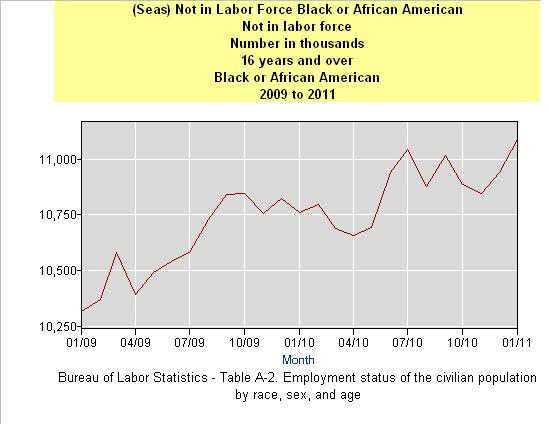
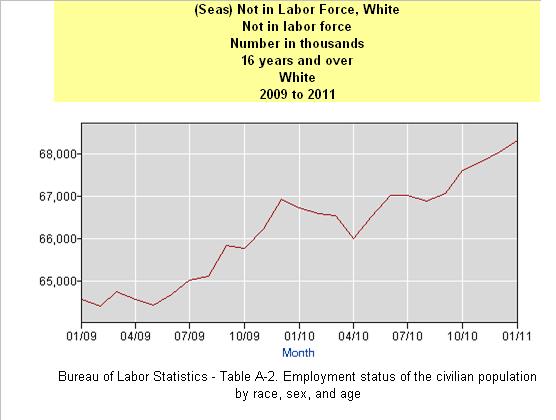
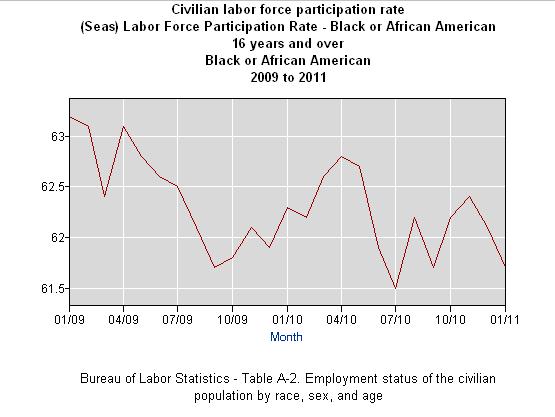
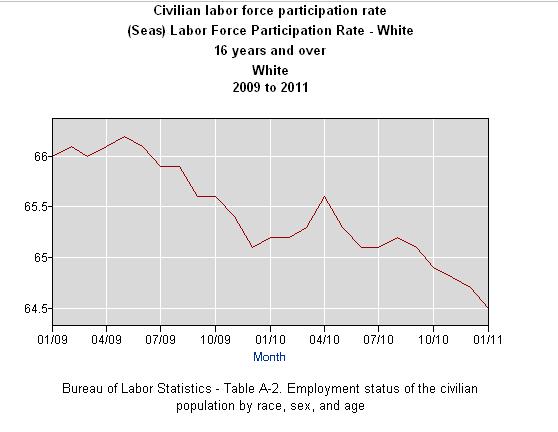
Can we call the American Recovery and Reinvestment Act of 2009 (ARRA) a failure yet? After all, the number of black and white Americans who are no longer counted as part of the labor force has reached a record high under the present White House occupant. Is this good or bad? According to the Bureau of Labor Statistics, since the beginning of February of 2009, an additional 772,000 black Americans, and an inconceivable 3,743,000 white Americans have left the labor force. Additionally, the labor force participation rate among both white and black Americans has declined to the lowest level since 1984. From the start of February of 2009 through January of 2011 the labor force participation rate among whites fell from 66.0% to 64.5%, while the participation rate among blacks declined from 63.2% to 61.7%.

If he was so wrong about the Stimulus Bill, couldn’t he also be wrong about health care and every other one of his experimental proposals?

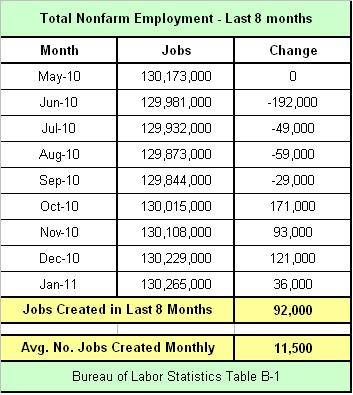
In the past 8 months, only 92,000 net jobs have been created, so exactly how are we better off? Has the back of the Great Recession really been broken? I would say not.

According to my previous post which is based on data which is publicly available from the Bureau of Labor Statistics, through January of 2011 the Stimulus Bill has resulted in a loss of 3.3 million jobs, and that is in addition to the number of jobs lost from the beginning of the recession until that time. The total number of jobs lost or squandered under the policies of the current White House occupant has been 5.19 million.

Revised: Stimulus Jobs Tracker

Stimulus Jobs Tracker

Step 1: Honesty – Get honest (with yourself).

Video: Vanguard TV3 Failed Rocket Launch after Sputnik

——————–

Sources:

http://stats.bls.gov/news.release/empsit.t02.htm

http://stats.bls.gov/webapps/legacy/cpsatab2.htm

Final: Tracking the 5.19 Million Jobs Obama Squandered

Day 745

“We have a system that increasingly taxes work and subsidizes nonwork.” ~ Milton Friedman ~

– By: Larry Walker, Jr. –

Formerly: Tracking the 5.2 Million Jobs Obama Squandered (published on 10/29/2010) *

Obama’s economic stimulus bill was sold to us with the promise of creating 3.5 million jobs by January of 2011. Well, since January has now passed, it’s time to tally up the results. My previous post, Tracking the 5.2 Million Jobs Obama Squandered, was about dead on. You can call it 5.19 million jobs squandered if you like, but it’s still 5.2 million when rounded off.

For a refresher, “Tracking the 3.5 million jobs Obama will save or create” was the title of a blog post, last updated on January 8, 2010, on a website named Understanding The Market – Capire Il Mercato. In a note, the author, Cole Kendall stated, “I will make the calculations in a way that provides a “best case” to the Obama team.” Since Mr. Kendall decided to give up on his tracking operation at the end of 2009, I decided to follow it through to it’s dire conclusion.

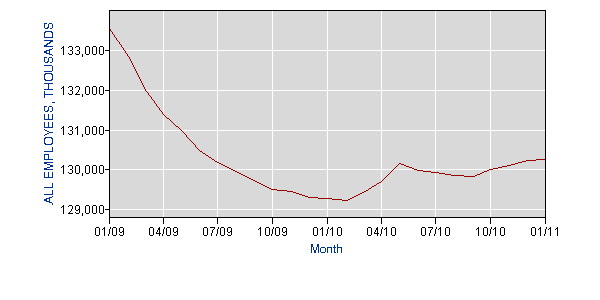
Using the same criteria as originally outlined by Obama’s (now former) economic team, jobs are defined by counting the total non-farm employment, from Table B-1 of the Bureau of Labor Statistics, “Employment Situation Report” (as seasonally adjusted). Instead of boring you with the month-by-month data, I went ahead and cut to the chase, skipping from December of 2009, where Mr. Kendall left off, to January of 2011, up to the latest data available from the 02/04/2011 jobs report.

Following is an excerpt from Cole Kendall’s original blog post, followed by my revised stimulus jobs tracker, and a brief analysis:

In an earlier essay I tried to explain President Obama’s notion of saving or creating jobs. The stimulus plan bill was passed by both houses of Congress last night and the final plan was a bit smaller than the earlier version, so the President now asserts that the plan will save or create 3.5 million jobs.

This post will track the 3.5 million jobs. There are a number of ways to measure jobs in the US. Some people work several different jobs at a time while others change employers frequently, so measuring jobs is not as simple as it might seem. There was a cartoon from the Clinton era showing the President speaking at a dinner that he had created 8 million jobs and an overworked waiter thinking that he had three of them. Obama’s economic team defined jobs [as those contained in the Department of Labor’s establishment payroll data] (see here for their original report).

Just before the stimulus bill passed the Department of Labor issued a report (see here). The number of people working (see Table B1, about 2/3 of the way down, with the heading “Establishment Data”) was 134,580,000 (seasonally adjusted). This is a preliminary measure and will be revised next month and probably revised again in a year. Using the Obama team methodology, without the stimulus bill employment would be expected to fall by around 1,613,000 jobs during the next two years so that without the stimulus bill we would expect employment to be 132,967,000 in January 2011.

With the revised estimate of 3,500,000 jobs “saved or created”, employment should be 136,467,000, creating 1,887,000 in addition to the 1,613,000 jobs saved.

The table below will be updated with every new employment release to see how jobs have changed. The first column is the actual number of payroll jobs starting with the month before the stimulus plan passed; the second column is the total change in employment since the month when the stimulus plan passed and the third column shows the gap remaining of jobs to be “created” in order to reach the target.

Revised: Stimulus Jobs Tracker

Stimulus Jobs Tracker

The conclusion is pretty grim, and certainly doesn’t mesh with what Obama has been saying out on the campaign trail. The sad truth is that instead of creating 3.5 million jobs, since it was passed, the stimulus plan has instead resulted in the loss of 3.3 million jobs. Since the stimulus plan was supposed to have saved 1,613,000 jobs, in addition to creating 1,887,000 jobs, by January of 2011, and since it has actually resulted in the loss of 3,298,000 jobs, Obama’s Economic Stimulus has fallen short of the original target by 5,185,000 jobs.

I don’t know what you call this, but I call it a colossal failure. Perhaps it’s time for an orderly transfer of power? Do we need another stimulus plan, or just another President? I don’t think Obama is helping his case by roaming around the country making false claims in what appears to be a frantic effort to get re-elected, especially when he’s the one who screwed this up. The thought of trillions in deficit-financed spending flushed down the drain, to no avail, doesn’t bode well for Democrats, nor for Mr. Obama.

Obama was a job creator from day one.” ~ Nancy Pelosi

You can fool some of the people all of the time, and all of the people some of the time, but you can not fool all of the people all of the time. ~ Abraham Lincoln (R-IL)

Sources:

http://stats.bls.gov/news.release/empsit.t17.htm

http://stats.bls.gov/webapps/legacy/cesbtab1.htm

http://understandingthemarket.com/?p=63

Table B-1 Data: Total Non-Farm Employment (In Thousands, As Seasonally Adjusted):

http://stats.bls.gov/webapps/legacy/cesbtab1.htm