Obama’s Right Direction Exposed

Ouch

If this is the right direction — I would rather be wrong than right.

Compiled by: Larry Walker, Jr.

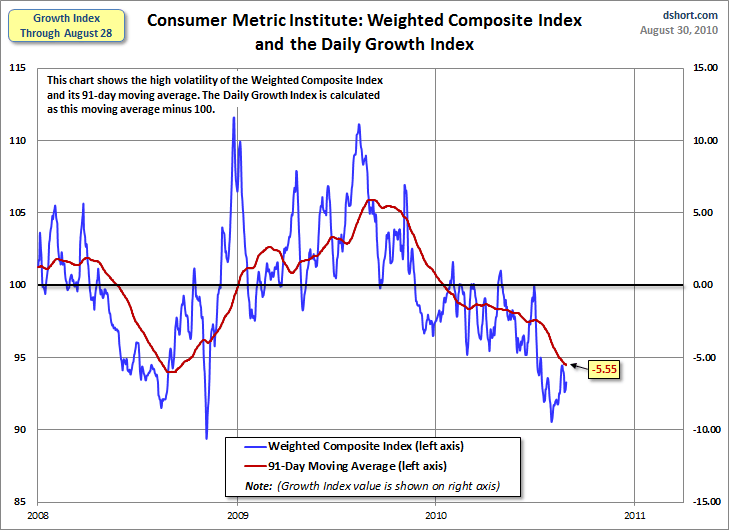
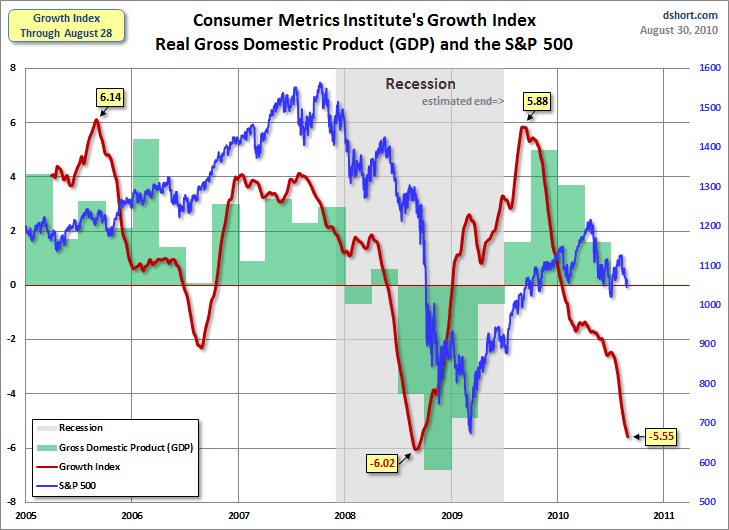
I was looking over the Consumer Metrics Institute’s New Growth Index and some of their other charts (here) and almost fell out of my chair. While every left-wing pundit, Obama, and his inept administration are boldly declaring that we are headed in the right direction, the facts beg to differ.

Who should I believe, the facts or the White House?

Their Conclusion: “As such, the prospect of a double-dip recession, something that’s happened only once since the Great Depression, remains a distinct possibility. That earlier double dip was a 6-month recession from January 1980 to July 1980, a 12-month recovery, and a 16-month of recession from July 1981 to November 1982. The one bit of good news for that earlier period is that the second dip coincided with the end of a secular bear market and the beginning of an 18-year cycle of accelerating growth.”

“The charts below focus on the ‘Trailing Quarter’ Growth Index, which is computed as a 91-day moving average for the year-over-year growth/contraction of the Weighted Composite Index, an index that tracks near real-time consumer behavior in a wide range of consumption categories. The Growth Index is a calculated metric that smooths the volatility and gives a better sense of expansions and contractions in consumption.”

“The 91-day period is useful for comparison with key quarterly metrics such as GDP. Since the consumer accounts for over two-thirds of the US economy, one would expect that a well-crafted index of consumer behavior would serve as a leading indicator. As the chart suggests, during the five-year history of the index, it has generally lived up to that expectation. Actually, the chart understates the degree to which the Growth Index leads GDP. Why? Because the advance estimates for GDP are released a month after the end of the quarter in question, so the Growth Index lead time has been substantial.”

View source, updates and more information here, or go directly to:

http://www.consumerindexes.com/

Congress needs to quit spending, and cut taxes – now. If you’re not part of the solution, you’re part of the problem.

Related posts:

Obama: The Era of Flimflam Economics, Part II ; Are We Heading In The ‘Right’ Direction?

Are We Heading In The ‘Right’ Direction?

Crossroads

That depends on the meaning of the word right. Right?

By: Larry Walker, Jr.

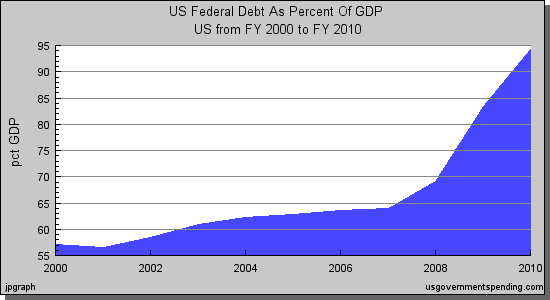
If growing the national debt faster than gross domestic product is the right direction, then the Obama Administration is correct. If the goal is to reach a 100% debt to GDP ratio, as quickly as possible, then the Democrats are correct. If doubling-down on the failed part of Bush policies (i.e. deficit spending) is the right direction, then Democrats are up to par.

However, if the term ‘right direction’ means that we are heading towards a Conservative resurgence in November, then that would be an honest assessment. Every time I hear Democrats make this declaration in the coming weeks, I’ll be thinking about the Conservative resurgence. The chart below shows the direction we are heading.

Tax Cuts: The Right Direction

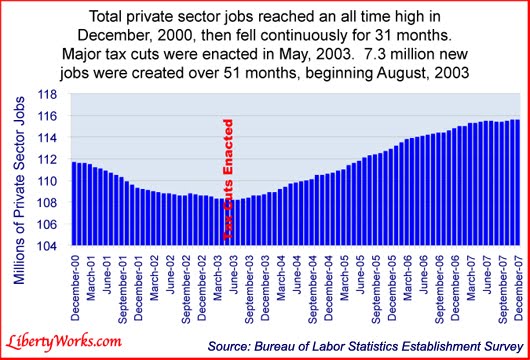
In May of 2003, tax cuts were enacted. The tax cuts were responsible for the creation of 7.3 million new jobs beginning in August of 2003 and lasting through the end of 2007 (source: http://libertyworks.com/bush-tax-cut-myths-and-fallacies-1/). Tax cuts are the only proven method for bringing an economy out of recession. The deeper the tax cut, the greater the expansion.

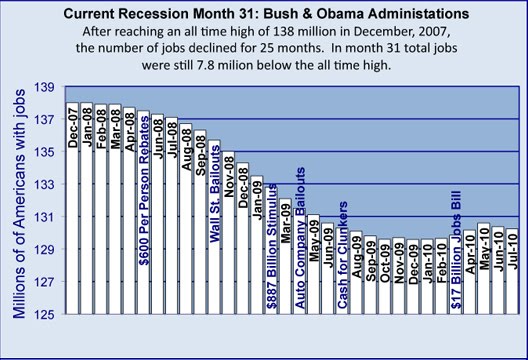
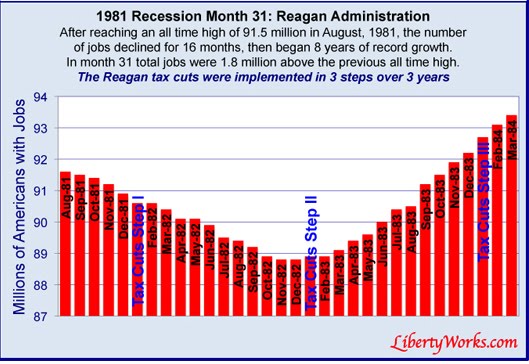
As Liberty Works so aptly reminds us, “President Obama and the Democrat Congress have implemented a series of measures that defy the lessons of past recessions”, especially that of 1981, which was by some measures worse than this one. The chart below shows, “the job market recovery is faltering at best, after 31 months of Bush/Obama policies. There are 8 million fewer Americans now employed than in December, 2007.”

The results in the next chart, speak for themselves. “Reagan’s policies turned the job market around after 16 months of losses. The Reagan economy grew continuously for 90 months, creating a total of 21 million new jobs, or a 24% increase in the number of Americans who were employed.”

Right Means Right

If the goal is to grow the economy, create jobs, and increase tax revenues, then tax cuts are the right direction. However, if the goal is something more sinister, then one must brainwash their constituents into believing that ‘tax cuts cause recessions’; that we are somehow heading in the right direction, and that a tax hike will further this trend.

The facts show that the 1983 and 2003 tax cuts brought us through successful business cycles. In 2008, the housing bubble burst, credit markets froze, and we fell into a deep recession, but tax cuts didn’t cause the recession. If you listen closely, a year ago, Obama was saying the recession was caused by the ‘lack of affordable health insurance’, and today he’s saying that it was caused by ‘tax cuts’. I suppose next he’ll be saying the recession was caused by climate change.

It’s sinister enough to take advantage of a (manufactured) crisis in order to pass unwanted legislation. It’s entirely another matter to purposefully prolong a (manufactured) crisis, to the detriment of every American: black, white, red, yellow, and brown; Democrat, Republican, and Independent. Obama’s play book is little more than the old tried and failed policies of FDR. In an article entitled, “FDR’s policies prolonged Depression by 7 years, UCLA economists calculate“, you will find the following conclusion:

“We found that a relapse isn’t likely unless lawmakers gum up a recovery with ill-conceived stimulus policies.”

Are Democrats doing anything other than gumming up this recovery with ill-conceived stimulus policies? Are we really heading in the right direction?

Congress needs to quit spending, and cut taxes – now. If you’re not part of the solution, you’re part of the problem.

Credits: Photo via sapientsparrow.wordpress.com charts via USGovernmentSpending.com and LibertyWorks.com.

The Progressive Slide to 2020 | GDP vs. Debt

2020 GDP vs. National Debt

By: Larry Walker, Jr.

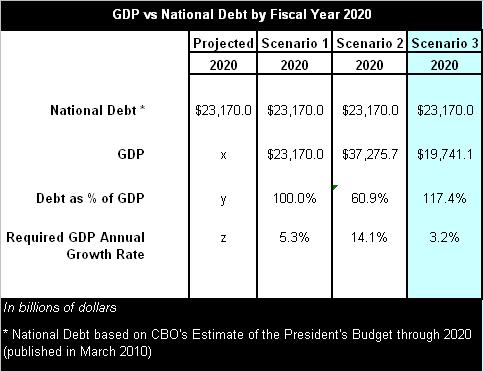
The question of the day is what will the USA’s Gross Domestic Product (GDP) need grow to by the year 2020 in order to keep pace with the Progressive’s ruinous spending? And based on the answer to that, at what annual rate should our economy be growing?

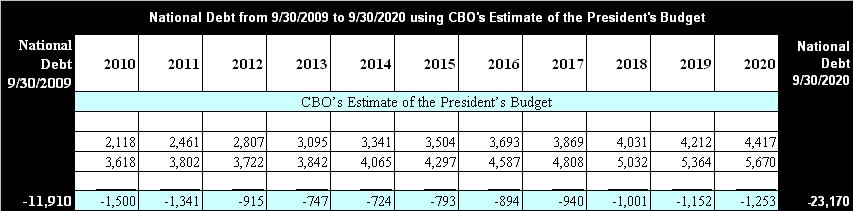
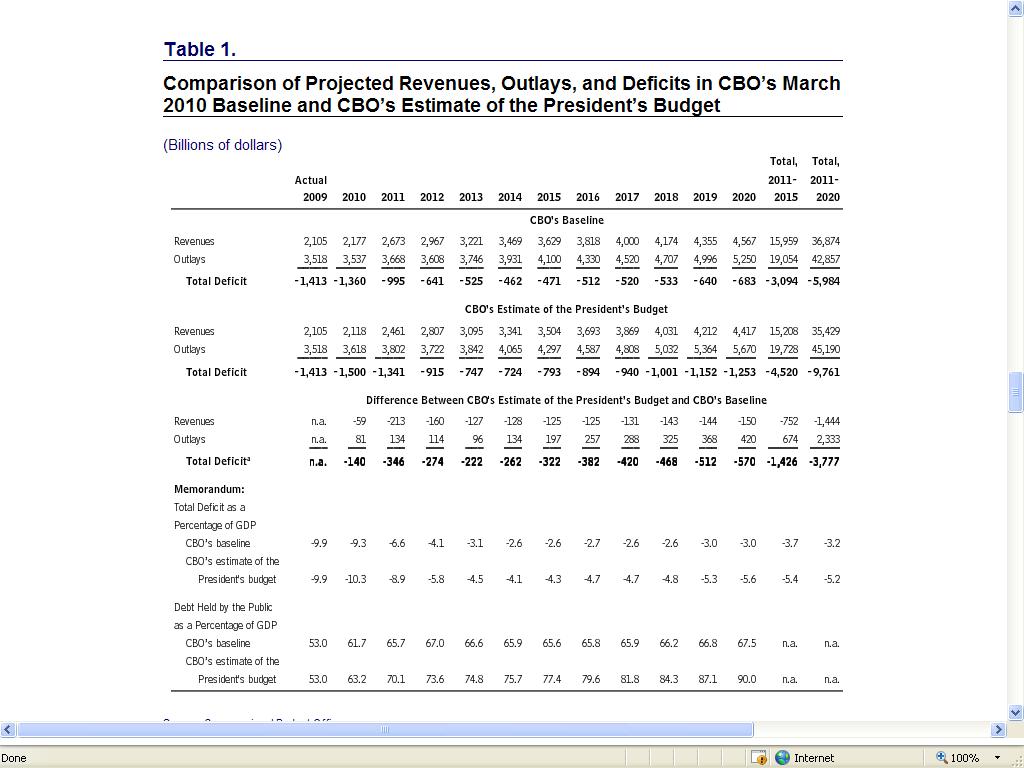
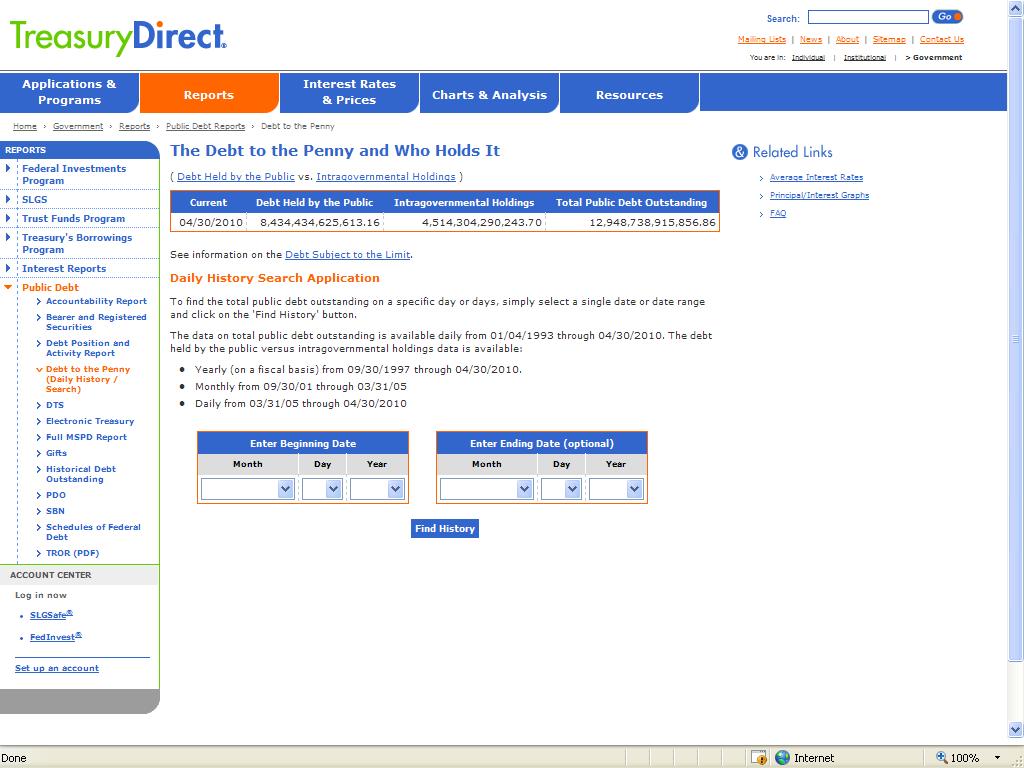
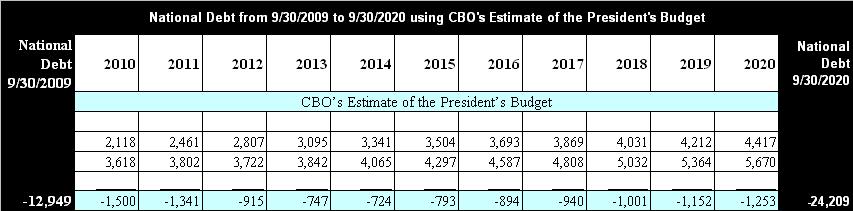
If we add the CBO’s 2010 to 2020 projected estimate of the president’s budget deficit to the current national debt of $12,948.7 billion (as of 4/30/2010), then the National Debt will total $23,170.0 billion by the year 2020.

click to enlarge

click to enlarge

click to enlarge

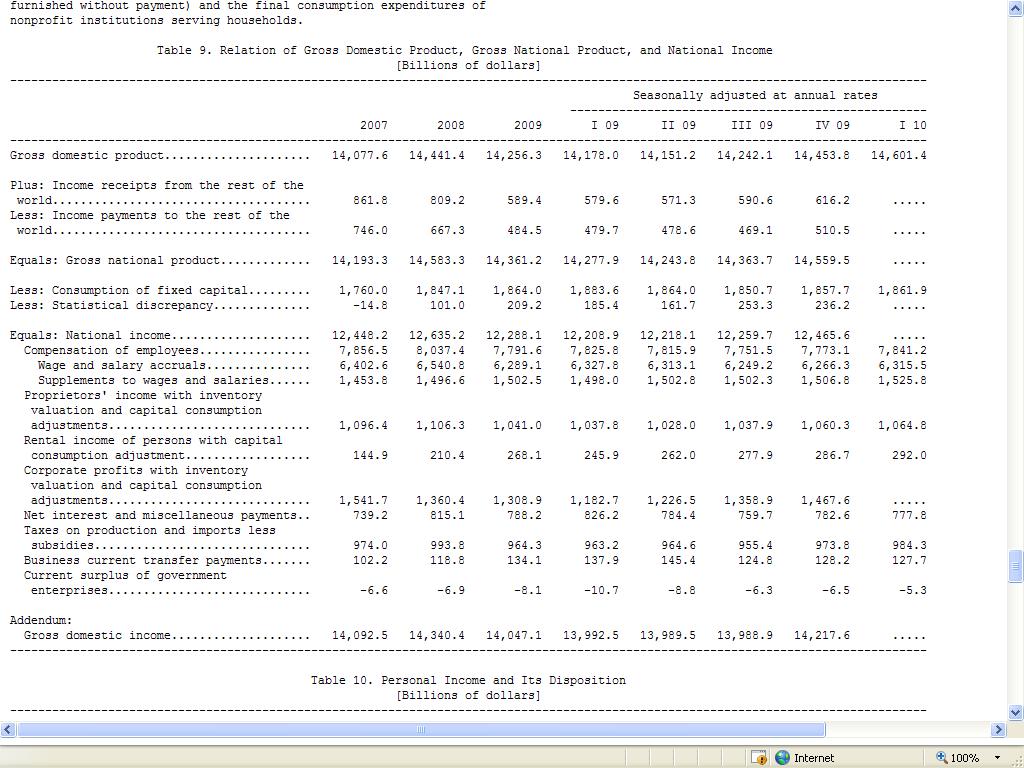
As of the end of the 1st quarter of 2010, based on the Bureau of Economic Analysis (BEA’s) latest preliminary estimate, GDP is averaging $14,601.4 billion annually.

click to enlarge

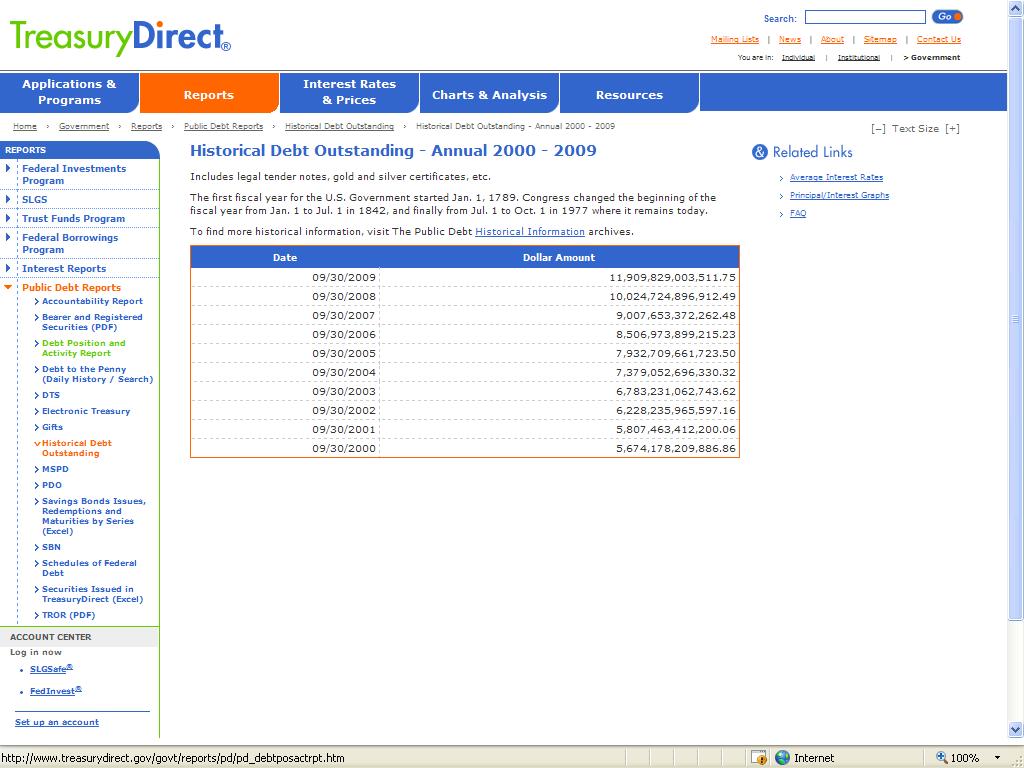
Depending upon the rate of growth of our economy over the next 11 years, our National Debt will exceed GDP, sooner or later. We know that even the Progressive’s say that our National Debt is unsustainable, but the question is just how unsustainable? If we take a look back to the days when our debt was sustainable and the economy was growing at roughly 5% per year with low unemployment, for example 2003, we will discover that our Debt to GDP ratio was 60.9%.

Scenario #1, below, determines the rate of growth necessary in order for GDP to match our projected debt by the year 2020. Scenario #2 determines the rate of growth needed in order to return to the 2003 debt-to-GDP ratio of 60.9%. Finally, Scenario #3 reveals what the debt-to-GDP ratio will be by 2020 if GDP maintains its current pace.

click to enlarge

Scenario #1 – The road to nowhere

GDP must grow from $14,601.4 to $23,170.0 billion in order to equal the National Debt by 2020. In other words, GDP must maintain an average sustained growth rate of 5.3% per year for the next 11 years, in order to achieve a Debt to GDP ratio of 100%. This represents ‘the road to nowhere’. Although, per the BEA, GDP grew at a rate of 3.2% in the first quarter of 2010, as you can see, this will not be enough to reach the destructive Progressive goal of a 100% debt-to-GDP ratio.

Scenario #2 – The way back to 2003

In order to return to the more prosperous 2003 Debt-to-GDP ratio of 60.9%, GDP must grow at a sustained annual rate of 14.1% for the next 11 years. In order to achieve such a rate of growth, our economy would have to grow at the pace of an emerging market, a feat which is clearly impossible for an industrialized nation. This is precisely why the president’s debt commission has stated publicly that, we will never grow our way out of this ‘man-made disaster’.

Scenario #3 – The Hellenistic toboggan slide

If GDP maintains its present annual growth rate of 3.2%, then by the year 2020 our debt-to-GDP ratio will reach 117.4%. Welcome to the Progressive Utopia. Welcome to the Republic of Greece.

Conclusion

The end of the Progressive trail leads to Greece. What you are seeing in Greece today is precisely where Progressive ideology will take us. Prepare for riots, violence, chaos, class warfare, and national bailouts. If that’s what you want, then support Barack Obama, and his Progressive entourage, and vehemently defend all of their policies. But, if this is not where you want to be in 2020, then identify and support true fiscal conservatives. Join with independents and moderates, and let’s elect responsible mainstream leaders who will lead us out of the wilderness, through sound fiscal policy, and free-enterprise solutions. It’s time to put the Progressives in their place: prison.

Sources:

http://www.bea.gov/newsreleases/national/gdp/2010/txt/gdp1q10_adv.txt

http://www.treasurydirect.gov/govt/reports/pd/histdebt/histdebt_histo5.htm

http://www.treasurydirect.gov/NP/BPDLogin?application=np

http://www.cbo.gov/ftpdocs/112xx/doc11231/frontmatter.shtml

click to enlarge

click to enlarge

2009 GDP | The Bottom Line

Click to Enlarge

2009 GDP

Real GDP decreased 2.4 percent in 2009 (that is, from the 2008 annual level to the 2009 annual level), in contrast to an increase of 0.4 percent in 2008.

The decrease in real GDP in 2009 primarily reflected negative contributions from nonresidential fixed investment, exports, private inventory investment, residential fixed investment, and personal consumption expenditures (PCE) that were partly offset by a positive contribution from federal government spending.

So now it’s time for a huge tax increase, right?

Couple the worst GDP results in decades along with unemployment hovering around 10%, then add to that 4.5 million foreclosure filings expected in 2010, and mix in personal incomes falling by an average of 1.7% in 2009, and you will begin to understand Obamanomics.

Time to end this nightmare! Vote them out.

By: Larry Walker, Jr.

References:

http://www.bea.gov/newsreleases/national/gdp/gdpnewsrelease.htm

Did GDP Fall by 2.4% in 2009?

More B.S. from D.C.

By: Larry Walker, Jr.

According to the Bureau of Economic Analysis (BEA’s) second release regarding – the 4th quarter 2009 GDP, issued earlier today, GDP increased at an annual rate of 5.9% in the 4th quarter of 2009. That is the rate of increase from the 3rd to the 4th quarter, expressed as an annualized percentage rate. The BEA also stated that, in the 3rd quarter, real GDP increased 2.2%. Sounds good, right? Woo-hoo!

“Real gross domestic product — the output of goods and services produced by labor and property located in the United States — increased at an annual rate of 5.9 percent in the fourth quarter of 2009 (that is, from the third quarter to the fourth quarter) according to the “second” estimate released by the Bureau of Economic Analysis. In the third quarter, real GDP increased 2.2 percent.”

But if you read down a little further into the report, the part where the BEA re-enters the atmosphere, you will discover that real GDP fell by (2.4%) in 2009. That is the rate of decline from the 2008 level to the 2009 level. So, is this good, or bad?

[2009 GDP] “Real GDP decreased 2.4 percent in 2009 (that is, from the 2008 annual level to the 2009 annual level), in contrast to an increase of 0.4 percent in 2008.”

Like I said in a previous post, it’s like telling me that my IRA account grew at an annual rate of 5.9% in the 4th quarter, but when I look at my statement I find that my account balance has actually declined by (2.4%) from 2008. So am I better off? No. Are you?

The next time Obama & Company start boasting about 4th quarter 2009 GDP, I wish someone would stand up and say, “but, sir, GDP actually fell by 2.4% under your watch”. Put that in your tea and drink it!

Click to Enlarge

Reference:

http://www.bea.gov/newsreleases/national/gdp/gdpnewsrelease.htm

Health Care Expenditures vs Income

Click to Enlarge

A Fiscal Conservative Opines: Where is all the excess?

By: Larry Walker, Jr.

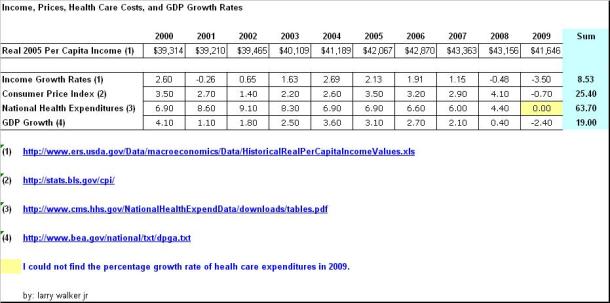
I am once again attempting to overlay data upon data from different sources, not being certain whether any of them are accurate, yet they are all so called ‘reputable’. There are some who will look at the table, above, and think that health care expenditures are out of control. I look at it and my take is that the lack of growth in real incomes is the problem.

In fact, health care expenditures have been on the decline since 2003. Granted I was not able to find the rate of change for 2009, even if there was no increase, health care expenditures have grown faster than incomes, the consumer price index, and GDP. This doesn’t tell me that there is necessarily a problem with health care expenditures. What it tells me … is that there is a problem with the economy.

Over the past ten years, consumer prices have risen by 25% while incomes have only risen by 9%. Does this mean that prices are out of control? Not to me. To me it means that our incomes are not keeping pace with inflation.

GDP is growing slower than prices. GDP is only growing at an average of 1.9% per year. For the past decade, GDP grew by 19% while prices grew by 25%. So again, is the problem with prices, or with GDP?

Let’s be real. Unless prices rise, incomes will not. How can a business provide raises for employees every year unless the business is also raising its prices? One way would be to keep prices static and to increase productivity, which generally means doing more with less employees. Everyone expects to get a cost of living increase each year, however, in order to receive one, your employer must generally raise its prices in line with the consumer price index. Yet, if that was reality, then incomes would be rising as fast as inflation. Yet, prices have risen nearly three times as fast as incomes. So where is all the excess?

My suspicion is that the problem lies more in the area of manufacturing, international trade, unionization, and the growth of government. We don’t make things anymore in America, we have become a service economy. Most of the products that we buy are imported from other countries. Unions are constantly demanding higher wages and better benefits. The number of government employees is growing as is their pay and benefits. The end result is that our Federal and State governments are going broke, jobs are being lost to emerging market economies, and the incomes of non-governmental and non-union employees are going down.

So the question is how do we improve the growth prospects for our economy? The answer lies in finding ways to increase exports and decrease imports, to lower income taxes and reduce the size of government, and to remove the restraints currently being imposed upon the free market. Our economy doesn’t need more controls, but rather less.

You say rising health care costs are at the center of all of our problems. I say, you’re focusing on the wrong statistic. If a man or woman has no way to earn their livelihood, then what good is a government run health care program. You will have your health care, but you will live in poverty. You will be taxed, but you will lack the wherewithal to pay your taxes. The poor will remain poor. The middle class will cease to exist. The government will continue to spend more than it can tax until even it falls by the wayside.

You cannot fix a problem, until you have identified one. So where is all the excess?

If the price of say automobiles rises, yet most of the autos are purchased from Japan, then there’s your answer. Sure, some jobs were provided in America, but the excess (also known as profit) has left the country.

If the price of health insurance has risen, yet most of the insurance is purchased from domestic providers, then where is all the excess? The answer is in a broken governmental system. The government (federal and state) spends nearly twice as much on health care as does the private sector. The government gets its revenue by taxing those who are viable and paying for the health services of those who are not. The government pays less for services than does the private sector which in turn, means prices will rise for everyone to compensate for the shortfall created by government providers. Thus, prices rise, but incomes do not.

A major reason why incomes are not rising is because the cost of income taxes, social security taxes, and medicare taxes are set to rise every year. It’s not that the rates have necessarily changed, but that the income ceilings have. So you work hard to make more than the social security cap, but by the time you reach that goal, the government has raised the bar (or removed it completely). This is not a progressive tax system, it’s a progressive annual tax increase. It’s a system designed to keep our economy in chains.

So where is all the excess? One need only look at our national debt. If there were excess, the United States Federal government would not be $13 trillion in debt. So there is no excess.

The problem lies not in price controls but rather in wealth creation. Wealth is not created through price controls. In fact, wealth is restrained by controlling prices. If prices did not rise, then neither would wealth. Yet, when wealth is not rising along with prices there is a breach.

If every American either worked for the government, or received government services, how would the government be able to continue as a going concern? The answer is that it would not. So then part of the solution, which is ingrained in your soul, is that bigger government is not the answer. On the other hand, if everyone worked in the private sector, and if everyone were able to sustain themselves, what would be the role of government? Most likely the role that was intended by our founders. So once again we can conclude that government is not the solution to our problems, government is the problem.

Message to uncle Sam, “get out of my way, and get off my back.”

End of rant….

References:

http://www.ers.usda.gov/Data/macroeconomics/Data/HistoricalRealPerCapitaIncomeValues.xls

http://stats.bls.gov/cpi/

http://www.cms.hhs.gov/NationalHealthExpendData/downloads/tables.pdf

http://www.bea.gov/national/txt/dpga.txt

Other Links and Solutions:

http://citizenownership.blogspot.com/2010/02/every-citizen-owner.html

http://citizenownership.blogspot.com/2010/02/expanded-capital-ownership-now.html

http://www.aipnews.com/talk/forums/thread-view.asp?tid=12453&posts=3#M33855

http://www.freerepublic.com/focus/f-bloggers/2460284/posts
The Real November Job Loss Number Was 255,000

Joe Weisenthal Dec. 4, 2009, 2:56 PM

Source: BusinessInsider.com

Just about every time the monthly jobs numbers comes out, economic research firm TrimTabs comes out and slams the government’s methodology, usually honing in on the Birth/Death model of new businesses entering the market.

This week is no exception.

Frankly, we’re not sure what to make of their arguments. We’ve been hearing about this Birth-Death issue for a long time, but unless you believe they’re changing their methodology from month to month, then that issue only goes so far.

We welcome your thoughts.

————

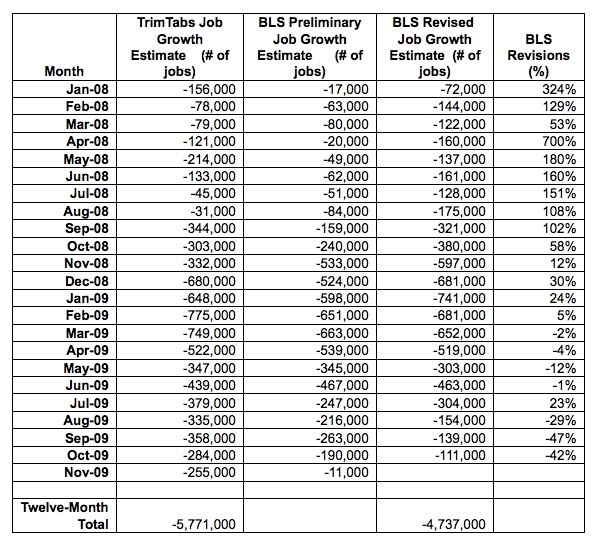
TrimTabs’ Estimates 255,000 Jobs Lost in November, While BLS Reports a Decline of Only 11,000

BLS Revises September and October Results Down a Whopping 45%

Something’s Not Right in Kansas!

TrimTabs employment analysis, which uses real-time daily income tax deposits from all U.S. taxpayers to compute employment growth, estimated that the U.S. economy shed 255,000 jobs in November. This past month’s results were an improvement of only 10.2% from the 284,000 jobs lost in October.

Meanwhile, the Bureau of Labor Statistics (BLS) reported that the U.S. economy lost an astonishingly better than expected 11,000 jobs in November. In addition, the BLS revised their September and October results down a whopping 203,000 jobs, resulting in a 45% improvement over their preliminary results.

Something is not right in Kansas! Either the BLS results are wrong, our results are in error, or the truth lies somewhere in the middle.

We believe the BLS is grossly underestimating current job losses due to their flawed survey methodology. Those flaws include rigid seasonal adjustments, a mysterious birth/death adjustment, and the fact that only 40% to 60% of the BLS survey is complete by the time of the first release and subject to revision.

Seasonal adjustments are particularly problematic around the holiday season due to the large number of temporary holiday-related jobs added to payrolls in October and November which then disappear in January. In the past two months, the BLS seasonal adjustments subtracted 2.4 million jobs from the results. In January, when the seasonal adjustments are the largest of the year, the BLS will add anywhere from 2.0 to 2.3 million jobs. In our opinion, trying to glean monthly job losses numbering in the tens of thousands or even in the hundreds of thousands are lost in the enormous size of the seasonal adjustments.

In November, the BLS revised their September and October job losses down a surprising 44.5%, or 203,000 jobs. In the twelve months ending in October, the BLS revised their job loss estimates up or down by a staggering 679,000 jobs, or 13.0%. Until this past month, these revisions brought the BLS’ revised estimates to within a couple percent of TrimTabs’ original estimates.

The large divergence between the two results begs the question of what is causing the difference. While we don’t have an answer today, we will be poring over the data in an attempt to answer that question.

A comparison of TrimTabs’ employment results versus the BLS’ results from January 2008 through November 2009 is summarized below.

click to enlarge

Source: TrimTabs Investment Researchhttp://www.trimtabs.com/ and Bureau of Labor Statistics – http://www.bls.com/

Several other employment related data statistics support the conclusion that the labor market is not as robust as the BLS is reporting:

  • Automatic Data Processing reported on Wednesday that 169,000 jobs were lost in November.
  • The Institute of Supply Management (ISM) Non-Manufacturing Survey reported that the majority of companies surveyed were still shedding employees.
  • The ISM Manufacturing Survey reported weaker employment conditions in November.
  • Weekly unemployment claims were 457,000 in the week ended November 27, 2009. While last week’s results were below the important psychological level 500,000, the weekly claims are still uncomfortably high and point to a contracting labor market.
  • The TrimTabs Online Jobs Index reported lower online job availability in the past three weeks.
  • The Monster Employment Index declined in November.

We will have the opportunity to truth our employment model estimates at the end of January 2010 when the BLS releases its annual benchmark revisions. The BLS revisions are based on actual payroll data for March 2009. The BLS revision is then divided by twelve to correct prior month’s data back to April 2008. We also use the March 2009 revisions to adjust our model inputs and make any necessary corrections.

For a complete analysis of the current employment situation and economic conditions, refer to TrimTabs Weekly Macro Analysis published this coming Tuesday, December 8, 2009

The Raw Truth: GDP vs National Debt

GDP vs National Debt – The Raw Truth

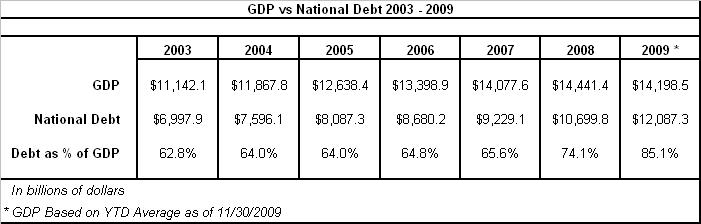
I am still mulling over the Bureau of Economic Analysis’ recent, erroneous, GDP projection after my last post Gross Domestic Product (GDP) Mumbo Jumbo. One aspect that was not addressed previously was the pace at which our National Debt is catching up to annual GDP.

The question for today is what will Gross Domestic Product need to be in 2019 in order to keep pace with the Federal Government’s ruinous spending? And based on the answer to that, at what pace must the economy grow annually?

click to enlarge

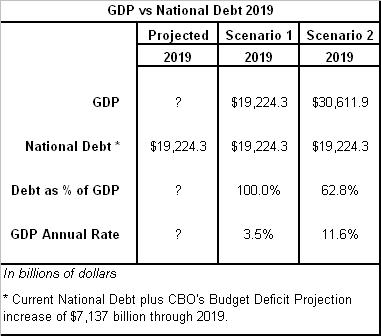
If we add the CBO’s 2010 to 2019 projected budget deficit of $7,137.0 billion to our current national debt of $12,087.3 billion, then the National Debt will total $19,224.3 billion by the year 2019. At the same time, GDP is averaging $14,198.5 billion annually. Thus, if our economy does not grow over the next 10 years, the National Debt will soon exceed GDP. [Note: GDP represents the amount that our economy can produce in a year.]

I know that the ‘hope and change’ crowd will say, “So what, It does not matter as long as the interest payments don’t exceed GDP”, or some other lame reasoning. However, I choose to look back to the days when the economy was growing at 5% per year with low unemployment. After all, surely America had some banner years in the past. The question should be, “how do we return to a more reasonable Debt-to-GDP ratio?” Not, “how far can we go before the economy breaks?”

Thus, the first scenario, below, determines the rate of growth necessary in order for GDP to match our projected debt. The second scenario determines the rate of growth needed in order to return to the 2003 debt-to-GDP ratio of 62.8%. Finally scenario three simply states the obvious.

Scenario #1 – The Road to Nowhere

GDP must grow from $14,198.5 to $19,224.3 billion in order to equal the National Debt by 2019. In other words, GDP must increase by $5,025.8 over the ten year period. This represents an increase of 35.4% for the period. That means that GDP must grow at a rate of 3.54% per year in order to equal our National Debt by 2019. As I clarified in my last post, GDP is currently declining at the rate of 1.21% per year, so although this is achievable, we still have a ways to go on this road to nowhere.

click to enlarge

Scenario #2 – Back to 2003

In order to return to the more prosperous, albeit not the most optimal, 2003 Debt-to-GDP ratio of 62.8%, annual GDP must grow to $30,611.9 by 2019. In other words, GDP must increase by $16,413.4 billion, over 10 years, in order for the National Debt to equal 62.8% of GDP. That equals a percentage increase of 116.0% over the 10 year period. In other words GDP must grow at the rate of 11.6% per year, over the next 10 years in order to return to the 2003 Debt-to-GDP ratio.

Scenario #3 – Stop Spending Money that we don’t have.

Of course there are many possible scenarios. One common sense scenario would be to stop spending money that we don’t have. I don’t think it’s possible to grow the economy at 11.6% per year. At least I don’t see any plans from the Congress, the Senate, or Obama that would come anywhere close. In fact, their current plans do nothing to increase GDP, but rather are focused shamefully on doubling the National Debt. And you know what that means: higher taxes, and higher interest rates, leading to less economic growth.

Conclusion

GDP must grow at an annual rate of 3.54% in order to equal the National Debt by 2019, a road to nowhere. GDP must grow at an annual rate of 11.6% in order to return to the 2003 Debt-to-GDP ratio of 62.8% by 2019. Government spending needs to be cut dramatically, and immediately. Any plan that falls short of scenarios #2 and #3 is not a plan. That’s the raw truth.

Sources:

GAO FINANCIAL AUDIT Bureau of the Public Debt’s Fiscal Years 2007 – 2008

CBO Budget Projections through 2019

Treasury Direct – Historical National Debt

Gross Domestic Product (GDP) Mumbo Jumbo

Give me a break!

by: Larry Walker, Jr.

Worthless Government Statistics

It was just back on November 3rd when the Bureau of Economic Analysis (BEA), a division of the U.S. Commerce Department, declared that Gross Domestic Product grew at an annual rate of 3.5% during the 3rd quarter of 2009. Then on November 23rd, the Bureau declared that the revised rate of growth for the 3rd quarter was only 2.8%. The question that came to mind, right away, was: What exactly does this mean?

Click to Enlarge

First of all what it does NOT mean is that the economy grew at the rate of 2.8% during the 3rd quarter of 2009. The rate of 2.8% is derived by taking the rate of increase from the 2nd quarter to the 3rd quarter of 0.70% and assuming that this will stay constant for the next 3 quarters (0.70% times 4). Why is this a bogus way of measuring the economy?

When I open my quarterly 401K statement and it reads that my portfolio has increased by 8.0% during the recent period, I don’t automatically assume that my annual rate of return is 32.0% (8.0% times 4). No, on the contrary, I look at the past four quarters to determine my annual return. If I lost 8.0% in the previous three quarters combined, and then gained 8.0% in the most recent quarter, then I am close to breaking even. But have I broken even? No.

To demonstrate, let’s assume my portfolio was valued at $100,000 at the end of the previous fiscal year. After declining by 8.0% in the succeeding three quarters, the value had dropped to $92,000 ($100,000 times 0.92). Now, after gaining 8.0% in the most recent quarter, the value of my portfolio has increased to $99,360 ($92,000 times 1.08). You will note that I have yet to break even. I am in fact still down by 0.64% ($640 divided by $100,000) having started with $100,000 and declined to $99,360 over the past four quarters. So much for growth. Now back to GDP.

GDP has declined by 1.42% over the past four quarters

Now when it comes to GDP, a more reasonable way to look at our present rate of growth, similar to measuring an investment portfolio, is to look at the past 4 quarters. Since the BEA only publishes figures in annual terms, I will approach this by using their figures, but keep in mind that the quarterly GDP figures are shown as annual amounts (in billions).

  • 4th Quarter 2008 – $14,347.3

  • 1st Quarter 2009 – $14,178.0

  • 2nd Quarter 2009 – $14,151.2

  • 3rd Quarter 2009 – $14,266.3

Dividing the above by four, the average GDP over the past four quarters is $14,235.7 billion. The final GDP figure for all of 2008 was $14,441.4. So GDP has dropped by $205.7 billion ($14,441.4 minus $14,235.7) over the past four quarters. That equals a percentage drop of 1.42% ($205.7 divided by $14,441.4) since 2008.

GDP has declined at the rate of 1.21% since 2008

An even more accurate way to look at this is to start with the 2008 total GDP of $14,441.4 billion and to measure the decline over the next three quarters. In this respect GDP declined by 1.82% in the 1st quarter of 2009, by another 0.19% in the 2nd quarter of 2009, and then improved by 0.80% in the 3rd quarter of 2009. Overall GDP has declined by 1.21% since 2008. This is the statistic that’s most meaningful to me.

GDP has declined at the rate of 1.21% since 2008. In dollar terms that’s $175.1 billion per year in lost production in our economy. That’s the equivalent of losing 3.5 million jobs paying $50,000 per year. That’s more meaningful to me than the BEA’s mumbo jumbo.

GDP growth averaged 4.93% per year from 2003 to 2008

While we are at it, you will note on the chart above that GDP was $11,142.1 billion in 2003 and grew to $14,441.4 billion in 2008. That’s an increase of 29.6% over the six-year period, or an average of 4.93% per year. It also represents an increase of $3,299 billion in U.S. production over the period. That’s the equivalent of an increase of around 65.9 million jobs paying $50,000 per year.

So wake me up when Obama’s economy killing policies have created 65.9 million jobs, or when GDP reaches $18,490.7 billion (an increase of 29.6% from today’s level), whichever comes first, but don’t bother me with meaningless government statistics.

Sources:

http://www.bea.gov/newsreleases/national/gdp/gdpnewsrelease.htm

http://www.bea.gov/newsreleases/national/gdp/2009/xls/gdp3q09_2nd.xls

3.5% Growth in the 3rd Quarter? No! Try 0.87%

Source: Trade and Taxes

Raymond L. Richman

The U.S. Bureau of Economic Analysis issued a misleading report when it announced October 29, 2009, that annualized Gross Domestic Product, measured in 2005 prices, increased 3.5 percent from the 2nd quarter 2009 to the 3rd Quarter of 2009. The fact is that annualized GDP in the 3rd quarter was $13,014 billion compared with $12,901 in the 2nd quarter , an increase of 0.872, less than one percent. The number, 3½ , asserted by the BEA was obtained by multiplying 0.872 by 4, in other words by extrapolating the rate of increase in the 3rd quarter for three additional future quarters, hardly a scientific way of prediction . What is worse, analysis of the data indicates no reason to expect any future growth of the economy at all.

Net private non-residential investment, the key to a growing economy, declined in the 3rd quarter. So did net exports. Exports increased but imports increased even more, resulting in a drag on the economy. Personal Consumption increased but that was due principally to a non-recurring factor, the “klunkers” rebate, a costly exercise in subsidized consumption which did more economic harm than good. We already have evidence that it was at the expense of sales in the succeeding period. Thus, it will contribute to a decline in the current quarter. And it will no doubt have a negative effect on auto repairs and maintenance expenditures. Although the administration claimed that it was intended as a stimulus to the economy, it was done at the urging of environmentalists wanting to reduce carbon emissions in the atmosphere. Personal Consumption may increase in the future but there was nothing in the 3rd quarter data to give any assurance that it will.

Personal consumption may grow if expectations about the future of the economy improve. Unfortunately, the data do not lend to the expectation of the economy’s growth. The real growth of the economy is dependent on fixed private investment. Private non-residential fixed investment fell, -1.88 percent in current dollars and -.636 percent in 2005 dollars. Multiply those by four!

The other principal contributor to economic growth is positive net exports. While exports of goods rose 4.65 percent in current dollars and 3.49 percent in 2005 dollars, imports increased faster, 6.43 percent and 3.86 percent respectively. This occurred in spite of a falling dollar which is supposed to increase exports and reduce imports. Multiply those numbers by four, too!

For years we have been warning that the growing trade deficits of the U.S. were a threat to the health of the U.S. economy. It caused the loss of millions of industrial jobs, depressed wages as the laid off industrial workers sought jobs in the service sector, and worsened the American distribution of income. It is urgent that we get trade into reasonable balance. If we succeed, the economy has a chance of recovering quickly because it would stimulate private investment , growth, and employment. These and other measures appear in our book, Trading Away Our Future (2008), which deals with the causes of and cures for the trade deficits.

The stock markets boomed on the news that GDP had grown at an annual rate of 3.5 percent. Pres. Obama and Dr. Romer, Chairwoman of the President’s Council of Economic Advisors, repeated the number. The latter should have known better. What should have been reported is that in the third quarter GDP rose, compared with the 2nd quarter, 1.06 percent in current dollars and 0.87 percent in 2005 dollars. The next day, after investors had time to read the release and the accompanying tables, the stock markets collapsed.

We have great respect for the Bureau of Economic Analysis and their statistical methods. But the extrapolation of the rate of growth into the future serves no purpose and adds nothing to the data and should be abandoned.

__________________________________________________

Link to BEA Report: http://www.bea.gov/newsreleases/national/gdp/gdpnewsrelease.htm

Note: It says, “Real gross domestic product…increased at an annual rate of 3.5 percent in the third quarter of 2009…” The use of the term Annual Rate means that GDP actually only rose by 0.87% during the 3rd Quarter of 2009. Thus, I concur. This is a shameful deception by the Obama Administration and he needs to be called on it.

It’s also debatable whether when annualizing GDP growth one should take the previous three quarters plus the current one, or as makes no sense here, take the current quarter and expand it out by three future quarters at the same rate.

I don’t see any consistency with this even with the BEA. In checking the BEA’s 2nd quarter report, for example, GDP decreased by -0.8% in the 2nd Quarter but the annualized decrease was stated as minus -1.0%, not minus -3.2% as would be apples to apples. So what’s up with that?

http://www.bea.gov/newsreleases/national/gdp/2009/gdp2q09_adv.htm