[D]issing America: The Looming [R]esurgence

D is for Dissing America

The Case for Further Tax Cuts

Ranted By: Larry Walker, Jr.

Obama’s progressive form of economic change is destroying America. Not only does he threaten to hoard the keys, but to thrust the car over a cliff. Specifically, the effect of his policies on productivity, government subsidies, tax credits, class warfare, income taxes, and government spending is doing more harm to America than the Great Recession ever could.

Taking Away the Incentive

In the private sector, when you want to motivate a workforce you offer them things like more time off, bonuses, or stock ownership. In other words you offer them something in exchange for something. The Obama administration offers nothing for those who work hard. With Obama, if you work hard, you receive the reward of paying higher taxes, fees and fines to support those who don’t work as hard, or at all. If I told my employees that next year, the lowest paid would be getting a 50% decrease in pay, and the more highly paid would receive a 10% pay cut, would they work harder? No. In the real world they would quit immediately, hang around while looking for another job, or simply decrease their performance in line with the coming downgrade. Isn’t this what Obama is doing by proffering a tax hike for those who are working hard, paying their bills on time, and in essence supporting everyone else?

The Failure Subsidy

Now let’s take a person who has been unemployed for a year and is about to lose their home. They haven’t really looked for work because they’re on 99 weeks of unemployment, courtesy of Obama, and they expect the government to step in and make up the back payments on their home. Why should this person work when they can live off of less and still get by? Their plan is to start looking for work again when all the free government benefits run out. This person has in effect been given a government subsidy not to work, at the expense of those who are working. When my teenagers can go out and find jobs in this economy, I find it hard to believe that there are no jobs. One of them gets up at 5:00 AM and goes off to bake bread, while moochers stay home to collect free checks. Why do my kids work? Because their mother told them they must either work, or get out of the house. That’s the kind of incentive that will either make you or break you. Implying that we somehow need illegal immigrants to perform undesirable work, because Americans won’t is a sad, sad excuse.

Breaking the Free-Market

At a time when home prices had fallen between 30 to 50% in some Georgia communities, in stepped the federal government with an $8,000 refundable tax credit for first time homebuyers. Initially the credit was only $7,500 and had to be repaid over a 15 year period. People were already buying houses at the time, and were turning down the initial credit because it had to be repaid, so the government, in its wisdom, made it a giveaway. Did potential buyers really need an additional incentive beyond the existing 30-50% discount? What about the hardworking folks down the street who were left paying for their largest, and now most devalued, asset? Prices may have eventually recovered on their own had fewer houses been sold in the trough, but through government intervention, now all of our houses have been hopelessly devalued. Those who received the tax credit also received the bonus of equity in their homes, while those who hung on through tough times got screwed.

The Victims

The Obama administration talks a lot about the “haves” and “have-nots”. It seems there are a lot more have-nots today, than there were in January of 2009 (roughly 6.4 million more). Those who still have a job, a business, or some savings (things that they worked hard to achieve) are the new haves. The have-nots are those who are victims of an economy, hindered by the federal government. In many cases, the have-nots are the direct victims of the federal government. Instead of motivating people to get off of unemployment, welfare, subsidized housing and food stamps, the government is increasing these programs and fostering the entitlement mentality. What incentive is there for one of these, government-made, have-nots to ever claw their way out? If working means giving half of ones labor to the government, then why even try?

Legalized Robbery

I was looking over a client’s job situation recently. The conclusion was that if she accepts the proposed contract, she and her husband will be in a position where every additional dollar she earns, for the rest of the year, will be subject to 50% in federal, self-employment, and State taxes. Is it even worth the effort? If you were offered a contract that would pay you $68,000 in five months, but you had to pay $20,000 in travel expenses to earn it, and then another $24,000 in taxes, leaving you with just $24,000 would you do it? It might be better to just stick closer to home and find a W-2 job paying $30,000. Where is the incentive when the government stands to gain 50% of ones labor? Yet the Obama administration wants to raise taxes. Hell, taxes are already too high. We need additional tax cuts, not an increase. Top tax rates should be cut back down to 28% like they were under Reagan (and even that’s too high). No one in their right mind is going to put forth maximum effort for half. It’s just not going to happen. Many have-nots ponder this same dilemma everyday.

The Spending Bonanza

If the Bush tax cuts caused such huge deficits, then how did Obama’s July 2010 budget deficit end up exceeding Bush’s 2007 annual budget deficit, by $5.0 Billion?

Per the website, Liberty Works, “the one-month deficit for July was $165,043,000,000 or $5 Billion more than the “irresponsible Bush deficit” for the entire year of 2007.”
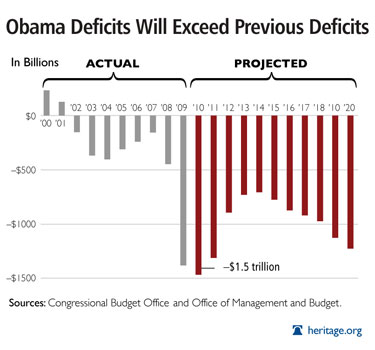
Graph via: http://blog.heritage.org/2010/02/05/past-deficits-vs-obamas-deficits-in-pictures/

Will the government ever be able to raise enough tax revenue to cover Obama’s massive spending gap? Let me answer that for you. No. Never in a 1,000 years. The only thing certain about our exploding national debt is that more revenue will eventually be required to cover it. The question is how to increase revenue without further damaging the economy.

A Conservative [R]esurgence

What’s the solution? We need a conservative resurgence in America. Give us the incentive to produce, take away the subsidy for failure, stop tampering with the free market, and free us that we may lift the have-nots. Reduce income tax rates, and stop spending more than we have. Our present course is destined for failure.

The bottom line: Drastically cut the size of government, and don’t just freeze tax rates, cut them. You can’t just cut taxes without a corresponding reduction in spending. It doesn’t work like that. Yet, until taxes are cut, the government will be trapped in providing greater failure subsidies (bailouts), and further destructive interference with the free market. That’s how it works.

If you’re not part of the solution, you’re part of the problem.

Black Employment Relapses Year-Over-Year

New Black Dummies

Black Employment Plummets on Obama’s Watch

By: Larry Walker, Jr.

The question of the day: Will Black or African Americans continue to support policies that don’t represent them?

According to the latest from the Bureau of Labor Statistics (BLS), employment has continued to decline among Black or African Americans over the last twelve months. After 17 months of the Obama administration’s massive recovery program, we find that African Americans have benefited the least. If Black Americans are losing under the leadership of President Barack Obama, who’s winning?

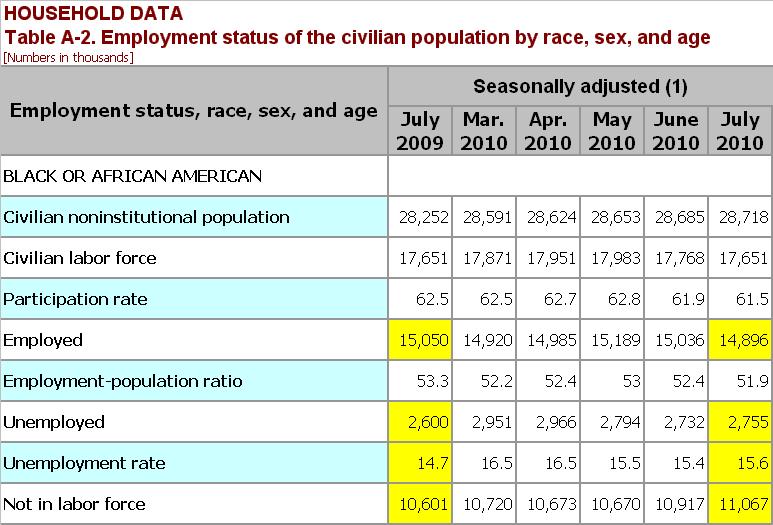
The latest Employment Status Report reveals the following:

  • There were 154,000 fewer blacks working in July than there were a year ago.

  • The number of blacks added to the unemployment rolls rose by 155,000 over the past year.

  • The unemployment rate among black Americans has increased by nearly 1.0%, since July of 2009.

  • Worst of all, an additional 466,000 blacks entirely abandoned the labor force over the past 12 months. Those classified as ‘no longer in the labor force’ are no longer counted in the official unemployment rate. These are the forsaken, the forgotten, the hopeless, the lost ones.

Here’s the latest table derived from the Bureau of Labor Statistics:

click to enlarge

Using his own laughable analogy, Obama refuses to put the car in [R], yet neither will he shift it into [D]. Instead, Obama has chosen to keep our economy in [P]. The folly of the [p]rogressive party president lies in that he has villainized corporations, small business owners, and the wealthy – those who actually provide and create jobs. It looks like it’s up to us to finally throw the car into gear. The best way to do this is to shift the balance of power in the November mid-terms.

“Change you can believe in?” – Nah!

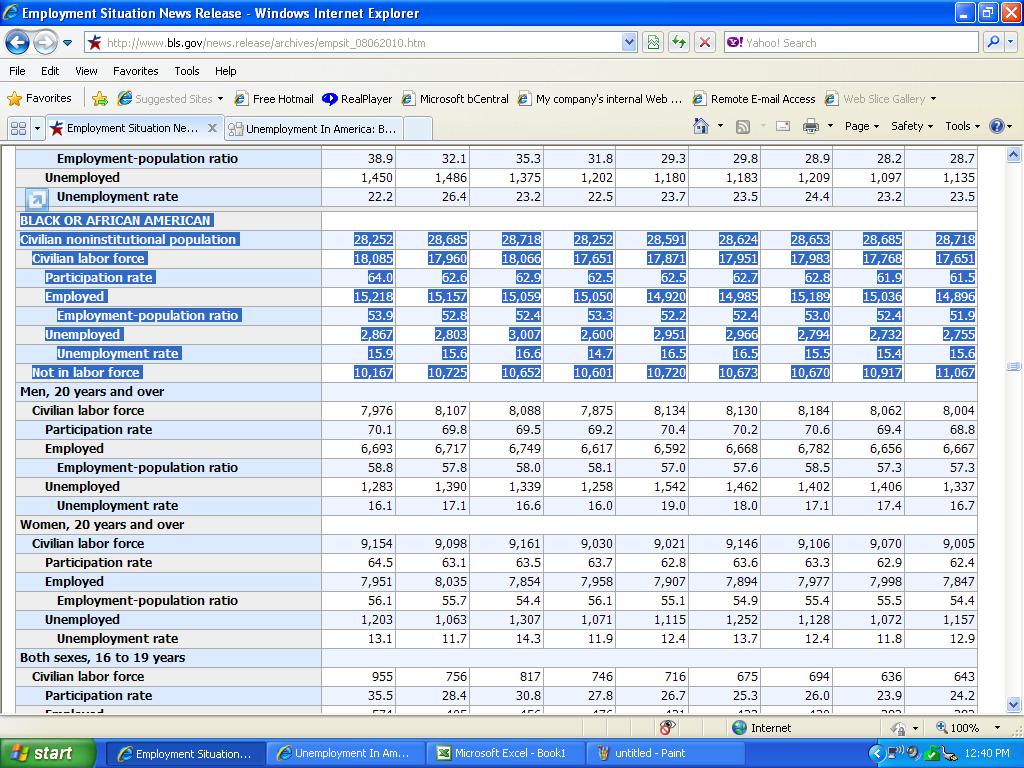
And so you know I’m not just making this up, here’s a snapshot of the BLS report:

click to enlarge

Sources:

Bureau of Labor Statistics: Employment Situation 8/6/2010

Bureau of Labor Statistics: Historical Data

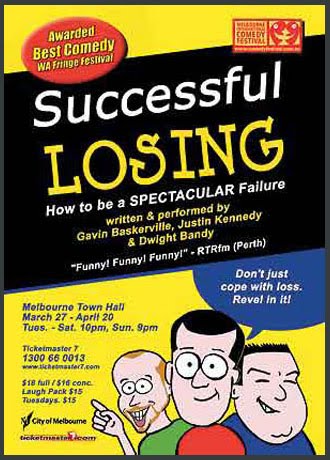
Successful Losing: Obama on Jobs

Losing is the New Winning

By: Larry Walker, Jr.

According to today’s Employment Status Report, the Bureau of Labor Statistics (BLS) reveals that as of July 31, 2010 there were 857,000 fewer persons employed than there were in July of 2009. Yet from Barack’s glass bubble, it sounded like all is well. Sure, his chief economist, Christina Romer just resigned, but that’s no cause for concern. The latest from Obama is that ‘private employment has increased every month’ during 2010. Really? Does that mean there are more jobs today than there were yesterday?

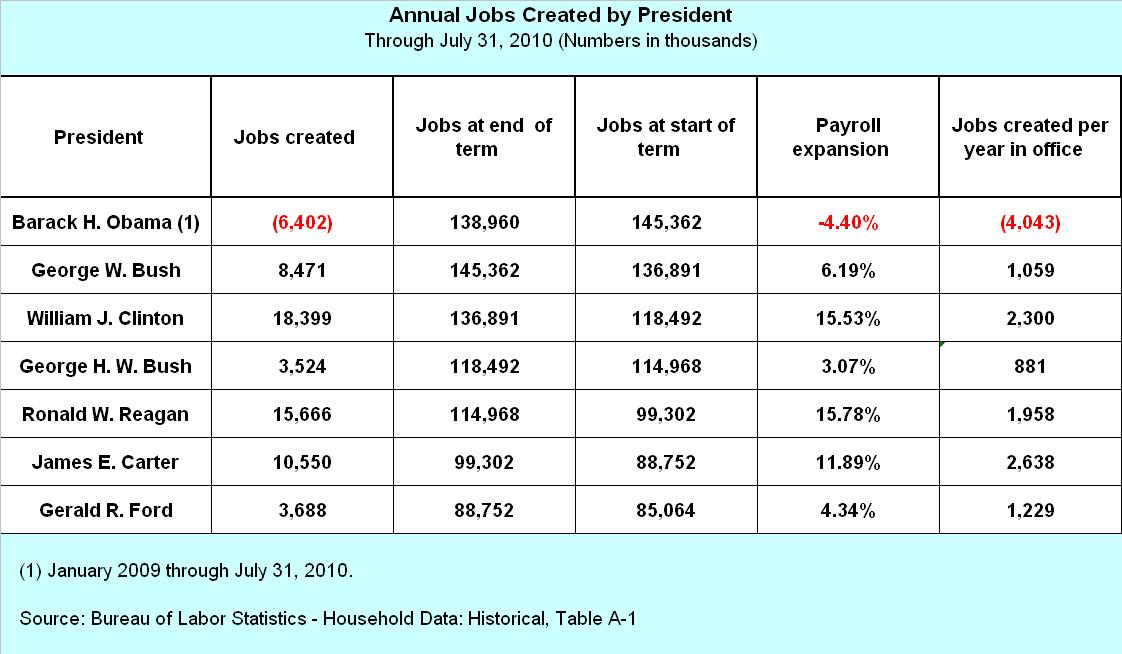
Following is my latest presidential scorecard, based purely on official BLS data:

Scorecard - Click to Enlarge

Obama was quick to take credit for the false increase in overall employment, earlier this year, when the U.S. Census Bureau hired 500,000 temporary workers, but now that they’re all gone he’s been slow to acknowledge the true situation. According to the BLS there were 139.8 million Americans employed in July of 2009, and 138.9 million employed in July of 2010. That’s a decline of 857,000 jobs over the past 12 months. There has actually been a steady, and progressive, decline in civilian employment for the past year, but you know, Obama doesn’t have time to look at facts and figures.

When G.W. Bush entered office in January of 2001, there were 136.8 million jobs. When he left office in December of 2008, there were 145.3 million jobs. When Obama entered office in January of 2009, there were 145.3 million jobs. As of July 31st of this year, there were 138.9 million jobs. So when we do the math, there are now 6.4 million fewer jobs than there were when Obama entered office in January of 2009. That’s reality. That’s what it feels like on the ground. Obama is losing, and losing big. And in his losing, he’s dragging America and the Democrat party along for the ride.

Is this what success looks like in the minds of progressive Democrats? Is losing the new winning? If so, Obama is certainly leading the pack. It’s time to throw the bum(s) out!

Just so you know that I’m not making this stuff up, here’s a snapshot of the latest BLS report:

BLS Table A - Double Click to Enlarge

Sources:

Bureau of Labor Statistics: Employment Situation 8/6/2010

Bureau of Labor Statistics: Historical Data

Obama on Jobs: Fool Me Thrice

Minus 6.2 Million Jobs and Counting

*By: Larry Walker, Jr.*

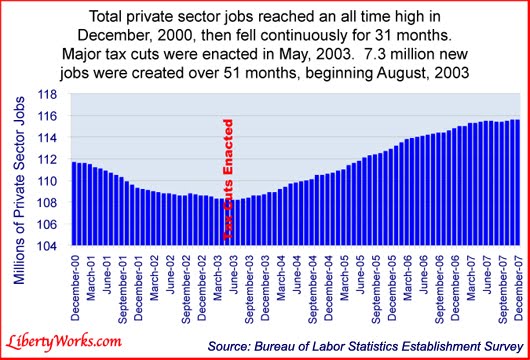
The question of the day is how will Obama turn his record of 6.2 million job losses into a positive number by the end of his four-year term? G.W. Bush cut taxes in his third year, which led to 51 month’s of positive job growth and the creation of 7.3 million jobs (not saved, just created). Obama will commence his third year (2011), 6.2 million jobs in the red, by imposing a tax hike.

Click to Enlarge

Obama is still out on the campaign trail trying to justify his failed economic policies by implying fallacious ideas like how the $80 billion auto-bailout saved the industry. The other day he was boasting about how his policies single-handedly created 55,000 new auto industry jobs, but he failed to mention that the same industry has hemorrhaged 400,000 jobs since 2008 (per Lawrence H. Summers). For the record, that means he’s still 345,000 auto industry jobs in the hole.

Whether Obama cuts or raises taxes will have no positive effect on the economy. Obama could cut the top tax rates down to 28%, like Reagan, but it would still have no effect. Why not? Because one of the keys to positive economic growth is confidence. There is no confidence in Barack Obama, period.

Obama squandered his credibility from day one. His recovery plan failed to contain job losses. His promise to cut taxes for 95% of Americans while accelerating the National Debt to historic proportions is not possible within the realm of human reason. His imposition of a health care mandate despite the will of the majority of Americans sealed his fate. There is no confidence in the president, or in his policies. Confidence will only begin to return when there is a shift in the balance of power. A change in the leadership of both houses of Congress is step one. Step two is the removal of Obama from the White House.

What the facts show (and what is certain) is that since Obama took over the reigns of power, the economy has lost a total of 6 million, 243 thousand jobs. What we don’t know (and what remains uncertain) is which Obama policies are even capable of breakeven. Breaking even means creating 6.2 million new jobs. Saving the job market from further deterioration is a given, not a grand accomplishment. Obama needs to aim a lot higher. Even if he were to actually create 6.2 million American jobs, Obama would still be considered a failure.

Do you have enough confidence in the rules of the game to be able to develop a winning (or survival) strategy? Under the present administration, the rules are not clear. Are your taxes going up next year, or not? Do you have to buy health insurance, or not? Will your health care costs continue to rise? Will your social security and Medicare benefits be cut? Will the government continue to run budget deficits after raising taxes? Even if we knew for certain that the answer to all of the above was affirmative, it wouldn’t make us more confident. There is no confidence, and when there is no confidence, jobs begin to perish.

Bush Tax Cuts

As the website Liberty Works correctly points out, in Bush Tax Cut Myths and Fallacies (1), the Bush tax cuts of 2003 led to quantifiable job growth. In fact, within 3 months of passage jobs were being created, and by the end of 2007 a total of 7.3 million jobs were created. Although progressives like Obama claim that this never happened, the facts are the facts no matter how twisted ones ideology. Thus, if we are comparing Obama and Bush, it should take roughly 3 months for a positive policy to show positive results. The American Recovery and Reinvestment Act (ARRA) was implemented in February of 2009, and 17 month’s later we are 6.2 million jobs in the hole. That’s a clear indication that the ARRA has failed.

Relative Tax Rates

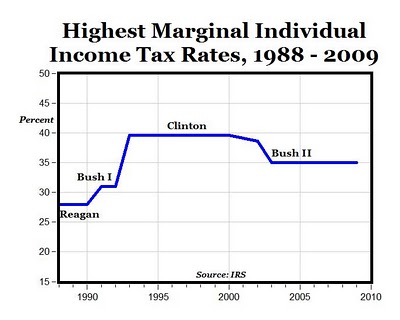
As Mark Perry points out, in Tax Cuts, Tax Hikes, It’s All Relative, tax cuts and tax hikes are pretty much relative. We are historically in a period of low tax rates. So if top tax rates go from 35% back to 39.6% it probably won’t kill the economy, but neither will it spark any positive growth. What will be affected is the level of confidence in a government that needs more and more but still can’t balance a simple budget.

…Certainly, compared to the “Clinton tax hikes” that took effect in 1993 and raised the top marginal income rate to 39.6%, the reductions of the top tax rate to 38.6% in 2002 and 35% in 2003 were “tax cuts” (see chart above).

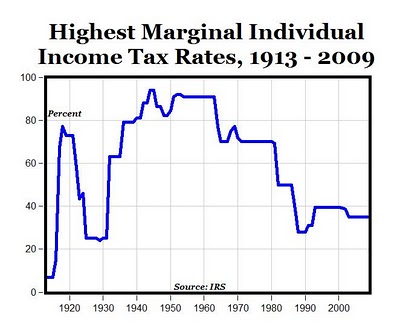
But if you go back further and compare the Bush tax rates to the highest marginal tax rates under Bush, Sr. (31%) and Reagan (28%), couldn’t the Bush II tax rates more accurately be referred to as the “Bush tax hikes”? Of course, the tax rates were much higher before 1988, here’s the full history back to 1913 in the chart below. Compared to most of the tax rates between the 1930s and the 1980s, couldn’t the Clinton tax rates also accurately be referred to as the “Clinton tax cuts”?

It’s not about tax hikes, it’s about how to grow the economy and how to create jobs. Clinton raised taxes during a period of economic growth, not to recover from a recession. If Obama can create jobs in a recession by raising taxes, then ‘God bless him’. But if Obama’s tax hikes lead to further job losses, forget about it. Fool me twice, shame on me. Fool me three times, and I must be a fool. Yet fools we are not.

“Confusing legislation, high unemployment, record deficits, and impending tax hikes do not confidence make.”

Related: Obama on Jobs: Worst Track Record in History

References: Bureau of Labor Statistics Official Data

2011 Tax Hike: Progressive Style

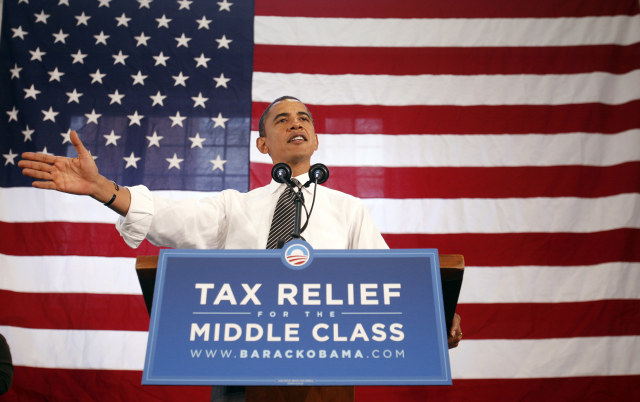
Tax Relief for the Middle Class (whatever middle class means)

by: Larry Walker, Jr.

With the imminent expiration of the Bush tax cuts, Mr. Obama and his progressive minions fathom that its termination doesn’t really constitute a tax increase. It’s not a tax hike in their minds, it’s just the conclusion of another failed Bush policy which helped contribute to the ‘great recession’. So in 2011, when your taxes climb, and they will advance across the board (as shown here), you shouldn’t blame Obama. Paying a little bit more shouldn’t be a problem now, because we are far better off today under Obama’s economic stimulus, than we were in all of 2001 through 2008. Right?

Leave it to Barack H. Obama, II to have an answer for every problem facing Americans today.

You got problems? Obama’s got solutions.

Problem: You are upside down on your mortgage and can’t see the light of day.

Solution: That’s not my fault, it’s Bush’s fault. You’re still getting a tax hike.

___

Problem: You are still trying to work out a loan modification to try to save your home.

Solution: Hopefully that will work out, but right now I need to raise your taxes.

___

Problem: You recently lost your home and are struggling to make ends meet.

Solution: So sorry, but I gotta raise your taxes too.

___

Problem: You’re on 99 weeks of extended unemployment benefits due to a rotten economy and the failed stimulus program.

Solution: Be sure to have taxes taken out of it, because you’re getting a tax hike too.

___

Problem: You haven’t saved enough for retirement and you are trying to find a way to save more.

Solution: Well, if you have money to save, then you can pay more taxes. You’re definitely getting a tax hike.

___

Problem: Your business suffered massive losses over the last two years and you’re still paying off loans and credit lines, and trying to dig your way out of a hole.

Solution: We all have to do our fair share. A tax hike for you.

___

Problem: The Gulf of Mexico oil spill completely destroyed your livelihood and you don’t know what you’re going to do.

Solution: That’s BP’s fault, not mine. Set some of that BP money aside, because you’re getting a tax hike too.

___

Problem: You’re already working two jobs and still living paycheck to paycheck.

Solution: Try to cut back on expenses, or get a third job, because you’re getting a tax hike too.

___

Problem: You’re one of the 1.4 million who filed for bankruptcy last year.

Solution: Now that all of your debts are out of the way, paying more taxes should not be a problem. Tax hike!

___

Problem: You’re one of the 40 million Americans currently on food stamps.

Solution: Since there will be 3 million more on food stamps next year, we have to raise taxes on everyone else to help out folks like you. And if you earn enough income to be taxed in the near future, don’t you worry, you’re getting a tax hike too.

___

Problem: You’ve paid taxes your whole life, and you’re worried that the reinstatement of the 55% estate tax in 2011 will force the sale of your family business.

Solution: If you leave an estate worth over $1 million, your estate will be forking over the 55%. But, since you’ll be dead by that time you shouldn’t worry about it so much. When we spread the wealth around it’s good for everybody.

___

Problem: You’re worried about how the known (and hidden) taxes in Obamacare, the Stimulus Act and other stealth legislation will affect you on top of the 2011 tax increase.

Solution: Don’t worry about it. You’ll find out when we do. Once we finally finish reading and interpreting all of this mess, … I mean reform, we’ll let you know.

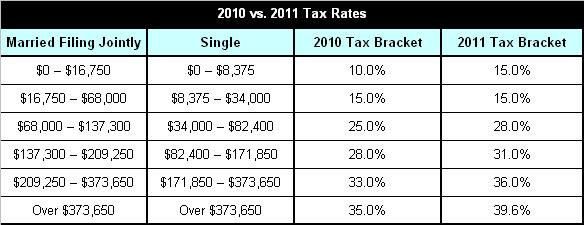
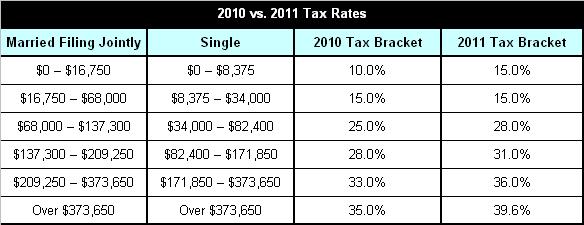
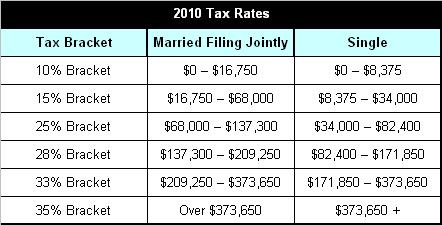
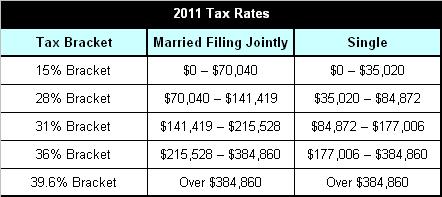
Here’s what our current tax rate schedule looks like as compared to what the 2011 rates may look like (assuming no adjustment for inflation):

2010 vs. 2011 Tax Rates

Obama and the progressives want to somehow let the Bush tax cuts expire for anyone making over $200,000 per year, but it’s not clear whether or not tax rates for those below that amount will revert to pre-2001 levels. Since there is no cut-off at $200,000 per year under our current tax rate schedule, Obama will need to invent a new tax rate schedule. Here’s what an Obama tax rate schedule might look like:

Obama's Tax Rate Schedule?

Under current tax law, those making over $373,650 a year are considered wealthy, but from now on, if you make over $200,000 a year (formerly $250,000) you’re rich, because Obama says so.

Unusual uncertainty remains unusually uncertain.

It will be interesting to see how Congress resolves this. If Congress fails to take action, taxes will rise across the board, by default. Waiting until after the November elections is not an option.

2011 Tax Jam: Wrong Way, Wrong Road

Directions for Misguided Democrats

by: Larry Walker, Jr.

In my last blog post, 2011 Tax Increase: A Reality Check, I attempted to point out how the Bush tax cuts applied to all Americans at every level of income, and that with their expiration at the end of 2010, income taxes will rise across the board. Although valid enough to ignite renewed interest, I now want to expand on this in a more technical manner with examples.

The following table compares the pending change in tax rates (assuming no change for inflation).

2010 vs. 2011 Tax Rates

As evident with a quick glance, those in lower income levels will see their taxes increase the most with taxes increasing by 50% (from 10% to 15%), but this doesn’t tell the whole story. Only by looking at effective tax rates, can we see the impact of the pending tax increase on hard working Americans, and small business decision makers. [Note: The effective tax rate is calculated by dividing the amount of taxes paid, by the amount of gross income.]

When it comes to taxes, there are many variables that will effect the calculation of ones effective tax rate, such as filing status, number of children, whether or not one itemizes deductions, and whether one has income from pass-throughs (i.e. Partnerships, and S-Corporations), or from capital gains. So in an effort to keep this somewhat simple, the examples that follow assume a married couple without children, without capital gains, who does not itemize deductions, and whose income is limited to $500,000.

[Note: The following tables place income on the cusp of each tax bracket, and thus were prepared on a ‘give or take a dollar or two’ basis. (You may click on each table to enlarge.)]

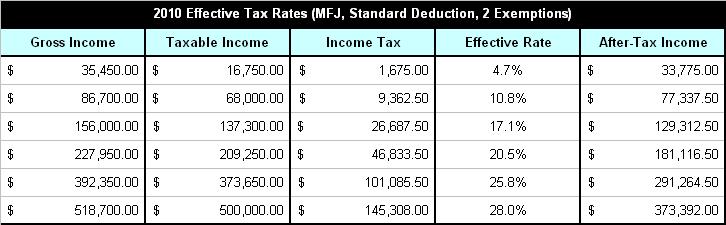
2010 Effective Tax Rates

2011 Effective Tax Rates

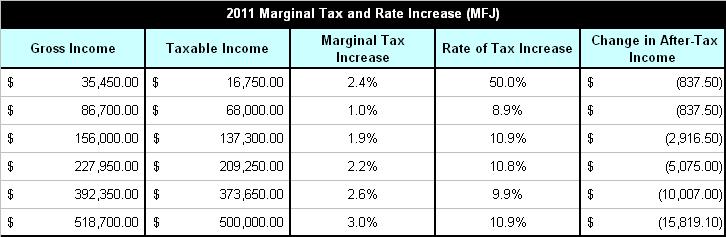
2011 Marginal Tax and Rate Increases

Example 1 – 10% Bracket: Joe and Jane are married and have combined wages of $35,450.00. In 2010 they will pay income taxes of $1,675 with an effective tax rate of 4.7%. Their 2010 after-tax income is $33,775. In 2011 they will pay income taxes of $2,512.50 with an effective tax rate of 7.1% which represents a tax increase of 50%. Their after tax income in 2011 will fall by $837.50.

Example 2 – 15% Bracket: Lance and Lori are married and have combined income of $86,700.00. In 2010 they will pay income taxes of $9,362.50 with an effective tax rate of 10.8%. Their 2010 after-tax income is $77,337.50. In 2011 they will pay income taxes of $10,200 with an effective tax rate of 11.8% which represents a tax increase of 8.9%. Their after tax income in 2011 will fall by $837.50.

Example 3 – 25% Bracket: Nick and Nancy are married and have combined income of $156,000.00. In 2010 they will pay income taxes of $26,687.50 with an effective tax rate of 17.1%. Their 2010 after-tax income is $129,312.50. In 2011 they will pay income taxes of $29,604.00 with an effective tax rate of 19.0% which represents a tax increase of 10.9%. Their after tax income in 2011 will fall by $2,916.50.

Example 4 – 28% Bracket: Paul and Penny are married and have combined income of $227,950.00. In 2010 they will pay income taxes of $46,833.50 with an effective tax rate of 20.5%. Their 2010 after-tax income is $181,116.50. In 2011 they will pay income taxes of $51,908.50 with an effective tax rate of 22.8% which represents a tax increase of 10.8%. Their after tax income in 2011 will fall by $5,075.00.

Example 5 – 33% Bracket: Ronald and Rhonda are married and have combined wages $392,350.00. In 2010 they will pay income taxes of $101,085.50 with an effective tax rate of 25.8%. Their 2010 after-tax income is $291,264.50. In 2011 they will pay income taxes of $111,092.50 with an effective tax rate of 28.3% which represents a tax increase of 9.9%. Their after tax income in 2011 will fall by $10,007.00.

Example 6 – 35% Bracket: Tom and Tammy are married and have combined income of $518,700.00. In 2010 they will pay income taxes of $145,308.00 with an effective tax rate of 28.0%. Their 2010 after-tax income is $373,392.00. In 2011 they will pay income taxes of $161,127.10 with an effective tax rate of 31.1% which represents a tax increase of 10.9%. Their after tax income in 2011 will fall by $15,819.10.

Does the government deserve 30-40% of your money? From the examples provided, those making over $392,350 will pay between 31.1% up to 39.6% of every additional dollar earned in taxes. This particularly impacts small business owners whose income is taxed at the personal level. It’s hardly worth the effort to expand operations and provide jobs when the government will get 30% to 40% of the paper profits.

All income is not created equal. The federal government should understand that just because a small business has taxable income of $400,000 doesn’t mean that its owner has $400,000 in the bank. Some of that money was used to pay non-deductible principal payments on loans, and some of it is necessary for working capital in order to continue operations. Although the interest paid on loans is deductible for tax purposes, principal repayments are not, so the government really shouldn’t assume that taxable income is the same thing as disposable income.

A tax increase is a tax increase. Those making under $36,000 per year will see the highest tax rate increase of 50%. Although those making between $36,000 and $87,000 will see the smallest increase at potentially 8.9%, a tax increase is a tax increase. For those in the remaining brackets, taxes will increase by approximately 10% to 11%. This is a far cry from Obama’s bold declaration that we would not see our taxes increase by ‘one dime’. Technically it will be more like a dime to fifty cents on the dollar. Yes, income taxes will increase for all who pay taxes, without quick action.

Taxes will rise by a lot more than a dime. When the Bush tax cuts expire at the end of this year, couples making over a nickel and under $500,000 per year, will see their effective income tax rates rise, from between 8.9% to 50.0%. Lower income wage earners face the largest increase. Couples with income above $392,350 will be effectively handing the government 30% – 40% of each additional dollar earned.

Unusual uncertainty is unusually uncertain. The longer Congress delays in giving the public clarity, the more prolonged this period of ‘unusual uncertainty’. Individuals and small businesses are already in process of making plans for the remainder of 2010 and forward, and without knowing for certain whether or not the Bush tax cuts will be extended, planning has come to a halt. Under the assumption that taxes will rise in 2011, plans for further spending in 2010 have been shelved, because those deductions will be of better use next year. Delaying a decision until year-end would not be wise.

What’s your total tax bill? Now when you add to the above effective tax rates: State and Local taxes, Social Security and Medicare taxes, sales taxes, property taxes, excise taxes; and possibly new health care and carbon taxes, the situation is not only unusually uncertain, but unbearable and unsustainable. Politicians should listen when taxpayers holler the acronym, T.E.A., which stands for taxed enough already. Congress should not only re-instate the Bush tax cuts, but should consider further cuts in both income taxes and its own out-of-control spending (which leads to higher and higher taxes). Failure to take the public seriously will result in the death of the American economy. Yes, Misguided One, when it comes to taxes and spending, we wish to go backwards, not further into the abyss.

A Potential Solution – One solution would be to extend the Bush tax cuts for another three years with one minor change. There should be an additional standard deduction granted to small business owners. Job creators who own Partnerships and S-Corporations should specifically be granted an additional deduction based on the level of business income reported on their personal tax returns. This incentive would encourage small business owners to expand, will create more jobs, and will improve the overall economy. Let’s start putting the incentive where it matters and stop punishing those who drive the American economy.

Related: Liberals, Conservatives Agree: Re-Imposing the Death Tax Designed to Penalize the Wealthy

2011 Tax Increase : A Reality Check

Income Tax Reality Check

Compiled by: Larry Walker, Jr.

“If you make less than $250,000, you will not see your taxes increase by one dime.” ~ B. H. Obama

Left-wing pundits are claiming that the Bush tax cuts were for the wealthy, which is simply not true. Next year when the 10% tax bracket disappears, and tax rates return to pre-2001 levels, will represent an across the board tax increase affecting every American. In addition, the child tax credit will return from $1,000 (per child under age 17) to $500 representing a tax increase for everyone who has children, not the wealthy. The fact is that the Bush tax cuts applied to every American at every level of income, and when they expire taxes will rise from the bottom up.

In 2011, if you make over a nickel in taxable income, your taxes will increase a minimum of 9%, and as much as 50%. Since our tax rates are progressive, taxes on the first $16,750 for couples ($8,375 for singles) will increase by 50%. Taxpayers who make under $8,375 in taxable income will see the largest tax increase at 50%. Middle income earners will see their taxes rise by no less than 9%. The contention that the Bush tax cuts only affected the wealthy is a bald-faced lie. Similarly, the contention that Obama’s tax increases will only affect the wealthy is nothing but a fairy tale. Americans are educated and can comprehend income tax tables. You can choose to believe whatever you want, but reality should not be optional.

2010 Tax Brackets

Nickel over at fivecentnickel.com has projected how the 2011 income tax brackets may look. The commentary below is attributed to Nickel. I have retouched his 2011 table (below), and added the 2010 table (above) for comparison.

Income tax bracket changes for 2011 – In case you weren’t aware, the Bush tax cuts of 2001 and 2003 are set to expire at the end of 2010. Thus, if Congress doesn’t act, the relatively low income tax rates that we’ve been enjoying (hah! enjoying?) will soon be a thing of the past. They will be replaced by the pre-2001 tax brackets.

In other words, the 10%, 15%, 25%, 28%, 33% and 35% tax brackets that we’ve grown accustomed to will be replaced by 15%, 28%, 31%, 36%, and 39.6% brackets. It’s hard to say exactly where the income cutoffs will lie, but if we base the numbers on the 2010 income tax brackets and add 3% for inflation, the 2011 tax brackets might look something like this:

2011 Projected Tax Brackets

Capital gains tax changes in 2011 – Beyond the increased federal income tax brackets, the capital gains tax rates will also be changing (and not for the better). The top rate for long-term capital gains will be rising from 15% to 20%, and the 0% rate for those in the lowest tax brackets will be replaced by a 10% long-term capital gains rate.

Why worry about 2011 income tax changes? – Since the 2011 tax year is so far off, you might be wondering why we’re even talking about it right now. Well, as I noted above, the time to be planning for things like this is right now – before the changes go into effect as these potential income tax rates have the potential to take a big bite out of your savings account.

What sort of planning should you be doing? I can think of several things off the top of my head. For starters, if you’re in a position to accelerate income from 2011 into 2010, you might want to do so. In many cases this is easier said than done, but it’s worth exploring if you’d like to shield your income from the potentially higher rates.

Also, if you’re anything like me, you may wait until the end of the year to make your charitable donations. If so, then by waiting just a few more days (until January 1, 2011) to write that check, you could net a substantial tax savings. While you’d have to wait longer to claim the deduction, it might be worth it.

Similarly, if you anticipate selling investments to generate cash during 2011, you might consider moving that up to the end of 2010 to get in on the (presumably) lower capital gains tax rates.

Reference: http://www.fivecentnickel.com/2010/02/15/2011-federal-income-tax-brackets-irs-income-tax-rates/

Obama on Jobs: Reality is Not Optional

Reality is not optional

To: Obama and other Quasi-Socialist Progressive Fundamentalist Racism Chasers

In response to various comments regarding my last blog post: Obama on Jobs: Worst Track Record in History.

By: Larry Walker, Jr.

Actually the full quote as attributed to Economist, Thomas Sowell was: “Hope is not reality, and reality is not optional.”

Of all the jobs created, and recovered before progressives co-opted the Democrat party, how many were created by the lie that it is up to the Government to borrow money and use it to provide economic stimulus? The answer is none. The old liberal policy used to be called tax and spend (i.e. get the money first and then spend it). The tried and true conservative policy is to cut taxes and let the people spend their own money (i.e. let the free market dictate). The progressive slant has regressed into a new policy called, borrow and spend (i.e. borrow money by the trillion, spend it first, and then tax the hell out of anyone who survives).

We know that the first two methods worked to some degree, although we often disagreed on which was better. All we have to do is go back in history to measure their results. The goal has always been to grow our economy in line with the population, with limited inflation and full employment. But under this new borrow and spend philosophy, all we have is the hope that, if you are ever able to get your head above water, you will be taxed back into oblivion to pay for all the money spent to get you there. In the meantime you just hope that the $250 or $400 per year government handout is enough to get you by.

The hope that an unproven policy will be able to produce the same result as proven methods is not only uncertain, but in this matter impossible. Uncertainty is optional, but reality is not.

Joe Biden recently stated, “We will never be able to recover the eight million jobs that were lost.” Why would he say that? Because there is no way that it can be done under progressive ideology. It doesn’t take a rocket scientist to figure that out.

Under progressive ideology, the economy is something that will continue to function efficiently no matter which policies are crammed down its throat: stimulus, health care, energy policy, financial reform, etc… All of which may be noble goals in a fictitious world, but neither has anything to do with economic growth, nor job creation. True, each may create a few (net) jobs in the next 20 to 40 years, but there may not be any need by that time. In the end, you may be able to force all of these wonderful policies upon the peons, but by then no one will care because the great economy that once existed will be no more.

We need an economy that works for us today, not 20 years from now.

In reality, mandatory health insurance won’t do much good if there are no doctors or hospitals to visit. And where will one go to purchase it when all the insurance companies are gone? Renewable energy and carbon taxes won’t do much for the masses then living in cardboard boxes. Financial reform will be for naught if no one has any money left to save or invest. You can’t have it both ways. Either you put jobs and the economy first, or you fail on all counts.

Hoping that an unproven set of policies will work is not reality. We gave it a shot by spending well over $1 trillion, and it didn’t work. The national debt is now almost 100% of GDP and there is nothing to show for it. So what do you want to do? Do you want to keep on borrowing and stimulating until there’s nothing left? Or should we perhaps pause and consider making a u-turn? I say we heed the warning and make a u-turn before it’s too late.

We know what works, all we have to do is look back in our history at the policies that made America great.

“Reality is not optional.”

___________________________

My previous blog post may also be found at the following sites:

http://www.bookerrising.net/2010/06/larry-walker-jr-commentary-obama-on.html and,

http://aipnews.com/talk/forums/thread-view.asp?tid=15308&posts=1#M40159

Obama on Jobs: Worst Track Record in History

Obama: Worst President in History Award

Progressive Policies are Losing 4.2 Million Jobs Annually

By: Larry Walker, Jr.

On January 9, 2009, a staff writer for the Wall Street Journal wrote a smear piece entitled, “Bush On Jobs: The Worst Track Record On Record,” in which an attempt was made to show that Bush was somehow the worst President, and that therefore, Conservative economic policies (i.e. tax cuts) don’t work.

According to the staff writer, George W. Bush created a dismal +375,000 jobs per year during his eight year term; Bill Clinton created +2.9 million jobs per year; while George H.W. Bush created +625,000; Reagan prospered by +2.0 million; Carter by +2.6 million; etc… The staff writer also went into population growth during each term and the percentage of change in the population (for whatever reason). You can find the smear piece and the WSJ table here. Following is an excerpt:

President George W. Bush entered office in 2001 just as a recession was starting, and is preparing to leave in the middle of a long one. That’s almost 22 months of recession during his 96 months in office.

His job-creation record won’t look much better. The Bush administration created about three million jobs (net) over its eight years, a fraction of the 23 million jobs created under President Bill Clinton’s administration and only slightly better than President George H.W. Bush did in his four years in office.

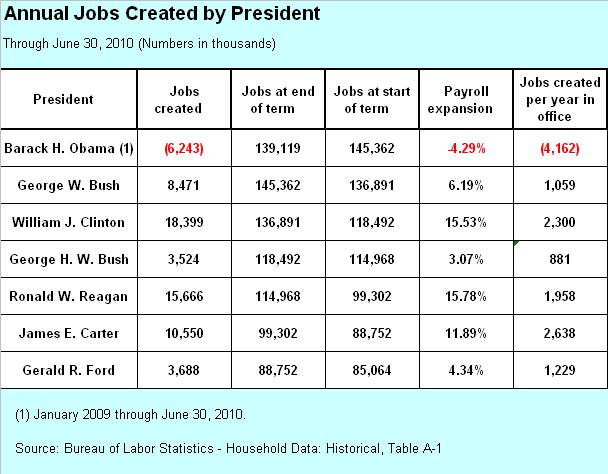
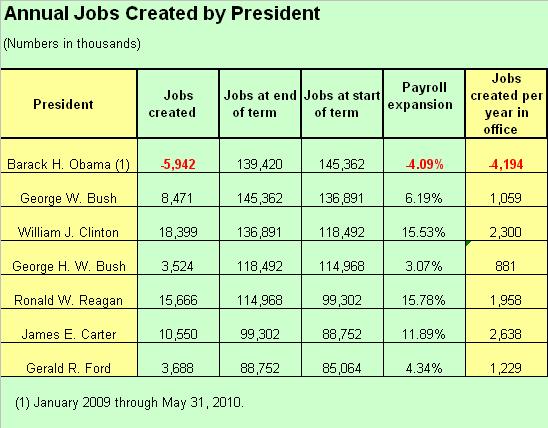
Naturally it is important to use this same benchmark to measure how Barack H. Obama stacks up against his predecessors. So I went over to the good old Bureau of Labor Statistics website and made up my own table, based on the raw data. I brought my chart up to date through May 31, 2010. True, Obama has only been in office for 17 month’s, but we can at least get an idea of how he measures up.

Like the WSJ writer, the counts are based on total payrolls between the start of the month the president took office (using the final payroll count for the end of the prior December) and his final December in office (May 31, 2010 for Obama). Thus, there is no blaming the last POTUS for inheriting a bad economy, and no foul in taking credit for inheriting a good one. After all, being President is about leadership, and leaders take what is in front of them and do the best they can.

Net Job Creation by President (Click to Enlarge)

According to my table, Barack Obama has lost a total of -4.2 million jobs per year, making him, to date, the worst President in history. G.W. Bush actually created 1.1 million jobs per year during his eight-year term. Bill Clinton is responsible for 2.3 million jobs in each of his years. George H. W. Bush can lay claim to 881,000 during each of his four years. Reagan gets credit for 2.0 million jobs per year. And finally, even Jimmy Carter can boast in having created 2.6 million jobs per year. Net job creation is so much better than, economy killing, Progressive policies that there really is no comparison.

Now I am not naïve enough to believe that Presidents, or that governments for that matter, are responsible for job creation, but if you want to make that case, at least get the numbers right. It looks like the WSJ staffer padded Clinton’s numbers while taking away from both of the Bush’s. At the same time, he did manage to get both Reagan’s and Carter’s numbers right.

In conclusion, thus far, the Progressive policies of Barack H. Obama are failing. There ought to be a law. Actually there is a law. It’s called, ‘The Law of Supply and Demand’. When prices fall, demand increases. When taxes are reduced, investment, production and employment increase. And when supply is increased, prices fall, leading to increased demand. Government intervention in the private sector has never worked, and it never will. Reducing the size of government, lowering taxes, and decreasing government regulation actually work after all. We will most definitely be following up.

References:

ftp://ftp.bls.gov/pub/suppl/empsit.cpseea1.txt

http://blogs.wsj.com/economics/2009/01/09/bush-on-jobs-the-worst-track-record-on-record/

Progressive Regression II | Financial Regulation Crisis

– By: Larry Walker, Jr. –

Government Regulation vs. Self-Regulation

Once again, the Progressive Obama Administration’s magical solution, for all problems American, is more government regulation. But is government regulation really any better than self-regulation? Progressive government regulation is even worse. (A Progressive regulator is pictured to the left.)

I contend that banks and financial services companies have a direct interest in the safe, efficient, and profitable business of making loans, investments, and protecting assets. Would it benefit a bank to carelessly make loans to unqualified borrowers, taking the risk of never being repaid? No. Would it benefit a financial services company to recommend investments in financial instruments that continually lose money? No. Every private sector company has a direct interest in self-regulation.

Surely there will be incidents of fraud, theft, and abuse, but when such incidents occur, private companies will pay stiff fines under applicable Federal and State laws. When it is discovered that laws have been violated, corporate employees, and executives often face stiff fines and/or prison time. But what happens when government regulators screw up?

On August 9, 2007, former SEC Commissioner, Roel C. Campos officially announced his resignation.

On October 2, 2007, former SEC Commissioner, Annette L. Nazareth, a nine-year SEC veteran, officially announced her resignation.

On August 13, 2008, Florida’s top financial regulator, Don B. Saxon resigned before he could be fired. He was blamed for lax enforcement of state laws which allowed convicted felons to be licensed as mortgage brokers, including individuals who took part in mortgage fraud.

On January 26, 2009, Timothy Geithner, former President of the Federal Reserve Bank of New York, was sworn in as Secretary of the Treasury.

On May 7, 2009, Stephen Friedman, the former chairman of the Federal Reserve Bank of New York, abruptly resigned; days after questions arose about his ties to Goldman Sachs.

When regulators make costly mistakes most of them simply resign, disappearing into the shadows with taxpayer funded golden-parachutes. However, in some cases (Geithner) they get promoted. So there is no accountability when it comes to government regulation.

The case against more government regulation:

Raymond Richmond, in his latest article, Geithner and Summers Make Their Economic Mistakes Transparent, reminds us that the last major governmental intrusion into the private financial sector is what created our current recession. Instead of learning the valuable lesson that ‘government regulation equals no regulation’, the Progressive Obama Administration’s solution, like a junkie in relapse, is more of the same. “This time it will be different.”

“Here at home, we are on the verge of completing the most sweeping financial reform in more than 70 years.”

They failed to mention that the last major intervention in bank regulation caused this recession. Beginning in 1977 with the Community Reinvestment Act, every administration pressured the banks to make loans on easy terms, turning their eyes away from the housing bubble they were causing and the dangerous lack of collateral backing most mortgages. Government created two Government Sponsored Enterprises, Fannie Mae and Freddie Mac to create a secondary market for such ill-fated loans. Wall Street got into the act and created derivatives which brokers sold all over the world. When the housing bubble burst, the U.S. and Europe’s largest banks and insurance companies faced bankruptcy, and stock markets round the world collapsed. The U.S. does not need new bank regulations; it needs to keep the politicians from making decisions that should be left to the shareholders of private firms who have the major stake in the firm’s success. This is the lesson that should be learned around the world.

The past year and a half has seen unemployment grow in the U.S. to double digits, factories disappear, witnessed a worsening in the distribution of income, saw soaring government budget deficits, saw the U.S. dollar, the world’s standard, lose more than a third of its value in foreign exchange.

Prospects have never been worse. And all of these are the product of government intervention in the private economy. This is the lesson the G-20 ought to learn, government intervention in the economy usually does more harm than good. That would include intervention in the economy by the G-20, should it become an institution that makes and enforces decisions.

Michael Pomerleano in a Financial Times article entitled, The Failure of Financial Regulation, explains how government regulation failed. This is more proof that all of the time, effort, and money spent on government financial regulation has been for naught.

The regulation and supervision of the banking system rest on three pillars: disclosure to ensure market discipline, adequate capital and effective supervision.

Did the regulatory philosophy governing our financial markets withstand the test of the recent crisis? My conclusion is that all three regulatory pillars failed.

Was adequate information available before the crisis erupted? The information on the subprime exposure was out there for anyone who had the determination to collect and [analyze] the (sometimes patchy) data from quarterly 10Q reports filed with the Securities and Exchange Commission for US banks, supplemented by rating agencies’ and investment banks’ research reports.

A final question we need to ask is how effective was the supervisory apparatus in this crisis?

It is reasonable therefore to infer that the regulatory agencies would have taken notice of those estimates as early as the autumn of 2007. For a long time the regulatory and supervisory apparatus was silent.

We need to question why didn’t any regulator add up the potential size of the losses on the sub prime exposure, based on publicly available information, and verify them with on-site examinations?

Why wasn’t there a far more forceful response from the supervisory agencies? Equally, we should have expected credit rating agencies, investment research and investors to respond more forcefully. In this context, one can only express puzzlement and disappointment at the tepid regulatory reaction. Only after the monumental policy mistake of allowing Lehman Brothers to fail, did the authorities grasp the full significance of the problems and we witnessed a systematic effort to manage and contain the crisis.

Finally, Glenn Hubbard in his Harvard Business Review Article, Financial Regulation: It’s Not About More, reminds us that over-regulation by the government can do more harm than good.

…the economic concern that over-regulation of financial instruments and institutions in the name of safety can lead to aggregate harm — most obviously by raising the cost of funds to household and business borrowers. The key is to design regulation to insure proper pricing of risk and information about risk — such an approach (not that really taken in the bill winding its way through Congress) offers the right balance between protection of the individual and society.

The end result of the Progressive Obama Administration’s magical plan of more government regulation will lead directly to higher costs for American consumers and businesses. Businesses will pass their costs on to customers. Consumers will be hurt. Those who get hurt the most will be those on the lowest end of the economic food chain. Thus, the end result of Barack Obama’s cowardly, status quo, regressive, regulation policies will be to harm those that he claims to be helping.

Smaller government and less governmental regulation will lead to lower taxes, lower consumer prices, greater accountability, more freedom, and more opportunities for wealth creation. What exactly have we gotten in return for all of our money that has been squandered on regulating the financial industry? What will we get with Obama’s ‘more of the same’ approach?