U.S. Jobs Deficit Increases by 72,000 in August

Obama’s Cure – More Jokes

– By: Larry Walker, Jr. –

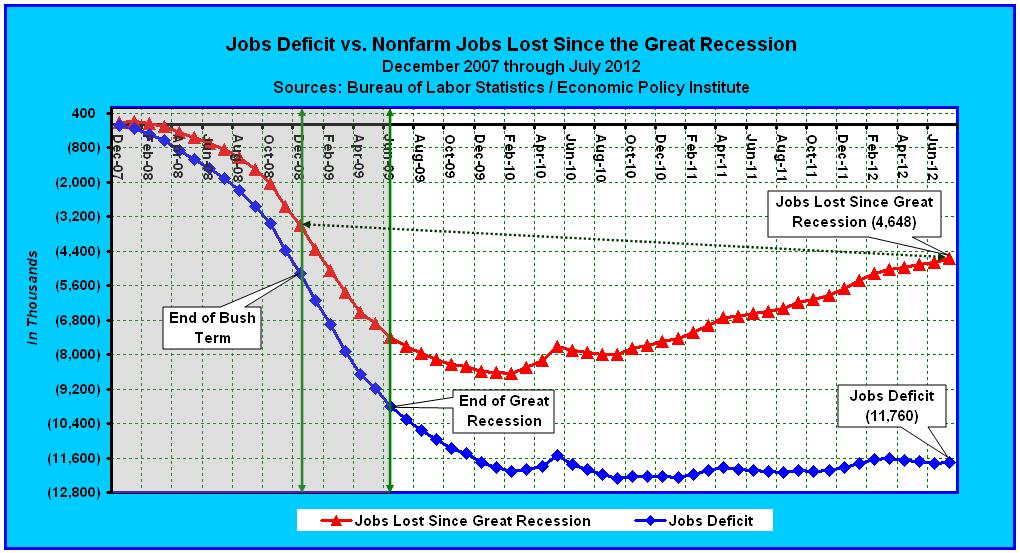
The U.S. Jobs Deficit increased by 72,000 in August, rising from a deficit of 11,760,000 in July to 11,832,000, based on Friday’s Employment Situation Report. The economy added a mere 96,000 jobs in August, while June and July’s numbers were revised downward by 41,000. Thus, the U.S. realized a net gain of 55,000 Nonfarm jobs in the month of August. But since the economy needs to create 127,000 jobs a month in order to keep up with population growth, this resulted in an overall increase to the jobs deficit of 72,000, as compared to the previous report.

Having been informed of the news prior to his DNC acceptance speech, that the hopes and dreams of another 72,000 Americans had been decimated, along with those of an estimated 27 million who were already unemployed or underemployed, Barack Obama slid into his quotidian comedy routine, ridiculing conservative economic policies, stating that, “They want your vote, but they don’t want you to know their plan. And that’s because all they have to offer is the same prescription they’ve had for the last thirty years: ‘Have a surplus? Try a tax cut.’ ‘Deficit too high? Try another.’ ‘Feel a cold coming on? Take two tax cuts, roll back some regulations, and call us in the morning!’”

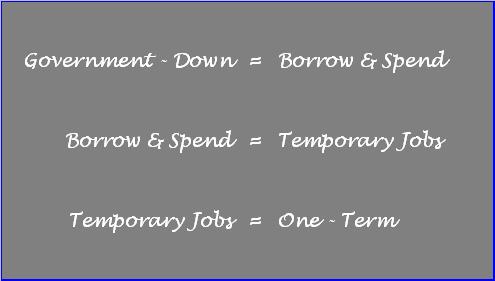
Here’s the big picture. We had a recession which lasted for the last 12 month’s of the Bush term through the first 6 month’s of Obama’s, not for the last 30 years. Today 12,544,000 Americans are counted as officially unemployed. Another 7,031,000 are unemployed and want jobs, but have dropped out of the labor force and are thus not officially counted. And still another 8,031,000 are employed part-time for economic reasons. The truth is that if Barack Obama’s government-down, borrow-and-spend policies worked, then the jobs deficit wouldn’t be worse-off today than it was in December 2009, yet it is. So enough with the jokes, how many jobs need to be created each month in order to reach full-employment, and how long will it take? And in light of the answer, is four more years of Obama’s deficit spending and light-mindedness the cure?

Obama Got Jokes

No Mr. President, it’s not a surplus, or a cold that we feel coming on, it’s something much more fatal. You see, the U.S. National Debt surpassed the $16 trillion mark before Obama took to the podium. And why is this problematic? Well for one, the USA’s credit rating was already downgraded once on Obama’s watch, on August 5, 2011, the first such occurrence in American history. And secondly, because Barack Obama’s prescription for all that ails our economy is the same one he’s offered for the last 4 years: ‘Debt too high? Borrow and spend some more.’ ‘Entitlement spending bankrupting the nation? Add a new entitlement (Obamacare), then borrow and spend even more.’ ‘Job creation numbers insufficient? Tell more jokes, then borrow and spend a little bit more.’

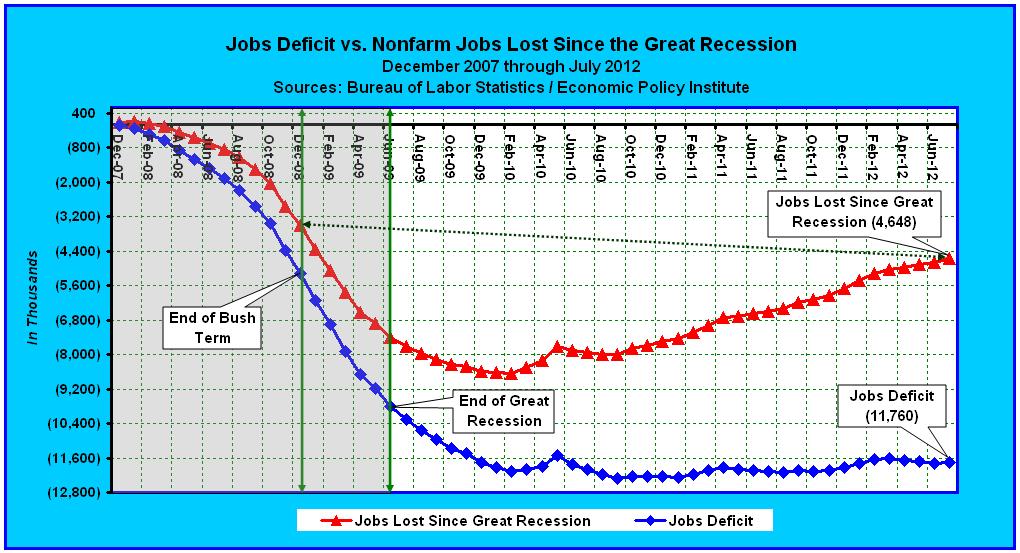
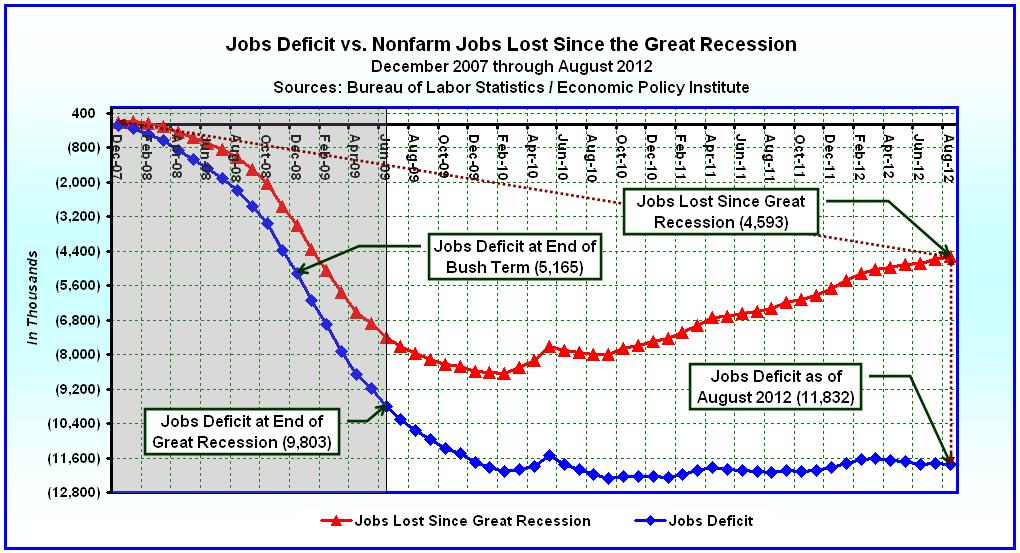
Yet while Barack Obama has elected to waste the last four years of our lives running up the national debt, while capping on conservative economic policies, the U.S. jobs deficit has increased from 5,165,000 in December 2008 to 11,832,000, an increase of 6,667,000 (see chart below). Essentially, what this means is that since Obama implemented his $831 billion Stimulus plan, the economy has been unable to create a sufficient number of jobs for 6,667,000 new entrants, many of whom have been ushered straight out of high school or college into hopelessness and generational dependency. Do you think this is funny? I don’t. Exactly where have four years of Barack Obama’s borrow-and-spend prescription refills landed us?
Updated Jobs Benchmark

Updating Economist Paul Krugman’s job creation benchmark with the latest figures, we discover that to be meaningful, the number of jobs needed to return to more or less full employment by December of 2014, or within the next 28 months, is now 549,571 jobs a month, as follows:

  • In order to keep up with population growth, we would need to create 127,000 jobs times 28 months, or 3,556,000. Add in the need to make up for the jobs deficit and we’re at around 15,388,000 (3,556,000 + 11,832,000) over the next 28 months — or 549,571 jobs a month.

If we extend the target date to 5 years from today, which will be more than 8 years from the time the recession ended, then the number of jobs needed to return to more or less full employment by August of 2017, or within the next 60 months, is now 324,200 jobs a month, as follows:

  • In order to keep up with population growth, we would need to create 127,000 jobs times 60 months, or 7,620,000. Add in the need to make up for the jobs deficit and we’re at around 19,452,000 (7,620,000 + 11,832,000) over the next 60 months — or 324,200 jobs a month.

Did the U.S. add 549,571 jobs last month? Nope. In fact we haven’t come anywhere close in any month during the entire Obama recovery. Did employers add 324,200 jobs last month? Nope. In fact, we haven’t even come close to this number in any month during the entire Obama recovery, except for the single month of May 2010, but those were just temporary Census jobs that went away in subsequent months (see the related table).

The sad truth is that the U.S. only added 55,000 Nonfarm jobs in August (+96,000 minus 41,000 of previous overstatements). And because the jobs deficit increased by 72,000, we are currently on track towards a permanent decline. In other words, it is impossible to reach full-employment while the jobs deficit is increasing. Thus, we are NOT moving in the right direction, we are moving towards another recession. We have wasted 44 months coping with the unreasonable economic policies of Barack Obama, and what did we get in return? We are worse off today than before he started.

Incomplete or Deficient?

At this point, we either need to create 549,571 jobs each and every month to be on a track towards full employment within the next 28 months, or 324,200 jobs each and every month to be on track towards full employment within the next 5 years (which will be more than 8 years from the end of the recession). And although Barack Obama has orated a plan which would add 600,000 new jobs in Natural Gas by 2020 (or over the next 8 years), and 1,000,000 new Manufacturing jobs over the next four years, we are forced to give his plan a grade of “D” for deficient. Under Obama’s government-down, borrow-and-spend economic policies, most of us will indeed be in “a better place” by the time the U.S. reaches full-employment.

A lot of my friends, neighbors, and clients lost their jobs, lost their homes, divorced or filed for bankruptcy over the last 3 years and eight months. My neighborhood has been decimated, as our homes have lost a third of their value. Our business revenues have declined and leveled off at a lower tier. And as far as I can see, only one political party offers any hope of turning things around. The Obama-Biden plan includes a goal of creating 1,000,000 new manufacturing jobs over the next four years, which would be great, because their policies have thus far resulted in a loss of 582,000 manufacturing jobs since January 2009. In stark contrast, the Romney-Ryan Plan includes a goal of creating more than 12,000,000 jobs in the next four years, which is entirely doable.

I don’t care what the policies are as long as they lead to the desired result. The Obama-Biden goal is deficient. Even if the plan works, it won’t result in a sufficient number of new jobs to even keep pace with population growth (127,000 a month / 1,524,000 per year). In fact, Obama has set the bar so low that his plan is incapable of eliminating the jobs deficit, even if granted a second term. So what’s the point? Based on our current trajectory, Obama’s plan never comes close to full-employment, ever.

If you think that adding $5.3 trillion to the national debt over four years, establishing a goal of 1,000,000 new jobs when more than 12,000,000 are needed, and sprinkling it over with meaningless ramblings of a far-left gagman is a plan, then you might need to get your head examined. But if the cure for what ails America today really does involve reducing the growth of government spending, reducing income taxes and capital gains taxes, reducing the number of government regulations, and creating more than 12,000,000 new jobs in the next four years, and you reject it in favor of the former, then God help us all. If you’re still sane after filtering through all the nonsense, then you know what you have to do. Vote for the Plan, there’s only one.
Data: Worksheet on Google Drive

Obama’s Jobs Recovery — In Temporary Help Services

One Term Wonder

Symptoms of Government-Down, Borrow-and-Spend Economics

– By: Larry Walker, Jr. –

According to Barack Obama, “We tried this trickle-down fairy dust before. And guess what — it didn’t work then, it won’t work now. It’s not a plan to create jobs.” But only the most gullible members of the Democrat Party would find such words edifying. What really matters to the majority of Americans, a point all but ignored by the Obama-Biden Entourage, is the fact that since the beginning of the Great Recession, a total of 4,778,000 Nonfarm Jobs have been entirely wiped out, and what we have been waiting to hear is a coherent plan whereby they might be recovered, not the comedic rhetoric of a left-wing jester.

In reality what Mr. Obama’s words describe are his own government-down, borrow-and-spend, loot-and-plunder policies, which have not only failed to add a single net Nonfarm Job (see chart below), but have instead added more than $5 trillion to the National Debt in just four years, resulting in the first credit rating downgrade in U.S. history. Instead of inundating the nation with more empty rhetoric, what every American deserves to know is the truth regarding where we stand, and how furthering Mr. Obama’s government-down, borrow-and-spend policies would help to restore both America’s credit rating and American jobs.

An analysis of real facts and figures, supplied by the U.S. Bureau of Labor Statistics, finds that during the Obama-Biden Administration a total of 316,000 Nonfarm Jobs have been lost, and regarding Private Sector Jobs, out of a mere 332,000 which have been recovered during the Obama-Biden Dynasty, every single one can be traced directly to the Temporary Help Services Industry. So when it comes to jobs, the pomposity we’ve all heard repeated over and over again by the Obama-Biden Crew and its cheerleading squad, including those prone to media-bias, is just that. A more substantive analysis begins.

Total Nonfarm Jobs

Examining the growth (decline) in Total Nonfarm Jobs [Private Sector + Government] since January 2001, it is clear that job creation is not something the Obama-Biden Administration should be bragging about. Here’s why (see chart below).

Total Nonfarm Jobs

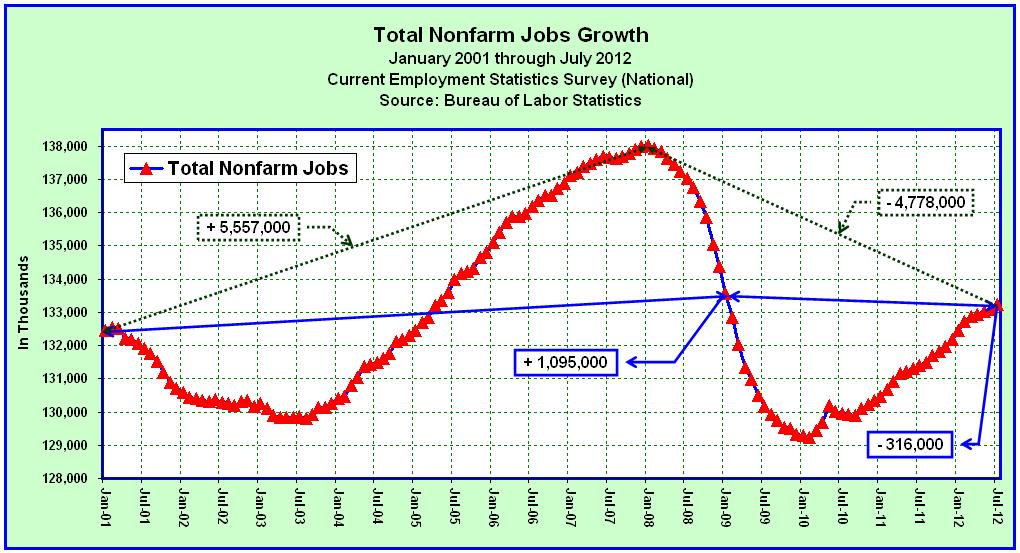
  • From the end of January 2001 through the end of January 2008, a total of 5,557,000 Nonfarm Jobs were gained, during the Bush Administration.

  • During the last year of the Bush Administration, as a result of the Great Recession, from the end of January 2008 to the end of January 2009, a total of 4,462,000 Nonfarm Jobs were lost.

  • Thus, a total of 1,095,000 Nonfarm Jobs were gained during the Bush Administration.

  • During the Obama Administration, from the end of January 2009 through July 2012, a total of 316,000 Nonfarm Jobs have been lost.

  • Overall, we are still 4,778,000 Nonfarm Jobs in arrears, from a record high established by the Bush Administration at the end of January 2008.

Thus, in terms of Total Nonfarm Jobs, 1,095,000 were added during the Bush Administration, a rather pathetic record since we need to create 1,524,000 jobs a year (127,000 per month) just to keep up with population growth. In comparison, after nearly four years, and $5.3 trillion in new federal debt, not a single Nonfarm job has been added by the Obama-Biden Administration, but rather 316,000 have been lost. In spite of the policies of Obama-Biden, Nonfarm Jobs are still 4,778,000 short of the January 2008 peak, so gullible Obama-Biden loyalists need to find something else to showboat.

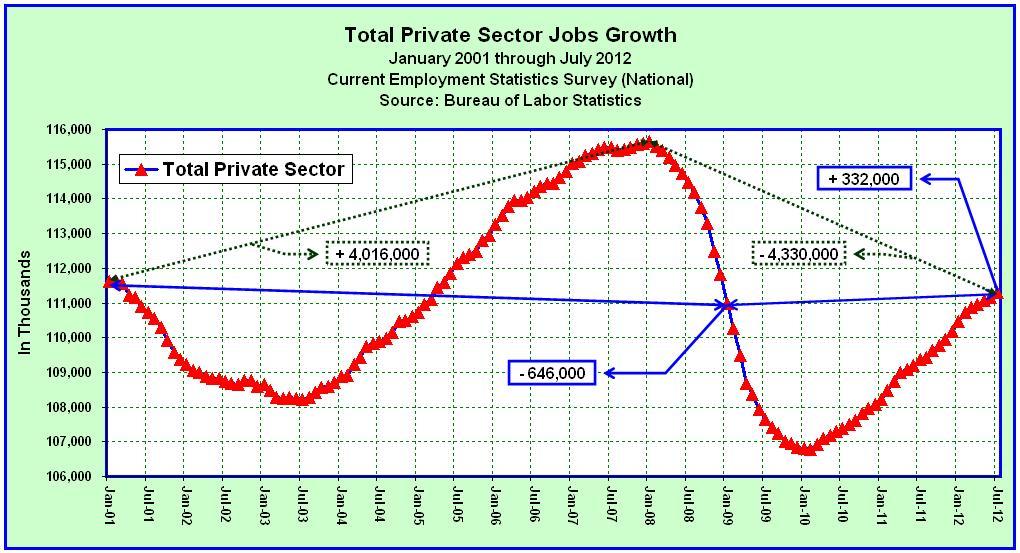
Total Private Sector Jobs

After cringing at the Total Nonfarm statistics above, gullible Obama-Biden loyalists will say that what they were really bragging about was their record on Private Sector Jobs (exclusive of Government). Okay, so let’s examine the growth (decline) of Private Sector Jobs since January of 2001.

Total Private Sector

  • From the end of January 2001 through the end of January 2008, a total of 4,016,000 Private Sector Jobs were gained, during the Bush Administration.

  • From the end of January 2008 to the end of January 2009, due to the Great Recession, a total of 4,662,000 Private Sector Jobs were lost, during the Bush Administration.

  • Thus, a total of 646,000 Private Sector Jobs were lost, during the Bush Administration.

  • During the Obama-Biden Administration, from the end of January 2009 through July 2012, a total of 332,000 Private Sector Jobs have been recovered.

  • Overall, Private Sector Jobs are still in arrears by 4,330,000 from a record high established by the Bush Administration at the end of January 2008.

So in terms of Private Sector Jobs, we have to hand it to Obama-Biden. While the Bush Administration lost 646,000 Private Sector Jobs over eight years, the Obama-Biden Administration has recovered 332,000 over the last four years. However, since we really need to create 1,524,000 jobs a year (127,000 per month) just to keep up with population growth, and since Private Sector Jobs remain 4,330,000 short of the January 2008 peak, the Obama-Biden Administration’s record isn’t really worth grandstanding. In fact, when government-down supporting, Obama-Biden loyalists discover the subsector in which these jobs were added, they should run as far away from their Party’s chosen platform as they can get.

Which Subsector(s) Gained Jobs?

Which areas of the Private Sector gained jobs during the Obama-Biden Administration? To know the answer, one must comb through all of the various industries detailed by the Bureau of Labor Statistics, in Table B-1, sector by sector. Were jobs gained in Mining and Logging, Construction, or Manufacturing? No. What about in the Wholesale Trade, Retail Trade, or Transportation and Warehousing? Nope. How about Information, Financial Activities, Education and Health Services, Leisure and Hospitality, or Other Services? Nope.

To be precise, the only sector of the economy where you’ll find any net jobs growth during the Obama-Biden Administration is under the Professional and Business Services category, and there only in the subsector named Temporary Help Services (under Professional and Business Services >> Administrative and Waste Services >> Administrative and Support Services >> Employment Services >> Temporary Help Services).

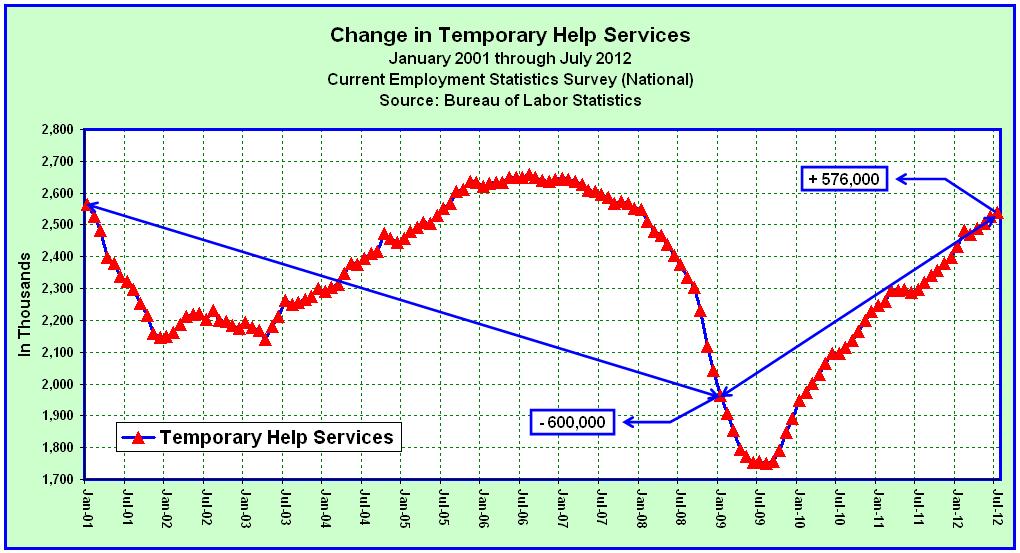
Temporary Help Services (NAICS 56132) – The temporary help services industry comprises establishments primarily engaged in supplying workers to clients’ businesses for limited periods of time to supplement the working force of the client. The individuals provided are employees of the temporary help service establishment. However, these establishments do not provide direct supervision of their employees at the clients’ work sites. So let’s examine the growth (decline) of Temporary Help Service Jobs since January of 2001.

Temporary Help Services Jobs

  • From the end of January 2001 to the end of January 2009, a total of 600,000 Temporary Help Service jobs were lost, during the Bush Administration. [Note: This accounts for nearly all of the 646,000 Private Sector Jobs lost over the period.]

  • During the Obama-Biden Administration, from the end of January 2009 through July 2012, a total of 576,000 Temporary Help Service jobs have been recovered. [Note: This accounts for all of the 332,000 Private Sector Jobs recovered during the period, minus losses in other sectors.]

So 600,000 Temporary Help Service jobs were lost during the Bush Administration, and the Obama-Biden Administration was able to recover 576,000 of them. In effect, since a total of 646,000 Private Sector Jobs were lost during the Bush Administration, among them, 600,000 or almost all were Temporary Help Service jobs. Since then, the Obama-Biden Administration has recovered a total of 332,000 Private Sector Jobs, and every single one of them, 576,000 minus losses in other sectors, were in Temporary Help Services.

Conclusion

From the end of January 2001 to the end of January 2009, a total of 1,095,000 Nonfarm Jobs were gained during the Bush Administration. In contrast, during the Obama-Biden Administration, from the end of January 2009 through July 2012, a total of 316,000 Nonfarm Jobs have been lost. Meanwhile, as Barack Obama, Joe Biden and their gullible loyalists boast about this great accomplishment, we are still 4,778,000 Nonfarm Jobs, and 4,330,000 Private Sector Jobs short of the record highs established by the Bush Administration at the end of January 2008. Even worse, since the population continues to grow, from the start of the Great Recession the real jobs deficit in the U.S. has increased to 11,760,000. That’s the record. Those are the facts. That’s the truth.

Like it or not, the only platform on the ballot this November which includes a plan and a promise to create more than 12,000,000 middle-class jobs over the next four years is the Romney-Ryan platform. In contrast, the plan and promise outlined by the Obama-Biden platform, to-date, includes more gloating, more lofty rhetoric, more special interest tax breaks, more deficit-financed subsidies, more uncertainty, more divisiveness, more government dependency, more government regulation, more borrowing and spending, higher health care costs, higher taxes, and with any luck a few more Temporary Help Service jobs.

It’s time to wake-up. It’s time to care. It’s time to do what’s in your best interests and that of your country. It’s time to stop believing in myths, and time to ‘Believe in America’.

“It is impossible to calculate the effect of deficit-financed government spending on demand without specifying how people expect the deficit to be paid off in the future.” ~ Theory of Rational Expectations

Chart Data | At Google Drive

Has Obama’s Loot-and-Plunder Theory Worked?

A 50-Year Retrospective

– By: Larry Walker, Jr. –

“Socialism is a philosophy of failure, the creed of ignorance, and the gospel of envy, its inherent virtue is the equal sharing of misery.” ~ Winston Churchill ::

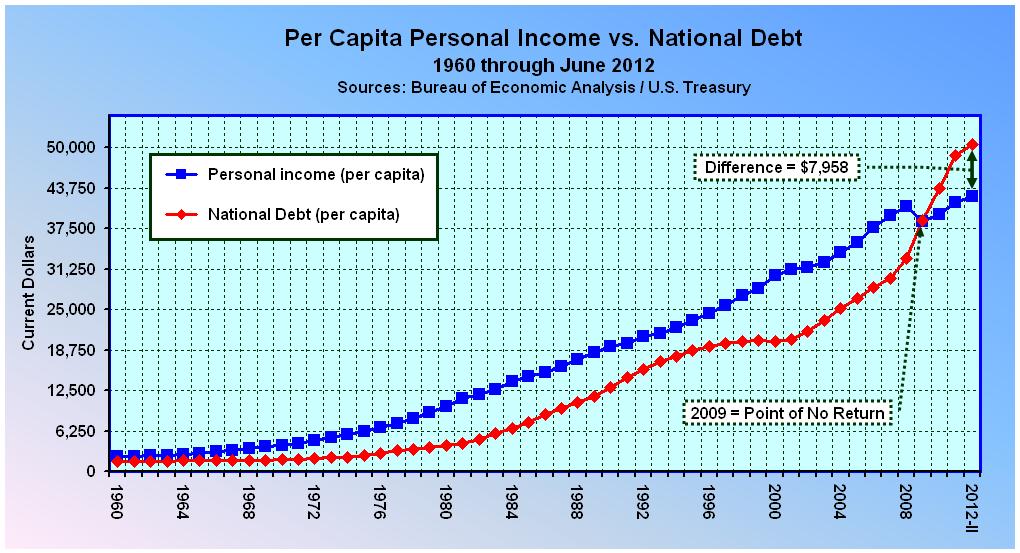
Discussing his economic policies at a fundraiser in Oakland, California on July 23rd, Barack Obama, told supporters that, “We tried our plan, and it worked.” Yet, by the end of his first year in office, he had only managed to drag America, kicking and screaming, beyond the point of no return, as our National Debt, on a per capita (per person) basis, surpassed per capita Personal Income for the first time in more than 50 years (see chart above). As of June 30, 2012, after nearly four years of disservice to the nation, under the leadership of Barack Obama, every American now owes $7,958 more in federal government debt, on a per capita basis, than their personal income.

Per Capita National Debt to GDP

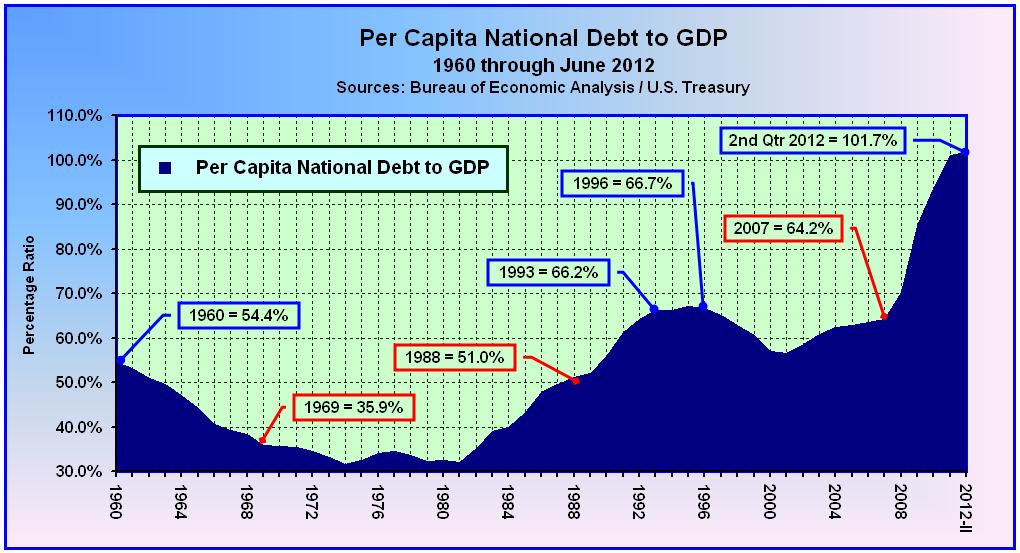
Equally alarming, as of June 30, 2012, the U.S. National Debt per capita reached a stunning 101.7% of Gross Domestic Product, an increase of 45.1% since the end of 2008. Looking back over the last half-century, no other President of the United States has done more to destroy our standard of living than Barack Obama. Now if that was his goal, then yes – it worked like a charm. However, this temporary condition will soon meet its demise.

Gross Domestic Product (GDP) is the market value of all officially recognized final goods and services produced within the United States. GDP per capita is considered an indicator of our nation’s standard of living. As of June 30, 2012, U.S. GDP per capita was equal to $49,672. The National Debt is the sum of all previously incurred annual federal deficits. Since deficits are financed by government borrowing, either from the public or from itself, the national debt is equal to all government debt outstanding. As of June 30, 2012, the U.S. National Debt per capita was equal to $50,502.

Thus, it may be stated that, as of June 30, 2012, the standard of living of the United States is negative. In other words, when taken as a whole, on a per capita basis, for the first time in more than a half-century, Americans now owe more in federal government debt than we produce. In effect, there isn’t anything left to address the growing mountain of state and local government, personal and business arrearages.

Granted that Barack Obama and a tiny remnant of gullible far-left loyalists have devised numerous excuses as justification for this atrocity, one way of accurately measuring the validity of such subterfuge is to simply compare the ratio of per capita National Debt to GDP over the last half-century. After all, it was Barack Obama who said of supply-side economics, a theory which has been deployed during most of the 1960’s through 2007, “We tried this trickle-down fairy dust before, and guess what — it didn’t work then, it won’t work now… It’s not a plan to lower the deficit…” Well, let us test this hypothesis on a relative basis, and see just how well his loot-and-plunder theory stacks up.

A quick study of the chart above, Per Capita National Debt to GDP: 1960 through June 2012, tells the whole story.

Testing Obama’s Theory

  1. At the end of 1960 per capita National Debt to GDP was equal to 54.4%.

  2. John F. Kennedy’s Tax Reduction Act of 1964 was signed into Law by his successor Lyndon B. Johnson. Under the ensuing era of lower tax rates, by the end of 1981, per capita National Debt to GDP declined all the way to 31.9%.

  3. Ronald W. Reagan’s Economic Recovery Tax Act went into effect in 1982, and even though government spending was higher than he would have liked, by the end of his term in 1988, per capita National Debt to GDP stood at just 51.0%.

  4. In 1993, Bill Clinton signed the Deficit Reduction Act, which turned out to be nothing more than a tax hike. By the end of 1996, per capita National Debt to GDP had increased to 66.7%.

  5. Then in 1997 the Republican-led Congress passed a tax-relief and deficit-reduction bill that was resisted but ultimately signed by President Clinton. One of the things the 1997 bill did was lower the capital gains tax. It was actually the 1997 tax cut, not the 1993 Clinton tax hike, which produced the boom of the 1990’s. By the end of the year 2000, per capita National Debt to GDP declined to 57.0%.

  6. In 2001, George W. Bush signed the Economic Growth and Tax Relief Reconciliation Act. By the end of 2001, per capita National Debt to GDP decreased to 56.5%, and later increased slightly to 58.5% in 2002.

  7. The following year, George W. Bush signed the Jobs and Growth Tax Relief Reconciliation Act of 2003, which provided the tax rates in effect today. By the end of 2007, per capita National Debt to GDP held at just 64.2%.

  8. In 2009, Barack H. Obama signed the American Recovery and Reinvestment Act (ARRA). The primary objective for ARRA was to save and create jobs almost immediately. Secondary objectives were to provide temporary relief programs for those most impacted by the recession and invest in infrastructure, education, health, and ‘green’ energy. The cost of the economic stimulus package was estimated to be $787 billion at the time of passage, but was later revised to $831 billion. By the end of 2009, per capita National Debt to GDP increased to 85.2%.

  9. The following year, Barack H. Obama signed the Tax Relief, Unemployment Insurance Reauthorization, and Job Creation Act of 2010, which extended long-term unemployment benefits and cut the employee’s portion of the Social Security payroll taxes by 2.0%. By the end of 2010, per capita National Debt to GDP increased to 93.5%. By the end of 2011 the ratio had increased to 101.0%, and by June 30, 2012, per capita National Debt to GDP notched up by another seven tenths of a percent to 101.7%.

Ever since Barack Obama implemented his plan, America’s standard of living has gone straight down the tubes. And since he said, “We tried our plan, and it worked…,” we are forced to conclude that his goal was to destroy America’s standard of living. If for some reason this wasn’t his goal, then a more honest assessment would have been, ‘We tried our plan, and it failed.’

When Barack Obama said, “We tried this trickle-down fairy dust before. And guess what — it didn’t work then, it won’t work now… It’s not a plan to lower the deficit..,” whose policies could he possibly have been referring to? A quick study of U.S. per capita National Debt to GDP ratios and per capita Personal Income to National Debt over the last 50 years leads to only one possible conclusion – his own.

Conclusion

Since per capita National Debt to GDP is at the highest ratio since the unsustainable heights attained during the second World War, and higher than at any time in the last half-century, and since Barack Obama has clocked the highest annual budget deficits in American history ($1,412.7 billion in 2009, $1,293.5 billion in 2010, $1,299.6 billion in 2011, and $1,326.9 billion in 2012), we can only conclude that his loot-and-plunder economic theory has achieved the worst results of any set of economic policies deployed by any American president, ever. The facts speak for themselves.

We tried Barack Obama’s loot-and-plunder theory, and it failed. And not only have Obama’s policies failed, but American’s are now worse off than at any time since the 1940’s. No one has managed our economy more recklessly than Barack H. Obama. Are you still a believer? Isn’t it high time we go back to what we know works, make some improvements, and implement some of the reforms proposed over the years, which were errantly pushed aside? Yes it’s time. And since Barack Obama has proved himself unwilling to bend to the will of the American people, it’s time we gave someone else the opportunity. It’s time to switch teams. It’s time to follow real leadership. It’s time to elect a true Conservative.

References:

Table 7.1 Selected Per Capita Product and Income Series in Current and Chained Dollars | Bureau of Economic Analysis

Debt to the Penny | Treasury Direct

Chart Data | Google Drive

Talk about Fairy Dust and Snake Oil!

:: Obama’s Loot-and-Plunder Theory on Social Benefits

– By: Larry Walker, Jr.-

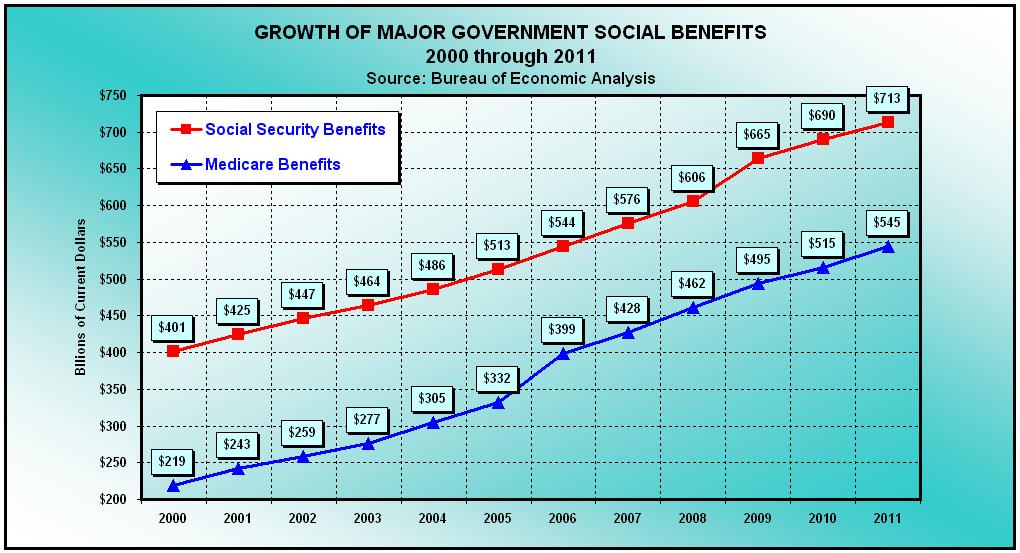
Under Barack Obama’s economic theory, better known as Loot-and-Plunder Economics, income tax rates will necessarily skyrocket, perhaps by as much as 50% across-the-board. If you don’t believe it, just look at the facts and figures. For example, as of FY 2011, annual outlays on Social Security Benefits were 77.7% greater than they were in 2001, while outlays on Medicare were 148.8% greater (shown in current dollars in the chart above). Has Obama solved the problem through entitlement reform? Has he raised Social Security and Medicare taxes by 77.7% and 148.8% respectively? No, so what do you think is coming?

While Obama talks the talk, regarding taxing the rich and fairness, surely even he knows that his plan is not sustainable. It doesn’t balance the budget or grow the economy. The truth is that Obama has no plans for lowering income tax rates on the middle-class, but instead he created Obamacare, which is a nifty way of imposing a whole new set of taxes on those who can least afford health insurance, namely the middle-class. Got it? There will be no middle-class tax relief in a second Obama term, just new health care taxes (i.e. more pain).

So other than leading us all to the edge of a Fiscal Cliff, what else has Obama done for the middle-class? Well, he delivered a two-year Make Work Pay Credit (MWPC), which represented a $400 to $800 reduction in Social Security Taxes in 2009 and 2010, and followed this up with a two-year 2.0% Social Security Tax Cut. In other words, he gave us four years of temporary measures in an effort to stimulate the economy. But what did this really accomplish?

Two Things

#1 – The jobs deficit has grown to 11,760,000 under Obama’s watch, from 5,165,000 when Bush turned over the keys. So we can state without ambiguity that his attempts to stimulate the economy have failed. Sure, things might not be as bad as they could have been, but at the same time, things might not be as good as they could have been either.

The “jobs deficit” increases every month that employers create fewer than 127,000 jobs, the number needed to keep pace with population growth. As you can see in the chart below, the jobs deficit has increased under Obama’s watch, and has remained virtually unchanged since December of 2009. Aside from the jobs deficit, we are still 4,648,000 jobs short of where we were in December of 2007, partially due to the Great Recession, which ended in June of 2009, but namely due to Barack Obama’s loot-and-plunder economic policies, which were designed to prolong the crisis.

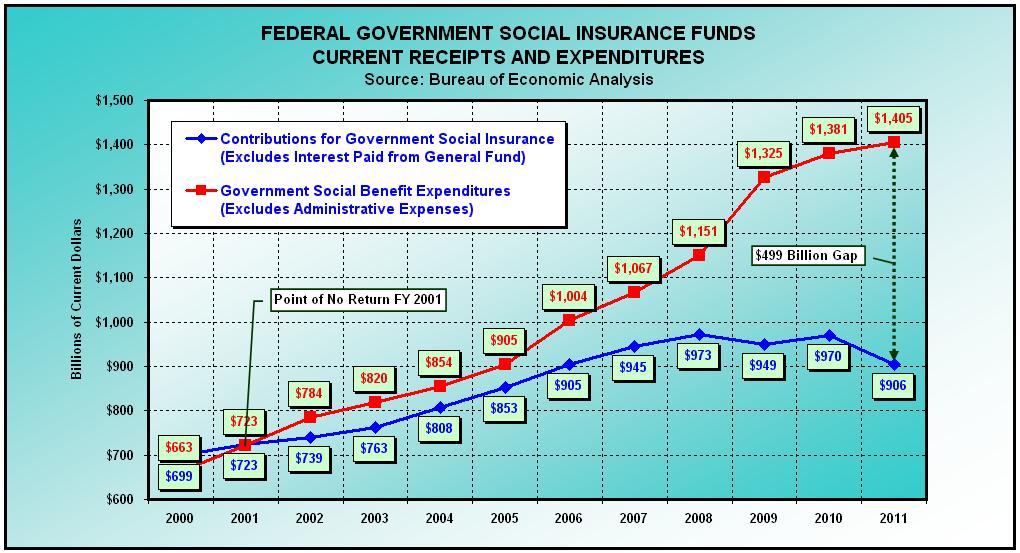
#2 – Not only has the unemployment rate remained above 8.0% for his entire term, but Obama’s ingeniously designed Social Security tax cuts have since created a $500 billion per year shortfall in the Social Insurance Fund accounts. Per the chart below, derived from the Bureau of Economic Analysis, Table 3.14 – Government Social Insurance Funds Current Receipts and Expenditures, the gap between Social Insurance receipts and expenditures is now worse than ever, thanks to Obama. I guess we’ll find out whether or not work pays (i.e. the MWPC), a few years from now, when we discover that our Social Security and Medicare guarantees were squandered away during the Obama years. His looting of an additional $716 billion out of Medicare to fund Obamacare should be le coup de grâce (the final blow).

As you can see in the chart above, the point of no return was actually breached in FY 2001, when Outlays for Social Benefits equaled Insurance Contributions. This was primarily due to an escalation in the number of baby-boomers reaching retirement age. But instead of addressing the obvious dilemma, the federal government allowed it to fester into larger and larger annual deficits. Thus, the “Social Benefits Deficit” eventually reached $177 billion by Fiscal Year 2008. Then along came Obama, who instead of addressing the problem has handed out four consecutive years of Social Security Tax cuts (i.e. loot-and-plunder fairy dust).

In just three years Obama turned a $177 billion annual Social Benefits Deficit into a $500 billion per year morass. Free money! Obamabucks! What were the results? As you can see in the chart above, and in the related table, in Fiscal Year 2009 the gap between Government Social Benefit Expenditures and Contributions swelled to $376 billion, from $177 billion in 2008, or by 112.4%. Those were the consequences of giving both taxpayers and non-taxpayers a reduction in their Social Insurance responsibilities via the MWPC. In Fiscal Year 2010, with the extension of MWPC, the Social Benefits Deficit widened to $411 billion, or by another 9.3%.

As if that wasn’t enough, Obama devised an even more cunning way of plundering America’s future retirement security. Replacing MWPC with his 2.0% Payroll Tax Cut, in 2011, caused the Social Benefits Deficit to widen by an additional 21.4%, to $499 billion. That’s a half-a-trillion dollar shortfall. And it’s not over yet. Since the 2.0% Payroll Tax Cut was extended into 2012, we will find out where Social Insurance Benefits stand, at the close of the fiscal year, on September 30th. But so far, when added together, $376 billion in 2009, $411 billion in 2010, and $499 billion in 2011, equals a total Social Benefits Deficit of $1.3 trillion. That’s the amount Obama has added to the national debt by tampering with our future retirement security, and that’s just a fraction of the $5.3 trillion he’s added to the overall debt.

Summary:

Between FY 2001 and 2008, Contributions for Government Social Insurance grew by 39.3%, while Social Benefit Expenditures grew by 73.6%. But instead of raising a red flag and solving the problem, Barack Obama proceeded to loot-and-plunder contributions, at a time when the demand for benefits was soaring. This was an amateurish move. Between FY 2009 and 2011, Contributions for Government Social Insurance actually shrank by -6.9%, while Social Benefit Expenditures rose by 22.1%, creating a $1.3 trillion shortfall.

So while gullible far-left loyalists continue to fall for Obama’s pretense, that the Romney-Ryan Ticket and Supply-Side economics would gut Social Security and Medicare, if they took five minutes to look up the facts, they would discover that Obama, through his own brand of loot-and-plunder fairy dust, has already beat them to it. The snake oil Obama is pushing is the same stuff that prolonged the Great Depression. Everyone knows that the federal government didn’t end the Depression, World War II did. That is everyone except for Obama, the unlearned and a few far-left loons.

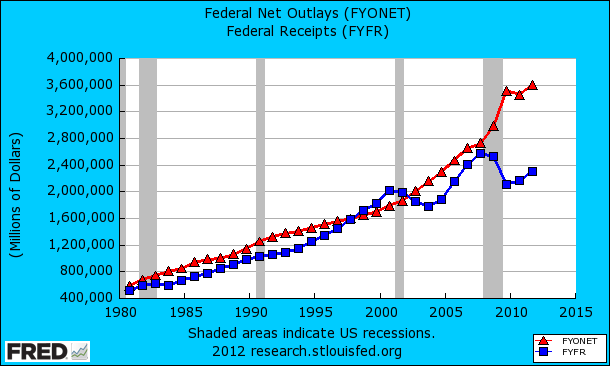
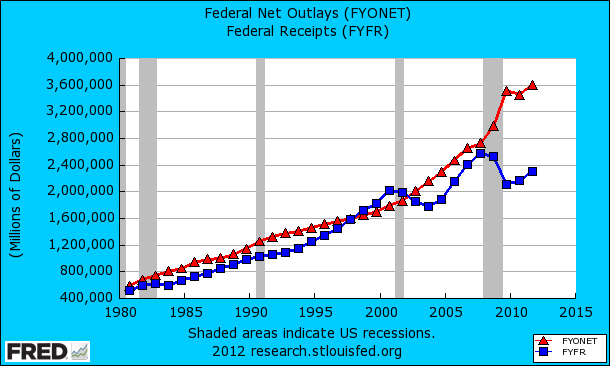
What folks should be engaged in is bipartisan criticism of the manner in which Barack Obama is destroying our future economic security. We should at least be able to agree that there has to be a more viable alternative. Supply-side economics worked in the Roaring 20’s under Coolidge, in the 1960’s under JFK, in the 1980’s under Reagan, and in the 1990’s through 2007 under Clinton and Bush. That’s right! But according to Barack Obama, “It never worked.” Don’t believe that lie. A quick glance at the following chart, Net Federal Outlays and Receipts since 1980, says it all. Trillion dollar annual deficits are a phenomenon which began with Obama.

Lest we forget, Bill Clinton’s famed tax plan was a package which included tax rates ranging from 15% to 39.6% (i.e. rates were higher at all levels across-the-board), in addition to the Republican-led Tax-Relief and Deficit-Reduction Bill of 1997 (i.e. what actually created the boom of the 90’s). But if you think Obama can cherry-pick just one smidgen of Clinton’s tax policies, apply it to only a fraction of taxpayers, those making more than $250,000 (the equivalent of $157,197 in 1993), and achieve the same results, then you’re not using your brain.

Loot-and-Plunder economics ends when everyone sees their taxes rise by 50% or more across-the-board. That’s the only way the federal government can continue to spend at current levels, and move even halfway towards balancing its budget. When you see the symptoms of a failed economic policy (above), and your candidate boasts, “My plan worked,” that’s when you run!

—————————–

Notes:

The third chart (above) purposefully excludes interest contributed towards Social Insurance, since such interest is paid from general government funds. The federal government long ago raided the Social Security Trust Fund spending every dime, and now owes the Social Security Trust Fund $2.5 trillion, per Note 24 of the United States Government’s Notes to the Financial Statements, for the year ended September 30, 2011. From time to time, the federal government pays the Trust Fund interest on its debt, but with trillion dollar deficits for the last four years, it is reasonable to conclude that every dime of the interest paid is borrowed, thus it makes no sense to double count. The chart also excludes administrative expenses.

References:

U.S. GAO | Fiscal Year 2011 Financial Report of the United States Government

Bureau of Economic Analysis | Table 3.14 Government Social Insurance Funds Current Receipts and Expenditures

Chart Data | Google Drive

Obama’s Loot-and-Plunder Theory on Steroids

:: Use It or Lose It: We Can’t Wait

– By: Larry Walker, Jr. –

According to unelected hoodlums within the Obama Administration, from 2003 to 2006, Congress set aside $473 million in earmark transportation funds that have never been spent. “These idle earmarks have sat on the shelf as our infrastructure continued to age and construction workers stood on the sideline,” Transportation Secretary Ray LaHood said in a conference call Friday. “I’m taking that unspent money and giving it right back to the states so they can put it to work on the infrastructure projects that they need most — projects that will put people to work.”

So according to Mr. LaHood he’s going to take (i.e. steal) $473 million that was earmarked for infrastructure projects from 2003 through 2006, and send it right back (i.e. 6 to 9 years after the fact) to the states so they can spend it on the infrastructure projects they need the most (i.e. for purposes other than Congress intended). Aside from the fact that this proposal is felonious, the money Mr. LaHood is referring to no longer exists.

The idea of taking funds earmarked towards specific projects, which were deemed unworthy of pursuit during a previous administration, and shifting them towards other purposes today is felonious. What does the term “earmarked funds” mean? It means if Congress passes legislation to repair a certain bridge, the money to repair that bridge is “set aside”. But following Mr. LaHood’s gangster logic, ‘fictitious’ funds earmarked towards certain projects, six to nine years ago, may now be used to fund projects such as California’s Bullet Train to Nowhere. Perhaps a pair of handcuffs is in order.

Common sense dictates that if a bridge still needs fixing, and if the funds still exist and are not barred by the statute of limitations, then it should be fixed. But if the bridge doesn’t need fixing, if it was subsequently replaced by another project, or if the statute of limitations has expired, then the funds, assuming they still exist, should be returned to the Treasury. The notion of “use it or lose it” in this matter is felonious. According to Mr. LaHood, States now have around 45 days, or until October 1st, to identify projects for which they plan to use the money, or else they will lose it. In other words, the funds were not lost after sitting idle for 6, 7, 8 and 9 years, but suddenly there is an arbitrary 45-day deadline. Who passed that law? What is the statute of limitations for spending on earmarked transportation projects – 9, 8, 7, or 6 years? Is there one, or do bureaucrats just get to make up the rules as they go along?

Where’s the Money?

The following analysis from John A. Swinford on his blog, People, Places, News and Other Stuff, answers a key question: Where’s the money?

“Sounds reasonable, right? Hold on to your horses; remember this is a politician speaking. According to Transportation Secretary Ray LaHood, “These idle earmarks have sat on a shelf…” Well, OK, they were authorized but not used. I get that, but what happened to the funding for those earmarks…where is the money…in a lock box or a savings account…or somewhere else? Secretary Hood claims the earmarks were authorized during a period between 2003 and 2006 but not actually spent and therefore, the cash is still available.”

“Before you buy that explanation consider the difference between a budget and cash accounting. If you go to the St. Louis Federal Reserve Bank website you can pull up the actual Federal cash receipts and outlays. In each of the years to which Secretary Hood refers, the cash deficits ran $378 billion, $413 billion, $318 billion and $248 billion respectively (in current dollars). OMG, Washington spent more cash than it took in…What a surprise… But if that is so how could there possibly be some extra loose cash sitting around. Answer… there is none. The only way to fund “Use It or Lose It” is what? You guessed it…more borrowing.”

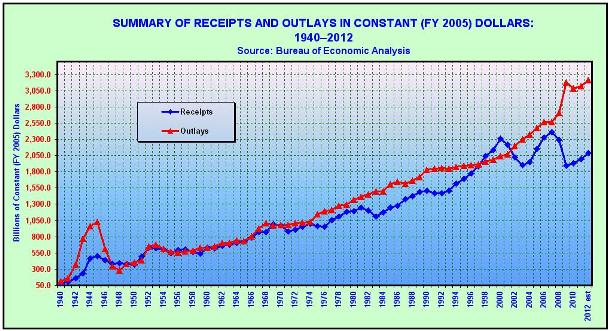
In fact, according to the Bureau of Economic Analysis, in real terms, the federal government operated at deficits of -1,955.2 billion from 2003 to 2008, and another -4,678.1 billion from 2009 to 2012 (shown in Constant FY 2005 Dollars). So not only was there nothing leftover, the money was never there to begin with.

The annual deficits shown in the chart above and listed below are shown in billions of constant (FY 2005) dollars. Note that the federal budget was nearly balanced in FY 2007.

  • 2003 -402.6
  • 2004 -427.9
  • 2005 -318.3
  • 2006 -239.7
  • 2007 -151.0
  • 2008 -415.7
  • 2009 -1,274.4
  • 2010 -1,153.0
  • 2011 -1,127.6
  • 2012 -1,123.1 (estimate)

The chart below summarizes receipts and outlays as percentages of Gross Domestic Product. Notice how the budget gap has widened dramatically since 2009.

Obama’s ideas on the economy are nothing more than classic Loot-and-Plunder, trickle-up, middle-out snake oil. In other words, borrow now – pay never. It didn’t work during the Great Depression, it hasn’t worked since 2009, it has never worked and it never will. Proposing to implement 1/16th of President Clinton’s 1990’s tax policies, while ignoring the fact that back then, income tax rates were higher on every American across-the-board, isn’t a serious plan for either growing the economy or balancing the budget. It’s a notion that most certainly fails to justify the felonious borrowing conjured up by Transportation Secretary LaHood just yesterday.

It’s time to return to supply-side economics which proved itself during the Roaring 20’s, the 1960’s, the 1980’s, the 1990’s and most of the 2000’s (through 2007). Obama has no plan to pay down the $5.3 trillion (in current dollars) which he’s added to the national debt, let alone the $16 trillion overall balance. Yet he seems to have no problem borrowing another $500 million under the guise that it’s somehow Bush’s fault. That’s right! Expect the extra $500 million in borrowing to magically be credited to George W. Bush, while Obama continues to promote the obvious lie that spending hasn’t increased on his watch.

But as each of the above charts show, whether in terms of current dollars, constant (FY 2005) dollars, or as percentages of GDP, Obama has allowed spending to skyrocket while revenues have continued to suffer due to a weak economy and high unemployment, symptoms of his failed economic policies. It’s time to put an end to this churlish presidency. Borrow It or Save It? We can wait – all the way to November 6th.

“The debt and the deficit is just getting out of control, and the administration is still pumping through billions upon trillions of new spending. That does not grow the economy.” ~ Paul Ryan

Addendum:

During 2008 the Highway Trust Fund required support of $8 billion from general revenue funds to cover a shortage in the fund. This shortage was due to lower gas consumption as a result of the recession and higher gas prices. Further transfers of $7 billion and $19.5 billion were made in 2009 and 2010 respectively.

^ Weiss, Eric M. (September 6, 2008). “Highway Trust Fund Is Nearly Out of Gas“. The Washington Post. Retrieved May 4, 2010.

^ “President Signs Bill Providing 9-Month Extension, $19.5 Billion for Highway Trust Fund“. The Washington Post. March 19, 1010. Retrieved August 15, 2011.

———————————————

References:

THE OLD WASHINGTON SHELL GAME? | John A. Swinford

Trickle Up Economics | Peter Schiff

Chart Data: Spreadsheet | Google Drive

Understanding Obama’s Loot and Plunder Theory

A.K.A. Trickle-up, or Trickle-sideways

– By: Larry Walker, Jr. –

The ignorance of one voter in a democracy impairs the security of all.” ~ John F. Kennedy –

“Trickle-down theory” is a pejorative term in United States politics which refers to the idea that tax breaks or other economic benefits provided by government to businesses and the wealthy will benefit poorer members of society by improving the economy as a whole. In the real world, and called by its proper name, supply-side economics has never failed. In fact, in spite of the ignorance of a few, any improvement in our economy since the end of the Great Recession can be attributed directly to the remaining bands of supply-side tax policies left over from the Bush Tax Cuts, which are scheduled to expire on December 31st.

In the 1980’s what was known as Reaganomics was pejoratively referred to by RINO’s and the far-left as “trickle-down” or “voodoo” economics. But they were wrong. Supply-side economics worked then and it will work now. Yet according to our clueless president, Barack Obama, it’s just “fairy dust”. We have to remind the far-left, including our clownish president (act like a clown and you get called one), that the four pillars of Reagan’s economic policy were to reduce growth of government spending, reduce income taxes and capital gains taxes, reduce government regulation of the economy, and control the money supply to reduce inflation. Now if that’s just “fairy dust” to you, then perhaps like Mr. Obama, back in your college days, you took one drag too many off a marijuana cigarette.

Mitt Romney’s five-point plan is the closest platform on the ballot to Reagan’s four pillars. Romney’s policies would also cut the deficit, reduce income taxes and capital gains taxes, reduce the number of government regulations, and would create a Reagan Economic Zone to strengthen free-enterprise and the U.S. Dollar world-wide. We call this supply-side economics. What’s the alternative? Does Obama have a better plan? Economist George Reisman, a proponent of tax cuts, said the following:

“Of course, many people will characterize the line of argument I have just given as the ‘trickle-down’ theory. There is nothing trickle-down about it. There is only the fact that capital accumulation and economic progress depend on saving and innovation and that these in turn depend on the freedom to make high profits and accumulate great wealth. The only alternative to improvement for all, through economic progress, achieved in this way, is the futile attempt of some men to gain at the expense of others by means of looting and plundering. This, the loot-and-plunder theory, is the alternative advocated by the critics of the misnamed trickle-down theory.”

On the other side of reality is Barack Obama’s one-point plan, also known as Obamanomics, “trickle-up”, “trickle-sideways” or “loot-and-plunder theory”. Under the Obama hypothesis, the deficit isn’t cut, income and capital gains taxes are hiked on those making over $250,000 while remaining static on those making less, the number of government regulations on the economy continue to expand, and nothing is done to improve the U.S. trade deficit or to strengthen the dollar. In other words, his one-term plan lacks a growth catalyst. Raising taxes on businesses and the wealthy isn’t an economic growth strategy, not even according to its chief proponent, Barack Obama. It’s merely a futile attempt of some men to gain at the expense of others by means of looting and plundering.

The Ends of Obama’s Loot-and-Plunder Theory

There are many countries with top tax rates higher than the 35% paid by the wealthiest Americans. In fact, the U.S. is ranked #23 in terms of top marginal tax rates among the 96 countries surveyed by KPMG in 2011. In the U.S. the top rate kicks in at around $388,350 of taxable income in 2012. Workers are also mandated to pay social security taxes of 4.2% (10.4% if self-employed) on the first $110,100 in wages, plus another 1.45% (2.9% if self-employed) on an unlimited amount of earned income. The U.S. tax on capital gains is currently 15%. The top U.S. corporate tax rate also clocks in at a healthy 35%, in addition to a matching portion of social security and Medicare taxes (6.2% of the first $110,100 and an unlimited 1.45%) on wages paid.

Among nations with the highest tax rates in the world, Ireland ranks #10. Its top tax rate of 48% kicks in at about $43,900 USD of taxable income (including a Universal Social Tax of 7.0%). Other notable taxes include a capital gains rate of 30%, and a pay related social insurance tax of 4% (also 4% if self-employed, with a 10.75% employer match). But while its personal tax rates are high, it has among the lowest corporate tax rates in Europe at just 12.5%.

The country with the #1 tax rate in the world is the Dutch territory of Aruba. Its top marginal rate of 58.95% kicks in at around $165,000 USD of taxable income, but the 35% rate kicks it at around $38,500 USD. Other notable taxes include a capital gains tax of 25%, a 1.6% (9.5% if self-employed) health insurance tax, a 4.0% (13.5% if self-employed) pension and accident insurance tax, and a 3% national sales tax. While its individual tax rates are the highest in the world, Aruba levies a flat corporate tax rate of just 28%, which is better than in the U.S.

A quick analysis of nations with the highest tax rates in the world reveals one common thread. Once a populace is conned into loot-and-plunder theory and tax rates begin to rise, it’s not long before tax brackets fall to a level where top tax rates affect almost everyone except for those below the poverty line. The top tax rate of 48% in Ireland kicks in at around $43,900 USD of taxable income and a tax rate of 35% kicks in at around $38,500 USD in Aruba. And that’s not including social insurance, health care, and VAT or national sales taxes which always follow. Where loot-and-plunder theory ends is when every middle-class worker is forking over 40% or more of their income to the government.

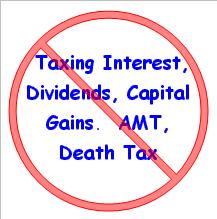
Live by the sword, die by the sword. If you’re in favor of hiking taxes on businesses and the wealthy, then you’re in favor of having your own and everyone else’s taxes hiked as well. That’s the deal. That’s the choice. The only one on the ballot offering a 20% across-the-board tax rate cut on every American is Mitt Romney. The only one offering not to tax interest, dividends or capital gains for those making less than $200,000 is Mitt Romney. The only one offering to eliminate the Alternative Minimum Tax and the Death Tax is Mitt Romney. The only one offering to cut the top corporate tax rate to 25% is Mitt Romney. The only pro-growth, deficit reduction plan on the ballot is Mitt Romney’s. The only things standing in the way are the clueless clown and part-time president Barack Obama (no I’m not laughing), and the ignorance of a few.

“Our tax system still siphons out of the private economy too large a share of personal and business purchasing power and reduces the incentive for risk, investment and effort – thereby aborting our recoveries and stifling our national growth rate.” ~ John F. Kennedy, Jan. 24, 1963, message to Congress on tax reduction and reform, House Doc. 43, 88th Congress, 1st Session

References:

Oxford English Dictionary

“The General Benefit from Reducing Taxes on the ‘Rich'”.Capitalism: A Treatise on Economics. p. 308. ISBN 978-0915463732

Countries With the Highest Income Tax Rates | CNBC

Aruba Tax Rates

Ireland Income Taxes and Tax Laws 2012

U.S. Jobs Deficit Holds at 11,760,000 in July

Break Out the Fairy Dust –

“The largest single barrier to full employment of our manpower and resources and to a higher rate of economic growth is the unrealistically heavy drag of federal income taxes on private purchasing power, initiative and incentive.” ~ John F. Kennedy, Jan. 24, 1963, special message to Congress on tax reduction and reform

– By: Larry Walker, Jr. –

The U.S. Jobs Deficit declined by 30,000 in July, falling from 11,790,000 in June, to 11,760,000, based on yesterday’s Employment Situation Report. While May’s number was revised upward by 10,000, and June’s number was revised downward by 16,000, the economy added a mere 163,000 jobs in July. And since we need to create 127,000 jobs a month, just to keep up with population growth, this resulted in an overall decline in the jobs deficit of 30,000 compared to the month prior (see chart below).

Emboldened by the 30,000 net improvement to the jobs deficit, Barack Obama ridiculed Mitt Romney’s economic plan, stating that, ‘the idea that tax cuts would pay for themselves by way of a “massive boom in the economy” is “fairy dust” that the GOP has “tried to sell” in the past and hasn’t worked.’ But what’s ironic is that even July’s tiny increase in jobs can be attributed to nothing more than traces of fairy dust leftover from the Bush Tax Cuts of 2003. To state otherwise, would infer that allowing the Bush Tax Cuts to expire would have yielded a better result, and surely not even Obama believes that one.

According to U.C. Berkley Professor and President Obama’s former Chair of his Council of Economic Advisers (CEA), Christina Romer, in a paper published in 2010, a tax increase of 1.0% of GDP, reduces output over the next three years by nearly 3.0%. I would add that a decline of 3.0% in output equates to a loss of around 12.7 million jobs. So does it take a rocket scientist to understand that a tax cut of 1.0% of GDP would have the opposite effect, increasing output over the next three years by nearly 3.0%, and adding around 12.7 million jobs? Call it voodoo, fairy dust, Reaganomics, supply-side economics or whatever you wish, but it’s really just common sense.

“Tax increases appear to have a very large, sustained and highly significant negative impact on the economy.” ~ Christina Romer (just prior to leaving the Obama Administration)

What’s wrong with a little fairy dust?

Obama’s misconception is steeped in the theory of Static Revenue Analysis, while Mitt Romney’s plan is based on Dynamic Revenue Analysis, or if you prefer “fairy dust”. Obama wants to raise taxes on the top 2% of income earners while doing absolutely, positively, nothing for the other 98% of Americans. Great plan Stan. On the other hand, Romney wants to cut personal income tax rates by 20% across-the-board on all Americans, eliminate taxes on interest, dividends and capital gains on those making less than $200,000, eliminate the death tax, eliminate the alternative minimum tax and lower the top corporate tax rate from 35% to 25%. What’s wrong with that?

Under Obama’s static theory, the size of the economy, the number employed persons, personal incomes, and the amount of income tax collected are all fixed. Following are five common assumptions under his static theory.

  1. If you’re not working today, you will never work again.

  2. If you are working today and making $25,000 a year, you’ll be making $25,000 for the rest of your life.

  3. Since the official U-6 unemployment rate is currently 15.0%, it will remain so indefinitely.

  4. If taxes are cut, the rich will pay less in taxes (unproven).

  5. Because the government collected roughly $2.4 trillion in taxes last year, unless tax rates are hiked, it will collect roughly the same amount every year going forward, from exactly the same taxpayers.

Thus, under static theory, the only way the government can get more money, Obama’s ultimate goal, is by raising taxes, and any reduction in tax rates would result in a permanent reduction in revenue.

Under Romney’s dynamic theory, the belief is that the stimulative effect of allowing citizens to keep and spend more of their own money will result in growth in the size of the economy, the number of working persons, personal incomes and the amount of tax revenue. Following are five common assumptions under dynamic theory.

  1. If you’re not working today, you will eventually find a job and start paying income taxes.

  2. If you are already working and making $25,000, your income will eventually rise and you’ll end up paying more in taxes than you were before, albeit at a lower tax rate.

  3. The economy will reach full-employment.

  4. When taxes are cut, the rich will pay more in taxes (proven), and more people will become rich.

  5. An increase in economic output yields an increase in the number of working persons, which means more taxpayers, and thus greater government revenues.

What we should understand is that supply-side economics has always worked in the past and always will in the future. In the 1980’s it was called Reaganomics, but pejoratively referred to as “trickle-down” or “voodoo” economics. Today, according to Barack Obama it’s just “fairy dust”. How original. Call it what you will, it does work, and that’s more than can be said of Obamanomics.

In the 1980’s, the four pillars (i.e. fairy dust) of Reagan’s economic policy were to reduce the growth of government spending, reduce income tax and capital gains tax, reduce government regulation of economy, and control the money supply to reduce inflation. Mitt Romney’s five point plan builds on Reagan’s four pillars, his policies also cut the deficit, reduce income and capital gains taxes, reduce the number of government regulations and create a Reagan Economic Zone to strengthen free-enterprise and the U.S. Dollar world-wide. What’s wrong with that?

Revised Jobs Benchmark

So where have Barack Obama’s policies gotten us? Well, extending Economist Paul Krugman’s job creation benchmark and updating it with the latest figures, we discover that to be meaningful, the number of jobs needed to return to more or less full employment by December of 2014, or within the next 29 months, is now 532,517 jobs a month, as follows:

In order to keep up with population growth, we would need to create 127,000 jobs times 29 months, or 3,683,000. Add in the need to make up for the jobs deficit and we’re at around 15,443,000 (3,683,000 + 11,760,000) over the next 29 months — or 532,517 jobs a month.

If we extend the target date to 5 years from today, then the number of jobs needed to return to more or less full employment by July of 2017, or within the next 60 months, is now 323,000 jobs a month, as follows:

In order to keep up with population growth, we would need to create 127,000 jobs times 60 months, or 7,620,000. Add in the need to make up for the jobs deficit and we’re at around 19,380,000 (7,620,000 + 11,760,000) over the next 60 months — or 323,000 jobs a month.

The Bottom Line: Since we only created 163,000 jobs in July, and since the jobs deficit declined by a mere 30,000, under the policies of Barack Obama, we are something in the order of 54 years away from full-employment [(323,000 / 30,000 = 10.8) and (10.8 * 5 = 54 years)]. In other words, we are NOT moving in the right direction, we aren’t moving at all. Due to a waste of 43 months under the failed policies of Barack Obama, we must now create 532,000 jobs each and every month to be on a track towards full employment within 29 months, or 323,000 jobs each and every month to be on track towards full employment within 5 years. Thus, since Obamanomics has pushed us so far away from the mark that most of us living today will never see full-employment again within our lifetimes; perhaps a little “fairy dust” is in order.

Photo Credit: Where’s the antimatter then? | Michigan State University

Data: Worksheet on Google Drive

Who Built What? – Obama’s Fallacy of Composition

You Didn’t Build That!

– By: Larry Walker, Jr. –

The “framework” is not a person, natural or legal, to whom a debt can be owed, “institutions” do not act, “society” has no mind, no will, and makes no contributions. Only persons do these things. Imputing responsibility and credit for accumulated wealth, current production and well-being to entities that have no mind and no will is nonsense. It is a variant of the notorious fallacy of composition. ~ Anthony de Jasay *

The fallacy of composition arises when one infers that something is true of the whole from the fact that it is true of some part of the whole. For example, Obama’s use of the fallacy surmises that, “If you’ve got a business, you didn’t build that. Somebody else made that happen.” In other words, if an individual owns a successful business, then the individual didn’t build it, but rather society as a whole built it. Thus, he concludes that the assets of all successful business endeavors, and any profit generated therefrom, whether owned by an individual, a partnership, corporation, or joint venture, really belong to society, not its owners.

But this is nothing new. Anthony de Jasay wrote about it in 2002, in his article entitled, Your Dog Owns Your House. Following the same line of fallacious reasoning, if an individual is a drug addict and derelict, then he didn’t get that way on his own either, but rather society made him so. Therefore, society owes all drug addicted derelicts a free pass to the nearest community owned rehabilitation center, as well as an equal piece of the collective economic pie. As such, one clouded by the fallacy of composition might make the following statement.

‘It always amazes me when someone says, “I became a drug addict and derelict on my own, and I take full responsibility for my actions and want to make things right.” Nah, nah, nah, you didn’t get that way on your own, society made that happen. You walked and drove over public roads and bridges that someone else built in your quest for dereliction. You had a teacher somewhere who influenced you to experiment with drugs. You didn’t become a derelict by yourself. Therefore you have no right to take responsibility for your actions and try to make things right. Society will rehabilitate you and make you whole.’ Does that sound familiar?

Yet, in spite of our omniscient government, approximately 7,000 high school students drop out every school day, which translates to one in three students. So extending Obama’s fallacious reasoning a bit further, it may be stated that an individual who decided to drop out of high school, to perhaps become a full-time gangbanger, didn’t make that decision on his own either, society made it for him. Somewhere along the way, teachers, police officers, judges, social workers, and politicians made a contribution. Thus, the fallacious would conclude that society owes the dropout not only an an equal piece of the collective economic pie, but a second chance to return to school and start over again, no matter how long it takes, the cost, or whether or not the individual is a willing participant.

Under Obama’s long-known fallacy, it’s damn free will, damn ingenuity, and damn hard work and tenacity, no one has ever accomplished anything on their own, good or evil. You are a product of society. Your dog owns your house. You have no right to the income produced by the sweat of your brow. There are no winners or losers. If you succeed, your wealth belongs to the state, and if you fail or don’t even try, then society will always bail you out.

Goose-stepping to the nth degree, it would follow that there is no difference between good and evil. All actions are created equal. The murderer, mass murderer, rapist, child rapist, kidnapper, thief, the avowed racist, down to the lowest level of the depraved, all have a right to share in the fruit of law-abiding, productive, citizens. There is no failure, and there is no success. We are all one. So it would follow that all prisoners should be freed, including terror suspects world-wide. And further, that all borders should be open to the poor across the globe, since they too have a right to share in the successes of those who are more fortunate.

Never mind that you studied day and night to perfect your craft, that you worked hard to get where you are, that you paid your own way, filed all your tax returns and paid all taxes due, are current on all your bills, and both you and your record are clean. To the fallacious, you deserve no more than dropouts, do-nothings, freeloaders, tax cheats, deadbeats, drug addicts, derelicts or common criminals. These are the ends of Obama’s fallacy of composition. But we know better.

For every house is built by someone, but God is the builder of everything. ~ Hebrews 3:4

All hard work brings a profit, but mere talk leads only to poverty. ~ Proverbs 14:23

The borrower is servant to the lender. ~ Proverbs 22:7

For even when we were with you, we gave you this rule: “If a man will not work, he shall not eat.” ~ 2 Thessalonians 3:10

Woe to those who call evil good and good evil, who put darkness for light and light for darkness, who put bitter for sweet and sweet for bitter. ~ Isaiah 5:20

Photo Credit: Fallacy of Composition | The Fallacy-a-Day Podcast

Reference:

Your Dog Owns Your House, by Anthony de Jasay | Library of Economics and Liberty

Book of Isaiah, Chapter 5 | Holy Bible

Taxing Inflation, Part 3 | Romney vs. Nothing

“We are in the midst of yet another great American discussion about taxation. Perhaps no policy area has become more sensitive or controversial. At stake are two vital concerns for the American future: How will we generate sufficient revenue to balance our budget without discouraging economic activity, and will the burden of taxation fall equitably on all Americans?” ~ Mitt Romney

Faith vs. Hopelessness | Independence vs. Dependence

– By Larry Walker, Jr. –

Under Mitt Romney’s tax proposal, no one making less than $200,000 a year is taxed on interest income, dividends or capital gains. For more on why this is just, see Parts One and Two, but to be brief, when investments are losing purchasing power at a faster pace than current returns, a tax on investment income merely acts as a second tax on top of inflation. In addition, under Romney’s plan, income tax rates are cut by 20% across the board, with the bottom tax bracket reduced from 10% to 8%, and the top bracket from 35% to 28%. The last President to lower top tax rates to 28% was Ronald Reagan, and we all know what happened back in the 1980’s. Romney’s game plan also eliminates the alternative minimum tax (AMT), which deserves to die, since Congress has failed to peg its exemptions to inflation.

Aside from the above, Romney eliminates the death tax and caps corporate tax rates at 25%. Altogether Romney’s strategy is pro-growth, one fully capable of giving our stagnant economy the boost it needs to reach a full recovery, and place us back on the right track. Although Romney’s proposal isn’t perfect, it’s far better than the alternative, which can be pretty much summed up as nothing to less than nothing. That’s right! Barack Obama’s scheme omits economic growth as a viable possibility, instead settling on sanctimonious indignation against high achievers, especially business owners who would be hit by his proposed tax hikes.

Obama’s blueprint offers nothing for 98% of Americans, those making less than $157,197 in 1993 dollars (the equivalent of $250,000 today). In other words, you won’t see your taxes rise or fall by one dime, except of course for those new health care taxes. And for the remaining 2%, those making more than $157,197 in 1993 dollars (the equivalent of $250,000 today), Obama offers to hike tax rates to 36% and 39.6%, and to raise the capital gains tax from 15% to 30% or more. In short, under Obama’s outline, 100% of the 51% of Americans who pay income taxes will either receive nothing, or less than nothing. But the most glaring flaw in Obama’s program is that it omits incentives capable of stimulating private sector investment, and thus growth. And without private sector growth, there will be even fewer jobs to go around, and only more of the same — temporary, deficit-financed, government boondoggles.

A Dearth of Gross Private Domestic Investment

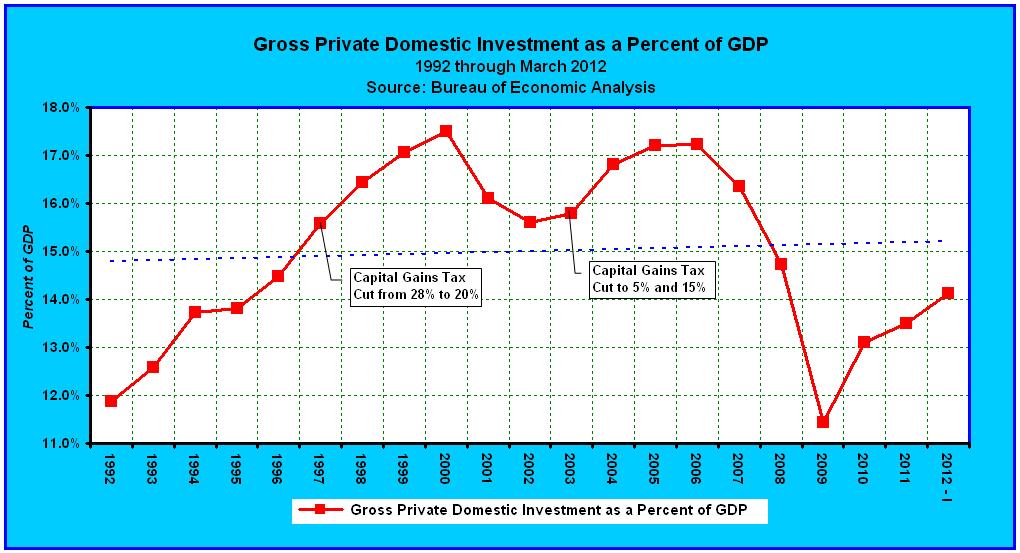
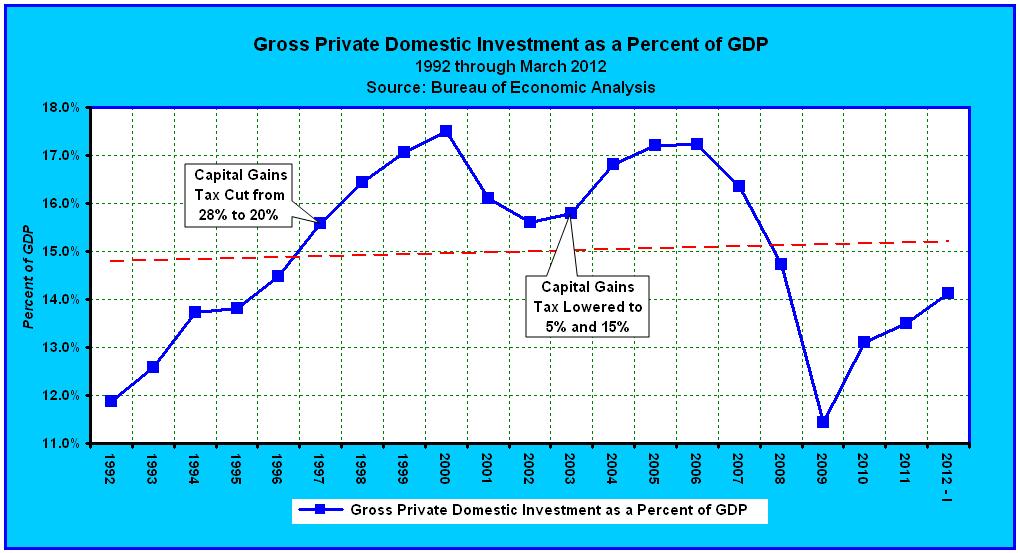
Gross Private Domestic Investment is one of the four components of Gross Domestic Product (GDP). In the United States, real gross private domestic investment currently represents just 14.1% of real GDP, or $1.9 trillion. But after the Republican-led Congress passed a tax-relief and deficit-reduction bill in 1997, real gross private domestic investment subsequently peaked at 17.5% of GDP in the year 2000. The 1997 bill lowered the capital gains tax from 28% to 20%, which induced greater levels of private domestic investment, leading to a higher rate of GDP growth, and increases in economic activity, employment and tax collections. Contrary to popular opinion, it was actually the 1997 tax cuts, not the 1993 Clinton tax hike, which produced the boom of the 1990’s (see chart below).

In the year 2000, the Dot-Com Bubble burst, wiping out a great deal of private capital and reducing gross private domestic investment back to 15.6% of GDP by 2002. So Republicans passed the Jobs and Growth Tax Relief Reconciliation Act of 2003. The 2003 Act slashed capital gains rates once again, this time to 5% and 15%. This attracted capital investment back into the economy, boosting gross private domestic investment to 17.2% of GDP in the years 2005 through 2006. Then in 2007, global credit markets went haywire, the housing bubble burst, and the Great Recession commenced. Lasting until June of 2009, the most recent downturn dragged gross private domestic investment to a 20-year low of 11.4% of GDP. Although there has since been a mild rebound to 14.1% of GDP, gross private domestic investment remains hopelessly mired in the same doldrums faced in the mid-1990s. Private investors, perhaps with good reason, are still reluctant to place new capital at risk domestically.

The Perils of Government Investment

There is a strong correlation between gross private domestic investment and real GDP growth (see table). Which came first, the investment or the growth? Well, without investment, there is no growth. And investment can only come from two sectors, private or government. Federal government consumption has remained constant, representing 7.7% of GDP in 1995 and 7.6% currently, while state and local government consumption has declined from 13% of GDP in 1995 to 10.6% currently (see table). The federal goverment’s contribution to GDP is already deficit financed, and state and local governments have bankrupted themselves through commitments to union induced pension schemes and Medicaid. So which is likely to succeed, more deficit-financed government investment, or higher levels of private sector investment?

The reason gross private domestic investment remains retarded is due to the policies of Barack Obama. Under Obama’s program, government spending has spiraled completely out of control, resulting in a glut of low interest U.S. Treasury securities, which are siphoning off capital from the private sector, via the lure of a government guarantee. This is doing a great deal of harm to the American economy, since government is incapable of building anything on its own. As a matter of fact, the only accoutrement the federal government has built by its lonesome is a $15.8 trillion mountain of debt, which now amounts to $139,500 for each U.S. taxpayer (subject to increase every millisecond). What’s ironic is that a taxpayer investing in U.S. government securities is also responsible for making interest payments on the same, through income taxes. After all, it’s not like the government has its own private stash with which to pay. Thus, the notion of government investment is but a farce.

The Obama administration’s latest presumption involves purchasing aviation biofuel through the U.S. Air Force at $59 per gallon, while straight avgas is selling for $3.60 a gallon. This they surmise is somehow a good use of taxpayer monies. The Obama administration, in its wisdom, fully expects the price of biofuels to fall by 2015, even if solely through the demand of a single customer – the U.S. taxpayer. Apparently, no private sector airline is dumb enough to join the gala. The major flaw in this design is that the recipient of this generous subsidy, Gevo, Inc., relies heavily on corn in the manufacture of its patented isobutanol fuel. And since day corn prices have jumped by more than 52% in the last month, due to the severe drought, this puppy is liable to go bankrupt by the end of the year, along with the rest of the Obama administration’s not-so-green, government financed, ventures. But at least we can say, “We didn’t build that, somebody else made that happen.” Is converting the food supply into fuel ever a good idea? Hello!

By the way, Gevo’s stock peaked on the NASDAQ exchange at $25.55 per share in April of 2011, but since the end of June has been trading below $5.00 per share. The fact that the stock had already lost over 80% of its value before the drought tells us all we need to know about the current administration’s due diligence. Relying on government investment to make up for a shortfall in private investment is kind of like cutting off your nose to spite your face. Barack Obama’s parting shot, proposing to raise income taxes in the middle of an economic quandary, is about twice as dopey. By now it should be clear that Obama’s big-government dream isn’t the solution to our problems, it is the problem. Government doesn’t know best. In fact, but for the $2.4 trillion a year it collects in taxes from the private sector, the federal government wouldn’t exist.

The Verdict

Raising real gross private domestic investment back to 17.5% of GDP would add as much as 3.4% to real GDP, or the equivalent of $455.6 billion. And since according to the Bureau of Economic Analysis, per capita personal income is currently $37,500, that means rebalancing the economy in favor of gross private domestic investment could translate into as many as 12.2 million new jobs.

Mitt Romney’s proposal, to eliminate the tax on interest, dividends, and capital gains for those making less than $200,000, is the only serious plan on the table capable of boosting gross private domestic investment back to 2000 levels, and beyond. And the creation of 12.2 million new jobs through Romney’s strategy is just the tip of the iceberg. Additional jobs are created through increases in personal consumption as the result of cutting income tax rates by 20% across the board, eliminating the AMT, eliminating the death tax, and capping corporate taxes at 25%.

In contrast, Barack Obama’s inflation tax raises taxes on the most productive Americans, those making more than $157,197 in 1993 dollars (the equivalent of $250,000 today), and does nothing for the other 98% of Americans, the combination of which will result in the loss of as many as 12.7 million jobs. So Obama’s notion offers nothing to less than nothing in terms of economic growth.

Mitt Romney’s proposal, on the other hand, leads to higher levels of gross private domestic investment, GDP, economic activity, employment, and tax collections. It’s the best hope for improving America’s economic condition. It’s economic independence versus dependence. It’s faith versus hopelessness. It’s pro-growth versus nothing. Thus, you may place me in the decided column. Was there ever a doubt?

Taxing Inflation, Part 2 | Simple Pro-Growth Policies

Are we interested in treating the symptoms of poverty and economic stagnation through income redistribution and class warfare, or do we want to go at the root causes of poverty and economic stagnation by promoting pro-growth policies that promote prosperity? ~ Paul Ryan

… Promoting Prosperity

– By: Larry Walker, Jr. –

In the United States, real gross private domestic investment currently represents 14.1% of real GDP, or $1.9 trillion. But it only represented 12.6% in 1993, after the Clinton tax hikes. Then in 1997, the Republican-led Congress passed a tax-relief and deficit-reduction bill that was at first resisted but ultimately signed by President Clinton. The 1997 bill lowered the top capital gains tax rate from 28% to 20%. The reduction in capital gains rates encouraged greater private domestic investment, leading to GDP growth, and increases in both economic activity and tax collections. After the bill passed, real gross private domestic investment grew to 15.6% in 1997, and reached a peak of 17.5% by the year 2000. It was actually the 1997 tax cuts, not the 1993 Clinton tax hike, which produced the boom of the 1990’s.

But then the Dot Com Recession began, lasting from March through November 2001, wiping out capital and reducing gross private domestic investment to a low of 15.6% of GDP. Then Republicans passed the Jobs and Growth Tax Relief Reconciliation Act of 2003. The 2003 Act slashed capital gains rates to 5% and 15%, which boosted gross private domestic investment back to 17.2% of GDP in 2005 and 2006. But then the housing bubble burst and the Great Recession began, lasting from December 2007 through June 2009, eviscerating trillions of dollars in capital. Recessions typically destroy capital, and the Great Recession was no exception. Afraid of losing again, investors have been reluctant to place new capital at risk. Government spending has since spiraled out of control, absorbing capital from the private sector with the lure of low return guaranteed government securities.

Boosting gross private domestic investment back to 2000, 2005 and 2006 levels, or to between 17.2% and 17.5%, would add as much as 3.4% to GDP growth. But Barack Obama, through a series of temporary measures, coupled with threats of higher taxes, has done little to allay investors fears. So the question today is what can the U.S. government do to encourage more private investment in the domestic economy? Following are three simple policies which can and should be implemented right away.

Pro-Growth Tax Policies

Long-term capital gains are currently taxed at a top rate of 15%, while short-term gains are taxed as ordinary income (at rates ranging from 10% to 35%). At the same time, capital losses are limited to the lesser of $3,000 per year, or up to the amount of concurrent capital gains. Interest income and ordinary dividends are currently taxed as ordinary income, while qualified dividends (paid on stocks held for 60 days or longer) are treated as long-term capital gains and taxed at a maximum rate of 15%.

But this is all subject to change next year – with the rate on long-term capital gains increasing to a maximum of 20%, and the tax on interest, ordinary dividends and qualified dividends all increasing to ordinary rates of between 15% and 39.6%. Until Congress either changes or extends the current rates, uncertainty and flagging private domestic investment will prevail. But a more exigent question is whether taxing any form of return on capital investment is fair. What’s a fair tax for the return on investment?

1. Indexing Capital Gains

As discussed in Part I, in India, capital gains are computed differently than in the U.S. Under India’s tax law an investor is allowed to increase the cost of the original investment by the annual inflation index, before computing a capital gain or loss. Capital gains in Israel are also inflation adjusted. And as stated previously, the following countries don’t tax capital gains at all: Belize, Barbados, Bulgaria, Cayman Islands, Ecuador, Egypt, Hong Kong, Islamic Republic of Iran, Isle of Man, Jamaica, Kenya, Malaysia, Netherlands, Singapore, Sri Lanka, Switzerland, and Turkey. Other countries like Canada, Portugal, Australia, and South Africa do levy a tax on capital gains, but the tax only applies to 50% of the gain.

However, in the United States, capital gains are figured without the benefit of an inflation adjustment. What’s wrong with this? What’s wrong is that the U.S. dollar has lost 96% of its value since the Federal Reserve was established and the Tax Code imposed in 1913. Therefore, much of what is thought of as a capital gain in the U.S. isn’t a gain at all, it is rather the recovery of an amount equivalent to (or in some cases less than) the purchasing power of the original investment.

For example, if you had invested $100,000 in 1981, your investment would have the same purchasing power as $261,497 today. That’s because annual inflation has averaged 3.15% in the U.S. over the last 31 years (calculate it here). So an investment of $100,000, 31 years ago, which happened to appreciate by $161,497, hasn’t really made a dime. Yet the federal government will levy a tax of $24,225 (@ 15%) on the investor as a reward for believing in America. But had the same investment been made in India, Israel, or in any of the other 17 above mentioned countries which don’t tax capital gains, the return on capital would have been tax-free. So what’s a fair share?

Does the USA’s current capital gains policy encourage American citizens and corporations to invest more at home, or to move abroad? The answer should be clear. But making matters worse, the tax rate on capital gains is scheduled to increase from 15% to 20% in 2013. And even worse, Barack Obama is proposing to raise the rate to at least 30% on the “wealthy”, while doing nothing for the other 98% of Americans. But on a brighter note, Mitt Romney would eliminate the capital gains tax entirely on taxpayers with incomes below $200,000, while lowering ordinary income tax rates to between 8% and 28%. Romney is on the right track, but he could go a bit farther.

Why not simply index capital gains to inflation, tax real capital gains at ordinary tax rates, and allow an unlimited amount of real capital losses to be claimed within the year recognized? That way it’s not necessary to play the class warfare game. Making capital gains taxes fairer for everyone is a way to increase private domestic investment and GDP, while at the same time attracting capital back to the U.S. and away from what are currently more just investment havens.

2. No Tax on Interest Income

In the U.S., interest income earned on deposits at banks and credit unions, on money market funds, on bonds, and on loans, such as seller-financed mortgages is taxed as ordinary income, subject to ordinary income tax rates. Interest on U.S. Treasury bonds and savings bonds is taxable for federal purposes, but tax-free at the state level. Interest on municipal bonds is tax-free at the federal level and tax-free at the state level if invested within one’s state of residence. Interest on municipal private activity bonds is tax-free for the regular tax, but is taxable for the alternative minimum tax.

Focusing on taxable interest, when the interest rate earned is less than the inflation rate, why is it considered taxable? If an investor isn’t earning at least the inflation rate, there are no real earnings, since the investor suffers a loss in purchasing power. For example, according to FDIC.gov, the national average interest rate paid on bank savings accounts is currently 0.09%, and the average rate on 60-month certificates of deposit, whether over or under $100,000, is 1.06%. Meanwhile, inflation has averaged 1.81% over the last five years (lower than normal due to the recession). So at today’s interest rates, an investor with $100,000 in a savings account is losing something on the order of 1.71% in purchasing power each year. This adds up over time. At current averages it would amount to loss in capital of 8.55% over five years. And that doesn’t include service charges some banks impose for the privilege of having an account.

Interest rates banks pay today aren’t a reward, but rather a punishment. But as if interest rates aren’t pathetic enough, after losing purchasing power while trying to save a dollar or two, the federal government then levies a tax on the decline in value, ensuring that no American will ever get ahead. The return on U.S. Treasury securities isn’t any better. On July 16th, the U.S. Treasury was somehow able to sell 3-year Treasury Notes offering an interest rate of 0.25%, and a yield of 0.366%. That’s laughable especially considering that the interest earned is taxable as ordinary income. Meanwhile, the inflation rate for urban consumers was 2.93% last year, and is expected to reach 3.00% in 2013. Are we paying our fair share yet?

The federal government currently taxes interest income at rates ranging between 10% and 35%, yet those rates are scheduled to increase to between 15% and 39.6% in 2013. Barack Obama’s solution is to do nothing for anyone making less than $250,000, and to raise rates to 36% and 39.6% on those making more. Mitt Romney’s solution is to eliminate the tax on interest for taxpayers with incomes below $200,000, while lowering ordinary income tax rates to between 8% and 28%. But Romney shouldn’t even have to play the class warfare game.

Either taxing interest is fair, or it’s not. And if it’s not fair, then it’s not fair for any American. If the U.S. government is serious about encouraging savings within its borders, then at the very least it will eliminate the tax on interest. It’s that simple. In no case should any investor earning less than the rate of inflation be insulted with an income tax bill. And to be truly fair, a capital loss deduction should be allowed when a long-term saver loses purchasing power by getting trapped at rates below the rate of inflation.

3. No Tax on Dividends

In 2003, President George W. Bush proposed to eliminate the U.S. dividend tax stating that “double taxation is bad for our economy and falls especially hard on retired people.” He also argued that while “it’s fair to tax a company’s profits; it’s not fair to double-tax by taxing the shareholder on the same profits.” Perhaps he was right.

In Brazil, dividends are tax free, since the issuer company has already paid a tax. In Japan, since 2009, capital losses may be used to offset dividend income. But in the U.S. dividend income is first taxed to corporations at rates ranging from 15% to 35%, before being paid to shareholders. Investors then get hit with a second tax on the same income ranging from 10% to 35% on ordinary dividends, or limited to 15% on qualified dividends (on stock held for greater than 60 days). And income tax rates on dividends are scheduled to increase to between 15% and 39.6% in 2013, on both ordinary as well as qualified dividends.

Naturally, Barack Obama’s solution is to raise taxes on dividends. Obama plans to keep Bush’s lower 10% tax bracket in place, but to raise top tax rates to 36% and 39.6% on those most likely to invest in dividend paying ventures, those making more than $250,000. Mitt Romney, on the other hand, would eliminate the tax on dividends for taxpayers with incomes below $200.000, while lowering ordinary income tax rates to between 8% and 28%. I believe that Romney is on the right track; however, if double taxation is unfair, then it’s just not fair – no matter how much income is involved.

Dividends should either be taxable to the corporation or the individual, but not both. And lest we forget, a tax on dividends may also be punitive, in the sense that when an investor’s returns are lower than the rate of inflation, purchasing power is being lost, not gained. If the government insists on taxing both entities, then the tax should only apply to individuals on the amount of return in excess of the rate of inflation.

Summary

No American should have to pay a tax on capital gains or interest income, unless the return on investment exceeds the rate of inflation. No American should have to pay a tax on dividends when the tax has already been paid by a corporation. Whether it’s easier to just do away with investment taxes altogether is subjective, but I do believe that it’s in best interests of the United States to entirely eliminate them for every American. No American should ever be taxed after suffering a decline in the purchasing power of their capital. At the very least, the basis of capital investments should be adjusted for inflation, and capital losses should be deductible in full and concurrently. If the return on investment is less than the rate of inflation, then there is nothing to tax.

Barack Obama has proposed to do nothing for 98% of taxpayers, and to raise taxes on the investment income of those making more than $250,000. He’s so stuck on the class warfare tack that he has totally forgotten to put anything on the table which would encourage greater levels of savings and investment within the United States. If Obama is somehow successful, I would expect more capital and more jobs to be shipped overseas.

Mitt Romney has proposed policies which will encourage greater savings and investment. Although his plan isn’t perfect, it’s far better than the alternative. Romney would eliminate the tax on capital gains, interest and dividends for taxpayers making less than $200,000. He would also lower the bottom tax rate to 8% from 10%, and top rates to 28% from 35%. Romney’s policies are more likely to retain capital within the U.S. and to attract more from abroad, which will lead to increases in gross private domestic investment, GDP, economic activity, employment and wealth creation.

Data: Spreadsheet on Google Drive