Adventures in Politicking I : A President’s Job

* By: Larry Walker, Jr. *

“In America the President reigns for four years, and Journalism governs forever and ever.” ~ Oscar Wilde *

According to Barack Obama, the job of the President of the United States is to “make sure everyone has a fair shot.” However, according to Article II (Sections 1 – 3) of the United States Constitution, in which the job of the President is officially and clearly outlined, nowhere do we find such ‘verbage’. Therefore, it is unnecessary to try to figure out who’s included or excluded in ‘everyone’, and how fair a shot must be – before it becomes unfair. What a relief! So what’s the President’s real job?

According to the United States Constitution, a President’s main job is, to the best of his Ability, to preserve, protect and defend the Constitution of the United States. The Executive Power is vested in a President of the United States primarily to act as Commander in Chief of the Military, to Read the opinions of the Principal Officers of each Executive Department, and to Grant Reprieves and Pardons for Offenses against the United States, except in Cases of Impeachment.

The Constitution also grants a President the power, with the Advice and Consent of the Senate, to make Treaties, to appoint Ambassadors, other public Ministers and Consuls, Judges of the Supreme Court, and all Officers of the United States, although the Congress may by law vest the appointment of such inferior Officers in the President alone, or in the Courts, or the Heads of Departments.

The President also has the power to fill up all Vacancies that may happen during the Recess of the Senate, by granting Commissions which shall expire at the End of their next Session.

Thus far, there’s no mention of making sure everyone has a fair shot. Has the current POTUS made enough nominations to to fill the growing number of judicial vacancies? No.

Other than the duties mentioned above, a President is commissioned by the Constitution to, from time to time, give to the Congress information on the State of the Union, and recommend to their Consideration such Measures as he may judge necessary and expedient.

I believe our forefathers meant that a President should give Congress the actual state of the Union, not just the part that improves his chances for reelection. And by making recommendations to Congress, I don’t think they meant publicly browbeating and demonizing those who might disagree.

The President may also, on extraordinary Occasions, convene both or either Houses of Congress, and in Case of Disagreement between them, with Respect to the Time of Adjournment, he may adjourn them to such Time as he shall think proper. The President is further directed to receive Ambassadors and other public Ministers. Finally, a President must take care that the Law is faithfully executed, and to Commission all the Officers of the United States.

Well, that’s it. Nothing here about making sure everyone has a fair shot.

Although Article II (Section 3) states that the President shall from time to time recommend for Congressional consideration, such measures as he shall judge necessary and expedient, that’s not the same thing as roaming around the countryside espousing radical, partisan ideals about what he feels is fair and unfair. In fact, some would call Mr. Obama’s attempts to indoctrinate the most radical elements of the public to his personal philosophy, through making repetitious statements regarding his own notion of fairness, instead of listening to the Principal Officers of each Executive Department, and instead of making his recommendations directly to our elected Representatives, as outlined in the Constitution, many of whom express genuine concern over whether such ideals may lead our Nation to the brink of bankruptcy, akin to Treason.

In other words, instead of egging on the most radical members of the public, inciting many to violence, Mr. Obama should be talking with our Congressional Representatives and Senators. The act of advocating to the general public, a policy of raising taxes in the midst of a weak Global economy, based upon nothing more than his own personal beliefs, after having been warned of, and in spite of, the dire consequences which will surely follow, instead of doing his job as clearly outlined in the Constitution, should be treated as a Crime against the United States. This is precisely why Article II (Section 4) adds that the President, Vice President and all civil Officers of the United States, may be removed from Office upon Impeachment for, and Conviction of, Treason, Bribery, or other high Crimes and Misdemeanors.

Conclusion:

The job of the President of the United States is outlined in Article II of the U.S. Constitution. The President’s job is not to lecture the public as Professor in Chief, nor to make sure everyone has a fair shot, whatever that means. And to take it a step further, it really doesn’t matter whether a presidential candidate used to be a college professor, a community organizer, a State senator or Governor, or the Chief Executive Officer of a Private Equity Firm, what matters is whether he or she is capable of comprehending the duties of the Office, as outlined in the Constitution, and has the willingness and ability to carry them out.

The qualifications for being President of the United States are also found in Article II (Section 1). “No person except a natural born Citizen, or a Citizen of the United States, at the time of the Adoption of this Constitution, shall be eligible to the Office of President; neither shall any Person be eligible to that Office who shall not have attained to the Age of thirty-five Years, and been fourteen Years a Resident within the United States.” That’s it.

Is Obama qualified to be President? Is Mitt Romney qualified? Are Ron Paul, Gary Johnson, and Tom Hoefling qualified? Your guess is as good as mine, however, this Election isn’t about qualifications any more than it’s about some eccentric job description pulled out of thin air. This Election is about whether or not Mr. Obama has fulfilled the official job of President, not his make-believe ideal, to the satisfaction of the majority of the American people. It’s about whether we the people want real change, or perhaps just a freaking break. The fact that Mr. Obama has no idea what his job is, after nearly three-and-a-half years of on-the-job training, says a lot.

Related:

Hope and Change on Ice

Reference:

The United States Constitution

Obama’s Economic Fallacy: The Not-To-Do List

Small Business Goals, Rewards and Incentives

* By: Larry Walker, Jr. *

“Contrariwise, if it was so, it might be; and if it were so, it would be; but as it isn’t, it ain’t. That’s logic.” ~ Lewis Carroll *

In his latest weekly address, Mr. Obama outlined a mirage of goals, rewards and incentives which he says Congress ‘must’ act upon immediately. But for the most part, what he proffered are just more of the same tried and failed policies, conjured from the same line of illogical reasoning we’ve heard, time and time again, over the last four years. Therefore, what Mr. Obama coined as a “Congressional To-Do List” should rather be endorsed as the official “Not-To-Do List”. Why? Well, let’s test the logic of just one item on the, so called, ‘To-Do List’.

Mr. Obama said, “Third, Congress should help small business owners by giving them a tax break for hiring more workers and paying them higher wages. Small businesses are the engine of economic growth in this country. We shouldn’t be holding them back – we should be making it easier for them to succeed.”

In order to understand why Mr. Obama’s argument is fallacious, one must understand what an argument is. Very briefly, an argument is an attempt to persuade someone of something, by giving reasons or evidence for accepting a particular conclusion. It consists of one or more premises followed by a conclusion. In a logical argument, the premises support the conclusion. When we place Mr. Obama’s argument in its proper order we arrive at the following:

Premise 1 – Small businesses are the engine of economic growth in this country.

Premise 2 – We (the government) shouldn’t be holding them back – we should be making it easier for them to succeed.

Conclusion – Congress should help small business owners by giving them a tax break for hiring more workers and paying them higher wages.

No one in their right mind would disagree with either premise. Yes, small businesses are the engine of economic growth in the USA. And no, the government shouldn’t be holding us back, but should rather get out of our way, and off of our backs, so that we may succeed. However, the premises Mr. Obama presented do not support his conclusion.

Will the act of offering or failing to offer the reward of tax breaks to small businesses, that hire more workers and pay higher wages, make them any more, or less, the engine of economic growth in America? Will the act of passing additional governmental laws, rules, regulations and loopholes make it any easier for small businesses to succeed?

As a small business owner myself, I can state first hand, that offering my company a reward for hiring more workers and paying them higher wages won’t help my company in the least. That’s because nowhere in my mission statement will you find the stated goals of hiring more workers and paying them higher wages.

How many small business owners do you know that are in business for the purpose of hiring more workers and paying them higher wages? I’m in business to provide a top quality, affordable service, and to hopefully make a profit in the process, not to hire more workers and pay higher wages.

In my world, hiring more workers and paying higher wages are by-products of increased demand. But since demand is still a far cry from where it was in 2007, why would I suddenly alter my goals toward hiring more workers and paying them higher wages? If demand were to suddenly increase, I might be forced to hire more workers and/or offer higher wages, but I would not do so to receive a deficit-financed government reward.

If, and when, I decide to hire another employee, the decision will be solely based on demand. But as long as the economy remains in its present lackadaisical state, if enacted, Mr. Obama’s proposed reward will wind up just like the 17 other so called tax cuts he has offered to small businesses over his failed term – another waste of paper and ink. If anything, what small business owners lack is an incentive to succeed, not more rewards for jumping through narrowly defined governmental hoops.

Goals, Rewards and Incentives

In order to understand how illogical Mr. Obama’s proposal is, one must have an understanding of goals, rewards and incentives. A goal is simply the purpose toward which an endeavor is directed. And while a reward is a positive reinforcement granted after the performance of a desired behavior, an incentive is an expectation of reward, offered in advance, in order to induce action or motivate effort.

Goal: The purpose toward which an endeavor is directed; an objective.

Reward: The return for performance of a desired behavior; positive reinforcement.

Incentive: An expectation of reward that induces action or motivates effort.

In the matter at hand, an incentive would be something offered upfront to motivate small business owners to reach their own goals. But what Mr. Obama has proposed is to reward small business owners after they achieve a government-imposed goal.

According to Mr. Obama, the measure of success for a small business lies in the number of persons it employs. What’s wrong with this theory? The main problem is that it fails to align with the realistic goals of most small businesses. Following is a list of goals for my small business. As you can see, hiring more workers and paying them higher wages isn’t on the list.

  1. Offer top quality services at affordable prices.

  2. Make a profit.

  3. Control costs.

  4. Maintain sufficient demand to remain viable.

  5. Meet all current obligations with current revenue.

  6. Payoff existing debt without incurring more.

  7. Build and maintain a prudent reserve.

  8. Achieve moderate growth, in-line with current resources.

Hiring more workers and paying them higher wages might be Obama’s goal for business owners, but what business has he ever run? Common sense dictates that hiring more workers and paying higher wages are by-products of successful business practices, not primary objectives. It is only when small business owners meet their goals that business activity, hiring and wages increase. So instead of offering a reward for something low on the priority list of small business owners (not even on my list), Congress could do better by offering an incentive to help small businesses reach their true goals. Number one on that list is, indisputably, a reduction of individual income tax rates.

Lower Individual Income Tax Rates

Like me, since most small business owners are taxed at the individual level, lowering individual income tax rates will support small businesses in the following ways:

  1. Helps small businesses keep prices level by not forcing them to raise prices to meet higher income tax obligations.

  2. Enables small companies to maintain the same effective profit margin, in the present unstable economy, without raising prices or slashing expenses.

  3. Makes it easier to control costs without raising prices, or laying-off existing workers.

  4. Helps small companies stay in business in the face of lower demand, which is the by-product of oppressive government taxing and regulatory policies.

  5. Allows small businesses to meet current obligations without incurring additional debt.

  6. Enables small companies to pay down existing debt without incurring more.

  7. Allows small companies to build prudent reserve accounts to meet obligations in the face of future business cycle downturns.

  8. Helps small companies achieve moderate growth in-line with existing resources.

In addition, lowering individual income tax rates will enable increased consumer demand for the products and services offered by small businesses, since a rate cut would apply to everyone across-the-board. Lower income tax rates are therefore a win-win for the economy.

Who asked you anyway?

The only one asking for tax breaks for small businesses that hire more workers and pay them higher wages is Barack Obama. No small business owner that I know has requested any such nonsense. But on the other hand, everyone that I know would benefit from the incentive of lower individual income tax rates. If we can’t agree on this, can we at least agree not to raise individual income tax rates?

Raising tax rates on small business owners on January 1, 2013, which is what’s really on the table, will not help them reach their goals, nor will it achieve Mr. Obama’s fallacious goal. Raising taxes will rather have the opposite effect. Even if the proposed carrot on a stick, tax breaks for those who hire more workers and pay higher wages, is offered, the pending tax hikes will negate that reward, leaving both those who take the bait, and those who don’t in jeopardy.

Arbitrarily hiring more workers and paying higher wages, in a stagnant economy, will force small businesses to raise prices on existing customers, and raising prices, without regard to demand, will have the effect of reducing demand, as customers seek lower cost alternatives. The resulting drop in demand, in the face of higher costs, will lead to further price hikes, in order to meet current obligations. In effect, pursuing the third item on Mr. Obama’s ‘To-Do List’ would land most small businesses – out-of-business – in double-time.

I am frankly sick and tired of all the special interest gimmicks conjured from the illogical mind of an amateur. What Mr. Obama ought to do at this point is simply surrender the keys, and let someone who knows what they’re talking about manage the economy. That’s what I call a logical conclusion.

“Companies are not charitable enterprises: They hire workers to make profits. In the United States, this logic still works. In Europe, it hardly does.” ~ Paul Samuelson

Related:

Picture via: Christ, My Redeemer


Real GDP Per Capita — Dead!

Moving Forward — Without Obama

* By: Larry Walker, Jr. *

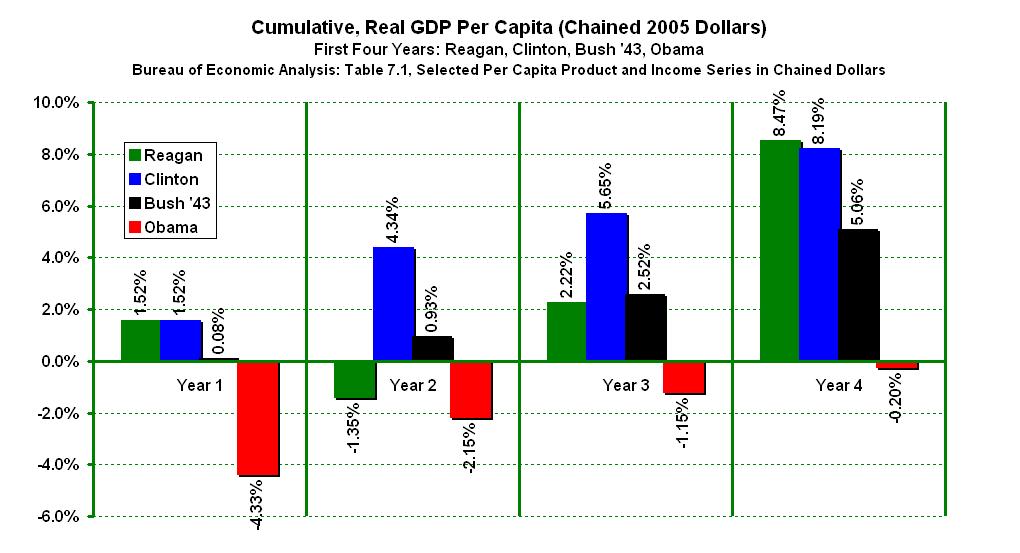
Why do I get the eerie feeling that we’ve gotten nowhere in the last four years? The answer is because we’ve gone precisely nowhere with Obama. As the chart above displays, on a per capita basis, real gross domestic product has declined by a cumulative -0.20% during Obama’s four-year term (through Q1 2012).

President’s Ronald Reagan and Bill Clinton both inherited rather weak economies. Each achieved real GDP per capita growth of 1.52% in the first year in office, but by the second year, Reagan’s cumulative GDP had declined to -1.35%, while Clinton’s rate climbed to 4.34%. Yet by the end of the fourth year, Reagan’s policies resulted in cumulative GDP per capita growth of 8.47%, versus Clinton’s 8.19%. Man, whatever Reagan was onto needs to be codified and replayed, over and over and over again. Needless to say, both were overwhelmingly re-elected.

George W. Bush inherited a really crummy economy. After only achieving real per capita growth of 0.08% in his first year, by his fourth, Bush’s policies had grown the economy to cumulative real GDP per capita of 5.06%. And with that, Bush ’43 was easily re-elected.

The policies of Reagan, Clinton and Bush ’43 moved America ‘forward’. That’s what I call progress – moving the economy forward in real and measurable terms. Terms that every American could see, touch and feel in their own billfolds, as real GDP per capita was spread around, lifting many from poverty and mediocrity into new realities.

Why Real GDP Per Capita?

Why measure GDP on a per capita basis? GDP is an aggregate figure which does not consider differing sizes of nations. Therefore, it should be stated as GDP per capita (per person) in which total GDP is divided by the resident population on a given date.

Why use chained dollars? When comparing GDP figures from one year to another, it is desirable to compensate for changes in the value of money – i.e., for the effects of inflation. The factor used to convert GDP from current to constant values in this way is called the GDP deflator. Unlike the Consumer price index, which measures inflation or deflation in the price of household consumer goods; the GDP deflator measures changes in prices of all domestically produced goods and services in the economy.

It is only by comparing cumulative changes in real GDP per capita that we are able to understand whether today’s economic policies are helping or hurting. Furthermore, by making the comparison in 4 and 8 year increments we are able to determine whether to re-elect a POTUS or send him packing, or to continue with the same party affiliation or make a break towards independence. So where do we stand today?

GDP is Dead

Although Barack Obama also inherited a bad deal, his policies made it worse. The economy was declining at a real per capita rate of -1.27% in 2008, but by the end of 2009, Obama turned that into a decline of -4.33%. That’s a fact. Then, by the end of his second year, Obama’s stimulus programs resulted in a slight improvement, as the economy achieved negative cumulative growth of -2.15%. Although similar to Reagan’s second year decline to -1.36%, that’s where all similarities end.

Now in his fourth year (as of Q1 2012), Obama has achieved cumulative real GDP per capita growth of -0.20%. Compared to Reagan, Clinton, and Bush ‘43’s fourth year benchmarks of 8.47%, 8.19% and 5.06%, Obama is clearly a first-term loser. In absolute terms, the economy has gone nowhere under Obama. In terms that really matter, inflation adjusted dollars, as a percentage of the population; the economy hasn’t moved at all under the policies of Barack Obama. We are still below zero as far as real per capita growth – below zero, in spite of $6.3 trillion of additional debt. If Barack Obama is re-elected, he will be the only POTUS in modern history to be reinstated based on driving our economy into the ground.

Forward

“If you cry ”Forward” you must be sure to make clear the direction in which to go. Don’t you see that if you fail to do that and simply call out the word to a monk and a revolutionary, they will go in precisely opposite directions?” ~ Anton Chekhov

Forward? Yes, we will be moving forward – without Obama. The distraction of rising student loan interest rates is irrelevant in a shrinking economy. The concepts of a fair shot and a fair share are inapposite and unworthy of further discussion given the circumstances. And this garbage about being the only American around capable of giving a nod to take out a dangerous radical jihadist is just that – garbage.

I care about my children, my grandchildren, my parents, my sisters, my friends, my business, my customers, my community and my neighbors, but I could care less about Afghanistan. Why are Americans still dying in that cesspool? If Obama really wants to take responsibility for all of his actions, then why not include the fact that 69% of U.S. Afghan War casualties have occurred during his 39 month command? Explain that! How did Obama manage the war for only 30% of the time, 3 years out of 10, yet wind up responsible for 69% of the casualties?

Between the trail of blood, death and destruction abroad and his tanking of the economy at home there’s really no reason to grant Obama a second chance. It’s time for Obama to give up the keys, stop impersonating a president, and go home. Only new leadership will move America forward.

References:

Bureau of Economic Analysis, Table 7.1. Selected Per Capita Product and Income Series in Current and Chained Dollars (A) (Q)

Spreadsheet:

Per Capita Product and Income

Rising Interest on Federal Debt | Don’t Double My Rates

Hey, Don’t Double Obama’s Rates!

* By: Larry Walker, Jr. *

Mr. Obama asked students at the University of North Carolina yesterday afternoon to tell their members of Congress one thing: Don’t double my rates.

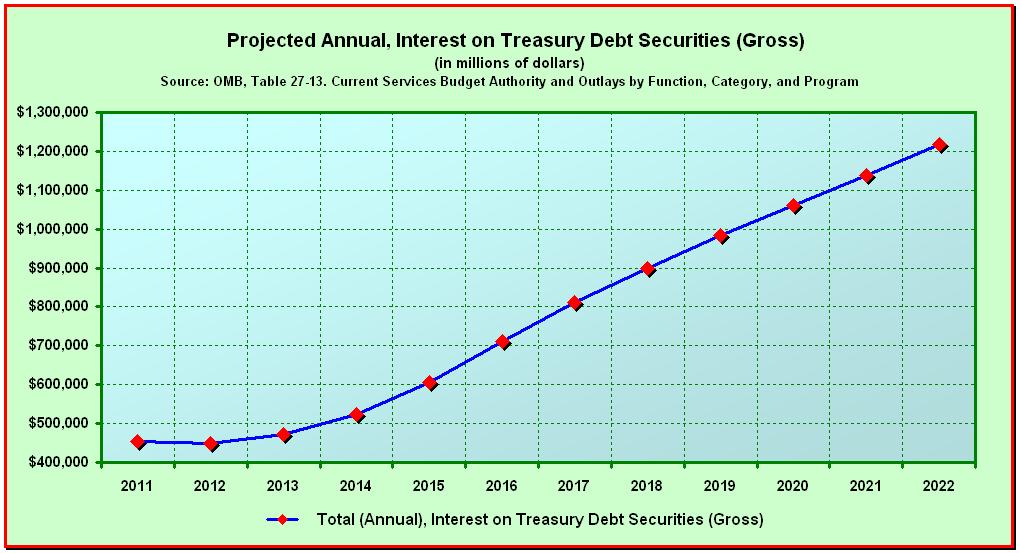
Once again, Mr. Obama doubled down on flimflam, this time misdirecting towards rising interest rates on student loan debt — instead of targeting the rising cost of interest on the federal debt. According to the White House, interest on the federal debt is projected to surpass $1.0 trillion per annum by the year 2020. Mr. Obama also failed to mention the $494 billion tax hike scheduled to hit American taxpayers on January 1, 2013.

According to Mr. Obama, “Five years ago, Congress cut the rates on federal student loans in half. That was a good thing to do. But on July 1st — that’s a little over two months from now — that rate cut expires.  And if Congress does nothing, the interest rates on those loans will double overnight…. And just to give you some sense of perspective — for each year that Congress doesn’t act, the average student with these loans will rack up an additional $1,000 in debt — an extra thousand dollars.  That’s basically a tax hike for more than 7 million students across America…”

If rising interest rates on student loan debt represents a tax hike, what are we to make of next year’s higher income tax rates?

Nine years ago, Congress cut income tax rates across the board. That too was a good thing to do. But on December 31st — that’s a little over eight months from now — those rates expire. And if the U.S. Senate does nothing, income tax rates will rise overnight… Tax policies in seven different categories will expire, including the Bush Tax Cuts, the payroll tax cut, and the AMT Patch. Plus five of the 18 new tax hikes from Obamacare will begin. And just to give you some sense of perspective — Taxmageddon is a $494 billion tax increase, so each year that the U.S. Senate doesn’t act, every man, woman, and child in America will rack up an additional $1,500 in income taxes — an extra fifteen hundred dollars. That’s an extra $6,900 for every U.S. taxpayer (the 50% of us who actually pay income taxes) – an extra six thousand nine hundred dollars.

So should my three children, who are all in college, be worried more about rising interest rates on student loans, dismal employment prospects, looming tax hikes, or rising interest on the federal debt?

Rising Interest on the Federal Debt

Based on Obama’s fiscal year 2013 budget, per Table 27-13, Baseline Budget Authority and Outlays by Function, Category, and Program, Gross Annual Interest on Treasury Debt Securities is projected to grow from $453.9 billion in 2011 to over $1.0 trillion by 2020, and to surpass $1.2 trillion by the year 2022 (see Chart below). Since this represents about half of the government’s current revenue, that doesn’t leave much room for anything other than Social Security and Medicare.

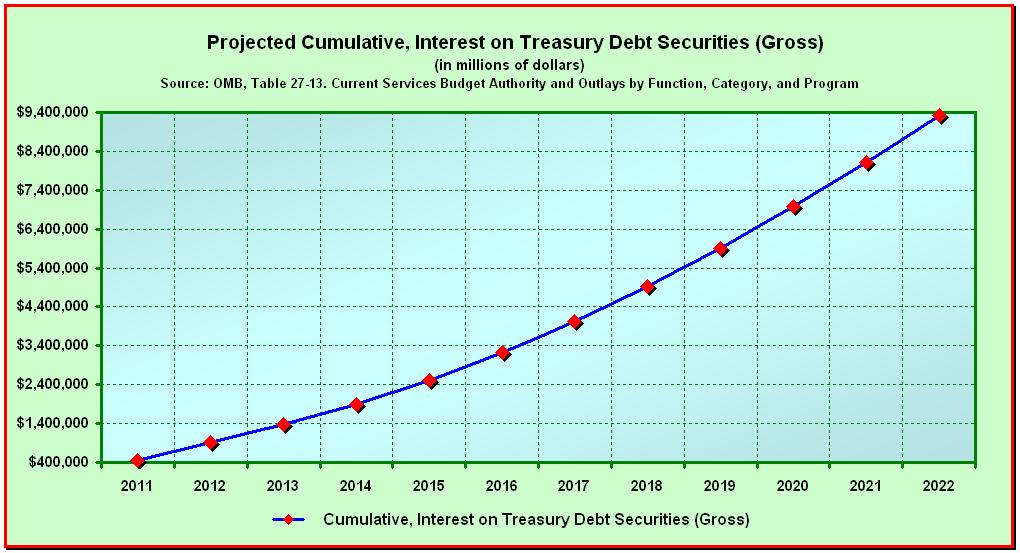
Today’s college students need to give serious and careful thought to a lot more than interest rates on student loan debt. Within the next eleven years, on a cumulative basis, the U.S. Government will incur more than $9.3 trillion in interest on the federal debt (see Chart below). That equates to roughly $30,000 for every man, woman and child in America. And since only 50% of working Americans pay income taxes, for those fortunate enough to obtain gainful employment, it amounts to nearly $131,378 each. And that’s just over the next eleven years — an extra one hundred and thirty one thousand three hundred and seventy eight dollars.

Thanks, Mr. Obama, for sugarcoating the dire consequences of your lack of a cohesive economic plan, and for sacrificing my children and grandchildren’s futures in lieu of your own selfish ambitions.

Tables

Reference:

Table 27-13. Current Services Budget Authority and Outlays by Function, Category, and Program

Passing the Buck and Taking Names | Obama’s GSA

* By: Larry Walker, Jr. *

“Ultimately the buck stops with me… I’m going to be accountable.” ~ Barack Obama *

What a load of bull! Harry Reid’s U.S. Senate hasn’t passed a budget resolution since April 29, 2009. Barack Obama hasn’t presented a budget, at least not one acceptable to either Democrats or Republicans, since the day he set foot in office. Yet he thinks he should keep his job. But that’s not how it works in America. Obama was given a fair shot; he had his fair share of opportunities, but he chose to pass the buck, running his mouth instead of governing, and now it’s time to give someone else a shot.

U.S. Gross Domestic Product has grown by a mere 7.59% from 2007 to 2011, or at an average annual growth rate of a pathetic 1.90%. But Federal Agency spending has increased by 32.04% over the same period, or at an average annual growth rate of 8.01%. Does the fact that Agency spending outpaced the economy by 322% sound any alarms? Well if we had a chief executive who was paying attention it would. This is an outrageous, hair-raising, mind-boggling, egregious, statistical fact, yet all U.S. taxpayers have heard for the last three plus years are threat after threat of higher taxes.

The Bush tax cuts are out, no they’re in. The payroll tax cut is gone, no it’s back. The AMT Patch is dead, no it’s still breathing.’

And now we have to contend with yet another threat, Taxmageddon. Taxmageddon is a $494 billion tax increase that strikes at the beginning of 2013. This time it’s the largest tax increase in U.S. history, scheduled to hit us smack in the face on January 1, 2013. Under current law, tax policies in seven different categories will expire, including the Bush Tax Cuts, payroll tax cut, the AMT Patch, plus five of the 18 new tax hikes from Obamacare will begin, see Taxmageddon: Massive Tax Increase Coming in 2013.

Unusual uncertainty remains unusually uncertain.

With Taxmageddon looming, the GSA scandal is well-timed. It has undeniably exposed the truth. And the truth is that the federal government has been living large through its discretionary spending, throwing our future to the wind, while we’ve been left sitting on pins and needles. Since the economy is practically at zero growth, where do these morons think the money to pay higher taxes will come from? I find it amazing, simply amazing, that no one has been in charge of the national purse for the last three-plus years. Absolutely no one has kept tabs on how our tax dollars were spent. We deserve better.

With an estimated $6.3 Trillion borrowed and squandered on Obama’s watch, and red flags abounding, it makes me sick to my stomach that politicians are suddenly concerned. You would have to be blind or not paying any attention to federal spending whatsoever to not notice the humongous 6,896.30% increase in the GSA’s expenditures from 2007 to 2011. Why blame the GSA? Blame yourselves, or blame Obama. The buck stops with Obama, right? So fire him. Put Obama on trial.

Maybe if someone wasn’t on the golf course, on vacation, or campaigning every other week (at our expense), and instead actually took time to study the budget “line by line”, and to work with Congress on cutting and capping spending, the GSA incident wouldn’t have occurred. I call it not doing the job you were elected to do. But hindsight is 20/20; foresight is not reelecting someone who has proven he can’t handle the job.

Does the following condensed OMB table, Outlays by Agency, which compares government spending growth from 2007 to 2011, raise any flags? If you ask me, the entire record is a red flag. The General Services Administration is an obvious bell ringer, its expenditures having grown from $27 million in 2007, to over $1.8 billion in 2011, or by 6,896.30%. But it’s not the only agency that should concern us, frankly they all should.

As you scan through the following highlights, keep in mind that the entire U.S. economy grew by a mere 7.59% over the four-year period, or at average annual growth of 1.90%.

  • The Department of Agriculture’s four-year spending growth was 65.11%, with average annual growth of 16.28%. You would think they were actually growing crops or raising livestock, but we know that’s not the case, so why have annual expenditures increased by $54.9 billion? Cut it.

  • The Department of Commerce’s four-year spending growth was 53.36%, with average annual growth of 13.34%. You would think they were actually manufacturing products or providing services, but we know that’s not the case, so why have annual expenditures increased by $3.5 billion? Cut it.

  • The Department of Energy’s four-year spending growth was 55.95%, with average annual growth of 13.99%. You would think they were actually producing electricity, mining coal or drilling for oil, but we know that’s not the case, so why have annual expenditures increased by $11.3 billion? Cut it.

  • The Department of Labor’s four-year spending growth was 177.58%, with average annual growth of 44.40%. You would think they were actually performing job placement services, but we know that’s not the case, so why have annual expenditures increased by $84.4 billion? Cut it.

  • The Department of State’s four-year spending growth was 77.29%, with average annual growth of 19.32%. You would think they were annexing nations and granting Statehood, in order to increase GDP, but we know that’s not the case, so why have annual expenditures increased by $10.6 billion? Cut it.

  • The Department of Veterans Affairs’ four-year spending growth was 74.36%, with average annual growth of 18.59%. Is this sustainable on average annual GDP growth of just 1.90%? Not hardly. So why have annual expenditures increased by $54.1 billion? Cut it.

  • The Corps of Engineers–Civil Works’ four-year spending growth was 158.75%, with average annual growth of 39.69%. You would think they were actually building roads and bridges, but we know that’s not the case, so why have annual expenditures increased by $6.2 billion? Cut it.

  • The Small Business Administration’s four year spending growth was 424.51%, with average annual growth of 106.13%. You would think they were actually making loans directly to small businesses, but we know that’s not the case, so why have annual expenditures increased by $4.9 billion? Cut it.

  • The Social Security Administration’s (On-Budget) four-year spending growth was 182.82%, with average annual growth of 45.70%. On-budget spending isn’t mandated, it’s not the entitlements portion in which Social Security Taxes offset payments to retirees and those with disabilities. No, this is interest and principal repayments of previously looted funds, and coverage of shortfalls due to the payroll tax cut and other gimmicks. You would think they were actually increasing benefit checks or lowering Medicare premiums, but we know that’s not the case, so why have annual expenditures increased by $100.4 billion? Cut it.

  • Total Federal Outlays experienced four-year spending growth of 32.04%, with average annual growth of 8.01%. With that kind of spending, you would think our economy would have grown by more than 7.59% over the four-year period, and achieved far more than average annual growth of 1.90%, but we know that didn’t happen, so why have annual expenditures increased by $874.4 billion? Has the economic stimulus program of 2009 become permanent? Cut it.

  • And last but far from least, the General Services Administration’s four-year spending growth was a whopping 6,896.30%, with average annual growth of 1,724.07%. You would think they were throwing some really wicked parties, or something. Oh, it turns out that was the case! No wonder annual expenditures increased by $1.9 billion. Just cut it.

Our government is spending at a rate which is 322% greater than the underlying economy. We call this “unsustainable”. What do you call it? The egregious growth of the GSA’s expenditures should have been caught long before it became a public scandal. Has anyone in the District of Columbia been paying attention for the past three years? You would think Obama would have caught this with his vast experience running companies, governing States, and all. Oh that’s right, he doesn’t have any experience.

I just gave you $340.2 billion of simple budget cuts, while Obama refuses to acknowledge the problem. If you still don’t get it, here’s the wrap.

The economy isn’t growing. The government is spending at a rate which is 322% greater than its underlying economy. Every additional dollar of tax revenue sucked out of our stagnant economy will cause the economy to decline further, while government continues to live the high life. Since there is no additional revenue to garner, government spending must be cut. The economy was on fire in 2007 on dramatically less government spending. Therefore, returning to the budget of 2007 damages nothing, other than Obama’s plan to bankrupt the nation. If Obama isn’t trying to bankrupt the USA, then what is he doing?

Fire Obama! Cut government spending. Cut the B.S. Cut it big. And cut it now!

References:

Table 4.1—Outlays by Agency: 1962–2017

BEA—Gross Domestic Product and Personal Income

Spreadsheets

Obama’s Secretarial Tax Fallacy

By: Larry Walker, Jr.

There’s no way Obama’s secretary paid a higher effective tax rate than the Obamas. You don’t believe it? Are income taxes such a mystery that we can’t figure it out? Well, let’s run the numbers and see.

According to Jake Tapper of ABC News, Mr. Obama released his 2011 federal income tax today, with he and his wife reporting an adjusted gross income of $789,674. The Obamas paid $162,074 in total tax – an effective federal income tax rate of 20.5%.

The White House also reported that President Obama’s secretary, Anita Decker Breckenridge, makes $95,000 a year. White House spokeswoman Amy Brundage told ABC News that Breckenridge “pays a slightly higher rate this year on her substantially lower income, which is exactly why we need to reform our tax code and ask the wealthiest to pay their fair share.”

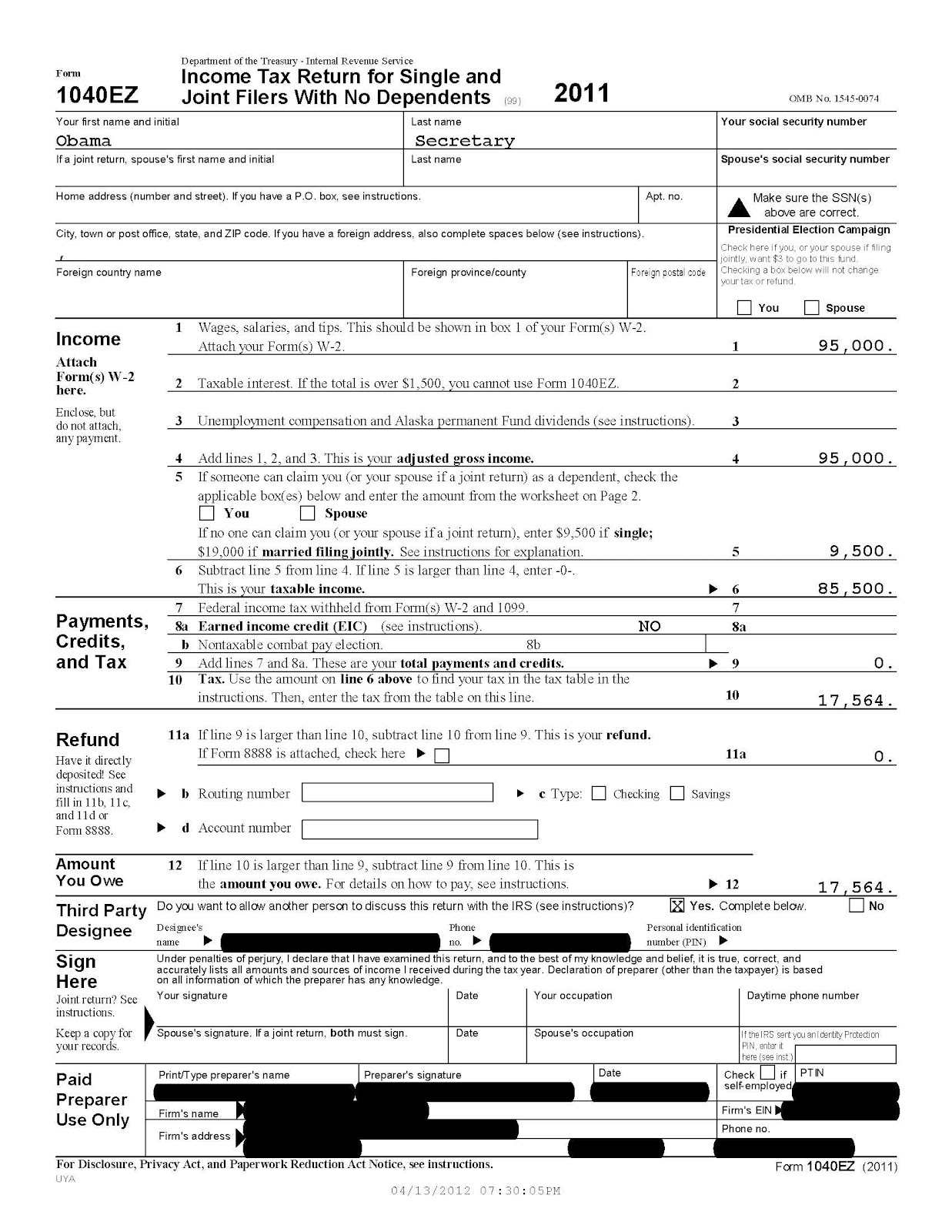
The only problem with this story is that Amy Brundage doesn’t know how to compute a tax return, or an effective tax rate. If Ms. Breckenridge were single, made wages of $95,000, and had no other dependents or deductions, her standard deduction would have been $5,800 and her personal exemption $3,700. So taking Ms. Breckenridge’s income of $95,000 and subtracting her deductions of $9,500 results in taxable income of $85,500, and a total income tax of $17,564 (click the tax return image below to enlarge). Thus, her effective tax rate is 18.4% (17,564 / 95,000). The last time I checked 18.4% was less than not greater than 20.5%.

Is the Obama Administration so delusional that it believes the American public doesn’t understand basic math? Get a clue! Or ask an accountant. In my opinion we’re all paying way too much for the incompetence of this government. The mainstream media should be ashamed for not verifying the numbers. And Obama’s definitely on the wrong track, one which should (should have) lead to the end of his short and sorry career. That suits me fine.

Note: What I have calculated above is the maximum effective tax rate possible for a single person with $95,000 of gross income. However, if Ms. Breckenridge is married her tax rate will be lower, if she has dependents her total tax will be reduced, if she owns a home and pays mortgage interest, gives to charity, or pays a substantial amount in State taxes she could itemize deductions on Schedule A, any combination of which would make her effective tax rate substantially lower than 18.4%.

U.S. Economic Growth at 21-Month Low

* Recession Due by November of 2012 *

* By: Larry Walker, Jr. *

“Are you cut out to live a lie? If you don’t mind skulking around, leading a double life and constantly having to look over your shoulder to make sure you don’t get found out, you may have just what it takes.” ~ How to Live a Lie (eHow.com)

As I pointed out in War on Wealth, Part II | Keeping Our Foot on the Gas, Barack Obama, the unopposed Democrat presidential nominee, has been out on the campaign trail spreading the following wildly inaccurate cliff-hangers. He says, “Manufacturing is coming back. Companies are starting to bring jobs back. The economy is getting stronger. The recovery is speeding up. We’re moving in the right direction. And now we have to do everything in our power to keep our foot on the gas.”

But according to the Economic Cycle Research Institute (ECRI), the same crew that predicted the last recession, U.S. economic growth is at a 21-month low, and we are heading straight into another recession, this year, in 2012.

ECRI is a private forecasting firm based in Manhattan which was founded by Geoffrey H. Moore, the economist who helped originate the practice of using leading indicators to predict business cycles. Over the last 15 years, ECRI has gotten all of its recession calls right, while issuing no false alarms.

In the institute’s view, the United States, which under the leadership of Barack Obama has failed to recover from the last downturn, is currently plummeting into a new one. On September 30, 2011, Lakshman Achuthan, the institute’s chief operations officer, said,” If the United States isn’t already in a recession now it’s about to enter one.” Mr. Achuthan maintains this position to this day. Here he is in a February 24, 2012 interview on CNBC:

http://plus.cnbc.com/rssvideosearch/action/player/id/3000075118/code/cnbcplayershare

In fact, if you carefully study the table below, courtesy of the National Bureau of Economic Research, what should stand out is the fact that, ever since 1945, the United States has averaged an economic recession once every 59-month’s. Therefore, it is logical to infer that since the last recession began in December of 2007, the next recession should be arriving by November of 2012.

After the way Mr. Obama has divided and driven the federal government and our nation into the ground over the last 37 month’s, can you imagine how he would act under the duress of a self-imposed recession? More bailouts, never-ending stimulus, trillions more in crushing debt, bigger deficits, numberless regulations, higher taxes, continued covering of his tracks with a vast array of alibis and excuses, and more lies. Oops! Did I say lies?

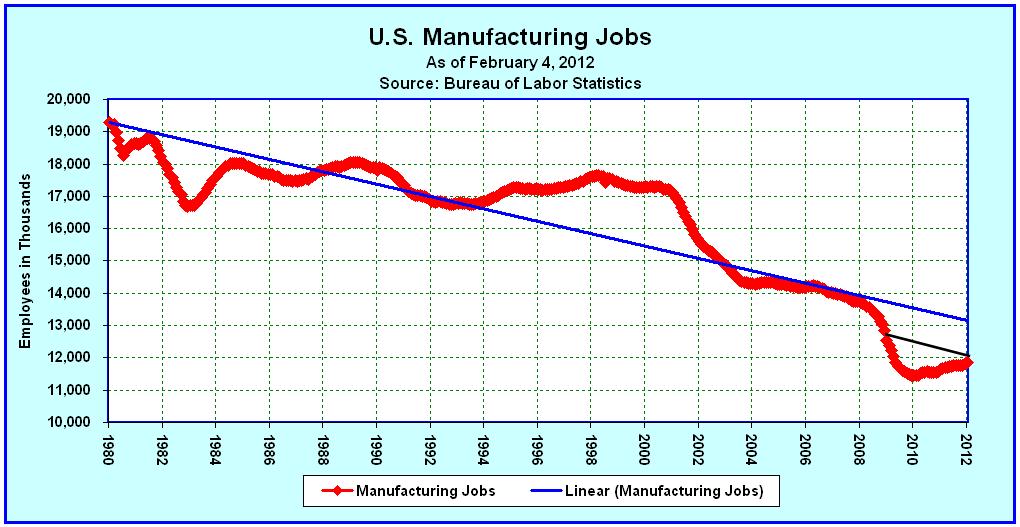
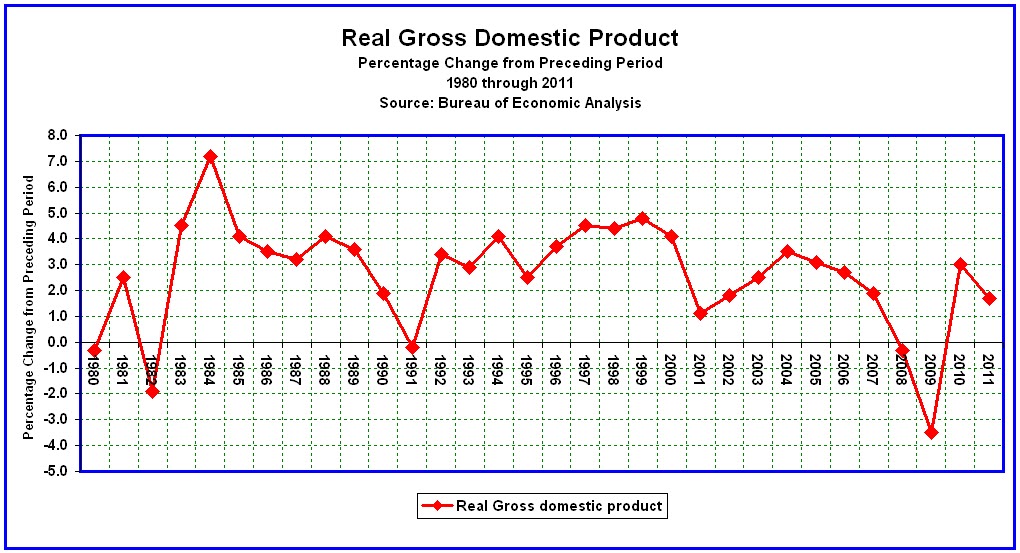
It’s been real though, I mean the loss of almost a million manufacturing jobs since 2008; the decline in economic growth from a peak annual rate of 3.0% in 2010, to just 1.7% in 2011; the national debt as a percentage of GDP skyrocketing from 69.9% in 2008 to 104.8% in 2012, and projected to reach 107.8% by 2014; and lest we forget, gasoline prices rising from an average price of $1.61 in the week ending December 29, 2008, to $3.79 as of the week ending March 5, 2012. However, anyone who’s still considering Mr. Obama’s re-election should take the time to study not only ECRI’s economic indices, but also the eHow.com article, “How to Live a Lie” – because if you still believe in Obama there’s no sense in beating around the Bush.

Ends of the Green Agenda

Costs of Algae Biofuel

* By: Larry Walker, Jr. *

Detective Thorn: It’s people. Soylent Green is made out of people. They’re making our food out of people. Next thing they’ll be breeding us like cattle for food. You’ve gotta tell them. You’ve gotta tell them! ~ Memorable quotes from Soylent Green *

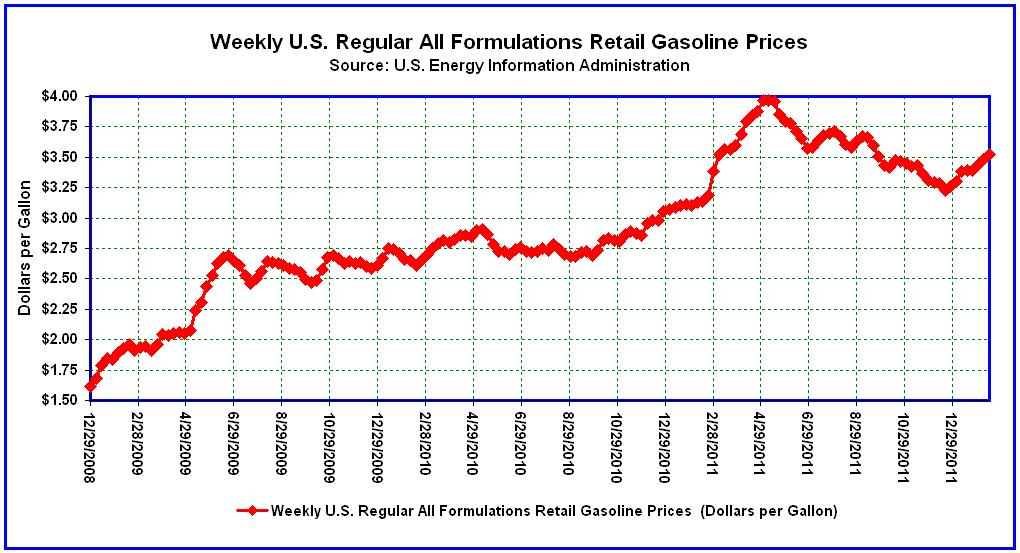
The U.S. Energy Information Administration (EIA) reported that gasoline prices have risen from an average price of $1.61, in the week ending December 29, 2008, to $3.72, as of the week ending February 27, 2012 (see chart above). So with gasoline prices on a tear having risen by 131% just since December 29, 2008, biofuel enthusiasts have once again arisen from the sludge, this time proclaiming that algae biofuel is the answer to our energy needs.

According to Marine Corps Times, in 2009 the U.S. Navy paid $424.00 per gallon for 20,055 gallons of biodiesel made from algae, which set a world record at the time for the cost of fuel. Are you kidding me? In the midst of the worst recession since the Great Depression, the Navy thought that paying $424.00 per gallon for algae biodiesel while petroleum based diesel was selling for an average of $2.50 per gallon was somehow smart?

Then, in December of 2011, according to Defense News, the U.S. Defense Department signed a contract to buy 450,000 gallons of biofuel – the largest purchase ever by the federal government – to power the U.S. Navy’s “green” carrier strike group. The blend of used cooking oil and algae will be mixed with traditional fuels to help power the carrier strike group during military exercises this summer in the Pacific Ocean. The $12 million purchase works out to about $26.00 per gallon.

More recently, on February 27, 2012, House Armed Services Committee member Randy Forbes had harsh words for Navy Secretary Ray Mabus, saying he was focusing too much on alternative fuel development and not enough on sailors and ships. Forbes says biofuel costs four times as much to manufacture as fossil fuel, and that’s something the Navy can’t afford now. “That’s why I said ‘Mr. Secretary, with all due respect, you’re not the Secretary of Energy, you’re the Secretary of the Navy,'” stated Forbes.

Although, in the second purchase, no breakdown was provided for the cost of algae biofuel by itself, it’s obvious that the cost per gallon has dropped dramatically over a two year period. But it’s doubtful that this would have occurred without massive government stimulus through agency purchases such as by the U.S. Navy, as well as loan guarantees and grants from the U.S. Department of Energy. But with the price of petroleum based diesel fuel currently selling at around $4.00 per gallon, does it make sense for our military to be purchasing fuel which costs six-and-one-half times more? Well, let’s just hope we don’t get involved in major war anytime soon.

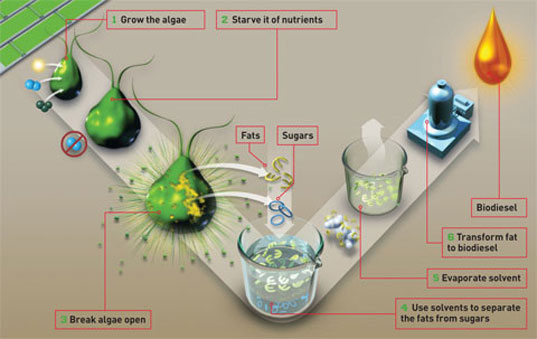
A peek at the algae biofuels production process. [Image Source: Solix Biofuels]

The Cost of Converting to Algae Biofuel

In his paper entitled, “Widescale Biodiesel Production from Algae,” Michael Briggs, of the University of New Hampshire, Physics Department, lays out some of the costs of replacing our dependence on oil with algae biofuel.

“First, consider if you will, a treaty between the United States and Mexico, where Mexico grants the U.S. a permanent right-of-way to the Gulf of California for the purpose of building a seawater canal that will transport a large and continuous flow of seawater from the Gulf of California into the USA. For the sake of discussion, let us assume that a canal has already been built between the Gulf of California and the Salton Sea; and that the Salton Sea will serve as a transfer reservoir.

Now, visualize a large aqueduct between the Salton Sea and Death Valley where a second inland sea has formed, approximately the size of the Salton Sea. From these two inland seas, several aqueducts extend out into the deserts of the Southwestern United States; Reaching into Arizona and Nevada.

Of the many and various desert farms, ranches and communities served by the aqueducts, there will be forty-thousand algae farms, having a total water surface area of 250 acres each. Two-hundred and fifty acres multiplied by forty-thousand farms equals a total of ten million acres of shallow water algae ponds, dedicated for the purpose of growing non-food renewable biomass for the production of transportation fuels.”

Sure Mr. Briggs, I am trying to envision the federal government building a canal from the Gulf of California to the Salton Sea, but I’m having a little trouble because I’m wondering why it hasn’t been able to secure our Southern border, and I’m also pondering the $16 trillion federal debt, pending construction of California’s $53 billion Bullet Train to nowhere, and the government’s unwillingness to move forward with the privately funded Keystone XL pipeline.

Note: The costs of constructing the necessary seawater canal, aqueducts and reservoir outlined above are not included in Mr. Briggs’ cost estimates which follow.

Capital Requirements

  • 1 hectare = 2.47 acres. Michael Briggs gave an estimate of $80,000 per hectare for the construction costs to build the algae ponds.
  • $80,000 divided by 2.47 = 32,390 rounded. We will say $32,500 per acre.
  • $32,500 times 250 acres = $8,125,000 construction costs for a 250 acre algae farm.
  • $8,125,000 times 40,000 farms = $325,000,000,000 to construct ten million acres of algae ponds.

Note: That’s a total of $325 Billion to construct the required 10 million acres of algae ponds. This does not include the costs of building a seawater canal from the Gulf of California to the Salton Sea, or the costs of constructing an aqueduct from there to an inland reservoir in Death Valley. Neither does it include the costs of constructing the many distributed biorefineries that will be needed to process the algae into biodiesel.

Operating Expenses

Mr. Briggs also provided an estimate of $12,000 per hectare for operating costs (including power consumption, labor, chemicals, and fixed capital costs).

  • $12,000 divided by 2.47 = 4,860 rounded. We will say $5,000 per acre for operating costs.
  • $5,000 times 250 acres = $1,250,000 annual operating costs for a 250 acre algae farm.

Annual Production

The University of New Hampshire Biodiesel Group also provided the following information on their Algae ponds:

“Micro algaes present the best option for producing biodiesel in quantities sufficient to completely replace petroleum. While traditional crops have yields of around 50-150 gallons of biodiesel per acre per year, algaes can yield 5,000-20,000 gallons per acre per year. Algaes grow best off of waste streams. Agricultural, animal, or human. Some other studies have looked into designing raceway algae ponds to be fed by agricultural or animal waste. We are now pursuing funding to investigate redesigning wastewater treatment plants to use raceway algae ponds as the primary treatment phase. With the dual goal of treating the waste and growing algae for biodiesel extraction. We also plan to investigate the possibility of using the algae mush (what is left after extracting the oil) as a fertilizer.”

An estimate of 5,000 to 20,000 gallons per acre per year is a rather wide discrepancy. Apparently seawater doesn’t provide enough nutrients to grow micro algae. Algaes grow best off streams of human, animal and agricultural waste. Wait; did he just say human waste?

In his paper, under the section titled: “How much biodiesel,” Mr. Briggs concluded that 140,800,000,000 (140.8 billion) gallons of biodiesel could replace 100% of the petroleum transportation fuels consumed in the United States annually, without requiring a big change in driving behavior or automotive technology. Although he did assume everyone would switch to diesel engines because of the superior efficiency of diesel compared to gasoline engines.

  • 140.8 billion gallons divided by ten million acres = 14,080 gallons per acre (per year). We will say 15,000 gallons per acre (per year).

Note: The costs of converting all gasoline powered engines to diesel were also omitted from Mr. Briggs’ cost estimates.

Operating and Capital Costs

Based on Michael Briggs’ estimates, an algae farm with 250 acres of pond surface area would have $1,250,000 in annual operating expenses.

  • 15,000 gallons per acre times 250 acres = 3,750,000 gallons per algae farm per year.
  • $1,250,000 divided by 3,750,000 gallons = 33.3333 cents per gallon in operating costs.

How much will it cost to pay off the $32,500 per acre loan for the initial construction costs (the $80,000 per hectare)? That is: $32,500 times 250 acres = $8,125,000 construction costs for a 250 acre algae farm.

Let us assume a zero Interest federally insured loan spread over 20 years with a single payment of 1/20th of the principle due each year.

  • $8,125,000 divided by 20 years = $406,250 cost of debt per year per 250 acre algae farm.
  • $406,250 divided by 3,750,000 gallons = 10.8333 cents per gallon cost of debt (at 15,000 gallons per acre).

If the annual yield is 15,000 gallons per acre, then the cost of producing algae biodiesel feedstock would be .442 cents (10.8333 + 33.3333) per gallon. Multiplying this by 42 = $18.56 per barrel of oil equivalent.

Finally, if each farm earned .10 cents per gallon profit, then:

  • 15,000 gallons times 250 acres times 10 cents = $375,000 per year net earnings.

This would bring the total cost of algae crude to .542 (.442 + .10) cents per gallon, or $22.76 per barrel of oil equivalent.

Summary

Although a cost of $22.76 per barrel of oil equivalent sounds great, it doesn’t include the following costs:

  • Building a massive seawater canal from the Gulf of California to the Salton Sea, and then constructing a series of aqueducts from there into a reservoir in Death Valley. How much will that cost, and who will foot the bill?

  • Constructing the many distributed biorefineries that will be needed to process the algae into biodiesel, without which this scheme is all for naught. How much will this cost? Who’s going to put up the capital?

  • Converting all gasoline powered engines to diesel. Who’s going to cover this?

Aside from the above omissions, who will front the $325 Billion initial capital expenditure for construction of the algae farms? And what’s going to happen if production estimates per acre fall short of the required 15,000 gallons?

Since the federal government is officially broke, and unable to fund construction of a massive seawater canal, system of aqueducts, and the necessary reservoir, it sounds like the least costly and most efficient scenario for algae biofuel lies in finding a way to pump all of our raw sewage – human, animal and agricultural – directly to the proposed algae farms.

It turns out that using raw sewage is the best way to ensure the most bang-for-the-buck out of each algae farm. But won’t raw sewage attract rodents and create other ecological problems? Perhaps, but who cares about that? Just toss the looming hordes of tadpoles and sewer rats into the refining vats as well.

While everyone has been focusing on the means of the green agenda, don’t its ends lead to the recycling of all things, including eventually human beings? That’s been pretty clear since the 1972 production of Soylent Green. Anyways, for now, Green energy enthusiasts may have to settle for converting renewable human waste into algae biofuel.

I can imagine, sometime in the near future, a Charlton Heston type (Detective Thorn in Soylent Green) crying out with his last breath, “It’s poo-poo. Algae Biofuel is made out of poo-poo. They’re making our fuel out of poo-poo. You’ve gotta tell them. You’ve gotta tell them!” Yeah, yeah, we know, just follow the sewer rats.

In the meantime, for me anyway, a little more gasoline production will suffice. Can we please, please, exhaust America’s God-given natural resources before we start breaking out the Soylent Green? And no Mr. Obama, Step one is “Drill”, Step two is “Baby”, and Step three is “Drill”. You got that?

War on Wealth III | National Debt Review

* Great Debt Spikes in American History: 1792 to 2014 *

By: Larry Walker, Jr. –

By the end of 2012, the national debt per citizen will reach $52,222 for every man, woman, and child in the United States of America. But even more sobering and significant is the fact that the national debt per U.S. taxpayer will reach $144,539 for each and every American taxpayer. So while Mr. Obama portends to be fighting wealth disparity, what he has accomplished in all his efforts has only made every American citizen poorer.

The public debt of the United States can be traced back as far as the American Revolution. In 1776, a committee of ten founders took charge of what would become the U.S. Treasury, and they helped secure funding for the war through “loan certificates” (equivalent to bonds) with which they borrowed money from France and the Netherlands. This committee morphed over the next decade into the Department of Finance. Robert Morris, a wealthy merchant and Congressman was chosen to lead the new Department of Finance in 1782. On January 1, 1783, the public debt of the new United States totaled $43 million.

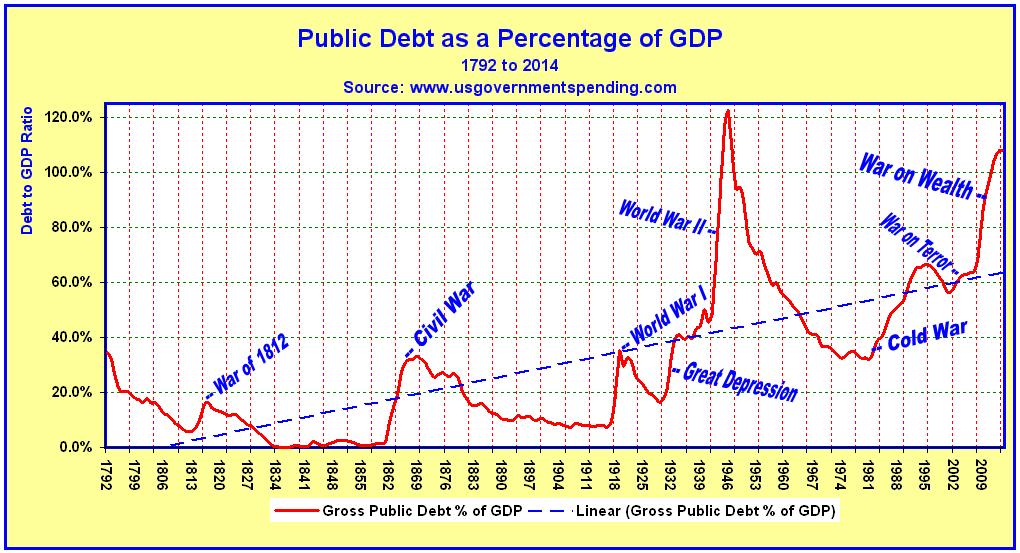
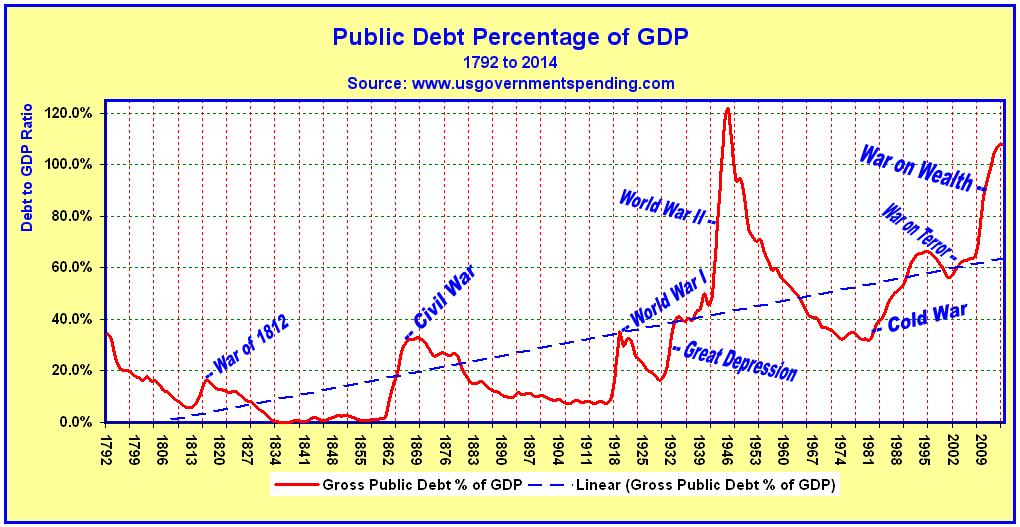
By 1792 the public debt had climbed to $80 million. The debt ratio, as a percentage of Gross Domestic Product (Debt-to-GDP), stood at just 34.6% in 1792. However, as of February 26, 2012, the gross public debt of the United States now totals $15.4 trillion, and the Debt-to-GDP ratio equals more than 100%. Of all the wars America has fought, none has been more costly than Obama’s War on Wealth. So what is the War on Wealth? How costly is this campaign compared to other wars? And when will it end?

The War on Wealth

The War on Wealth (2009 – Present) is a political, philosophical, and mostly rhetorical war launched within the United States in 2009, by the Progressive Party leader, and part-time President of the United States, Barack Obama. The war is in essence a Second Civil War, except this time there are no slaves to free, and no States to Unite. The war was instead launched to pit poor Americans against middle class Americans, and both groups against wealthy Americans, its main theme being “fairness”. Some of its top tenets include the following:

  1. The rich must pay the same effective income tax rate as the poor and middle class. Another way of stating this would be simply, “There should be a flat tax levied on everyone based on gross income.” But in the War on Wealth, this is not the goal. What Obama really means is that the rich should pay a higher percentage of taxes, while 50% of working Americans pay none.

  2. The unemployed must be paid government benefits for up to three years or longer, at the expense of the federal government. The main problem with this theory is that it’s not the federal government that pays, but instead small business employers and working taxpayers have to pick up the tab. For example, under the 2011 Federal Unemployment Credit Reduction Rule, a $21 per employee tax was levied on employers in most states, while Michigan employers paid the highest rate at $63 per employee, the funds being used to pay for the last unemployment extension. I didn’t at all appreciate having to pay $21 for each active employee, to cover the unemployed who never worked for my company, especially since Georgia had already chosen to charge my company the maximum rate for State unemployment taxes. Of course, an even bigger problem with this theory is that every extension of unemployment benefits directly increases the duration of unemployment.

  3. The federal government must provide health insurance benefits for everyone. Once again, the main problem with this is that it’s not the federal government that pays, but rather it’s those who (if they are lucky) are barely able to afford to take care of their own health care needs, who are now being asked to pay even more to help those who can’t afford to pay for their own care. I can’t afford health insurance right now, because it costs too much. But I don’t want you to pay for my care; I want the government to get out of the market and increase free-market competition so that I will be able to afford it. For the time being, I am paying the cost of my own health care needs without insurance.

  4. The government must ensure that everyone who works hard should do well enough to raise a family, own a home, send their kids to college and put a little away for retirement. What’s wrong with this tenet? Well, first of all, how does one define the term “hard work”? Did a high school drop-out who works at McDonald’s work as hard to reach his or her goal as a PhD? Is everyone who has a job considered a “hard worker”? Based on my own work experience, I know that not everyone who works does so at the same level of responsibility, complexity or productivity. If all work were created equal, then when I was a low level accounting manager, I should have been paid just as much as the Comptroller and CFO, right? And when I was a mail clerk at a top accounting firm back in the 1980’s, I should have been paid just as much as the senior accountants and all the partners, right? Nonsense.

    And then, who’s to say that everyone wants to raise a family, own a home, or even has kids to send to college? I chose to get married and raise a step-son and three children of my own, but my next door neighbor has never been married and doesn’t have children. I later got divorced from my first wife and then chose to remarry and to help raise another three step-children in addition to my three kids. And I’m sorry to tell you this, but I’m afraid there are no shortcuts. Every individual is responsible for figuring out such matters on their own, just like my family, and our forefathers before us.

    My suggestion for anyone who wants to raise a family, own a home, and send their kids off to college, is that you take all of this into consideration while planning your future. And if you fail to plan, or if your plan fails, then don’t look to me or anyone else to bail you out, because we have our own lives to contend with. Our lives haven’t exactly been a piece of cake, but rather about making choices and then taking personal responsibility for our actions, the good, the bad, and the ugly.

How much has the War on Wealth cost?

Thus far, the War on Wealth has added another $6.4 Trillion (USD) to the national debt, which is more than any other debt spike in U.S. history. Yet this record level of borrowing and spending has delivered next to nothing in terms of results. Thus far, the war has sent our nation’s Debt-to-GDP ratio soaring from 69.9% at the end of 2008, to 104.8% in 2012. In fact, the last (and only) time that the United States’ debt-to-GDP ratio exceeded 100% was during World War II. But it only took 4 years to win the Second World War, while the War on Wealth has no end in sight.

The War on Wealth won’t end until the government runs out of other people’s money. But once that happens, it will also spell the end of the United States of America. However, thankfully the War on Wealth appears to be backfiring. Recently, the focus has shifted from a feeling of guilt for failing to help the poor and needy, to most Americans, even many on the left, now inquiring as to where the $6.4 trillion, which Mr. Obama has borrowed, was spent. Where’s the money? That’s what Americans want to know.

What Obama’s grand achievement has amounted to is a $20,329 increase in the per capita share of the national debt for every man woman and child in America, and even worse, an increase of $56,266 for every U.S. taxpayer. Has your personal income increased by $20,329, over the last four years (for each person in your household)? Probably not, but irrespective of whether it did, as a U.S. taxpayer, your share of future income taxes just went up by $56,266 courtesy of Obama’s War on Wealth.

Barack Obama will have borrowed and spent $6.4 trillion during his 4 year presidency, which is more than any other president in U.S. History. He has borrowed and spent more than was required to fight any war America has fought in her great history, and many times more than was spent even during the Great Depression. Yet nothing has changed, no victory has been won, and no American is better off than they were 4 years ago. So just how bad is Obama’s deficit spending from a historical perspective? Let’s go back in time and compare.

The War of 1812

The War of 1812, also known as the Anglo-American War (1812 – 1815), was a military conflict fought between the forces of the United States of America and those of the British Empire. America declared war in 1812 for several reasons, including trade restrictions due to Britain’s ongoing war with France, the impressment of American merchant sailors into the Royal Navy, British support of American Indian tribes against American expansion, and outrage over insults to national honor after humiliations on the high seas.

From a Debt-to-GDP Ratio of 5.8% in 1812, the ratio peaked at 16.2% in 1817 before subsiding, ultimately reaching a trough of 0.0% in 1835. During this period, the national debt increased from $50 million in 1812, to $120 million by 1817, but was subsequently wiped out entirely by 1835. In fact, the national debt was negligible from 1834 through1842, totaling between $0 to less than $10.0 million, an amazing feat considering that there was no income tax during the era.

The Civil War

The American Civil War (1861–1865) was a civil war fought in the United States of America. In response to the election of Abraham Lincoln as President of the United States, 11 southern slave states declared their secession from the United States and formed the Confederate States of America (“the Confederacy”); the other 25 states supported the federal government (“the Union”). After four years of warfare, mostly within the Southern states, the Confederacy surrendered and slavery was outlawed everywhere in the nation.

From 1.9% in 1861, the Debt-to-GDP ratio peaked at 32.9% in 1869 before subsiding. It would ultimately reach a trough of 7.3% in 1916. During the era, the national debt increased from $90 million in 1861, to $2.6 billion in 1869, and would ultimately reach $3.6 billion by 1916. Although the national debt had increased by 1916, the Debt-to-GDP ratio was lower due to a surge in GDP following the war. What’s interesting to note is that although a temporary income tax was imposed to pay for the war, it only existed between the years of 1862 and 1872. In fact, no income tax was imposed on American citizens from the founding of the nation until 1862, and no income tax existed between the years 1873 and 1912.

World War I

World War I (1914 – 1918) was a major war centered in Europe that began on July 28, 1914 and lasted until November 11, 1918. It involved all the world’s great powers, which were assembled in two opposing alliances: the Allies (based on the Triple Entente of the United Kingdom, France and Russia) and the Central Powers (originally centered around the Triple Alliance of Germany, Austria-Hungary and Italy). These alliances both reorganized (Italy fought for the Allies), and expanded as more nations entered the war. Ultimately more than 70 million military personnel, including 60 million Europeans, were mobilized in one of the largest wars in history. More than 9 million combatants were killed, largely because of great technological advances in firepower without corresponding advances in mobility. It was the sixth deadliest conflict in world history, subsequently paving the way for various political changes such as revolutions in the nations involved.

In January 1917, Germany resumed unrestricted submarine warfare. The German Foreign Minister, in the Zimmermann Telegram, told Mexico that U.S. entry was likely once unrestricted submarine warfare began, and invited Mexico to join the war as Germany’s ally against the United States. In return, the Germans would send Mexico money and help it recover the territories of Texas, New Mexico, and Arizona that Mexico had lost during the Mexican-American War 70 years earlier. Wilson released the Zimmerman note to the public, and Americans saw it as a cause for war.

President Wilson spoke before Congress, announcing the break in official relations with Germany on February 3, 1917. After the sinking of seven U.S. merchant ships by submarines and the publication of the Zimmerman telegram, Wilson called for war on Germany, which the U.S. Congress declared on April 6, 1917.

From 7.2% in 1916, our Debt-to-GDP ratio peaked at 32.6% in 1921 before subsiding. The debt would ultimately reach a trough of 16.3% of GDP in 1929. During the era, the national debt increased from $3.6 billion in 1916 to $23.9 billion by 1921, before resting at $16.9 billion in 1929. The national debt actually declined between 1921 and 1929 along with the debt ratio. The primary reason for this phenomenon was that GDP soared after implementation of the Mellon Tax Bill, which lowered the top personal income tax rate from 73% in 1919 to just 25.0% from 1925 through 1931.

The Great Depression

The Great Depression, although not a war, was a severe worldwide economic depression in the decade preceding World War II. The timing of the Great Depression varied across nations, but in most countries it started in about 1929 and lasted until the late 1930’s or early 1940’s. It was the longest, most widespread, and deepest depression of the 20th century.

The Great Depression is commonly used as an example of how far the world’s economy can decline. The depression originated in the U.S., starting with the fall in stock prices that began around September 4, 1929 and became worldwide news with the stock market crash of October 29, 1929 (known as Black Tuesday). From there, it quickly spread to almost every country in the world.

The Great Depression had devastating effects in virtually every country, rich and poor. Personal income, tax revenue, profits and prices dropped, while international trade plunged by more than 50%. Unemployment in the U.S. rose to 25% and in some countries rose as high as 33%. Some economies started to recover by the mid-1930’s. But in many countries, the negative effects of the Great Depression lasted until the start of World War II.

From 16.3% in 1929, the Debt-to-GDP ratio peaked at 50.0% in 1940 before subsiding. The debt would ultimately reach a trough of 45.4% of GDP in 1941. During the era, the national debt increased from $16.9 billion in 1929 to $50.7 billion by 1940, before resting at $57.5 billion in 1941. Although the national debt continued to increase from 1940 to 1941, Debt-to-GDP declined from 50.0% to 45.4% due to an increase in GDP related to the pre-war buildup.

World War II

World War II was a global conflict that was underway by 1939 and ended in 1945. It involved most of the world’s nations—including all of the great powers—eventually forming two opposing military alliances: the Allies and the Axis. It was the most widespread war in history, with more than 100 million military personnel mobilized. In a state of “total war”, the major participants placed their entire economic, industrial, and scientific capabilities at the service of the war effort, erasing the distinction between civilian and military resources.

Marked by significant events involving the mass death of civilians, including the Holocaust and the only use of nuclear weapons in warfare, it is the deadliest conflict in human history, resulting in 50 million to over 70 million fatalities. The United States didn’t formally enter the war until the Japanese bombing of Pearl Harbor on December 7, 1941.

From 45.4% in 1941, the Debt-to-GDP ratio peaked at 121.9% in 1946 before subsiding. The debt would ultimately reach a trough of 31.8% of GDP in 1981. During the era, the national debt increased from $57.5 billion in 1941 to $270.9 billion by 1946, before resting at $994.8 billion in 1981. Although the national debt increased almost 4-fold from 1946 to 1981, growing from $270.9 billion to $994.8 billion, the Debt-to-GDP ratio declined from 121.9% to 31.8%. The decline in the debt ratio was due to an increase in GDP following the war. In fact, over this period, GDP increased 14-fold – growing from $222.2 billion in 1946 to $3.1 trillion by 1981.

[It’s notable that top personal income tax rates were increased from 25% in 1931 to as high as 94% in 1944 -1945, but were later reduced to just 70% from 1965 through 1981 by John F. Kennedy’s, Tax Reduction Act of 1964. Thus it was the post-war boom coupled with tax cuts which caused GDP to surge, leading to a decline in the Debt-to-GDP ratio.]

The Cold War

The Cold War (approx. 1945-1991) was a continuing state of political and military tension between the powers of the Western world, led by the United States and its NATO allies, and the communist world, led by the Soviet Union, its satellite states and allies. This began after the success of their temporary wartime alliance against Nazi Germany, leaving the USSR and the US as two superpowers with profound economic and political differences.

The Soviet Union created the Eastern Bloc with the eastern European countries it occupied, maintaining these as satellite states. The post-war recovery of Western Europe was facilitated by the United States’ Marshall Plan, while the Soviet Union, wary of the conditions attached, declined and set up COMECON with its Eastern allies. The United States forged NATO, a military alliance using containment of communism as a main strategy through the Truman Doctrine, in 1949, while the Soviet bloc formed the Warsaw Pact in 1955. Some countries aligned with either of the two powers, whilst others chose to remain neutral with the Non-Aligned Movement.

In the 1980s, the United States increased diplomatic, military, and economic pressures on the Soviet Union, at a time when the nation was already suffering economic stagnation. In the late 1980s, Soviet President Mikhail Gorbachev introduced the liberalizing reforms of perestroika (“reconstruction”, “reorganization”, 1987) and glasnost (“openness”, ca. 1985). This opened the country and its satellite states to a mostly peaceful wave of revolutions which culminated in the collapse of the Soviet Union in 1991, leaving the United States as the dominant military power.

From 32.8% in 1981, the Debt-to-GDP ratio peaked at 66.1% in 1996 before subsiding. The debt would ultimately reach a trough of 56.4% of GDP in 2001. During the era, the national debt increased from $994.8 billion in 1981 to $5.2 trillion by 1996, before resting at $5.8 trillion in 2001. Although the national debt increased from $5.2 trillion in 1996 to $5.8 trillion in 2001, the Debt-to-GDP ratio declined from 66.1% to 56.4%. The decline in the Debt-to-GDP ratio was primarily due to a rise in GDP, which had grown from $3.1 trillion in 1981 to $10.2 trillion by 2001. The growth in GDP was primarily due to Ronald Reagan’s Tax Reform Act of 1986.

The War on Terror

The War on Terror, also known as the Global War on Terror or the War on Terrorism (2002 to January 20, 2009), is a term commonly applied to an international military campaign led by the United States and the United Kingdom with the support of other NATO as well as non-NATO countries. Originally, the campaign was waged against al-Qaeda and other militant organizations with the purpose of eliminating them.

The origins of al-Qaeda as a network inspiring terrorism around the world and training operatives can be traced to the Soviet war in Afghanistan (December 1979 – February 1989). In May 1996 the group World Islamic Front for Jihad Against Jews and Crusaders (WIFJAJC), sponsored by Osama bin Laden and later reformed as al-Qaeda, started forming a large base of operations in Afghanistan, where the Islamist extremist regime of the Taliban had seized power that same year. In February 1998, Osama bin Laden signed a fatwa, as the head of al-Qaeda, declaring war on the West and Israel, later in May of that same year al-Qaeda released a video declaring war on the US and the West.

Following the bombings of US embassies in Kenya and Tanzania, US President Bill Clinton launched Operation Infinite Reach, a bombing campaign in Sudan and Afghanistan against targets the US asserted were associated with WIFJAJC, although others have questioned whether a pharmaceutical plant in Sudan was used as a chemical warfare plant. The plant produced much of the region’s anti-malarial drugs and around 50% of Sudan’s pharmaceutical needs. The strikes failed to kill any leaders of WIFJAJC or the Taliban.

It was the 2000 millennium attack plots, including an attempted bombing of Los Angeles International Airport, the bombing of the USS Cole in October 2000, followed by the September 11, 2001 attacks, which led to a declaration of war. The War on Terror officially ended on January 20, 2009, when it was reduced to an Overseas Contingency Operation, and with commencement of the War on Wealth.

From 56.4% in 2001, the Debt-to-GDP ratio peaked at 69.9% in 2008. During the era, the national debt increased from $5.7 trillion in 2001 to $9.9 trillion by 2008. The debt has since skyrocketed as a result of the new War on Wealth. Although the gross public debt increased by $4.2 trillion, from 2001 through 2008, expanding from $5.7 to $9.9 trillion, it has subsequently burgeoned by another $6.4 trillion in half the time, since the commencement of the War on Wealth. From 2009 through 2012, the federal debt will have ballooned from $9.9 trillion to $16.3 trillion. The debt will ultimately reach a peak of 104.8% of GDP by the end of 2012, and is expected to increase to 107.8% by the year 2014.

Summary of Federal Borrowing

  • War of 1812 – Increase in Federal Debt: $70 million

  • American Civil War of 1861 – Increase in Federal Debt: $2.5 billion

  • World War I – Increase in Federal Debt: $20.3 billion

  • The Great Depression – Increase in Federal Debt: $33.8 billion

  • World War II – Increase in Federal Debt: $213.4 billion

  • Cold War – Increase in Federal Debt: $4.8 trillion

  • War on Terror – Increase in Federal Debt: $4.2 trillion

  • War on Wealth – Increase in Federal Debt (to date): $6.4 trillion

Conclusion

What is significant about all of these great debt spikes in American history is that it took 189 years (1793 to 1981) for the national debt to reach $994.7 billion, an average increase of $5.2 billion per year. From there on it took just 20 years (1982 to 2001) for the debt to rise by another $4.8 trillion, an average increase of $238.7 billion per year. Subsequent to that, it took a mere 7 years (2002 to 2008) for the debt to grow by another $4.2 trillion, an average increase of $602.3 billion per year. Compared with the former eras, the federal debt has surged by another $6.4 trillion just since January of 2009, which amounts to an average increase of $1.6 trillion per year.

With federal borrowing now completely out of control, one can only wonder who’s really benefiting from the War on Wealth, and when it will come to an end. What Obama’s grand achievement has amounted to is a $20,329 increase in the per capita share of the national debt for every man woman and child in America, and even worse, an increase of $56,266 for every U.S. taxpayer. Has your personal income increased by $20,329, over the last four years (for each person in your household)? Probably not, but irrespective of whether it did, as a U.S. taxpayer, your share of future income taxes just went up by $56,266 courtesy of Obama’s War on Wealth.

By the end of 2012, the national debt per citizen will reach $52,222 for every man, woman, and child in the United States. But even more sobering and significant is the fact that the national debt per taxpayer will reach $144,539 for each and every American taxpayer. So while Obama portends to be fighting wealth disparity, what he has accomplished in all his efforts has only made every American citizen poorer.

Well, we have a choice, we can either wait for the next recession, or the next genuine war, either of which will surely bankrupt our nation, or we can end the War on Wealth once and for all, in November of 2012, by simply voting Obama out. It’s time to stop playing games and time to get serious about America’s future.
War on Wealth, Part II | Keeping Our Foot on the Gas

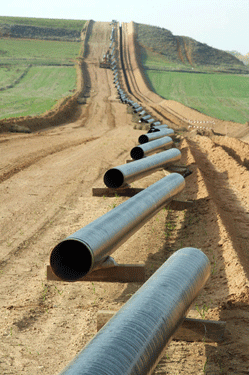
* Pieces of the Keystone XL pipeline await construction in South Dakota. Via: North Platte Post *

By: Larry Walker, Jr. –

When Mr. Obama visited the padlock maker Master Lock in Milwaukee, on February 15, 2012, he drew the following conclusions. He said, “Manufacturing is coming back. Companies are starting to bring jobs back. The economy is getting stronger. The recovery is speeding up. We’re moving in the right direction. And now we have to do everything in our power to keep our foot on the gas.” So in keeping with my fact based approach, I have to ask, Are Mr. Obama’s claims reasonable? Let’s run down the list.

“Manufacturing is coming back. Companies are starting to bring jobs back.”

First of all, in my last post, War on Wealth | Obama Visits Master Lock, I pointed out that the United States has lost more than 6.0 million manufacturing jobs since 1990, and almost 1.0 million of those have been lost since Obama’s inauguration (see chart above). That’s hardly indicative of a manufacturing boom. And since Master Lock only brought back an alleged 100 jobs from China, that’s hardly proof of companies bringing jobs back. It would have been more accurate to state, although less of a reason to re-elect Mr. Obama, that one U.S. company brought back 100 jobs from China.

“The economy is getting stronger. The recovery is speeding up.”

Next, according to the Bureau of Economic Analysis, GDP declined at an annual rate of (3.5%) in 2009, increased at an annual rate of 3.0% in 2010, and then slowed to an annual rate of just 1.7% in 2011 (as of 1/27/2012). So since our economy declined from an annual growth rate of 3.0% in 2010, to an annual growth rate of just 1.7% in 2011, does this mean the economy is getting stronger? Not in my book. So instead of backing Obama’s claim, that the recovery is speeding up, the facts show that the recovery is actually slowing down (see chart above).

“We’re moving in the right direction.”

Are we moving in the right direction? Well, in terms of deficit spending, the government is borrowing at the highest rate of GDP since World War II, as shown in the chart (above). The national debt as a percentage of GDP has skyrocketed from 69.9% in 2008 to 104.8% in 2012, and is projected to reach 107.8% by 2014. The last time our debt-to-GDP ratio surpassed 100% was in 1945, when the federal debt climbed to 116.6% of GDP, peaking at 121.9% in 1946.

We know where the money was spent during the Second World War, but where’s the $5 trillion Obama borrowed and spent? For God’s sake, we could have cured cancer, or built a colony on the Moon with that kind of dough.

In terms of the near record debt-to-GDP ratio, coupled with the continuing loss of manufacturing jobs and the year-over-year decline in GDP, I conclude that the United States is moving in the wrong direction.

“And now we have to do everything in our power to keep our foot on the gas.”

Wait a minute; did Mr. Obama dare mention the word gasoline in his delusional tirade? When I first heard this, I wondered for a minute whether he really meant to say, ‘And now we have to do everything in our power to keep our boot on the neck of U.S. oil and gas producers.’

According to the U.S. Energy Information Administration (EIA), gasoline prices have risen from an average price of $1.61 in the week ending December 29, 2008, to $3.52 through the week ending February 13, 2012 (see chart above).

So since gasoline prices have risen by 118.6% under the Obama Administration, perhaps we should be doing everything in our power to remove the federal government’s dead cold foot from the gas pedal. Gasoline prices are expected to rise further, to $4.50 per gallon by this summer, which may give Mr. Obama a temporary victory in his War on Wealth, but fortunately for America, his chance of re-election will simultaneously run out of gas.

To the contrary, instead of being a time to continue recklessly forward, our foot glued to the accelerator, now is the time for America to pull over to the pits for refuelling, new tires, repairs, mechanical adjustments, and a driver change. The replacement of Mr. Obama with a truly Conservative POTUS is imminent. And just so you don’t get the wrong idea, no, I’m not suggesting as a substitute the severely moderate Mitt Romney. [But I’ll back Mr. Romney in a heartbeat over another four years of Obama.]

References:

A Crude Hit to the Recovery

18 Statistics That Prove That the Economy Has Not Improved Since Barack Obama Became President

Related:

War on Wealth | Obama Visits Master Lock

Manipulation 201: Playing With Unemployment

Drill Here, Drill Now | Facebook Petition