National Debt Bomb | 1976 to 2011

The 4th Deadly Sin

By: Larry Walker, Jr. –

Definition of Lazy – “encouraging inactivity or indolence”

The Nixon Shock was a series of economic measures taken by U.S. President Richard Nixon in 1972, which included unilaterally cancelling the direct convertibility of the United States dollar to gold and essentially ending the existing Bretton Woods system of international financial exchange. However, it was not until March of 1976 when the world’s major currencies began floating. It is notable that what cost $1.00 in 1976, now costs $3.95, and what costs $1.00 today, cost only $0.25 in 1976, as annual inflation over the period averaged 4.00%.

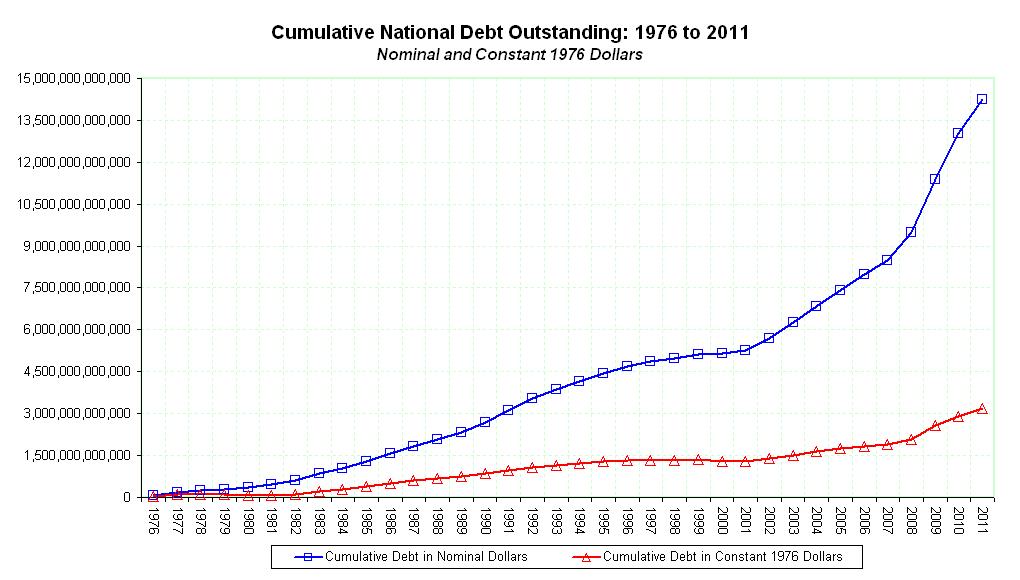
Meanwhile, since 1976, the U.S. National Debt has grown from $620.4 billion to $15,039.4 billion, in nominal dollars (as of November 17, 2011). So the questions today are as follows: How much of the national debt is attributable to a declining dollar? And, does anyone really care about the looming debt implosion?

Measuring the National Debt in 2011 Dollars

At the close of fiscal year 1976, the U.S. National Debt stood at $620.4 billion. Converting this to 2011 dollars, would have made it equivalent to $2,450.1 billion. So it took the United States 186 fiscal years, from 1791 to 1976, to accumulate today’s equivalent of $2,450.1 billion in debt. This averages out to around $13 billion per year, in today’s dollars, over the entire 186 year period. In contrast, over the last 4 fiscal years, the national debt has grown by a total of $5,006.9 billion, when measured in 2011 dollars. This averages out to borrowing of $1,251.7 billion per year, over the last 4 fiscal years.

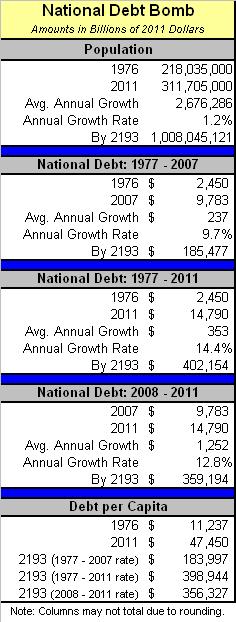
Per NationMaster.com, in 1976, the U.S. population stood at 218.0 million. By 2011 the population had increased to 311.7 million, representing an average annual growth rate of 1.2%. At the current rate of growth, the population will reach 1,008 million by the year 2193, 186 years from 2007.

From 1977 through fiscal year 2007, the national debt grew from $2,450 billion to $9,783 billion (in 2011 dollars). That’s an increase of $237 billion per year, or an average annual growth rate of 9.7%. On that trajectory, the debt would reach $185.5 trillion by the year 2193.

From 1977 through fiscal year 2011, the national debt grew from $2,450 billion to $14,790 billion (in 2011 dollars). That’s an increase of $353 billion per year, or an average annual growth rate of 14.4%. On this trajectory, the debt would reach $402.2 trillion by the year 2193.

In fiscal years 2008 through 2011, the national debt grew from $9,783 billion to $14,790 billion (in 2011 dollars). This represents an increase of $1,252 billion per year, or an average annual growth rate of 12.8%. Since the growth rate has been slightly lower over the last four years, as compared to 1977 to 2011, on its current trajectory, the national debt will reach $359.2 trillion by the year 2193.

On a per capita basis, the national debt was $11,237 in 1976 as compared to $47,450 at the end of fiscal year 2011 (in 2011 dollars). Based on its 1977 to 2007 growth rate, the debt would reach $183,997 per capita by the year 2193. At its 1977 to 2011 growth rate, the debt would reach $398,944 per capita by the year 2193. However, at the rate of growth since the end of 2007, the debt will reach $356,327 per capita by the year 2193.

To summarize, measuring in 2011 dollars, the national debt grew by an average of $13 billion per year over the 186 year period ending in 1976, and over the last four fiscal years it has increased at an average of $1,252 billion per year. Putting this into historical context, as compared to pre-1977 borrowing, the federal government is presently incurring the equivalent of 96 years of debt in each new fiscal year.

Another way of looking at this is that since the debt grew from $2,450.1 billion in 1976, to $14,790.3 billion in 2011, it has grown by $12,340.2 billion over the last 35 years, or by an average of $352.6 billion per year (in 2011 dollars). So because since 1976 we have borrowed an average of $352.6 billion per year, versus an average of $13 billion pre-1977, it may be stated that, the United States is currently borrowing at an annual rate which is 2,612.3% higher than its pre-1977 average.

And thanks to the Federal Reserve, what cost $0.25 in 1976, now costs $1.00. So since everything costs about 400% more than it did in 1976, in real terms, government borrowing is only off target by 2,212.3% from its pre-1977 level. Therefore, although the declining dollar is partially responsible for the increased borrowing, it only represents about 15.3% of the problem.

Debt to GDP: 1976 vs. 2011

By the end of fiscal year 2011, the national debt had grown to $14,790.3 billion. Meanwhile, according to the Bureau of Economic Analysis, U.S. Gross Domestic Product stood at $15,198.6 billion, as of the end of the 3rd quarter 2011. So at the close of fiscal year 2011, our debt-to-GDP ratio was 97.3% (14,790.3 / 15,198.6). In comparison, the national debt stood at $2,450.1 billion, in 1976, and GDP was $7,205.7 (in 2011 dollars). So at the close of fiscal year 1976, our debt-to-GDP ratio was only 34.0% (2,450.1 / 7,205.7).

  • 1976 Debt-to-GDP Ratio: 34.0%

  • 2011 Debt-to-GDP Ratio: 97.3%

Measuring the National Debt in Constant 1976 Dollars

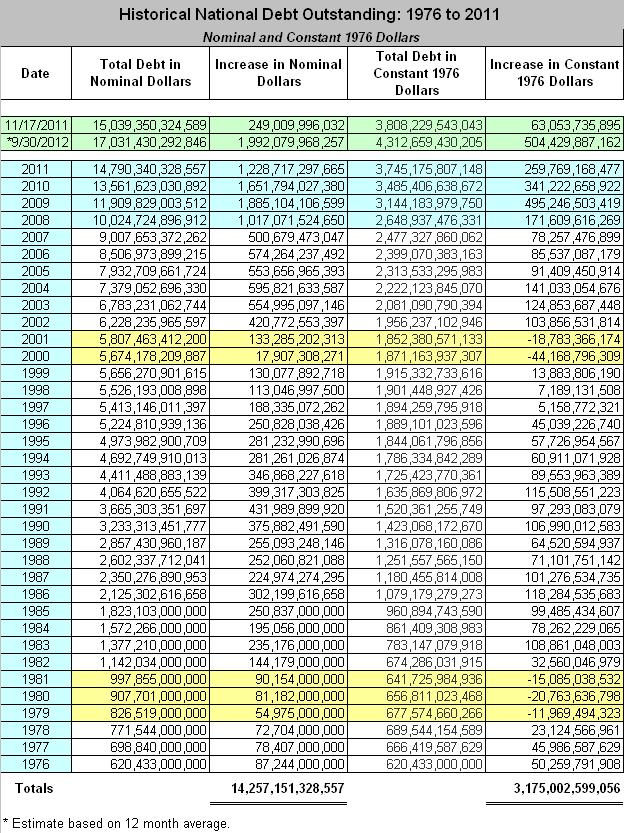
Since the dollar has lost 300% of its value since 1976, courtesy of the Federal Reserve, what would the national debt look like had our currency remained stable? Well, according to the table below, the national debt would be $3.8 trillion, as of 11/17/2011, in constant 1976 dollars, as opposed to its present value of $15.0 trillion. More interestingly however, there are five years where the national debt actually declined, when valued in constant 1976 dollars – 1979, 1980, 1981, 2000 and 2001.

Best 5 vs. Worst 5

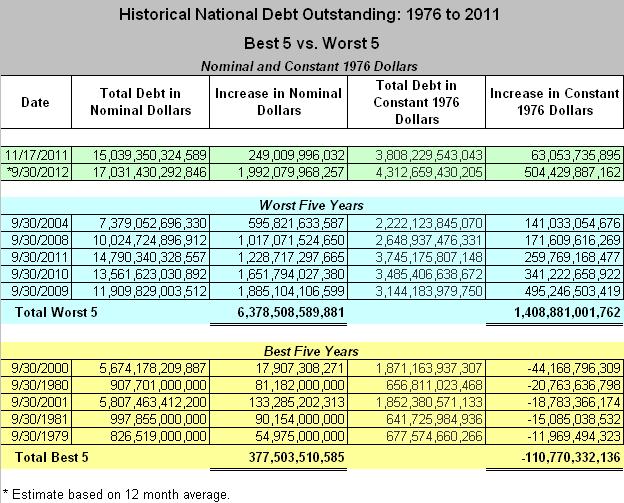
When valuing the national debt in 2011 dollars, the table below shows that the worst 5 years were 2004, 2008, 2011, 2010, and 2009, with annual debt increases of $595.8, $1,017.1, $1,228.7, $1,651.8, and $1,885.1 billion, respectively. But what’s more disturbing is that, based on the first month and a half of fiscal year 2012, borrowing is currently on pace to reach $1,992.1 billion, which would exceed the fiscal year 2009 record of $1,885.1 billion, making this year, potentially, the all-time worst on record.

The table also shows that the best 5-years were 2000, 1980, 2001, 1981, and 1979, with annual borrowing decreases of $-44.1, $-20.7, $-18.8, $-15.1, and $-11.9 billion, when valued in constant 1976 dollars, respectively.

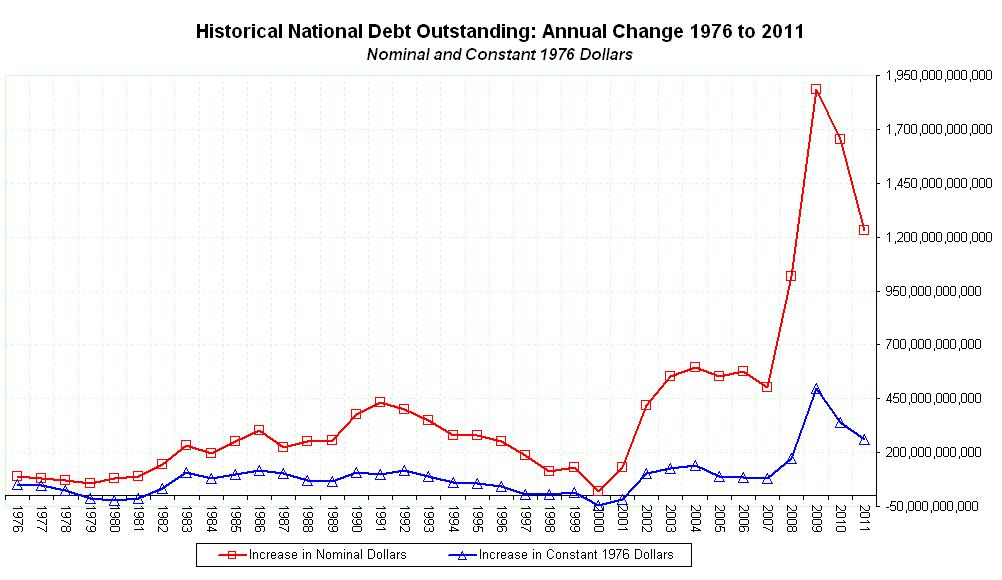
The chart above reflects the annual change in the national debt, in nominal dollars as compared to constant 1976 dollars. But it’s not like anyone really cares. Who’s paying attention anyway? I definitely have better things to do than worry about what’s going on in Washington, DC. As far as I’m concerned, wherever the buck stops is where the blame lies. So what does Obama have to say, after posting 3 of the worst 5 spending records in modern U.S. history? “…Also to put our economy on a stronger and sounder footing for the future, we’ve got to rein in our deficits and get the government to live within its means, while still making the investments that help put people to work right now and make us more competitive in the future.” So in other words, according to Obama, government needs to spend more and lower its annual deficit at the same time.

Obama recently made the admission that, “We’ve been a little bit lazy over the last couple of decades. We’ve kind of taken for granted — ‘Well, people would want to come here’ — and we aren’t out there hungry, selling America and trying to attract new businesses into America.” So pray tell, exactly who has “gotten a little bit lazy” in attracting foreign investment to America? It looks to me like most of that investment is coming in to cover Obama’s own irresponsible spending, and that the only other attraction would be the lure of higher taxes, and tighter governmental regulations. Oh, and by the way, those Obama manufactured Occupy Protests aren’t exactly lending America the aura of stability either. If America has gotten “a little lazy over the last couple of decades”, she must have committed the 4th Deadly Sin over the last 3 years.

References:

Nixon Shock – http://en.wikipedia.org/wiki/Nixon_Shock

Dollar Times – Inflation Calculator – http://www.dollartimes.com/calculators/inflation.htm

U.S. Treasury – Historical Debt – http://treasurydirect.gov/govt/reports/pd/histdebt/histdebt.htm

Obamacare’s Effect on Small Business

Unaffordable Care Act | Jobless, Unshared, and Irresponsible –

By: Larry Walker, Jr. –

“An unlimited power to tax involves, necessarily, a power to destroy; because there is a limit beyond which no institution and no property can bear taxation.” ~ Daniel Webster in M’CULLOCH v. STATE, 17 U.S. 316 (1819) –

Although Barack Obama boasts of having implemented 17 tax cuts for small business during his one-term proposition, as I pointed out in Why Congress Shouldn’t Just Pass Obama’s Jobs Bill, Again, not one item on the list actually meets the definition of a tax cut. #1 on the list was the Small Employer Health Insurance Tax Credit, which is found in Internal Revenue Code Section 45R. The goals of the Section 45R credit are supposedly as follows: (1) to help offset the cost to small businesses that offer employee health insurance coverage, and (2) to encourage small businesses not providing health insurance to start offering coverage.

But unfortunately, the overall effect of the Patient Protection and Affordable Care Act, will be to encourage large employers, those with 50 or more full-time employees, to drop health insurance coverage, reduce the number of employees, or cut weekly work hours to less than 30 in order to avoid paying the so-called shared responsibility penalty. Neither will the new legislation encourage smaller companies, those with fewer than 50 full-time employees, to offer health insurance, as it merely provides a six-year subsidy for those with fewer than 25 employees, encouraging them to limit their growth to 24 or fewer full-time employees, and it does absolutely nothing for companies with between 25 and 49 full-time equivalent employees.

Code Section 45R – Small Employer Health Insurance Tax Credit

The tax credit is available from 2010 through 2015. For 2010 – 2013 the maximum credit is 35% of qualified premium costs paid by for-profit companies, and 25% for non-profits. The maximum credit is only available to employers with no more than 10 full-time equivalent employees (FTE’s), who are paid average annual wages of $25,000 or less. A reduced credit is available on a phase-out basis for employers with between 10 and 25 FTE’s, who are paid average wages of $25,000 to $50,000. In effect, the credit is reduced by 6.667% for each FTE in excess of 10, and by 4% for each $1,000 in average annual wages paid above $25,000. For example, an employer with 13 full-time equivalent employees who are paid average annual wages of $45,000 will not receive a tax credit. No tax credit is available for employers with 25 or more FTE’s, or who pay average annual wages of $50,000 or more.

From Unaffordable Care Act

In 2014 through 2015, the credit increases to 50% of the amount of qualified premium costs paid by for-profits, and 35% for non-profits, however by then, the employer must participate in a state insurance exchange in order to obtain the credit. [Note: Each state is required to create an insurance exchange by January 1, 2014 which must include an American Health Benefit Exchange, as well as a Small Business Health Options Program (SHOP) Exchange.]

Full-Time Equivalent Employees (FTE’s) – For purposes of the Code Section 45R Credit, the number of FTE’s is determined by dividing the total number of hours worked by each employee (but not more than 2,080 per employee) by 2,080. This is based on a 40 hour work-week for all 52 weeks of a calendar year. The result is rounded down to the nearest whole number. An employer with 25 or more employees may still qualify for the credit if it employs part-time or seasonal workers. Seasonal workers are disregarded in determining the number of FTE’s as long as they work for less than 120 days during the tax year, however the amount of health insurance premiums paid on their behalf is still counted in determining the amount of the Section 45R credit. The number of FTE’s is calculated by totaling all hours worked by each full-time employee, each part-time employee, and each seasonal employee (working more than 120 days) and then dividing the total hours worked by 2,080.

Example: TEA Corporation has 7 employees who worked 2,000 hours each, and 5 who worked 1,500 hours each, during the tax year. The number of FTE’s is calculated by totaling all the hours worked, and dividing the result by 2,080. In this case, TEA Corporation has 10 full-time equivalent employees.

Average Annual Wages – Average annual wages is calculated by dividing the total amount of wages paid for the year by the number of FTE’s. However, certain employees are excluded from both the FTE and average annual wage calculations as follows: sole proprietors, partners in partnerships, greater than 2% owners of S-Corporations, greater than 5% owners of C-Corporations or other entities, and most family members (including children, step-children, siblings, step-siblings, parents, step-parents, nieces or nephews, aunts or uncles, and in-laws).

Example: TEA Corporation paid total annual wages of $250,000, not including the wages paid to its owner. Since TEA Corporation has 10 FTE’s, its average annual wages are $25,000 ($250,000 / 10).

Premiums – Only health insurance premiums paid by the employer under a qualifying arrangement are counted in calculating the Code Section 45R tax credit. For 2010, employers were allowed to count the total amount of premiums paid for the entire year, even though the health reform plan wasn’t passed until March 23, 2010. However, in order to qualify, the employer must pay at least 50% of the total premium costs. Employers are only allowed to count the amount the company pays and not the amounts paid by employees. Health insurance coverage also includes amounts employers pay for dental, vision, long-term care, nursing home care, home health care, community based care or any combination thereof.

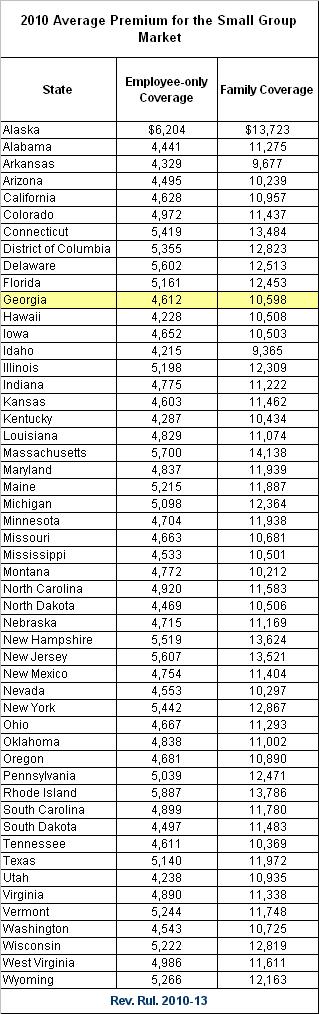
The amount of an employer’s premium payments that counts is capped by the amount of average premiums for the small group market in the state (or an area within a state) in which the employer offers coverage. The average premium for the small group market in a state or area is determined by the Department of Health and Human Services (HHS). The IRS released the average premium for the small group market in each state for 2010 in Revenue Rule 2010-13 (table at left-hand). For example, in 2010, the limits in Georgia were $4,612 for self-only coverage, and $10,598 for family coverage.

Carry Back and Carry Forward – The Section 45R credit is not refundable to for-profit companies. Any unused portion may be carried back 1 year and carried forward for 20 years, however a credit earned in 2010 may only be carried forward. Note: Companies with no tax liability will not receive any immediate assistance from the Section 45R credit. So for example, a company taking advantage of the 100% bonus depreciation provision, or other tax benefits, and the Section 45R credit in the same year may not gain any immediate benefit from the health care credit.

Health Insurance Deduction and Tax Credit – Under Internal Revenue Code Section 162, long before health care reform, employers have generally been allowed to deduct the cost of providing health insurance coverage for employees. However, going forward the IRS has interpreted that the amount that may be deducted must now be reduced by the amount of any Code Section 45R credit.

Example: A Georgia Based Small Business

TEA Corporation is a Georgia based company with a single owner and 10 full-time equivalent employees, average annual wages of $25,000 per year, and it provides self-only health insurance coverage. TEA Corporation pays 50% of the total premium for each employee. These figures were chosen specifically; since in order to qualify for the maximum Section 45R credit an employer can have no more than 10 FTE’s, average wages of no more than $25,000, and must pay at least 50% of its employee’s insurance premiums.

Because the total amount of premiums cannot exceed $4,612 for self-only coverage within the State of Georgia, the total amount of premiums paid by TEA Corporation, for purposes of the tax credit, is limited to be $23,060 (2,306 X 10). Assuming the company is in a 34% income tax bracket (i.e. taxable income is between $75,000 and $100,000 per the table below); the Section 162 deduction would normally save the company $7,840 (23,060 X 34%) in taxes.

Now, since the company qualifies for the maximum Section 45R credit of 35%, it will receive a tax credit of $8,071 (23,060 X 35%), however it will only be allowed to deduct health insurance expenses under Section 162 of $14,989 (23,060 – 8,071). So the Section 162 deduction of $14,989 saves the company $5,096 (14,989 X 34%), in addition to the Section 45R credit of $8,071, for total tax savings of $13,167 (5,096 + 8,071). So in effect, the new tax credit benefits the company by an additional $5,327 (13,167 – 7,840), or by $532 per employee, because the company would have already saved $7,840 (23,060 X 34%) prior to Obamacare.

From Unaffordable Care Act

If in the example above, TEA Corporation was not able to afford health insurance prior to Obamacare, then how does the Section 45R credit change things? Won’t the company still have to shell out an additional $23,060 to cover the employer’s share of health insurance costs? Yes. And although it will be eligible for the Section 45R credit, it won’t realize the $13,167 in tax savings until its tax return is filed in the subsequent year. So in effect, the company’s cost per employee will have risen by $2,306. Adding to the dilemma is the fact that the amount each employee must contribute also increases by $2,306. So both the company and its employees will be poorer at the end of the year, although the employer may have a chance to recoup about 57% (13,167 / 23,060) of its costs through subsequent year tax savings, and its employees will receive health insurance.

Problems: (1) In tax years 2010 through 2013, the federal government is going to somehow magically come up with $13,167 to cover 57% of TEA Corporation’s health insurance premiums, and do the same for potentially thousands of other similar small businesses, but who’s going to pay for this? Won’t the tab simply be added to the seemingly unlimited national debt balance? (2) And since employees will have to pay for potentially half of their own health insurance costs, each one who wasn’t previously covered by health insurance, and more specifically those making less than $25,000 per year, will have to figure out how to live off of approximately $2,306 less in disposable income. Does this sound like a good deal for those making under $25,000 per year, or even $50,000?

More Problems: (1) Of course, if any of the 10 employees in this example require family coverage, the costs for both the employer and employee will go up dramatically, as will the government’s cost of the subsidized tax credit. In the example above, the employer and employee obligation rises from $2,306 to $5,299 per year, or half of the average premium for small group family plans of $10,598. (2) Then in 2014 and 2015, as the Section 45R Credit increases to a maximum of 50%, the federal government’s (i.e. taxpayers) share increases by even more. This additional federal spending, though tax expenditures, will only add to the federal government’s current national debt balance of $14.7 trillion and ticking, until the tax credit well runs dry in 2016. (3) If small companies can’t afford it now, how will those who employ fewer than 25 workers be able to afford health insurance after 2015?

Exempt Organizations – Meanwhile, tax-exempt organizations will receive a “refundable tax credit” of up to 25% of the amount of health insurance premiums paid between 2010 and 2013, and 35% in 2014 and 2015. This refundable tax credit is limited to the amount of federal tax withheld from employees’ paychecks, the amount of Medicare tax withheld from employees, and the amount of Medicare tax matched by the employer.

Problem: Since exempt organizations don’t pay income taxes, the cost of the refundable Section 45R tax credit will never be recovered. In effect, individual and for-profit business taxpayers are subsidizing the tax credits granted to small non-profit organizations. Non-profit organizations, which are not even subject to the income tax, are being allowed to receive refundable income tax credits based on the amount of payroll taxes paid essentially by their employees. So in this respect, all Obamacare does is to giveaway more tax expenditures to folks who don’t pay any federal income tax. Wasn’t this already a major problem prior to Obamacare?

Large Employers – “Play or Pay”

Although Obamacare doesn’t mandate small employers to offer health insurance coverage to their employees, it does include play or pay rules which apply after 2013. The provision is intended to encourage employers to offer coverage or to pay a shared responsibility penalty. The play or pay rules only apply to large employers, those with 50 or more full-time employees. [Note: Employers who offer free choice vouchers to qualified employees were supposed to have been exempt from the penalty, but this provision was repealed in 2011.]

Problem: Employers who employ 25 or fewer employees are given an incentive to begin or to continue health insurance coverage, but are not required to provide it; while those with 25 to 49 employees are given no incentive, and are not required to provide insurance; and those with 50 or more employees are given no incentive, but face penalties for not offering adequate and affordable coverage by 2014.

Shared Responsibility Penalty The shared responsibility penalty will apply to two groups of employers after 2013: (1) Large employers that do not offer health insurance coverage. (2) Large employers that offer coverage but have one or more employees receiving premium assistance tax credits or cost-sharing because the coverage is deemed unaffordable. If even one employee receives premium assistance tax credits through a state insurance exchange, then the penalty will be $2,000 per full-time employee (not including the first 30 workers). And if the employer offers what is deemed to be unaffordable coverage, then the penalty will be $3,000 for any employee who receives premium assistance tax credits through a state insurance exchange up to a cap of $2,000 for every full-time employee.

[Note: Unaffordable coverage is defined as when the premium required to be paid by the employee is more than 9.5% of the employees’ household income. In such cases the employee is eligible for a premium assistance tax credit and cost-sharing reductions, but only if the employee declines to enroll in the employer’s coverage and purchases coverage through a state insurance exchange.]

Large Employer Problems:

(1) Large employers need to know how much household income each employee has including all working adults within their households.

(2) For purposes of the shared responsibility penalty, a Large Employer is an employer which employed an average of at least 50 full-time employees during the preceding calendar year. In other words, those with an average of 50 or more full-time equivalent employees in 2013 will be subject to the penalty in 2014, even if they have reduced the number of employees by that time.

(3) Full-Time Equivalent Employees for Large Employers – Unlike the definition of full-time equivalent employee for small employers, for purposes of the shared responsibility penalty, a full-time employee is defined as one who works an average of 30 hours per week. Employers who think they won’t be affected by the penalty or the employer mandate need to read the fine print.

Conclusions

  1. By offering incentives to micro-sized businesses, those with 25 or fewer full-time employees with average wages of less than $50,000, and no incentives to larger companies, Obamacare discriminates against job creators.

  2. Since employers with fewer than 25 employees are not required to provide health insurance coverage, and are not penalized for not providing coverage, most employers who qualify for the tax credit are not taking the bait. Let’s face it, health insurance plans drive up business costs even with a generous tax credit. And since the tax credit expires at the end of 2015, what is the catalyst which will make health insurance more affordable in the future? Will businesses and their customers have more money in their pockets as a result of Obamacare?

  3. Employers with more than 25 full-time employees and fewer than 50 fall between the cracks. For them, there is no incentive to provide health insurance coverage and no penalty for failing to provide it. It’s as if they don’t exist, which clearly displays the discriminatory aspect which Obamacare casts upon job creators.

  4. Meanwhile, large employers, those with 50 or more employees working at least 30 hours per week, receive no incentive to provide coverage, yet will be punished for not providing it. In the end, some large employers are encouraged to reduce the number of full-time equivalent employees to below 50 before 2013, to reduce the number of hours worked for some employees to below 30 per week, or to simply pay the shared responsibility penalty of $2,000 on each employee (excluding the first 30), rather than commit to even more costly health insurance contracts.

If TEA Corporation, in the example above, had 100 employees requiring self-only coverage, and paid 50% of the premiums, then its health insurance expense would be roughly $230,600. However, if TEA Corporation simply opted to pay the shared responsibility penalty of $2,000, on the 70 applicable employees, it would have to pay the IRS a penalty of just $140,000, in lieu of the $230,600 cost of insurance. But, if TEA Corporation is not able to afford $230,600, to pay for health insurance on its employees, it is compelled by the rule of law to hand over $140,000, money that it may or may not have, to the federal government under the play or pay rules. Is this fair?

The way things stand today, if by the year 2014 a large employer can’t afford health insurance, in spite of Obamacare – which does nothing to make it more affordable, or if providing health insurance would jeopardize its ability to continue as a going concern – in the Obama economy, then it still must pay the shared responsibility penalty, even if it means laying off workers, shuttering operations, or filing for bankruptcy. In other words, America’s job creators will either play, pay or be destroyed. If this job killing law is not repealed by 12/31/2012, the unemployment rate will continue to soar, because the companies which will be most affected are compelled to take action before then. In fact, in order to ensure that they are not blindsided by the one year look-back rule which begins on 01/01/2013, many companies are already taking action.

In my humble opinion, the Patient Protection and Affordable Care Act cannot be repealed fast enough. Be sure to sign the White House Petition to Repeal Obamacare. You must cast your Vote by 10/22/11.

Why Congress Shouldn’t Just Pass Obama’s Jobs Bill, Again

– 6 Temporary Stimuli, 17 Tax “Cuts”, and Zero Results

– By: Larry Walker, Jr. –

As I carefully chronicled in, “Obama: The Era of Flimflam Economics, Part II – Untimely and Proven to Fail”, the policy theory, known as economic stimulus, was designed by economists as a tool for implementation at the onset of a recession, with the goal of either softening its effects, or averting a downturn altogether. However, in the real economy, economic stimulus has yet to be proven successful at doing either. In February of 2009, partisan windbag, Barack Obama declared, “What do you think a stimulus is?“, implying that the idea was for the government to borrow and spend near a trillion dollars on anything, but then later at a Jobs Council, after the money had been squandered, he admitted that, “Shovel-Ready Was Not as Shovel-Ready as We Expected”.

Short-Term Stimulus vs. Long-Term Policy

To summarize, it was near the end of 2007, when prominent economists began advising the federal government that the economy was heading into a recession, and that it could be avoided if the government would implement an economic stimulus program. They proffered that in order to work successfully, such a stimulus needed to be targeted, timely, and temporary. As far as timeliness was concerned, tax refund checks needed to reach taxpayers in a matter of weeks not months. But economists must have forgotten that they were dealing with the federal government. How in the world would the federal government be able to: (1) agree on and pass legislation, (2) send it on to the IRS for interpretation and implementation, and (3) expect for tax refund checks to start rolling out in a couple of weeks, especially in the middle of the tax filing season?

The first economic stimulus package of the Great Recession was proposed in January of 2008. Even though a similar stimulus plan was attempted and failed in 2001, nevertheless, Congress was suckered in through panic mode once again. This time they would fling $150 billion to the wind, but by the time the checks reached taxpayers, in April of 2008, it was too late, the recession had commenced. Looking back, it turns out that the recession officially commenced in December of 2007 and didn’t end until June of 2009. So why is it that millions of job losses, millions of home foreclosures, hundreds of bank failures and trillions of dollars in government debt later, politicians still seem to be hell bent on the premise that temporary stimulus policies work?

In February of 2009, a year after the first failed tactic, Barack Obama enacted a second stimulus plan. The American Recovery and Reinvestment Act of 2009 turned out to be nothing more than a gigantic, nearly $1 trillion, spending program. Although his borrow-and-spend policy was designed to be temporary, it was neither targeted nor timely. So the questions then and now are: Why was the federal government still trying to implement a stimulus program 14 months after the recession began, when every honest economist knows that the idea is to inject stimulus either prior to or just as a recession commences? By February of 2009, was it possible for a stimulus plan to prevent something which had already occurred? And lastly, why is the federal government still toying with the idea today, some 27 months after the recession has ended?

It should be rather obvious by now that economic stimulus programs don’t work in the real world. Although the theory may look impressive on a chalk board, the federal government is not an efficient institution for implementing a positive jolt to the economy, let alone much of anything else. It should also be clear that there are economic recovery policies which have been proven to work, time immemorial, once a recession has passed. For example, The Tax Reduction Act of 1964, The Economic Recovery Tax Act of 1981, The Tax Reform Act of 1986, The Deficit Reduction Act of 1993, and the Jobs and Growth Tax Relief Reconciliation Act of 2003 were all long-term plans which stabilized and grew the economy following recessions.

What’s lacking today is a long-term tax policy which would inject a sense of stability and predictability to the economy at large. Small businesses don’t make plans based on hope and change, what we need is to know what our income tax rates and incentives will be for the next 8 to 10 years. Yet, Obama has wasted nearly 3 years already, passing one temporary measure after another, and now it’s more of the same. As far as I’m concerned, it’s over for Obama. With the knowledge that long-term tax policies have been used as effective recovery tools following recessions, and that short-term stimulus programs have never been successful, why in the world is Obama trying to subject the nation to another stimulus prototype now, some 3 years and 9 months after the Great Recession began? Is it because we’re on the verge of another recession? And if we are on the verge of a double-dip, knowing that temporary stimulus programs don’t work in the real world, why would we ever allow Obama and Congress to waste more time, and money that we don’t have, with yet another futile stab?

From Main Street to Washington, DC

Having been an accountant and tax advisor for many small businesses, including my own, through at least the last two recessions, I know first hand which tax policies have worked and haven’t, and which have been important to small businesses versus the completely useless. For example, after passage of the Jobs and Growth Tax Relief Reconciliation Act of 2003, there was a sense of stability, and future plans could be implemented without the lingering fear that something would change or be taken away the following year. Its key policies which helped small businesses, within my orbit, were as follows:

  1. Stable and well defined Personal and Corporate Income Tax Rates and Brackets.

  2. Accelerated Depreciation through Section 179 and Bonus Depreciation within clearly defined limits and timeframes.

  3. Increasing and well defined limits on IRA and Qualified Retirement Plan contributions.

  4. Stable and declining tax rates on capital gains, and qualified dividends.

  5. Defined and stable tax credits such as the energy efficiency credit, child tax credit, education credit, and the life-time learning credit.

  6. Stable, declining and well defined Estate tax rates and brackets.

In contrast, the policies I have witnessed since February of 2009, have made planning next to impossible and pretty much pointless. For example, we knew that the tax rates and most of the policies implemented by #43 would expire at the end of 2010, so that was pretty much the end of the planning cycle, however the recession cut many plans short well before 2010. In fact, many small businesses didn’t make it through 2008, and some went under in 2009. As for the survivors, well what we’ve all been waiting for are the permanent policies which will carry us through the next decade. But thus far, all we’ve seen is a series of temporary tax measures, many with erratic nonsensical start and end dates, and most of which have been completely useless at a time when gross business income has for the most part been depressed.

Obama’s 17 Phantom Tax Cuts for Small Business

Obama has implemented 17, so called, tax cuts for small business. For the complete list, see the Feb. 25, 2011, posting on the official White House blog entitled, “Seventeen Small Business Tax Cuts and Counting.” The post is touted as enumerating 17 small business tax cuts and credits created or extended through legislation signed by Obama, since February of 2009. But what is important to remember is that it’s not how many tax cuts have been implemented, but rather, whether or not they have been effective. Overall, I would have to give the Obama policies a grade of “D”. Obama’s 17 small business tax policies (or as he calls them “cuts”), and their effectiveness from my point of view follows, but first, here’s a short summary:

  • Eight of them were included in American Recovery and Reinvestment Act (aka the economic stimulus), the Affordable Care Act (aka the health care law), and the Hiring Incentives to Restore Employment Act (aka the Hire Act). Among the cuts: the exclusion of up to 75 percent of capital gains on key small business investments; a tax credit for the cost of health insurance for small business employees, and new tax credits for hiring Americans out of work for at least two months.

  • Another eight came via the Small Business Jobs Act, signed by President Obama in September of 2010. These included: adding deductions for business cell phone use; creating a new deduction for health care costs for the self-employed; allowing greater deductions for business start-up expenses; eliminating taxes on all capital gains from key small business investments, and raising the small business expense limit to $500,000.

  • Three months later, he signed a tax bill that raised the expense limit to 100 percent of small business new investments until the end of 2011. It also extended the elimination of capital gains taxes for small business investments through the end of 2012.

From the Recovery Act, HIRE Acts, and Affordable Care Act

1. A new small business health care tax credit

We didn’t have any businesses qualify for this credit. The calculation was very complex, so it wasn’t readily known whether any businesses would qualify until after the end of the tax year. It’s kind of difficult to shoot for something when even your accountant says, “I don’t know. I’ll let you know as soon as the IRS puts out some regulations showing us how it will be calculated.” And then well into the following year, “I’ll get back to you as soon as the IRS releases the appropriate tax forms.” One business came close to qualifying, but the employees’ salaries turned out to be too high. Who knew?

The small businesses I deal with don’t normally determine what their employees salaries and benefits will be based on temporary government policies. And they don’t sit around waiting on the IRS to publish forms and regulations when a decision is needed right away. In other words, when a business needs 4 more engineers, due to demand, negotiations don’t center on keeping salaries below a certain threshold in order to qualify for a one-year, one-time tax credit. And negotiations for health care plans center more on the affordability of monthly payments, and are not recklessly entered into with the hope of receiving a one-time tax credit, to be realized in some subsequent year.

Most small businesses in my sphere don’t offer health insurance, simply because it’s cost prohibitive, so the idea of a one-time tax credit, to offset the cost of something unaffordable to begin with, turned out to be pretty much a waste of orating skills, paper and ink. It sounded good though, and I guess that’s what counts with Obama and his cronies.

2. A new tax credit for hiring unemployed workers

I would say three businesses may have qualified for this credit, and mostly by luck. Others thought they would qualify, but it turned out that the new hires had not been unemployed for at least 60 days which disqualified them. I got lucky by hiring someone who had been unemployed for more than 60 days, and was luckily hired a few days after the law went into effect. But it wasn’t like I was hunting for someone who would qualify, and didn’t even know about the credit at the time because the details were not readily available. Again, I don’t know of any small businesses that hire people based on temporary tax credits, most hire people when they are needed to meet the objectives of the organization.

Also, since our payroll tax software wasn’t set up to account for the credit, because it was implemented after the start of the tax year, and since IRS Form 941 was not updated when the credit went into effect, it turned out to be more of an accounting nightmare than anything else. Personally, I would have gladly forgone the credit in exchange for not having to figure out how to account for it. Thank God that’s over with. Can we please just have some stability so we can run our businesses without something changing every few months?

3. Bonus depreciation tax incentives to support new investment

Section 179 depreciation has generally been sufficient. Although, bonus depreciation is advantageous at times, it’s more advantageous when a business has a loss, which is generally not the goal. If net income is high enough to write-off all equipment purchases, why would anyone choose to write-off half? Like I said, there is an application, but it mostly applies when net income equals zero, and one wishes to accelerate a loss. There were a few takers, but come to think of it, most of those went out of business due to the losses already incurred.

Uncertainty – From a planning standpoint, the other looming question was that, if the Bush tax cuts were going to expire at the end of 2010, might the depreciation expense perhaps be better utilized in the year rates were set to increase rather than while rates were low? Thus it may have made more sense to just delay any purchases until 2011, or 2012 rather than accelerate the write-offs while tax rates were still relatively low. Again, a stable long-term tax policy trumps temporary measures any day.

4. 75 percent exclusion of small business capital gains

This was of no use whatsoever from my vantage point. One would have to purchase qualified small business stock after February 17, 2009 and before January 1, 2011, and then hold it for five years in order to take advantage. None of our small businesses make a living through buying and selling small company stock. The only practical use I could see was for owners planning to sell their stake in a company, but they would have had to acquire that stake between the dates above, so it wasn’t much use to existing business owners. My first impression was that it was a policy designed for those looking to make a quick exit and perhaps relocate overseas, but the five year hold time destroyed that dream. If you’re interested in how convoluted this provision turned out to be, there’s an interesting article here.

5. Expansion of limits on small business expensing

Did anybody in Washington, DC get the memo that surviving small businesses just got hammered for two years straight, and thus had no money left, and no desire to go out on credit for new equipment, if credit could even be obtained? All I can say is that the old limit of $25K seemed to be more than sufficient to cover replacement items. I haven’t witnessed any considerable expansion plans since 2006.

Uncertainty – From a planning standpoint, the other looming question was that, if the Bush tax cuts were going to expire at the end of 2010, might the depreciation expense perhaps be better utilized in the year rates were set to increase rather than while rates were low? Thus it may have made more sense to just delay any purchases until 2011, or 2012 rather than accelerate the write-offs while tax rates were still relatively low. Again, a stable long-term tax policy trumps temporary measures any day.

6. Five-year carryback of net operating losses

This was yet another policy more useful for those who lost money and were on their way out of business, than for those fighting but keeping their heads above water. I took this as more of a policy of defeat than future success. I guess the government figured that a small tax refund from five years ago would encourage small businesses to keep hiring while losing money in the meantime. I had a couple of businesses utilize the five-year carryback, but unfortunately they are no longer in business.

7. Reduction of the built-in gains holding period for small businesses from 10 to 7 years to allow small business greater flexibility in their investments

This was another waste of paper and ink. This policy only helped out S-Corporations who were formerly taxed as C-Corporations, and had built in gains at the time of conversion. A built in gain is the difference between the fair market value of an asset and its tax basis at the time of the conversion. I’m sure some businesses out there took advantage, but really, how many C-Corporations switched to S-Corporation status? I think I advised one to do it maybe 10 years ago, but other than that it hasn’t always been the best move due to built-in gains, undistributed net profits, the number of shareholders, or the owner’s personal tax situation. The majority of the small businesses in my neck of the woods have been S-Corporations from inception, generally based on my advice. So did anyone actually benefit from this provision? I have serious doubts.

8. Temporary small business estimated tax payment relief to allow small businesses to keep needed cash on hand

Since estimated tax payments are made throughout the year in order to reduce or eliminate the amount owed when the tax return is due, the full amount being due by March 15th, why would I advise any small business to skimp? I had no takers here either. Most small business owners who make estimated tax payments want their taxes covered by tax time, and don’t want to skimp on estimated tax payments during the year, and then get stuck with a gigantic tax bill later. If a business took advantage of this and then didn’t have funds to pay on March 15th it would only snowball into perpetual tax debt. ‘Once you get behind, you never catch up.’ So this was another waste of paper and ink. Hey, do we look stupid or what? Why not just cut the doggone tax rates, and stop playing games?

From the Small Business Jobs Act

9. Zero capital gains taxes on key investments in small businesses

Zero is right! Like I said in number 4 (above), it was of no use whatsoever when 75% of the gain was excluded, from my vantage point. To slip through this loophole, one would have had to purchase qualified small business stock after September 27, 2010 and before January 1, 2011. Since there were only three month’s to gear up, and it was the holiday season, I’m pretty sure no one took advantage, but if you did, please shout it from the rooftops. None of our small business clients make a living through buying and selling small company stock. The only practical use I could see was for an owner planning to sell their stake in the company, but to gain any benefit, they would have to acquire that stake between the dates above, and so it wasn’t much use to existing small business owners. My first impression was that it was a policy designed for those looking to make a quick exit and perhaps relocate overseas, but the five year hold time once again destroys that dream. This was another waste of paper and ink. If you’re interested in how convoluted this provision turned out to be there’s an interesting article here.

10. Raising the small business expensing to $500,000

I didn’t have any small business clients who were able or desired to purchase anywhere near $500K of new equipment. Since this doesn’t apply to real property, it’s generally well beyond the needs of most of the small businesses in my area. Thus, I had no takers. This might be a great policy for well capitalized startup businesses, but the number of startups has been on the decline, and most that I know of haven’t had that much capital. Since the write-off is limited to a businesses net income, $500K is generally beyond the earnings of most first year enterprises. This is generally a good policy to implement in the middle of a recovery in order to maintain growth, but not in the midst of a weak economy. Thus to me, it amounted to another waste of paper and ink.

11. An extension of 50 percent bonus depreciation

Hey, didn’t we try this already? See number 3 (above).

12. A new deduction for health care [insurance] expenses for the self-employed

This is actually a bit misleading. It should read ‘deduction for health “insurance” expenses’, not ‘health “care” expenses’. Since most of the small businesses we advise are S-Corporations, owner-employees with company paid health insurance, were already allowed a 100% deduction for health insurance long before this Act. The amount paid is included in their wages, but not subject to Social Security and Medicare taxes, and is allowed to be written off in full on their personal returns. This results in a total offset on the personal return, and a higher wage deduction on the S-Corporation return. I suppose it helped some sole-proprietors, Schedule C filers who have health insurance, but it didn’t affect anyone within my practice. Why walk when you can fly?

13. Tax relief and simplification for cell phone deductions

Most small businesses actually using cell phones for business purposes were already deducting the business usage portion. This provision only helped to avert a threatened crack down on the deduction which would have made it more costly to maintain records proving every call was business related, but since the crackdown never occurred, the effect upon small businesses was a sigh of relief, but no additional savings. In other words it saved us from having to spend more to comply with yet another ridiculous government regulation, but was really just a wash. Nothing was really saved, and nothing gained, in other words, it may have sounded good, but the effect was nil.

It’s akin to the government making 1099’s mandatory for all vendors, cancelling the regulation before implementation, and then claiming to have saved businesses money. No. You didn’t save us money. What you did was give us two years of uncertainty and unneeded stress, that’s what you gave us. That’s why government should just get out of the way.

14. An increase in the deduction for entrepreneurs’ start-up expenses

Although this policy temporarily increased, in 2010, the amount of start-up expenditures entrepreneurs could deduct from their taxes from $5,000 to $10,000, most of the start-up expenses that come across my desk are in the $100’s not thousands. And in cases where there are larger amounts, but little initial year net income, taking the write-off over 60 months is sometimes more plausible, especially when one doesn’t know whether tax rates will be higher in subsequent years, which by the way, we still don’t know.

15. A five-year carryback of general business credits

This policy allowed certain small businesses to “carry back” their general business credits to offset five years of taxes. I didn’t have any business clients qualify for any of the general business credits last year, and none who were really targeting them. In fact, the last business I can remember taking advantage of one of these credits was advised to do so through a tax scam. They paid the scammer an upfront fee in same amount as the credit they were assured to get back from the IRS. But in the end, all they got was an IRS audit resulting in the disallowance of the credit, had to pay the IRS back, and then had to sue the scammer to be made whole. I’m sure there are legitimate uses for some of these credits; I just haven’t dealt with any small businesses lately where any of them would have made a difference. You may view a full list of the credits here. In my view, most are either obsolete, redundant, or serve only a narrow base of special interests. Anyone serious about tax reform has my permission to strike the entire list.

16. Limitations on penalties for errors in tax reporting that disproportionately affect small business

The bill would change the penalty for failing to report certain tax transactions from a fixed dollar amount – which was criticized for imposing a larger penalty on small businesses – to a percentage of the tax benefits from the transaction. There was a time that all tax penalties were based on a percentage of taxes owed, but that’s no longer the case. Unfortunately this new provision doesn’t limit the effect of the $195 per month penalty the IRS currently charges, per shareholder, for each part of a month that an S-Corporation or Partnership return is filed late. S-Corporations and Partnerships, which have no income tax liability, are currently assessed the penalty, even though the late filing typically affects only a limited number of owners, or sometimes just one. If the government was serious about helping small businesses, they would stick to the old percentage of tax benefit policy (i.e. no tax benefit, no penalty), and eliminate this unfair charge on small businesses immediately.

And from the Tax Relief, Unemployment Insurance Reauthorization and Job Creation Act

17. 100 percent expensing

Hey, didn’t we do this twice already? See numbers 3 and 11 (above). This provision only applies to qualified property placed in service after September 8, 2010 and before January 1, 2012. So for those who purchased qualifying equipment on or before September 7, 2010, too bad, you should have waited. This is a prime example of another wacky implementation date from Obama. It’s also the provision that allows up to 100% of the price of an SUV or Corporate Jet to be written off in the first year, a provision signed into law by Obama, who later railed against the same.

This might be a good thing for some, but so far we haven’t seen any great demand for purchasing new equipment, no matter the incentive. Most small businesses, within my scope, are trying to pay off the debt from yesteryears purchases, and not looking to expand, or to replace equipment unless it’s an emergency. In other words, it’s not just hiring that’s down, it’s the economy as a whole, and with that comes dealing with slow paying customers, managing debt, grappling with price competition, and cutting back on expenses – including the purchase of new equipment. Thus, upping bonus depreciation from 50% to 100% looks good on paper, but it’s another temporary measure which in my estimation will not provide the spark needed to boost the economy.

Conclusion

Overall, most of Obama’s so called tax “cuts”, listed above, may make good sound bites, but I haven’t found them to have much practical application in the real world. There was a time, not so long ago, that the term tax cut, meant exactly that. It meant that tax rates were reduced. None of the provisions above represent reductions to income tax rates or adjustments to tax brackets, so they are not technically tax cuts. They are merely temporary ploys, targeting special interest groups, requiring one to either borrow and spend money, or jump through unreasonable (often impossible) hoops simply to obtain an additional deduction or credit.

Meanwhile, on Main Street, a permanent reduction in personal and corporate income tax rates, from the get go, would probably have had a greater impact, even if it were done in stages, with super low rates for two years followed by modest increases over the next eight, or something. None of Obama’s 17 tax deductions, credits, or extensions have really mattered much to me or to most of my small business clients, and the stuff he’s talking about now won’t make much of a difference either. If it’s temporary, and if it requires jumping through hoops, borrowing money, or meeting time frames beginning in the middle of the year – or starting on some arbitrary date in some odd month, then just forget it. It would be a heck of a lot easier to just cut overall income tax rates for one year, and then provide fixed rate schedules for the next decade. Is that so difficult? Is it really? If JFK, Reagan, Clinton, and ‘W’ could do it, why couldn’t Obama?

It’s all over for Obama now, time to move on. He had his chance, and blew it. The era of temporary stimulus boondoggles is over. Instead of thinking targeted, timely and temporary, it’s time to move towards a plan that’s broader based, strategic and permanent. Now it’s up to Congress and the 2012 presidential candidates to outline a long-term strategy and take it to every corner of the country.

References:

DNC Chair Wasserman Schultz says Obama has signed bills with 17 small business tax cuts
Four More Trillion | Not Change

What? Obama Borrowed $4 Trillion in 2 1/2 Years?

By: Larry Walker, Jr. –

It was back on July 3, 2008 when Barack Obama exclaimed, “The problem is, is that the way Bush has done it over the last eight years is to take out a credit card from the Bank of China in the name of our children, driving up our national debt from $5 trillion for the first 42 presidents – #43 added $4 trillion by his lonesome, so that we now have over $9 trillion of debt that we are going to have to pay back — $30,000 for every man, woman and child. That’s irresponsible. It’s unpatriotic.”

Now, just two and a half years into his one-term proposition, Barack Obama has added $4 trillion to the national debt by his lonesome. So what does that make him? Today we have a national debt of $14.6 trillion that we are going to have to pay back — that’s $46,935 for every man, woman and child, and $130,786 for every U.S. taxpayer. It may be stated that Obama’s record on the national debt is 320 times more irresponsible, and 320 times more unpatriotic, no? But let’s just call it, “Not Change”. I know, I know, I can “go straight to Hell”, right Maxine Waters?

“You hypocrite, first take the plank out of your own eye, and then you will see clearly to remove the speck from your brother’s eye.” – Matthew 7:5

From Point of No Return

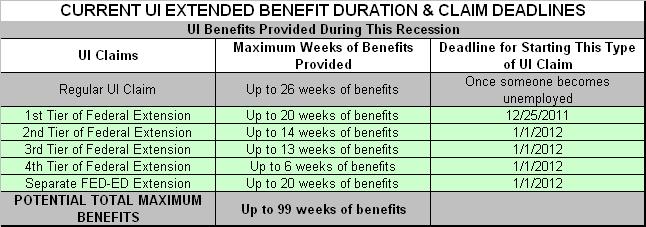
So what’s the plan, Stan? More ‘temporary’ shovel ready jobs? Overthrow another Libya? Form a government-run infrastructure bank (LOL)? Add another 99-weeks to unemployment benefits? Raise taxes on $250,000-aires? Form another debt commission? Raise the debt ceiling, raise the debt ceiling, raise the debt ceiling? Create a super-committee? Build a bullet train to nowhere? Tighten the noose around Gadaffi? Fix health care again? Another temporary Social Security tax cut? Extend the 100% bonus depreciation write-off on corporate jets and SUVs? Blame the Tea Party and Republicans? Give another speech? Take another bus tour to nowhere? Play another four-year round of golf?

Nah! I don’t think so. Looks like a one-term proposition to me, if that. Now it’s Obama vs. Obama. A kind of lose-lose hypothesis. Heck, this guy couldn’t even beat himself. We might as well bring Bush back. Or maybe we’d be better off without a President at all. How about a “none of the above” bubble on the next ballot? I’d rather have no President at all than four more years of misery. Hey Obama, why don’t you just do us all a favor by resigning right now?

It’s time for serious solutions. Give me something to die for. Give me a candidate I can stake my name and reputation on. Dazzle me with common sense. Show me how it’s really supposed to work. Rock my free-market world. Naturally, we independent small business types will be placing principles above personalities, so you best watch what you say, and do.

“A bill will be presented to the Congress for action next year. It will include an across-the-board, top-to-bottom cut in both corporate and personal income taxes. It will include long-needed tax reform that logic and equity demand … The billions of dollars this bill will place in the hands of the consumer and our businessmen will have both immediate and permanent benefits to our economy. Every dollar released from taxation that is spent or invested will help create a new job and a new salary. And these new jobs and new salaries can create other jobs and other salaries and more customers and more growth for an expanding American economy.”John F. Kennedy, Aug. 13, 1962, radio and television report on the state of the national economy.

Related:

Read more: John F. Kennedy on taxes

What Austerity? – Federal spending will hit a new record this year.

Just What We Need, A Government Bank – Outrage

Conn Carroll: Infrastructure bank is just another stimulus boondoggle

Obama’s Failed Jobs Subsidy | 99 Weeks

Photo via: http://ibloga.blogspot.com/2009/02/new-one-trillion-dollar-bill.html

Black Employment | Back to the 1970s

– Halfway to Nowhere

– Larry Walker, Jr. –

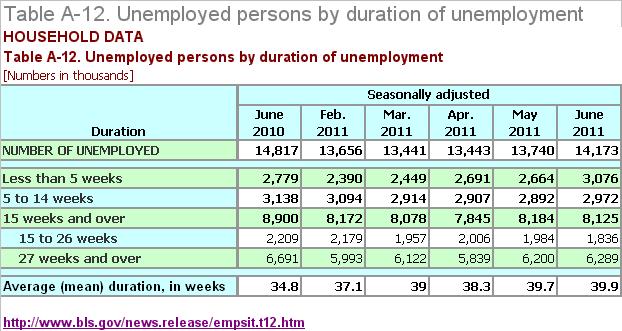
One of the figures that stood out in the July 2011 Employment Situation Report was that Black labor force participation had declined to 60.4%, or to the same level attained in March of 1973, from a rate of 63.2% in January of 2009. The rate has fluctuated between a record low of 58.5% during 1975, to a record high of 66.4% in 1999. It stood at 63.4% in December of 2007, the first month of the Great Recession, and clocked in at 62.6% when the recession ended in June of 2009. In fact, the rate hasn’t dropped below 62.0% since May of 1984. But since February of 2009, the Black labor force participation rate has declined by 2.8 percentage points, and most of that decline, 1.7 points to be precise, has occurred since the beginning of 2011. So why did Black labor force participation suddenly plummet during Obama’s 3rd year in office, over two years after the recession ended?

Black labor force participation rate – The labor force participation rate measures the labor force as a percent of the civilian non-institutional population.

From Black Employment – July 2011

Why hasn’t a Black White House resident correlated with improvement in the lives of Black and African American people, or anyone else for that matter? It’s one thing to be giddy that a Black man made it into the White House, but entirely another when you take a look around the community. The fact that the Black labor force participation rate has fallen back to 1970s levels, and exclusively on Obama’s watch, either means that his policies aren’t working; or that they are, but just in reverse.

For example, does the act of extending unemployment benefits to an historic 99-weeks mesh with increasing labor force participation? Is the act of handing out record amounts in government food stamps somehow in lock-step with prosperity? Does legislation providing a $50,000, per unemployed household, government subsidy to cover mortgage payments for up to two years help get folks back to work? Will Obama’s policies of doling out record amounts of unemployment, food stamps, and $50,000 per household mortgage subsidies, concurrently, lead us out of the ditch, or over a cliff? When ‘shovel ready’ turned out not be so shovel ready, it appears that this was Obama’s Plan B.

The Black employment-population ratio is also at 1970s levels; while the Black unemployment rate, although not the worst ever recorded, has averaged 15.6% since February of 2009.

Black employment-population ratio (Current Population Survey) – The proportion of the civilian non-institutional population aged 16 years and over that is employed.

The Black employment-population ratio has fluctuated between a record low of 48.8% from December of 1982 through January of 1983, to a record high of 61.4% in April of 2000. It stood at 57.7% in December of 2007, the first month of the Great Recession, was 55.2% in January of 2009, and clocked in at 53.3% when the recession ended in June of 2009. It has since declined to 50.8% as of July of 2011, a decline of 4.4 percentage points since Obama’s inauguration.

From Black Employment – July 2011

Black unemployment rate – The unemployment rate represents the number unemployed as a percent of the labor force.

The Black unemployment rate has fluctuated between a record low of 7.0% in April of 2000, to a record high of 21.1% in January of 1983. It stood at 9.0% in December of 2007, the first month of the Great Recession, was 12.7% in January of 2009, and clocked in at 14.9% when the recession ended in June of 2009. It has risen to 15.9% as of July of 2011, an increase of 3.2 percentage points since Obama’s inauguration.

From Black Employment – July 2011

At a fundraiser in Chicago on August 3, 2010, Barack Obama remarked, “…But the thing that we all ought to remember is that as much as good as we have done, precisely because the challenges were so daunting, precisely because we were inheriting so many challenges, that we’re not even halfway there yet. When I said ‘change we can believe in’ I didn‘t say ’change we can believe in tomorrow.’ Not change we can believe in next week.”

Well, it’s been about two and a half years already, so if they’re not even halfway “there” yet, does that mean it will take another 3, 4, 5, or 40 years? And exactly what does Obama mean by, “we’re” and “there”? Who is we, and where is there? It looks to me like our nation is around three-fourths of the way to declaring bankruptcy; the economy is maybe four-fifths of the way towards a depression, and the labor force statistics for Black and African Americans have receded to levels not seen since the 1970s and early 1980s.

So if I’m reading this correctly, as long as Obama has the bully pulpit, change will kick-in after my girls graduate from college, but not right now when it’s needed? Just wait a few more years, after my twin granddaughter’s start pre-school, but not now, two month’s before their birth, when my son needs it, eh? Heck, it may take another 40 years just to fill in the trench Obama has dug. I guess since ‘shovel ready’ wasn’t as shovel ready as he thought, and since “we’re not even halfway there”, unemployment benefits will have to be extended for another 99 weeks, while those who are able to endure carry the water. Heck, we might as well extend unemployment benefits for the rest of Obama’s term, since according to most of today’s Democrat Party, unemployment compensation and food stamps add more to the economy than the private sector anyway?

Obama has turned this economy around alright — back to the 1970s. Now he wants another four years, after he campaigns his way through the remainder of this term? Thanks, but no thanks. Every policy he’s put on the table has failed. The fact that he lost the USA’s triple-A credit rating, through devil-may-care spending, ought to say it all. What would the USA’s credit rate be after another term, since he’s only halfway there, BBB? Four more years to bobble his head from one teleprompter to the other, lecturing us on bugged out Socialist ideals from decades past, yeah right! If his plans don’t work in the real world, it may be that they are simply outdated. I say it’s time for Conservatives to take the horns of this democracy, and make a quick U-turn.

Halfway to nowhere – Heck, Obama’s policies might be succeeding beyond our wildest dreams, but we just can’t see it. Maybe where we get confused is when we open our eyes and look around. After all, he never said it was change we would be able to see, or change that would actually occur. He merely said it would be something intangible, an idea that we could believe in. In other words, a fairy tale, a chimera of the way we wish things were, but know they could never be. A world where electricity is generated without power plants, where heating oil rains down like manna from heaven, and where a big government hands us everything we need. But when we keep it in the day, and open our eyes, what do we see? – An incompetent, partisan, rascal, spouting half-truths, and railing away at his enemy, which turns out to be at least half of America.

“The best social program is a good job.” ~Bill Clinton

“I do not believe we can repair the basic fabric of society until people who are willing to work have work. Work organizes life. It gives structure and discipline to life.” ~Bill Clinton

“Nothing in this world can take the place of persistence. Talent will not; nothing is more common than unsuccessful people with talent. Genius will not; unrewarded genius is almost a proverb. Education will not; the world is full of educated derelicts. Persistence and determination alone are omnipotent. The slogan ‘press on’ has solved and always will solve the problems of the human race.” ~Calvin Coolidge

———————————————–

Definitions:

  • Labor force (Current Population Survey) – The labor force includes all persons classified as employed or unemployed in accordance with the definitions contained in this glossary.

  • Civilian non-institutional population (Current Population Survey) – Included are persons 16 years of age and older residing in the 50 States and the District of Columbia who are not inmates of institutions (for example, penal and mental facilities, homes for the aged), and who are not on active duty in the Armed Forces.

  • Employed persons (Current Population Survey) – Persons 16 years and over in the civilian non-institutional population who, during the reference week, (a) did any work at all (at least 1 hour) as paid employees; worked in their own business, profession, or on their own farm, or worked 15 hours or more as unpaid workers in an enterprise operated by a member of the family; and (b) all those who were not working but who had jobs or businesses from which they were temporarily absent because of vacation, illness, bad weather, childcare problems, maternity or paternity leave, labor-management dispute, job training, or other family or personal reasons, whether or not they were paid for the time off or were seeking other jobs. Each employed person is counted only once, even if he or she holds more than one job. Excluded are persons whose only activity consisted of work around their own house (painting, repairing, or own home housework) or volunteer work for religious, charitable, and other organizations.

  • Unemployed persons (Current Population Survey) – Persons aged 16 years and older who had no employment during the reference week, were available for work, except for temporary illness, and had made specific efforts to find employment sometime during the 4-week period ending with the reference week. Persons who were waiting to be recalled to a job from which they had been laid off need not have been looking for work to be classified as unemployed.

  • Not in the labor force (Current Population Survey) – Includes persons aged 16 years and older in the civilian non-institutional population who are neither employed nor unemployed in accordance with the definitions contained in this glossary. Information is collected on their desire for and availability for work, job search activity in the prior year, and reasons for not currently searching. (See Marginally Attached Workers.)

  • Marginally Attached Workers (Current Population Survey) – Persons not in the labor force who want and are available for work, and who have looked for a job sometime in the prior 12 months (or since the end of their last job if they held one within the past 12 months), but were not counted as unemployed because they had not searched for work in the 4 weeks preceding the survey. Discouraged workers are a subset of the marginally attached. (See Discouraged Workers.)

  • Discouraged Workers (Current Population Survey) – Persons not in the labor force who want and are available for a job and who have looked for work sometime in the past 12 months (or since the end of their last job if they held one within the past 12 months), but who are not currently looking because they believe there are no jobs available or there are none for which they would qualify.

References:

Data Tables

http://www.bls.gov/bls/glossary.htm

http://stats.bls.gov/news.release/empsit.t02.htm

http://stats.bls.gov/webapps/legacy/cpsatab2.htm

Guess You Can’t | Super Committee 2.0

~ Too Big, Messy, Tough and Democratic for Obama

– Larry Walker, Jr. –

When that year was over, they came to him the following year and said, “We cannot hide from our lord the fact that since our money is gone and our livestock belongs to you, there is nothing left for our lord except our bodies and our land. Buy us and our land in exchange for food, and we with our land will be in bondage…” ~Genesis 47:18-19

At a fundraiser in Chicago on August 3, 2010, Barack Obama said, “It’s been a long, tough journey. But we have made some incredible strides together. Yes, we have. But the thing that we all ought to remember is that as much as good as we have done, precisely because the challenges were so daunting, precisely because we were inheriting so many challenges, that we’re not even halfway there yet. When I said ‘change we can believe in’ I didn‘t say ’change we can believe in tomorrow.’ Not change we can believe in next week. We knew this was going to take time because we’ve got this big, messy, tough democracy.”

We have a big, messy, tough democracy? So is Obama advocating an alternative form of government? Would change come quicker if we had a dictatorship, or a super-committee? If I understand Obama correctly, what he is saying is that, “a government by the people; a form of government in which the supreme power is vested in the people and exercised directly by them or by their elected agents under a free electoral system”, is too big, too messy, and too tough for him. Well, I have one suggestion for you: ‘Quit’! Go back home, and use your community organizing (a.k.a. destabilizing) tools to try to fix what you got wrong in Chicago. This will relieve you of a couple of hundred thousand dollars per year that you didn’t need anyway, while giving us a chance to clean up the damage you have done to our nation in such a short time span.

A democracy can also be described as a state of society characterized by formal equality of rights and privileges. The way it’s supposed to work is that whether majority or minority ideas are put on the table, they are given equal respect. One side calling the ideas of the other evil, terroristic, or selfish does not a democracy make, especially when such ideas may be more plausible than its own. Is killing the leader of Libya and his supporters democratic? Does the execution of one political party leader promote equality of rights and privileges for all?

“For in the same way you judge others, you will be judged, and with the measure you use, it will be measured to you.” ~Matthew 7:2

In the United States, one side believes that raising taxes on those who are more prosperous will solve all of society’s problems. They call this, shared sacrifice. But when others point out that the process will only raise $70 billion per year against a budget deficit of $1.2 trillion, thus leaving a $1.13 trillion per year gap, they are called “terrorists”, and blamed when the nation’s credit rating is slashed. So what about the other $1.13 trillion per year? The compromise: ‘We will form a new democracy, comprised of 12 politicians, six from each major political party, and let them decide’. Is this how democracy works? What happened to the fundamental right of ‘no taxation without representation’?

One side believes that if more tax revenues are needed, then taxes ought to be raised on the 5% who already carry water for the other 95%. But another school of thought believes that if more taxes are needed, society should encourage the creation of more taxpayers. When one side points out that 51% of the labor force pays FICA taxes, but doesn’t pay any income taxes, while the other 49% pay both, they are called evildoers, haters of the poor, and accused of being against the concept of “shared sacrifice”. What gives?

“A man planted a vineyard. He put a wall around it, dug a pit for the winepress and built a watchtower. Then he rented the vineyard to some farmers and went away on a journey. At harvest time he sent a servant to the tenants to collect from them some of the fruit of the vineyard. But they seized him, beat him and sent him away empty-handed. Then he sent another servant to them; they struck this man on the head and treated him shamefully. He sent still another, and that one they killed. He sent many others; some of them they beat, others they killed. He had one left to send, a son, whom he loved. He sent him last of all, saying, ‘They will respect my son.’ But the tenants said to one another, ‘This is the heir. Come, let’s kill him, and the inheritance will be ours.’ So they took him and killed him, and threw him out of the vineyard. What then will the owner of the vineyard do?” ~Mark 12:1-9

While one side devises to kill capitalists, who are also citizens, and distribute their property to the masses, the other simply asks, “Do the 51% who don’t pay personal income taxes benefit from a national defense? Do they drive on federally funded roads and bridges? Have they not benefited from public education, and other federal programs?” We have a government that dishes out up to $8,000 per year in income tax refunds to families who pay no personal income taxes, taking it from those who do, and when the families who pay question the logic, they are called selfish. But is it selfish to ask why the one who has sacrificed time and effort to plant, build, and employ others must be brought down, while those who have not are lifted up? Shall the life’s work of the few be stolen and distributed to the masses in the name of good? What will the owner of the vineyard do?

“For if the willingness is there, the gift is acceptable according to what one has, not according to what he does not have.” ~2 Corinthians 8:12

Everyone who owns real property in my community pays real estate taxes, a form of shared sacrifice, to help fund our common welfare. The tax is based on the value of each property. Even senior citizens, widows, veterans, and those with disabilities pay, although at lower rates. Homesteaders receive a discount, while landlords pay the most, but no one is exempt. Even renters pay real estate tax, which is embedded in the rent. But when it comes to federal income taxes, 51% are given a pass, while a minority is robbed. One side believes that “shared sacrifice” means, “Everyone should pay something”; while the other believes that, “the most fortunate should pay it all”. So who’s right? If all who own or use real property must pay real estate taxes, shouldn’t all American citizens and residents who have income pay some measure of the income tax?

There is one change you can believe in, and it will be here in November of 2012. You can believe that the haters of democracy, those who continually bash the most noble ideals which made this nation great, who instigate racial, class, and party division, who seek to buy their jobs through political favors, who call their neighbors terrorists, and selfish evildoers, who destabilize other nations, killing women and children in the process; it is they and their leader in the White House who will be sent packing. That’s how democracy works, that’s what’s coming, and you can bank on it.

Joseph said to the people, “Now that I have bought you and your land today for Pharaoh, here is seed for you so you can plant the ground. But when the crop comes in, give a fifth of it to Pharaoh. The other four-fifths you may keep as seed for the fields and as food for yourselves and your households and your children.” ~Genesis 47:23-24

Obama’s 1950s Tax Fallacy

– Is the FICA tax a tax?

– By: Larry Walker, Jr. –

During a press conference on June 29, 2011, Barack Obama said, “The revenue we’re talking about isn’t coming out of the pockets of middle-class families that are struggling — it’s coming out of folks who are doing extraordinarily well and who are enjoying the lowest tax rates since before I was born. If you’re a — if you are a wealthy CEO or a … hedge fund manager in America right now, your taxes are lower than they have ever been. They’re lower than they’ve been since the 1950s.”

Does Obama really want to go there? Why stop at the 1950s? Why not go all the way back to 1913, or 1926, when top marginal tax rates were only 7.0% and 25.0%, respectively? And if top marginal tax rates are lower today than they’ve been since the 1950s, are they not also lower than they’ve been since 1964? For what it’s worth, I know that within my lifetime, top marginal tax rates are higher today than they were in the late 1980s, and lower than they were for most of the 1990s, but as for the 1950s, why should I care? That was before my time as well.

If I understand Obama correctly, what he’s saying is that if you were a wealthy CEO or a hedge fund manager in the 1950s, your taxes are lower today, than they were back then. But, if you were a wealthy CEO or a hedge fund manager in the 1950s, and are still breathing, you’re probably well into your 80s and could care less, like me. Enjoy forking over the paltry 35% of your earnings for your remaining years, and don’t forget the Social Security, Medicare, and State taxes. I mean, if anyone deserves a break, it’s our elders.

Now, I wasn’t born until 1960, and didn’t start working consistently until the 1980s, and I think my Mom was only 12 in 1950, so is anyone around today who can relate? The truth is that for anyone to have entered the workforce, at say the age of 18, in 1950, would make them at least 79 years old today. And anyone who entered the workforce at the end of that decade, in 1959, would be at least 70. So in order to have been in the prime earning years back then, ages 30 to 50, would make one well beyond 80 years of age today. For example, Alfred Winslow Jones (9 September 1900 – 2 June 1989), who formed the first hedge fund in 1949, would have been 111 years old by now. And, since the average age of a CEO in the United States, today, is just 56, most wouldn’t even have been born until the mid-1950s. The fact that there aren’t any CEOs or hedge fund managers around today, who were in those positions in the 1950s, leads anyone paying attention to think that Obama is out of touch with reality. And that’s putting it kindly.

The table below compares what 1950s tax rates looked like back then, against what they would look like in 2010 dollars. [Note: Tax rates were the same throughout the 1950s, and the brackets for Single and Married Filing Separate taxpayers were exactly one-half of the amounts in the following 1955 Married Filing Joint schedule.]

From 1950s Tax Fallacy

Winning The ‘50s – At least in the 1950s, everyone had skin in the game. If you had taxable income of under $32,352, in 2010 dollars, your marginal tax rate would have been 20%. If you had taxable income of $250,000, in today’s dollars, your marginal tax rate would have been 47%. And if you had taxable income of over $1,000,000, in 2010 dollars, your marginal rate would have been between 78% and 91%. So is this what Obama wants? If so, he should change his slogan from “Winning the Future” to “Winning the ‘50s”, or something.

Nobody really knows what Obama is bloviating about, but just for the heck of it, let’s analyze whether the amount of personal tax revenues collected, as a percentage of GDP, was any higher in the 1950s than it is today. The chart below was derived from statistics published by the U.S. Bureau of Economic Analysis. According to the data, personal taxes, as a percentage of GDP, averaged 7.6% in the 1950s, and 7.5% between 2001 and 2010. So in that sense, Americans are paying a whopping 1.3% less in personal taxes than our grandparents, and great-grandparents paid back in the 1950s. I included federal government spending just out of curiosity. It turns out that government spending as a percentage of GDP, while only averaging 16.4% in the 1950s, has averaged 21.3% since 2001. So it appears that the percentage decline of 1.3% in personal taxes, which we are all enjoying today, is miniscule, compared to the unsustainable 29.8% spike in federal government spending. Perhaps Obama should have picked a different decade.

From 1950s Tax Fallacy

Although it may be true that in the single year of 2010, personal taxes declined to 6.2% of GDP, versus the 7.6% average of the 1950s, or by -18.4%; at the same time, government spending has skyrocketed to 25.5% of GDP, versus 16.4% in the 1950s, or by +55.5%. So in 2010, personal taxes declined by -18.4%, while federal spending increased by +55.5%, compared to 1950s averages. So what’s wrong with this picture? Should we just adopt the 1950s tax brackets and then jack the rates up by 73.9%?

Back to the point of Obama’s tirade: Although in terms of tax brackets, it would appear on the surface that we are paying lower taxes today, than our ancestors who worked in the 1950s, there is one additional item to consider. Without getting into all the other taxes we pay today, which either were not around or at least not as burdensome in the 1950s (i.e. federal fuel taxes, airline ticket taxes, state and local taxes, and such), FICA payroll taxes were much lower in the 1950s compared to today.

Is the FICA tax a tax?

We know that the Federal Insurance Contributions Act (FICA) is codified at Title 26, Subtitle C, Chapter 21 of the United States Code. And that the FICA tax is a United States payroll (or employment) tax imposed by the federal government on both employees and employers to fund Social Security and Medicare —federal programs that provide benefits for retirees, the disabled, and children of deceased workers, etc… And we know that the amount that one pays in payroll taxes throughout one’s working career is indirectly tied to the social security benefits annuity that one receives as a retiree. Yet while some folks claim that the payroll tax is not a tax because its collection is tied to a benefit, the United States Supreme Court decided in Flemming v. Nestor (1960) that no one has an accrued property right to benefits from Social Security. Add to that the fact that the Trust Funds have been looted, and it is clear that the FICA tax is really just a tax. My basic rule of thumb is that, if it comes out of my paycheck, and goes to the federal government, it’s a tax.

In 1950, the Old-Age, Survivors, and Disability Insurance (OASDI) tax rate levied on both employees and employers was just 1.5% of the first $3,000 in wages ($3,000 in 1950 was equivalent to $27,451 in 2010). And by 1959, the rate had increased to 2.5% of the first $4,800 in wages ($35,866.96 in 2010 dollars). There wasn’t any Medicare tax in the 1950s, as it was not implemented until 1966. Historical FICA tax rates are shown below.

From 1950s Tax Fallacy

As most of us working today are aware, beginning in 1990, the OASDI tax rate was increased to 6.2% of the first $51,300 in earnings, and the wage base has increased each year since by increases in the national average wage index. Also beginning in 1990, Medicare taxes were assessed at the rate of 1.45% of the first $51,300 in wages, and the wage base was stepped up to $125,000 in 1991, $130,200 in 1992, $135,000 in 1993, and has been levied without earnings limitations since 1994. Most of today’s workforce is also aware that since 2009, the OASDI rate of 6.2% has applied to the first $108,600 in wages, while the Medicare tax of 1.45% has been levied without limit (see chart below). By the way, Medicare taxes are scheduled to increase in 2013, for those who are not paying their “fair share” today.

From 1950s Tax Fallacy

So if we add social insurance taxes, since they are a tax, to personal income taxes, and compare the total amount of taxes paid in the 1950s to the present, are taxes still lower today? Well, per the chart below, the average amount of combined social insurance and personal taxes paid in the 1950s was 9.7% of GDP, versus an average of 14.3% for the decade ending in 2010. So it turns out that the total amount of taxes the federal government collects from us today are 47.4% more than in the 1950s. This might explain why many of us feel as though we are taxed enough already. But how would we know without first checking the facts? What is clear, without question, is that taxes are a heck of a lot lower today, than they were when they reached a record 17% of GDP in the year 2000. Also of note is the fact that government spending only represented 18.8% of GDP in the year 2000, or about the same as it was in 1969, versus a disgraceful 25.5% in 2010.

From 1950s Tax Fallacy

The Point: The fact that we are paying 6.2% in Social Security taxes on the first $108,600 of earnings today, whereas the rate was only 2.5% of the first $4,800 in 1959; and that we are paying an additional 1.45% in Medicare taxes on an unlimited amount of earnings today, whereas the tax did not exist in the 1950s; means that the amount of taxes paid by individuals, as a percentage of GDP, is much greater today than it was for those living and working in the 1950s. In fact, the total amount of taxes Americans pay today is at least 47.4% greater than it was in the 1950s. It’s also interesting to note that the amount of taxes paid in 2010 was exactly the same, as a percentage of GDP, as paid by those who lived and worked in 1970 (see the chart above, data here). So what’s the bottom line?

The bottom line: If Obama wants to go back to the 1950s, let’s go. But it’s not going to work unless government spending follows suit. So cut government spending from 25.5% of GDP, back down to 16.4%, and you’ve got a deal. But I’m afraid that short of passing the Monetary Reform Act, the next step forward is another shellacking. But that’s a given. America lacks leadership. Either you’re hot, lukewarm or cold, but attempting to divert attention away from the real problem, excessive government spending, towards some make-believe injustice since the 1950s, is so far from the mark that it’s almost incomprehensible. As I see it, there are two problems with Obama’s sound bite. First of all, 51% of the current American workforce doesn’t pay any income taxes at all (i.e. not paying their fair share). Secondly, the injustice du jour lies not in the amount of taxes being collected, but rather in the amount of money the federal government is squandering. It would appear that with Obama, all roads lead to Athens, or is it Rome?

“It is a paradoxical truth that tax rates are too high and tax revenues are too low and the soundest way to raise the revenues in the long run is to cut the rates now … Cutting taxes now is not to incur a budget deficit, but to achieve the more prosperous, expanding economy which can bring a budget surplus.” ~John F. Kennedy, Nov. 20, 1962, president’s news conference

References:

Data Tables

http://www.bea.gov/national/nipaweb/SelectTable.asp#S2

http://www.ssa.gov/OACT/ProgData/taxRates.html

http://findarticles.com/p/articles/mi_m2893/is_4_26/ai_n25340358/

http://www.taxfoundation.org/publications/show/151.html

http://www.dollartimes.com/calculators/inflation.htm

Obama’s Failed Jobs Subsidy | 99 Weeks

“Government does not solve problems; it subsidizes them.” ~Ronald Reagan

– Policies Have Consequences

– By: Larry Walker, Jr. –

Since 1948, the average duration of unemployment in the United States, has rarely exceeded twenty weeks. In fact, up until February of 2009, the average had only exceeded twenty weeks for a total of 8 out of 721 months. To be specific, the average exceeded twenty weeks for five months consecutively in 1983, for the month of January 1984, and for two non-consecutive months in 2004. But since February of 2009, the month after Barack Obama’s inauguration; the average duration of unemployment has exceeded twenty weeks for his entire 29 month term. But more significantly, the average has doubled under his Hope & Change regime. The average duration of unemployment has skyrocketed from 19.9 weeks in January of 2009 to 39.9 weeks through June of 2011. So what’s up with that?

From Average Weeks Unemployed

I am reminded of the old Chinese Proverb, “Give a man a fish and you feed him for a day. Teach a man to fish and you feed him for a lifetime.” It may also be deduced that to borrow a fish and give it to a man, is to impoverish oneself; and that a nation borrowing and giving a ton of fish to men for 99 weeks will in time bankrupt itself. Of course it doesn’t get any better when one proffers to steal and give away the fish. For one thing, you can’t give away what you don’t have. And of equal importance, the act of extending unemployment benefits for 99 weeks actually does more to discourage, rather than encourage, employment. Can anyone dispute the end result?

If you take a look at Table A-12 (above), from the Bureau of Labor Statistics latest report, two items stand out. First of all, the officially counted number of unemployed persons, per Household Data, increased from 13.7 million in May to 14.2 million by June of 2011 (a fact overlooked by many). Secondly, the average duration of unemployment increased from 34.8 weeks in June of 2010 to 39.9 weeks by June of 2011. As you may recall, the recession officially ended in June of 2009, so what’s causing this? The unintended consequences themselves dispute Obama’s errant theory that, extending unemployment benefits for up to 99 weeks would help the unemployed find ‘good’ jobs. No one can deny the outcome.

It was back in July of 2010, after signing a bill extending unemployment benefits to 99 weeks, when Barack Obama said, After a partisan minority used procedural tactics to block the authorization of this assistance three separate times over the past weeks, Americans who are fighting to find a good job and support their families will finally get the support they need.” Excuse me, but I fail to see how an extension of unemployment benefits could ever be used as a tool for landing any kind of job. Exactly how does that work? As evidenced by the end result, not very well. And although unemployment benefits may help to support a family, when I was on unemployment for two weeks (many years ago), after having been furloughed by the federal government, it didn’t take any longer than that for me to figure out that my family of five could not survive on an unemployment check. So what did I do? I got religion, and found another job. “Finding a job is a full-time job.” ~Unknown

“Keep on asking, and you will receive what you ask for. Keep on seeking, and you will find. Keep on knocking, and the door will be opened to you.” ~Matthew 7:7

I recently spoke with an acquaintance, who stated that he was going to have to get back to work soon, because the $1,200 per month check he had been getting for the past two years was about to run out. I thought for a minute, and then put two and two together. What he was saying was that he really wasn’t trying very hard while the unemployment checks were coming in. But as soon as the government-subsidy to not work came near an end, he knew he would have to get off of his behind and do what, for the past two years, he had no incentive to do. He also indicated during this dialogue that he had been doing some self-employed work on the side, using the government handout as a backstop. I’ve overheard a number of other people saying that they were working full-time jobs while continuing to collect unemployment checks as well, a behavior which I strongly condemn.

But this is really the government’s own fault. A government-funded, deficit-financed, subsidy to not work will always be respected for exactly what it is – free-money, carelessly doled out by a lackadaisical, sugarcoating, and weak-kneed Administration. It’s nothing more than an act of cold-blooded kindness. The act of extending unemployment benefits to 99-weeks has produced exactly what such a program should – an increase in the average duration of unemployment. If the big-time, millionaire, POTUS had an ounce of honesty; he would admit that you can’t support a family on an unemployment check, and that extending unemployment benefits doesn’t help anyone find a ‘good’ job. What sounds kind isn’t necessarily true. It is rather the threat of losing governmental assistance which produces the swift kick in the rear, necessary to inspire action.

When I took public transportation half way across town for four months, to a minimum wage job, to push a mop and empty trash cans, often standing at a bus stop in the pouring rain, I complained to no man. With simple faith in God, and a belief that He helps those who help themselves, it dawned on me one day that, ‘it really didn’t matter what I did for a living’. ‘If I showed up everyday, and performed my job to the best of my ability, promotion would come from above.’ And promotion did come, and in short order. Government has never been the solution to my problems, but for many unemployed persons today, government is the problem.

I have wondered at times how many people are really just lying around thinking that their lives would be so much better if only millionaires and billionaires would contribute more of their money to the federal government. If you listen to Obama’s rhetoric long enough, you would think that there is a whole class of envious people sitting around somewhere dwelling on this thought, every waking day. But hopefully it’s just him. Whatever happened to words of encouragement?

“Industry, thrift and self-control are not sought because they create wealth, but because they create character.” ~Calvin Coolidge

There was a day when I found myself jobless, homeless and broke. I didn’t have an unemployment check, or any other kind of governmental subsidy. When I checked into the local homeless center for a week (a center that I still donate to today), I wasn’t sitting around wishing I had someone else’s money. To the contrary, I was engaged in doing whatever I had to do to get out of there, and to get back on my feet. Pulling yourself up by your own bootstraps used to be thought of as a noble feat, and in my view it still is. After all, doesn’t God help those who help themselves? Yeah, I went through some hard times, and worked some low paying, back-breaking, temporary jobs. But within three years of utter destitution, I had a good paying managerial job; good enough to buy a modest home, a car, to get married, and to move on to the next level. I haven’t looked back since.

So how much is the federal government squandering on this failed, so called, jobs program? Well, per the President’s own 2012 historical budget, federal spending on unemployment compensation reached a record high of $166.2 billion in 2010, eclipsing the previous record of $127.6 billion in 2009. Prior to this, the old record of $57.4 billion was set in 2003. And in case you’re wondering, total spending on unemployment in 2007 and 2008 was $35.3 billion and $45.6 billion, respectively. So not only has Obama’s misguided policy doubled the average duration of unemployment, but it has exceeded the previous spending record by 189%. Chalk up two more historical, extraordinary accomplishments for Obama.

From Average Weeks Unemployed

If I was engaged in the battle to reduce government spending, the first thing I would do is cut unemployment back to the traditional 26-week benefit. If government wants to reduce the number of unemployed, the best thing it can do is get out of the way. That’s right! There are jobs available now, but people are not going to take them until the government pacifier is withdrawn. I thank God for every back-breaking, low paying, non-unionized job I ever had. To be blunt about it, if you are an adult, and can’t find work within 26 weeks, in the United States of America, it’s not because there aren’t any jobs, it’s because you’re not trying. I tell that to my children, who are all working now, and I will say it to anyone who has ears.

“Go to the ant, you hater of work; give thought to her ways and be wise.” ~Proverbs 6:6

Here are some more words of wisdom that will stick with me for the rest of my days: “Do what you don’t want to do, and don’t do what you want to do.” | “Grow up or die.” | “If you don’t work, you don’t eat.” | “Get in where you fit in.” | “Good planning and hard work lead to prosperity, but hasty shortcuts lead to poverty.” ~Proverbs 21:5

What? You don’t like this? Too bad! It’s time we had leaders who tell the people what they need to hear, and not what they want to hear. It’s time to take our ideals back. It’s time to restore integrity. It’s time to judge men and women by the content of their character. It’s time to get government out of our way and off of our backs. It’s time for another shellacking. It’s time for the community destabilizer to shape-up, or ship-out.

“Government’s view of the economy could be summed up in a few short phrases: If it moves, tax it. If it keeps moving, regulate it. And if it stops moving, subsidize it.” ~Ronald Reagan

References:

http://thehill.com/blogs/on-the-money/801-economy/134443-unemployment-benefits-extension-in-tax-cut-deal-only-goes-so-far

http://www.edd.ca.gov/Unemployment/Federal_Unemployment_Insurance_Extensions.htm

http://www.bls.gov/news.release/empsit.t12.htm

http://data.bls.gov/pdq/SurveyOutputServlet

http://www.gpoaccess.gov/usbudget/fy12/xls/BUDGET-2012-TAB-5-1.xls

Link to Data:

Data Tables

Images

Saving Our Way to Prosperity

Yes. You Can.

– By: Larry Walker, Jr. –

According to Barack Obama, “We can’t simply cut our way to prosperity.” Prior historical references: None. Upon hearing such an absurd statement, and being of the homo economicus persuasion, my first instinct is to define what it means to me, and then to determine whether it has any relevance in my life. If we are honest, we must each define what the word prosperity, or rich, means to us. Only after we have defined its meaning are we able to chart a course.

In the WikiHow.com article, “How to get rich,” there are seven steps, the first of which is to define the word “rich.” Obviously it means different things to different people. According to Obama, the word rich means making more than $250,000 per year. A more formal definition of prosperity is “to be fortunate or successful, especially in terms of one’s finances.” For others it means achieving a certain level of prestige, or being able to afford a comfortable retirement, neither of which necessarily involves making $250,000 in a year. How would you define prosperity?

Homo Economicus

The term Homo economicus, or Economic human, is the concept in some economic theories of humans as rational and narrowly self-interested actors who have the ability to make judgments toward their subjectively defined ends. My definition is that men and women are primarily interested in making judgments which will improve their own economic condition. My goal is not to be a millionaire, although that would be nice. My goal is to be able to meet my obligations in life and to remain self-sufficient upon retirement.

In John Stuart Mill’s work on political economy, in the late nineteenth century, he further defined this economic man as “a being who inevitably does that by which he may obtain the greatest amount of necessaries, conveniences, and luxuries, with the smallest quantity of labor and physical self-denial with which they can be obtained.” I have to admit that my goal is also to get the most out of life with the least possible amount of labor, but that’s not exactly how it’s been working out. I work much too hard. What’s your goal?

Yes. You can.

Notice that Obama uses the words, “we and our”, as in, “We can’t simply cut our way to prosperity.” Exactly what does that mean? The last time I checked, “we” wasn’t responsible for paying my bills. Actually, you and I just might be able to cut our way into relative prosperity. But I don’t believe that the federal government can tax and spend us into a utopian paradise. If this were possible, wouldn’t we already be there?

Returning to “How to Get Rich,” the 4th Step is entitled, Delay Gratification, under which we find the following guidance on the path to prosperity:

  1. Are you spending money on things that won’t get you rich?

  2. Are you sticking with a job that doesn’t make that much money to begin with?

  3. In order to get rich, you’re going to have to give up some of the things you enjoy doing now, so that you can enjoy those things without restriction later. For example, you might like having free time, so you give yourself a few hours a day to do nothing. But if you were to invest those few hours into getting rich, you could work towards having 20 years of free time (24 hours a day!) with early retirement. What can you give up now in exchange for being rich later?

  • Cut expenses
  • Get a job that pays more or get a promotion
  • Downgrade or give up your car
  • Downgrade your apartment or house
  • Reallocate your spare time

Although there is an element of truth in the statement, “we can’t cut our way to prosperity”, the fact is that you and I can, individually. The act of cutting, or reducing, my personal expenses causes me to save money. So to cut means the same as to save. By substituting the word ‘cut’ with ‘save’ in Obama’s original comment; what he is really saying to me is that, “We can’t simply save our way into prosperity.” Why, that’s preposterous! It’s as if he is implying that I should empty my emergency fund and retirement savings, spend it all today, and I will be magically ushered into prosperity. But if I did that, then I would be forced to borrow huge sums of money when ready to invest in furtherance of my dreams. But this won’t work out too well, especially since banks normally require a down payment.

The 5th Step in How to Get Rich is entitled, Save Money. It states, “You’ve heard the phrase “It takes money to make money.” So start socking away the extra money you’re making now that you’ve delayed gratification as outlined previously. After all, what’s the point in giving up the stuff you like if you have a hole in your pocket? Start building a “get rich fund” at the bank. Always pay yourself first. This means before you go and blow your pay check on a new pair of shoes or a golf club you don’t need, put money aside in to an account that you don’t touch.” This makes much more sense to me than the idea of squandering my savings, as implied by Obama. So for me, yes, I can save my way into relative prosperity, and so can you. The federal government could do the same, after paying off its massive $14.4 trillion debt, that is. This ought to be Obama’s goal. Yes. You can.

No. Government Can’t.

He jabbers on, “We need to do what’s necessary to grow our economy; create good, middle-class jobs; and make it possible for all Americans to pursue their dreams.

There he goes with that “our” stuff again. We need to do what’s necessary to grow our economy. That sounds appealing, but fortunately my economy is not yours, and yours is not mine. My economy is comprised of my household, my family, my business customers, vendors, lenders, employees and other obligations. I don’t know where Obama is coming from, but there is one way that the federal government could help to grow my economy, and that would be to stop taking as much of my hard earned money in taxes. That would help quite a bit. If I didn’t have to pay any taxes at all, my economy would be doing pretty well. Try that one on for size! If the government concentrated more on how to take less of my money, then my economy would improve, and so would yours. This simply requires cutting the size of government.

Next, he says that we need to create good, middle class jobs. What exactly is a good, middle class job? Does it require picking up a shovel? The idea of having a good, shovel-ready, middle class job doesn’t exactly mesh with prosperity, at least not in my book. Thanks but no thanks. I don’t really want a middle class job; I would rather have more freedom and prosperity. I don’t believe that group effort is required in job creation. I believe that one economic man can create many jobs. In fact, the true economic man is going to need a lot of help upon reaching his own prosperity. He’s going to need employees, suppliers, accountants, attorneys, financial planners, housekeepers, gardeners, service people, travel agents, retailers, restaurants, auto dealers, gas stations, chauffeurs, etc. It seems to me that Obama’s goal should be to inspire more economic men and women, and greater prosperity, rather than higher taxes, and more mundane, government-manufactured, temporary, shovel-ready, middle class jobs.

Finally, Obama says that we need to make it possible for all Americans to pursue their dreams. But all that’s required here is freedom. Are we not free? As long as I am free, I can do anything, and so can you. Nothing can stop me from pursuing my dreams, yet my dreams are not yours, and yours are not mine. Maybe your dream is to manufacture a product, while mine is to provide a good quality affordable service. Someone else’s dream might involve freeloading off of the toil of others. Just as the word prosperity means different things to different people, our dreams are not all the same. “We hold these truths to be self-evident, that all men are created equal, that they are endowed by their Creator with certain unalienable Rights, that among these are Life, Liberty and the pursuit of Happiness.” The federal government didn’t give these rights to me, and it can’t take them away. You sir, cannot spend our way into life, liberty, and the pursuit of happiness, they are the gift of God.

The bottom line: Yes we can save our way to prosperity. That’s how it works in this Universe. It takes money, to make money. Here are a few more steps we can follow along the path to prosperity. Step 1: Cut discretionary government spending back to 1996 levels. Step 2: Force the federal government to start making principal payments against its debt. Step 3: Abolish every new governmental regulation established since January of 2009. Step 4: Vote against Barack Obama and his queer notions about the economy.

Want Tax Hikes? Push the Reset Button

Cut Government Spending Back to 1996

– By: Larry Walker, Jr. –

Dialing the top income tax bracket back 15 years without a reciprocal cut in government spending does nothing to preempt the debt bubble. However, if the Golfer in Chief and his inept cohorts remain stuck on reinstating those bygone tax rates, then all taxpayers must necessarily stand as staunchly fixated on cutting the size of discretionary government spending, back to 1996 levels if necessary. Those not willing to regress on government spending really need to stop kidding themselves into believing the silly notion of resurrecting 15 year old tax brackets as a serious solution. If you are confounded, then more than likely you have never heard of inflation, don’t purchase goods and services with your own money, and lack the skills required to balance a simple checkbook. In other words, those who don’t comprehend would better serve the public by resigning from government and returning to their own ruinous private lives.

The fallacy of anointing $250,000 as the top tax bracket of the 21st Century is actually based on 20th Century income tax tables. What worked in 1996 won’t work today. What Barack Obama and fellow democrat party residue from the last shellacking are really talking about is reimposing the top income tax brackets of 1996, which applied some 15 years ago. Omitted from this quandary are two key factors: inflation and the level of discretionary government spending in 1996.

  1. Inflation – As far as personal income, $250,000 in 2011 had the same buying power as $175,085 in 1996. And $250,000.00 in 1996 has the same buying power as $356,969.06 in 2011. Annual inflation over this period was 2.40%. Thus $250,000 isn’t what it used to be.

  2. Discretionary Government Spending – Discretionary spending in 1996 was $532.7 billion compared to the 2012 budget estimate of $1,340.3 billion ($1.3 trillion). If they want us to acquiesce to 1996 tax brackets, then shouldn’t the government backtrack to 1996 discretionary spending as well?

In terms of both inflation and discretionary government spending, the budgeted 2012 discretionary spending level of $1,340.3 billion had the same buying power as $938.6 billion in 1996. And the $532.7 billion actually spent in 1996 has the same buying power as $760.6 billion today. If democrats insist on hiking taxes on those making over $250,000, then a simple compromise would be for them to agree to cut discretionary government spending by $579.7 billion in 2012 ($1,340.3 minus $760.6). This would bring both government spending and income tax rates in line with the late 20th century. But the right thing to do under Obamanomic theory is to simply return to actual 1996 discretionary spending. This requires cutting the federal budget by $807.6 billion, as shown below.

From General

This means cutting National Defense by $463.9 billion, International Affairs by $46.1 billion, General Science, Space and Technology by $15.3 billion, Energy by $10.2 billion, Natural Resources and Environment by $19.2 billion, Agriculture by $2.9 billion, Commerce and Housing Credit by $557 million, Transportation by $3.5 billion, Community and Regional Development by $14.2 billion, Education, Training, Employment and Social Services by $66.8 billion, … etc…

Don’t worry about who gets hurt or rewarded, just cut it, and then tell governmental agencies, “Here’s your budget, now you figure out how best to spend it.” Problem solved. Next question!

“Knowledge is an inherent constraint on power.” ~ Thomas Sowell

“Collecting more taxes than is absolutely necessary is legalized robbery.” ~ Calvin Coolidge

References:

http://www.dollartimes.com/calculators/inflation.htm

http://www.gpo.gov/fdsys/pkg/BUDGET-2012-TAB/xls/BUDGET-2012-TAB-8-7.xls