Slick Barack’s Oil Spill | White Lies | IXTOC I

History Lesson: Sedco 135F – IXTOC I

Compiled by: Larry Walker, Jr.

So if the Gulf Oil Blowout is going to take 3 to 10 month’s to cap, then why lie? I’m tired of the lies. If it took Red Adair nearly 10 month’s to cap IXTOC I, why would Obama think his disaster could be resolved in a few weeks? The only way that’s going to happen is through the use of military ordinance to blow the well, creating an underwater seismic event. Any thing short of this is wishful thinking.

In the IXTOC I accident the U.S. had two months to prepare the coast with booms and still failed to prevent a disaster. The Obama administration has wasted a month already. The IXTOC I dumped 3.5 million barrels into the Gulf making it the worst oil disaster ever, until now. Obama could blow the well, but he won’t. Obama could do more for the Gulf States, but he won’t. All Obama knows how to do is run his mouth (with a teleprompter), tell white lies, and make us think everything is F.I.N.E. Those who fail to learn from history are destined to repeat it. Deja Vu…

_____________________________________________________

Summary

In 1979, the Sedco 135F was drilling the IXTOC I well for PEMEX, the state-owned Mexican petroleum company when the well suffered a blowout. The well had been drilled to 3657m with the 9-5/8″ casing set at 3627m. Reports then state that mud circulation was lost (mud is, in essence, a densely weighted drilling fluid used to lubricate the drill bit, clean the drilled rock from the hole and provide a column of hydrostatic pressure to prevent influxes) so the decision was made to pull the drill string and plug the well. Without the hydrostatic pressure of the mud column, oil and gas were able to flow unrestricted to the surface, which is what happened as the crew were working on the lower part of the drillstring. The BOP was closed on the pipe but could not cut the thicker drill collars, allowing oil and gas to flow to surface where it ignited and engulfed the Sedco 135F in flames. The rig collapsed and sank onto the wellhead area on the seabed, littering the seabed with large debris such as the rig’s derrick and 3000m of pipe.

The well was initially flowing at a rate of 30,000 barrels per day (1 barrel = 42 US gallons = 159 litres), which was reduced to around 10,000 bpd by attempts to plug the well. Two relief wells were drilled to relieve pressure and the well was eventually killed nine months later on 23 March 1980. Due to the massive contamination caused by the spill from the blowout (by 12 June, the oil slick measured 180km by 80km), nearly 500 aerial missions were flown, spraying dispersants over the water. Prevailing winds caused extensive damage along the US coast with the Texas coast suffering the greatest. The IXTOC I accident was the biggest single spill ever, with an estimated 3.5 million barrels of oil released.

Aftermath

In the next nine months, experts and divers including Red Adair were brought in to contain and cap the oil well.[6] Approximately an average of ten thousand to thirty thousand barrels per day were discharged into the Gulf until it was finally capped on 23 March 1980, nearly 10 months later.[7] Prevailing currents carried the oil towards the Texas coastline. The US government had two months to prepare booms to protect major inlets. Eventually, in the US, 162 miles (261 km) of beaches and 1421 birds were affected by 3,000,000 barrels (480,000 m3) of oil.[7] Pemex spent $100 million to clean up the spill and avoided paying compensation by asserting sovereign immunity.[8]

The oil slick surrounded Rancho Nuevo, in the Mexican state of Tamaulipas, which is one of the few nesting sites for Kemp’s Ridley sea turtles. Thousands of baby sea turtles were airlifted to a clean portion of the Gulf of Mexico to help save the rare species.

Sources:

http://home.versatel.nl/the_sims/rig/ixtoc1.htm

http://en.wikipedia.org/wiki/Ixtoc_I_oil_spill

Office of Response and Restoration: IXTOC I

The Royal Society of Canada: Report on Science Issues Related to Oil and Gas Activities

Photos
1. Encyclopaedia of New Zealand
2. NOAA Photo Library
3. New Hope, PA
4. ORR Incidents Gallery

Gulf Oil Spill and Obama: "It’s 3:00 AM!"

By: Larry Walker, Jr.

If it were up to me, I would focus on stopping the source of the oil spill in the Gulf of Mexico. The Obama Administration is all fired up about investigating the ’cause’ of the leak. BP is all giddy about siphoning off a third of the amount of oil still gushing into the gulf. Congress is all wound up about having endless hours of meetings and testimony about who (since the government is effectively broke) is going to pay for the damage. Meanwhile, the hemorrhage continues.

Why not stop the source of the leak first, then focus on the massive cleanup? Decision makers make decisions and then stand by them. An ‘organizer-in-chief’ like Obama can only excogitate ways to extort money out of BP.

Obama is going to get to the bottom of how this happened and his administration is going to look for a neck to place its boot on. Yeah, right. Sounds like the work of a community organizer, not a president. A real president would focus on stopping the flow and then cleaning up the damage.

Meanwhile, BP has figured out how to make money by syphoning off some of that crude. Why not syphon off as much as you can while you’re drilling that relief well? For BP it’s about recouping some of the losses, not really about stopping the leak.

And Congress? Congress can’t even take the time to read a bill before they vote on it. What is Congress going to do to stop a real crisis? Nothing. Passing Obamacare was some kind of National emergency, but the destruction of the Gulf Coast is not a big deal.

If a water main breaks in my front yard, the solution is not to point fingers, run my mouth, or to see how much water I can syphon off. The solution is to stop the leak.

How do you stop a mile deep oil gusher? Explosives. You blow it up.

What technology might the Federal Government have in its vast arsenal capable of sealing the breach?

I would to God that someone in the Federal Government or Military would have the stones to seal the well and stop playing games. Cap the @&%# well head.

Has the well been capped yet?

You got a better solution?

[Note: The use of nukes may not be necessary. Conventional explosives may suffice.]

Food for thought:

Nuclear Option for Oil Spill? – Video – FoxNews.com

Operation Wigwam – 2,000 ft. underwater nuke

Could nuclear bomb be answer for huge leak at US Gulf coast?

Nuclear depth bomb – Cap The Gulf Disaster

The Progressive Slide to 2020 | GDP vs. Debt

2020 GDP vs. National Debt

By: Larry Walker, Jr.

The question of the day is what will the USA’s Gross Domestic Product (GDP) need grow to by the year 2020 in order to keep pace with the Progressive’s ruinous spending? And based on the answer to that, at what annual rate should our economy be growing?

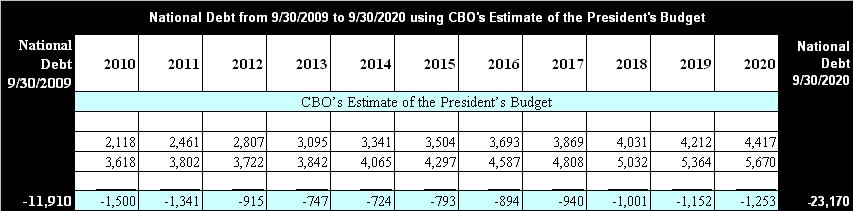
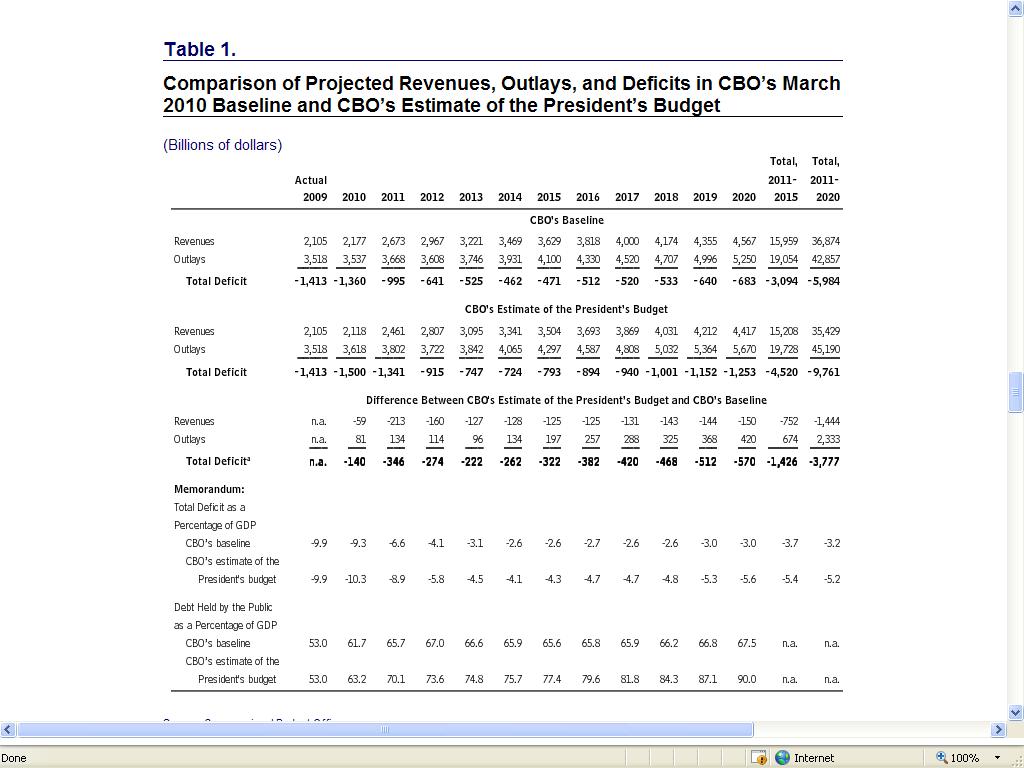
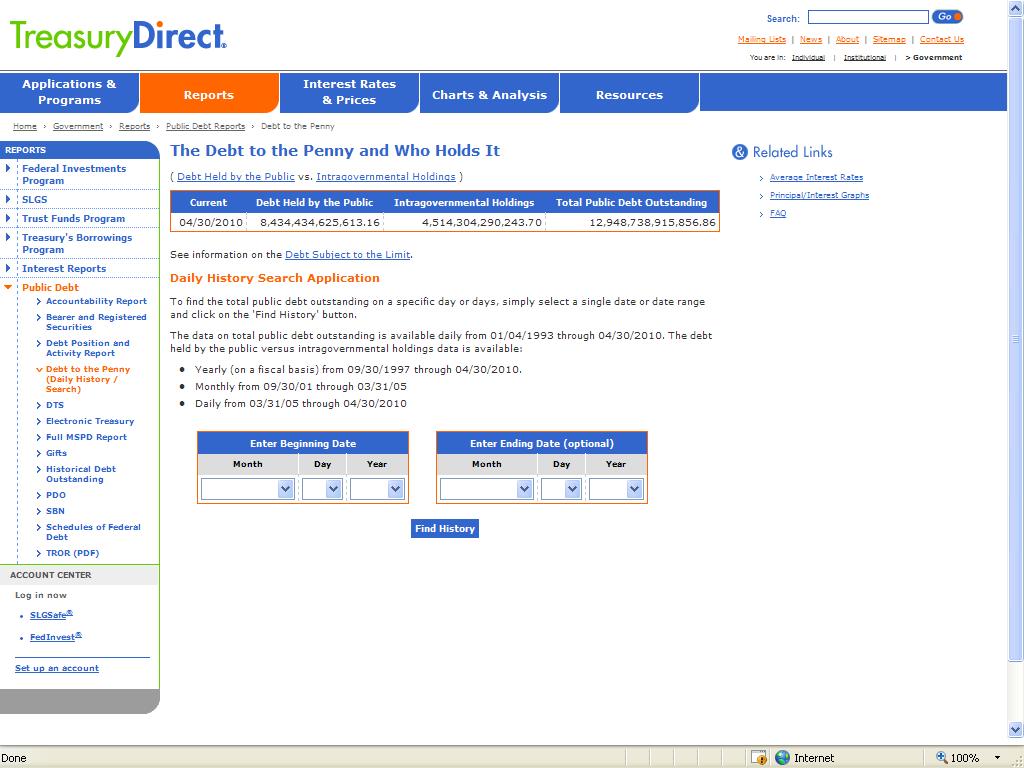
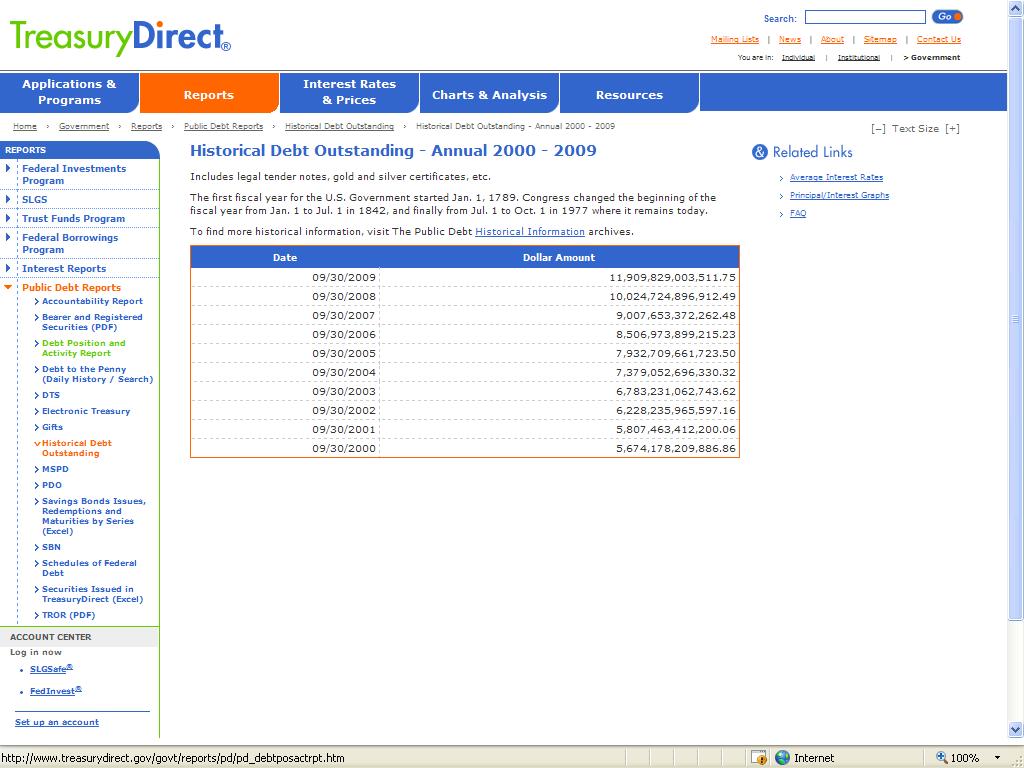
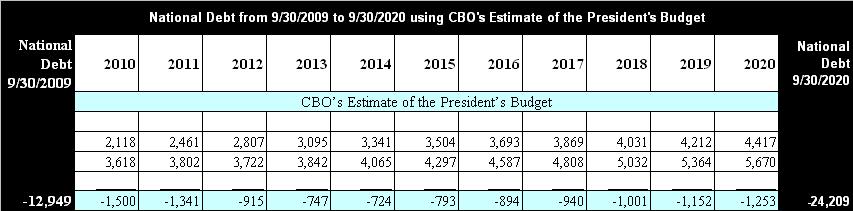
If we add the CBO’s 2010 to 2020 projected estimate of the president’s budget deficit to the current national debt of $12,948.7 billion (as of 4/30/2010), then the National Debt will total $23,170.0 billion by the year 2020.

click to enlarge

click to enlarge

click to enlarge

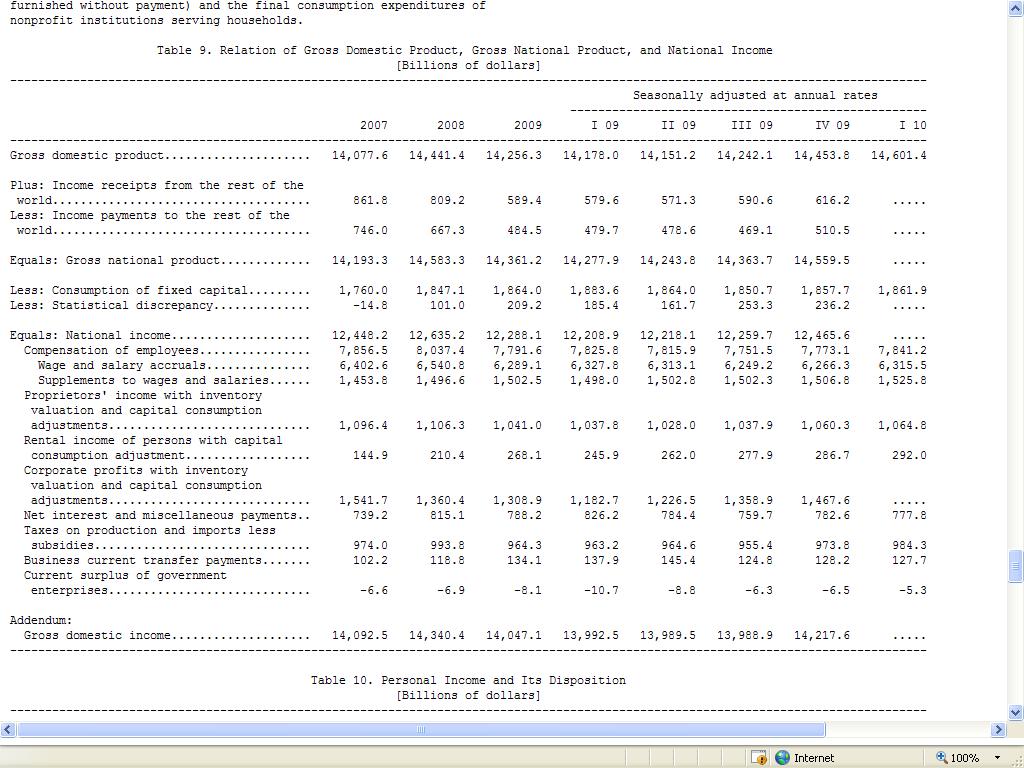
As of the end of the 1st quarter of 2010, based on the Bureau of Economic Analysis (BEA’s) latest preliminary estimate, GDP is averaging $14,601.4 billion annually.

click to enlarge

Depending upon the rate of growth of our economy over the next 11 years, our National Debt will exceed GDP, sooner or later. We know that even the Progressive’s say that our National Debt is unsustainable, but the question is just how unsustainable? If we take a look back to the days when our debt was sustainable and the economy was growing at roughly 5% per year with low unemployment, for example 2003, we will discover that our Debt to GDP ratio was 60.9%.

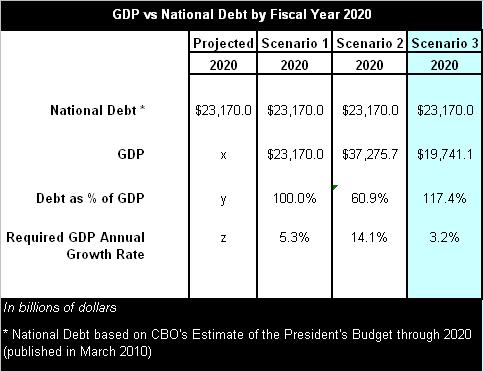
Scenario #1, below, determines the rate of growth necessary in order for GDP to match our projected debt by the year 2020. Scenario #2 determines the rate of growth needed in order to return to the 2003 debt-to-GDP ratio of 60.9%. Finally, Scenario #3 reveals what the debt-to-GDP ratio will be by 2020 if GDP maintains its current pace.

click to enlarge

Scenario #1 – The road to nowhere

GDP must grow from $14,601.4 to $23,170.0 billion in order to equal the National Debt by 2020. In other words, GDP must maintain an average sustained growth rate of 5.3% per year for the next 11 years, in order to achieve a Debt to GDP ratio of 100%. This represents ‘the road to nowhere’. Although, per the BEA, GDP grew at a rate of 3.2% in the first quarter of 2010, as you can see, this will not be enough to reach the destructive Progressive goal of a 100% debt-to-GDP ratio.

Scenario #2 – The way back to 2003

In order to return to the more prosperous 2003 Debt-to-GDP ratio of 60.9%, GDP must grow at a sustained annual rate of 14.1% for the next 11 years. In order to achieve such a rate of growth, our economy would have to grow at the pace of an emerging market, a feat which is clearly impossible for an industrialized nation. This is precisely why the president’s debt commission has stated publicly that, we will never grow our way out of this ‘man-made disaster’.

Scenario #3 – The Hellenistic toboggan slide

If GDP maintains its present annual growth rate of 3.2%, then by the year 2020 our debt-to-GDP ratio will reach 117.4%. Welcome to the Progressive Utopia. Welcome to the Republic of Greece.

Conclusion

The end of the Progressive trail leads to Greece. What you are seeing in Greece today is precisely where Progressive ideology will take us. Prepare for riots, violence, chaos, class warfare, and national bailouts. If that’s what you want, then support Barack Obama, and his Progressive entourage, and vehemently defend all of their policies. But, if this is not where you want to be in 2020, then identify and support true fiscal conservatives. Join with independents and moderates, and let’s elect responsible mainstream leaders who will lead us out of the wilderness, through sound fiscal policy, and free-enterprise solutions. It’s time to put the Progressives in their place: prison.

Sources:

http://www.bea.gov/newsreleases/national/gdp/2010/txt/gdp1q10_adv.txt

http://www.treasurydirect.gov/govt/reports/pd/histdebt/histdebt_histo5.htm

http://www.treasurydirect.gov/NP/BPDLogin?application=np

http://www.cbo.gov/ftpdocs/112xx/doc11231/frontmatter.shtml

click to enlarge

click to enlarge

Bail and Fail | Obama’s Bank Rescue Sham

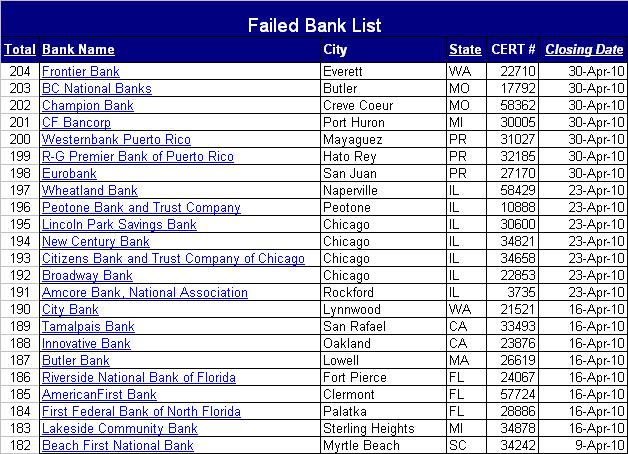
On Friday, April 30th, the FDIC reported 7 additional bank closings including three banks in Puerto Rico. It’s ironic that Congress passed a bill asking Puerto Rico if it wants statehood on the same day.

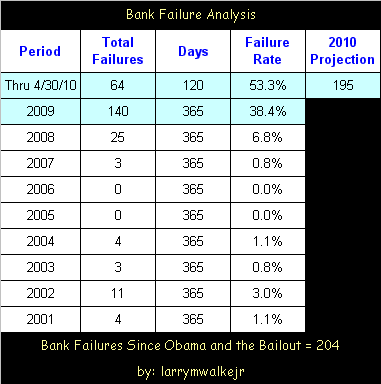
This brings the total number of bank failures under Obama to 204. The total number of bank failures in April was 23, and the year-to-date figure is 64. You can thank left-wing Progressives like Obama, Pelosi, Reid, and some on the right for the continued destruction and consolidation which is happening in the banking sector. I am now projecting that 195 banks will fail this year.

Meanwhile, approximately $370 billion of the $700 billion TARP fund sits on the sidelines, while troubled assets remain on many bank’s balance sheets dragging them under. Wasn’t that money supposed to be used to get rid of toxic assets? Well, if Progressives are going to sit idly by and watch banks fail, then they need to give us back our $370 billion. The other $330 billion appears to be a total loss. Obama and his Progressive entourage should claim it, cut their (our) losses, and prepare for defeat at the polls.

Remember that these are the same Progressives who hate banks and corporations and who will stop at nothing in their efforts to destroy our free enterprise system and turn America into a state run socialist utopia. They must be defeated.

click to enlarge

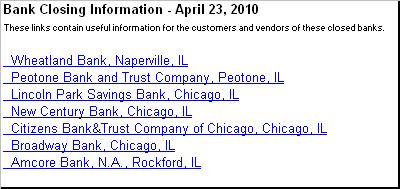
Below is a list of the 23 banks that failed in April of 2010.

click to enlarge

Below is a comprehensive listing of the 204 banks that have failed since Obama took the reigns. There were 25 bank failures in 2008, and 3 in 2007 making the total for the present crisis 232. In contrast, during the S&L Crisis of the 1980’s and 1990’s there were 747 S&L failures at a total cost of $160.1 billion.

click to enlarge

Source: http://www.fdic.gov/bank/individual/failed/banklist.html

Real Financial Reform, Part II | The Shawmut Redemption

The Shawmut Redemption…

Reforms that need reform…

Compiled by: Larry Walker, Jr. –

On November 16, 1993, the New York Times reported the following:

In a move showing banking regulators’ increased emphasis on ending loan discrimination, the Federal Reserve Board has, for the first time, blocked a large bank merger because of concern over possible bias against minority groups in mortgage lending.

By a 3-to-3 vote, with one abstention, the Fed declined to approve the Shawmut National Corporation’s acquisition of the New Dartmouth Bank of Manchester, N.H., because of concern that Shawmut, based in Hartford, may not have complied with fair-lending laws.

The Justice Department is investigating a Shawmut subsidiary, the Shawmut Mortgage Company, for possible lending bias…

“Obviously we’re disappointed with the decision,” said Brent Di Giorgio, a spokesman for Shawmut, which has $27 billion in assets. “Notwithstanding the decision, Shawmut is proud of its lending record to minorities.”

Over the last year Shawmut has begun several programs to increase lending to low-income Americans and minority groups that some community activists say have made Shawmut a leader in the industry.

These programs include establishing mortgages with down payments of as little as 2.5 percent that use more flexible income criteria, hiring more minority mortgage staff workers and sending around home buyers from minority groups to check that Shawmut employees are not discriminating.

“The Fed is sending a strong signal to the banking industry that they’re going to be looking at banks’ lending practices,” said Joseph Duwan, a banking analyst with Keefe, Bruyette & Woods. “Clearly Shawmut is being made a little bit of scapegoat.”

http://www.nytimes.com/1993/11/17/business/fed-stops-bank-merger-cites-lending-concerns.html

The End of Shawmut National

So what happened to Shawmut National Corporation? Two years after being extorted by the Federal government, in conjunction with various social justice organizations, the bank ceased to exist. Let’s follow the trail from the end of Shawmut, to the $700 billion dollar Federal Bank Bailout:

1995 – Fleet Financial Group, Inc. acquires Shawmut National Corp.

1996 – Fleet Financial Group Inc. acquires Westminster Bancorp

1999 – Fleet Financial Corp. acquires BostonBank Corp. and becomes FleetBoston Financial Corp.

2001 – FleetBoston Financial Corp. acquires Summit Bancorp.

2004 – Bank of America Corp. acquires FleetBoston Financial Corp. for $47 billion.

2005 – Bank of America acquires MBNA Corporation and becomes Bank of America Card Services for $35 billion.

2007 – Bank of America acquires LaSalle Bank for $21 billion.

2007 – Bank of America acquires US Trust and becomes Bank of America Private Wealth Management

2008 – Bank of America acquires Countrywide Financial for $4.1 billion and Merrill Lynch for $50 billion as part of the Bailout deal.

2009 – The Federal Government invests $45 billion of taxpayer’s money in Bank of America through the Troubled Asset Relief Program (TARP). Bank of America’s pays back the $45 billion along with $4.5 billion in dividends and fees.

http://en.wikipedia.org/wiki/List_of_bank_mergers_in_the_United_States

http://seekingalpha.com/article/60966-bofa-s-countrywide-acquisition-dumb-and-dumber

The Bailout

The Federal government’s solution was of course to create new agencies, more regulations, and to spend more borrowed money with the excuse that this time it will be different. Although it claims that it could make money as did off of Bank of America, so far, the US Treasury, Office of Financial Stability’s $700 billion bailout has, through 4/30/10, disbursed $517.1 billion, been repaid $186.9 billion, and is owed a balance of $330.2 billion.

http://bailout.propublica.org/main/list/index

1993 to 1995

So what happened in-between Shawmut National’s reprimand, the denial by the Fed to acquire other banks, and it’s ultimate demise?

William A. Niskanen, in his May/June 1995 Cato Policy Report, got it right when he stated that, “Redistributive rules among or between buyers and sellers, however, usually lead one or more parties to leave the market.” His reasoning was correct. His prediction was dead on. The arguments he posed way back then are worthy of repeating.

He said, “A market is where people come to make exchanges. Every market has its own rules, and markets thrive or wither, in part, depending on the choice of those rules. Clear rules for payment; the penalties for nonpayment, fraud, and nonperformance; and the rules for resolving disputes, for example, usually induce growth of the market, increasing the expected net benefit to each party. Redistributive rules among or between buyers and sellers, however, usually lead one or more parties to leave the market. U.S. financial markets today face several major new policy threats. Most of the new threats have a common pattern: the government is using existing regulatory authority or proposing new authority to aid some parties in the market at the expense of others.”

Mr. Niskanen continued, “Federal bank regulators and the Department of Justice have increasingly reinterpreted their authority under existing law to develop an extensive system of credit allocation. The four statutes under which bank regulations are issued are the Fair Housing Act of 1968, the Equal Credit Opportunity Act of 1974, the Home Mortgage Disclosure Act of 1975, and, most important, the Community Reinvestment Act of 1977. The common objective of those four laws was to reduce the alleged discrimination in bank lending to minorities. I say “alleged” because the premise that banks discriminate is both implausible and unsupported.”

With regard to Shawmut National Corporation, he continued, “In summary, there is no consistent evidence that banks discriminate among loan applicants by race, either consciously or inadvertently. In Washington, however, no good deed goes unpunished. Two major banks with records of outreach to minority borrowers have been subjected by the Department of Justice to what is best described as extortion. In a major 1993 case, following actions against three small banks, the Federal Reserve held up approval of several proposed acquisitions by Shawmut National Corporation pending resolution of a discrimination suit brought by Justice against Shawmut’s mortgage company subsidiary. The facts of the case are clear. During the period when the alleged discrimination occurred, Shawmut had an aggressive program to increase mortgage lending to minority applicants. Shawmut relaxed its normal lending criteria, substantially reduced the rejection rate on loan applications by minorities, and doubled the amount of new mortgage lending to minorities. Although no private person filed a discrimination complaint, the Department of Justice charged Shawmut with discrimination, based on findings that some of the loan officers had not been as aggressive as others in approving loans to minority applicants and that Shawmut had no internal review procedure to ensure that all the loan officers used the same lending criteria. In order to remove the barrier to approval of its proposed acquisitions, Shawmut agreed to settle that absurd case, set aside $1 million as a settlement fee, and worked with Justice to find some “victims” of the alleged discrimination to share the fee.”

http://www.cato.org/pubs/policy_report/pr-mj-ni.html

My Conclusion:

The chickens have come home to roost. The Progressives got what they wanted. Loans were made to people who should not have gotten them, who could not afford them, and who were bad credit risks in order to satisfy unreasonable government policies. In other words, the banks came up with whatever programs were necessary to ensure that anyone who applied for a loan got one. That took care of there ever being any question that a loan was denied based on racial discrimination. The banks used Option ARMs, no-doc, stated income or whatever it took to comply with the extortion. And what happened? The buck got passed. Banks were sold and acquired. Loans were packaged, sold and re-sold until they finally came back to their source, right smack in the government’s lap. The entire banking system nearly collapsed, and the Federal government came close to taking out the entire global economy. And it’s not over yet.

Have progressive politicians learned their lesson? Apparently not, as we see today, the progressives are trying to blame the crisis on those who simply carried out their warped policies. They are demonizing bank executives, Wall Street, Corporations, stock traders, and any and everyone who carried out their wishes. But it doesn’t take a degree from Harvard to figure out who’s really to blame. All one needs to do is look at how a progressive government manages itself. It is $13 trillion dollars in debt. Its trusted reserves of Social Security and Medicare have been emptied and left with IOU’s. And now it is heading towards $22 trillion of debt by the year 2020.

Obama had one thing right though, we do need to fundamentally transform the USA. However, that’s the only thing he got right. Policy-wise, he’s on the wrong track. He only offers to make a bad situation worse. Community organizers like Obama are part of the problem, not the solution. You cannot fix a problem when you are the problem. What America needs is a radical return to its founding principles of limited government, and free enterprise. We’ll know that we’re on the right track when every culpable progressive dimwit has been placed behind bars.

Real Financial Reform, Part I: The Option ARM

click to enlarge

Compiled by: Larry Walker, Jr.

While Progressives, both left and right, feign anger arguing the merits of criminalizing Goldman Sachs, one of the most profitable companies remaining in the United States, folks on Main Street are contemplating the real cause of the economic crisis of 2007. At least, that’s what I’m pondering.

For example, in reviewing the Office of Inspector General’s report regarding the fall of Downey Savings and Loan Association (Downey) it is clear to me that firms like Goldman Sachs were not the source of the problem. Punishing Goldman Sachs for profiting from a ‘crummy deal’ does not get to the root of the problem, nor will it prevent the next crisis. Where Senator Carl Levin fell short was in that, he failed to investigate the origination of the ‘crummy deals’ which continue to run rampant from coast to coast. But that’s what happens when you let amateur government workers have too much power.

_________________________________

Downey was taken over on November 21, 2008 by the FDIC at a cost of $1.4 billion. This placed it into the top ten most expensive institutions taken over by the FDIC during this crisis. It is revealing to note that in the report, we are told that the primary cause of Downey’s collapse was its high concentration of option adjustable rate (ARM) loans and its lack of documentation in loans:

“The primary causes of Downey’s failure were the thrift’s high concentrations in single-family residential loans which included concentrations in option adjustable rate mortgage (ARM) loans, reduced documentation loans, subprime loans, and loans with layered risk; inadequate risk-monitoring systems; the thrift’s unresponsiveness to OTS recommendations; and high turnover in the thrift’s management. These conditions were exacerbated by the drop in real estate values in Downey’s markets.”

The OTS made constant recommendations to the bank but of course, the OTS was stripped to the very minimum because of bank lobbying over the past decade. The policy implication here becomes radically clear that if we are to have a legitimate oversight board, it must have the power to enact regulations on the books. That is probably one thing many people fail to understand right now. Many of the regulations necessary are already on the books. Yet the bodies governing these policies are so weak and pathetic, that banks were able to ramrod legislation that essentially made them shells with no ability to enforce the laws.’

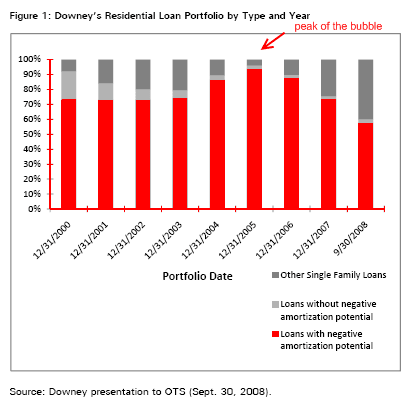
Downey by the end of 2005 at the height of the bubble had 91 percent of its single family home loan portfolio in option ARMs. They basically went 100 percent with this toxic product. 73 percent of Downey’s option ARMs had negative amortization potential which of course did occur and imploded the bank. Just take a look at this stunning chart:

As the chart shows, Downey was in the game early on. Thus, their recast of 5 years on their typical option ARM started imploding much earlier and led to their demise in 2008 even before the major wave of option ARMs will swarm the market in 2010 through 2012. The disturbing facts also come out regarding teaser introductory rates which artificially allowed people to buy more home than they could afford. With the availability of “no-doc” loans anyone with a desire to get a loan got one. The fact that 91 percent of their SFR loan portfolio is option ARMs is appalling. Institutions in California basically created a casino with housing even though agencies knew of the longer term implications. In regards to policy, this gives us clear implications:

  1. Do not bailout any mortgage product that is an option ARM.
  2. Government agencies overseeing these institutions must have teeth to act and stop companies before things get out of hand. Imagine the police with no power to enforce the laws on the book.
  3. Clearly these products had no life outside of the bubble. They should be labeled as such and any institutions engaging in these products goes forward at their own risk. No bailouts ever.

_________________________________

The bottom line, in Part I, is that Goldman Sachs was not in the loan origination business, and thus had nothing to do with the root cause of the financial crisis of 2007. Most of the culprits, banks who originated crummy deals, have already gone out of business. From January of 2009, through April 23rd of this year, there have been 197 bank failures. Of a certainty, there will be many more. The real questions should be (1) who legalized Option ARM’s?, and (2) who was responsible for regulating them? Try starting there and get back to me when you have a serious solution to a serious governmental failure.

Definitions:

Option ARMs
An “option ARM” is typically a 30-year ARM that initially offers the borrower four monthly payment options: a specified minimum payment, an interest-only payment, a 15-year fully amortizing payment, and a 30-year fully amortizing payment.

These types of loans are also called “pick-a-payment” or “pay-option” ARMs.

When a borrower makes a Pay-Option ARM payment that is less than the accruing interest, there is “negative amortization”, which means that the unpaid portion of the accruing interest is added to the outstanding principal balance. For example, if the borrower makes a minimum payment of $1,000 and the ARM has accrued monthly interest in arrears of $1,500, $500 will be added to the borrower’s loan balance. Moreover, the next month’s interest-only payment will be calculated using the new, higher principal balance.

Option ARMs are often offered with a very low teaser rate (often as low as 1%) which translates into very low minimum payments for the first year of the ARM. During boom times, lenders often underwrite borrowers based on mortgage payments that are below the fully amortizing payment level. This enables borrowers to qualify for a much larger loan (i.e., take on more debt) than would otherwise be possible. When evaluating an Option ARM, prudent borrowers will not focus on the teaser rate or initial payment level, but will consider the characteristics of the index, the size of the “mortgage margin” that is added to the index value, and the other terms of the ARM. Specifically, they need to consider the possibilities that (1) long-term interest rates go up; (2) their home may not appreciate or may even lose value or even (3) that both risks may materialize.

Option ARMs are best suited to sophisticated borrowers with growing incomes, particularly if their incomes fluctuate seasonally and they need the payment flexibility that such an ARM may provide. Sophisticated borrowers will carefully manage the level of negative amortization that they allow to accrue.

In this way, a borrower can control the main risk of an Option ARM, which is “payment shock”, when the negative amortization and other features of this product can trigger substantial payment increases in short periods of time.

The minimum payment on an Option ARM can jump dramatically if its unpaid principal balance hits the maximum limit on negative amortization (typically 110% to 125% of the original loan amount). If that happens, the next minimum monthly payment will be at a level that would fully amortize the ARM over its remaining term. In addition, Option ARMs typically have automatic “recast” dates (often every fifth year) when the payment is adjusted to get the ARM back on pace to amortize the ARM in full over its remaining term.

For example, a $200,000 ARM with a 110% “neg am” cap will typically adjust to a fully amortizing payment, based on the current fully-indexed interest rate and the remaining term of the loan, if negative amortization causes the loan balance to exceed $220,000. For a 125% recast, this will happen if the loan balance reaches $250,000.

Any loan that is allowed to generate negative amortization means that the borrower is reducing his equity in his home, which increases the chance that he won’t be able to sell it for enough to repay the loan. Declining property values would exacerbate this risk.

Option ARMs may also be available as “hybrids,” with longer fixed-rate periods. These products would not be likely to have low teaser rates. As a result, such ARMs mitigate the possibility of negative amortization, and would likely not appeal to borrowers seeking an “affordability” product.

References/Sources:

My Budget 360

Obama’s Scattershot: Works without Faith

By: Larry the Tishbite :

Definition: Scattershot – covering a wide range in a haphazard way (indiscriminating, undiscriminating – not discriminating)

Obama’s philosophy – Tell the people what they want to hear. Make it sound fabulous. Bend and stretch the truth when necessary. Convince the masses that everyone should agree with him. Demonize any opposing view points, because no one else could possibly have a solution. Make a broad range of neo-reforms and hope that something sticks. Because, after all, progress means getting stuff done, whether it’s the right stuff or not is irrelevant.

First, there was the financial bailout which was meant to save us from “the worst financial crisis since the seven year famine of Genesis 41:54“. [Boy am I tired of hearing that line.] The fact that, from the time Obama took over through April 23rd of this year, 197 banks have failed, including the 7 Illinois banks that failed on that day, is not even mentioned. Instead of admitting failure and going back to the drawing board, Obama, and his worshipers, continue to blame the ‘too big to fail’ entities for the crisis of 2008, and seek ways to prevent ‘that crisis’ from ever happening again. It seems like progress, but Obama is actually ignoring the fact that the original problem has yet to be resolved. When things seem to be improving, Obama will take credit, and when the situation worsens, Obama will blame the seers, bloggers, or anyone other than himself, or his policies.

Then there was the famous economic stimulus which was going to cap the unemployment rate at 8% and add 2 million and some-odd jobs in short order. Well, since that didn’t happen, Obama came up with a new measurement: ‘jobs created or saved’. Thus, if you saved one job you somehow could claim to have created six, or some nonsense. Once again, instead of admitting defeat and going back to square one, the obamanists, claimed victory and now say everything is fine. (That reminds me of the true definition of F.I.N.E.) Never mind the fact that the published unemployment rate was 10.2% at the end of March of 2010 and much higher if you count all of those who have permanently left the workforce. As is his custom, if the latest statistics seem favorable, Obama will take credit, and if things are not looking favorable, he will blame bloggers, Glenn Beck, Fox News or anyone other than himself or his socialist entourage.

And last but not least, there was Obamacare which was supposed to reduce deficit spending by $138 billion in the first decade, and then knock off another $1.2 trillion long after Obama could possibly be in office. Well for one thing, it looks like there may not be any savings in the first decade, and Obamacare may actually add to the deficit. But then there’s the real catch-22: How can one have the audacity to claim that Obamacare will reduce deficit spending by $138 billion during the same decade that deficit spending is actually being increased by more than $10 trillion? Maybe it’s just me, but that doesn’t equal any kind of savings whatsoever. If I put $1,000 in my savings account this year, but actually wind up adding $10,000 of credit card debt, am I not really worse off by $9,000? I think so.

I could name dozens of other Obama policies that follow the same pattern. Whether it’s nuclear defense, foreign policy, education, financial reform, climate change, energy, you name it, it’s just one big scattershot. The story is the same. Shoot a scattershot and hope that something sticks, take credit for any positive outcomes, pass blame for any negative results.

Oh, and then there’s that little quirk regarding the fact that the greatest benefits of any Obama policy don’t occur until long after he has been expelled from office. What’s up with that? That’s a neat way to CYA when none of your plans make any sense, and when everyone knows it. That way, Obama can blame the next administration for repealing his mistakes prematurely. In the end, this will only work to ensure that Obama goes down in history as the worst president since James Earl Carter.

I have made a few costly mistakes in my life, and I learned some valuable lessons. It never helped to sit around blaming everyone else for my mistakes, and I didn’t need some 3rd party changing the rules to prevent me from making the same mistake. I messed up, I paid the price, and I will never make those same mistakes again. I have also learned that the scattershot technique doesn’t work. I have learned to focus my energies on my personal areas of expertise, and to promptly concede what I don’t know.

In my world, we slay one dragon at a time. In Obama’s world, he seems to slay his own credibility one policy at a time.

The seven years of plenty ended in July of 2007.

29 There will be seven years of great plenty in all the land of Egypt. 30 After that, there will be seven years of famine, and all the good years will be forgotten, because the famine will ruin the country. 31 The time of plenty will be entirely forgotten, because the famine which follows will be so terrible. 32 The repetition of your dream means that the matter is fixed by God and that he will make it happen in the near future. 33 “Now you should choose some man with wisdom and insight and put him in charge of the country. 34 You must also appoint other officials and take a fifth of the crops during the seven years of plenty. 35 Order them to collect all the food during the good years that are coming, and give them authority to store up grain in the cities and guard it. 36 The food will be a reserve supply for the country during the seven years of famine which are going to come on Egypt. In this way the people will not starve.” 37 The king and his officials approved this plan,…

Obama’s Bank Failures | Too Busy To Care

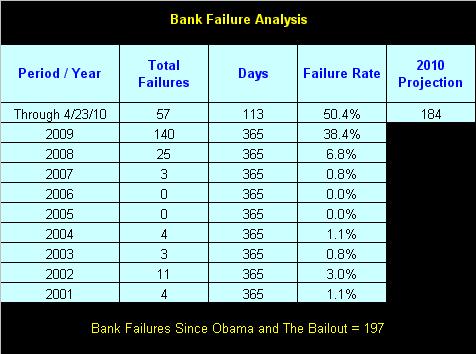
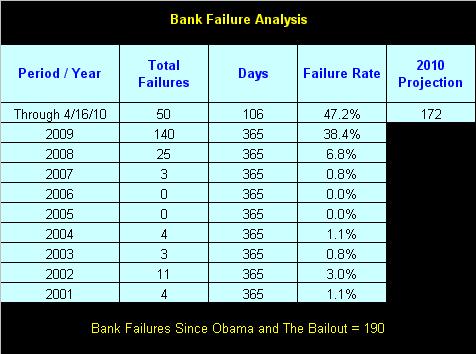
Through April 23, 2010, there have been 57 bank failures. That’s 57 in 113 days, or a failure rate of 50.4%. In 2009 there were 140 bank failures at a failure rate of 38.4%. So it’s been more than a year since the problem was ‘solved’, and the rate of bank failures has actually increased. In contrast, there were only 25 bank failures in 2008, 3 in 2007, none in 2005 or 2006, and only 22 from 2001 through 2004.

Wow, seven banks in his own back yard. We’ll see if he cares now, or whether he maintains the ‘quo’. Perhaps another round of golf is the cure!

Obama says he wants “…to get a better idea of what our options are…”. Well, here you go: (1) Crash and Burn, (2) Drastically Cut Government Borrowing and Spending, or (3) Burn and Crash. It’s not rocket science. Make an executive decision.

Reference:

FDIC Failed Bank List

Obama’s Bank Failures | Too Little to Save

By: Larry Walker, Jr.

After decades of failed government policies, from James Earl Carter, Jr. (Jimmy), to Barack Hussein Obama, II (Barry), it appears that policy makers haven’t learned a thing. After pouring billions of taxpayer dollars down the drain to fix the credit crisis, over a year has passed, and the problem isn’t fixed. While Obama and his minions now focus on controlling the Big financial institutions, the little guys, like the ones in your community are failing at the rate of one every other day.

And what is Obama’s solution to the destruction of capital occurring in our communities?

  1. To Add more than $10 trillion to the National Debt over the next 10 years, thus hogging up capital badly needed by community banks, and leading to higher interest rates.

  2. To tell citizens that they should be grateful, to him, that they got a $400 annual tax credit, paid for by higher taxes, and to just be quiet. – ‘Don’t patronize me.’

  3. To dole out $8,000, and $6,500 refundable home buyer tax credits, not realizing that it’s actually very difficult to get a home loan from failing banks. Not to mention impossible for the 10-20% of the workforce who are unemployed.

  4. To extend unemployment benefits, which doesn’t lead to job creation.

  5. To sit back, give an occasional pep rally to his constituency, make deals with America’s enemies, and alienate fellow Americans who have the solution.

In other words, he doesn’t have a solution. The only solution that a problem can have is to eliminate itself. Obama and his big government, ‘welfare state’ philosophy is the current problem. The only solution is to eliminate the problem. Everyday that Obama borrows and spends, borrows and spends, borrows and spends, pushes us that much farther from a solution, and thrusts us deeper and deeper into the problem.

Through April 16, 2010, there have been 50 bank failures. That’s 50 in 106 days, or a failure rate of 47.2%. In 2009 there were 140 bank failures at a failure rate of 38.4%. So it’s been more than a year since the problem was ‘solved’, and the rate of bank failures has actually increased. In contrast, there were only 25 bank failures in 2008, 3 in 2007, none in 2005 or 2006, and only 22 from 2001 through 2004.

click to enlarge
Failed Bank List - Click to Enlarge

References: FDIC Failed Bank List

Final: Obamacare | The Macro View

The Endgame

Catch 22 –

By: Larry Walker, Jr. –

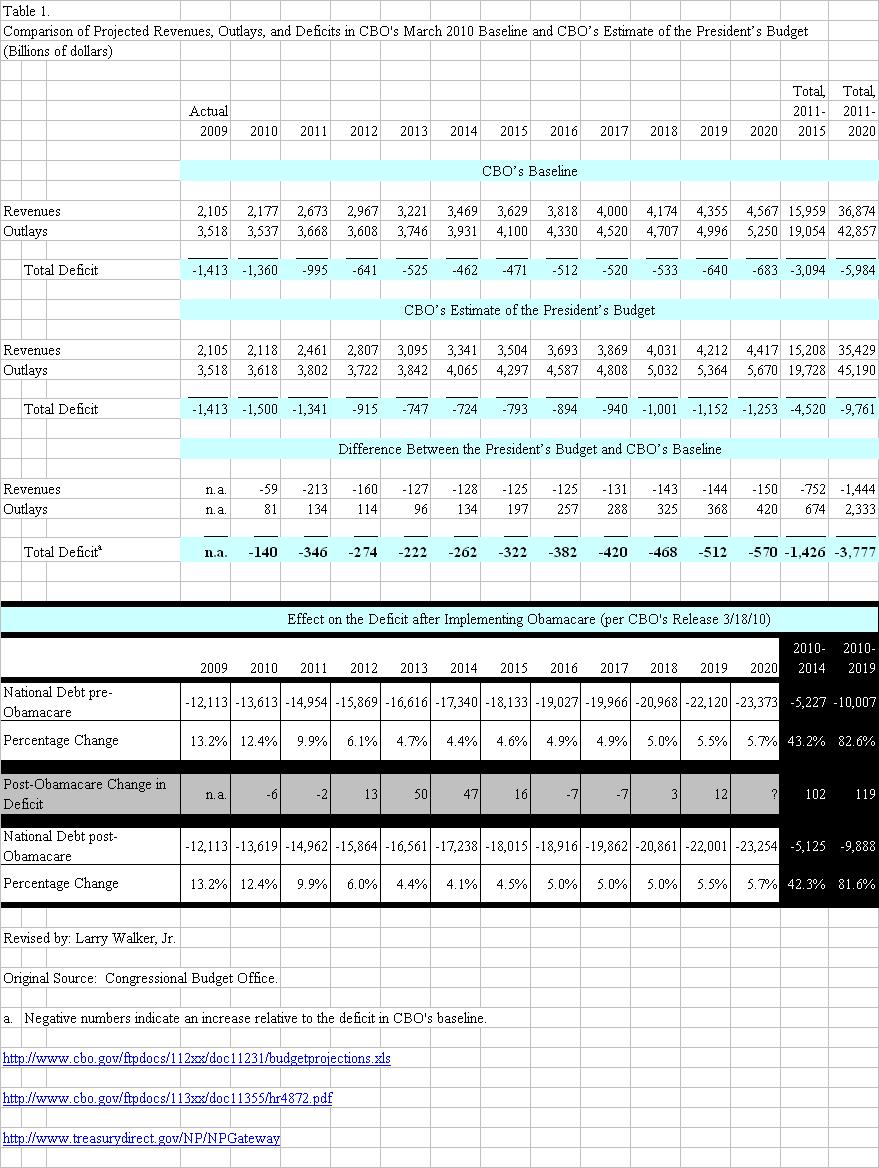
Point #1 – As I pointed out previously here, and as you can see in the top portion of the table below, Mr. Obama has outlined a budget which contains deficit spending of $-3.7 trillion more than the CBO’s Baseline Budget, between the years 2011 and 2020. The CBO’s Baseline Budget was already $-5.9 trillion in the red for the budget years 2011 through 2020. If you start with fiscal year 2010, the CBO’s Baseline Budget deficit was already $-7.3 trillion. The CBO’s estimate of the President’s budget calls for total deficit spending of $-11.2 trillion beginning with fiscal year 2010 and ending in fiscal year 2020. (Note: The baseline budget total is for 2011-2020, so you have to add 2010 to get this figure.) Now if you add the President’s budget deficit of $-11.2 trillion to our National Debt which was $-12.1 trillion at the end of 2009, then the national debt will reach $-23.3 trillion by the year 2020.

Table 1 - Click to Enlarge

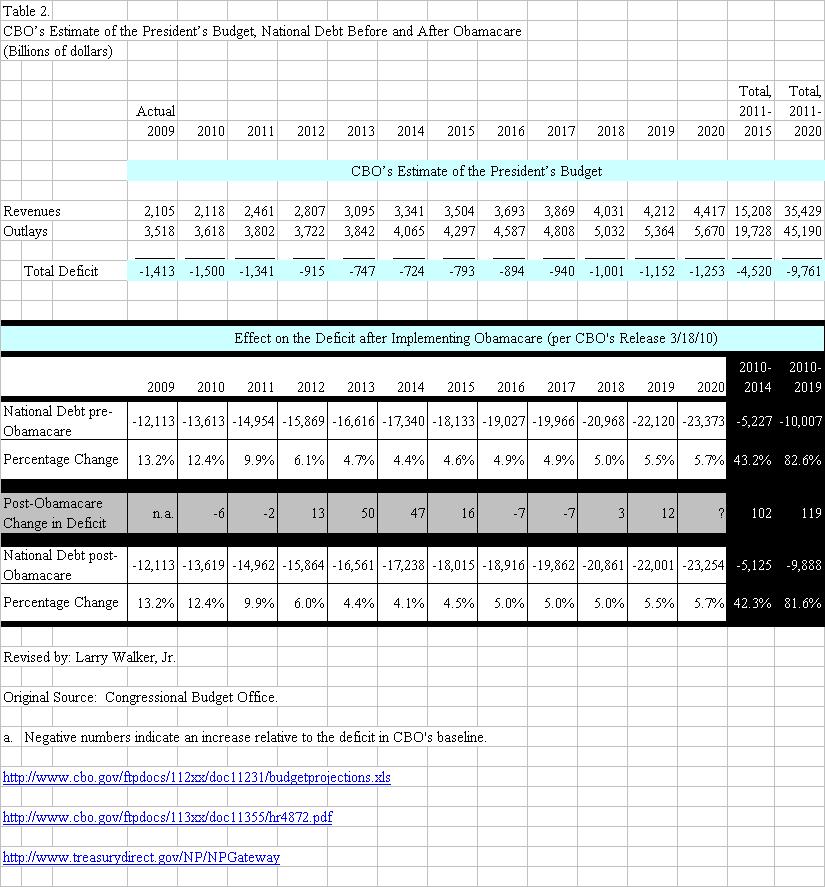
Point #2 – You will note in the bottom half of the table above (re-posted below), that the National Debt, which was $-12.11 trillion at the end of 2009, is projected to grow to $-22.12 trillion by the year 2019. (Note: The totals on this table end with fiscal year 2019 to correspond with the scoring of Obamacare.) This represents a percentage increase of 82.6% over the 10 year period. So before Obamacare, the President was already on target to increase our National Debt by 82.6% over the present decade.

Point #3 – Also in the table below, you will note that after implementing Obamacare, if one adds in the savings projected by the CBO of $119 billion over the first decade, then the National Debt is projected to grow to just $-22.00 trillion, or a percentage increase of 81.6% over the decade. This means that Obamacare will decrease the rate of growth of the national debt by just 1.0% in the first decade (82.6% vs 81.6%). In other words, by the year 2019, the National Debt will either be $-22.00 trillion with Obamacare, or $-22.12 trillion without it. (Note: I omitted the other $19 billion of savings which the CBO projected because I do not believe it to be attributable to Obamacare, however this is diminimus.)

Table 2 - Click to Enlarge

Point #4 – You will note that the CBO projects the savings from Obamacare to be $102 billion over the first five years, and only $17 billion over the second five, for a total of $119 billion in the first decade. The greatest savings appear in the years 2013 and 2014, $50 billion and $47 billion respectively. Why would anyone believe that there would suddenly be savings of over $1 trillion in the second decade, when the rate of savings decreases so dramatically in just the second five year period? If you study the numbers closely, the rate of savings from Obamacare declines by 83% from the first five years to the second. Yet, we are expected to believe that the rate of savings will suddenly jump by 740% (to over $1 trillion) during the second decade. This is simply unrealistic. Not to mention, unreliable, because the CBO calculated the savings rate in the second decade as a percentage of GDP. What we don’t have from the CBO is a projection of the Federal Budget that far out. If budget deficits continue to soar during the second decade after Obamacare, then any savings projected will be nullified.

Point # 5 – With government spending so out of control – with the national debt projected to grow to either $-22.12 trillion without, or $-22.00 trillion with Obamacare by 2019 – with the national debt projected to grow by either 82.6% without Obamacare, or 81.6% with it – it’s as if Obama and his Progressive colleagues have chosen to stick their heads in the sand, and to ignore the problem. The problem being the inability to pay for current federal programs. They are giddy and claiming victory because they think they have finally come up with a deficit neutral program, but what have they really done?

What have they done? – The term ‘deficit neutral’ implies that a program is implemented in a way that will not add to the deficit. But what does it mean for us as relates to Obamacare? What does it mean when government spending is already out of control? It means that the government will raise around $500 billion in new taxes, fees and fines in order to pay for a new entitlement program, Obamacare. It’s one thing to raise revenues in order to begin to balance the existing budget, but entirely another to ignore the debt, and to take more money out of our pockets for a new program. Meanwhile, the National Debt continues to grow at essentially the same rate.

Obamacare solves nothing. By the year 2020, the national debt will be nearly twice the amount of our current GDP. If we don’t take the debt crisis seriously, then by the year 2020 there will be no Obamacare, no Social Security, no Medicare, no Education, no Defense, and possibly not even a United States of America. Obamacare and its sister entitlement programs are not the solution to our problems, Obamacare and its sister entitlement programs are the problem.

Sources:
http://www.treasurydirect.gov/NP/NPGateway
http://www.cbo.gov/ftpdocs/113xx/doc11355/hr4872.pdf
http://www.cbo.gov/ftpdocs/112xx/doc11231/budgetprojections.xls
Obamacare: A Fiscal Point of View Updated!