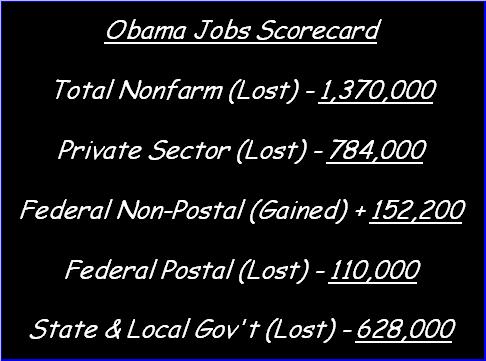
Obama Jobs Scorecard, Part 2 : Beyond the Private Sector

“He might as well have said that his stimulus plan would provide a temporary fix and a temporary economic recovery, which may have to be repeated over and over again to provide the impression that we are getting somewhere, even if we are really just going broke.”

* By: Larry Walker, Jr. *

The Great Recession lasted for a total of 19 months, beginning in December 2007 and ending in June 2009. So the U.S. economy has technically been in a state of recovery for exactly three years. Yet, other than the federal government, which has realized a net gain of 234,300 non-postal employees, since the recession began, the rest of the economy is worse off today than it was on the day Barack Obama was sworn in.

We addressed the Private Sector in Part 1. Today we’ll examine Total Nonfarm Employment, which includes the Private Sector, the Federal government, and State & Local governments, in order to assess our economic progress, since Barack Obama promised to deliver “a new foundation for our lasting economic growth and prosperity”.

Government Sector

The chart below summarizes the Government employment situation since the start of the Great Recession. The figures come from the Bureau of Labor Statistics, Table B-1 – Establishment Data. The main highlights are outlined below the chart.
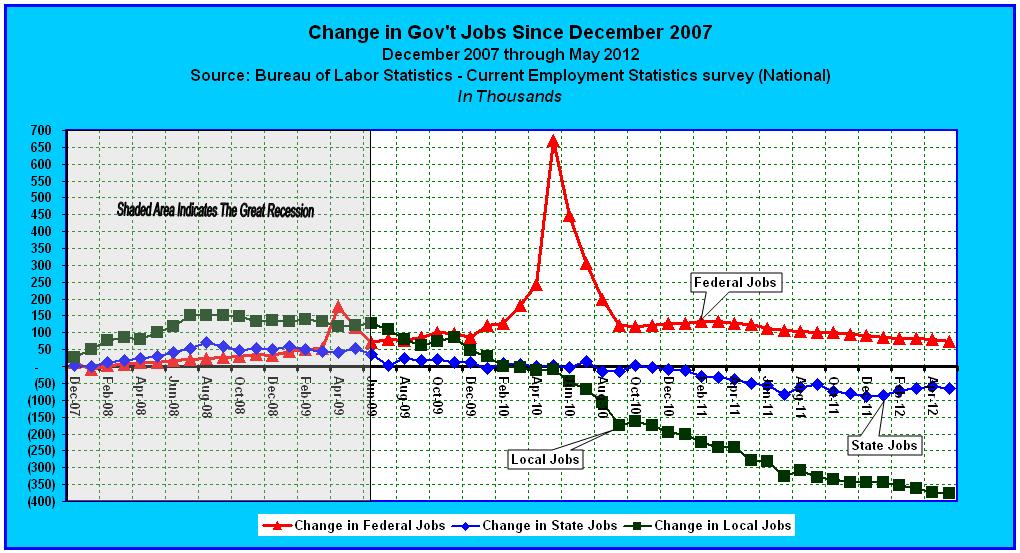
  1. The number of Federal government employees has increased by +75,000 from December 2007 through May of 2012. The federal government is the only sector of the economy with a net employment gain since the recession began. (Note: The huge spike represents temporary hiring by the U.S. Census Bureau.)

    1. Federal jobs grew by +33,000 during the last 13 months of President Bush’s term.

    1. Federal jobs have grown by an additional +42,000 during Barack Obama’s 41-month term.

    1. Non-postal workers increased by +234,300 [+82,100 during Bush’s last 13 months, and +152,200 during Obama’s 41-month term to-date].

    1. Postal workers decreased by -158,500 [-48,500 during Bush’s last 13 months, and -110,000 during Obama’s first 41 months].

  1. The number of State government employees has declined by -64,000 since December of 2007.

    1. State government jobs actually grew by +52,000 during the last 13 months of President Bush’s term.

    1. State government jobs have declined by -116,000 during Obama’s 41-month term to-date.

  1. The number of Local government employees has declined by -376,000 since the start of the Great Recession.

    1. Local government jobs continued to increase by +136,000 during the last 13 months of President Bush’s term.

    1. Local government jobs have since declined by -512,000 under the policies of Barack Obama.

Overall, the Government Sector has suffered a net loss of 365,000 jobs since the start of the Great Recession. But it’s important to note that 221,000 jobs were gained during President Bush’s final 13 months in office, while 586,000 jobs have been lost during Barack Obama’s 41-month term to-date. Digging a little deeper, we find that, since the baton was passed to Obama, 628,000 State and Local government jobs have been lost, while 42,000 Federal jobs were gained. Since government employment did not decline during the 19 months comprising the Great Recession, nor during President Bush’s term, who’s to blame for the decline?

You would think that a decline in the number of State & Local government workers is a good thing, but Barack Obama doesn’t think so. He has thus proffered more government borrowing and spending to fix the alleged problem. But as I pointed out previously, and it’s only common sense, even if the Federal government handed State and Local governments $1.0 trillion to rehire all 628,000 workers, whom they can obviously no longer afford, they will find themselves dumbfounded when the taxpayer funded handout expires.

Thus far, all of Barack Obama’s economic proposals have been temporary fixes, one after another. But the barrage of temporary measures hardly lines up with his 2009 rhetorical promise, that his stimulus plan would ‘lay a new foundation for our lasting economic growth and prosperity’. It’s been three and a half years, and he still doesn’t seem to understand that government stimulus is by its very definition, temporary. He might as well have said that his stimulus plan would provide a temporary fix and a temporary economic recovery, which may have to be repeated over and over again to provide the impression that we are getting somewhere, even if we are really just going broke.

Total Nonfarm Jobs

In Part 1, we discovered that a total of 3,735,000 Private Sector jobs were lost during the first 13 months of the Great Recession, and that an additional 784,000 have been lost since Barack Obama promised that his stimulus plan would, save or create more than 3.5 million jobs by January of 2011’. But now, as we factor in the number of government sector jobs gained or lost since the recession began, we discover the following facts.

  1. Total Nonfarm jobs declined by 3,514,000 during the last 13 months of President Bush’s term.

  2. Total Nonfarm jobs have declined by an additional 1,370,000 during Barack Obama’s 41-month term to-date.
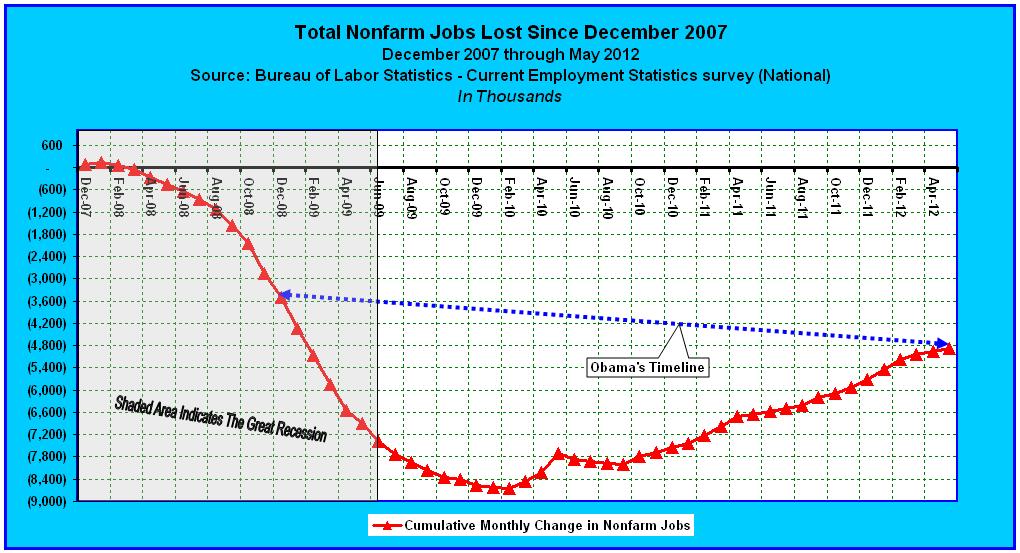
Overall, the U.S. economy has lost a total of 4,884,000 nonfarm jobs since December of 2007. Among them, 1,370,000 have been lost since Barack Obama was sworn into office. So his claim, that we have created 4.3 million jobs over the last 27 months, is wishful thinking. In reality, we lost 5,135,000 nonfarm jobs during his first 14 months in office. Do the math. The facts speak for themselves. And although the Federal government has gained 234,300 new non-postal workers, 152,200 of which are attributable to Mr. Obama, we haven’t created a single net job in the last 54 months. The chart above summarizes where we are statically, but as we shall see, the real employment situation is far worse.

That’s the end of Part 2, but it’s still not the end of the story. In Part 3 we’ll discuss how the increase in the Working-Age Population, since December 2007, in conjunction with a decline in the Labor Force Participation Rate, has made the real employment situation far worse than it appears, placing the American Dream in jeopardy.

To be continued… Obama Jobs Scorecard, Part 3 : The American Dream

Continued from… Obama Jobs Scorecard, Part 1 : The Private Sector
Obama Jobs Scorecard, Part 1 : The Private Sector
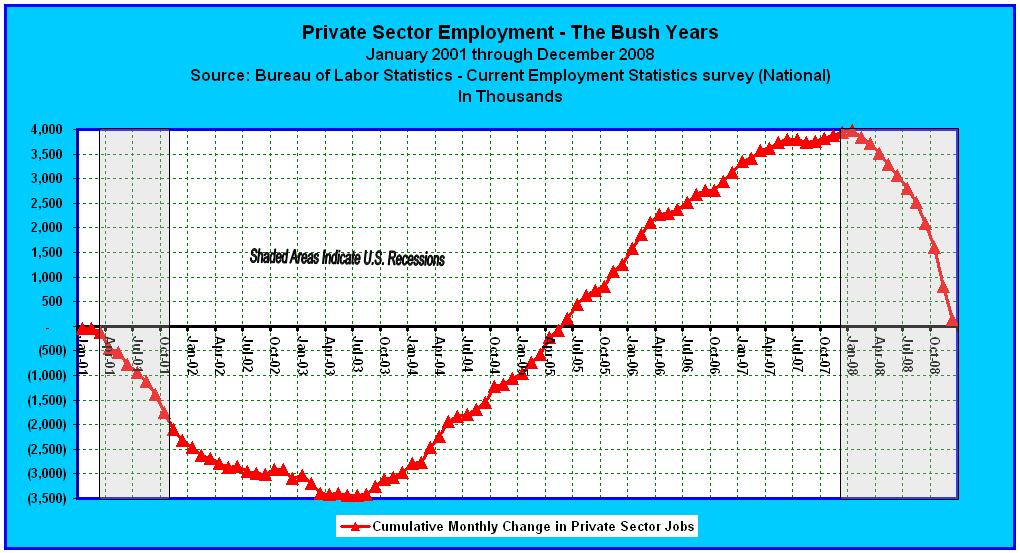
According to Barack Obama, “We’ve created 4.3 million new jobs over the last 27 months, over 800,000 just this year alone. The private sector is doing fine.” But what he failed to mention is what any American paying attention already knows, that we lost 5.0 million jobs during the first 14 months of his 41-month term.

* By: Larry Walker, Jr. *

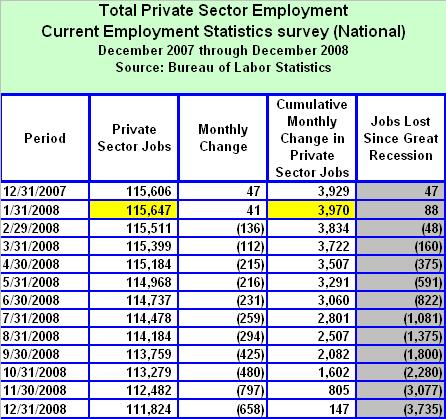
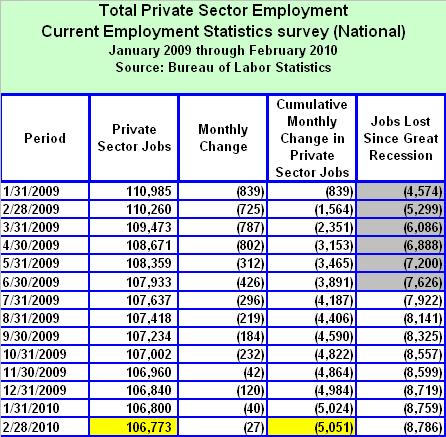
Using simple math, it doesn’t take much for any American to figure out that Mr. Obama has been in office for a total of 41 months. Curiosity leads us to believe that there must be some reason Mr. Obama isn’t saying anything about his first 14 months in office. So here’s what we found. By the time Mr. Obama reached the White House, the private sector had already lost 3.7 million jobs to the Great Recession. Then between January of 2009 and February of 2010, his first 14 months in office, another 5.0 million jobs were lost. And finally, over the last 27 months, 4.3 million jobs were either created or saved. Once again simple math leads us to the conclusion that the private sector is worse off today than before Mr. Obama was sworn in, by roughly 700,000 jobs.

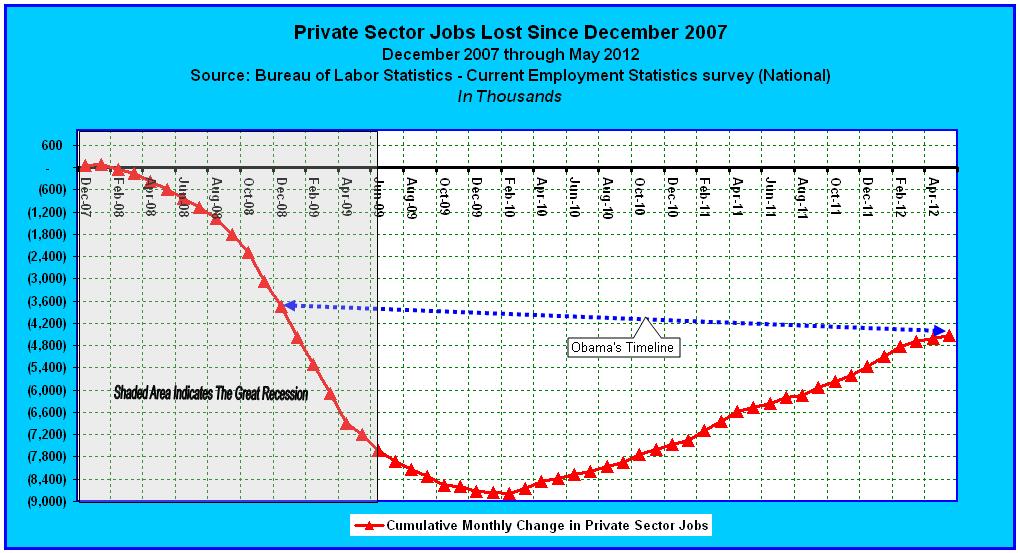
Over George W. Bush’s eight-year term, the economy went through two recessions. The first was much shorter than the second, lasting only nine months, from March of 2001 to November of 2001. But the Great Recession lasted for a period of 19 months, commencing in December of 2007 and not ending until June of 2009, six months into Mr. Obama’s term. However, in the month after the Great Recession began, the number of private sector jobs reached an all-time record high of 115,647,000. In fact, when we summed together all private sector employment gains and losses during Mr. Bush’s time in office, it resulted in a net gain of 3,970,000 jobs through January of 2008. But once the recession heated up, from its beginning until the baton was passed to Barack Obama in January of 2009, a total of 3,735,000 of this net gain had been wiped out. As a result, the number of net jobs gained during the Bush presidency was a paltry 147,000 (see chart above, and table below).

Obama’s First 14 Months

In January of 2009, Barack Obama stepped in to rescue us from the disaster of 2008. His stimulus plan was passed by both houses of Congress on February 14, 2009. At the time, Mr. Obama delivered the following statement. “Congress has passed my economic recovery plan – an ambitious plan at a time we badly need it. It will save or create more than 3.5 million jobs over the next two years, ignite spending by business and consumers alike, and lay a new foundation for our lasting economic growth and prosperity. But the promises he made on that day would soon come back to bite him.

Obama’s economic team calculated that without the stimulus plan, the economy would lose another 1,613,000 jobs over the ensuing two-year period. But with passage of the stimulus bill, they claimed that not only would those 1,613,000 jobs be saved, but an additional 1,887,000 would be created, all by January of 2011. But as you can see in the table below, Mr. Obama’s economic team was way off the mark. By February of 2010, just one year later, an additional 5,051,000 private sector jobs were lost. This brought the total number of jobs lost from the beginning of the Great Recession to 8,786,000. Fortunately, this turned out to be the end of the decline.

Obama’s Broken Promises

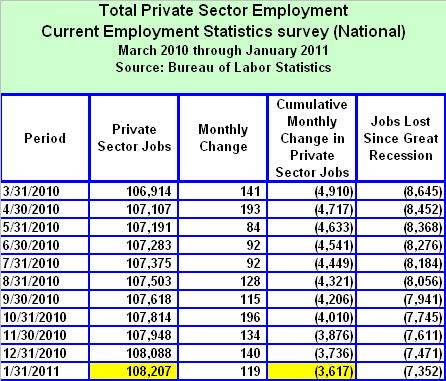
By January of 2011 it was time to tally the results of Mr. Obama’s $831 billion stimulus plan. As the next table reveals, instead of saving 1,613,000 jobs and creating another 1,887,000, from the beginning of his term through January of 2011 the private sector had instead lost a net total of 3,617,000 jobs. This brought the total number of private sector jobs lost since the beginning of the Great Recession to 7,352,000.

Since the recession had already wiped out 3,735,000 private sector jobs before Mr. Obama came along, if his plan had worked as promised, then the number of jobs lost to the recession should have been reduced to 1,848,000 by January of 2011. But instead this number rose to 7,352,000. In other words, if 1,613,000 jobs were expected to be lost and saved over his first 25 months, then there should not have been any losses at all. And since we were already 3,735,000 jobs in the red before Mr. Obama’s time, if the private sector had created 1.887,000 jobs as promised, then by his 25th month we should have only been off target by 1,848,000 jobs (3,735,000 minus 1,887,000). Thus, the stimulus plan failed miserably. When Barack Obama was sworn in, he inherited an economy that was 3,735,000 jobs in the hole, but after two years of his policies, and $831 billion tax dollars squandered on his stimulus plan, the private sector lost an additional 3,617,000 jobs.

Are we there yet?

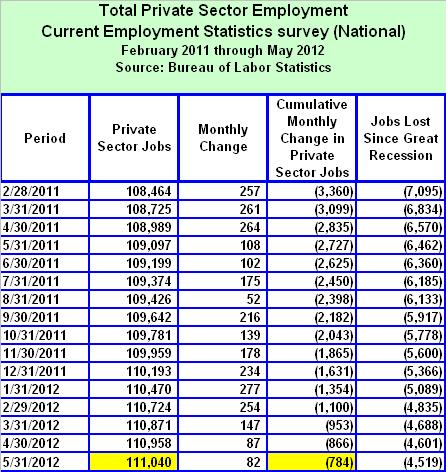
Skipping ahead to May of 2012, we find that since the time of Mr. Obama’s inauguration, the private sector has lost a total of 784,000 private sector jobs, for an average loss of 19,122 jobs per month. This is in addition to the 3,735,000 lost under Mr. Bush, for a cumulative loss of 4,519,000 jobs since the beginning of the Great Recession (see table below). In other words, the private sector is worse off today than it was on the day Barack Obama was sworn into office. And if you will, not only is the private sector worse off than it was three years and five months ago, the Federal government has taken on an additional $5.3 trillion in debt just to get us where we are – nowhere.

The total number of private sector jobs lost, since the beginning of the Great Recession, is shown graphically in the chart below. In spite of his repetitious rhetoric, and no matter how many times he boasts that his policies have “created 4.3 million private sector jobs over the last 27 months,” the truth is that not one private sector job has been created since the beginning of Barack Obama’s 41-month term.

The Bottom Line: No one likes to discuss Mr. Obama’s initial 14 months in office, but it will nevertheless go down in history as a part of his record. The truth is that over his first 14 months the private sector lost 5,051,000 jobs. Then during his last 27 months it recovered 4,267,000 of the jobs lost during his first 14 months. So it was only after suffering far worse job losses under the influence of Mr. Obama than we started with, that the private sector was able to recover 4,267,000 of the 5,051,000 jobs lost during his 41-month term. So where is the private sector today? We are still down by the same 3,735,000 jobs lost to the Great Recession before Mr. Obama arrived, plus an additional 784,000 lost during his 41-month term to-date. Yet, Mr. Obama seems to think that the private sector is doing fine, and that for some reason he deserves a second shot. Sorry pal, but we don’t have another $5.3 trillion to throw away.

That’s the end of Part 1, but it’s not the end of the story. In Part 2 we’ll tack on the total number of Government sector jobs, Federal, State and Local, lost over Mr. Obama’s 41-month term. Then we’ll discuss how the 8.2 million person increase in the Working-Age Population, during Mr. Obama’s term, has made the real employment situation far worse than it appears to a casual observer.

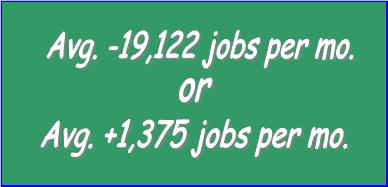
Note: Some economists and pundits will attribute the 839,000 jobs lost in January of 2009, Mr. Obama’s first month in office, to Mr. Bush. If you insist on doing so, then that would mean that the total number of private sector jobs gained over Mr. Obama’s 40-month term would be 55,000 (i.e. 839,000 minus 784,000). However, the number of jobs lost since the beginning of the Great Recession is unchanged, at 4,519,000. But before you start boasting about how Barack Obama added 55,000 private sector jobs over his 40-month term, you might want to consider whether a job creation record averaging just 1,375 jobs per month is worth the effort.

To be continued… Obama Jobs Scorecard, Part 2 : Beyond the Private Sector

The Private Sector is NOT Doing Fine | How’s the Federal Government Doing?
* By: Larry Walker, Jr. *

“The Private Sector is doing fine.” ~ Barack Obama *
A couple days ago, Joe Weisenthal wrote an article, inappropriately entitled, “Here’s What’s Really Happened to the Private Sector Under Obama”, in which he sought to prove why Mr. Obama will be reelected. His premise, like Obama’s, is that the Private Sector is doing fine, but State and Local governments aren’t. There was no mention at all of how the Federal government, the part of the economy Mr. Obama actually influences, is doing (see the chart above). However, what Mr. Weisenthal actually did was highlight the main reasons why Mr. Obama should not be reelected, and should lose by a landslide in November. I hate to burst Mr. Weisenthal’s bubble, but he’s in La-La Land if he thinks his 24 chart presentation will convince even Mr. Obama to defend his own senseless remark.
First of all, Mr. Weisenthal’s article was inappropriately titled because by definition, the “Private Sector” is not “under Obama”, as he so implies. To the contrary, the only part of the economy Mr. Obama presides over is the Federal government, whose $16 trillion debt, $5.3 trillion of which has been added by Obama himself, actually imposes a drag on the private economy. Yet, Mr. Weisenthal supports Mr. Obama’s plea for more Federal borrowing, to be expended at the State and Local level. Secondly, Mr. Weisenthal doesn’t provide any benchmarks. It’s as if he’s comparing the pre-2010 Obama to the post-2009 Obama. That’s all well and good, but if this were baseball, Mr. Obama would be heading back to the Minor Leagues (and so he is).

Here’s a brief summary of Mr. Weisenthal’s main points (in bold type) and my comments. You may view his 24-chart catastrophe here.

  1. ‘Corporate profits after tax are higher than ever.’ – I concur. But this is primarily due to corporate austerity, which has nothing at all to do with Mr. Obama. Although some corporations have been able to increase sales, most all of them have actually improved profitability through reductions in labor and other operating costs. We call this productivity, which is something Mr. Obama could learn from, but not something he practices within his sphere of influence.

  2. Rental Income is higher than ever. – I agree. But, the fact that more than 3.3 million families lost their homes since September of 2008, and are now forced to rent, is hardly anything to boast about. Could there be any other reason for the 125% increase in rental income since the recession began, such as some program implemented by Mr. Obama? The claim that rental income has reached a new record, under the policies of Barack Obama, is more of an admission of failure than anything else.

  3. ‘Gross private domestic investment is coming back nicely.’ – If you consider a rebound to 1999 levels a nice comeback, that’s all fine and well, but I think it’s rather pathetic. By the way, this particular chart has actually moved sideways and to the right since 1999, not upwards. So far in 2012, it looks like most of what should go towards gross private domestic investment is actually being invested into U.S. Treasury’s. After all, someone has to buy all of the newly created Federal debt, and the Federal Reserve appears to be closed for business, at least for the time being.

  4. ‘The private sector has been adding jobs steadily since the end of Obama’s first year, and today there are more private sector jobs than there were before Obama took office.’ – Did he say, ‘since the end of his first year’? Of course no good Democrat should ever discuss Obama’s first year in office. It’s as if he took over the reigns in January of 2010, instead of 2009. In reality, the Private Sector lost a total of 5,051,000 jobs between January of 2009 and February of 2010, before things started to turn around. Even still, the Private Sector has only gained 55,000 jobs over the last three years and four months (not including the 839,000 jobs lost in January of 2009). This represents an annual growth rate of just 0.015%, and a total growth rate of a mere 0.050%.
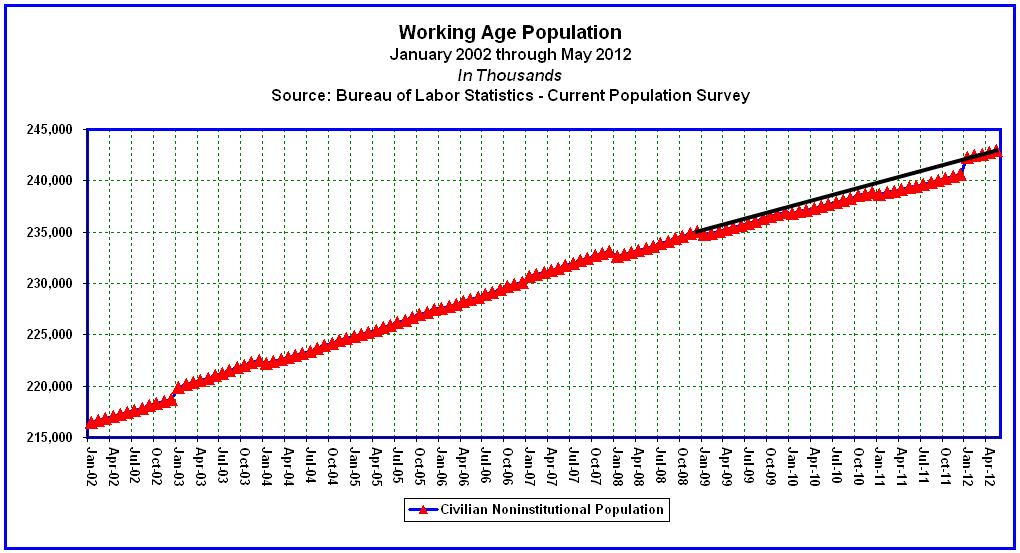
    Meanwhile, the Working Age Population increased by more than 8.2 million over the same period. So let’s see, that’s 55,000 private sector jobs created since Obama took office, for 12.2 million unemployed workers (4.0 million who had already lost their jobs before Obama took office, and another 8.2 million who reached working age during his term). That’s gotta be a record alright, but it’s not exactly the kind of record either Mr. Weisenthal, or Mr. Obama should be ginning up.

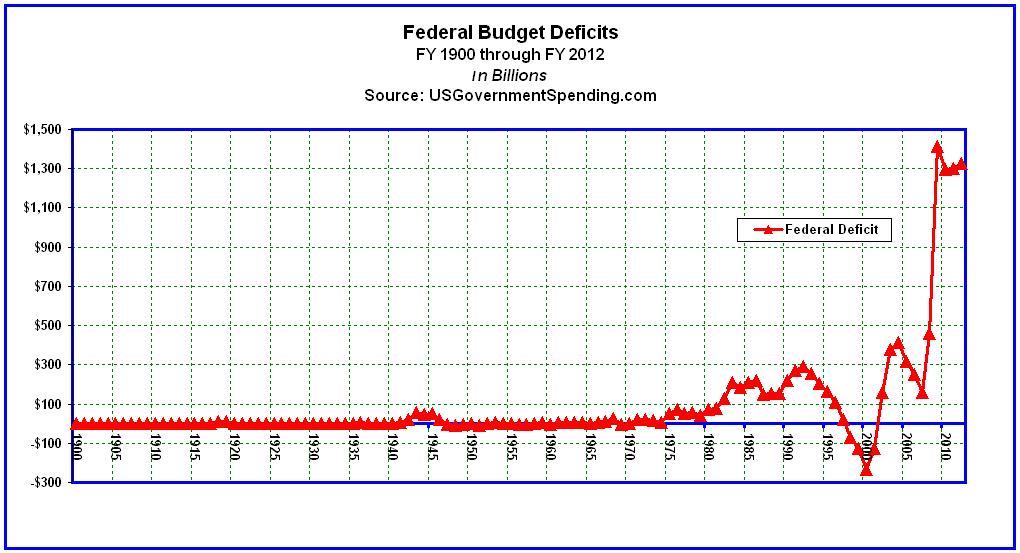
  5. ‘It would be great if the [Private] Sector were stronger, but things are going up and to the right in these charts.’ – Yes, and things are going up and to the right in some other charts as well. For example, Federal budget deficits (shown below) are far outpacing any of the statistics above. The fact that a chart is moving upwards and to the right doesn’t mean anything on its own merits. The following questions come to mind. Is this good or bad? What’s the trend? What’s the growth rate? Is it keeping pace with population growth? How is its performance against other benchmarks? Comparing the last two years and five months of Obama to his first year in office, and then drawing conclusions, is like saying that a baseball player with a batting average of .000 in his first year and who is now batting .00015 has improved. Yeah, he’s improved alright, but he won’t be playing in the Majors next year.

  6. ‘Total government employment is far below where it was when Obama started office.’ – This is true, and it’s actually a good thing. Who can afford to pay for more public sector workers when more than 23 million Americans are either unemployed or underemployed? Mr. Weisenthal and Mr. Obama seem to think that more State and Local government hiring will solve our unemployment problem. What they really mean is that the Federal government should take more money from a shrunken private sector labor force to pay others. What planet have they been living on? Apparently neither one of them received the memo issued in November of 2010.

  7. ‘Why is employment going down? Because state and local government spending growth has hit its lowest level ever.’ – The first part of this statement is false; the second part is true. To say that the decline in State and Local government spending is causing the decline in employment may fire the emotions of a few State and Local government workers, but it’s simply untrue. State governments employed a record 5,198,000 workers in January of 2009, versus 5,073,000 today. Local governments employed a record 14,588,000 in January of 2009, versus 14,077,000 today. So State and Local government employment is only off the mark by 636,000 from an all time high in January of 2009. If all 636,000 workers were rehired tomorrow, how would that solve the problem for the 23 million Americans who are either unemployed or underemployed?

    Although it’s true that State and Local government spending has declined, the reason is that revenues have plummeted. Unlike the Federal government, State and Local governments can’t spend money they don’t have. Nor should they borrow what they can’t repay. The decline in revenues is due to the downturn in real estate values, high unemployment, and the need to cover unfunded pension liabilities. With legal requirements to balance their budgets and an inability to print their own currencies, State and Local governments are prohibited from implementing the disastrous borrow-and-spend policies of Washington, DC.

  8. During the crisis, the state & local pain was mitigated by aid from the Federal Government, but that has since dropped off dramatically. – He’s referring to the part of Obama’s $831 billion Stimulus Program that went to State and Local governments in 2009/2010. Remember that? The problem is that it didn’t work then, and it won’t work now. The reason it didn’t work the first time is because it’s not the Federal government’s job to tell State and Local governments what to do. The Federal government is not in charge of State and Local budgets and thus cannot mandate more hiring.

    State and Local governments legislate according to the desire of their residents; they don’t take orders from Washington. State and Local government officials actually have to live under the policies they implement. They are in-touch with their constituents, while Mr. Obama seems to be completely out-of-touch with most of America. Even if the Federal government handed State and Local governments another $1.0 trillion to hire more workers, how would they pay those same workers in subsequent years? And if they have to pay the money back as well, how will they be able to pay the additional workers while repaying the loans? Ideas that make sense to a desperate reelection campaign are not always practical in the real world, or in the best interests of anyone other than the candidate. Think about it.

Monetizing the Debt

Mr. Obama presides over the Federal government, whose $16 trillion national debt imposes a drag on the Private Sector. For example, in 2011 the Federal Reserve monetized 77% of the Federal deficit (see chart below). By the way, that’s the opposite of what it said it would do. Eventually the Fed will have to reduce its Treasury holdings, and as you can see, the last time it did so the economy went straight into recession. Maybe the Fed can afford to sit on piles and piles of low interest Federal debt forever, but that doesn’t mean everyone else can, or will. The question Mr. Weisenthal ought to be asking himself is where will the Federal government get the money to repurchase this debt? It will ultimately come out of the Private Sector, through higher taxes, fees, and fines. The prospects for additional Federal borrowing are growing slim.

Private Sector Employment Benchmarks
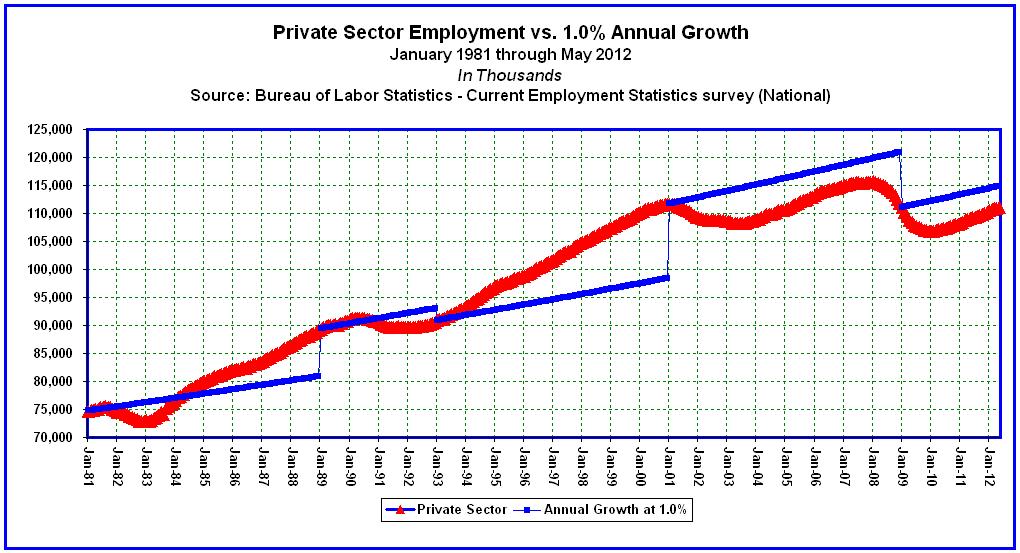
Mr. Weisenthal’s charts don’t provide any benchmarks, so I will. Assuming that Private Sector Employment should grow at the same rate as the working age population, approximately 1.0% annually, the chart below compares actual Private Sector jobs growth to a 1.0% benchmark, beginning with the terms of the last 5 presidents.

  • By the end of Ronald Reagan’s first term, Private Sector Employment beat the benchmark by 2,088,000 jobs. He was reelected based on his pro-business policies.

  • By the end of Reagan’s second term, Private Sector Employment had topped the benchmark by 8,248,000 jobs.

  • By the end of George H.W. Bush’s only term, Private Sector Employment fell behind the benchmark by 2,466,000 jobs.

  • By the end of Bill Clinton’s first term, Private Sector Employment beat the benchmark by 6,901,000 jobs. He was reelected based on small government, pro-business policies.
  • By the end of Clinton’s second term, Private Sector Employment had topped the benchmark by 13,291,000 jobs.

  • By the end of George W. Bush’s first term, Private Sector Employment had fallen behind the benchmark by 5,562,000 jobs. He was reelected based upon his strong defense and anti-terrorism policies, not for his economic record. Were it not for the War on Terror, Mr. Bush would have lost his reelection bid.

  • By the end of W’s second term, Private Sector Employment had fallen behind the benchmark by 9,100,000 jobs.

  • After three years and five month’s of Barack Obama, Private Sector Employment has fallen behind the benchmark by 3,801,000 jobs. Short of finding another reason, such as convincing Americans that the killing of thousands of innocent civilians in drone attacks is important to their security, Obama’s anti-business policies should make this his final term.

Federal Government Employment Benchmarks

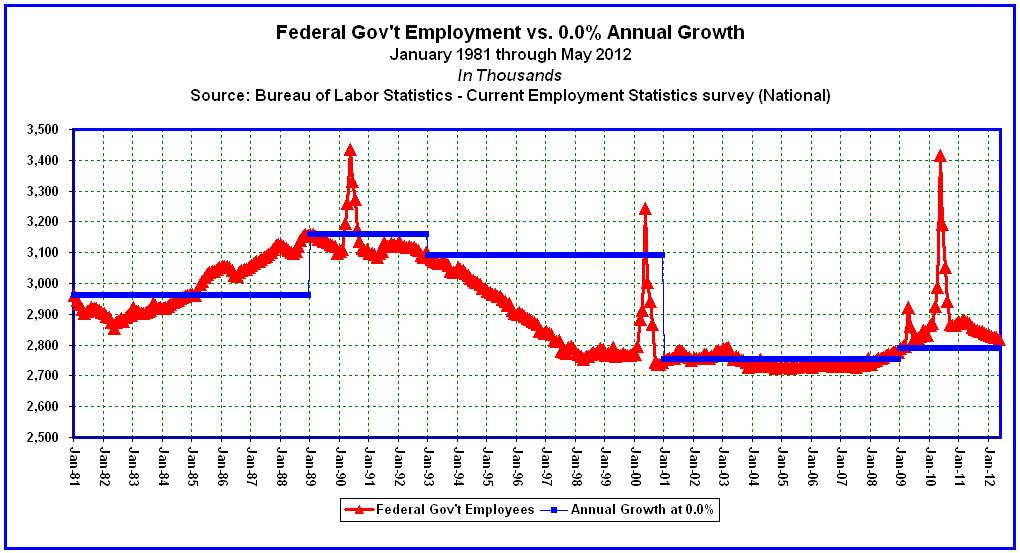
Who wants more Federal workers? Instead of telling State and Local governments what to do, Barack Obama should spend some time figuring out how to shed the 29,000 Federal positions added under his administration. Assuming that Federal Government Employment should grow at 0.0% or less, the chart below compares actual Federal government jobs growth to a 0.0% benchmark, beginning with the terms of the last 5 presidents.

  • By the end of Ronald Reagan’s first term, Federal Employment exceeded the benchmark by 3,000 jobs.

  • By the end of Reagan’s second term, Federal Employment exceeded the benchmark by 195,000 jobs.

  • By the end of George H.W. Bush’s only term, Federal Employment dropped below the benchmark by 57,000 jobs.

  • By the end of Bill Clinton’s first term, Federal Employment dropped below the benchmark by 253,000 jobs.

  • By the end of Clinton’s second term, Federal Employment was below the benchmark by 347,000 jobs.

  • By the end of George W. Bush’s first term, Federal Employment dropped below the benchmark by 25,000 jobs.

  • By the end of W’s second term, Federal Employment exceeded the benchmark by 24,000 jobs.

  • After three years and five month’s of Barack Obama, Federal Employment has exceeded the benchmark by 29,000 jobs.

State Government Employment Benchmarks

Not that the Federal government has any control, but assuming that State Government Employment should grow at the same rate as the working age population, approximately 1.0% annually, the chart below compares actual State government jobs growth to a 1.0% benchmark, beginning with the terms of the last 5 presidents.

  • By the end of Ronald Reagan’s first term, State Government Employment dropped below the benchmark by 5,000 jobs.

  • By the end of Reagan’s second term, State Government Employment exceeded the benchmark by 183,000 jobs.

  • By the end of George H.W. Bush’s only term, State Government Employment exceeded the benchmark by 149,000 jobs.

  • By the end of Bill Clinton’s first term, State Government Employment dropped below the benchmark by 56,000 jobs.

  • By the end of Clinton’s second term, State Government Employment was below the benchmark by 9,000 jobs.

  • By the end of George W. Bush’s first term, State Government Employment dropped below the benchmark by 6,000 jobs.

  • By the end of W’s second term, State Government Employment was below the benchmark by 16,000 jobs.

  • After three years and five month’s of Barack Obama, State Government Employment has fallen behind the benchmark by 306,000 jobs.

Local Government Employment Benchmarks

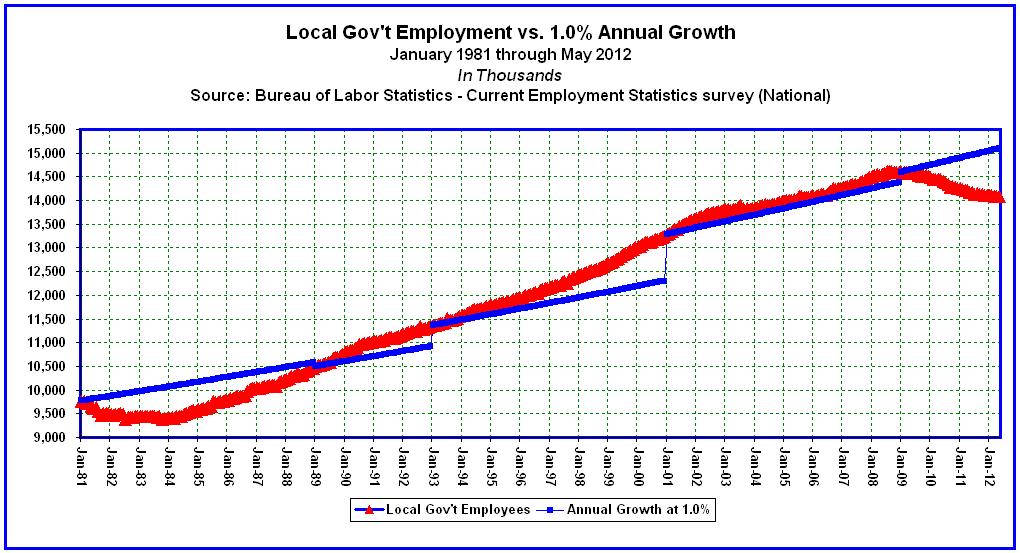
The Federal government has no jurisdiction over Local governments, but assuming that Local Government Employment should grow at the same rate as the working age population, approximately 1.0% annually, the chart below compares actual Local government jobs growth to a 1.0% benchmark, beginning with the terms of the last 5 presidents.

  • By the end of Ronald Reagan’s first term, Local Government Employment dropped below the benchmark by 622,000 jobs.

  • By the end of Reagan’s second term, Local Government Employment was below the benchmark by 118,000 jobs.

  • By the end of George H.W. Bush’s only term, Local Government Employment exceeded the benchmark by 416,000 jobs.

  • By the end of Bill Clinton’s first term, Local Government Employment exceeded the benchmark by 334,000 jobs

  • By the end of Clinton’s second term, Local Government Employment was above the benchmark by 943,000 jobs.

  • By the end of George W. Bush’s first term, Local Government Employment exceeded the benchmark by 151,000 jobs.

  • By the end of W’s second term, Local Government Employment was above the benchmark by 207,000 jobs.

  • After three years and five month’s of Barack Obama, Local Government Employment has fallen behind the benchmark by 1,018,000 jobs. This is certainly not due to any lack of Federal spending.

The bottom line:

If the creation of 55,000 net Private Sector jobs, over 40 months, for 23 million unemployed or underemployed Americans, is considered “doing fine”, then Mr. Obama’s prospects for a second term, one in which another 8.0 million plus will reach working-age, should be nipped in the bud right now. Mr. Obama had a fair shot and his policies failed. If he is so concerned about State and Local government employment now, then why didn’t he focus his stimulus plan on this sector back in 2009? Instead he placed the emphasis on extending unemployment benefits, which actually exacerbated the problem. And why did he focus so much of his time on passing Obamacare, instead of worrying about how 23 million unemployed and underemployed Americans would be able to afford it? This isn’t Little League. When you’re batting .00015 in the Major’s, the chances of keeping your job are pretty much nonexistent.

If Barack Obama wants to control State and Local government budgets, then perhaps he should be running for Governor, Mayor, State Senator, County Commissioner, or City Councilman. If he wants to take credit for improvements in the Private Sector, then perhaps he should take a shot at running a corporation, in his next career. But if he wanted to continue as President of the United States, he should have paid more attention to the Federal budget while he had the job. There’s an old saying, “If you want a different result, try something different.” So make up your mind today, do you want more insanity, or something different?

References:

Here’s What’s Really Happened To the Private Sector Under Obama

U.S. Government Spending

Data: Spreadsheets

Manipulation 401 : U-3 vs Real Unemployment


Another 522,000 left the labor force in April 2012.

April’s Bogus Unemployment Rate

* By: Larry Walker, Jr. *

Now that economists, media pundits, and the Obama administration have weighed in with half-hearted and inaccurate theories respecting April’s decline in the U.S. unemployment rate, it’s time to set the record straight. We learned yesterday, that the official rate declined from 8.2% in March to 8.1% in April, but what’s really beneath the decline? To know, one must have an understanding of how the unemployment rate is calculated, and how to access the appropriate reports. From there it’s just a matter of simple mathematics. After poring through the numbers, I have concluded that the official unemployment rate actually rose to 8.3% in April, while the real unemployment rate ticked up to 11.1%.

According to the U.S. Bureau of Labor Statistics (BLS), as of May 4, 2012, “Nonfarm payroll employment rose by 115,000 in April, and the unemployment rate was little changed at 8.1 percent.” What’s wrong with this pronouncement? The quandary is that nonfarm payroll employment comes from Establishment Data, reported in Table B-1, and has nothing to do with the official unemployment rate. The official unemployment rate is completely derived from Household Data, which is found in Table A-1.

Nonfarm payroll employment and the official unemployment rate are inapposite (one has nothing to do with the other). In fact, if you take a gander at Table A-1, from which the unemployment rate is officially derived, you will notice that the number of employed persons actually declined by 169,000 from March to April of 2012. Does it make sense that establishments reported the creation of 115,000 jobs, while households reported losing 169,000 jobs? Which data set are we to trust? Well, since most of the hoopla surrounds the decline in the unemployment rate, we shall focus on Household Data.

As I outlined in Manipulation 101: The Real Unemployment Rate, the Labor Force is comprised of those who are either Employed or Unemployed, and the Unemployment Rate is calculated by dividing the number of unemployed persons by the size of the labor force, as follows:

[ (A) Total Unemployed / (B) Labor Force = (C) Unemployment Rate ]

Thus, the official unemployment rate of 8.2% in March, as reported by the Bureau of Labor Statistics on April 6, 2012, was calculated as follows:

[ 12,673,000 / 154,707,000 = 8.2% ]

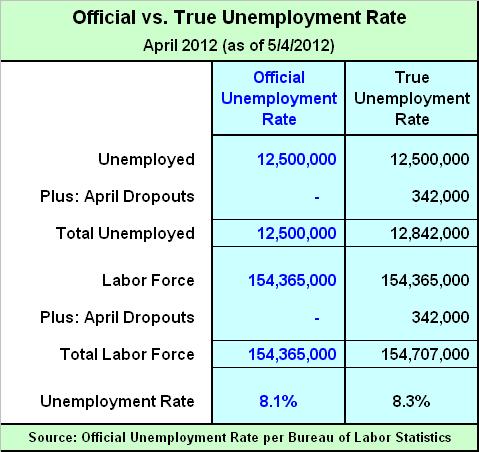
As shown in the table below, at the end of March 2012, 12,673,000 persons were officially unemployed, out of a labor force totaling 154,707,000, equaling an unemployment rate of 8.2%. Got it?

To take it a step further, if 12,673,000 persons were unemployed, out of a labor force of 154,707,000, then it should follow that the remaining 142,034,000 were employed. I found this to be consistent with BLS data and labeled the number of employed as item (D) in the table above. Next, in order to determine whether or not the decline in the unemployment rate is completely bogus, we must take into account some additional statistics from Table A-1, so I included the number of persons “Not in the Labor Force” (E), and the “Civilian Noninstitutional Population” (F). Now we will compare the March statistics to April’s calculation.

The April Employment Situation Summary concluded that a total of 12,500,000 persons were unemployed, out of a labor force totaling 154,365,000, equaling a decline in the official unemployment rate to 8.1%, from 8.2% in March. So what changed?

Comparing the monthly changes in the table below, you will note that from March to April, the number of unemployed persons (A) declined by 173,000. This would be a good thing, if they were all able to find jobs, right? So how many found jobs? Well, none. As you can see, according to Table A-1, the number of employed persons (D) also fell by 169,000. Since the number of employed and unemployed persons both declined, where did they go? As you can see the entire labor force declined by 342,000. Is it a coincidence that 173,000 plus 169,000 equals 342,000? No, it’s not.

The number of unemployed persons declined by 173,000, not because they were able to find work, the BLS merely removed them from the labor force. The BLS also removed an additional 169,000 persons from the labor force, who were considered employed just a month prior. Thus, 169,000 persons were ushered directly from a status of employed in March, to completely out of the labor force by the end of April. Does this raise any eyebrows? Also noteworthy are changes in the number of persons “Not in the Labor Forcewhich increased by 522,000, and the “Civilian Noninstitutional Population” which increased by 180,000. How de we reconcile this?

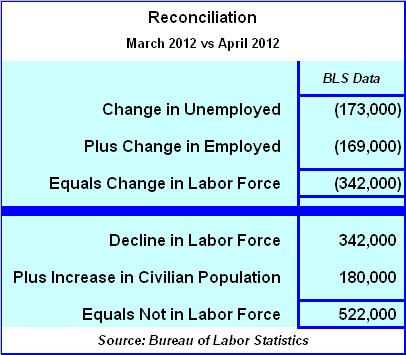
Reconciliation

The table below summarizes the truth behind the decline in the official unemployment rate.

Here’s what happened.

  1. The number of unemployed persons declined by 173,000 in April.

  2. The number of employed persons declined by 169,000 in April.

  3. The labor force declined by 342,000 in April, which is the sum of #1 plus #2.

  4. The 342,000 persons in #3, who officially dropped out of the labor force in April, were added to those considered “Not in the Labor Force”.

  5. The Civilian Noninstitutional Population (working age population) increased by 180,000 in April, but none entered the labor force.

  6. The number of persons counted as ”Not in Labor Force” increased by 522,000 in April, which is the sum of the 342,000 persons who were previously counted as unemployed (173,000) and employed (169,000), plus the 180,000 new working age persons who were swept under the rug.

Sequitur

To sum it up, in April, 342,000 persons dropped out of the labor force, while another 180,000 new entrants fell by the wayside. In effect, a total of 522,000 persons were removed from the labor force. So what would the official unemployment rate have been had the 342,000 April dropouts been instead left in the labor force and counted as unemployed? The answer is 8.3%, as shown below. Thus, the true unemployment rate ticked up by 1 basis point, from 8.2% in March to 8.3% in April, rather than down by 1 basis point as the BLS reported.

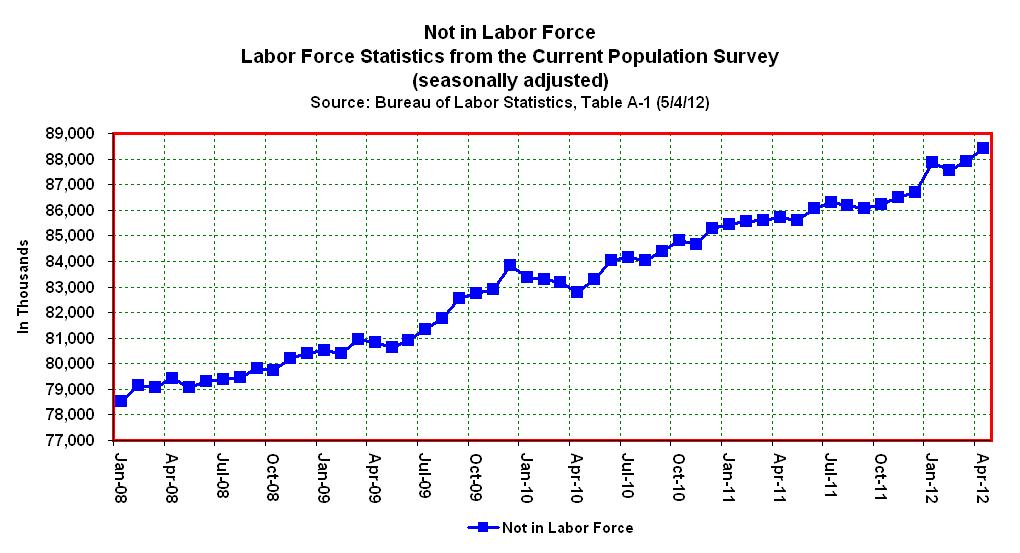
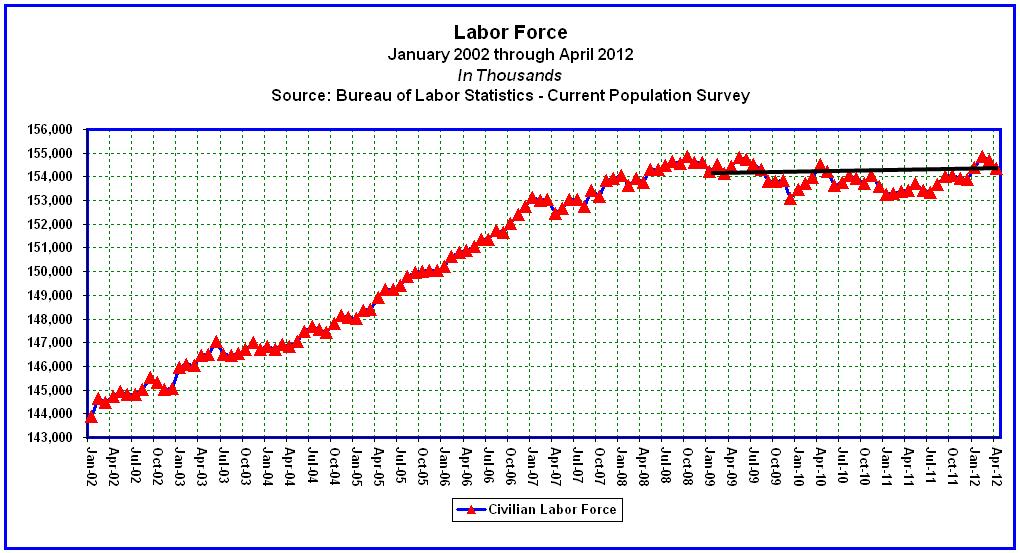
The labor force has historically grown at an annual rate of 1.0% (mirroring population growth), but looking back to December of 2008, it is safe to state that the labor force stopped growing altogether since Obama’s inauguration (see chart below). [Note: The labor force participation rate has likewise declined from 65.8% to 63.6% over the same period, or by 220 basis points.]

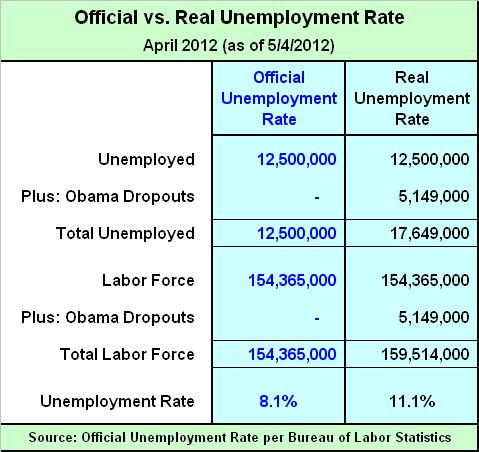
Final question: What would the unemployment rate be if the 1.0% per annum shortfall in the labor force, since January of 2009, was restored? Well, since 40 month’s have passed, the labor force should have grown by 3.33% ((1.0% / 12) * 40). And since the labor force stood at 154,626,000 in December of 2008, it should have grown to 159,775,000 by April of 2012, a difference of 5,149,000. Thus, the real unemployment rate is 11.1%, not 8.1%, as shown below.

Are we really moving the right direction? That depends on ones definition of the word “right”. Is manipulating the truth right?

“Anyone who doesn’t take truth seriously in small matters cannot be trusted in large ones either.” ~ Albert Einstein

Data:

Spreadsheets

Real GDP Per Capita — Dead!

Moving Forward — Without Obama

* By: Larry Walker, Jr. *

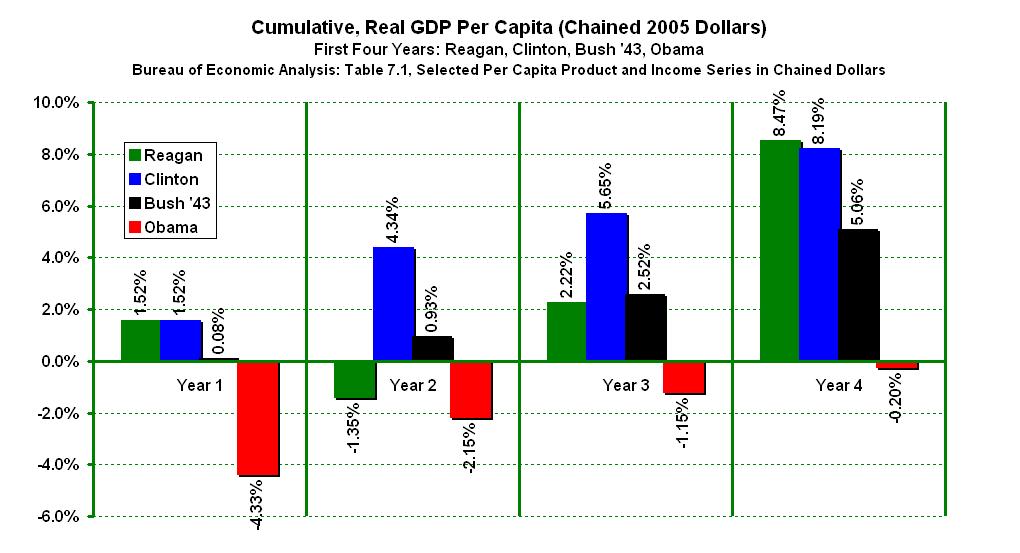
Why do I get the eerie feeling that we’ve gotten nowhere in the last four years? The answer is because we’ve gone precisely nowhere with Obama. As the chart above displays, on a per capita basis, real gross domestic product has declined by a cumulative -0.20% during Obama’s four-year term (through Q1 2012).

President’s Ronald Reagan and Bill Clinton both inherited rather weak economies. Each achieved real GDP per capita growth of 1.52% in the first year in office, but by the second year, Reagan’s cumulative GDP had declined to -1.35%, while Clinton’s rate climbed to 4.34%. Yet by the end of the fourth year, Reagan’s policies resulted in cumulative GDP per capita growth of 8.47%, versus Clinton’s 8.19%. Man, whatever Reagan was onto needs to be codified and replayed, over and over and over again. Needless to say, both were overwhelmingly re-elected.

George W. Bush inherited a really crummy economy. After only achieving real per capita growth of 0.08% in his first year, by his fourth, Bush’s policies had grown the economy to cumulative real GDP per capita of 5.06%. And with that, Bush ’43 was easily re-elected.

The policies of Reagan, Clinton and Bush ’43 moved America ‘forward’. That’s what I call progress – moving the economy forward in real and measurable terms. Terms that every American could see, touch and feel in their own billfolds, as real GDP per capita was spread around, lifting many from poverty and mediocrity into new realities.

Why Real GDP Per Capita?

Why measure GDP on a per capita basis? GDP is an aggregate figure which does not consider differing sizes of nations. Therefore, it should be stated as GDP per capita (per person) in which total GDP is divided by the resident population on a given date.

Why use chained dollars? When comparing GDP figures from one year to another, it is desirable to compensate for changes in the value of money – i.e., for the effects of inflation. The factor used to convert GDP from current to constant values in this way is called the GDP deflator. Unlike the Consumer price index, which measures inflation or deflation in the price of household consumer goods; the GDP deflator measures changes in prices of all domestically produced goods and services in the economy.

It is only by comparing cumulative changes in real GDP per capita that we are able to understand whether today’s economic policies are helping or hurting. Furthermore, by making the comparison in 4 and 8 year increments we are able to determine whether to re-elect a POTUS or send him packing, or to continue with the same party affiliation or make a break towards independence. So where do we stand today?

GDP is Dead

Although Barack Obama also inherited a bad deal, his policies made it worse. The economy was declining at a real per capita rate of -1.27% in 2008, but by the end of 2009, Obama turned that into a decline of -4.33%. That’s a fact. Then, by the end of his second year, Obama’s stimulus programs resulted in a slight improvement, as the economy achieved negative cumulative growth of -2.15%. Although similar to Reagan’s second year decline to -1.36%, that’s where all similarities end.

Now in his fourth year (as of Q1 2012), Obama has achieved cumulative real GDP per capita growth of -0.20%. Compared to Reagan, Clinton, and Bush ‘43’s fourth year benchmarks of 8.47%, 8.19% and 5.06%, Obama is clearly a first-term loser. In absolute terms, the economy has gone nowhere under Obama. In terms that really matter, inflation adjusted dollars, as a percentage of the population; the economy hasn’t moved at all under the policies of Barack Obama. We are still below zero as far as real per capita growth – below zero, in spite of $6.3 trillion of additional debt. If Barack Obama is re-elected, he will be the only POTUS in modern history to be reinstated based on driving our economy into the ground.

Forward

“If you cry ”Forward” you must be sure to make clear the direction in which to go. Don’t you see that if you fail to do that and simply call out the word to a monk and a revolutionary, they will go in precisely opposite directions?” ~ Anton Chekhov

Forward? Yes, we will be moving forward – without Obama. The distraction of rising student loan interest rates is irrelevant in a shrinking economy. The concepts of a fair shot and a fair share are inapposite and unworthy of further discussion given the circumstances. And this garbage about being the only American around capable of giving a nod to take out a dangerous radical jihadist is just that – garbage.

I care about my children, my grandchildren, my parents, my sisters, my friends, my business, my customers, my community and my neighbors, but I could care less about Afghanistan. Why are Americans still dying in that cesspool? If Obama really wants to take responsibility for all of his actions, then why not include the fact that 69% of U.S. Afghan War casualties have occurred during his 39 month command? Explain that! How did Obama manage the war for only 30% of the time, 3 years out of 10, yet wind up responsible for 69% of the casualties?

Between the trail of blood, death and destruction abroad and his tanking of the economy at home there’s really no reason to grant Obama a second chance. It’s time for Obama to give up the keys, stop impersonating a president, and go home. Only new leadership will move America forward.

References:

Bureau of Economic Analysis, Table 7.1. Selected Per Capita Product and Income Series in Current and Chained Dollars (A) (Q)

Spreadsheet:

Per Capita Product and Income

Rising Interest on Federal Debt | Don’t Double My Rates

Hey, Don’t Double Obama’s Rates!

* By: Larry Walker, Jr. *

Mr. Obama asked students at the University of North Carolina yesterday afternoon to tell their members of Congress one thing: Don’t double my rates.

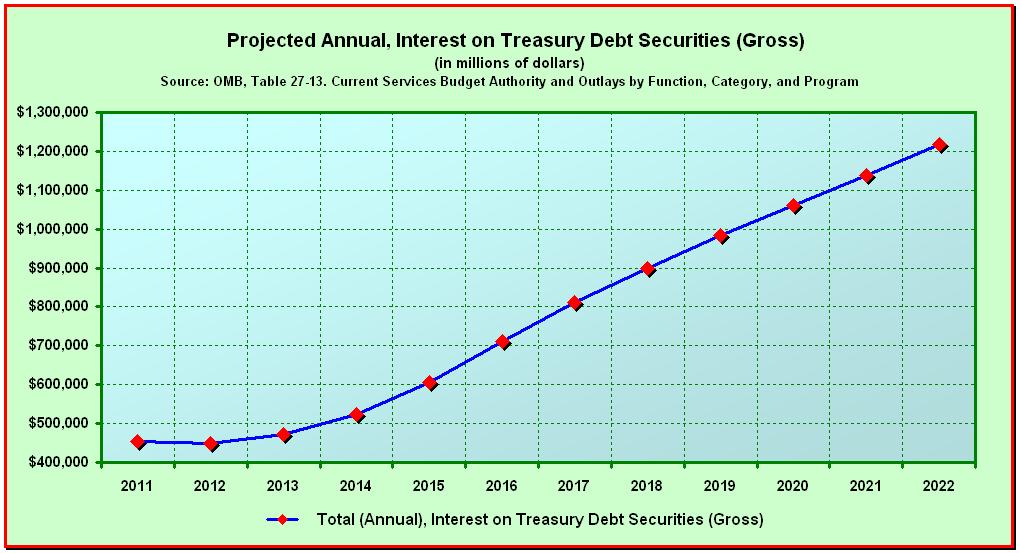
Once again, Mr. Obama doubled down on flimflam, this time misdirecting towards rising interest rates on student loan debt — instead of targeting the rising cost of interest on the federal debt. According to the White House, interest on the federal debt is projected to surpass $1.0 trillion per annum by the year 2020. Mr. Obama also failed to mention the $494 billion tax hike scheduled to hit American taxpayers on January 1, 2013.

According to Mr. Obama, “Five years ago, Congress cut the rates on federal student loans in half. That was a good thing to do. But on July 1st — that’s a little over two months from now — that rate cut expires.  And if Congress does nothing, the interest rates on those loans will double overnight…. And just to give you some sense of perspective — for each year that Congress doesn’t act, the average student with these loans will rack up an additional $1,000 in debt — an extra thousand dollars.  That’s basically a tax hike for more than 7 million students across America…”

If rising interest rates on student loan debt represents a tax hike, what are we to make of next year’s higher income tax rates?

Nine years ago, Congress cut income tax rates across the board. That too was a good thing to do. But on December 31st — that’s a little over eight months from now — those rates expire. And if the U.S. Senate does nothing, income tax rates will rise overnight… Tax policies in seven different categories will expire, including the Bush Tax Cuts, the payroll tax cut, and the AMT Patch. Plus five of the 18 new tax hikes from Obamacare will begin. And just to give you some sense of perspective — Taxmageddon is a $494 billion tax increase, so each year that the U.S. Senate doesn’t act, every man, woman, and child in America will rack up an additional $1,500 in income taxes — an extra fifteen hundred dollars. That’s an extra $6,900 for every U.S. taxpayer (the 50% of us who actually pay income taxes) – an extra six thousand nine hundred dollars.

So should my three children, who are all in college, be worried more about rising interest rates on student loans, dismal employment prospects, looming tax hikes, or rising interest on the federal debt?

Rising Interest on the Federal Debt

Based on Obama’s fiscal year 2013 budget, per Table 27-13, Baseline Budget Authority and Outlays by Function, Category, and Program, Gross Annual Interest on Treasury Debt Securities is projected to grow from $453.9 billion in 2011 to over $1.0 trillion by 2020, and to surpass $1.2 trillion by the year 2022 (see Chart below). Since this represents about half of the government’s current revenue, that doesn’t leave much room for anything other than Social Security and Medicare.

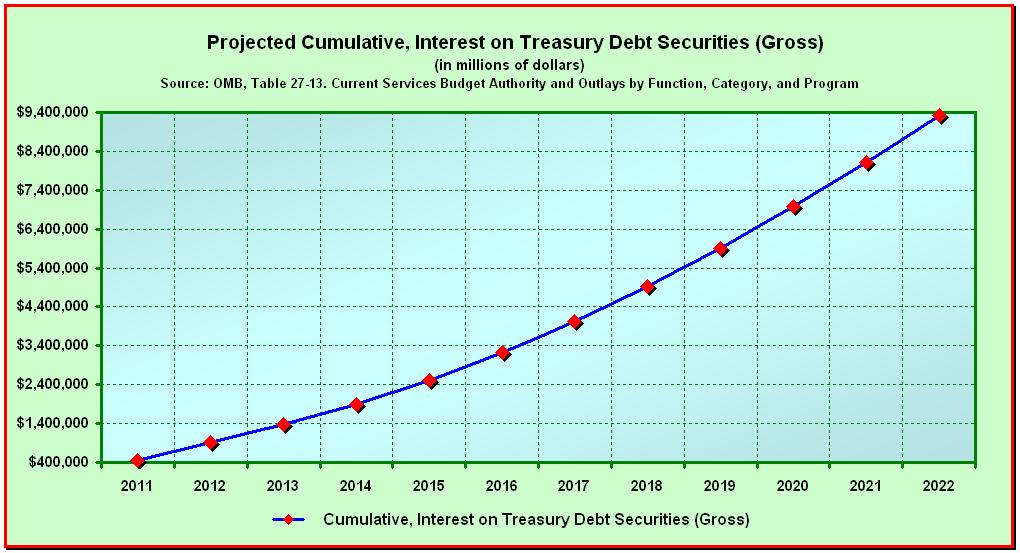
Today’s college students need to give serious and careful thought to a lot more than interest rates on student loan debt. Within the next eleven years, on a cumulative basis, the U.S. Government will incur more than $9.3 trillion in interest on the federal debt (see Chart below). That equates to roughly $30,000 for every man, woman and child in America. And since only 50% of working Americans pay income taxes, for those fortunate enough to obtain gainful employment, it amounts to nearly $131,378 each. And that’s just over the next eleven years — an extra one hundred and thirty one thousand three hundred and seventy eight dollars.

Thanks, Mr. Obama, for sugarcoating the dire consequences of your lack of a cohesive economic plan, and for sacrificing my children and grandchildren’s futures in lieu of your own selfish ambitions.

Tables

Reference:

Table 27-13. Current Services Budget Authority and Outlays by Function, Category, and Program

Evacuated Tube Transport | A Silver Bullet

Nix the Bullet Train to Bankruptcy

* By: Larry Walker, Jr. *

Forget about airplanes, electric cars, algae biofuel, and the bullet train to bankruptcy, evacuated tube transport is the wave of the future. At 1/10th the cost of high speed rail, and 1/4th the cost of a freeway, with top speeds of 370 mph intrastate and 4,000 mph interstate/international, silent, safe, and faster than jets, ET3’s six passenger frictionless magnetic levitation capsules are far more viable than any other form of transportation on the horizon.

Does the idea of travelling from New York to L.A. in 45 minutes, without a TSA pat down, and at a fraction of the cost sound appealing to you? Would I buy a ticket? Hell yeah! I would ride today if I could. Looks like the government can cancel its plans on that $500 billion high-speed rail network to nowhere. It’s already obsolete.

There’s just one caveat: Let the private sector run it.

Reference: http://www.et3.com/

Passing the Buck and Taking Names | Obama’s GSA

* By: Larry Walker, Jr. *

“Ultimately the buck stops with me… I’m going to be accountable.” ~ Barack Obama *

What a load of bull! Harry Reid’s U.S. Senate hasn’t passed a budget resolution since April 29, 2009. Barack Obama hasn’t presented a budget, at least not one acceptable to either Democrats or Republicans, since the day he set foot in office. Yet he thinks he should keep his job. But that’s not how it works in America. Obama was given a fair shot; he had his fair share of opportunities, but he chose to pass the buck, running his mouth instead of governing, and now it’s time to give someone else a shot.

U.S. Gross Domestic Product has grown by a mere 7.59% from 2007 to 2011, or at an average annual growth rate of a pathetic 1.90%. But Federal Agency spending has increased by 32.04% over the same period, or at an average annual growth rate of 8.01%. Does the fact that Agency spending outpaced the economy by 322% sound any alarms? Well if we had a chief executive who was paying attention it would. This is an outrageous, hair-raising, mind-boggling, egregious, statistical fact, yet all U.S. taxpayers have heard for the last three plus years are threat after threat of higher taxes.

The Bush tax cuts are out, no they’re in. The payroll tax cut is gone, no it’s back. The AMT Patch is dead, no it’s still breathing.’

And now we have to contend with yet another threat, Taxmageddon. Taxmageddon is a $494 billion tax increase that strikes at the beginning of 2013. This time it’s the largest tax increase in U.S. history, scheduled to hit us smack in the face on January 1, 2013. Under current law, tax policies in seven different categories will expire, including the Bush Tax Cuts, payroll tax cut, the AMT Patch, plus five of the 18 new tax hikes from Obamacare will begin, see Taxmageddon: Massive Tax Increase Coming in 2013.

Unusual uncertainty remains unusually uncertain.

With Taxmageddon looming, the GSA scandal is well-timed. It has undeniably exposed the truth. And the truth is that the federal government has been living large through its discretionary spending, throwing our future to the wind, while we’ve been left sitting on pins and needles. Since the economy is practically at zero growth, where do these morons think the money to pay higher taxes will come from? I find it amazing, simply amazing, that no one has been in charge of the national purse for the last three-plus years. Absolutely no one has kept tabs on how our tax dollars were spent. We deserve better.

With an estimated $6.3 Trillion borrowed and squandered on Obama’s watch, and red flags abounding, it makes me sick to my stomach that politicians are suddenly concerned. You would have to be blind or not paying any attention to federal spending whatsoever to not notice the humongous 6,896.30% increase in the GSA’s expenditures from 2007 to 2011. Why blame the GSA? Blame yourselves, or blame Obama. The buck stops with Obama, right? So fire him. Put Obama on trial.

Maybe if someone wasn’t on the golf course, on vacation, or campaigning every other week (at our expense), and instead actually took time to study the budget “line by line”, and to work with Congress on cutting and capping spending, the GSA incident wouldn’t have occurred. I call it not doing the job you were elected to do. But hindsight is 20/20; foresight is not reelecting someone who has proven he can’t handle the job.

Does the following condensed OMB table, Outlays by Agency, which compares government spending growth from 2007 to 2011, raise any flags? If you ask me, the entire record is a red flag. The General Services Administration is an obvious bell ringer, its expenditures having grown from $27 million in 2007, to over $1.8 billion in 2011, or by 6,896.30%. But it’s not the only agency that should concern us, frankly they all should.

As you scan through the following highlights, keep in mind that the entire U.S. economy grew by a mere 7.59% over the four-year period, or at average annual growth of 1.90%.

  • The Department of Agriculture’s four-year spending growth was 65.11%, with average annual growth of 16.28%. You would think they were actually growing crops or raising livestock, but we know that’s not the case, so why have annual expenditures increased by $54.9 billion? Cut it.

  • The Department of Commerce’s four-year spending growth was 53.36%, with average annual growth of 13.34%. You would think they were actually manufacturing products or providing services, but we know that’s not the case, so why have annual expenditures increased by $3.5 billion? Cut it.

  • The Department of Energy’s four-year spending growth was 55.95%, with average annual growth of 13.99%. You would think they were actually producing electricity, mining coal or drilling for oil, but we know that’s not the case, so why have annual expenditures increased by $11.3 billion? Cut it.

  • The Department of Labor’s four-year spending growth was 177.58%, with average annual growth of 44.40%. You would think they were actually performing job placement services, but we know that’s not the case, so why have annual expenditures increased by $84.4 billion? Cut it.

  • The Department of State’s four-year spending growth was 77.29%, with average annual growth of 19.32%. You would think they were annexing nations and granting Statehood, in order to increase GDP, but we know that’s not the case, so why have annual expenditures increased by $10.6 billion? Cut it.

  • The Department of Veterans Affairs’ four-year spending growth was 74.36%, with average annual growth of 18.59%. Is this sustainable on average annual GDP growth of just 1.90%? Not hardly. So why have annual expenditures increased by $54.1 billion? Cut it.

  • The Corps of Engineers–Civil Works’ four-year spending growth was 158.75%, with average annual growth of 39.69%. You would think they were actually building roads and bridges, but we know that’s not the case, so why have annual expenditures increased by $6.2 billion? Cut it.

  • The Small Business Administration’s four year spending growth was 424.51%, with average annual growth of 106.13%. You would think they were actually making loans directly to small businesses, but we know that’s not the case, so why have annual expenditures increased by $4.9 billion? Cut it.

  • The Social Security Administration’s (On-Budget) four-year spending growth was 182.82%, with average annual growth of 45.70%. On-budget spending isn’t mandated, it’s not the entitlements portion in which Social Security Taxes offset payments to retirees and those with disabilities. No, this is interest and principal repayments of previously looted funds, and coverage of shortfalls due to the payroll tax cut and other gimmicks. You would think they were actually increasing benefit checks or lowering Medicare premiums, but we know that’s not the case, so why have annual expenditures increased by $100.4 billion? Cut it.

  • Total Federal Outlays experienced four-year spending growth of 32.04%, with average annual growth of 8.01%. With that kind of spending, you would think our economy would have grown by more than 7.59% over the four-year period, and achieved far more than average annual growth of 1.90%, but we know that didn’t happen, so why have annual expenditures increased by $874.4 billion? Has the economic stimulus program of 2009 become permanent? Cut it.

  • And last but far from least, the General Services Administration’s four-year spending growth was a whopping 6,896.30%, with average annual growth of 1,724.07%. You would think they were throwing some really wicked parties, or something. Oh, it turns out that was the case! No wonder annual expenditures increased by $1.9 billion. Just cut it.

Our government is spending at a rate which is 322% greater than the underlying economy. We call this “unsustainable”. What do you call it? The egregious growth of the GSA’s expenditures should have been caught long before it became a public scandal. Has anyone in the District of Columbia been paying attention for the past three years? You would think Obama would have caught this with his vast experience running companies, governing States, and all. Oh that’s right, he doesn’t have any experience.

I just gave you $340.2 billion of simple budget cuts, while Obama refuses to acknowledge the problem. If you still don’t get it, here’s the wrap.

The economy isn’t growing. The government is spending at a rate which is 322% greater than its underlying economy. Every additional dollar of tax revenue sucked out of our stagnant economy will cause the economy to decline further, while government continues to live the high life. Since there is no additional revenue to garner, government spending must be cut. The economy was on fire in 2007 on dramatically less government spending. Therefore, returning to the budget of 2007 damages nothing, other than Obama’s plan to bankrupt the nation. If Obama isn’t trying to bankrupt the USA, then what is he doing?

Fire Obama! Cut government spending. Cut the B.S. Cut it big. And cut it now!

References:

Table 4.1—Outlays by Agency: 1962–2017

BEA—Gross Domestic Product and Personal Income

Spreadsheets

Obama’s Secretarial Tax Fallacy

By: Larry Walker, Jr.

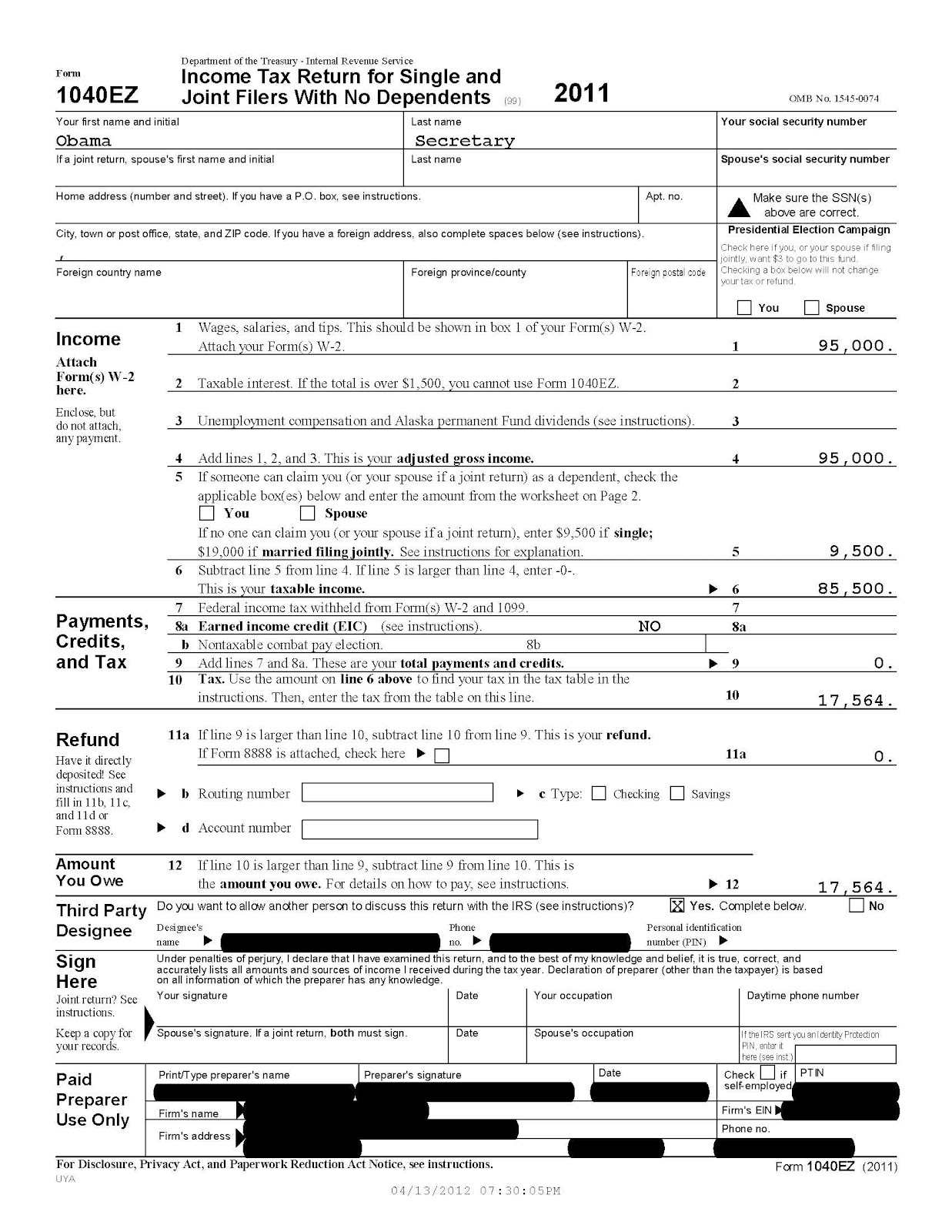
There’s no way Obama’s secretary paid a higher effective tax rate than the Obamas. You don’t believe it? Are income taxes such a mystery that we can’t figure it out? Well, let’s run the numbers and see.

According to Jake Tapper of ABC News, Mr. Obama released his 2011 federal income tax today, with he and his wife reporting an adjusted gross income of $789,674. The Obamas paid $162,074 in total tax – an effective federal income tax rate of 20.5%.

The White House also reported that President Obama’s secretary, Anita Decker Breckenridge, makes $95,000 a year. White House spokeswoman Amy Brundage told ABC News that Breckenridge “pays a slightly higher rate this year on her substantially lower income, which is exactly why we need to reform our tax code and ask the wealthiest to pay their fair share.”

The only problem with this story is that Amy Brundage doesn’t know how to compute a tax return, or an effective tax rate. If Ms. Breckenridge were single, made wages of $95,000, and had no other dependents or deductions, her standard deduction would have been $5,800 and her personal exemption $3,700. So taking Ms. Breckenridge’s income of $95,000 and subtracting her deductions of $9,500 results in taxable income of $85,500, and a total income tax of $17,564 (click the tax return image below to enlarge). Thus, her effective tax rate is 18.4% (17,564 / 95,000). The last time I checked 18.4% was less than not greater than 20.5%.

Is the Obama Administration so delusional that it believes the American public doesn’t understand basic math? Get a clue! Or ask an accountant. In my opinion we’re all paying way too much for the incompetence of this government. The mainstream media should be ashamed for not verifying the numbers. And Obama’s definitely on the wrong track, one which should (should have) lead to the end of his short and sorry career. That suits me fine.

Note: What I have calculated above is the maximum effective tax rate possible for a single person with $95,000 of gross income. However, if Ms. Breckenridge is married her tax rate will be lower, if she has dependents her total tax will be reduced, if she owns a home and pays mortgage interest, gives to charity, or pays a substantial amount in State taxes she could itemize deductions on Schedule A, any combination of which would make her effective tax rate substantially lower than 18.4%.

Fair Shot, Fair Share and a Glass of Algae

* By: Larry Walker, Jr. *

“Lake Erie is facing its worst toxic algae bloom since the 60’s and somehow it is going unnoticed…” ~ JoeOH111 *

According to Mr. Obama, you don’t have a fair shot right now, and it’s all because millionaires aren’t paying enough income tax. If millionaires would just give the federal government its fair share, then you, I, and everyone else would have a fair shot…, and a glass of algae.

What, pray tell, is a fair shot?

The best definition I can surmise is “a lawful chance at odds.” But don’t we all have this already? For example, the odds of winning the recent $640 million Mega Millions jackpot were 1 in 176 million. In order to guarantee a win, one would have had to spend $176 million buying up every combination. So if some nefarious millionaire had purchased all 176 million combinations, would he or she have had an unfair advantage?

Well, perhaps, but what millionaire would be dumb enough to blow $176 million on lottery tickets? What are the odds of that ever happening? The odds of one person buying all 176 million winning combinations, across multiple States, would probably be 1 in (infinity). In other words, a guaranteed win is impossible, at least when it comes to the Mega Millions lottery. But a fair shot is open to anyone who plays the game. “You gotta be in it to win it.”

According to CBS News, one person purchased $2,600 worth of lotto tickets, and another threw down $55, while the more frugal played their usual dollar or two. Did the one who blew $2,600 have an unfair advantage over $55 and $1 players? I will concede that the $2,600 player had an advantage, but I would hesitate to call it unfair. The poor sap simply had more to lose, yet not a dime more to gain. Not one dime. Now let’s flip over to the Mega Trillions Federal Debt Lotto.

Mega Trillions Federal Debt Lotto

If a taxpayer earns $176 million in taxable income and pays $29.9 million in federal taxes (a rate of 17%), while another earns $50,000 and pays $8,500 in taxes (also a rate of 17%), and yet another earns $25,000 and pays $0, does either have an unfair advantage? Since both the millionaire and the $50,000 wage earner pay the exact same tax rate (17%), the non-taxpayer has an advantage. But is it an unfair advantage? I would say so, especially since in the recent past we all pitched in at every level of income. Yet the one paying $29.9 million in taxes has a lot more to lose than both the $8,500 payer, and the non-taxpayer.

But who wins in this crapshoot? With the federal government borrowing and spending hundreds of billions of dollars, in advance, and squandering it to produce test-tube sewage-fed algae biomass for fuel, while Lake Erie and other U.S. lakes are full of “free” blue-green scum, the answer is no one. You’d have to be an idiot to waste hundreds of billions of dollars manufacturing something that’s sitting right in front of your face, wouldn’t you? Hindsight is 20/20, foresight is priceless.

When it comes to the national debt, those who don’t pay federal income taxes make out like bandits, they have nothing to lose. And those who already pay more than their “fair share” (i.e. taxed enough already) have nothing to gain. It’s not the 2% of top earners that worry me, they generally pay their bills on time, but rather the federal government which has already borrowed more than 100% of our entire economy, an amount estimated to reach $16.3 Trillion by September 30th of this year.

Only a depraved leader would have his nose in other peoples finances while ignoring his own debt laden, broken, overspent, and soon to be bankrupt enterprise. The federal government is not the solution to our problems; it’s the $16.3 Trillion in the hole, deadbeat, money squandering, largest debtor-nation in the Universe, leach, which is forever in the way and constantly on our collective back.

The moral of this story: Never confuse motion with action.

In other words, quit giving speeches and fix the problem. No one is going to vote for a tax increase in the middle of an election cycle, no matter how many speeches are enounced and dribbled. Especially not the one proffered, which in the end will barely cover one day’s worth of current deficit spending. No not a one! We don’t have a revenue problem; no, no, no, what we have is a deadbeat, money squandering, and largest debtor-nation in the Universe, ass-backwards, leach of a federal government problem. Get a clue!

Rather than paying more taxes, or spending multi-millions on lottery tickets to become multi-millionaires all over again, our well-to-do brethren would do better by investing in their own casinos, creating jobs and fair shot opportunities for others. And that leads us back to square one all over again: cut taxes, cut spending, and get out of our way and off our backs.

Photo Credit: Lake Erie, Stirred Up | Via: NASA Earth Observatory (March 21, 2012)