Keeping It Real: Obama’s $250,000 Fallacy

You've Been Robbed

Legalized Robbery

Collecting more taxes than is absolutely necessary is legalized robbery. ~ Calvin Coolidge

– By: Larry Walker –

The question of the day: Why is making $250,000 a year suddenly considered wealthy? The Obamas made $5.5 million last year. Is that wealthy?

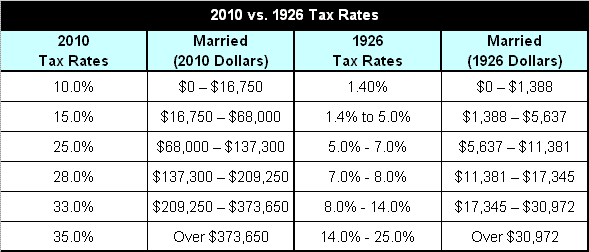
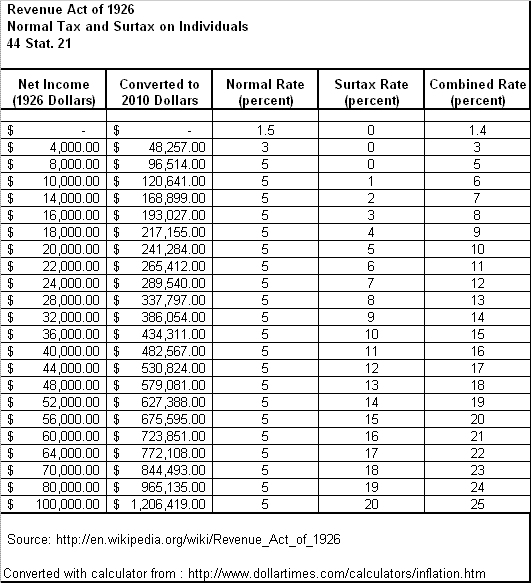
Contrary to popular belief, $250,000 in 2010 had the same buying power as $20,722 in 1926. Annual inflation over this period was 3.01%. An income of $250,000, adjusted for inflation, would have placed a taxpayer in an 11% tax bracket in 1926. In order to have been considered in the top tax bracket back then, in today’s dollars, would have required taxable income in excess of $1,206,419. The 1926 tax tables are shown below along with equivalent 2010 dollar amounts:

Click to Enlarge

So in inflation adjusted dollars, people like the Obamas would have been considered wealthy in the 1920’s and should rightfully be in the top tax bracket today. On the other hand, folks making $50,000 to $250,000 today, would have been barely considered middle class back in 1926.

The Revenue Act of 1921 contained additional tax brackets above the $100,000 level to tax the super rich. They were as follows: $100,000 @ 56%, $150,000 @ 57%, $200,000 @ 58%, $300,000 @ 71%, $500,000 @ 72%, $1,000,000 @ 73%. Translating this into 2010 dollars would yield the following amounts, respectively: $1,113,139 @ 56%, $1,669,709 @ 57%, $2,226,278 @ 58%, $3,339,418 @ 71%, $5,565,696 @ 72%, and $11,131,392 @ 73%.

President Calvin Coolidge, under the Mellon Tax Bill, slashed top rates from 73% in 1921, down to 25% in 1926. The new top bracket was 25% for anyone making over $100,000 ($1,206,419 in 2010 dollars). So under the Revenue Act of 1921, the Obamas would have been forking over 72% of their income to Uncle Sam, but only 25% under Coolidge. What a relief that would have been. The “Roaring Twenties” had arrived, catapulting multitudes into the middle class.

Now let’s bring it up to today. How did the lower tax brackets of 1926 grow from being between 1.4% and 14%, all the way to today’s level of 10% to 33%? And let’s not forget about the 7.65% (15.3% for the self-employed) that we all get soaked for in Social Security and Medicare taxes. Under the Social Security Act of 1935, the FICA tax was set at 1% of the first $1,400 in wages. It’s interesting to note that $1,400 in 1935 is the equivalent of $22,562 today, and yet the rate today (exclusive of Medicare tax) is 6.2% (12.4% for the self-employed) of the first $106,800 in wages. It’s called legalized robbery.

When voters finally drop this left, right bickering and start looking at the facts they are going to wake up one day and realize that we’ve all been bamboozled. We’ve been getting robbed for so long that we don’t even know the difference. The following table compares today’s tax rates with 1926 rates for comparable incomes.

Click to Enlarge

In reviewing our current tax tables, it is apparent that a couple making $250,000 in 2010 would have been taxed at a rate of 11% in 1926, and yet the rate is now 33%. Also, those in the top tax bracket, those making over $373,650, would have had tax rates between 14% (at the low end), and 25% for the super rich, and yet the rate is now 35%. Then along comes Obama proffering to raise the top rate up to 39.6%. The problem is that the whole tax system is out of whack.

Under Obama’s ‘made up’ theory, a couple making $250,000 should be taxed at the same rate as a couple making $5.5 million or more. Is that fair? Should a couple who makes $250,000 be taxed at the same rate as a couple making $11 million or more? Who’s kidding who?

Annual income, as defined in current tax tables, needs to be appropriately adjusted for inflation. Tax rates, on the other hand, should be adjusted back towards the historical lows, not adjusted for inflation (as eventually they would exceed 100%). There is not one section of the Internal Revenue Code that has been consistently adjusted for inflation, neither the standard deduction, nor personal exemptions have kept pace. Tax brackets have been lowered and raised seemingly based on the whims of politicians, and not based on historical inflation adjusted incomes, and that’s wrong. It’s just plain wrong.

It’s time to stop playing games with the American people, and time to start governing honestly. I’m sick and tired of rich Washington politicians, like the Obamas, trying to pretend that they’re on the same level as everyone else. The Obamas are millionaires and should pay accordingly. But let’s be fair about it, making $250,000 a year in 2010 is not rich, it wasn’t considered rich in 1926, and it’s not rich today.

What we need is real tax reform, not more of the same. If you’re not part of the solution, you’re part of the problem, and unfortunately, Obama is part of the problem.

Sources:

http://www.dollartimes.com/calculators/inflation.htm

http://en.wikipedia.org/wiki/Revenue_Act_of_1926

http://en.wikipedia.org/wiki/Revenue_Act_of_1921

Obama’s Static Tax Blunder

Make Believe

Revisiting Static vs. Dynamic Tax Revenue

Comments by: Larry Walker

The Obama Administration’s static view on tax policy can never succeed. We all know that Obama is an ideologue who thinks that people who make more money should pay a higher share of taxes, and yet we already have a progressive tax system. But apparently that’s not good enough for Obama. Under our present system, roughly 40% of those fortunate enough to be employed don’t pay any income taxes at all, while the top 5% of income earners pay 60% of income taxes, and those considered in the top 50% pay 97% of the tax burden. There are some on the other side of the ideological playing field who think this to be unfair, and are promoting a flat tax. But there’s more to the story.

The reasoning behind Obama’s economic team, or what’s left of it anyway, would go something along these lines:

“If we cut taxes, our revenue will decrease, and if we raise taxes, our revenue will increase.” “So let’s compromise. Let’s keep taxes the same on the many, and raise them on the few, that way we’ll increase our revenue, and we’ll get re-elected too.”

Sounds smart, but does it work in real life? True, under a static view of revenue, if taxes are cut, revenue will decrease, and if taxes increase so will revenue, but is government revenue the only concern? What about economic growth? What about restoring confidence in a broken system? What about growth of the job market? Will raising taxes on everyone making over $250,000 per year, and keeping taxes the same for everyone else bring about a robust economic recovery? I think we’ve been down this road before. The following report, written in 1996, by the Congressional – Joint Economic Committee, already provides the answer.

Source: http://www.jec.senate.gov/republicans/public/?a=Files.Serve&File_id=9576a929-37b4-497c-9b06-4bf3481f9f0a

————————————————————

April 1996

The Reagan Tax Cuts: Lessons for Tax Reform


During the summer of 1981 the central focus of policy debate was on the Economic Recovery Tax Act (ERTA) of 1981, the Reagan tax cuts. The core of this proposal was a version of the Kemp-Roth bill providing a 25 percent across-the-board cut in personal marginal tax rates. By reducing marginal tax rates and improving economic incentives, ERTA would increase the flow of resources into production, boosting economic growth. Opponents used static revenue projections to argue that ERTA would be a giveaway to the rich because their tax payments would fall.

The criticism that the tax payments of the rich would fall under ERTA was based on a static conception of human behavior. As a 1982 JEC study pointed out,[1] similar across-the-board tax cuts had been implemented in the 1920s as the Mellon tax cuts, and in the 1960s as the Kennedy tax cuts. In both cases the reduction of high marginal tax rates actually increased tax payments by “the rich,” also increasing their share of total individual income taxes paid. Unfortunately, estimates of ERTA by the Democrat-controlled CBO continued to show falling tax payment by upper income taxpayers, even after actual IRS data had become available showing a surge of income tax payments by affluent taxpayers.

Given the current interest in tax reform and tax relief, a review of the effects of the Reagan tax cuts on taxpayer behavior and tax burden provides useful information. During the 1980s ERTA had reduced personal tax rates by about 25 percent, while the Tax Reform Act of 1986 chopped them yet again.

Tax Rates and Tax Revenues

High marginal tax rates discourage work effort, saving, and investment, and promote tax avoidance and tax evasion. A reduction in high marginal tax rates would boost long term economic growth, and reduce the attractiveness of tax shelters and other forms of tax avoidance. The economic benefits of ERTA were summarized by President Clinton’s Council of Economic Advisers in 1994: “It is undeniable that the sharp reduction in taxes in the early 1980s was a strong impetus to economic growth.” Unfortunately, the Council could not bring itself to acknowledge the counterproductive effects high marginal tax rates can have upon taxpayer behavior and tax avoidance activities.

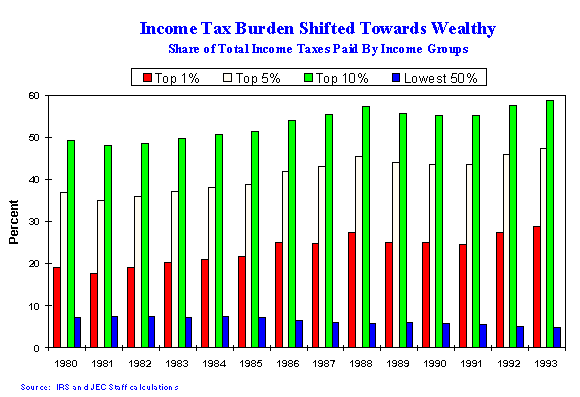
Since 1984 the JEC has provided factual information about the impact of the tax cuts of the 1980s. For example, for many years the JEC has published IRS data on federal tax payments of the top 1 percent, top 5 percent, top 10 percent, and other taxpayers. These data show that after the high marginal tax rates of 1981 were cut, tax payments and the share of the tax burden borne by the top 1 percent climbed sharply. For example, in 1981 the top 1 percent paid 17.6 percent of all personal income taxes, but by 1988 their share had jumped to 27.5 percent, a 10 percentage point increase. The graph below illustrates changes in the tax burden during this period.

The share of the income tax burden borne by the top 10 percent of taxpayers increased from 48.0 percent in 1981 to 57.2 percent in 1988. Meanwhile, the share of income taxes paid by the bottom 50 percent of taxpayers dropped from 7.5 percent in 1981 to 5.7 percent in 1988.

A middle class of taxpayers can be defined as those between the 50th percentile and the 95th percentile (those earning between $18,367 and $72,735 in 1988). Between 1981 and 1988, the income tax burden of the middle class declined from 57.5 percent in 1981 to 48.7 percent in 1988. This 8.8 percentage point decline in middle class tax burden is entirely accounted for by the increase borne by the top one percent.

Several conclusions follow from these data. First of all, reduction in high marginal tax rates can induce taxpayers to lessen their reliance on tax shelters and tax avoidance, and expose more of their income to taxation. The result in this case was a 51 percent increase in real tax payments by the top one percent. Meanwhile, the tax rate reduction reduced the tax payments of middle class and poor taxpayers. The net effect was a marked shift in the tax burden toward the top 1 percent amounting to about 10 percentage points. Lower top marginal tax rates had encouraged these taxpayers to generate more taxable income.

The 1993 Clinton tax increase appears to having the opposite effect on the willingness of wealthy taxpayers to expose income to taxation. According to IRS data, the income generated by the top one percent of income earners actually declined in 1993. This decline is especially significant since the retroactivity of the Clinton tax increase in that year limited the ability of taxpayers to deploy tax avoidance strategies, temporarily resulting in an increase in their tax burden. Moreover, according to the FY 1997 Clinton budget submission, individual income tax revenues as a share of GDP will be lower during the first four years of the Clinton tax increase, which include the effects of the 1990 tax increase, than under the last four years of the Reagan tax changes (FY 1986-89). Furthermore, according to a study published by the National Bureau for Economic Research,[2] the Clinton tax hike is failing to collect over 40 percent of the projected revenue increases.

Incidentally, the claim that unrealistic supply side Reagan Administration revenue projections caused large budget deficits during the 1980s is false. Nonetheless, this false allegation is often used against current tax reform proposals. The official Reagan revenue projections immediately following enactment of ERTA did not assume huge revenue increases, and were actually quite close to the CBO revenue projections. Even the Democrat-controlled CBO projected that deficits would fall after the enactment of the Reagan tax cuts. The real problem was a recession that neither CBO nor OMB could foresee. Even so, individual income tax revenues rose from $244 billion in 1980 to $446 billion in 1989.

Conclusion

The Reagan tax cuts, like similar measures enacted in the 1920s and 1960s, showed that reducing excessive tax rates stimulates growth, reduces tax avoidance, and can increase the amount and share of tax payments generated by the rich. High top tax rates can induce counterproductive behavior and suppress revenues, factors that are usually missed or understated in government static revenue analysis. Furthermore, the key assumption of static revenue analysis that economic growth is not affected by tax changes is disproved by the experience of previous tax reduction programs. There is little reason to expect static revenue analysis to evaluate the economic or distributional effects of current tax reform proposals much better than it evaluated the Reagan tax program 15 years ago.

Christopher Frenze
Chief Economist to the Vice-Chairman

————————————————————

Endnotes:

1. Joint Economic Committee, The Mellon and Kennedy Tax Cuts: A Review and Analysis, 1982.

2. Feldstein, Martin and Daniel Feenberg, The Effect of Increased Tax Rates on Taxable Income and Economic Efficiency: A Preliminary Analysis of the 1993 Tax Rate Increases, NBER, 1995.

Obama’s Right Direction Exposed

Ouch

If this is the right direction — I would rather be wrong than right.

Compiled by: Larry Walker, Jr.

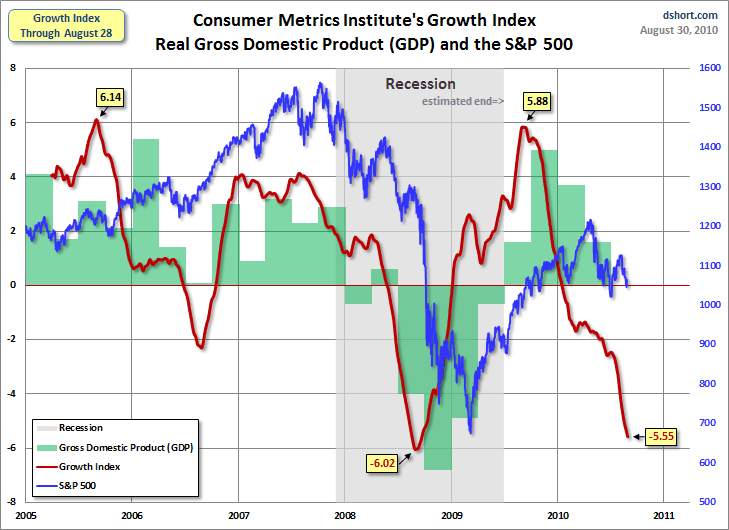
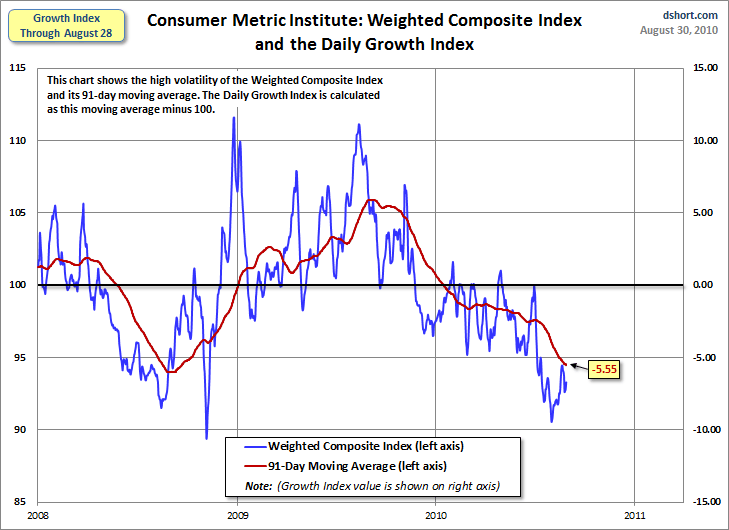
I was looking over the Consumer Metrics Institute’s New Growth Index and some of their other charts (here) and almost fell out of my chair. While every left-wing pundit, Obama, and his inept administration are boldly declaring that we are headed in the right direction, the facts beg to differ.

Who should I believe, the facts or the White House?

Their Conclusion: “As such, the prospect of a double-dip recession, something that’s happened only once since the Great Depression, remains a distinct possibility. That earlier double dip was a 6-month recession from January 1980 to July 1980, a 12-month recovery, and a 16-month of recession from July 1981 to November 1982. The one bit of good news for that earlier period is that the second dip coincided with the end of a secular bear market and the beginning of an 18-year cycle of accelerating growth.”

“The charts below focus on the ‘Trailing Quarter’ Growth Index, which is computed as a 91-day moving average for the year-over-year growth/contraction of the Weighted Composite Index, an index that tracks near real-time consumer behavior in a wide range of consumption categories. The Growth Index is a calculated metric that smooths the volatility and gives a better sense of expansions and contractions in consumption.”

“The 91-day period is useful for comparison with key quarterly metrics such as GDP. Since the consumer accounts for over two-thirds of the US economy, one would expect that a well-crafted index of consumer behavior would serve as a leading indicator. As the chart suggests, during the five-year history of the index, it has generally lived up to that expectation. Actually, the chart understates the degree to which the Growth Index leads GDP. Why? Because the advance estimates for GDP are released a month after the end of the quarter in question, so the Growth Index lead time has been substantial.”

View source, updates and more information here, or go directly to:

http://www.consumerindexes.com/

Congress needs to quit spending, and cut taxes – now. If you’re not part of the solution, you’re part of the problem.

Related posts:

Obama: The Era of Flimflam Economics, Part II ; Are We Heading In The ‘Right’ Direction?

Are We Heading In The ‘Right’ Direction?

Crossroads

That depends on the meaning of the word right. Right?

By: Larry Walker, Jr.

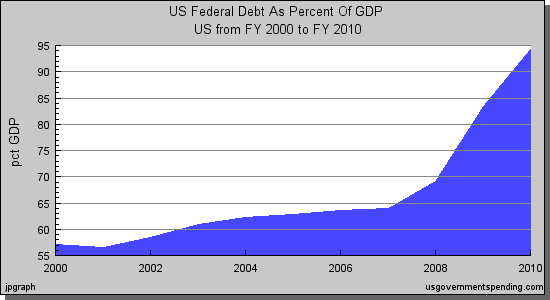
If growing the national debt faster than gross domestic product is the right direction, then the Obama Administration is correct. If the goal is to reach a 100% debt to GDP ratio, as quickly as possible, then the Democrats are correct. If doubling-down on the failed part of Bush policies (i.e. deficit spending) is the right direction, then Democrats are up to par.

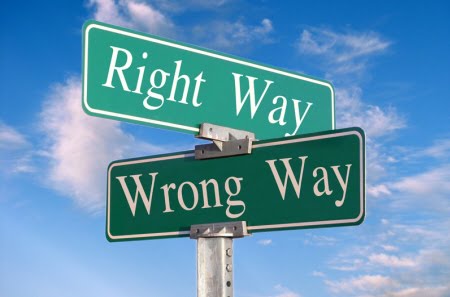
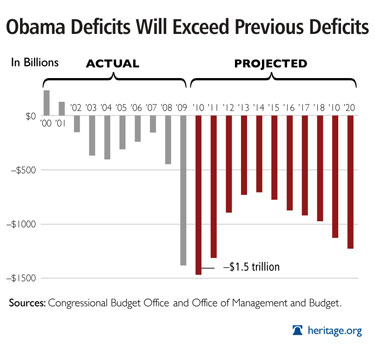
However, if the term ‘right direction’ means that we are heading towards a Conservative resurgence in November, then that would be an honest assessment. Every time I hear Democrats make this declaration in the coming weeks, I’ll be thinking about the Conservative resurgence. The chart below shows the direction we are heading.

Tax Cuts: The Right Direction

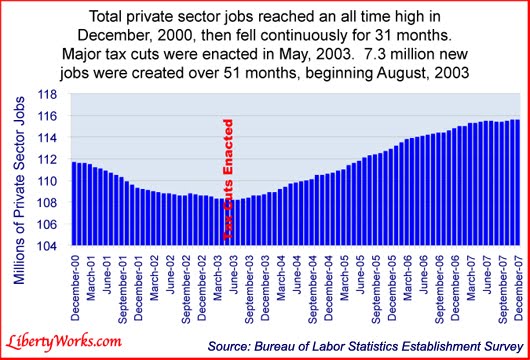
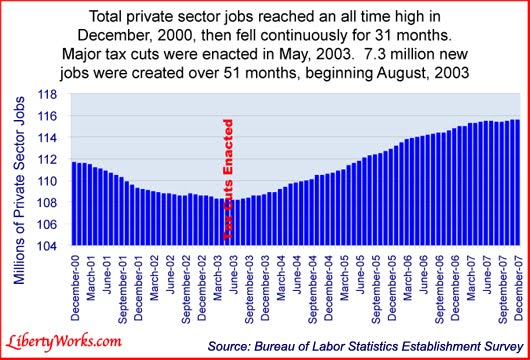
In May of 2003, tax cuts were enacted. The tax cuts were responsible for the creation of 7.3 million new jobs beginning in August of 2003 and lasting through the end of 2007 (source: http://libertyworks.com/bush-tax-cut-myths-and-fallacies-1/). Tax cuts are the only proven method for bringing an economy out of recession. The deeper the tax cut, the greater the expansion.

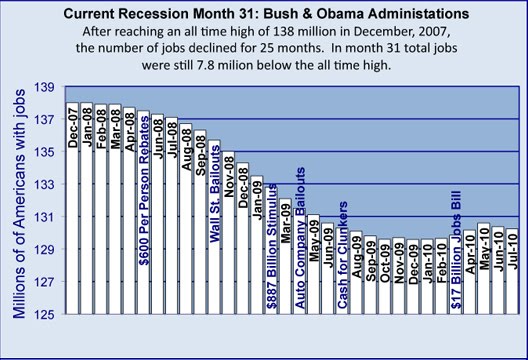
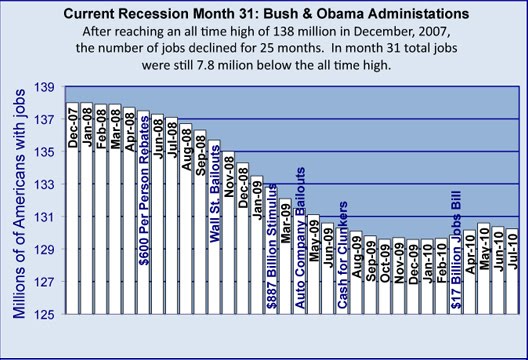
As Liberty Works so aptly reminds us, “President Obama and the Democrat Congress have implemented a series of measures that defy the lessons of past recessions”, especially that of 1981, which was by some measures worse than this one. The chart below shows, “the job market recovery is faltering at best, after 31 months of Bush/Obama policies. There are 8 million fewer Americans now employed than in December, 2007.”

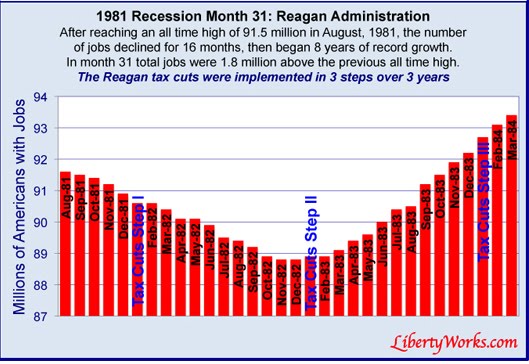
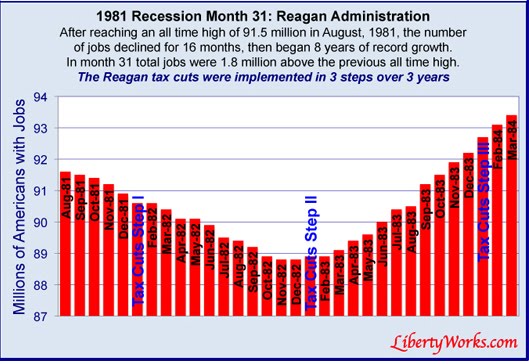
The results in the next chart, speak for themselves. “Reagan’s policies turned the job market around after 16 months of losses. The Reagan economy grew continuously for 90 months, creating a total of 21 million new jobs, or a 24% increase in the number of Americans who were employed.”

Right Means Right

If the goal is to grow the economy, create jobs, and increase tax revenues, then tax cuts are the right direction. However, if the goal is something more sinister, then one must brainwash their constituents into believing that ‘tax cuts cause recessions’; that we are somehow heading in the right direction, and that a tax hike will further this trend.

The facts show that the 1983 and 2003 tax cuts brought us through successful business cycles. In 2008, the housing bubble burst, credit markets froze, and we fell into a deep recession, but tax cuts didn’t cause the recession. If you listen closely, a year ago, Obama was saying the recession was caused by the ‘lack of affordable health insurance’, and today he’s saying that it was caused by ‘tax cuts’. I suppose next he’ll be saying the recession was caused by climate change.

It’s sinister enough to take advantage of a (manufactured) crisis in order to pass unwanted legislation. It’s entirely another matter to purposefully prolong a (manufactured) crisis, to the detriment of every American: black, white, red, yellow, and brown; Democrat, Republican, and Independent. Obama’s play book is little more than the old tried and failed policies of FDR. In an article entitled, “FDR’s policies prolonged Depression by 7 years, UCLA economists calculate“, you will find the following conclusion:

“We found that a relapse isn’t likely unless lawmakers gum up a recovery with ill-conceived stimulus policies.”

Are Democrats doing anything other than gumming up this recovery with ill-conceived stimulus policies? Are we really heading in the right direction?

Congress needs to quit spending, and cut taxes – now. If you’re not part of the solution, you’re part of the problem.

Credits: Photo via sapientsparrow.wordpress.com charts via USGovernmentSpending.com and LibertyWorks.com.

Obama: The Era of Flimflam Economics, Part III

Transformation

Jobs Inheritance Mantra

By: Larry Walker, Jr.

Every time I turn on the news I hear the same sob story, whether it’s Obama, Geithner, Biden, Pelosi, Reid, a left-wing congressperson, or some low level administration official, they all repeat the same Democrat mantra (give or take a few thousand Americans), “We inherited an economy that was losing 700,000 jobs a month.” “We inherited an economy that was losing 750,000 jobs a month.” “We inherited an economy that was losing 800,000 jobs a month.” “Aum – Bush bad, Obama good”. I’m so sick of it that I decided to pull the Bureau of Labor Statistics historical archive to see for myself. Where did they come up with these numbers? Why does it keep growing? Does anyone ever refute the bull…, excuse me, lies? And better still, who cares?

Based on the facts, unemployment didn’t really fall off a cliff until Obama won the election, in November of 2008. That’s when everything went to hell in a hand basket. And where are we today? Other than a few gains in March, April and May of 2010, in large part due to the hiring of around 500,000 temporary census workers, there’s not much to be proud of. The unemployment rate stood at 9.5%, last month, essentially the same as it was in May of 2009. So much for the “Recovery Summer”.

The truth is that in September of 2008 the economy lost (-159,000) jobs which was 89% worse than the previous month’s loss of (-84,000). Then in October of 2008 we lost (-240,000) jobs which was 51% worse than September. Then once Obama was elected, in November 2008, we lost (-533,000) jobs, an increase of 122% over October, and then we lost another (-524,000) in December. Was it just a coincidence that the economy fell off a cliff as soon as Obama won the election? I think not.

The greatest declines in employment occurred as soon as Obama won the election (and really as soon as took the lead in the polls).

August 2008 -84,000

September 2008 -159,000

October 2008 -240,000

—————————-

November 2008 -533,000

December 2008 -524,000

January 2009 -598,000

February 2009 -651,000

March 2009 -663,000

April 2009 -539,000

May 2009 -345,000

June 2009 -467,000

I’m sorry, but I don’t see where Obama inherited an economy that was losing 700,000 to 800,000 jobs per month. Sorry, but the facts don’t support the mantra. The sad truth is that once Obama won the election it was his questionable – identity, qualifications, philosophy, intentions and relations that did the greatest harm to the economy. And even if it turns out to be true, who cares. Who needs a leader who’s constantly making excuses?

I don’t remember President G. W. Bush, or President R. W. Reagan ever complaining about what they inherited from the previous administration, they just did their jobs, gave us some relief through tax cuts, and then things turned around. Somebody needs to stop whining, chanting, and making up numbers – and just do their jobs. Cut taxes, cut spending, then sit down and shut up. If you can’t handle that, then resign.

You may review the archived Employment Situation Reports available from the Bureau of Labor Statistics and decide for yourself.

If you’re not part of the solution, you’re part of the problem. And if all you can do is make excuses, then you’re not part of the solution.

[Revised on 9/5/2010 – Chopped down to emphasize the point about: Who cares? Stop making excuses and deal with reality. Obama was a threat to the economy long before his official election date, and people simply cut their losses and fled as he came into power. Things will get better the day he leaves office.]

Obama: The Era of Flimflam Economics, Part II

Too Much Stimulus

Untimely and Proven to Fail

By: Larry Walker, Jr.

Near the end of 2007, prominent economists began advising the federal government that the economy was heading into a recession. They also mistakenly advised that the recession could be avoided if the government were able to implement some kind of economic stimulus program. In order to work successfully, such a stimulus needed to be large, targeted, and timely. Tax refund checks needed to reach taxpayers in a matter of weeks not months. Economists must have forgotten that they were dealing with the federal government.

Recessions are a normal part of the business cycle. The U.S. has averaged a recession about once every five years since WWII. Although economists have gotten better at predicting business cycles, it’s fairly clear that no one has ever been able to sidestep a recession. Avoiding a recession is like trying to stop an oncoming hurricane, when you see it coming you get out of the way, wait for the storm to subside, and then focus on recovery.

An economic stimulus package was proposed in January of 2008, in order to avert the recession. Although a similar stimulus plan had been attempted in 2001, and failed to prevent a recession, Congress was compelled to it try again. By the time the checks reached taxpayers, in April of 2008, it was too late, the recession had commenced.

In February of 2009 President Obama enacted a second stimulus plan. What was that about? Was he trying to prevent something that had already occurred? The Obama stimulus plan occurred more than a year after it was originally called for. By the time Congress passed Obama’s stimulus plan, the economy was well in the midst of recession. The only purpose of an economic stimulus is to avert a recession. Once an economy is in recession, a whole new set of policies is required. As of this month, around nineteen months after Obama’s first failed stimulus program, and nearly 2 1/2 years after Bush’s tardy attempt, Obama is still talking about a stimulus plan. Isn’t this just economic flimflam?

It should be obvious by now that stimulus programs don’t work in the real world. Although the classroom theory is plausible, the federal government is not an efficient vehicle for carrying one out. What should also be obvious is the type of recovery policies that work, once a recession has occurred. The 2003 Bush Tax Cuts and the 1983 Reagan Tax Cuts were effective tools in creating economic expansions following severe recessions.

If the goal is to grow the economy, create jobs, and increase tax revenues, then tax cuts are the way to go. However, if the goal is to flush trillions of borrowed dollars down the drain by attempting something that’s untimely and proven to fail, then maybe that’s Obama’s fate. Obama’s first stimulus plan was untimely and proven to fail, a kind of Flimflam Economics. And even today, he is talking about another economic stimulus program. Again, is Obama trying to prevent something which has already occurred? Does Obama really have the best interests of America at heart?

Stimulus: The Need for Speed

In a January 20, 2008 Dow Jones News article entitled, “The Need for Speed”, it was stated that, “A plan out of Washington to stimulate the flagging US economy may be a day late, but it certainly isn’t a dollar short.” Two days earlier, President George W. Bush called for fast tax relief for individuals and tax incentives for businesses that would total up to $150 billion.

Economists said that would be enough of a jolt to have a notable impact on growth, if done right and quickly. Bush said the tax relief for consumers could be a “shot in the arm to keep a fundamentally strong economy healthy.” Bush’s rough draft proposal highlighted the US economy’s big problem: the consumer.

“Americans could use this money as they see fit: to help meet their monthly bills, cover higher costs at the gas pump or pay for other basic necessities,” the president said.

Bush wasted no time announcing the rescue plan after getting a firm nod of approval Thursday from the country’s pre-eminent economic policymaker, Fed Chairman Ben Bernanke. The central bank chief said he would approve of such a fiscal stimulus plan so long as it was “timely” and implemented “decisively” and “quickly.”

The need for speed in such a plan is no doubt important, as Bernanke pointed out Thursday. If Congress dilly-dallies on the matter, rebate checks may not arrive to consumers in time to fortify the weak economic growth that is likely to continue throughout 2008.

Lakshman Achuthan, managing director of the Economic Cycle Research Institute in New York, said the fiscal plan essentially calls for “throwing a ‘money wrench’ into the system.” That plan, he said, can be successful, but he said rebate checks need to start arriving in “the next few weeks.”

Democrat Congress Drags Feet

Now scroll forward to a March 21, 2008, Financial Week article entitled, “U.S. can’t avoid recession, says influential forecaster”. The subtitle reads, “Economic Cycle Research Institute claims economy ‘on a recessionary course’; blames Congress for tardy rebate checks.”

Mr. Achuthan argued that this recession could have been averted had Congress considered “innovative ways” to get tax rebates into consumers’ hands sooner. (The rebates still have not begun to reach taxpayers). “Following a presidential initiative, Congress passed a tax rebate package with unusual speed, as officials noted that time was of the essence,” he wrote, “but they were content to let the rebates start reaching consumers several months later.”

Choosing Recession

Moving forward to an April 21, 2008, Forbes article entitled, “Choosing Recession”, Lakshman Achuthan and Anirvan Banerji stated, “This recession was actually avoidable as recently as several weeks ago.” They added, “The 2008 recession guarantees many months of job losses that will boost foreclosures and feed the credit crisis. But if fiscal stimulus had reached consumers quickly, it would have forestalled a recession, helping to stabilize the housing market. Such a soft landing would have bought some breathing room in which to resolve the credit crisis until the lagged effect of monetary policy kicked in.”

They continued, “Policy makers seemed to get the urgency. In January, Treasury Secretary Hank Paulson declared that “time is of the essence.” House Speaker Nancy Pelosi spoke of “timely, targeted and temporary” stimulus, and the administration and Congress enacted a tax rebate package with exemplary speed. The fatal flaw was their willingness to allow a delayed delivery of the stimulus. It was as if the medics had arrived and taken a quick decision to administer CPR–but in a few months rather than a few seconds.”

Stimulus Arrives Late

Later, an April 28, 2008 report on CNN Money summed it up, in an article entitled, “U.S. can’t avoid recession, says influential forecaster”. Tax rebates had started to arrive in bank accounts. But many economists we’re doubtful that they would keep the economy from recession. The stimulus package was to give rebates to about 130 million Americans, at a cost of more than $110 billion. Married taxpayers earning $150,000 or less were to receive up to $1,200, while single taxpayers earning under $75,000 would get up to $600. But it was too late.

“This will not avert a recession, because it is too late,” said Lakshman Achuthan, the managing director of the Economic Cycle Research Institute. “For this to have kept us out of what was an avoidable recession, it needed to happen a couple of months ago, in January or February.”

Obama’s Plan: A Year Late and $900 Billion Short

Months later appeared a November 22, 2008 article by NPR entitled, “Obama Offers Plan to Revive Economy“. The author lead with, “President-elect Barack Obama set out plans for an ambitious economic stimulus that would create 2.5 million jobs by January 2011”.

“We’ll put people back to work rebuilding our crumbling roads and bridges, modernizing schools that are failing our children, and building wind farms and solar panels, fuel-efficient cars and the alternative energy technologies that can free us from our dependence on foreign oil and keep our economy competitive in the years ahead,” he said.

In the same November 22, 2008 NPR article, business and economics historian John Steele Gordon stated that, “the New Deal didn’t end the Great Depression, World War II did.” He added that “building bridges and painting schools won’t provide a quick fix.” He was right. The Great Depression lasted from 1929 until 1945, or around 15 years, and it didn’t end through the action of any clever government policy.

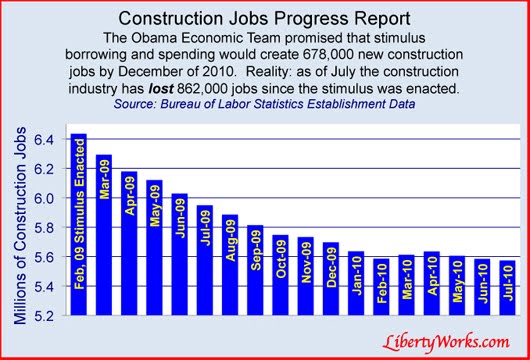
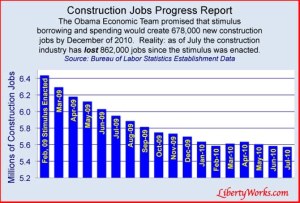
According to Liberty Works, the Obama Economic Team promised that stimulus borrowing and spending would create 678,000 new construction jobs by December of 2010. However, by July of 2010, the construction industry had actually lost 862,000 jobs.
Tax Cuts Work

During the 2001 economic recession, the government attempted an economic stimulus in the form of tax rebates (similar to the 2008 rebates), but it likewise failed. Then finally in May of 2003, the Bush tax cuts were enacted. The tax cuts were responsible for the creation of 7.3 million new jobs beginning in August of 2003 and lasting through the end of 2007. Tax cuts are the only proven method for bringing an economy out of recession. The deeper the tax cut, the greater the expansion.
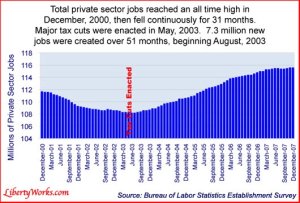
As the website Liberty Works so aptly reminds us, “President Obama and the Democrat Congress have implemented a series of measures that defy the lessons of past recessions”, especially that of 1981, which was by some measures worse than this one.
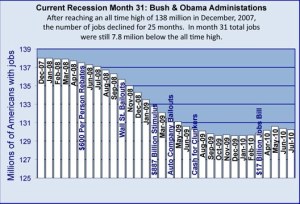
The chart above shows, “the job market recovery is faltering at best, after 31 months of Bush/Obama policies. There are 8 million fewer Americans now employed than in December, 2007.”

The results in the second chart (above), speak for themselves. “Reagan’s policies turned the job market around after 16 months of losses. The Reagan economy grew continuously for 90 months, creating a total of 21 million new jobs, or a 24% increase in the number of Americans who were employed.”

You’ve Been Flimflammed

If the goal is to grow the economy, create jobs, and increase tax revenues, then tax cuts are the way to go. However, if the goal is something more sinister, then one must brainwash their constituents into believing that ‘tax cuts cause recessions’. The Bush tax cuts brought us through another successful business cycle. Then the housing bubble burst, credit markets froze, and we fell back into recession. But tax cuts didn’t cause the recession. I don’t mind cutting Bush to pieces where warranted, and I was doing just that in 2007/08, but to say that the Bush tax cuts didn’t work because you disagree with his foreign policy is ignorant.

Whether or not the recession could have been avoided is highly doubtful due to the severity of the housing bubble and credit crisis. Yet if you listen closely, a year ago Obama was saying the recession was caused by the ‘lack of affordable health insurance’, and today he’s saying that it was caused by the ‘Bush tax cuts’. I suppose next he’ll be saying the recession was caused by whatever supports the legislation du jour.

It’s sinister enough to take advantage of a crisis in order to pass an unwanted legislative agenda. It’s entirely another matter to purposefully prolong a crisis to the detriment of every American: black, white, red, yellow, and brown; Democrat, Republican, and Independent. In fact, Obama’s looking more and more like another FDR. In FDR’s policies prolonged Depression by 7 years, UCLA economists calculate, you will find the following quote: “We found that a relapse isn’t likely unless lawmakers gum up a recovery with ill-conceived stimulus policies.”

Congress needs to cut spending, and cut taxes, now. If you’re not part of the solution, you’re part of the problem.

Obama: The Era of Flimflam Economics, Part I

Flimflammer in Chief

Economic Flimflam – Deceptive Nonsense

By: Larry Walker, Jr.

Down here on Main Street, while company X is waiting for person Y to pay their past due bill, company X is cutting back on everything it can, and borrowing money to fill the void. When person Y finally gets that stimulus money and pays their debt, company X will use the money to payback what was borrowed. Company X is not aggressively pursuing new business out of fear of attracting more deadbeat customers, but instead is focused on downsizing and preserving trusted relationships. Company X is now practicing sound business policy (i.e. fiscal responsibility). After nearly two years of being flimflammed, we find that demand has not been sparked, and that not one new job has been created.

Theory P – Temporary Stimulus Drives the Economy (False)

Rationale: If we give 150 million taxpayers a $400 annual tax credit for working, they will go out and spend it, which will spark additional demand, which will in turn fuel an economic recovery. Once the demand begins, Joe the widget maker will start getting a flood of calls for his product and will hire new employees, and buy new equipment as he expands his operation. So next we will need to make loans available for small businesses so they can prepare for the massive expansion. Problem solved. Government stimulus works, right? Wrong.

In Reality – When the government gives a $400 annual tax credit to a person who is broke, in debt, behind on bills, about to lose a job, or behind on their rent (or house note), it won’t be spent on anything new. It will be either saved, used to pay a debt, expedited to pay a past due bill, eaten, drank or smoked.

Under theory P, when the federal government gives a little extra money to person Y, person Y will go out and buy a new car, or a new house, or I-Pad, or something to help the economy. One problem is everyone knows that what the government is promoting is just a tiny, temporary fix. Lets get real, it’s not like person Y is going to get an extra $400 per month, which would possibly pay a car note. Instead, person Y is receiving an extra $33.33 per month (money that normally goes towards income taxes), and $33.33 per month doesn’t go very far in 2010 (it’s amazing that millionaire, Washington elitists don’t understand this). The clincher is that a stimulus, by its nature, is only temporary. Sure, tax credits were provided in 2009 and 2010, but will be capped off by a massive tax increase in 2011. The proposed tax increase will likely be at least double the pathetic stimulus.

‘As the government giveth, so the government taketh away.’

The other part of theory P involves making loans available for small businesses. The loans will theoretically be used to keep the doors open, and to meet payroll while small businesses wait on the massive flood of demand that’s sure to come. The only problem is that the demand came and went with the stimulus checks. So company X is reluctant to commit collateral for additional loans (loans that it may not be able to repay). So the government is encouraging small businesses to take the loans anyway. “Take a chance,” they say. “Hire some people, spend some money, add another location, get things moving and surely the demand will come.” In response, businesses have cut back more, and layoffs persist.

Theory C – Permanent Tax Cuts Do Drive the Economy (True)

Rationale: Under this theory taxes are cut permanently, and incentives are provided for business investment. Let’s give person Y an extra $400 per month, permanently, and see what happens. At the same time, let’s give business X a large incentive to invest and expand. What happens?

The Reality – Initially, person Y will pay off any past due bills, but within a few short months may go ahead and purchase that new car, or a new home, or an I-Pad (or two). Company X will begin to see real sustained demand, and will begin to hire and to think about expansion. With more people working, and with multiples of increased demand, the flame will have been kindled, and recovery will have begun. Tax revenues will increase as the economy grows, and as 15 million unemployed begin to become productive members of society.

The Flimflam Guys – Now, in step the flimflam guys (Krugman, Obama, Geithner, Greenspan, Reid, Pelosi and company) claiming that such a huge tax cut will only add to the current budget deficit.

After adding $2.7 trillion to the federal debt over the past two years and achieving nothing, now these geniuses want to complain about the deficit? Shut the hell up. Sorry but we’re not buying it this time. You had your shot and you failed. Those guys that you call the ‘party of no’, you know, the ones who have offered, “Not one new idea,” told you about ‘theory C’ before you flushed our money down the toilet and you mocked them. Now I guess you have to choose between eating crow, and sending the economy into an endless spiral of debt, inflation and higher taxes.

‘If you can’t stand the crow, just add a little more of Krugman’s Flimflam Sauce.’

The smart money’s on Theory C. Tax cuts work, but they will only work, if you cut spending on everything else across the board, and this is exactly what needs to happen. Cut out the wasteful spending, and give us a real tax cut.