MythBuster: Has Obama Created More Jobs Than Bush?

Hmmm!

Rational or Ridiculous

by: Larry Walker, Jr.

So the latest spin by the left-wing media and the White House is to repeat the following mantra, “Obama created more jobs in 2010 than Bush did in eight years.” However, how much sense does it make to compare an arbitrary nine-month period for Obama to a full eight-year term? Well none, none at all, at least not within the realm of rational human thought. For those of us who are rationally-minded, we will begin with the month that Obama took office, and compare his full term to-date with whomever.

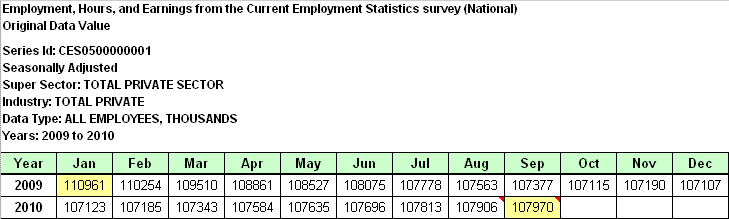
Turning to the Bureau of Labor Statistics (BLS), when we added up the total number of private sector jobs created during Obama’s short twenty one month tenure, we found that a total of 2,991,000 jobs had been lost (110,961,000 – 107,970,000). Oops!

Private Sector Jobs 2009/2010

Total Private Sector Employment (Bureau of Labor Statistics)

Private Sector Job Growth (Loss)

Busted!

Although I too could cherry-pick and find periods where private sector job growth was up by 4 or 5 million under Bush, I choose to remain among the rational. Needless to say, private sector job growth was at least slightly positive over Bush’s eight-year term, while under Obama, the words – worst track record in history – come to mind.

Is there no shame?

Also see: Tracking the 3.5 Million Jobs Obama Saved or Created and Deceptive Claim from Obama & The Democrats or Obama’s New Reality: Black Unemployment

Dismantling Nancy Pelosi

Nancy Pelosi (D-CA)

Common Sense and Opportunity Cost

By: Larry Walker, Jr.

According to the Speaker of the House of Representatives, Democrat, Nancy Pelosi, “For every dollar a person receives in food stamps, $1.79 is put back into the economy. It is the biggest bang for the buck when you do food stamps and unemployment insurance. The biggest bang for the buck.”

It’s the biggest bang for the buck versus what? There is a basic concept in economics known as opportunity cost, which teaches us that for every choice we make, there is a cost which is related to the next-best choice available. In other words, if unemployment and food stamps provide the biggest bang for the buck, does that mean it’s better to be unemployed than employed? Let’s put this under the microscope.

Joe the Salesman generates commission income for his company of 5% of the amount of sales produced. Out of the income generated for the company, Joe receives a cut of 50%. Let’s assume that Joe personally makes gross pre-tax commission income of $50,000 in a year. In order to generate this income Joe’s sales must have been $2,000,000 for the year. The company Joe works for receives commission income of $100,000 and pays Joe his cut of 50%, or $50,000.

What has Joe produced? Joe has contributed a total of $2,000,000 in economic activity in order to earn his pay. This $2,000,000 will multiply throughout the economy vertically and horizontally through related businesses and suppliers. Joe earns his keep and is a productive member of society.

Now let’s look at Joe after he has been laid off and becomes a recipient of unemployment benefits and food stamps:

Joe is now on unemployment and he receives $15,800 per year in unemployment benefits and $5,000 in food stamps. Joe produces nothing to receive this income. Sure, Joe still spends all of his money on rent, food and the basic necessities, but the multiplier effect can only be calculated on the $20,800 that Joe receives and spends. The unemployment checks that Joe receives are generated from unemployment insurance payments made by his former employer, leaving the employer with less money to work with, as well as a smaller amount of sales and productivity. The food stamps he receives are funded by taxpayer dollars, which are currently paid for by money, which is being borrowed by the federal government. [Note: When congress chose to extend unemployment benefits for up to 99 weeks, the added cost was also deficit-financed.]

So if we are talking about the multiplier effect, then which Joe has the greatest impact, the working Joe, or the unemployed Joe?

Assuming that Nancy Pelosi was correct in her statement that, for every dollar spent on unemployment insurance and food stamps $1.79 is added to the economy, and assuming that the same multiple applies to the private sector, which sector will provide the biggest bang for the buck?

Working Joe produced $2,000,000 in gross sales, so he will have added $3,580,000 in economic activity.

Unemployed Joe produced nothing, but did consume $20,800 worth of goods and services. However, out of this, $15,800 was taken from his former employer, and $5,000 from taxpayers, which reduced their consumption dollar-for-dollar. In effect, unemployed Joe took $20,800 from another working Joe and spent the other working Joe’s money. But the other working Joe would have spent or invested the same money anyway. Thus, in my opinion, the multiplier effect of unemployed Joe is zero, since just a different Joe is spending the same money.

To make matters worse, not only is the unemployment and food stamps multiplier zero, it is negative, in my opinion. Why? Because of the fact that unemployed Joe’s food stamps and part of his unemployment benefits were paid for with deficit-financed money. Generations of working Joe’s across the country will be paying interest on this debt, through higher taxes, for years to come and eventually will have paid more than twice the initial amount in principal and interest payments. On top of this, Joe’s former employer is on the hook for higher unemployment insurance premiums, which could have been invested or spent to create additional jobs.

Lesson: All private sector employees produce more than they are paid, that’s the whole point. Unemployed persons produce nothing and merely spend dollars that would have been spent or otherwise invested more productively. The biggest bang for the buck is achieved through implementing government policies, which promote private sector growth, not through unemployment insurance and food stamps.

Obama: The Era of Flimflam Economics, Part III

Transformation

Jobs Inheritance Mantra

By: Larry Walker, Jr.

Every time I turn on the news I hear the same sob story, whether it’s Obama, Geithner, Biden, Pelosi, Reid, a left-wing congressperson, or some low level administration official, they all repeat the same Democrat mantra (give or take a few thousand Americans), “We inherited an economy that was losing 700,000 jobs a month.” “We inherited an economy that was losing 750,000 jobs a month.” “We inherited an economy that was losing 800,000 jobs a month.” “Aum – Bush bad, Obama good”. I’m so sick of it that I decided to pull the Bureau of Labor Statistics historical archive to see for myself. Where did they come up with these numbers? Why does it keep growing? Does anyone ever refute the bull…, excuse me, lies? And better still, who cares?

Based on the facts, unemployment didn’t really fall off a cliff until Obama won the election, in November of 2008. That’s when everything went to hell in a hand basket. And where are we today? Other than a few gains in March, April and May of 2010, in large part due to the hiring of around 500,000 temporary census workers, there’s not much to be proud of. The unemployment rate stood at 9.5%, last month, essentially the same as it was in May of 2009. So much for the “Recovery Summer”.

The truth is that in September of 2008 the economy lost (-159,000) jobs which was 89% worse than the previous month’s loss of (-84,000). Then in October of 2008 we lost (-240,000) jobs which was 51% worse than September. Then once Obama was elected, in November 2008, we lost (-533,000) jobs, an increase of 122% over October, and then we lost another (-524,000) in December. Was it just a coincidence that the economy fell off a cliff as soon as Obama won the election? I think not.

The greatest declines in employment occurred as soon as Obama won the election (and really as soon as took the lead in the polls).

August 2008 -84,000

September 2008 -159,000

October 2008 -240,000

—————————-

November 2008 -533,000

December 2008 -524,000

January 2009 -598,000

February 2009 -651,000

March 2009 -663,000

April 2009 -539,000

May 2009 -345,000

June 2009 -467,000

I’m sorry, but I don’t see where Obama inherited an economy that was losing 700,000 to 800,000 jobs per month. Sorry, but the facts don’t support the mantra. The sad truth is that once Obama won the election it was his questionable – identity, qualifications, philosophy, intentions and relations that did the greatest harm to the economy. And even if it turns out to be true, who cares. Who needs a leader who’s constantly making excuses?

I don’t remember President G. W. Bush, or President R. W. Reagan ever complaining about what they inherited from the previous administration, they just did their jobs, gave us some relief through tax cuts, and then things turned around. Somebody needs to stop whining, chanting, and making up numbers – and just do their jobs. Cut taxes, cut spending, then sit down and shut up. If you can’t handle that, then resign.

You may review the archived Employment Situation Reports available from the Bureau of Labor Statistics and decide for yourself.

If you’re not part of the solution, you’re part of the problem. And if all you can do is make excuses, then you’re not part of the solution.

[Revised on 9/5/2010 – Chopped down to emphasize the point about: Who cares? Stop making excuses and deal with reality. Obama was a threat to the economy long before his official election date, and people simply cut their losses and fled as he came into power. Things will get better the day he leaves office.]

Obama: The Era of Flimflam Economics, Part II

Too Much Stimulus

Untimely and Proven to Fail

By: Larry Walker, Jr.

Near the end of 2007, prominent economists began advising the federal government that the economy was heading into a recession. They also mistakenly advised that the recession could be avoided if the government were able to implement some kind of economic stimulus program. In order to work successfully, such a stimulus needed to be large, targeted, and timely. Tax refund checks needed to reach taxpayers in a matter of weeks not months. Economists must have forgotten that they were dealing with the federal government.

Recessions are a normal part of the business cycle. The U.S. has averaged a recession about once every five years since WWII. Although economists have gotten better at predicting business cycles, it’s fairly clear that no one has ever been able to sidestep a recession. Avoiding a recession is like trying to stop an oncoming hurricane, when you see it coming you get out of the way, wait for the storm to subside, and then focus on recovery.

An economic stimulus package was proposed in January of 2008, in order to avert the recession. Although a similar stimulus plan had been attempted in 2001, and failed to prevent a recession, Congress was compelled to it try again. By the time the checks reached taxpayers, in April of 2008, it was too late, the recession had commenced.

In February of 2009 President Obama enacted a second stimulus plan. What was that about? Was he trying to prevent something that had already occurred? The Obama stimulus plan occurred more than a year after it was originally called for. By the time Congress passed Obama’s stimulus plan, the economy was well in the midst of recession. The only purpose of an economic stimulus is to avert a recession. Once an economy is in recession, a whole new set of policies is required. As of this month, around nineteen months after Obama’s first failed stimulus program, and nearly 2 1/2 years after Bush’s tardy attempt, Obama is still talking about a stimulus plan. Isn’t this just economic flimflam?

It should be obvious by now that stimulus programs don’t work in the real world. Although the classroom theory is plausible, the federal government is not an efficient vehicle for carrying one out. What should also be obvious is the type of recovery policies that work, once a recession has occurred. The 2003 Bush Tax Cuts and the 1983 Reagan Tax Cuts were effective tools in creating economic expansions following severe recessions.

If the goal is to grow the economy, create jobs, and increase tax revenues, then tax cuts are the way to go. However, if the goal is to flush trillions of borrowed dollars down the drain by attempting something that’s untimely and proven to fail, then maybe that’s Obama’s fate. Obama’s first stimulus plan was untimely and proven to fail, a kind of Flimflam Economics. And even today, he is talking about another economic stimulus program. Again, is Obama trying to prevent something which has already occurred? Does Obama really have the best interests of America at heart?

Stimulus: The Need for Speed

In a January 20, 2008 Dow Jones News article entitled, “The Need for Speed”, it was stated that, “A plan out of Washington to stimulate the flagging US economy may be a day late, but it certainly isn’t a dollar short.” Two days earlier, President George W. Bush called for fast tax relief for individuals and tax incentives for businesses that would total up to $150 billion.

Economists said that would be enough of a jolt to have a notable impact on growth, if done right and quickly. Bush said the tax relief for consumers could be a “shot in the arm to keep a fundamentally strong economy healthy.” Bush’s rough draft proposal highlighted the US economy’s big problem: the consumer.

“Americans could use this money as they see fit: to help meet their monthly bills, cover higher costs at the gas pump or pay for other basic necessities,” the president said.

Bush wasted no time announcing the rescue plan after getting a firm nod of approval Thursday from the country’s pre-eminent economic policymaker, Fed Chairman Ben Bernanke. The central bank chief said he would approve of such a fiscal stimulus plan so long as it was “timely” and implemented “decisively” and “quickly.”

The need for speed in such a plan is no doubt important, as Bernanke pointed out Thursday. If Congress dilly-dallies on the matter, rebate checks may not arrive to consumers in time to fortify the weak economic growth that is likely to continue throughout 2008.

Lakshman Achuthan, managing director of the Economic Cycle Research Institute in New York, said the fiscal plan essentially calls for “throwing a ‘money wrench’ into the system.” That plan, he said, can be successful, but he said rebate checks need to start arriving in “the next few weeks.”

Democrat Congress Drags Feet

Now scroll forward to a March 21, 2008, Financial Week article entitled, “U.S. can’t avoid recession, says influential forecaster”. The subtitle reads, “Economic Cycle Research Institute claims economy ‘on a recessionary course’; blames Congress for tardy rebate checks.”

Mr. Achuthan argued that this recession could have been averted had Congress considered “innovative ways” to get tax rebates into consumers’ hands sooner. (The rebates still have not begun to reach taxpayers). “Following a presidential initiative, Congress passed a tax rebate package with unusual speed, as officials noted that time was of the essence,” he wrote, “but they were content to let the rebates start reaching consumers several months later.”

Choosing Recession

Moving forward to an April 21, 2008, Forbes article entitled, “Choosing Recession”, Lakshman Achuthan and Anirvan Banerji stated, “This recession was actually avoidable as recently as several weeks ago.” They added, “The 2008 recession guarantees many months of job losses that will boost foreclosures and feed the credit crisis. But if fiscal stimulus had reached consumers quickly, it would have forestalled a recession, helping to stabilize the housing market. Such a soft landing would have bought some breathing room in which to resolve the credit crisis until the lagged effect of monetary policy kicked in.”

They continued, “Policy makers seemed to get the urgency. In January, Treasury Secretary Hank Paulson declared that “time is of the essence.” House Speaker Nancy Pelosi spoke of “timely, targeted and temporary” stimulus, and the administration and Congress enacted a tax rebate package with exemplary speed. The fatal flaw was their willingness to allow a delayed delivery of the stimulus. It was as if the medics had arrived and taken a quick decision to administer CPR–but in a few months rather than a few seconds.”

Stimulus Arrives Late

Later, an April 28, 2008 report on CNN Money summed it up, in an article entitled, “U.S. can’t avoid recession, says influential forecaster”. Tax rebates had started to arrive in bank accounts. But many economists we’re doubtful that they would keep the economy from recession. The stimulus package was to give rebates to about 130 million Americans, at a cost of more than $110 billion. Married taxpayers earning $150,000 or less were to receive up to $1,200, while single taxpayers earning under $75,000 would get up to $600. But it was too late.

“This will not avert a recession, because it is too late,” said Lakshman Achuthan, the managing director of the Economic Cycle Research Institute. “For this to have kept us out of what was an avoidable recession, it needed to happen a couple of months ago, in January or February.”

Obama’s Plan: A Year Late and $900 Billion Short

Months later appeared a November 22, 2008 article by NPR entitled, “Obama Offers Plan to Revive Economy“. The author lead with, “President-elect Barack Obama set out plans for an ambitious economic stimulus that would create 2.5 million jobs by January 2011”.

“We’ll put people back to work rebuilding our crumbling roads and bridges, modernizing schools that are failing our children, and building wind farms and solar panels, fuel-efficient cars and the alternative energy technologies that can free us from our dependence on foreign oil and keep our economy competitive in the years ahead,” he said.

In the same November 22, 2008 NPR article, business and economics historian John Steele Gordon stated that, “the New Deal didn’t end the Great Depression, World War II did.” He added that “building bridges and painting schools won’t provide a quick fix.” He was right. The Great Depression lasted from 1929 until 1945, or around 15 years, and it didn’t end through the action of any clever government policy.

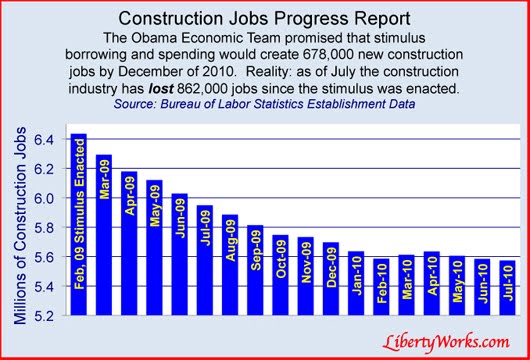
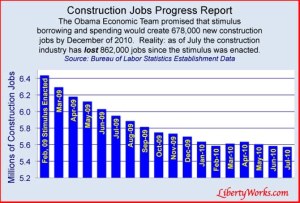
According to Liberty Works, the Obama Economic Team promised that stimulus borrowing and spending would create 678,000 new construction jobs by December of 2010. However, by July of 2010, the construction industry had actually lost 862,000 jobs.
Tax Cuts Work

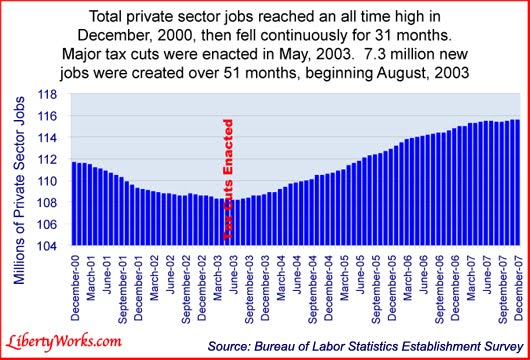
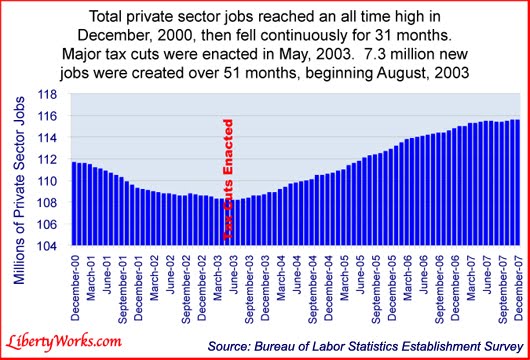
During the 2001 economic recession, the government attempted an economic stimulus in the form of tax rebates (similar to the 2008 rebates), but it likewise failed. Then finally in May of 2003, the Bush tax cuts were enacted. The tax cuts were responsible for the creation of 7.3 million new jobs beginning in August of 2003 and lasting through the end of 2007. Tax cuts are the only proven method for bringing an economy out of recession. The deeper the tax cut, the greater the expansion.
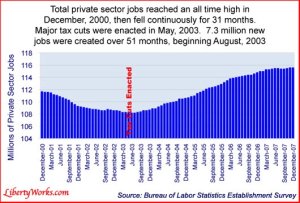
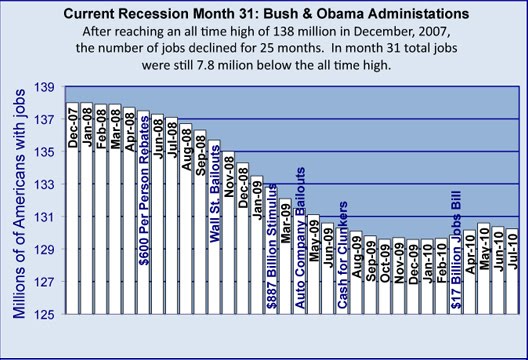
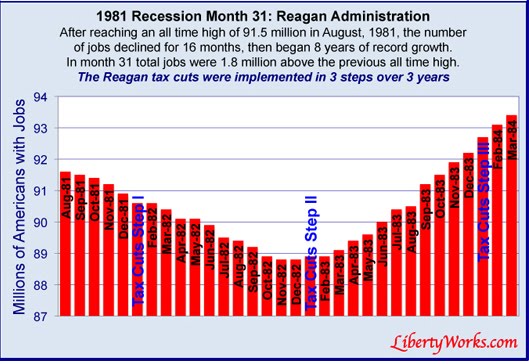
As the website Liberty Works so aptly reminds us, “President Obama and the Democrat Congress have implemented a series of measures that defy the lessons of past recessions”, especially that of 1981, which was by some measures worse than this one.
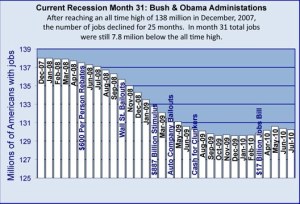
The chart above shows, “the job market recovery is faltering at best, after 31 months of Bush/Obama policies. There are 8 million fewer Americans now employed than in December, 2007.”

The results in the second chart (above), speak for themselves. “Reagan’s policies turned the job market around after 16 months of losses. The Reagan economy grew continuously for 90 months, creating a total of 21 million new jobs, or a 24% increase in the number of Americans who were employed.”

You’ve Been Flimflammed

If the goal is to grow the economy, create jobs, and increase tax revenues, then tax cuts are the way to go. However, if the goal is something more sinister, then one must brainwash their constituents into believing that ‘tax cuts cause recessions’. The Bush tax cuts brought us through another successful business cycle. Then the housing bubble burst, credit markets froze, and we fell back into recession. But tax cuts didn’t cause the recession. I don’t mind cutting Bush to pieces where warranted, and I was doing just that in 2007/08, but to say that the Bush tax cuts didn’t work because you disagree with his foreign policy is ignorant.

Whether or not the recession could have been avoided is highly doubtful due to the severity of the housing bubble and credit crisis. Yet if you listen closely, a year ago Obama was saying the recession was caused by the ‘lack of affordable health insurance’, and today he’s saying that it was caused by the ‘Bush tax cuts’. I suppose next he’ll be saying the recession was caused by whatever supports the legislation du jour.

It’s sinister enough to take advantage of a crisis in order to pass an unwanted legislative agenda. It’s entirely another matter to purposefully prolong a crisis to the detriment of every American: black, white, red, yellow, and brown; Democrat, Republican, and Independent. In fact, Obama’s looking more and more like another FDR. In FDR’s policies prolonged Depression by 7 years, UCLA economists calculate, you will find the following quote: “We found that a relapse isn’t likely unless lawmakers gum up a recovery with ill-conceived stimulus policies.”

Congress needs to cut spending, and cut taxes, now. If you’re not part of the solution, you’re part of the problem.

Obama: The Era of Flimflam Economics, Part I

Flimflammer in Chief

Economic Flimflam – Deceptive Nonsense

By: Larry Walker, Jr.

Down here on Main Street, while company X is waiting for person Y to pay their past due bill, company X is cutting back on everything it can, and borrowing money to fill the void. When person Y finally gets that stimulus money and pays their debt, company X will use the money to payback what was borrowed. Company X is not aggressively pursuing new business out of fear of attracting more deadbeat customers, but instead is focused on downsizing and preserving trusted relationships. Company X is now practicing sound business policy (i.e. fiscal responsibility). After nearly two years of being flimflammed, we find that demand has not been sparked, and that not one new job has been created.

Theory P – Temporary Stimulus Drives the Economy (False)

Rationale: If we give 150 million taxpayers a $400 annual tax credit for working, they will go out and spend it, which will spark additional demand, which will in turn fuel an economic recovery. Once the demand begins, Joe the widget maker will start getting a flood of calls for his product and will hire new employees, and buy new equipment as he expands his operation. So next we will need to make loans available for small businesses so they can prepare for the massive expansion. Problem solved. Government stimulus works, right? Wrong.

In Reality – When the government gives a $400 annual tax credit to a person who is broke, in debt, behind on bills, about to lose a job, or behind on their rent (or house note), it won’t be spent on anything new. It will be either saved, used to pay a debt, expedited to pay a past due bill, eaten, drank or smoked.

Under theory P, when the federal government gives a little extra money to person Y, person Y will go out and buy a new car, or a new house, or I-Pad, or something to help the economy. One problem is everyone knows that what the government is promoting is just a tiny, temporary fix. Lets get real, it’s not like person Y is going to get an extra $400 per month, which would possibly pay a car note. Instead, person Y is receiving an extra $33.33 per month (money that normally goes towards income taxes), and $33.33 per month doesn’t go very far in 2010 (it’s amazing that millionaire, Washington elitists don’t understand this). The clincher is that a stimulus, by its nature, is only temporary. Sure, tax credits were provided in 2009 and 2010, but will be capped off by a massive tax increase in 2011. The proposed tax increase will likely be at least double the pathetic stimulus.

‘As the government giveth, so the government taketh away.’

The other part of theory P involves making loans available for small businesses. The loans will theoretically be used to keep the doors open, and to meet payroll while small businesses wait on the massive flood of demand that’s sure to come. The only problem is that the demand came and went with the stimulus checks. So company X is reluctant to commit collateral for additional loans (loans that it may not be able to repay). So the government is encouraging small businesses to take the loans anyway. “Take a chance,” they say. “Hire some people, spend some money, add another location, get things moving and surely the demand will come.” In response, businesses have cut back more, and layoffs persist.

Theory C – Permanent Tax Cuts Do Drive the Economy (True)

Rationale: Under this theory taxes are cut permanently, and incentives are provided for business investment. Let’s give person Y an extra $400 per month, permanently, and see what happens. At the same time, let’s give business X a large incentive to invest and expand. What happens?

The Reality – Initially, person Y will pay off any past due bills, but within a few short months may go ahead and purchase that new car, or a new home, or an I-Pad (or two). Company X will begin to see real sustained demand, and will begin to hire and to think about expansion. With more people working, and with multiples of increased demand, the flame will have been kindled, and recovery will have begun. Tax revenues will increase as the economy grows, and as 15 million unemployed begin to become productive members of society.

The Flimflam Guys – Now, in step the flimflam guys (Krugman, Obama, Geithner, Greenspan, Reid, Pelosi and company) claiming that such a huge tax cut will only add to the current budget deficit.

After adding $2.7 trillion to the federal debt over the past two years and achieving nothing, now these geniuses want to complain about the deficit? Shut the hell up. Sorry but we’re not buying it this time. You had your shot and you failed. Those guys that you call the ‘party of no’, you know, the ones who have offered, “Not one new idea,” told you about ‘theory C’ before you flushed our money down the toilet and you mocked them. Now I guess you have to choose between eating crow, and sending the economy into an endless spiral of debt, inflation and higher taxes.

‘If you can’t stand the crow, just add a little more of Krugman’s Flimflam Sauce.’

The smart money’s on Theory C. Tax cuts work, but they will only work, if you cut spending on everything else across the board, and this is exactly what needs to happen. Cut out the wasteful spending, and give us a real tax cut.

[D]issing America: The Looming [R]esurgence

D is for Dissing America

The Case for Further Tax Cuts

Ranted By: Larry Walker, Jr.

Obama’s progressive form of economic change is destroying America. Not only does he threaten to hoard the keys, but to thrust the car over a cliff. Specifically, the effect of his policies on productivity, government subsidies, tax credits, class warfare, income taxes, and government spending is doing more harm to America than the Great Recession ever could.

Taking Away the Incentive

In the private sector, when you want to motivate a workforce you offer them things like more time off, bonuses, or stock ownership. In other words you offer them something in exchange for something. The Obama administration offers nothing for those who work hard. With Obama, if you work hard, you receive the reward of paying higher taxes, fees and fines to support those who don’t work as hard, or at all. If I told my employees that next year, the lowest paid would be getting a 50% decrease in pay, and the more highly paid would receive a 10% pay cut, would they work harder? No. In the real world they would quit immediately, hang around while looking for another job, or simply decrease their performance in line with the coming downgrade. Isn’t this what Obama is doing by proffering a tax hike for those who are working hard, paying their bills on time, and in essence supporting everyone else?

The Failure Subsidy

Now let’s take a person who has been unemployed for a year and is about to lose their home. They haven’t really looked for work because they’re on 99 weeks of unemployment, courtesy of Obama, and they expect the government to step in and make up the back payments on their home. Why should this person work when they can live off of less and still get by? Their plan is to start looking for work again when all the free government benefits run out. This person has in effect been given a government subsidy not to work, at the expense of those who are working. When my teenagers can go out and find jobs in this economy, I find it hard to believe that there are no jobs. One of them gets up at 5:00 AM and goes off to bake bread, while moochers stay home to collect free checks. Why do my kids work? Because their mother told them they must either work, or get out of the house. That’s the kind of incentive that will either make you or break you. Implying that we somehow need illegal immigrants to perform undesirable work, because Americans won’t is a sad, sad excuse.

Breaking the Free-Market

At a time when home prices had fallen between 30 to 50% in some Georgia communities, in stepped the federal government with an $8,000 refundable tax credit for first time homebuyers. Initially the credit was only $7,500 and had to be repaid over a 15 year period. People were already buying houses at the time, and were turning down the initial credit because it had to be repaid, so the government, in its wisdom, made it a giveaway. Did potential buyers really need an additional incentive beyond the existing 30-50% discount? What about the hardworking folks down the street who were left paying for their largest, and now most devalued, asset? Prices may have eventually recovered on their own had fewer houses been sold in the trough, but through government intervention, now all of our houses have been hopelessly devalued. Those who received the tax credit also received the bonus of equity in their homes, while those who hung on through tough times got screwed.

The Victims

The Obama administration talks a lot about the “haves” and “have-nots”. It seems there are a lot more have-nots today, than there were in January of 2009 (roughly 6.4 million more). Those who still have a job, a business, or some savings (things that they worked hard to achieve) are the new haves. The have-nots are those who are victims of an economy, hindered by the federal government. In many cases, the have-nots are the direct victims of the federal government. Instead of motivating people to get off of unemployment, welfare, subsidized housing and food stamps, the government is increasing these programs and fostering the entitlement mentality. What incentive is there for one of these, government-made, have-nots to ever claw their way out? If working means giving half of ones labor to the government, then why even try?

Legalized Robbery

I was looking over a client’s job situation recently. The conclusion was that if she accepts the proposed contract, she and her husband will be in a position where every additional dollar she earns, for the rest of the year, will be subject to 50% in federal, self-employment, and State taxes. Is it even worth the effort? If you were offered a contract that would pay you $68,000 in five months, but you had to pay $20,000 in travel expenses to earn it, and then another $24,000 in taxes, leaving you with just $24,000 would you do it? It might be better to just stick closer to home and find a W-2 job paying $30,000. Where is the incentive when the government stands to gain 50% of ones labor? Yet the Obama administration wants to raise taxes. Hell, taxes are already too high. We need additional tax cuts, not an increase. Top tax rates should be cut back down to 28% like they were under Reagan (and even that’s too high). No one in their right mind is going to put forth maximum effort for half. It’s just not going to happen. Many have-nots ponder this same dilemma everyday.

The Spending Bonanza

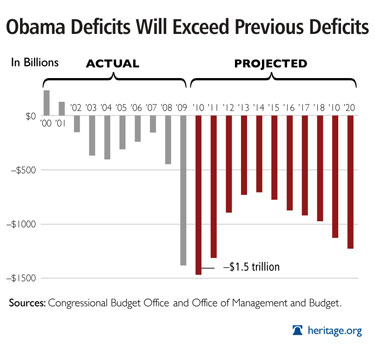
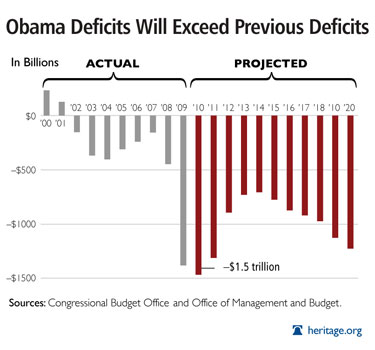
If the Bush tax cuts caused such huge deficits, then how did Obama’s July 2010 budget deficit end up exceeding Bush’s 2007 annual budget deficit, by $5.0 Billion?

Per the website, Liberty Works, “the one-month deficit for July was $165,043,000,000 or $5 Billion more than the “irresponsible Bush deficit” for the entire year of 2007.”

Graph via: http://blog.heritage.org/2010/02/05/past-deficits-vs-obamas-deficits-in-pictures/

Will the government ever be able to raise enough tax revenue to cover Obama’s massive spending gap? Let me answer that for you. No. Never in a 1,000 years. The only thing certain about our exploding national debt is that more revenue will eventually be required to cover it. The question is how to increase revenue without further damaging the economy.

A Conservative [R]esurgence

What’s the solution? We need a conservative resurgence in America. Give us the incentive to produce, take away the subsidy for failure, stop tampering with the free market, and free us that we may lift the have-nots. Reduce income tax rates, and stop spending more than we have. Our present course is destined for failure.

The bottom line: Drastically cut the size of government, and don’t just freeze tax rates, cut them. You can’t just cut taxes without a corresponding reduction in spending. It doesn’t work like that. Yet, until taxes are cut, the government will be trapped in providing greater failure subsidies (bailouts), and further destructive interference with the free market. That’s how it works.

If you’re not part of the solution, you’re part of the problem.

Black Employment Relapses Year-Over-Year

New Black Dummies

Black Employment Plummets on Obama’s Watch

By: Larry Walker, Jr.

The question of the day: Will Black or African Americans continue to support policies that don’t represent them?

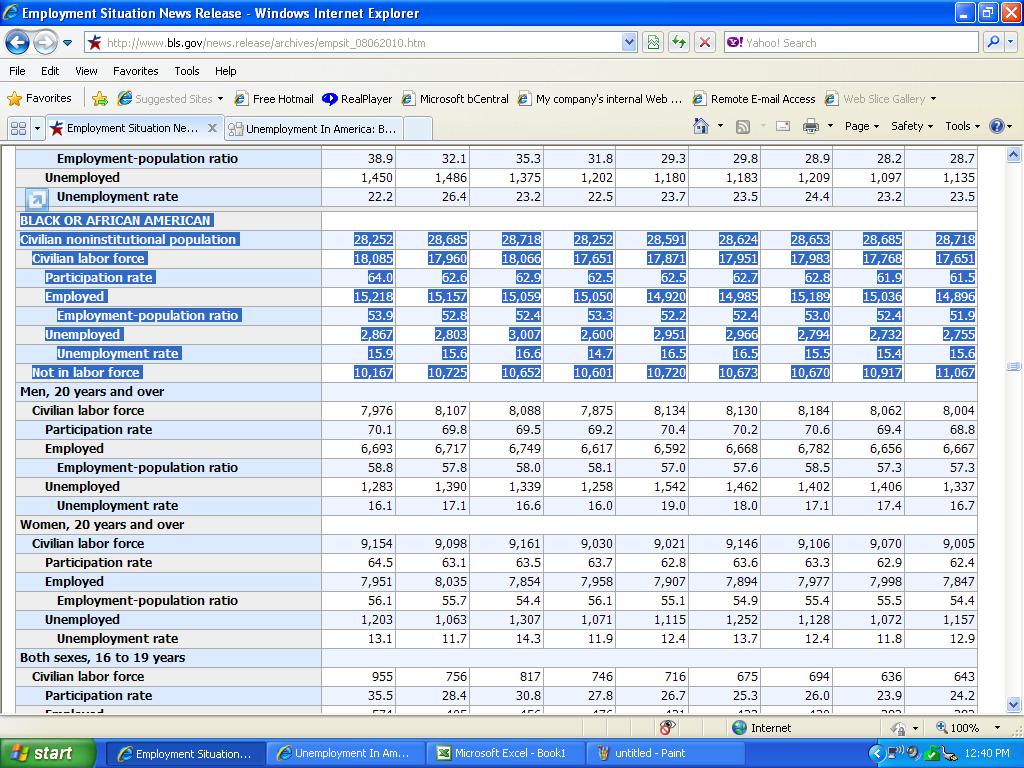
According to the latest from the Bureau of Labor Statistics (BLS), employment has continued to decline among Black or African Americans over the last twelve months. After 17 months of the Obama administration’s massive recovery program, we find that African Americans have benefited the least. If Black Americans are losing under the leadership of President Barack Obama, who’s winning?

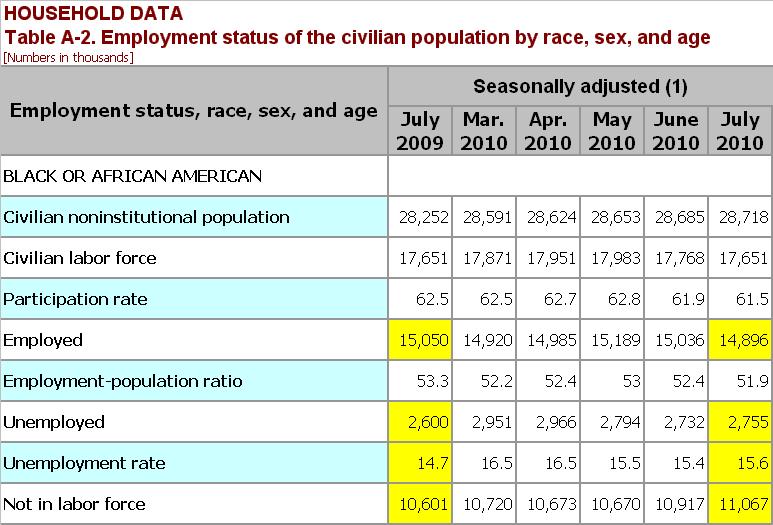
The latest Employment Status Report reveals the following:

  • There were 154,000 fewer blacks working in July than there were a year ago.

  • The number of blacks added to the unemployment rolls rose by 155,000 over the past year.

  • The unemployment rate among black Americans has increased by nearly 1.0%, since July of 2009.

  • Worst of all, an additional 466,000 blacks entirely abandoned the labor force over the past 12 months. Those classified as ‘no longer in the labor force’ are no longer counted in the official unemployment rate. These are the forsaken, the forgotten, the hopeless, the lost ones.

Here’s the latest table derived from the Bureau of Labor Statistics:

click to enlarge

Using his own laughable analogy, Obama refuses to put the car in [R], yet neither will he shift it into [D]. Instead, Obama has chosen to keep our economy in [P]. The folly of the [p]rogressive party president lies in that he has villainized corporations, small business owners, and the wealthy – those who actually provide and create jobs. It looks like it’s up to us to finally throw the car into gear. The best way to do this is to shift the balance of power in the November mid-terms.

“Change you can believe in?” – Nah!

And so you know I’m not just making this up, here’s a snapshot of the BLS report:

click to enlarge

Sources:

Bureau of Labor Statistics: Employment Situation 8/6/2010

Bureau of Labor Statistics: Historical Data

Successful Losing: Obama on Jobs

Losing is the New Winning

By: Larry Walker, Jr.

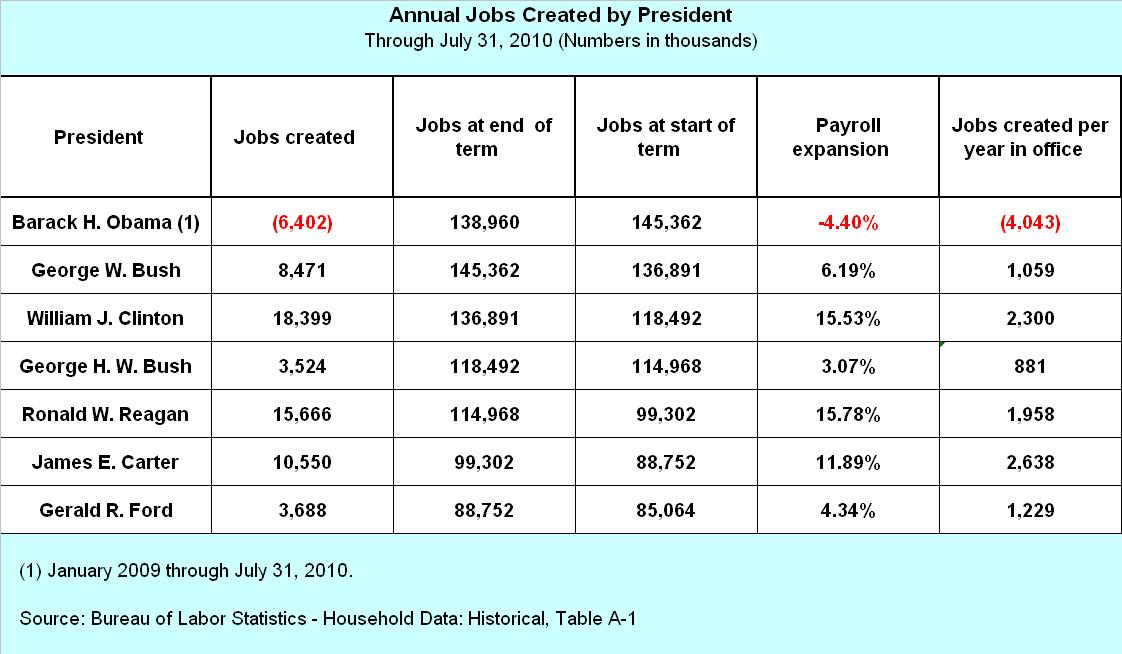
According to today’s Employment Status Report, the Bureau of Labor Statistics (BLS) reveals that as of July 31, 2010 there were 857,000 fewer persons employed than there were in July of 2009. Yet from Barack’s glass bubble, it sounded like all is well. Sure, his chief economist, Christina Romer just resigned, but that’s no cause for concern. The latest from Obama is that ‘private employment has increased every month’ during 2010. Really? Does that mean there are more jobs today than there were yesterday?

Following is my latest presidential scorecard, based purely on official BLS data:

Scorecard - Click to Enlarge

Obama was quick to take credit for the false increase in overall employment, earlier this year, when the U.S. Census Bureau hired 500,000 temporary workers, but now that they’re all gone he’s been slow to acknowledge the true situation. According to the BLS there were 139.8 million Americans employed in July of 2009, and 138.9 million employed in July of 2010. That’s a decline of 857,000 jobs over the past 12 months. There has actually been a steady, and progressive, decline in civilian employment for the past year, but you know, Obama doesn’t have time to look at facts and figures.

When G.W. Bush entered office in January of 2001, there were 136.8 million jobs. When he left office in December of 2008, there were 145.3 million jobs. When Obama entered office in January of 2009, there were 145.3 million jobs. As of July 31st of this year, there were 138.9 million jobs. So when we do the math, there are now 6.4 million fewer jobs than there were when Obama entered office in January of 2009. That’s reality. That’s what it feels like on the ground. Obama is losing, and losing big. And in his losing, he’s dragging America and the Democrat party along for the ride.

Is this what success looks like in the minds of progressive Democrats? Is losing the new winning? If so, Obama is certainly leading the pack. It’s time to throw the bum(s) out!

Just so you know that I’m not making this stuff up, here’s a snapshot of the latest BLS report:

BLS Table A - Double Click to Enlarge

Sources:

Bureau of Labor Statistics: Employment Situation 8/6/2010

Bureau of Labor Statistics: Historical Data

Obama on Jobs: Fool Me Thrice

Minus 6.2 Million Jobs and Counting

*By: Larry Walker, Jr.*

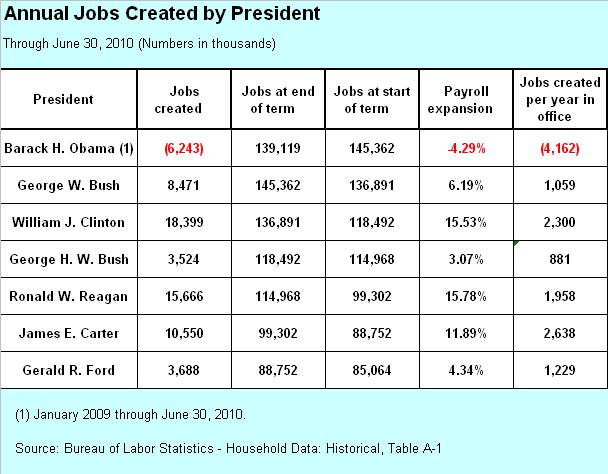
The question of the day is how will Obama turn his record of 6.2 million job losses into a positive number by the end of his four-year term? G.W. Bush cut taxes in his third year, which led to 51 month’s of positive job growth and the creation of 7.3 million jobs (not saved, just created). Obama will commence his third year (2011), 6.2 million jobs in the red, by imposing a tax hike.

Click to Enlarge

Obama is still out on the campaign trail trying to justify his failed economic policies by implying fallacious ideas like how the $80 billion auto-bailout saved the industry. The other day he was boasting about how his policies single-handedly created 55,000 new auto industry jobs, but he failed to mention that the same industry has hemorrhaged 400,000 jobs since 2008 (per Lawrence H. Summers). For the record, that means he’s still 345,000 auto industry jobs in the hole.

Whether Obama cuts or raises taxes will have no positive effect on the economy. Obama could cut the top tax rates down to 28%, like Reagan, but it would still have no effect. Why not? Because one of the keys to positive economic growth is confidence. There is no confidence in Barack Obama, period.

Obama squandered his credibility from day one. His recovery plan failed to contain job losses. His promise to cut taxes for 95% of Americans while accelerating the National Debt to historic proportions is not possible within the realm of human reason. His imposition of a health care mandate despite the will of the majority of Americans sealed his fate. There is no confidence in the president, or in his policies. Confidence will only begin to return when there is a shift in the balance of power. A change in the leadership of both houses of Congress is step one. Step two is the removal of Obama from the White House.

What the facts show (and what is certain) is that since Obama took over the reigns of power, the economy has lost a total of 6 million, 243 thousand jobs. What we don’t know (and what remains uncertain) is which Obama policies are even capable of breakeven. Breaking even means creating 6.2 million new jobs. Saving the job market from further deterioration is a given, not a grand accomplishment. Obama needs to aim a lot higher. Even if he were to actually create 6.2 million American jobs, Obama would still be considered a failure.

Do you have enough confidence in the rules of the game to be able to develop a winning (or survival) strategy? Under the present administration, the rules are not clear. Are your taxes going up next year, or not? Do you have to buy health insurance, or not? Will your health care costs continue to rise? Will your social security and Medicare benefits be cut? Will the government continue to run budget deficits after raising taxes? Even if we knew for certain that the answer to all of the above was affirmative, it wouldn’t make us more confident. There is no confidence, and when there is no confidence, jobs begin to perish.

Bush Tax Cuts

As the website Liberty Works correctly points out, in Bush Tax Cut Myths and Fallacies (1), the Bush tax cuts of 2003 led to quantifiable job growth. In fact, within 3 months of passage jobs were being created, and by the end of 2007 a total of 7.3 million jobs were created. Although progressives like Obama claim that this never happened, the facts are the facts no matter how twisted ones ideology. Thus, if we are comparing Obama and Bush, it should take roughly 3 months for a positive policy to show positive results. The American Recovery and Reinvestment Act (ARRA) was implemented in February of 2009, and 17 month’s later we are 6.2 million jobs in the hole. That’s a clear indication that the ARRA has failed.

Relative Tax Rates

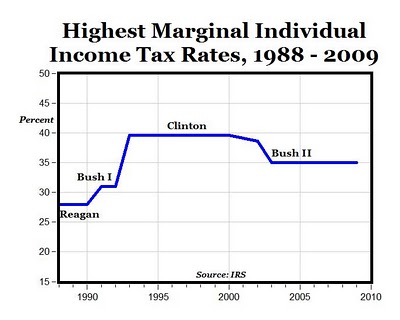
As Mark Perry points out, in Tax Cuts, Tax Hikes, It’s All Relative, tax cuts and tax hikes are pretty much relative. We are historically in a period of low tax rates. So if top tax rates go from 35% back to 39.6% it probably won’t kill the economy, but neither will it spark any positive growth. What will be affected is the level of confidence in a government that needs more and more but still can’t balance a simple budget.

…Certainly, compared to the “Clinton tax hikes” that took effect in 1993 and raised the top marginal income rate to 39.6%, the reductions of the top tax rate to 38.6% in 2002 and 35% in 2003 were “tax cuts” (see chart above).

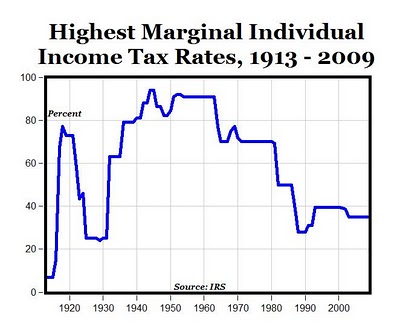
But if you go back further and compare the Bush tax rates to the highest marginal tax rates under Bush, Sr. (31%) and Reagan (28%), couldn’t the Bush II tax rates more accurately be referred to as the “Bush tax hikes”? Of course, the tax rates were much higher before 1988, here’s the full history back to 1913 in the chart below. Compared to most of the tax rates between the 1930s and the 1980s, couldn’t the Clinton tax rates also accurately be referred to as the “Clinton tax cuts”?

It’s not about tax hikes, it’s about how to grow the economy and how to create jobs. Clinton raised taxes during a period of economic growth, not to recover from a recession. If Obama can create jobs in a recession by raising taxes, then ‘God bless him’. But if Obama’s tax hikes lead to further job losses, forget about it. Fool me twice, shame on me. Fool me three times, and I must be a fool. Yet fools we are not.

“Confusing legislation, high unemployment, record deficits, and impending tax hikes do not confidence make.”

Related: Obama on Jobs: Worst Track Record in History

References: Bureau of Labor Statistics Official Data

Recovery (dot) Fail | Not Jobs

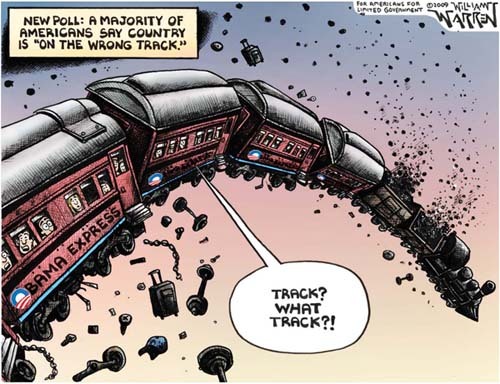
Wrong Track

Employment Situation Worse: Year-Over-Year

By: Larry Walker, Jr.

The Bureau of Labor Statistics (BLS) released their employment situation report on Friday July 2, 2010. My analysis is meant to expose facts that most casual observers ignore. Instead of the general month-to-month comparison, I am assessing changes in the employment situation over the last twelve months. This expanded view will tell us whether or not the Recovery Act is working. I will begin with my conclusions, followed by excerpts from the BLS report, and end with my analysis.

Conclusion: The employment situation is worse than it was a year ago. Although the U-6 unemployment rate stood unchanged at 16.5%, the population increased by 2.0 million, while the labor force fell by 1.0 million, making the employment situation unsustainable. The number of marginally attached and discouraged workers rose to 2.6 million, an increase of 415,000 year-over-year. The number of unemployed persons rose by 317,000. There are 919,000 fewer jobs than there were a year ago.

So much for, “the recovery is working.” So much for Progressive-Economics, the main tenets of which appear to be:

  1. Borrow huge sums of money from taxpayers and foreigners.

  2. Spend it in ways that won’t necessarily lead to job creation (i.e. tax cuts for all except for those who would use it to create jobs; more government jobs; mandatory health care; etc…)

  3. Raise taxes on the remaining smaller pool of workers who survive Steps 1 and 2, in order to pay for Step 1.

  4. Repeat Steps 1 through 3 (if you manage to survive after Step 2).

The following excerpts are from the latest BLS report entitled, THE EMPLOYMENT SITUATION — JUNE 2010:

Total nonfarm payroll employment declined by 125,000 in June, and the unemployment rate edged down to 9.5 percent, the U.S. Bureau of Labor Statistics reported today. The decline in payroll employment reflected a decrease (-225,000) in the number of temporary employees working on Census 2010. Private-sector payroll employment edged up by 83,000….

Both the number of unemployed persons, at 14.6 million, and the unemployment rate, at 9.5 percent, edged down in June….

In June, the number of long-term unemployed (those jobless for 27 weeks and over) was unchanged at 6.8 million. These individuals made up 45.5 percent of unemployed persons….

In June, about 2.6 million persons were marginally attached to the labor force, an increase of 415,000 from a year earlier. (The data are not seasonally adjusted.) These individuals were not in the labor force, wanted and were available for work, and had looked for a job sometime in the prior 12 months. They were not counted as unemployed because they had not searched for work in the 4 weeks preceding the survey….

Among the marginally attached, there were 1.2 million discouraged workers in June, up by 414,000 from a year earlier. (The data are not seasonally adjusted.) Discouraged workers are persons not currently looking for work because they believe no jobs are available for them. The remaining 1.4 million persons marginally attached to the labor force had not searched for work in the 4 weeks preceding the survey for reasons such as school attendance or family responsibilities….


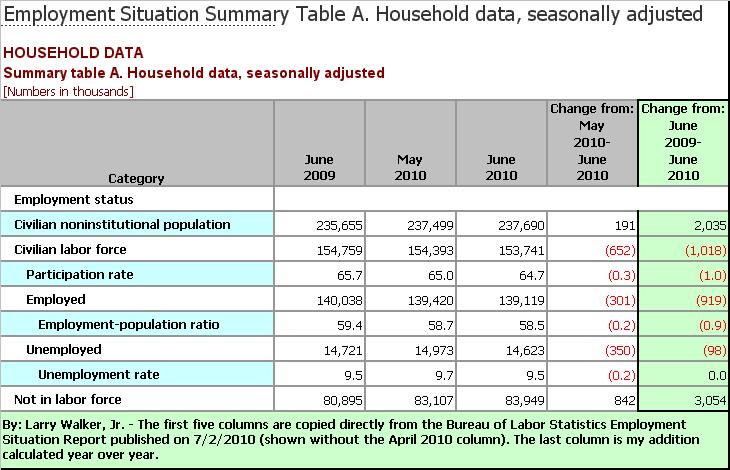
Table A (click to enlarge)

A Year-over-year Analysis of the Employment Situation (Table A)

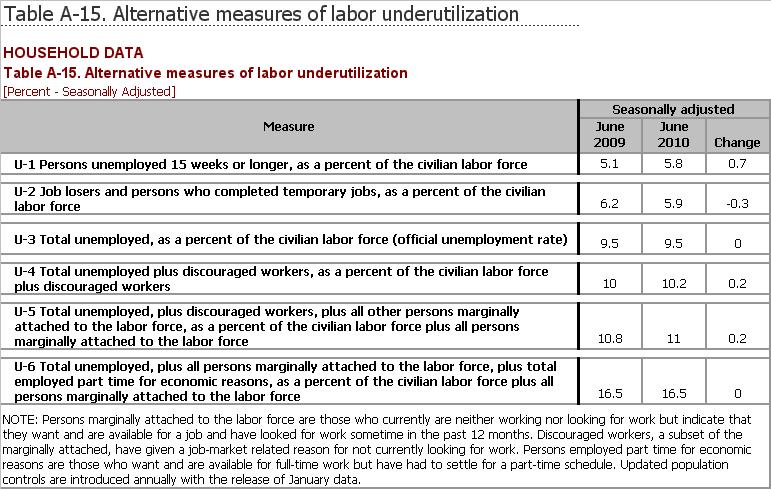
Unemployment Rate – The official unemployment rate has changed by 0.0%, from 9.5% in June of 2009 to 9.5% in June of 2010. This can be attributed to the success of the Economic Recovery Act, if you call ‘no change’ a success. However, according to table A-15, counting all marginally attached and discouraged workers, the U-6 unemployment rate, currently 16.5% was also unchanged year-over-year. (U-6 takes into consideration the total that BLS considers unemployed, plus all persons marginally attached to the labor force, plus total employed part time for economic reasons, as a percent of the civilian labor force plus all persons marginally attached to the labor force.)

The U-6 unemployment rate stood unchanged at 16.5% year-over-year.

Table A-15, click to enlarge

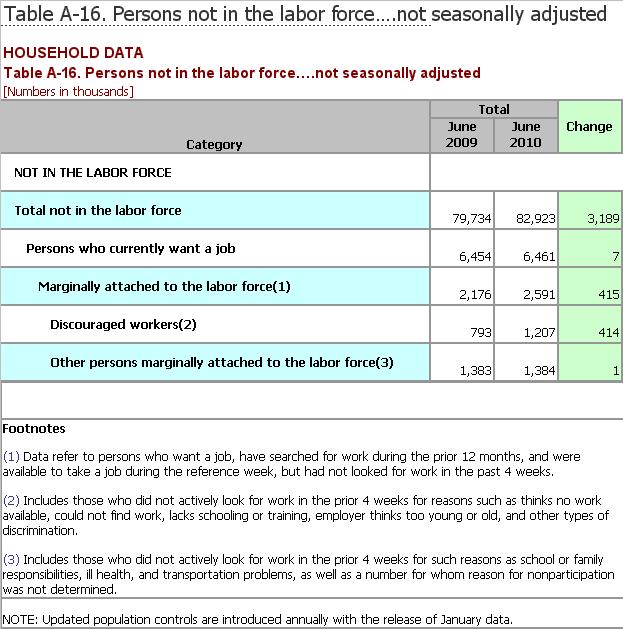
Civilian Labor Force – According to the BLS, the civilian labor force has declined by a little over 1 million workers, from 154.8 million in June of 2009 to 153.8 million in June of 2010. From table A-16 we learn that out of the 1 million who disappeared, 415,000 are no longer being counted because they are considered to be marginally attached (i.e. persons who want a job, have searched for work during the prior 12 months, and were available to take a job during the reference week, but had not looked for work in the past 4 weeks). Once identified, marginally attached workers are no longer counted as part of the labor force. Out of the 415,000, 414,000 are considered to be newly discouraged workers.

The number of persons no longer counted as part of the labor force, because they have stopped looking for work, increased by 415,000 year-over-year.

Civilian non-institutional population – The civilian population increased by slightly more than 2 million, from 235.6 million in June of 2009 to 237.7 million in June of 2010. So while the population increased by a little over 2 million, the labor force shrunk by 1 million, which is clearly unsustainable.

The employment situation is unsustainable.

Persons no longer in the labor force – The number of persons no longer in the labor force increased by 3.0 million, from 80.9 million in June of 2009 to 83.9 million in June of 2010. We learn from Table A-16 (below) that out of this 3.0 million, 415,000 more than a year ago are considered marginally attached (i.e. persons who want a job, have searched for work during the prior 12 months, and were available to take a job during the reference week, but had not looked for work in the past 4 weeks). We also learn from Table A-16 that a total of 6.5 million Americans who want jobs are not counted as part of the labor force, an increase of 7,000 year-over-year.

The number of marginally attached and discouraged workers rose to 2.6 million, an increase of 415,000 year-over-year.

Table A-16, click to enlarge

Number of unemployed – According to the BLS, the number of unemployed persons fell by 98,000 from 14.7 million in June of 2009 to 14.6 million in June of 2010. However, this figure ignores the increase in those considered marginally attached, so in reality the number of unemployed persons increased by 317,000 (415,000 more marginally attached minus 98,000 fewer unemployed persons) year-over-year. See Civilian Labor Force (above).

The number of unemployed persons rose by 317,000 year-over-year.

Number of employed – The number of persons employed fell by 919,000, from 140.0 million in June of 2009 to 139.1 million in June of 2010. In other words, there are 919,000 fewer people working than there were a year ago. I don’t know why Obama is out boasting about the success of his ‘Recovery Program’ when it is clearly a dud. Speaking in plain English, since there are currently 919,000 fewer jobs than there were a year ago, no jobs have been created or saved within the last twelve months (see Table A above).

There are 919,000 fewer jobs than there were a year ago.

Data Sources:

BLS Employment Situation: http://bls.gov/news.release/empsit.toc.htm

BLS Employment Summary: http://bls.gov/news.release/empsit.nr0.htm

Table A: http://bls.gov/news.release/empsit.a.htm

Table A-15: http://bls.gov/news.release/empsit.t15.htm

Table A-16: http://bls.gov/news.release/empsit.t16.htm