The Health Insurance Black Hole

Point of No Return

The Health Insurance Black Hole

By: Larry Walker, Jr.

Tweet

@CoachChic to @larrymwalkerjr Tell me: If Obama wants us to buy-into a healthcare package, why not just give us what congressmen get? I’m serious here.

Facts

With more than 1.8 million civilian employees, (1) the Federal Government, excluding the Postal Service is the Nation’s largest employer. The U.S. Postal Service employs an additional 636,000 (2) full-time employees.

Politicians and Federal employees receive the country’s best care – at taxpayers’ expense. While over 46 million Americans (disputed) remain uninsured and millions more underinsured, members of Congress receive health-related services that many in the U.S. will never see.

Representatives and Senators alike receive some of the best health care benefits in the country, much of it paid for with taxpayer dollars. Yet these same members seem unable – or unwilling – to extend similar protections to the rest of America.

Federal Employees Health Benefits Program

As soon as members of Congress are sworn in, they may participate in the Federal Employees Health Benefits Program (FEHBP). The program offers an assortment of health plans from which to choose, including fee-for-service, point-of-service, and health maintenance organizations (HMOs). In addition, Congressional members can also insure their spouses and their dependents.

Not only does Congress get to choose from a wide range of plans, but there’s no waiting period. Unlike many Americans who must struggle against precondition clauses or are even denied coverage because of those preconditions, Senators and Representatives are covered no matter what – effective immediately.

And here’s the best part. The government pays up to 75 percent of the premium. The government, of course, is funded by taxpayers; the same taxpayers who often cannot afford health care for themselves.

Self-only Estimates (Georgia Rates)

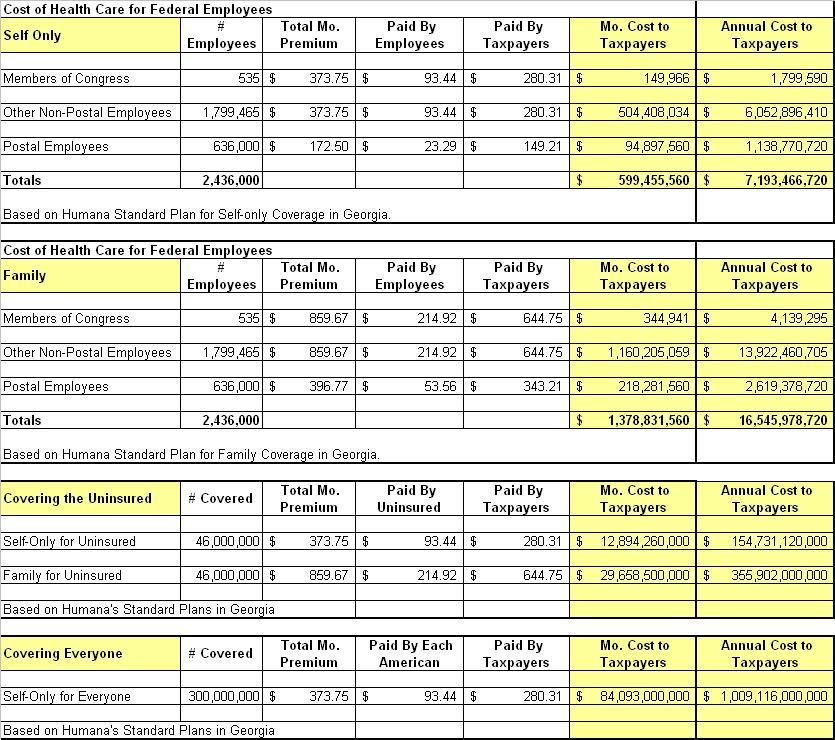
For non-Postal Employees, let’s use the federal government’s Georgia rates for Humana’s Standard Plan for self-only coverage. The total monthly premium in 2009 is $373.75. The amount paid by the employee is $93.44. The amount paid by taxpayers is $280.31 (3).

For Postal Employees, let’s use the federal government’s same Humana Standard Plan for self-only coverage. The total monthly premium in 2009 is $172.50. The amount paid by the employee is $23.29. The amount paid by taxpayers is $149.21 (4).
Click Image to Enlarge

Family Estimates (Georgia Rates)

For non-Postal Employees let’s use the federal government’s Georgia rates for Humana’s Standard Plan for Family coverage. The total monthly premium in 2009 is $859.67. The amount paid by the employee is $214.92. The amount paid by taxpayers is $644.75 (3).

For Postal Employees let’s use the federal government’s same Humana Standard Plan for Family coverage. The total monthly premium in 2009 is $396.77. The amount paid by the employee is $53.56. The amount paid by taxpayers is $343.21 (4).

Summary

Depending on the plan, and the State, the costs vary widely, but at the minimum, using Georgia’s insurance rates, which are among the lowest nationwide, taxpayers are on the hook for somewhere between $7.1 billion and $16.5 billion annually. Based on the rates in other states I think it would be safe to double these amounts. So let’s say it costs taxpayers between $14.2 billion and $33.0 billion per year to subsidize health insurance premiums for Federal Employees.

Again doubling the Georgia rates, health insurance subsidies for the 535 members of Congress cost taxpayers between $3.6 million and $8.2 million annually. To me this is a Black Hole. We pay for our own health insurance, and then we turn around and pay 75% of the cost for federal workers. Members of Congress and the Executive Branch need to start pulling their own weight. Especially since all they seem to be doing lately is spending money that we don’t have.

The Answer

Option 1: How much would it cost if the Congress were to grant the same health insurance plan that government workers enjoy, to the alleged 46 million uninsured?

If the government paid 75% of the premiums for the uninsured, the minimum cost to taxpayers would be somewhere between $154.7 billion and $355.9 billion. Since Georgia rates are about half of what they are in most States, the average is more reasonably, between $309.4 billion and $711.8 billion. Using the high-end figure of $711.8 billion, that’s about $2,372 per capita, annually.

Option 2: How much would it cost if Congress were to grant all 300 million of us access to the same 75% subsidized plan enjoyed by government employees?

The cost to taxpayers would be just over $1.0 trillion at Georgia rates, or more like $2.0 trillion nationwide. Using the high-end figure, again, $2.0 trillion is about $6,727 per year, per capita.

Thus it is unlikely that the nation could afford to offer all American’s access to the same kind of taxpayer subsidized health care which Federal employees receive. With the government paying 75% of the premiums, it would cost taxpayers around $2.0 trillion, or $6,727 per citizen, per year. And then we would still be responsible for 25% of the premiums.

As a Georgia resident, although my monthly premiums would only be perhaps $93.44, my taxes would increase by potentially $6,727 per year to subsidize everyone else. Thus, it would wind up costing me $7,848 per year, or $654 per month. For a family of four, the cost would be roughly $2,616 per month ($654 * 4). The average cost nationwide would be double the premium or $747 per month for individuals, and $2,990 per month for a family of four. Now that’s just outrageous.

Even if we could afford to give all Americans the same health insurance benefits hoarded by Congressmen and Senators, this still would not address the problems of rising annual health care costs, doctor shortages, rationing of care, lack of competition across state lines, undocumented workers, portability, unemployment, delinquent taxpayers, the recession, Medicare, Medicaid, the National Debt, the Budget Deficit, …etc….etc….etc…

Once again, I would conclude that it’s probably best to make some reforms to the current system, and not attempt any kind of radical ‘fundamental’ changes. However, one thing we can and should do right away is end the notion of taxpayer subsidized health insurance premiums for Federal Employees. We have to pay for our own insurance and then for 75% of theirs? This can and should end immediately, starting with the Black Hole – Congress, and the Executive Branch.

~A penny saved is a penny earned~

RT @CoachChic Again to my dream: That every American have on the tip of his/her tongue, “You design it, then join us!”

RT @CoachChic @HeavenandHealth My plan: Have pols design a healthcare plan, then join us in it. Fair enough?

RT @CoachChic Ya know, some of the most complicated problems have really simple solutions. 🙂

Sources:

  1. http://www.bls.gov/oco/cg/cgs041.htm

  2. http://www.federaltimes.com/index.php?S=4265826

  3. http://www.opm.gov/insure/health/rates/nonpostalhmo2009.pdf

  4. http://www.opm.gov/insure/health/rates/postalhmo2009.pdf

  5. http://public-healthcare-issues.suite101.com/article.cfm/health_care_for_the_us_congress#ixzz0RtqtCaVc

The IRS as Health Insurance Police

The charge: Breathing without health insurance.

No Health Insurance? You’re going to jail.

By: Larry Walker, Jr.

Many of us had ‘hoped’ for some simplification of the Internal Revenue Code, which has grown from 14 pages to over 17,000 pages since its inception. But it doesn’t look like that will happen anytime soon. H.R. 3200 will increase the burden of the income tax code by making the IRS the primary enforcer of Mandatory Health Insurance.

Did you hear that? You get your ‘mandatory’ health insurance, but you had better file your tax returns, and file them timely and correctly. Not only that, but you will have to determine what kind of health insurance you have and report it on your tax return, and if you don’t have it, or if it’s not acceptable, then a hefty penalty will be imposed.

It’s found in Title IV, Subtitle A, on pages 167-215 called Amendments to IRS Code of 1986. The expanded powers of the IRS in H.R. 3200 would empower the IRS to require taxpayers to show proof of health insurance coverage, collect fines on individuals and employers who did not have adequate proof of health insurance and determine whether your health insurance was a government approved plan.

So let’s see, will this make life easier, or more convoluted? My theory is that it will not only do the latter, but in the process will deprive all American’s of what if any liberty remains.

Linear thinkers, like Obama and others on the left, are incapable of seeing beyond the end of their noses, so it’s up to us to do our part to shed a little light.

According to Table 16 (below), courtesy of the IRS, at the end of 2008 approximately 9.2 million taxpayer cases were in inventory for filing income tax returns with additional taxes owed to the tune of $94.3 billion (including interest and penalties). And approximately 3.4 million taxpayer cases were in inventory for not filing income tax returns at all, and owe around $21.2 billion.

You don’t suppose there’s any chance that the same 12 million people who either don’t pay, can’t pay, or won’t file income tax returns are the same ones lacking health insurance? Imagine that, the very same people who may owe the government over $100 billion now begging for free health insurance. No I’m not blaming them, but I’m just saying, it may very well be that the tax code is too complicated, that penalties are too stiff, or that income taxes are just way too high. But let’s leave that for another century, and let’s entertain our Messiah’s plan to make taxes more burdensome through Government-run Health Insurance.

Now let’s consider some logic. The IRS, a government agency that allows around 15% to slip through the cracks, will be in charge of a health insurance system that lets around 15% slip through the cracks. What will be the outcome? Do you think it’s possible to achieve 100% compliance with the tax code? Just ask the Obama Administration (Geithner) about ‘that one’. And do you think it’s possible to achieve 100% participation in health insurance, or in anything else human?

Short of placing government security cameras in our houses, a micro-chip in our heads, and completely brainwashing us, 100% participation in anything is not a human attribute. The 80/20 principle is generally good enough for us mere mortals. So on that count, the human factor, the plan fails.

Most likely, the outcome of Obama’s far-left, linear, robotic health insurance plan will be one of the following:

  1. The same 85% who currently comply with income tax laws and have health insurance will continue to comply with income tax laws and buy health insurance, while the same 15% remain on the sidelines. (Most likely)

  2. More people will choose to comply with income tax laws, and more will choose to be covered by health insurance. (You wish)

  3. Less people will choose to comply with income taxes, and less will choose to be covered by health insurance. (Probable)

  4. The 85% who currently comply with income tax laws and have health insurance will revolt, and stop paying income taxes and for health insurance. (Possible)

  5. The ridiculous plan will die in committee, or if passed will subsequently be repealed. (Best)

What do you think?

Sources:

http://www.irs.gov/pub/irs-soi/08db16co.xls

http://www.irs.gov/taxstats/article/0,,id=207457,00.html

http://www.wnd.com/index.php?fa=PAGE.view&pageId=109741

Related:

Unreal– Obamacare Violators Will Face Up to One Year in Jail

Health Insurance Co-Ops vs. Government-Run Health Insurance

* More Honest Debate *

By: Larry Walker, Jr. –

What is a Cooperative (Co-Op)? *

A Cooperative is a business organization owned and operated by a group of individuals for their mutual benefit. A cooperative may also be defined as a business owned and controlled equally by the people who use its services or who work at it.

There are many types of Co-Ops in the United States. I will attempt to address some of the most common cooperatives. If you belong to a credit union, you are already a member of a Co-Op. My electric and natural gas utility company is an EMC, another word for Co-Op. In the insurance industry, Co-Ops are called Mutual Companies, or Mutual Legal Reserves.

Credit Unions are owned by their members. When you join, you must establish a share account and maintain a minimum balance. Your share account is your capital investment in the company. You are paid ‘dividends’ on your savings and checking accounts. Dividends are your share of the Credit Union’s profits. A Credit Union offers benefits for its members such as preference on home and automobile loans.

An Electric Membership Corporation (EMC) is a service cooperative owned by those who receive its services. There are nearly 1,000 electric cooperatives in the United States. When the EMC makes a profit, those profits are shared with customers through credits to their electric bills, or lower rates.

Health Insurance Co-Ops

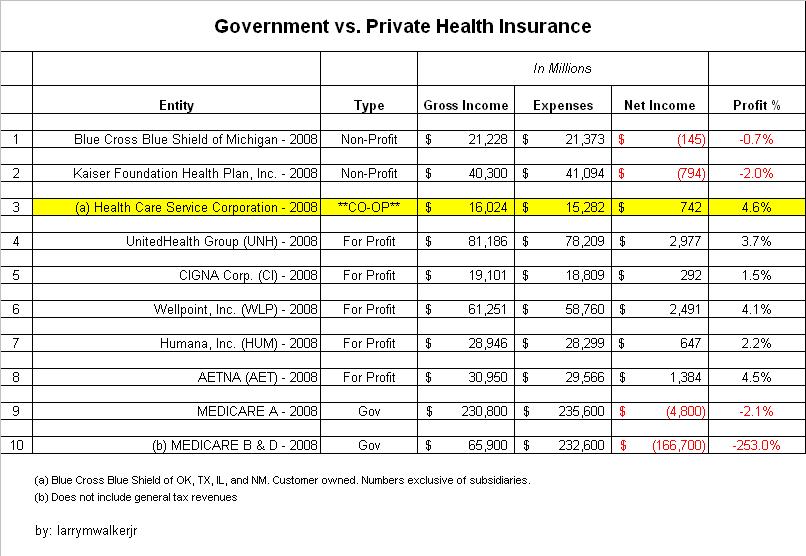
Health Care Services Corporation (HCSC) is the largest customer owned health insurer in the United States.

  • HCSC operates the Blue Cross and Blue Shield plans in Illinois, New Mexico, Oklahoma and Texas, employing 17,000 people and serving more than 12.4 million members – 38% in national employer plans, 32% in large local employer plans, 10% in small employer plans, 10% in individual plans and 10% in government plans.

  • HCSC is the fourth largest health insurance company in the United States and the largest customer-owned health insurer. In 2008, the company’s gross revenue totaled $39.9 billion (considering all subsidiaries which are not included in the chart below in accordance with GAAP).

  • HCSC is the most financially secure health insurer in the United States, with a rating of AA- (Very Strong) from Standard and Poor’s, Aa3 (Excellent) from Moody’s and A+ (Superior) from A.M. Best Co.

  • HCSC retains full or joint ownership of a number of subsidiary companies, including Fort Dearborn Life Insurance Co., Dental Network of America, MEDecision, Availity, Prime Therapeutics and RealMed.

If the HCSC model is the type of Health Insurance Co-Op being discussed in Congress, then I am a fan. Yes. Here is an idea that would have strong bi-partisan support. We can agree on Health Insurance Co-Ops. In my opinion Co-Ops are in line with the purest sense of Capitalism. On the other hand, if Congress is talking about some kind of partially Government owned, or Government controlled entity, then I am not in favor.

In fact, I would like to join HCSC, or a similar Co-Op, but unfortunately it only operates in 4 states, and none of the health insurers in my state are co-ops. Fostering increased competition by allowing insurers to operate in all states would be an improvement.

The Plan

So if America wants to convert its health insurance industry to Co-Ops, the question is how? Obviously, it would be unfair, and foolish, to force the existing insurers out of business, so how do you get them to convert?

I am a proponent of Binary Economics. Under Binary Economics, the only role of Government in private enterprise is to offer interest-free loans through its central bank. Existing publicly traded insurers will need to buy back all of their stock in order to make the conversion to mutual companies. Interest free loans from the Government will facilitate this conversion. The loans will be paid back over the long-term out of the profits of the insurers. Once the loans have been paid, the insured will be able to participate in a larger share of company profits. Profits will be shared with policy holders either in the form of dividends, or lower insurance rates.

Interest free loans are not hand-outs, or bailouts. The money gets paid back. Granting interest free loans would be a much better use of taxpayers money than the current foolishness being promoted by certain ‘linear’ thinkers (right and left). The World is not flat. In fact, most good ideas come from outside of the box.

Reforms I can believe in:

  1. Conversion of the Health Insurance Industry to Co-Ops

  2. Tort Reform

  3. Fostering Interstate Commerce for increased competition

  4. No denial for preexisting conditions

  5. Tax Incentives for those paying higher premiums due to preexisting conditions

  6. Tax incentives for purchasing health insurance

  7. Portability of policies

Reforms I don’t believe in:

  1. Making health insurance mandatory

  2. Taxing employers who don’t offer insurance

  3. Expanding Government-Run health care

  4. Excessive Government Regulation

  5. Triggers

click images to enlarge

Sources:

http://www.hcsc.com/about-hcsc/overview.html

http://www.investopedia.com/terms/m/mutualcompany.asp

http://en.wikipedia.org/wiki/Co-op

http://www.waltonemc.com/mycoop/

https://blackandcenter.blog/2009/09/02/government-run-vs-private-health-insurance/

Mopping Up After Obama – HSA’s and Energy Credits

More Honest Debate

Can the Federal Government outsmart itself?

Health Savings Accounts (H.S.A.’s) either work, or they don’t work. The government came up with a great plan, but failed to promote it. That’s what our government does. They solve a problem, and then come back in a couple of years and solve it again. We are seeing it with health care, as well as with energy policy.

Health Savings Accounts are a great idea. I have had one for over three years and have been satisfied with the program. Since I am in control of the spending, I don’t always take the doctors advice about redundant tests and follow up appointments. Since I have to pay for those tests and appointments I make sure that I really need them before making the appointment. If it wasn’t coming out of my pocket, I would be less inclined to question, and more inclined to take every redundant test, and make every redundant follow up appointment, whether I felt I needed it or not. Don’t you dare give me something that works, and then threaten to take it away because the rest of society hasn’t caught on. Either health savings accounts work, or they don’t. And if they do, then the government had better get to the business of promoting them.

Speaking of energy policy, I’m a bit disgruntled that, after spending over $10,000 in home energy improvements, the federal government through a cap-and-trade tax now thinks that wasn’t good enough and they want to raise the cost of energy, thus negating any long-term savings I may have hoped to gain. Either the energy tax credits worked, or they didn’t work. Make up your minds. We got the message already and most Americans have incorporated energy savings mechanisms through the free market. Now the message seems to be that Americans have failed to get the message so now the Government will take over and force energy savings down our throats. So will the Government reimburse me for what I have expended in following its previous advice?

Seems to me that Barack Obama and his left-wing cadre certainly don’t have the best interests of this American at heart. And, well, if the majority of Americans feel the same way, then I would venture to say that Obama doesn’t have the best interests of America at heart.

Empowering Patients First Act – H.R. 3400

Putting Patients First!

RSC Chairman Tom Price has introduced the Empowering Patients First Act. This is another positive solution from the Republican Study Committee that grants access to affordable, quality health care for all Americans, and is centered around the patient. By increasing patients’ control over their health decisions, we will make coverage more affordable, accessible and responsive, while offering more choices and the highest-quality care.

This solution is centered around four main principles:

#1: Access to Coverage for All Americans

  • The Empowering Patients First Act makes the purchase of health care financially feasible for all Americans, covers pre-existing conditions, protects employer-sponsored insurance, and shines light on existing health care plans.

#2: Coverage is Truly Owned by the Patient

  • This legislation grants greater choice and portability to the patient, and also gives employers more flexibility in the benefits offered. It also expands the individual market by creating several pooling mechanisms.

#3: Improve the Health Care Delivery Structure

  • Physicians know the best care for their patient. That’s why this legislation establishes doctor-led quality measures, ensuring that you get the quality care you need. It also reimburses physicians to ensure the stability of your care, and encourages healthier lifestyles by allowing employers to offer discounts for healthy habits through wellness and prevention programs.

#4: Rein in Out-of-Control Costs

  • A key concern in positive reform is reining in out-of control costs. This legislation does this by reforming the medical liability system. Also, the cost of the plan is completely offset through decreasing defensive medicine, savings from health care efficiencies, sifting out waste, fraud and abuse, plus an annual one-percent non defense discretionary spending step down.

Additional Information:

Short Summary

Detailed Summary

Section by Section Summary

Full Bill Text

RSC Press Release

Steny Shivers, Shakes at Patient-Centered Health Care Solution

Side-by-Side Comparison with the House Democrat Government Takeover (H.R. 3200)

POLITICO – “How the GOP Wants to Fix Health Care”

Chairman Price Accepts Obama’s Invitation to Examine Health Care Proposals Line-by-Line

Letters of Support:

From Americans for Tax Reform

:: http://rsc.tomprice.house.gov/Solutions/EmpoweringPatientsFirstAct.htm

The CBO and Our Common Welfare

This blog post was inspired today by comments made during Obama’s town hall event in Colorado. Here are the tweets that inspired this research:

Obama said, “Despite all the scare tactics out there, what is truly scary is if we do nothing.”

I said, “Isn’t this a scare tactic?”

Obama said, “Spread the word, knock on doors, to help enact his health coverage plan.”

I said, “It might help if he actually had a plan, no?”

Obama said, “Health care costs are the biggest part of federal deficit and debt?”

I said, “Defense and interest on the debt are right behind.”

Obama again states: “Nobody is talking about a government takeover of health care.”

I said, “Nobody as in Congress via H.R. 3200?”

My summary of Obama’s town hall meeting is this: “Let’s all get behind this idea of spending money that we don’t have, on a reform plan that hasn’t been written.”

Afterwards I watched the following CBO webcast, The Long-Term Budget Outlook, and studied the cost projections for Medicare, Medicaid, Social Security, and Interest on the Debt. After all of this, I am convinced that our government is on the wrong track.

Link to CBO Video

The issue should not be how to include more people in entitlements while cutting costs (an impossible feat). But rather how to create incentives to make people more self-sufficient so that they will not need to depend on the government? In other words, the focus needs to be on reducing the number of people covered by government entitlements, reducing government size and spending, and increasing government revenue to extinguish the debt.

In Mortimer Zuckerman’s USA Today column entitled, “The Coming Government Debt Bomb” [Spending must be cut, or surging deficit could leave U.S. deep in the red for years], he states the following:

The nonpartisan Congressional Budget Office reckons that the deficit will run for a decade and will still exceed $1.2 trillion in 2019. By that time, the United States will have virtually doubled its national debt, to over $17 trillion. Then, after 2019, we get another turn of the screw as the peak waves of baby boomers move into their retirement years and costs soar for the major entitlements, Social Security and Medicare.

At 41 percent of GDP in 2008, the accumulated federal debt will rise to 82 percent by 2019. One out of every 6 dollars spent then by the feds will go to interest, compared with 1 in 12 dollars last year. These out-year budgets will require an increase in everyone’s income taxes, raising federal income taxes an average of $11,000 for families, a hike of 55 percent per household—a political impossibility. The Government Accountability Office estimates that by 2040, interest payments will absorb 30 percent of all revenues and entitlements will consume the rest, leaving nothing for defense, education, or veterans’ pensions.

I know you don’t want to hear about private savings accounts versus Social Security. And you probably don’t want to hear about high deductible health insurance plans and health savings accounts. But the alternative being peddled by the Obama Administration and Congress is to increase government debt until it actually exceeds what our economy can produce in a year.

In other words they would rather bankrupt the United States, than face the fact that government cannot provide for the health and retirement needs of the people. And that’s the bottom line – the government cannot provide for the health and retirement needs of any but the most needy. Come to think of it, seems to me that was the original plan.

I realize that this is counter to the Biden-Obamanomics view that, “we need to spend more to keep from going bankrupt,” but I live on planet earth. The track being followed by this government will create a new problem, i.e. what do we pay or not pay this month. A bankrupt government would create a more serious crisis than any we have ever faced. Listen to the hearing, read the legislation, study the numbers, and see what you think.

“Give a man a fish and he will eat for a day. Teach a man to fish and he will eat for life.”

We can do this on our own if our government would get out of the way, and simply provide us with the incentives to provide for ourselves.

The bottom line on Obama’s non-existent health care/insurance reform ‘plan’ – show us the ‘plan’ you are talking about, or stop talking.