The Monetary Reform Act of 201X | Authentic

The Two Step Plan to National Economic Reform and Recovery

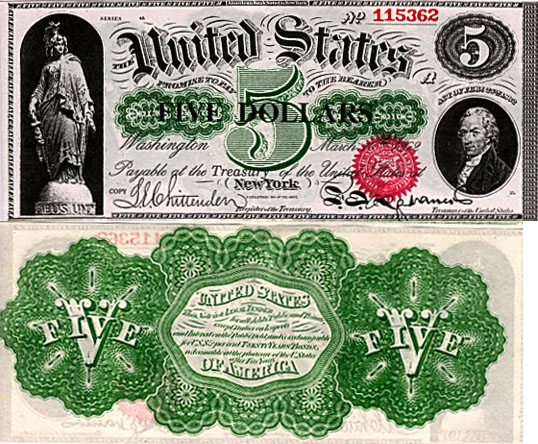
Step 1: Directs the Treasury Department to issue U.S. Notes (like Lincoln’s Greenbacks; can also be in electronic deposit format) to pay off the National debt.

Step 2: Increases the reserve ratio private banks are required to maintain from 10% to 100%, thereby terminating their ability to create money, while simultaneously absorbing the funds created to retire the national debt.

These two relatively simple steps, which Congress has the power to enact, would extinguish the national debt, without inflation or deflation, and end the unjust practice of private banks creating money as loans (i.e. fractional reserve banking). Paying off the national debt would wipe out the $400+ billion annual interest payments and thereby balance the budget. This Act would stabilize the economy and end the boom-bust economic cycles caused by fractional reserve banking.

Monetary Reform Act – Summary

This proposed law would require banks to increase their reserves on deposits from the current 10%, to 100%, over a one-year period. This would abolish fractional reserve banking (i.e., money creation by private banks) which depends upon fractional (i.e., partial) reserve lending. To provide the funds for this reserve increase, the US Treasury Department would be authorized to issue new United States Notes (and/or US Note accounts) sufficient in quantity to pay off the entire national debt (and replace all Federal Reserve Notes).

The funds required to pay off the national debt are always closely equivalent to the amount of money the banks have created by engaging in fractional lending because the Fed creates 10% of the money the government needs to finance deficit spending (and uses that newly created money to buy US bonds on the open market), then the banks create the other 90% as loans (as is explained on our FAQ page). Thus the national debt closely tracks the combined total of US Treasury debt held by the Fed (10%) and the amount of money created by private banks (90%).

Because this two-part action (increasing bank reserves to 100% and paying off the entire national debt) adds no net increase to the money supply (the two actions cancel each other in net effect on the money supply), it would cause neither inflation nor deflation, but would result in monetary stability and the end of the boom-bust pattern of US economic activity caused by our current, inherently unstable system.

Thus our entire national debt would be extinguished – thereby dramatically reducing or entirely eliminating the US budget deficit and the need for taxes to pay the $400+ billion interest per year on the national debt – and our economic system would be stabilized, while ending the terrible injustice of private banks being allowed to create over 90% of our money as loans on which they charge us interest. Wealth would cease to be concentrated in fewer and fewer hands as a result of private bank money creation. Thereafter, apart from a regular 3% annual increase (roughly matching population growth), only Congress would have the power to authorize changes in the US money supply – for public use -not private banks increasing only private bankers’ wealth.

Support the Monetary Reform Act – write your Congressman today!

Read the full version of the Monetary Reform Act here.

If not now, when?

“I am a firm believer in the people. If given the truth, they can be depended upon to meet any national crisis. The great point is to bring them the real facts.” ~ Abraham Lincoln

“The ignorance of one voter in a democracy impairs the security of all.” ~ John F. Kennedy

Debt Mayhem | End Fractional-Reserve Banking

An Empire Built on Sand ~

~ By: Larry Walker, Jr. ~

Those of us who lived through the financial crisis of 2008 are most familiar with the drawbacks of fractional-reserve banking. It’s core theory, that wealth is created through debt, is now so ridiculously out of control, that every newborn American citizen today enters this world more than $46,000 in debt. Those naive enough to think that America’s most pressing problem started in January of 2001, or some other arbitrary date, need to look back a bit further, to 1913 to be precise. In America, taxpayers have been the suckers, while the “middle class” have been lulled into serfdom. But since we the people are no longer willing to perpetuate this fraud, the federal government, on our behalf, and at our expense, has volunteered to further prop up a broken and obsolete monetary system, yet the days of fractional-reserve banking are numbered.

What is fractional-reserve banking? – Fractional-reserve banking is a type of banking whereby a bank does not retain all of a customer’s deposits within the bank. Funds received by the bank are generally loaned out to other customers. This means that the available funds, called bank reserves, are only a fraction (reserve ratio) of the quantity of deposits at the bank. As most bank deposits are treated as money in their own right, fractional reserve banking increases the money supply, and banks are said to create money, literally out of thin air.

Fractional-reserve banking is prone to bank runs, or other systemic crisis, as anyone who has studied the American economy since 1913 is well aware. In order to mitigate this risk, the governments of most countries, usually acting through a central bank, regulate and oversee commercial banks, provide deposit insurance and act as a lender of last resort. If the banking system could only find a big enough sucker, one dumb enough to borrow say $14.4 trillion or more indefinitely, its prospects would be unlimited.

How does it work? – As an example, let’s say you work hard and are able to deposit $100,000 into Bank A. What does the bank do with your money? I mean if you wanted to withdraw it all in the following week, would it still be there? The answer is yes, and no. You see once you deposit your money, the bank immediately loans it out to someone else, likely keeping none of it in reserve, or at the most 10%. Let’s assume that Bank A is one of the mega-banks subject to the maximum bank reserve requirement of 10%. What happens is that the bank will hold $10,000 of your money either in its vault, or in a regional federal reserve bank, and will loan the other $90,000 to someone else.

Let’s say that Joe, a borrower, walks in to Bank A and applies for a $90,000 home loan on the day after you make your deposit. Bank A gladly gives Joe the $90,000 loan, at 5% interest over 30 years. When Joe closes on the loan, the $90,000 is paid to Jenn, the seller of the home. Jenn then deposits the $90,000 into her account at Bank B. Bank B keeps $9,000 of her money in reserve while lending out the other $81,000. Now let’s say that Jack comes along and secures an $81,000 business loan from Bank B on the day after Jenn makes her deposit. Now Jack deposits the $81,000 into his account with Bank C, and the cycle continues.

Bank A counts the $100,000 in your account as a liability, because it owes this amount back to you, and at the same time counts the $90,000 loan made to Joe, and the $10,000 held in reserve as assets. In effect Bank A has created a $90,000 loan asset for itself out of thin air. Fractional-reserve banks count loans as assets, and then earn their money through charging interest on this fictitious money. They also make money through repackaging loans as investments and selling them on the open market, potentially creating an even bigger fraud.

Following the money, your bank statement shows a balance of $100,000 at Bank A, Jenn’s bank statement reveals a balance of $90,000 with Bank B, and Jack has a balance of $81,000 on deposit with Bank C. The money supply has amazingly increased by $171,000 (90,000 + 81,000), through very little effort. Amazing, considering that the only real money introduced into the system was your initial $100,000 deposit. Through the system of fractional-reserve banking your original $100,000 has been magically transformed into $271,000 of liquid cash, while at the same time creating $171,000 of debt.

So what happens if you come back the following week to withdraw all of your money? Well first of all, Bank A will likely tell you that you need to give them several days notice before making such a large withdrawal, because in reality, they don’t have your money anymore. Bank A is then forced to do one of three things: borrow the money overnight from the Federal Reserve, or another member bank; sell some of its loans on the secondary market; or wait until another customer makes a $100,000 deposit – using $90,000 of that plus the $10,000 it held in reserve for you. If this sounds like a Ponzi scheme, it just might be.

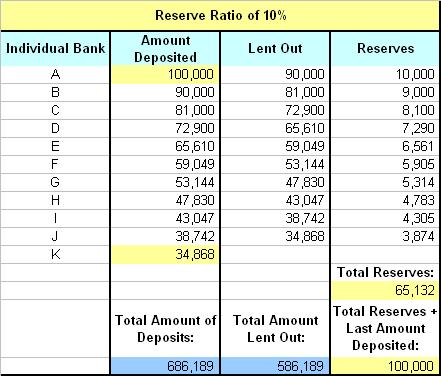
Creating Wealth through Debt – The table below displays how loans are funded and how the money supply is affected. It shows how a commercial bank creates money from an initial deposit of $100,000. In the example, the initial deposit is lent out 10 times with a fractional-reserve rate of 10% to ultimately create $686,189 of commercial bank money. Each successive bank involved in this process creates new commercial bank money (out of thin air) on a diminishing portion of the original deposit. This is because banks only lend out a portion of the initial money deposited, in order to fulfill reserve requirements and to allegedly ensure that they have enough reserves on hand to meet normal transaction demands.

The model begins when the initial $100,000 deposit of your money is made into Bank A. Bank A sets aside 10 percent of it, or $10,000, as reserves, and then loans out the remaining 90 percent, or $90,000. At this point, the money supply actually totals $190,000, not $100,000. This is because the bank has loaned out $90,000 of your money, kept $10,000 of it in reserve (which is not counted as part of the money supply), and has substituted a newly created $100,000 IOU for you that acts equivalently to and can be implicitly redeemed (i.e. you can transfer it to another account, write a check on it, demand your cash back, etc.). These claims by depositors on banks are termed demand deposits or commercial bank money and are simply recorded on a bank’s books as a liability (specifically, an IOU to the depositor). From your perspective, commercial bank money is equivalent to real money as it is impossible to tell the real money apart from the fake, until a bank run occurs (at which time everyone wants real money).
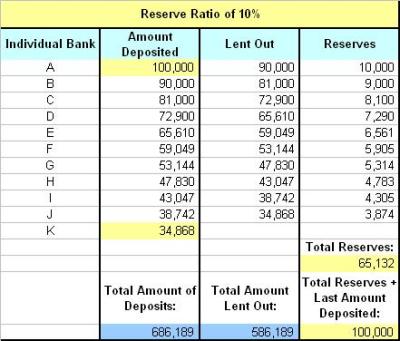
At this point in the model, Bank A now only has $10,000 of your money on its books. A loan recipient is holding $90,000 of your money, but soon spends the $90,000. The receiver of that $90,000 then deposits it into Bank B. Bank B is now in the same situation that Bank A started with, except it has a deposit of $90,000 instead of $100,000. Similar to Bank A, Bank B sets aside 10 percent of the $90,000, or $9,000, as reserves and lends out the remaining $81,000, increasing the money supply by another $81,000. As the process continues, more commercial bank money is created out of thin air. To simplify the table, different banks (A – K) are used for each deposit, but in the real world, the money a bank lends may end up in the same bank so that it then has more money to lend out.

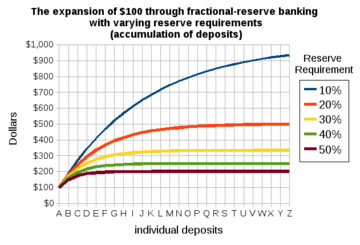
Although no new money was physically created, through the process of fractional-reserve banking new commercial bank money is created through debt. The total amount of reserves plus the last deposit (or last loan, whichever is last) will always equal the original amount, which in this case is $100,000. As this process continues, more commercial bank money is created. The amounts in each step decrease towards a limit. This limit is the maximum amount of money that can be created with a given reserve ratio. When the reserve rate is 10%, as in the example above, the maximum amount of total deposits that can be created is $1,000,000 and the maximum increase in the money supply is $900,000 (explained below).

Fractional reserve banking allows the money supply to expand or contract. Generally the expansion or contraction is dictated by the balance between the rate of new loans being created and the rate of existing loans being repaid or defaulted on. The balance between these two rates can be influenced to some degree by actions of the Fed. The value of commercial bank money is based on the fact that it can be exchanged freely as legal tender. The actual increase in the money supply through this process may be lower, as at each step, banks may choose to hold reserves in excess of the statutory minimum, or borrowers may let some funds sit idle, or some people may choose to hold cash (such as the unbanked). There also may be delays or frictions in the lending process, or government regulations may also limit the amount of money creation by preventing banks from giving out loans even though the reserve requirements have been fulfilled.

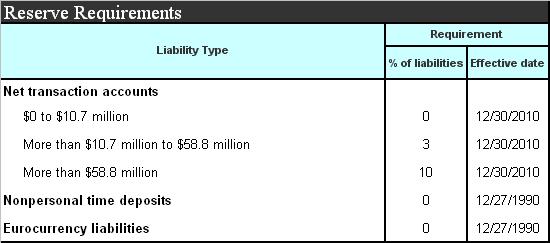
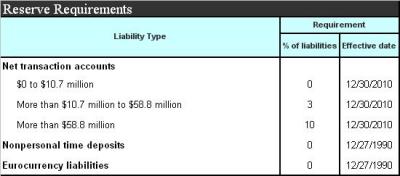
What are the Fed’s current reserve requirements? – According to the Federal Reserve, banks with less than $10.7 million on deposit are not required to reserve any amount. When deposits reach $10.7 to $58.8 million the requirement is just 3%. It’s only when deposits exceed $58.8 million that a 10% reserve requirement applies. The table below was extracted from the Federal Reserve’s website.
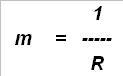
How much money can our banking system create out of thin air? – The most common mechanism used to measure the increase in the money supply is typically called the money multiplier. It calculates the maximum amount of money that an initial deposit can be expanded to with a given reserve ratio.

FormulaThe money multiplier, m, is the inverse of the reserve requirement R:
Examples

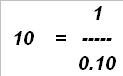
A reserve ratio of 10 percent yields a money multiplier of 10. This means that an initial deposit of $100,000 will create $1,000,000 in bank deposits.
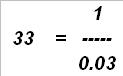
A reserve ratio of 3 percent yields a money multiplier of 33. This means that an initial deposit of $100,000 will create $3,300,000 in bank deposits.
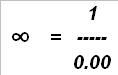
A reserve ratio of 0 percent yields a money multiplier of ∞ (infinity). This means that an initial deposit of $100,000 will create an unlimited amount of bank deposits.
What’s the problem? – The system works fine as long as everyone plays along. The biggest problem is that it’s a system by which wealth is only created through debt. Through this system, the lender always wins; while debtors – nowadays referred to as the middle class – always lose. As long as there are willing borrowers, our economy grows. When consumers, businesses, and the federal government stop borrowing, the system shuts down. But one cannot very well borrow into infinity; after all, life itself is finite. “There is a time to borrow, and a time to repay; a time to live and a time to die.” One definitely cannot borrow while lacking the means of repayment, unless of course, it has a seeming unlimited ability to tax.

The next biggest problem is that of absurdly low bank reserve requirements. With bank reserve requirements set at 0% to 10%, what could possibly go wrong? I mean besides banks having the ability to create an infinite supply of make-believe money through debt. The modern mainstream view of reserve requirements is that they are intended to prevent banks from:

  1. Generating too much money by making too many loans against the narrow money deposit base;
  2. Having a shortage of cash when large deposits are withdrawn (although the reserve is thought to be a legal minimum, it is understood that in a crisis or bank run, reserves may be made available on a temporary basis).
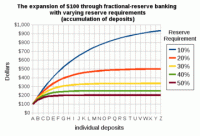
Let’s face the facts. Our present monetary policy is a disaster. When too many players wish to withdraw their money to hold as cash, or too many purchases are made overseas, or an excessive amount of loan defaults occur, the house comes crashing down. When all three events occur at the same time, as actually happened in 2008, it should have spelled the end of fractional-reserve banking. But instead, our leaders are in denial. Now “wealthy” U.S. taxpayers are being called upon to bailout the federal government, while at the same time, the government seeks more borrowing power. But when all our wealth is gone, who will rescue us then? And if the entire global monetary system has likewise been built on the same sinking sand, who will rescue them?

Well, hopefully you now have a better understanding of why our present monetary system is dysfunctional, why the federal government wants you to borrow more, and why it wants to borrow more itself. We are a nation built on a Ponzi scheme; one which cannot grow without incurring further debt. But as I said before, growth through debt amounts to nothing more than spending next year’s income today. Man does not live by debt alone.

What’s the solution? – We have to put an end to fractional-reserve banking. It should be clear, to all those with understanding that we need to get off of this merry-go-round. The first step is for the Federal government to take the power of money creation away from the Federal Reserve and from commercial banks by both issuing and controlling the quantity of its own currency (rather than Federal Reserve Notes). The second step is to increase bank reserve requirements to 100%, as banks should never again be allowed to loan out more money than actually on deposit. If there was a way to end the debt-money system and to payoff the national debt within a year or two, wouldn’t you want to know? For the details on how to accomplish this, I implore you to watch Bill Still’s full video entitled, The Secret of Oz (preview).

“Therefore everyone who hears these words of mine and puts them into practice is like a wise man who built his house on the rock. The rain came down, the streams rose, and the winds blew and beat against that house; yet it did not fall, because it had its foundation on the rock. But everyone who hears these words of mine and does not put them into practice is like a foolish man who built his house on sand. The rain came down, the streams rose, and the winds blew and beat against that house, and it fell with a great crash.” ~ Matthew 7:24-27 (NIV)

References:

Fractional-Reserve Banking

Principles of Monetary Reform

Federal Reserve: Monetary Policy
Monetary Reform, Part II | Lending and Interest

– By: Larry Walker, Jr. –

The interest that U.S. taxpayers pay on behalf of the federal government, for the privilege of having money in our wallets, and to cover irresponsible deficit-spending, is only the beginning of our woes. When it comes to our personal credit needs, American citizens are once again shackled and sold down river. With regards to borrowing and lending, we may be able to take a few pointers from Islamic banking. I know what you’re thinking, but just bear with me. Let me make one thing clear, I am a Christian, and I do not agree with any of the principles of Sharia, except for those it shares in common with the Bible. Upon these, I think most humans can agree. For in this case, we are not talking about matters of heaven or hell; we’re talking about money.

“If one of your countrymen becomes poor and is unable to support himself among you, help him as you would an alien or a temporary resident, so he can continue to live among you. Do not take interest of any kind from him, but fear your God, so that your countryman may continue to live among you. You must not lend him money at interest or sell him food at a profit.” ~ Leviticus 25:35-37

Interest – Sharia prohibits the charging of interest (known as usury) for loans of money. The Bible is also very clear on the matter of usury. The Biblical term for usury, neshek, is strongly negative, coming from a root whose basic meaning is to strike as a serpent. Islamic banking has the same purpose as conventional banking: to make money for the banking institute through the lending of capital. But because Islam forbids simply lending out money at interest, Islamic rules on transactions have been created to avoid this problem. The basic technique to avoid the prohibition is the sharing of profit and loss, via terms such as profit sharing, safekeeping, joint venture, cost plus, and leasing.

Loans in pre-industrial societies were made to farmers in seed grains, animals and tools. Since one grain of seed could generate a plant with over 100 new grain seeds, after the harvest, farmers could easily repay the grain with “interest” in grain. When an animal was loaned, interest was paid by sharing in any new offspring. What was loaned had the power of generation, and interest was a sharing of the result. Interest on tool loans would be paid in the produce which the tools had helped to create.

Monetary problems didn’t surface until societies began using metals, like gold, as forms of currency. When interest was allowed to be charged on loans of metals, with the interest to be paid in more metal, life became more difficult, particularly with agricultural loans. The problem is that inorganic materials, not being living organisms, have no means of reproduction. Thus, any interest paid on them must originate from some other source or process. The same is true with paper money today.

For example, if you borrow money to start a farming business, the only way to pay it back is if you are able to sell your crops to others in exchange for sufficient paper money to cover your expenses, including principal and interest. If your crops happen to get wiped out one season, then most likely, so do you. Even if you borrow money to start any kind of business, and are successful, you must make enough profit to cover the principal and interest payments on the debt. And in case you don’t know it, principal repayments are never deductible for income tax purposes. So a business with $100,000 in profit, which uses it to repay its debt, must then come up with additional money to cover the income taxes thereon; leading to the incurrence of more debt. What we have in the United States is a system of winners and losers, where the big banks always win, while the citizens of the Republic mostly lose.

Mortgage Loans – Let’s say you decide to buy a home for $110,000 by paying $10,000 down, and taking out a $100,000, 30 year – 5% fixed rate mortgage. When the term is over, you will have paid the lender $193,256, plus your down payment, for a total of $203,256. What you get in exchange is the privilege of living in a home which may or may not be worth its original value of $110,000 in 30 years. If your home loses value midstream, as far as the lender is concerned, “too bad”. If you miss, or are late on a payment, the lender will charge you penalties and destroy your credit, preventing you from obtaining future loans. If you get too far behind, the lender will put you out on the street. It doesn’t matter how good your credit was before your troubles, or how long you made timely payments, you will be destroyed. The lender will then confiscate your home, and sell it to someone else, pocketing any profit in the process.

In an Islamic mortgage transaction, instead of loaning the buyer money to purchase a home, a bank might buy the home itself from the seller, and re-sell it to the buyer at a profit, while allowing the buyer to pay the bank in installments. However, the bank’s profit cannot be made explicit and therefore there are no additional penalties for late payment. In order to protect itself against default, the bank asks for strict collateral. The property is registered to the name of the buyer from the start of the transaction. This arrangement is called Murabahah.

An innovative approach applied by some banks for home loans, called Musharaka al-Mutanaqisa, allows for a floating rate in the form of rental. The bank and borrower form a partnership entity, both providing capital at an agreed percentage to purchase the property. The partnership entity then rents out the property to the borrower and charges rent. The bank and the borrower will then share the proceeds from this rent based on the current equity share of the partnership. At the same time, the borrower in the partnership entity also buys the bank’s share of the property at agreed installments until the full equity is transferred to the borrower and the partnership is ended. If default occurs, both the bank and the borrower receive a proportion of the proceeds from the sale of the property based on each party’s current equity.

Business Loans – U.S. banks lend money to companies by issuing fixed or variable interest rate loans. The rate of interest is based on prevailing market rates and is not pegged to a company’s profit margin in any way. U.S. banks currently borrow the money they lend to businesses at rates as low as 0.25%. When was the last time you saw an ad for small business loans charging 0.50%, which would give the lender a 100% return? The fact is that banks are still charging rates of between 4.0% and 30.0%, in spite of the cost of money. When prevailing interest rates are too high fewer businesses are able to borrow, thus inhibiting economic growth; and when rates are too low, profit-dependent banks are less willing to lend, also hindering the economy at large. If a business with a profit margin of just 5.0% could only borrow money at interest rates of 10.0% or more, why would it bother?

Islamic banks lend their money to companies by issuing floating rate loans. The floating rate is pegged to the company’s individual rate of return. Thus the bank’s profit on the loan is equal to a certain percentage of the company’s profits. Once the principal amount of the loan is repaid, the profit-sharing arrangement is concluded. This practice is called Musharaka.

Risk – Under our present system, if a company has a bad year and misses a few payments, it may be forced into bankruptcy. In the U.S. the risk of failure is placed squarely on the back of entrepreneurs. If a small business owner defaults on a loan, he is run out of business and his future ability to borrow is destroyed. In the case of government guaranteed loans, which are backed by the full faith and credit of you and I, the banks get their money back, while the failed entrepreneur, having been made a personal guarantor, is hunted down by his own government, like a fugitive, for the rest of his days.

Islamic banks also lend through Mudaraba, which is venture capital funding to an entrepreneur who provides labor while financing is provided by the bank so that both profit and risk are shared. Such participatory arrangements between capital and labor reflect the Islamic view that the borrower must not bear all the risk/cost of a failure, resulting in a balanced distribution of income and not allowing the lender to monopolize the economy.

End Usury, Now – Our monetary system needs a complete overhaul. But so far, the only reforms offered have been to further back big banks, at the expense of U.S. citizens. This is not acceptable. Until there is real reform, you and I, our children and grandchildren will remain enslaved. Backing our currency with gold is not the answer. The first step is for the government to begin printing its own fiat currency. The second step is to outlaw the practice of charging interest.

References:

Islam in the Bible – Usury

Islamic banking

Leviticus, Chapter 25

Monetary Reform, Part I | End the Debt

~ By: Larry Walker, Jr. ~

The rich rule over the poor. The borrower is servant to the lender. ~ Proverbs 22:7 ~

Free Our Money – So what’s the problem? You know, you think about it all the time. It’s debt, debt, debt! The way our economy is set up now, the only way it can grow is through incurring more debt, either through government, business or consumers. Our economy cannot grow without increasing its money supply, and the only way that new money can be introduced, under the present monetary system, is through debt. But growth through debt really amounts to nothing more than spending next year’s income today. It’s a vicious cycle, one which has reduced millions to poverty, and to lives of indentured servitude. It’s time to end the debt, now. I believe that most good ideas are simple, and that any lasting reform must, like our very Constitution, be rooted and grounded in Judeo-Christian Principles.

There are two ways to approach monetary reform. One involves making changes to our current system, and the other involves a complete overthrow, starting over from scratch. I believe that one method is practical while the other is not. I am from the school of thought that believes it impossible to make the necessary reforms within the present corrupt system. Our monetary system has failed. Revolution is the only solution.

Under the current debt regime, there are two primary ways that our money supply is increased.

  1. The first way is that the Federal Reserve (the Fed) prints new money and loans it to the federal government by purchasing Treasury Bonds through Open Market Operations. The cash then enters the economy by being deposited into regional Federal Reserve banks accounts. Thus, the federal government, as it is today, can only create money through borrowing.

  2. The other way that money is created is through fractional-reserve banking. Under this system, Federal Reserve member banks are allowed to loan out at least ten-times the amount deposited with them in checking and savings accounts. When fewer loans are demanded, the supply of money contracts. It’s only when loan demand is high that the money supply increases.

Let’s face the facts. Consumers are tapped out. Most Americans have lost the equity in their homes and are buried in consumer debt. It’s not that banks aren’t willing to lend, it’s that nobody is willing to pay 4.0% to 30.0% interest on money the banks borrow at 0.25%. The system is broken. So today, our economy is being propped up mainly through deficit-financed government spending, but this will not continue. We have already passed the point of no return. This mark was decisively breached in early 2010, when per capita national debt surpassed per capita personal income. At this point there is no longer enough income to support the federal debt. Every additional dollar the government borrows merely expands the base of government-dependent citizens. If the course is not altered today, the government will eventually run out of other people’s money, leaving its citizens vulnerable to enslavement by an alien entity. So the problem is the federal government’s inability to create new money without incurring debt. If we can fix this, the problem is solved.

What happens when population growth outpaces its money supply? As an example, let’s say we have a two person society comprised of you and me, with a total of $1,000 in our economy. Our per capita money supply is $500. Now let’s say two more people cross over the border and become members of our society. Without an increase in the money supply, our standard of living will decline to $250 per person. This is also known as a recession or even depression. Recessions occur coincident with declines in the supply of money, as there is no longer enough to go around. Economic activity declines without an ability to increase the money supply. In order to maintain our standard of living, our money supply will need to increase from $1,000 to $2,000.

As long as there is population growth, the supply of money must constantly increase. In fact, regardless of population changes, in order for there to be any meaningful economic growth at all, a society demands steady increases in its supply of money. That’s our dilemma today. With U.S. population increasing by approximately 1.0% per year, the money supply must keep pace. However, the only way that the money supply can increase, without reform, is through debt.

Who’s to blame? – We the people have knowingly or unknowingly subscribed to a monetary system in which the Federal Reserve is our master, and we are its slaves. In this respect, we are not truly free. Some blame the bankers; others blame politicians; while still others blame more affluent taxpayers such as small businessmen or corporate jet owners. (By the way, corporations and their assets, including jets, are owned by shareholders; so if you own stock either directly, or through a retirement plan, you might be a corporate jet owner yourself.) In reality, you and I are to blame. We are the ones who have elected ignorant and corrupt politicians, who have allowed our government to maintain a flawed monetary policy.

When our monetary system achieved total failure in 2008, we had an opportunity to institute real reform, but instead we were conned into bailing it out, again at our own expense. The present administration promised change, but instead has delivered more chains. Next time will be different. We know that if we want a different result, we have to try something different. Any political candidate who doesn’t have a monetary reform plan which promotes the creation of debt-free money (fiat money), and solid debt reduction, and balanced budget plans is dead in the water.

“The ax is already at the root of the trees, and every tree that does not produce good fruit will be cut down and thrown into the fire.” ~ Matthew 3:10

Who’s Getting Hosed? – Under our present monetary system, the federal government, through the Treasury Department, prints Federal Reserve Notes and hands them over to the Fed. The Fed then lends the same money back to the federal government in exchange for U.S. Treasury Bills, Notes and Bonds. The Fed then sells some of these Treasury obligations at a discount to its member banks, investors, and foreign governments. The interest paid on these bills, notes and bonds is paid from income tax revenue collected off of the backs of U.S. taxpayers.

If the federal government could ever pay off its debt and balance its budget, it wouldn’t need to borrow as much. With the national debt already in excess of $14.4 trillion, it has become a burden for our government to meet its real responsibilities. This is the main reason why the national debt matters. As politicians do battle over whether or not the debt ceiling should be raised, in this case, to cover its own irresponsible spending, a more critical issue, the creation of money has been left in the hands of the Fed. Under our current system, the money supply cannot increase without adding to the debt. But if there was a way that the federal government could simply issue its own debt-free currency (fiat money), rather than Federal Reserve Notes, it would never have to borrow money from anyone ever again.

The more the federal government borrows, the more it binds U.S. taxpayers to cover its interest payments. It makes you wonder why a U.S. citizen would ever invest in Treasury obligations at all. I mean, in a way, the same citizen who buys this debt is also responsible, through income taxes, for paying the very interest he or she receives. And to make matters worse, the same citizen is taxed again on the interest earned. It’s a spiral of negative returns in which those who actually pay income taxes and invest in government debt are the losers; while the Fed, its member banks, and foreign investors can’t fail.

The Fed also loans some of this borrowed money to its member banks and to other “too big to fail” entities at interest rates currently as low as 0.25%. The banks then provide you and I, and our businesses with loans, or allow us credit, for the privilege of paying them anywhere from 4.0% to 30.0% interest, plus other transaction fees, pocketing the difference as profit. Banks even allow us to open checking or savings accounts for the additional privileges of earning next to nothing, and paying them even more in transaction fees, for the use of our own money. So we pay interest on debt just so the government can issue currency, we pay interest on the national debt, and then we pay more interest for banking and loan privileges. These are hidden taxes of which certain politicians, those who are always harping about higher taxes, seem to be completely ignorant. But we know better.

End the Debt, Now – Why does the federal government print money, give it to the Federal Reserve, and then borrow its own money back at interest? Couldn’t the government simply print United States Notes, rather than Federal Reserve Notes, and spend it into the economy without a middle man? According to Bill Still, yes it can. In fact, Mr. Still says that if the government took this route, it could repay all of its existing debt within a year or two, by simply replacing the old notes with new ones. For more on this, I recommend that you watch his video entitled, The Secret of Oz.

“There is no retreat but in submission and slavery! Our chains are forged!” ~ Patrick Henry

Other References:

Oz Economics

Saving Our Way to Prosperity

Yes. You Can.

– By: Larry Walker, Jr. –

According to Barack Obama, “We can’t simply cut our way to prosperity.” Prior historical references: None. Upon hearing such an absurd statement, and being of the homo economicus persuasion, my first instinct is to define what it means to me, and then to determine whether it has any relevance in my life. If we are honest, we must each define what the word prosperity, or rich, means to us. Only after we have defined its meaning are we able to chart a course.

In the WikiHow.com article, “How to get rich,” there are seven steps, the first of which is to define the word “rich.” Obviously it means different things to different people. According to Obama, the word rich means making more than $250,000 per year. A more formal definition of prosperity is “to be fortunate or successful, especially in terms of one’s finances.” For others it means achieving a certain level of prestige, or being able to afford a comfortable retirement, neither of which necessarily involves making $250,000 in a year. How would you define prosperity?

Homo Economicus

The term Homo economicus, or Economic human, is the concept in some economic theories of humans as rational and narrowly self-interested actors who have the ability to make judgments toward their subjectively defined ends. My definition is that men and women are primarily interested in making judgments which will improve their own economic condition. My goal is not to be a millionaire, although that would be nice. My goal is to be able to meet my obligations in life and to remain self-sufficient upon retirement.

In John Stuart Mill’s work on political economy, in the late nineteenth century, he further defined this economic man as “a being who inevitably does that by which he may obtain the greatest amount of necessaries, conveniences, and luxuries, with the smallest quantity of labor and physical self-denial with which they can be obtained.” I have to admit that my goal is also to get the most out of life with the least possible amount of labor, but that’s not exactly how it’s been working out. I work much too hard. What’s your goal?

Yes. You can.

Notice that Obama uses the words, “we and our”, as in, “We can’t simply cut our way to prosperity.” Exactly what does that mean? The last time I checked, “we” wasn’t responsible for paying my bills. Actually, you and I just might be able to cut our way into relative prosperity. But I don’t believe that the federal government can tax and spend us into a utopian paradise. If this were possible, wouldn’t we already be there?

Returning to “How to Get Rich,” the 4th Step is entitled, Delay Gratification, under which we find the following guidance on the path to prosperity:

  1. Are you spending money on things that won’t get you rich?

  2. Are you sticking with a job that doesn’t make that much money to begin with?

  3. In order to get rich, you’re going to have to give up some of the things you enjoy doing now, so that you can enjoy those things without restriction later. For example, you might like having free time, so you give yourself a few hours a day to do nothing. But if you were to invest those few hours into getting rich, you could work towards having 20 years of free time (24 hours a day!) with early retirement. What can you give up now in exchange for being rich later?

  • Cut expenses
  • Get a job that pays more or get a promotion
  • Downgrade or give up your car
  • Downgrade your apartment or house
  • Reallocate your spare time

Although there is an element of truth in the statement, “we can’t cut our way to prosperity”, the fact is that you and I can, individually. The act of cutting, or reducing, my personal expenses causes me to save money. So to cut means the same as to save. By substituting the word ‘cut’ with ‘save’ in Obama’s original comment; what he is really saying to me is that, “We can’t simply save our way into prosperity.” Why, that’s preposterous! It’s as if he is implying that I should empty my emergency fund and retirement savings, spend it all today, and I will be magically ushered into prosperity. But if I did that, then I would be forced to borrow huge sums of money when ready to invest in furtherance of my dreams. But this won’t work out too well, especially since banks normally require a down payment.

The 5th Step in How to Get Rich is entitled, Save Money. It states, “You’ve heard the phrase “It takes money to make money.” So start socking away the extra money you’re making now that you’ve delayed gratification as outlined previously. After all, what’s the point in giving up the stuff you like if you have a hole in your pocket? Start building a “get rich fund” at the bank. Always pay yourself first. This means before you go and blow your pay check on a new pair of shoes or a golf club you don’t need, put money aside in to an account that you don’t touch.” This makes much more sense to me than the idea of squandering my savings, as implied by Obama. So for me, yes, I can save my way into relative prosperity, and so can you. The federal government could do the same, after paying off its massive $14.4 trillion debt, that is. This ought to be Obama’s goal. Yes. You can.

No. Government Can’t.

He jabbers on, “We need to do what’s necessary to grow our economy; create good, middle-class jobs; and make it possible for all Americans to pursue their dreams.

There he goes with that “our” stuff again. We need to do what’s necessary to grow our economy. That sounds appealing, but fortunately my economy is not yours, and yours is not mine. My economy is comprised of my household, my family, my business customers, vendors, lenders, employees and other obligations. I don’t know where Obama is coming from, but there is one way that the federal government could help to grow my economy, and that would be to stop taking as much of my hard earned money in taxes. That would help quite a bit. If I didn’t have to pay any taxes at all, my economy would be doing pretty well. Try that one on for size! If the government concentrated more on how to take less of my money, then my economy would improve, and so would yours. This simply requires cutting the size of government.

Next, he says that we need to create good, middle class jobs. What exactly is a good, middle class job? Does it require picking up a shovel? The idea of having a good, shovel-ready, middle class job doesn’t exactly mesh with prosperity, at least not in my book. Thanks but no thanks. I don’t really want a middle class job; I would rather have more freedom and prosperity. I don’t believe that group effort is required in job creation. I believe that one economic man can create many jobs. In fact, the true economic man is going to need a lot of help upon reaching his own prosperity. He’s going to need employees, suppliers, accountants, attorneys, financial planners, housekeepers, gardeners, service people, travel agents, retailers, restaurants, auto dealers, gas stations, chauffeurs, etc. It seems to me that Obama’s goal should be to inspire more economic men and women, and greater prosperity, rather than higher taxes, and more mundane, government-manufactured, temporary, shovel-ready, middle class jobs.

Finally, Obama says that we need to make it possible for all Americans to pursue their dreams. But all that’s required here is freedom. Are we not free? As long as I am free, I can do anything, and so can you. Nothing can stop me from pursuing my dreams, yet my dreams are not yours, and yours are not mine. Maybe your dream is to manufacture a product, while mine is to provide a good quality affordable service. Someone else’s dream might involve freeloading off of the toil of others. Just as the word prosperity means different things to different people, our dreams are not all the same. “We hold these truths to be self-evident, that all men are created equal, that they are endowed by their Creator with certain unalienable Rights, that among these are Life, Liberty and the pursuit of Happiness.” The federal government didn’t give these rights to me, and it can’t take them away. You sir, cannot spend our way into life, liberty, and the pursuit of happiness, they are the gift of God.

The bottom line: Yes we can save our way to prosperity. That’s how it works in this Universe. It takes money, to make money. Here are a few more steps we can follow along the path to prosperity. Step 1: Cut discretionary government spending back to 1996 levels. Step 2: Force the federal government to start making principal payments against its debt. Step 3: Abolish every new governmental regulation established since January of 2009. Step 4: Vote against Barack Obama and his queer notions about the economy.

Want Tax Hikes? Push the Reset Button

Cut Government Spending Back to 1996

– By: Larry Walker, Jr. –

Dialing the top income tax bracket back 15 years without a reciprocal cut in government spending does nothing to preempt the debt bubble. However, if the Golfer in Chief and his inept cohorts remain stuck on reinstating those bygone tax rates, then all taxpayers must necessarily stand as staunchly fixated on cutting the size of discretionary government spending, back to 1996 levels if necessary. Those not willing to regress on government spending really need to stop kidding themselves into believing the silly notion of resurrecting 15 year old tax brackets as a serious solution. If you are confounded, then more than likely you have never heard of inflation, don’t purchase goods and services with your own money, and lack the skills required to balance a simple checkbook. In other words, those who don’t comprehend would better serve the public by resigning from government and returning to their own ruinous private lives.

The fallacy of anointing $250,000 as the top tax bracket of the 21st Century is actually based on 20th Century income tax tables. What worked in 1996 won’t work today. What Barack Obama and fellow democrat party residue from the last shellacking are really talking about is reimposing the top income tax brackets of 1996, which applied some 15 years ago. Omitted from this quandary are two key factors: inflation and the level of discretionary government spending in 1996.

  1. Inflation – As far as personal income, $250,000 in 2011 had the same buying power as $175,085 in 1996. And $250,000.00 in 1996 has the same buying power as $356,969.06 in 2011. Annual inflation over this period was 2.40%. Thus $250,000 isn’t what it used to be.

  2. Discretionary Government Spending – Discretionary spending in 1996 was $532.7 billion compared to the 2012 budget estimate of $1,340.3 billion ($1.3 trillion). If they want us to acquiesce to 1996 tax brackets, then shouldn’t the government backtrack to 1996 discretionary spending as well?

In terms of both inflation and discretionary government spending, the budgeted 2012 discretionary spending level of $1,340.3 billion had the same buying power as $938.6 billion in 1996. And the $532.7 billion actually spent in 1996 has the same buying power as $760.6 billion today. If democrats insist on hiking taxes on those making over $250,000, then a simple compromise would be for them to agree to cut discretionary government spending by $579.7 billion in 2012 ($1,340.3 minus $760.6). This would bring both government spending and income tax rates in line with the late 20th century. But the right thing to do under Obamanomic theory is to simply return to actual 1996 discretionary spending. This requires cutting the federal budget by $807.6 billion, as shown below.

From General

This means cutting National Defense by $463.9 billion, International Affairs by $46.1 billion, General Science, Space and Technology by $15.3 billion, Energy by $10.2 billion, Natural Resources and Environment by $19.2 billion, Agriculture by $2.9 billion, Commerce and Housing Credit by $557 million, Transportation by $3.5 billion, Community and Regional Development by $14.2 billion, Education, Training, Employment and Social Services by $66.8 billion, … etc…

Don’t worry about who gets hurt or rewarded, just cut it, and then tell governmental agencies, “Here’s your budget, now you figure out how best to spend it.” Problem solved. Next question!

“Knowledge is an inherent constraint on power.” ~ Thomas Sowell

“Collecting more taxes than is absolutely necessary is legalized robbery.” ~ Calvin Coolidge

References:

http://www.dollartimes.com/calculators/inflation.htm

http://www.gpo.gov/fdsys/pkg/BUDGET-2012-TAB/xls/BUDGET-2012-TAB-8-7.xls

Unequally Yoked | Social Security and the Working Class

Liberty?

Public vs. Private Sector Inequities

~ By: Larry Walker, Jr. ~

Did you know that most state and local government employees are exempt from Social Security taxes? Millions of Americans who are covered by state or local retirement plans do not pay into the Social Security system. If Social Security is such a great plan, then why are 17,738,156 [1] state and local government workers exempt? Why does the federal government continue to legally bind the rest of us to a sinking ship? This isn’t 1933 anymore. The time for change is now. Social Security is the biggest fraud in American history.

There is no retreat but in submission and slavery! Our chains are forged! ~ Patrick Henry

Teachers Retirement System of Georgia vs. Social Security

For example, teachers in the state of Georgia are covered by the Teachers Retirement System (TRS). Following are some of the differences between teachers covered by TRS and private sector workers covered by Social Security.

  1. Although Georgia teachers are required to contribute 5.0% of their pay into the TRS, the contribution is considered a pre-tax deduction. Workers covered by Social Security must contribute 6.2% of their pay on an after-tax basis.

  2. Georgia public employers pay a matching contribution of 9.24% into the TRS. Private sector employers pay a 6.2% match to the Social Security Administration (SSA).

  3. TRS contributions are invested in stocks, bonds and other liquid investments earning interest, dividends and the chance for appreciation in value. Social Security contributions are used to pay the benefits of current recipients. Any surplus is borrowed and spent by the federal government which is currently $14.3 trillion in debt.

  4. The normal retirement age for Georgia teachers is 60 years of age. Normal retirement for Social Security recipients is age 65, 66, 67 or greater.

  5. Georgia teachers may retire at any age after 25 years of service. Social Security recipients may not retire until they reach the age of 62 (with reduced benefits).

  6. The amount of benefits received by Georgia teachers is based on the two highest years of compensation. The benefits paid by Social Security are based on the average amount of earnings over a 35 year period.

  7. Georgia teachers become vested in their retirement benefits after 10 years of service. Upon separation from service they may either take a lump-sum distribution or rollover their contributions into an IRA. After the vesting period, Georgia Teachers may also take a lump-sum distribution or rollover the employer contributions into an IRA. Social Security recipients are vested after working 40 quarters, or 10 years, but have no rights to lump-sum distributions or rollovers.

  8. Upon separation of service or retirement, Georgia teachers may either take a lump-sum distribution or rollover their benefits into an IRA account. Georgia teachers may also elect to have their remaining benefits paid to their beneficiaries. Social Security recipients do not have any contractual right to take lump-sum distributions, make rollovers, or to pass benefits on to their heirs.

  9. The maximum amount of annual retirement benefits paid to Georgia teachers is determined by multiplying the average of their top two years’ salary by the number of years of service, and then by 2%. Thus an employee who earned $50,000 in their top two years, with 30 years of service, would receive an annual pension of $30,000 per year, or $2,500 per month [50,000 * (.02 * 30)]. The average amount of benefits paid to Social Security recipients is $14,088 per year, or $1,174 per month. The maximum Social Security benefit for a worker retiring in 2011 is $28,392 or $2,366 per month based on earnings at the maximum taxable amount for every year after the age of 21. The maximum taxable amount of Social Security wages in 2009/2010 is $106,800. [2,3]

Wisconsin Retirement System vs. Social Security

As a second example, teachers in the state of Wisconsin are covered by the Wisconsin Retirement System (WRS). Following are some of the differences between teachers covered by WRS and private sector workers covered by Social Security.

  1. Although Wisconsin teachers are supposed to contribute 5.0% of their pay into the WRS, the contribution is actually paid by their employer (i.e. amounts designated as employee contributions for accounting purposes are actually paid by the employer). [1 (pages 15-17)] WRS employees may also make additional tax deferred contributions to their WRS accounts. Workers covered by Social Security must contribute 6.2% of their pay on an after-tax basis.

  2. Wisconsin public employers pay a matching contribution of 4.5% into the WRS, but since they also pay the employees portion, their total contribution is 9.5%. Private sector employers pay a 6.2% match to the Social Security Administration (SSA).

  3. WRS contributions are invested in stocks, bonds and other liquid investments earning interest, dividends and the chance for appreciation in value. Social Security contributions are used to pay the benefits of current recipients. Any surplus is borrowed and spent by the federal government which is currently $14.3 trillion in debt.

  4. The normal retirement age for Wisconsin teachers is 65 years of age, or 57 with 30 years of service. Normal retirement for Social Security recipients is age 65, 66, 67 or greater.

  5. Wisconsin teachers may retire as early as the age of 55 (with reduced benefits). Social Security recipients may not retire until they reach the age of 62 (with reduced benefits).

  6. The amount of benefits received by Wisconsin teachers is based on an average of the three highest years of compensation. The benefits paid by Social Security are based on the average amount of earnings over a 35 year period.

  7. Wisconsin teachers become vested in their retirement benefits immediately and may either take a lump-sum distribution or rollover the employer contributions into an IRA upon separation. Social Security recipients are vested after working 40 quarters, or 10 years, but have no rights to lump-sum distributions or rollovers.

  8. Upon separation of service or retirement, Wisconsin teachers may either take a lump-sum distribution or rollover their benefits into an IRA account. Wisconsin teachers may also elect to have their remaining benefits paid to their beneficiaries. Social Security recipients do not have any contractual right to take lump-sum distributions, make rollovers, or to pass benefits on to their heirs.

  9. The maximum amount of annual retirement benefits paid to Wisconsin teachers is determined by multiplying the average of their top three years’ salary by the number of years of service, and then by 1.6%. Thus an employee who earned $50,000 in their top three years, with 30 years of service, would receive an annual pension of $24,000 per year, or $2,000 per month [50,000 * (.016 * 30)]. The average amount of benefits paid to Social Security recipients is $14,088 per year, or $1,174 per month. The maximum Social Security benefit for a worker retiring in 2011 is $28,392 or $2,366 per month, based on earnings at the maximum taxable amount for every year after the age of 21. The maximum taxable amount of Social Security wages in 2009/2010 is $106,800. [2,3]

Unequally Yoked

When it comes to retirement, not all Americans are treated equally. State and local government workers have great advantages over private sector employees. Not only does the private sector pay the salaries of state and local government workers through income and property taxes, and not only do we contribute towards their retirement, but we allow them to have better retirement plans than ourselves. As most of us sit, chained to the broken and antiquated Social Security system, state and local government employees continually bargain for more and more. Here are the major inequities in a nutshell.

  • Most state and local government employees contribute less towards their retirement plans than those covered by Social Security but receive back more in benefits. Wisconsin public employees contribute nothing towards their retirement yet receive back more in benefits than comparable working class peons.

  • State and local government employees have portable retirement accounts which actually exist. Americans who are covered by Social Security don’t have any portability of savings, nor have their funds been set aside or invested in any manner.

  • State and local workers have greater options for early retirement based on age and the number of years of service, while Social Security patrons must wait until the age of 62 to receive a reduced amount of benefits.

  • The age of full retirement for those covered by Social Security continues to be pushed back due to the lack of funds, while state and local employees are allowed to quit their jobs and take their savings with them at any time.

  • State and local employees are paid retirement benefits based on an average of their top 2 or 3 years of earnings, while Social Security benefits are calculated using an average of 35 years of earnings.

  • Social Security benefits are limited to $28,392 per year, in 2011, no matter how much is earned in a lifetime. The benefits paid to most state and local plan recipients are for the most part unlimited.

Not all workers in the United States are covered by Social Security, so why don’t the rest of us have a choice? Since state and local retirement plans are required to invest contributions in a fiduciary capacity, why doesn’t Social Security? What makes state and local government employees better than the average American? Wouldn’t privately owned and managed retirement accounts be an improvement for all Americans? It’s time to end Social Security. It’s time for all American workers to be treated equally. The ‘Nanny State’ has failed. The era of big government is over. Give me liberty, or give me death!

Sources:

[1] WISCONSIN LEGISLATIVE COUNCIL – 2006 COMPARATIVE STUDY OF MAJOR PUBLIC EMPLOYEE RETIREMENT SYSTEMS

[2] Social Security Administration – Answers

[3] Your Retirement Benefit: How It Is Figured

Other References:

Teachers Retirement System of Georgia – 2010 Annual Financial Report

Wisconsin Department of Employee Trust Funds – 2009 Annual Financial Report

Wisconsin Retirement System (WRS) Benefit Summary

Links:

Chile's Private Accounts Turn 30 – Investors.com

Bill Baar's West Side: NBC LA: A New Party Within a Party? Labor-Skeptic Democrats

Obsolete Government Programs, Part 2 | Medicare

Personal Responsibility

You Paid How Much For Medicare?

~ By: Larry Walker, Jr. ~

Medicare is a social insurance program administered by the United States government, providing health insurance coverage to people who are aged 65 and over, or who meet other special criteria. Some say that Medicare operates similar to a single-payer health care system, but with one key exception: Medicare Part A, the part that we pay for all of our working lives, only provides hospital insurance, and it doesn’t kick in until after the age of 65. Thus, Medicare is more akin to an excessively expensive, mandatory, long-term health care plan than anything else. Although there is a health insurance aspect to Medicare, known as Part B, it’s not free either. Medicare Part B requires the payment of additional monthly premiums upon retirement of between $96.40 and 308.30 per month, depending on the recipient’s level of income at the time.

Medicare is partially financed through payroll taxes imposed by the Federal Insurance Contributions Act (FICA) and the Self-Employment Contributions Act of 1954. In the case of employees, the tax is equal to 2.9% (1.45% withheld from the worker and a matching 1.45% paid by the employer) of the wages, salaries and other compensation in connection with employment. Until December 31, 1993, the law provided a maximum amount of compensation on which the Medicare tax could be imposed each year. But, beginning January 1, 1994, the compensation limit was removed. A self-employed individual must pay the entire 2.9% tax on self employed net earnings, but may deduct half of the tax from income in calculating income tax. Beginning in 2013, the 2.9% hospital insurance tax rises to 3.8% on earned income exceeding $200,000 for individuals and $250,000 for married couples filing jointly. [1]

Times Have Changed: Medicare is Obsolete

In the 1960s, Medicare was introduced to rectify the following problems: health care for the elderly and health care for the non-elderly with pre-existing conditions. The FICA tax was increased in order to pay for this expense. Both problems are listed below, followed by modern day private-sector solutions meant to address the same.

  • The U.S. had no federal-government-mandated health insurance for the elderly; consequently, for many people, the end of their work careers was the end of their ability to pay for medical care.

  • The U.S. had no federal-government-mandated health insurance for all those who are not elderly; consequently, many people, especially those with pre-existing conditions, have no ability to pay for medical care.

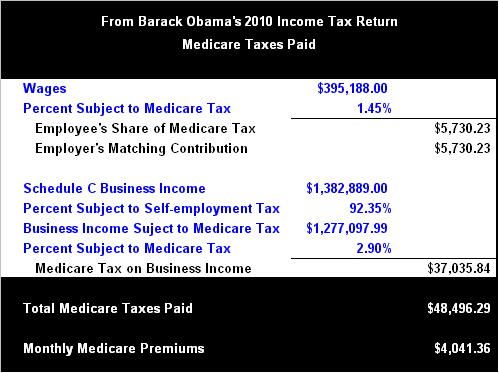
Most Americans would be able to afford real health insurance, or better plans, were we not forced to pay huge sums out of our current pay, for benefits that some will never see. For example, Barack Obama paid a total of $48,496.29 in Medicare taxes in 2010 alone. This means he paid $4,041.36 per month for long-term hospital insurance benefits that he won’t realize until he turns 65. A portion of the $48,496.29, namely $5,730.23 was actually paid by his employer, which would be you and I. Could Mr. Obama perhaps find a better deal in the private-sector? I would hope so. Would you pay $4,041.36 per month for long-term hospital insurance coverage if you had a choice? “AFLAC… AFLAC… AFLAC”!

Obama's Medicare Tab

Medicare Benefits

Medicare has four parts: Part A is Hospital Insurance. Part B is Medical Insurance. Medicare Part D covers prescription drugs. Medicare Advantage plans, also known as Medicare Part C, are another way for beneficiaries to receive their Part A, B and D benefits. All Medicare benefits are subject to medical necessity. The original program was only Parts A and B. Part D was new in January 2006; before that, Parts A and B covered prescription drugs in only a few special cases.

Medicare Premiums

Most Medicare enrollees do not pay a monthly Part A premium, because they (or a spouse) have had 40 or more 3-month quarters in which they paid Federal Insurance Contributions Act taxes. Medicare-eligible persons who do not have 40 or more quarters of Medicare-covered employment may purchase Part A for a monthly premium of:

  • $248.00 per month (in 2011) for those with 30-39 quarters of Medicare-covered employment, or

  • $450.00 per month (in 2011) for those with less than 30 quarters of Medicare-covered employment and who are not otherwise eligible for premium-free Part A coverage.

All Medicare Part B enrollees pay an insurance premium for this coverage; the standard Part B premium for 2009 is $96.40 per month. A new income-based premium schema has been in effect since 2007, wherein Part B premiums are higher for beneficiaries with incomes exceeding $85,000 for individuals, or $170,000 for married couples. Depending on the extent to which beneficiary earnings exceed the base income, these higher Part B premiums are $134.90, $192.70, $250.50, or $308.30 for 2009, with the highest premium paid by individuals earning more than $213,000, or married couples earning more than $426,000. In September 2008, CMS announced that Part B premiums would be unchanged ($96.40 per month) in 2009 for 95 percent of Medicare beneficiaries. This would be only the sixth year without a premium increase since Medicare was established in 1965.

Medicare Part B premiums are commonly deducted automatically from beneficiaries’ monthly Social Security checks. Part C and D plans may or may not charge premiums, at the programs’ discretion. Part C plans may also choose to rebate a portion of the Part B premium to the member. While private-sector health insurance premiums are deducted from employees’ paychecks on a pre-tax basis, Medicare taxes are confiscated from employees on an after-tax basis. Is that fair? Upon retirement, if one wishes to pay for Medicare Part B, the premiums are conveniently deducted from retirees Social Security checks on an after-tax basis. Is that fair?

Still Clueless?

Three-quarters of all taxpayers pay more in payroll taxes than income taxes. Do you get it now? It’s time for this to change. It’s time to stop confiscating money from today’s payroll checks to cover tomorrow’s health care needs. It’s time to give American citizens more of our own money so that we may provide for our current needs. All that we ever hear from the Democrats is how many Americans can’t afford health insurance. Did it ever dawn on any of them that maybe the reason we can’t afford health insurance is because we are being robbed blind by a 15.3% payroll tax? Out of every American paycheck, 15.3% is being literally looted and squandered by the federal government. We are being robbed by a 1933 law which has outlived its usefulness. It’s time to end Medicare and Social Security. All past obligations of Medicare must be immediately privatized through legitimate private-sector insurance companies.

References:

[1] http://www.ssa.gov/OACT/ProgData/taxRates.html

http://en.wikipedia.org/wiki/Medicare_(United_States)

Obsolete Government Programs, Part 1 | FICA

My Roots, circa 1918

“Free at last! Free at last! Thank God Almighty, we are free at last!” ~ MLK, Jr.

~ By: Larry Walker, Jr. ~

Are Social Security Benefits an Inalienable Right? ~

The Federal Insurance Contributions Act (FICA) is codified at Title 26, Subtitle C, Chapter 21 of the United States Code. The FICA tax is a United States payroll (or employment) tax imposed by the federal government on both employees and employers to fund Social Security and Medicare —federal programs that provide benefits for retirees, the disabled, and children of deceased workers. Social Security benefits include old-age, survivors, and disability insurance (OASDI); Medicare provides hospital insurance benefits. The amount that one pays in payroll taxes throughout one’s working career is indirectly tied to the social security benefits annuity that one receives as a retiree. Some folks claim that the payroll tax is not a tax because its collection is tied to a benefit. The United States Supreme Court decided in Flemming v. Nestor (1960) that no one has an accrued property right to benefits from Social Security. [1]

There has been a temptation throughout the program’s history for some people to suppose that their FICA payroll taxes entitle them to a benefit in a legal, contractual sense. That is to say, if a person makes FICA contributions over a number of years, Congress cannot, according to this reasoning, change the rules in such a way that deprives a contributor of a promised future benefit. Under this reasoning, benefits under Social Security could probably only be increased, never decreased, if the Act could be amended at all. Congress clearly had no such limitation in mind when crafting the law. Section 1104 of the 1935 Act, entitled “RESERVATION OF POWER,” specifically said: “The right to alter, amend, or repeal any provision of this Act is hereby reserved to the Congress.” Even so, some have thought that this reservation was in some way unconstitutional. This is the issue finally settled by Flemming v. Nestor. [1]

In this 1960 Supreme Court decision Nestor’s denial of benefits was upheld even though he had contributed to the program for 19 years and was already receiving benefits. Under a 1954 law, Social Security benefits were denied to persons deported for, among other things, having been a member of the Communist party. Accordingly, Mr. Nestor’s benefits were terminated. He appealed the termination arguing, among other claims, that promised Social Security benefits were a contract and that Congress could not renege on that contract. In its ruling, the Court rejected this argument and established the principle that entitlement to Social Security benefits is not a contractual right. [1]

So did you think that Social Security Benefits were an inalienable right? Think again.

Times Have Changed: Social Security is Obsolete

The Center on Budget and Policy Priorities states that three-quarters of taxpayers pay more in payroll taxes than they do in income taxes. The FICA tax is considered a regressive tax on income (with no standard deduction or personal exemption deduction) and is imposed (for the years 2009 and 2010) only on the first $106,800 of gross wages. The tax is not imposed on investment income (such as rents, interest and dividends). As a side note, the Earned Income Credit was enacted in 1975 to “offset the burden of social security taxes and to provide an incentive to work”. More recently the Making Work Pay Credit of 2010 and the 2% Payroll Tax Cut of 2011 were enacted with a redundant goal: “to offset the burden of social security taxes”. Why are Social Security taxes deemed to be so over-burdensome?

Perhaps Social Security has outlived its usefulness. In the 1930s, the New Deal introduced Social Security to rectify the following three problems: retirement, injury-induced disability, or congenital disability. It introduced the FICA tax as the means to pay for Social Security. Following are some of the difficulties that existed for working-class Americans prior to the Great Depression, countered with modern day private-sector innovations meant to address the same.

  • The U.S. had no federal-government-mandated retirement savings; consequently, for those people who had not voluntarily saved money throughout their working lives, the end of their work careers was the end of all income.

But times have changed. Prior to the Great Depression there weren’t many incentives in place to encourage saving towards retirement, nor were there as many options available as there are today. Nowadays employers, employees and the self-employed can choose between numerous retirement plans not limited to the following:

  1. Defined-Benefit Plans

  2. Defined-Contributions Plans

  3. 401(k) Plans

  4. 403(b) Plans

  5. Individual Retirement Accounts (IRAs)

  6. Roth IRAs

  7. Qualified Insurance Annuities

  8. Simplified Employee Pension’s (SEP)

  9. Savings Incentive Match Plan for Employees (SIMPLE)

This isn’t 1933 anymore. The time to end Social Security is now. Since we are able to choose between so many pre-tax options which result in the deferral of income taxes until the funds are withdrawn, why are we still stuck on pouring good money down a bad hole? By now, everyone knows that any surplus once heralded by the Social Security Trust Fund has been confiscated and comingled into the government’s general fund. And we all know that the government’s general fund is more than a whopping $14 trillion in the hole. If working folks and their employers weren’t chained by the bonds of mandatory contributions to Social Security we would be living on easy street.

If we were not forced to pay this mandatory tax of 6.2% (12.4% for the self-employed) on earned income up to the limit of $106,800, we would be able to save a greater portion of our own money into the modern retirement vehicles mentioned above. Loosing employers from burdensome payroll taxes will likewise allow them to provide a greater portion of benefits to employees. However, with government-run Social Security literally robbing us of our retirement savings, and ‘investing’ it in the abyss of debt and irresponsibility, known as Washington, DC, there is little leftover for most Americans to save. In fact, if every dollar of Social Security tax paid on my behalf since I began working had instead been invested in the S&P 500 Index; I would now be a millionaire. But since I haven’t had any choice in the matter, I may just have to settle for the paltry poverty level rations offered by Social Security. What’s worse is that thanks to Social Security, on the day that I die the government-squandered fruit of my labors will go with me.

  • The U.S. had no federal-government-mandated disability income insurance to provide for citizens disabled by injuries (of any kind—work-related or non-work-related); consequently, for most people, a disabling injury meant no more income (since most people had little to no income except earned income from work).

Nowadays, most employers offer mandatory and voluntary disability insurance plans through legitimate insurance companies. Likewise, all employers are required to provide Workers Compensation. Many of us would be able to afford our own portable disability insurance plans were we loosed from the bands of the FICA Act.

  • There was no federal-government-mandated disability income insurance to provide for people unable to ever work during their lives, such as anyone born with severe mental retardation.

Nor is there any such government-mandated disability income insurance today, the key word being insurance. Who in their right mind believes that the federal government provides insurance? If the federal government wants to provide real insurance for persons in need, then the responsible thing to do would be to pay for private-sector insurance policies, on behalf of those in need.

Social Security is an idea that has outlived its usefulness. It’s time for the United States to begin weaning itself off of Social Security. Let’s stop pretending that we are living in 1933. We have options in the 21st Century that didn’t exist in the 20th, but our options are severely constrained by the bonds of old stale ideas. Although it’s doubtful whether Social Security ever served its original purpose, it is indisputable that times have changed. In the 1930’s Americans had no safety net, today we know that we must provide for our own retirement security. However, the amount we are able to save is limited by the amount of money being confiscated from our earnings to cover past obligations. Get a clue. Three-quarters of all taxpayers pay more in payroll taxes than income taxes. Do you get it? It’s time for this to change. It’s time to phaseout Social Security. The age of federal government mandated retirement looting is over.

References:

[1] http://www.ssa.gov/history/nestor.html

http://en.wikipedia.org/wiki/Federal_Insurance_Contributions_Act_tax#cite_note-4

We Are All Billionaires Now

Big Words Small Mind

Tax Breaks for Millionaires and Billionaires ~

“But we cannot afford $1 trillion worth of tax cuts for every millionaire and billionaire in our society.” ~ Barack Obama

~ By: Larry Walker, Jr. ~

The Class Warfare Instigator in Chief (CWIC) has been railing against wealth. People who have saved up for retirement, or who were fortunate enough to acquire assets which have appreciated substantially are not impressed. Anyone with half a brain knows that a millionaire (or billionaire) is an individual whose net worth is equal to or exceeds one million (or one billion) units of currency. Net worth refers to an individual’s net economic position. It is calculated by adding the value of all of ones assets minus the value of all of their liabilities. Being a millionaire or billionaire has nothing to do with an individual’s annual taxable income. So when politicians, such as Obama, speak of tax breaks for millionaires and billionaires, do they even know what they’re talking about?

In the United States of America, we don’t pay income taxes based on the value of our net worth. We pay income taxes based on the amount of income earned or produced annually. So where exactly are these so called tax breaks for millionaires and billionaires? I contend that they don’t exist, namely because as I just stated; individuals are not taxed based on their net worth.

At the last count, there were just 412 billionaires in the United States. So the next time Obama refers to “billionaires”, it would be more appropriate for him to refer to them as “the 412 billionaires”. When one studies the IRS’ Statistics of Income reports, the top 400 annual incomes reported on tax returns in 2007 averaged just under $138 million, far short of a billion. Word twisting politicians, namely Obama, would have us believe that there are people making billions of dollars per year, but that’s simply not true. In reality, only 400 households were fortunate enough to report average annual incomes of around $138 million. And as stated, only 412 Americans have a net worth of over a billion dollars. According to the Spectrum Group there were 7.8 million millionaires in the United States in 2009. However, according to a Taylor Nelson Sofres report, half of all millionaire households in the US are headed by retirees.

Good luck to Democrats in first identifying tax breaks that benefit people with net worth’s of over $1 million (or $1 billion). They don’t exist. And secondly, since more than half of millionaire households are headed by retirees, most likely the only taxable income they receive is from pensions and investment income (a healthy chunk of that being tax-exempt). So does Obama want to raise taxes on grandpa? You mean to say that when people work hard all their lives and save up more than a million dollars for retirement, now that they have become millionaires they are evil and deserve to pay higher taxes? Get out of town, literally.

So is Obama talking about increasing taxes on investment income? Is he talking about doing away with tax-exempt interest? Does he want to get rid of the favorable capital gains rates? Does he intend to impose a tax based on unearned income (the amount of equity a citizen has in assets on a given date)? Or is he talking about re-imposing confiscatory death taxes? Say what you mean, and mean what you say, otherwise shut the hell up. It’s time to stop inciting envy, strife and class-warfare. On the other hand, if all Obama is trying to say, and rather poorly, is that he wants to lower the top tax bracket down to $250,000 and raise marginal tax rates to 39.6% above that amount (i.e. return to the 1993 tax rate schedules), then he should just continue to say that like a broken record until his demise.

I think I understand what Obama is really saying. What he’s saying to me is that since $250,000 is to $1 billion as $25,000 is to $100 million, if you make $25,000 per year, you’re a billionaire. Got it? That seems to be how Obama, sleepy Joe, and the 143 Democrats in Congress see it. With 535 members of Congress, and only 143 of them Democrats, how are they controlling this conversation anyway? After all, there are 311,174,158 citizens, only 412 billionaires, 7.8 million millionaires, and a mere 145 delusional Democrats in DC. Perhaps one of these 145 simpletons can list for the public all of the alleged tax breaks for millionaires and billionaires. I will attempt to identify a few of them presently.

Alternative Minimum Tax (reference)

The Alternative Minimum Tax attempts to ensure that anyone who benefits from certain tax advantages pays at least a minimum amount of tax. The AMT provides an alternative set of rules for calculating your income tax. In general, these rules should determine the minimum amount of tax that someone with your income should be required to pay. If your regular tax falls below this minimum, you have to make up the difference by paying alternative minimum tax.

Tax laws provide tax benefits for certain kinds of income and allow special deductions and credits for certain expenses. These benefits can drastically reduce some taxpayers’ tax obligations. Congress created the AMT in 1969, targeting higher-income taxpayers who could claim so many deductions they owed little or no income tax. Because the AMT is not indexed for inflation, a growing number of middle-income taxpayers are discovering they are subject to the AMT.

You may have to pay the AMT if your taxable income for regular tax purposes plus any adjustments and preference items that apply to you are more than the AMT exemption amount.

The AMT exemption amounts are set by law for each filing status. For tax year 2010, Congress raised the AMT exemption amounts to the following levels:

  • $72,450 for a married couple filing a joint return and qualifying widows and widowers;

  • $47,450 for singles and heads of household;

  • $36,225 for a married person filing separately.

  • The minimum AMT exemption amount for a child whose unearned income is taxed at the parents’ tax rate has increased to $6,700 for 2010.

Do the AMT exemption amounts (above) look like they’re targeting millionaires and billionaires to you? It doesn’t look that way to me. Not unless, like I said from the beginning, “we are all billionaires”. So just what kind of items can trigger the AMT? Here are a few.

Personal Exemptions – What? Believe it or not, personal exemptions contribute to AMT liability. The exemptions you claim for yourself, your spouse and your dependents are not allowed when calculating alternative minimum tax. It’s pretty rare (though not impossible) to see a tax return where someone had to pay AMT solely because of their exemptions, but the more exemptions you claim, the more likely it is that you’ll have AMT liability.

Standard Deduction – What? Some 70% of American taxpayers claim the standard deduction (rather than itemizing). The standard deduction isn’t allowed under the AMT. Usually this isn’t a problem because the AMT generally hits people with higher incomes, and these people are more likely to claim itemized deductions. Yet it’s worth noting that a deduction that’s so widely used can contribute to AMT liability.

State and Local Taxes – What? If you itemize, there’s a good chance you claim a deduction for state and local tax, including property tax, income tax and sales tax. These deductions are not allowed under the AMT. If you live in a place where state and local taxes are high, you’re more likely to be subject to the alternative minimum tax.

Interest on Second Mortgages – The AMT allows a deduction for interest on mortgage borrowings used to buy, build or improve your home. If you borrowed against your home for some other purpose, the interest deduction isn’t allowed under the alternative minimum tax.

Medical Expenses – The AMT allows a medical expense deduction, but it’s more limited than the deduction under the regular income tax. If you claim an itemized deduction for medical expenses, part or all of it will be disallowed when you calculate your alternative minimum tax.

Miscellaneous Itemized Deductions – Certain itemized deductions are available if your total deductions in this general category add up to more than 2% of your adjusted gross income. Among the items here are unreimbursed employee expenses, tax preparation fees and many investment expenses. You can’t deduct these items under the AMT, though. A large deduction in this category could lead you to pay alternative minimum tax.

Various Credits – Some of the credits that are allowed when you calculate your regular income tax aren’t allowed when you calculate your AMT. The more credits you claim, the more likely it is that you’ll end up paying alternative minimum tax. Fortunately, Congress has extended relief for the “personal credits” in recent years.

Well, the AMT certainly doesn’t constitute a tax break for millionaires and billionaires. Heck, we’ve barely breached the $75,000 mark if married ($50,000 if single) and most of the main tax breaks have already dissipated. Next!

Retirement Contributions Credit Limitation (reference)

You may be eligible for a tax credit if you make contributions to an employer-sponsored retirement plan or to an individual retirement arrangement. If you make eligible contributions to a qualified IRA, 401(k) and certain other retirement plans, you may be able to take a credit of up to $1,000 or up to $2,000 if filing jointly. The credit is a percentage of the qualifying contribution amount, with the highest rate for taxpayers with the least income. However, income limits apply to individuals with a filing status and income of the following amounts:

  • Single, married filing separately, or qualifying widow(er), with income up to $27,750

  • Head of Household with income up to $41,625

  • Married Filing Jointly, with incomes up to $55,500

So if you’re single and make more than $27,750 you can forget about this tax credit. It doesn’t appear that we’ve tapped into those elusive tax breaks for millionaires and billionaires yet. So let’s try again.

Earned Income Tax Credit Limitation (reference)

The Earned Income Tax Credit or the EITC is a refundable federal income tax credit for low to moderate income working individuals and families. Congress originally approved the tax credit legislation in 1975 in part to offset the burden of social security taxes and to provide an incentive to work. When EITC exceeds the amount of taxes owed, it results in a tax refund to those who claim and qualify for the credit.

Tax Year 2010 maximum credit:

  • $5,666 with three or more qualifying children

  • $5,036 with two qualifying children

  • $3,050 with one qualifying child

  • $457 with no qualifying children

Earned Income and adjusted gross income (AGI) must each be less than:

  • $43,352 ($48,362 married filing jointly) with three or more qualifying children

  • $40,363 ($45,373 married filing jointly) with two qualifying children

  • $35,535 ($40,545 married filing jointly) with one qualifying child

  • $13,460 ($18,470 married filing jointly) with no qualifying children

  • Investment income must be $3,100 or less for the year.

So much for tax breaks for millionaires and billionaires. There don’t appear to be many real breaks for folks making even $50,000 per year. Shall we try again?

Mortgage Interest Limitation (reference)

Interest deductions on home mortgages are limited. The law allows taxpayers to deduct interest on two categories of indebtedness secured by their residences. Acquisition indebtedness is used to acquire, construct, or substantially improve a residence, and cannot exceed $1,000,000. Home equity indebtedness is any debt other than acquisition indebtedness and cannot exceed $100,000.

So if you are lucky enough to be able to borrow more than $1 million on a mortgage, you cannot deduct any mortgage interest for the amount above $1 million. And if you have a home equity loan of more than $100,000, the amount of interest you can deduct is not allowed for the amount above $100,000. This doesn’t look like a tax break for millionaires and billionaires either. Surely there must be a humongous tax break for rich folks with children.

Child Tax Credit Limitation (reference)

The Child Tax Credit is for people who have a qualifying child under the age of 17. It is in addition to the earned income credit, if you even qualify for that. The maximum amount you can claim for the credit is $1,000 for each qualifying child. However, you must reduce your child tax credit if your modified adjusted gross income (AGI) is above the amount shown below for your filing status.

  • Married filing jointly – $110,000.

  • Single, head of household, or qualifying widow(er) – $75,000.

  • Married filing separately – $55,000.

So if you’re married with children and have income of more than $110,000, you don’t get the full $1,000 child tax credit. Oh well, this isn’t a tax break for so called millionaires and billionaires. Maybe if you borrow a ton of money to invest in a graduate degree you’ll get a huge tax break.

Student Loan Interest Limitation (reference)

You can claim up to $2,500 of student loan interest you paid as an above-the-line tax deduction on Form 1040. What? Does the government even have any idea that some people are paying upwards of $4,000 – $10,000 in student loan interest per year? And do they understand that an above-the-line tax deduction on $2,500 can at the most save an individual or couple 25-28% of the maximum amount? So if you’re married and pay $7,000 in student loan interest, you’ll receive a tax break amounting to between $250 and $700 depending on your tax bracket.

But if your income is too high, you won’t get any break at all. You can take this deduction only if your modified adjusted gross income (AGI) is less than: $75,000 if single, head of household, or qualifying widow(er); or $150,000 if married filing jointly. Oh well, we could go on and on, but so much for that theory.

Conclusion

No one pays income tax based on their net worth. We pay income taxes based on the amount of income we earn or produce each year. The simplistic act of raising the top marginal tax rate from 35% to 39.6%, and lowering the top tax bracket down to $250,000 won’t bring in an extra dime from millionaires and billionaires. Although it will take some money out of the pockets of small businesses, families and other hard working Americans, it will leave true millionaires and billionaires unscathed. There’s a dearth of tax breaks for anyone making more than $75,000 per year, and marginal tax rates are already way too high across the board, so Obama’s comments are simply absurd. Perhaps one of the other 144 Democrat Party simpletons in DC can list for us all of the alleged tax breaks for millionaires and billionaires. But until then, I’m going to have to ask you to muzzle it. Otherwise, prepare to give up your remaining 145 seats.

It’s not the 412 billionaires that worry me; it’s the federal government, $14 trillion in debt, with its hand in my pocket. That makes me queasy.