PUBLIC-sector Union Fallacy II | Capitalizing on Ignorance

Union Lap Dogs

“Before making a donation to any organization, be sure to review how it spends its money.”

~ By: Larry Walker, Jr. ~

The American Federation of Teachers, AFL-CIO of Madison, Wisconsin (AFT-WISC) is a tax exempt organization which is primarily funded by union dues paid by its mostly state and local government employee members. In the fiscal year ended June 30, 2009, AFT-WISC took in 91.5% of its revenue or a total of $3,358,143 from membership dues. On its latest Form 990, Return of Organization Exempt from Income Tax, while all of the revenue reported was identified as having been related to its exempt purpose, none of its expenditures were reported as such. So just how much of this money was actually used to improve the lives of its members?

According to page 10 of its latest Form 990 tax return, none of the $3,808,451 of expenditures was related to its exempt purpose. In fact, AFT-WISC spent $2,369,114, or 70.5% of member’s dues, on salaries, pensions, other benefits and payroll taxes for its 44 employees. Furthermore, due to reckless management, AFT-WISC posted a net loss of $(137,113) for fiscal year 2009. Union dues will therefore most likely increase in the near future.

In fiscal year 2009, AFT-WISC paid its president, Bryan Kennedy, total compensation of $164,781. The only problem with this is that he was only paid $56,913 in fiscal year 2008, leaving some to wonder what would justify a 190% pay raise in a year when the organization suffered a net loss. While Mr. Kennedy celebrated a $107,868 pay hike, AFT-WISC members were left bloodied by a $(137,113) net loss.

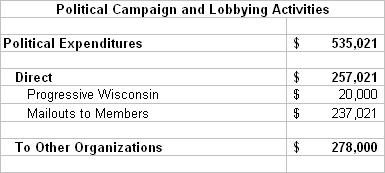
Aside from compensating its own employees, AFT-WISC squandered a total of $535,021 on political campaigns and lobbying activities. Among these activities, $20,000 was contributed to Progressive Wisconsin; $237,021 was spent on mailings containing information about legislative and electoral issues, and get out the vote events such as town hall meetings and phone banks; and the remaining $278,000 was sent to other organizations.

It appears that the difference between this particular union and a political party is very slim. Other than communicating a tiny bit of information to the public about issues affecting its members, AFT-WISC’s main accomplishments appear to be: (1) an ability to collect money from its members, (2) to compensate its own employees, (3) to support progressive organizations, (4) and to persuade people to vote for the candidates of its choosing. AFT-WISC, like most other public-sector employee unions, functions more like a political party than an association dedicated to the needs and concerns of its members. Teachers and public employees are free to join the political party of their choosing, and to direct their money to whomever they choose. So why do they need a middle-man? Public employees should be ashamed. Substituting a middle-man to make political choices for them is the antithesis of freedom and democracy.

Perhaps instead of jumping through hoops whenever the union bell tolls, teachers and other public servants should pay more attention to where their union dues are going. Then and only then will the rest of society believe you are more than just feeble lap dogs. As for the American Federation of Teachers, AFL-CIO of Madison, Wisconsin… it’s “Not Just No, But HELL NO!”

Reference:

http://www2.guidestar.org/organizations/39-0963086/american-federation-teachers.aspx#

PUBLIC-sector Union Fallacy I

Union Nazis

Where Solidarity Ends

~ By: Larry Walker, Jr. ~

Thank God for Governor Walker and the Wisconsin legislature. Clearly there is a line of demarcation between the rights of public-sector and private-sector workers. Patrick J. Wright, a director of the Mackinac Center Legal Foundation, breaks it down in his latest post, Public-Sector Bargaining Privileges Are Not Inalienable Rights.

Mr. Wright concludes with, “the power of government employee unions in collective bargaining necessarily amounts to power over the people themselves, therefore the people’s representatives must periodically scrutinize that power and curb excess. Why that’s pure natural law, and if you stop to think about it, just plain old common sense. But perhaps public-sector union donors and their supporting dunderheads need a less sophisticated explanation. What follows is an uncomplicated lesson in fiscal logic, just for you:

Point #1 – If you work for a state, local or federal government agency, and your employer’s treasury is tapped, you are most likely a part of the problem. Job security eludes you.

Point #2 – If you’re going around spouting off that a certain governmental entity isn’t broke, and you’re not one of its top executives, then you might not know what in the hell you’re talking about. Your beliefs are based on conspiracy, not facts.

Point #3 – If you have a government job paying 40% more than the private sector, with Cadillac benefits, then you’re not likely one who’s losing their home and going through financial hell. You’ve been brainwashed.

Point #4 – If you’re having $1,000 per year in union dues deducted automatically from your paycheck and sent to your government masters (politicians), and now complain about having to pay more toward pension and health costs, you might be better off dumping that worthless union. Perhaps union dues are a luxury you can ill afford.

Point #5 – If you think that private citizens exercising their right to trim some of the liberties that government workers take with their money is a form of class warfare, then which class are you – government or the people? You’re confused.

Point #6 – If you think that the way to effectively engage in political debate is by marching in mobs and shouting in unison, “shame, shame, shame…,” you might be mentally ill. You need a check up from the neck up.

To summarize, if you are still offended by the law that was just passed in Wisconsin, then :

  • Job security eludes you,

  • Your beliefs are based on conspiracy rather than facts,

  • You’ve been brainwashed,

  • Union dues are a luxury you can ill afford,

  • You are confused, and

  • You need a mental health check up.

Well, if that’s the case, then you better check yourself before you wreck yourself. If the glove fits, you must admit. My recommendation: Quit that cushy government gig and get a real job. And as far as private-sector unions supporting public-sector unions in so-called solidarity; can you say, “brainwashed“. Sorry but I can’t ride with you on that bucket of bolts. Sometimes you just have to surrender and face reality. Public-sector unions are the enemy of both private-sector unions, and of we the people.

Public sector – The area of the nation’s affairs under governmental rather than private control.

Private sector – The area of the nation’s economy under private rather than governmental control.  

References:

http://supreme.justia.com/us/431/209/case.html

http://www.mackinac.org/14734

http://www.mackinac.org/13741

Vaporizing PUBLIC Employee Unions

Ray-Gun

Hasta La Vista!!!

” Wisconsin is not broke. “ ~ Some Rich Fat Guy ~

Whatever rich fat guy, but who asked you anyway. The election is over. You lose, we win.

~ By: Larry Walker, Jr. ~

While state and local government employee unions (aka. public unions) clutch desperately to what they falsely perceive to be a God-given right to organize, pro football players are planning to de-unionize. You see, the National Football League Players Association (NFLPA) has legal options under federal law, while state and local government workers have none. Public workers exist to serve the public, and are compensated from tax dollars, not from profits earned in the private sector.

“The National Labor Relations Act or Wagner Act (P.L. 74-198, 49 Stat. 449, codified as amended at 29 U.S.C. § 151–169) is a 1935 United States federal law that limits the means with which employers may react to workers in the private sector who create labor unions, engage in collective bargaining, and take part in strikes and other forms of concerted activity in support of their demands. The Act does not apply to workers who are covered by the Railway Labor Act, agricultural employees, domestic employees, supervisors, federal, state or local government workers, independent contractors and some close relatives of individual employers.”

As for NFL players, decertifying the union means firing the NFLPA as their bargaining agent, which will prevent NFL owners from locking out the players when the existing collective bargaining agreement expires. Any lockout at that point would be a violation of federal antitrust law. Decertifying will also allow individual players to sue the NFL and their respective teams. The tactic has worked before, resulting in NFL players gaining free agent rights.

On the other hand, state and local government servants in Wisconsin and other states don’t have this option or any others. You see, public servants are not covered by federal labor relations laws. They have only been allowed to unionize under state laws granting them make-believe rights. In reality, all it would take to completely do away with public employee unions is a determined state house majority, duly elected by a base of overburdened taxpayers. And that’s where things stand. Hasta la vista!

AFTER HAVING DONE ALL STAND! ~ Eph 6:10-20

BTW: The word fat was directed at Moore in the sense of his reasoning being “practically nonexistent” (i.e. a fat chance).

Public Union Membership in Numbers

Eating Dots

~ By: Larry Walker, Jr. ~

In terms of raw numbers, local government union members stand to be crushed, or perhaps just eaten. There are roughly 14 million unemployed Americans who would love to have local government service jobs, minus collective bargaining. Perhaps the media should poll the unemployed. The bottom line is that it’s better to be gainfully employed than unemployed. Advice to local government employed union members: Work with your duly elected government officials, or kiss your jobs goodbye.

Out of 124 million Americans who are still employed (excluding the incorporated self-employed), only 14.7 million (or 11.9%) are members of unions.

Total Non-Union vs. Union Employees

Out of the 14.7 million union members, 7.6 million (or a majority of 51.8%) are government employees.

Government Sector Union Members

Out of the 7.6 million government employees who are members of unions, 4.7 million (or a majority of 61.3%) are local government employees, while 1.9 million (or 25.8%) are state government employees.

State & Local Government Union Members

Out of 124 million Americans who are still employed (excluding the incorporated self-employed), only 4.7 million (or just 3.8%) are local government employed union members.

Local Government Union Members

In terms of numbers, local government employed union members, those who are complaining the most, only represent 3.8% of all American workers (excluding the incorporated self-employed), 3.0% of the roughly 151 million American taxpayers, and 1.5% of the total population. We believe there is more empathy among Americans for the 9.0% of the labor force who are unemployed, and the millions more who have dropped out of the workforce, than there is for local government employed union members. In other words, the pink slips are in the mail.

“Every goodbye makes the next hello closer.” ~ Anonymous Unemployed

Related: Union Label : Owned by China & Liberty VS Union Power

Reference: U.S. Bureau of Labor Statistics

Table 3. Union affiliation of employed wage and salary workers by occupation and industry (Jan. 21, 2011 Report)

Table 3. Union affiliation of employed wage and salary workers by occupation and industry (Historical Data)

Union Label | Owned by China

Owned by China

When ‘Made In China’ Isn’t Enough ~

“Every once and awhile you need to get out on the streets and get a little bloody when necessary.” ~ Rep. Mike Capuano (D-Ma.) ~

Made in China wasn’t enough, now union minions want to be owned by China as well. ~

So far all I see is a bunch of snot-nosed, deficit-financed, government employed, union slugs spewing nonsense, but not one drop of blood. Hey union guys, this isn’t 1945, except maybe in terms of the National Debt. Back in the day, American unions used to fight so-called greedy capitalists for higher pay, greater benefits, and better working conditions, but that was then, and this is now. Today, almost all union members are government employees. What’s up with that? Who are these guys fighting against? Can American taxpayers who pay your salaries really be equated to the so-called ‘robber barons’ of the past? I don’t think so. Most of us are just fighting for survival. By us, I mean the other 88.1% of the workforce who are not union members. When a small minority (11.9% of loud-mouthed, snot-nosed, whiny, union cry babies) can impose its will upon the majority (88.1% of responsible, hard-working, non-union juiced, taxpayers) – that’ll be the day. Good luck with that fight.

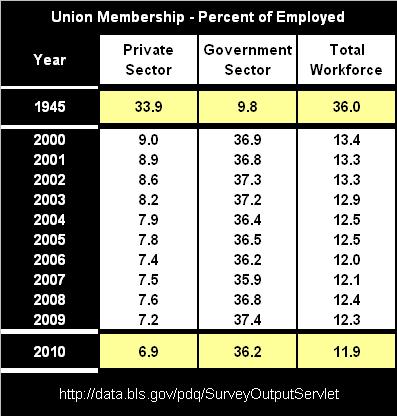
Back in 1945, almost 36% of American workers were represented by unions, but according to the U.S. Bureau of Labor Statistics, that number had dwindled to just 11.9% by the end of 2010. Although there has been a noted increase in the number of public employee unions since the 1960s, the decline in private-sector union membership has been most telling. If union membership was worth its weight in dues, then most of the goods that America purchases today wouldn’t be stamped “Made in China”.

Union Membership Plummets

At the height of union popularity in the 1940s, only about 9.8% of government slugs were represented by unions, versus 33.9% of private sector workers. However, by the end of 2010, those proportions had flipped. Today 36.2% of public workers are represented by unions while private sector union membership has plummeted to a mere 6.9%. The U.S. Bureau of Labor Statistics most recent survey indicates that union membership in the U.S. has fallen to just 11.9% of the total workforce.

I’m sorry, but all of you public union slugs need to shut the hell up and accept what we decide. We don’t work for you; you work for us.

References:

Payroll Tax Cut Forsakes the Poor

None and Done

Obama’s Phantom Tax Cut

– By: Larry Walker, Jr. –

When Barack Obama signed what was touted by the mainstream media as the middle-class cut bill on December 17, 2010, it was praised as a historic measure which would extend tax cuts for families at every income level, renew jobless benefits for the long-term unemployed and enact a new one-year cut in Social Security taxes that would benefit nearly every worker who earns a wage.

But first of all, extending last year’s tax rates actually didn’t do anything for anybody (i.e. nothing gained, nothing lost). Secondly, renewing jobless benefits for the long-term unemployed was simply the price we had to pay for a failed $887 billion economic stimulus program. Thirdly, and to the point of this blog post, as far as the one-year cut in Social Security taxes, exactly what does the term “nearly every worker” mean?

Well, just two months after its enactment, tens of thousands of American’s are beginning to find out. Many are noticing that their paychecks are actually smaller than they were last year, while others are seeing just an extra dollar or two per month. In fact, the only ones actually receiving the full 2% payroll tax cut are those making over $70,000 per year. Those making under $20,000 per year are actually ingesting a tax hike.

In an effort to determine why so many folks are complaining, we compared Internal Revenue Service Publication 15, (Circular E) Employer’s Tax Guide, for tax year 2010 to the 2011 publication. Then we created a spreadsheet to compare the differences. What we discovered is that in 2010 the amount of federal income tax withheld from paychecks was lowered, to compensate for the $400 Make Work Pay Credit. But with the expiration of the credit at the end of 2010, income tax withholding tables have been readjusted back to pre-stimulus levels. This adjustment in income tax withholding rates has completely negated the Social Security tax cut for the poor, and greatly reduced its effect on those with moderate incomes.

On its face, the new law lowers the amount of Social Security tax withheld from all paychecks from 6.2% to 4.2%, however not all paychecks are affected equally. Had this tax cut been implemented on its own, it would have been a good thing for all wage earners; however due to the corresponding expiration of the Make Work Pay Credit, the end result favors those making over $70,000 per year, and discriminates against those who earn less. The word on the street is that Obama’s 2% Social Security tax cut is just one more in a series of lies emanating from the White House. If we could impeach a POTUS for lying (or ignorance), Obama would have been impeached 10 times over.

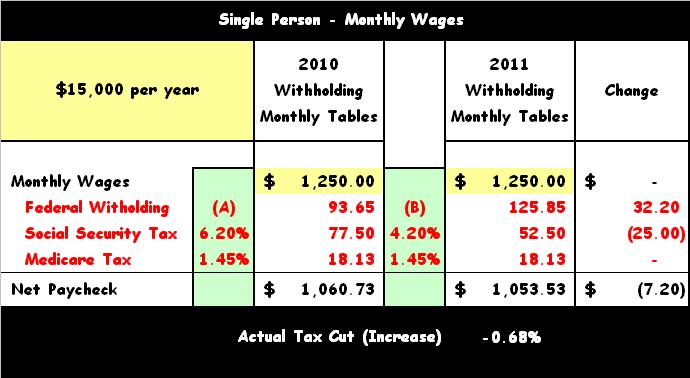
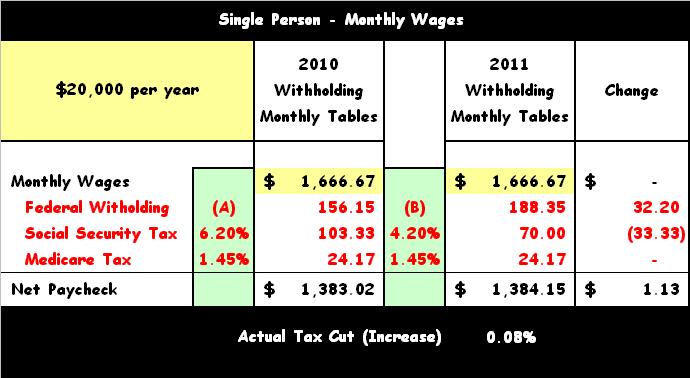
The following calculations are based on the IRS’s monthly percentage method tables for single taxpayers (Table 4). If you’re not convinced, you may always visit www.irs.gov, search for Publication 15, and make your own assessment. But if you don’t want to go through all of that trouble, you can simply compare your latest payroll tax report, or pay stub, to one from last year.

As the table above displays, rather than receiving a tax cut, those making $15,000 per year, or less, are actually receiving at least a 0.68% payroll tax hike. Although this may not have been the Democrat’s intent, this is what he delivered.

According to the table above, those making exactly $20,000 per year are receiving a mere 0.08% tax cut. Wow, that’s a whole $1.13 in tax savings each and every month, leaving many on Main Street in shock and awe. Since those making under $20,000 all got a tax hike, those whose lives have been improved by a buck a month must be so proud of their Democrat saviors.

The next table (above) reveals that although those making $30,000 per year received a bona fide tax cut, it is effectively only 0.88%, or $17.80 per month. I suppose $17.80 per month, which equals $213.60 per year, will have some impact on the economy, but not likely much.

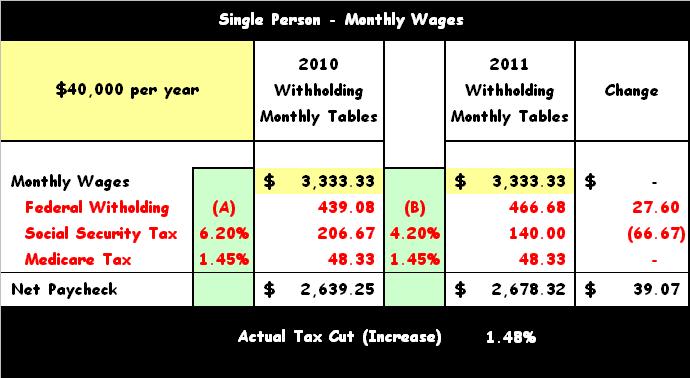
The table above shows that those making $40,000 per year are receiving a 1.48% tax cut. Although it’s not a full 2.0%, the extra $39.07 per month can at least be banked, or perhaps donated to the poor and needy.

As the table above exhibits, those making $50,000 per year are receiving a 1.74% tax cut. Now we’re talking real money, a whole $55.73 per month, although perhaps this would have been more appropriately directed toward those making less than $20,000.

The table above affirms that those making $60,000 per year are now taking home a 1.92% tax cut. It’s getting there, although it’s not quite 2%, an extra $72.40 per month can at least buy some extra food, or pay a bill. Then again, if you’re lucky enough to still have a job paying $60,000 per year under the present regime, how important is an extra $72.40 per month?

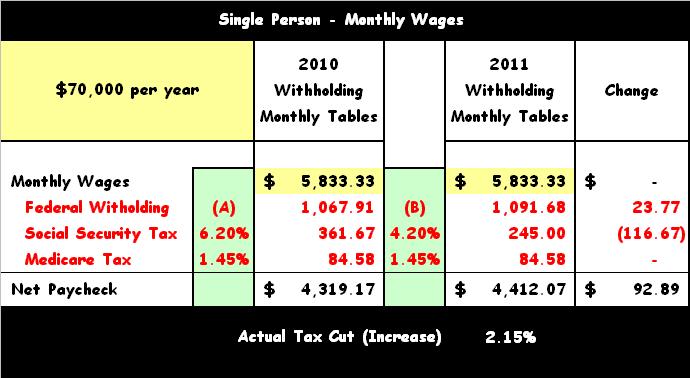
Finally as exposed in the last table (above), those making $70,000 per year are picking up the full 2% tax cut and then some (actually 2.15%), a savings of $92.89 per month. The percentage of taxes saved tops out at about the 2% level with the monthly dollar amount continuing to advance up to the $106,800 cap on Social Security wages.

In conclusion, those who needed a diminutive tax cut the least are receiving it the most. It all goes to show that in spite of a far left-wing progressive like Obama, “The rich keep on getting richer while the poor get poorer.” While other countries like China directed payroll tax cuts toward employers, you know, the ones who can actually provide jobs and a real boost to an economy, Obama has blown his 3rd and final chance to get it right. Three strikes and you’re out! Perhaps our next POTUS will be one who not only takes the time to read the bills presented for signature, but one who is actually capable of understanding cause and effect. Obviously, the present White House occupant is a wash. Obama is ‘one and done’, but in terms of American jobs, this could be more effectively expressed as ‘none and done’.

References:

Final: Tracking the 5.19 Million Jobs Obama Squandered

Day 745

“We have a system that increasingly taxes work and subsidizes nonwork.” ~ Milton Friedman ~

– By: Larry Walker, Jr. –

Formerly: Tracking the 5.2 Million Jobs Obama Squandered (published on 10/29/2010) *

Obama’s economic stimulus bill was sold to us with the promise of creating 3.5 million jobs by January of 2011. Well, since January has now passed, it’s time to tally up the results. My previous post, Tracking the 5.2 Million Jobs Obama Squandered, was about dead on. You can call it 5.19 million jobs squandered if you like, but it’s still 5.2 million when rounded off.

For a refresher, “Tracking the 3.5 million jobs Obama will save or create” was the title of a blog post, last updated on January 8, 2010, on a website named Understanding The Market – Capire Il Mercato. In a note, the author, Cole Kendall stated, “I will make the calculations in a way that provides a “best case” to the Obama team.” Since Mr. Kendall decided to give up on his tracking operation at the end of 2009, I decided to follow it through to it’s dire conclusion.

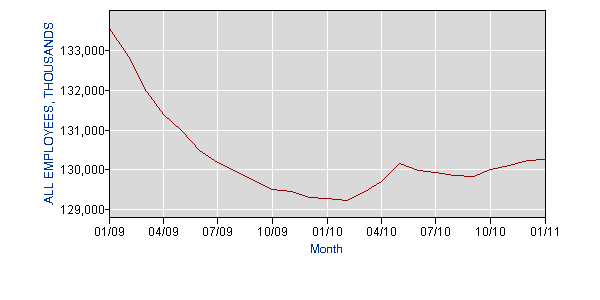
Using the same criteria as originally outlined by Obama’s (now former) economic team, jobs are defined by counting the total non-farm employment, from Table B-1 of the Bureau of Labor Statistics, “Employment Situation Report” (as seasonally adjusted). Instead of boring you with the month-by-month data, I went ahead and cut to the chase, skipping from December of 2009, where Mr. Kendall left off, to January of 2011, up to the latest data available from the 02/04/2011 jobs report.

Following is an excerpt from Cole Kendall’s original blog post, followed by my revised stimulus jobs tracker, and a brief analysis:

In an earlier essay I tried to explain President Obama’s notion of saving or creating jobs. The stimulus plan bill was passed by both houses of Congress last night and the final plan was a bit smaller than the earlier version, so the President now asserts that the plan will save or create 3.5 million jobs.

This post will track the 3.5 million jobs. There are a number of ways to measure jobs in the US. Some people work several different jobs at a time while others change employers frequently, so measuring jobs is not as simple as it might seem. There was a cartoon from the Clinton era showing the President speaking at a dinner that he had created 8 million jobs and an overworked waiter thinking that he had three of them. Obama’s economic team defined jobs [as those contained in the Department of Labor’s establishment payroll data] (see here for their original report).

Just before the stimulus bill passed the Department of Labor issued a report (see here). The number of people working (see Table B1, about 2/3 of the way down, with the heading “Establishment Data”) was 134,580,000 (seasonally adjusted). This is a preliminary measure and will be revised next month and probably revised again in a year. Using the Obama team methodology, without the stimulus bill employment would be expected to fall by around 1,613,000 jobs during the next two years so that without the stimulus bill we would expect employment to be 132,967,000 in January 2011.

With the revised estimate of 3,500,000 jobs “saved or created”, employment should be 136,467,000, creating 1,887,000 in addition to the 1,613,000 jobs saved.

The table below will be updated with every new employment release to see how jobs have changed. The first column is the actual number of payroll jobs starting with the month before the stimulus plan passed; the second column is the total change in employment since the month when the stimulus plan passed and the third column shows the gap remaining of jobs to be “created” in order to reach the target.

Revised: Stimulus Jobs Tracker

Stimulus Jobs Tracker

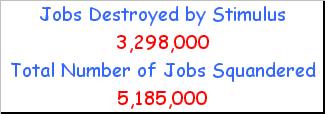
The conclusion is pretty grim, and certainly doesn’t mesh with what Obama has been saying out on the campaign trail. The sad truth is that instead of creating 3.5 million jobs, since it was passed, the stimulus plan has instead resulted in the loss of 3.3 million jobs. Since the stimulus plan was supposed to have saved 1,613,000 jobs, in addition to creating 1,887,000 jobs, by January of 2011, and since it has actually resulted in the loss of 3,298,000 jobs, Obama’s Economic Stimulus has fallen short of the original target by 5,185,000 jobs.

I don’t know what you call this, but I call it a colossal failure. Perhaps it’s time for an orderly transfer of power? Do we need another stimulus plan, or just another President? I don’t think Obama is helping his case by roaming around the country making false claims in what appears to be a frantic effort to get re-elected, especially when he’s the one who screwed this up. The thought of trillions in deficit-financed spending flushed down the drain, to no avail, doesn’t bode well for Democrats, nor for Mr. Obama.

Obama was a job creator from day one.” ~ Nancy Pelosi

You can fool some of the people all of the time, and all of the people some of the time, but you can not fool all of the people all of the time. ~ Abraham Lincoln (R-IL)

Sources:

http://stats.bls.gov/news.release/empsit.t17.htm

http://stats.bls.gov/webapps/legacy/cesbtab1.htm

http://understandingthemarket.com/?p=63

Table B-1 Data: Total Non-Farm Employment (In Thousands, As Seasonally Adjusted):

http://stats.bls.gov/webapps/legacy/cesbtab1.htm

Amtrak: A Lesson in Government Takeovers

Poison Pill

– By: Larry Walker, Jr. –

The Quest for Affordability

“They say it’s a government takeover of health care, a big lie just like Goebbels. You say it enough, you repeat the lie, you repeat the lie, you repeat the lie, and eventually, people believe it.” ~ Rep. Steve Cohen (A Government Employed Psychotic)

“If it ain’t broke, break it, and then when it’s broke, nationalize it.” ~ A Wayward Progressive

When facing a régime hell-bent on government takeovers, one must first understand exactly what a government takeover is, how one occurs, and whether or not a takeover is good for the nation. Once we understand what a government takeover is, how one occurs, and how it will end; and once convinced that a takeover is indeed occurring, we can make up our own minds about how to handle it. Of course, proponents of government takeovers will always deny that one is occurring. Such denial is generally accompanied by calling anyone who would so hint a liar, or Nazi propagandist.

According to advocates of government takeovers, any private entity which makes a profit is bad and worthy of increased regulation, and once bankrupted, in certain cases, worthy of takeover. Under the rules for government takeovers, the objective is government control of everything, from private industry to personal lives, and everyone is a loser. The only thing that matters for most politicians is that they keep their own government backed jobs, retirement security, and benefits; and the best way for them to ensure this is through increased government control.

The Government Takeover of Passenger Railroads

For example, before the National Railroad Passenger Corporation (a.k.a. AmTrak) existed, there was a profitable private passenger rail industry. But profits being deemed a bad thing by both big government and unions, meant that its days were numbered. “Bring them down”, they decried. “Top down, bottom up, inside out.” While unions pushed for higher pay, greater retirement security, and more benefits, big government tightened regulations — limiting the amount railroads could charge for their services. The attack came by big government from the top, and unions from the bottom. The only thing lacking was a thrust from the inside out.

The first line of attack would come from the Interstate Commerce Commission which prevented increases in the amounts that privately owned railroads could charge both shippers and passengers. This meant that the only way in which railroads could become more profitable was through cost-cutting. But the ability to slash costs was greatly hampered by agreements with aggressive employee unions. Eventually, the railroads turned to mergers as the only way of escape. What else can an industry do once it has been obstructed from responding to changing market conditions?

In 1968, the New York Central and Pennsylvania railroads merged creating Penn Central, which would result in a virtual monopoly within the U.S. passenger rail industry. But the nation would be shocked when only two years later, in June of 1970, Penn Central declared bankruptcy. At the time, it was the largest corporate bankruptcy in American history. But this was only the beginning. Behind the scenes a government takeover was being staged from the inside out.

In May of 1967, the National Association of Railroad Passengers (NARP) was founded to lobby for the continuation of passenger trains in the United States. Imagine that, a few months before the railroads were forced to merge, and just three years before they would go bust; a government takeover was already in the works. This was the missing link, an attack from the inside out. It was big government from the top, employee unions from the bottom, and now passengers themselves (at least in name) were demanding continued services, profitability be damned. The man-made crisis was complete and there was now enough force to justify a full blown government takeover.

The NARP’s lobbying efforts were successful at dividing both political parties. The Democrat Party was opposed to any sort of subsidies to privately-owned railroads, and the Republican Party feigned opposition to the nationalization of the industry. Sound familiar? But in the end, both Democrats and Republicans would compromise for fear of being responsible for the extinction of passenger trains. So what did big government do? What they always do, they agreed to both subsidize and nationalize the passenger rail industry.

In 1971, the federal government stepped in and created Amtrak, a virtual government agency, which began to operate a skeleton service on the tracks of Penn Central and other U.S. railroads. Today, the federal government owns all of the preferred stock in AmTrak, has invested $32.4 billion of taxpayer’s money into the government owned corporation over the past 40 years, and in return, AmTrak has netted total losses of $27.1 billion. In fiscal year 2010, the federal government pumped in an additional $2.4 billion, and AmTrak promptly lost $1.4 billion of it, before the red ink dried. Besides the federal government, the only other shareholders in AmTrak are the old railroad companies themselves, which are now consolidated into other private companies.

The Fate of Shareholders

AmTrak initially issued 10,000,000 shares of common stock, with a par value of $10 per share, to the bankrupt railroads in exchange for their assets. In fact, American Financial Group (AFG) still owns 5.2 million shares which were acquired directly from Penn Central. Although Congress, in 1997, ordered AmTrak to buy back all of its common shares by the year 2002, AmTrak has yet to have the funds, and has in fact been totally dependent on additional government subsidies just to remain viable.

In 2002, AFG filed suit against AmTrak seeking $52 million, plus interest (5.2 million shares @ $10). Two years prior, AmTrak had offered to buy back all of its common shares for a measly three cents per share. Of course none of the common stock holders accepted such a ridiculous offer. Who in their right mind would settle for $156,000 in return for a $52 million investment made some 40 years prior? This is a fine example of what private stock and bond investors may expect in the wake of a government takeover. The original stockholders would have gotten a better deal through normal bankruptcy proceedings, but because of the government’s takeover, everyone got screwed, including generations of unborn taxpayers. It would be wise to remember this as the government attempts to takeover the health care industry.

The Government Takeover of Health Care

And that brings us to the main point of this post, the government’s attempted takeover of the health care industry. The only difference between what I will call AmHeal, and AmTrak, is that the health care industry isn’t broke (yet). But regulations are coming which will attempt to restrict the amount that health insurance and health care providers may charge their customers, while increasing the burden of services they must provide. These regulations will naturally cripple the industry from the top down and from the bottom up.

Health care insurers and providers will quickly realize that the only way they can remain profitable is through cost-cutting, yet their ability to cut costs will be restricted by the increased amount of services they will be required to provide. With millions more customers having been mandated by the federal government, and with restrictions on the amount which may be charged, companies will begin to consolidate in order to achieve economies of scale. But just like the railroads, their attempts will fail. In the meantime, labor unions and progressive community organizers are seeking to stir up public support by way of demanding that health insurers and providers do more with less, profitability be damned. In the end, we will wind up with government run health care, just like many have warned all along.

Unless a poison pill strategy is implemented to derail this insidious disaster, we will soon see the AmTrak of health care, AmHeal. And AmHeal will be just as disastrous as AmTrak in every way. Over time, AmHeal will not only lose billions of dollars per year, but potentially trillions, and will eventually bankrupt the United States of America. Investors in health care companies will be among the first to get burned, as health care companies begin filing for bankruptcy. This will be the final blow to the $2.3 trillion health care industry, and the end of 1/6 of our free market economy.

So how do we derail AmHeal before it reaches the tarmac? In dealing with a government takeover, a poison pill must be taken from within the government itself. We must takeover the government with a top down, bottom up, and inside out approach. We the people must elect politicians dedicated to defunding all regulatory aspects of the affordable health proposal, and then put pressure on the political system from the bottom up. Then all private industry must place additional pressure on the government by requesting waivers, thereby opting out of the government’s proposed mandates. Tea Party advocates, moderates, centrists, conservatives, State governments, lobbyists, and proponents of the free-market must band together. We know that we must stop the government takeover of health care, and that is precisely what we are doing, and what we will accomplish.

References:

Penn Central Transportation

National Association of Railroad Passengers

Major Acts of Congress – Rail Passenger Service Act

AMTRAK REFORM AND ACCOUNTABILITY ACT OF 1997

History of U.S. Gov’t Bailouts

Amtrak management = worthless Amtrak stock

RAILROADS: Perils of Penn Central

Social Security: A Breach of Trust

Reviewed

– By: Larry Walker, Jr. –

Notes on 2010 Financial Statements of the U.S. Government

“I am a firm believer in the people. If given the truth, they can be depended upon to meet any national crisis. The great point is to bring them the real facts.” ~ Abraham Lincoln

“The ignorance of one voter in a democracy impairs the security of all.” ~ John F. Kennedy

Proponents of a bankrupt federal government continually proclaim that Social Security is solvent. They boast in the Trust Fund’s fictitious surplus balance of $2.6 trillion as proof. But even Note 24, of the United States Government’s Notes to the Financial Statements, for the year ended September 30, 2010 states that while, “In the private sector the term “trust fund” refers to funds of one party held and managed by a second party (the trustee) in a fiduciary capacity” that, “In the Federal budget, the term “trust fund” means only that the law requires a particular fund be accounted for separately, not that funds are actually set aside.” It further states that, “…as far as the federal government is concerned, earmarked funds, including the Social Security Trust Fund are the property of the federal government.”

In other words, as far as the government is concerned, any money it receives on our behalf may be spent in any way it desires, as long as an appropriate book entry is made. The money we have been paying in towards retirement security has already been spent. Note 24 goes on to verify this by stating that, “The government does not set aside assets to pay future benefits or other expenditures associated with earmarked funds (i.e. Social Security).” And further that, “The cash receipts collected from the public for an earmarked fund (i.e. Social Security) are deposited in the U.S. Treasury, which uses the cash for general Government purposes.”

As I explained in “The Social Security Bust Fund”, the federal government has summarily confiscated and spent every dime of the $2.6 trillion surplus, which would have comprised the Social Security Trust Fund, and has replaced it with non-marketable, special-issue, Treasury securities. Since these special-issue securities are an asset to the Trust Fund and a liability to the U.S. Treasury, they therefore cancel each other out and, according to Note 14, “are eliminated in the consolidation of these financial statements”. However, as we shall see later, they actually do appear on the financial statements and are detailed in Note 24.

During any fiscal year, when a trust fund’s disbursements exceed its receipts, then these special-issue securities require redemption. Note 24 warns us that, “Redeeming these securities will increase the Government’s financing needs and require more borrowing from the public (or less repayment of debt), or will result in higher taxes than otherwise would have been needed, or less spending on other programs than otherwise would have occurred, or some combination thereof.” Since less repayment of debt is a non-issue, the only options the government has in order to pay back what it has stolen from the Trust Fund are to borrow more from the public (i.e. increase the debt ceiling indefinitely), raise taxes, or cut spending on other programs.

In effect, there is no Trust Fund. The total amount of Social Security taxes collected within each fiscal year is spent on that year’s benefit payments. If the total receipts exceed the amount of benefit payments, then the surplus is taken by the Treasury and spent on general expenses. However, if the amount of benefit payments exceeds receipts, such as happened in 2010, then the Treasury must borrow more from the public in order to reimburse the Trust Fund. In the fiscal year ended September 30, 2010, the government collected a total of $552.8 billion in Social Security taxes, and paid out $574.9 billion in benefits. The difference was made up by the Treasury paying out some of the accrued interest that it owes on past borrowings. Of course, the interest which was paid out had to be borrowed from the public because, the government has been running trillion-dollar plus budget deficits for the past two years.

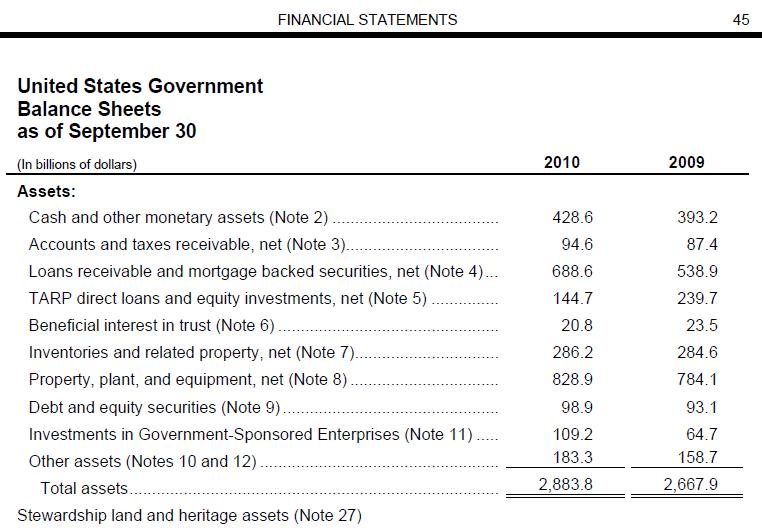
You should review the financial statements of the United States Government for the fiscal year ended September 30, 2010 for yourself, and draw your own conclusions. I have and I am sad to report that the Social Security Trust Fund is nothing more than an empty promise. Let’s check the balance sheet.

As of the close of fiscal year 2010, the federal government had total assets of just $2.9 trillion. As you can see above, there is no account named the “Social Security Trust Fund” which contains a balance of $2.6 trillion. The sad truth is that the federal government would have to liquidate nearly all of its assets including property, plant and equipment in order to raise the $2.6 trillion which it owes to the Social Security Trust Fund. So where’s the money, you ask? Like I said from the beginning, “It has already been spent.”

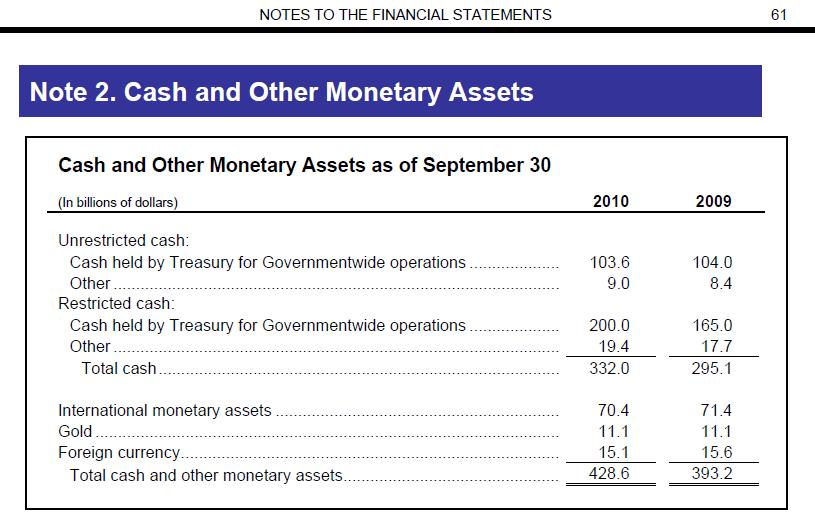
Among the government’s assets, only $428.6 billion was classified as “cash and other monetary assets”. Digging down into Note 2 of the financial statements, we discovered that the actual amount of cash was just $332.0 billion. Further, we discovered that out of this $332.0 billion, only $112.6 billion (103.6 + 9.0) was actually “unrestricted”, meaning available for use on government operating expenses. The remainder, which was listed as “restricted”, included $200 billion which was held by the Federal Reserve in the Supplementary Financing Program (SFP*), $18.6 billion held by the Foreign Military Sales program, and another $0.8 billion which was curiously omitted from explanation.

The other monetary assets listed were International Monetary Assets of $70.4 billion, Gold of $11.1 billion, and Foreign Currency of $15.1 billion. (It’s interesting to note that the government owns 261,498,900 troy ounces of gold, and that its book value is listed at $11.1 billion, or at the statutory value of just $42.22 per ounce. If valued at the fair market value of $1,307 per troy ounce on 9/30/2010, then the value would actually have been $341.8 billion.) A detailed explanation of cash and other monetary assets may be found in the narrative section of Note 2.

The Supplementary Financing Program (SFP)*

It’s worthy of noting that the SFP is a temporary program that deposits cash with the Federal Reserve to support Federal Reserve initiatives aimed at addressing the ongoing crisis in financial markets. It’s interesting to note that the Federal Reserve has control of more of the government’s cash assets than the U.S. Treasury, and that the crisis in the financial markets is deemed to be “ongoing”. Following is a more detailed explanation of the SFP as reported by Bloomberg, on February 25, 2010:

“The Supplementary Financing Program, in which the Treasury Department sells bills and places the proceeds in a Fed account, will be part of the Fed’s strategy for rolling back its extraordinary assistance to the economy and financial markets, the central bank said in its monetary policy report to Congress yesterday. The report also said the program was temporary and wasn’t an essential element of the Fed’s toolkit.”

“The program helped the Fed manage the more than doubling of its balance sheet as it battled the financial crisis and will be part of the central bank’s eventual efforts to withdraw more than $1 trillion in excess bank reserves.”
“The Treasury said the decision to move to $200 billion reflects the program’s outstanding balance between February and September 2009, before concerns about the debt ceiling forced the government to shrink the program. President Barack Obama this month signed a $1.9 trillion increase in the limit to $14.3 trillion.”

Show Me the Trust Funds

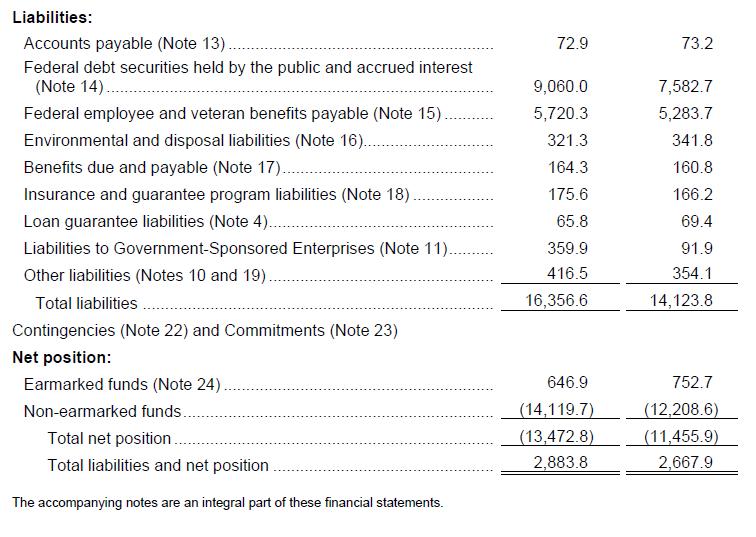
Where is the Social Security Trust Fund shown on the government’s financial statements? As you should understand by now, the government borrowed and spent all of the money and owes it back to the Trust Fund, however, you won’t find an entry matching $2.6 trillion on the balance sheet. Per Note 14, “Intragovernmental debt holdings represent the portion of the gross Federal debt held as investments by Government entities such as trust funds, revolving funds, and special funds. This includes trust funds that are earmarked funds. For more information on earmarked funds, see Note 24─Earmarked Funds. These intragovernmental debt holdings are eliminated in the consolidation of these financial statements.” However, the net amount of all of the government’s sacred trust funds does appear in the Net Position section as Earmarked Funds in the amount of $646.9 billion. What this means is that when all of the government’s various trust funds are netted together, the $2.6 trillion Social Security Trust Fund is reduced to a surplus of just $646.9 billion.
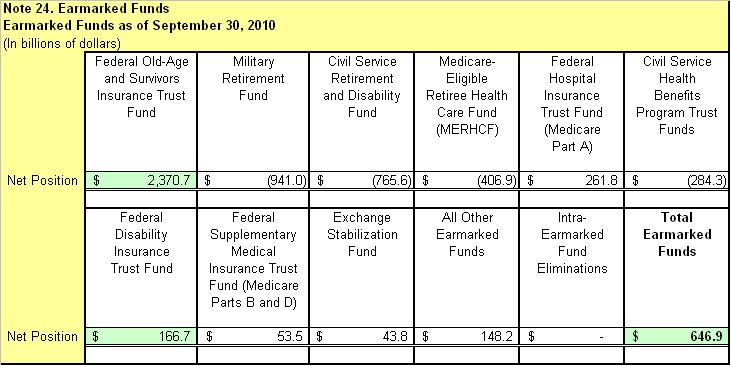
I created the following condensed table based on the one shown in Note 24 (the original is too large to be shown here). As you can see, when the $2.6 trillion surplus balances of the Federal Old-Age and Survivors Insurance Trust Fund, and the Federal Disability Insurance Trust Fund are netted against a $941.0 billion deficit in the Military Retirement Fund, a $765.6 billion deficit in the Civil Service Retirement and Disability Fund, a $406.9 billion deficit in the Medicare-Eligible Retiree Health Care Fund, and the rest of the trust funds, the net balance is just $646.9 billion. This is shown as the amount of “Earmarked Funds” which the government owes to itself out of its $14.1 trillion of accumulated deficits. In financial terms, the federal government has accumulated losses of $14.1 trillion since its inception. It may also be the only entity on earth with the audacity to proclaim that the $2.6 trillion, which it borrowed from funds which were supposed to have been held in trust, is somehow secured by its $14.1 trillion in accumulated losses. In reality, both the Federal Government, and the Social Security Trust Fund are insolvent.

Earmarked Funds (click to enlarge)

In conclusion, the only options that the government has of recovering the $2.6 trillion surplus, which our generation has dutifully paid into Social Security, are to either; (1) borrow more money from the public, (2) increase taxes, or (3) reduce spending on other programs.

  1. Borrowing more from the public, in order to pay back that which has already been borrowed from the government, could put the nation’s credit rating at risk, thus jeopardizing not only Social Security, but our National Security.
  2. Increasing taxes on the public in order to make up for what we have already paid in taxes, which should have been set aside for our welfare instead of having been squandered, is not acceptable.
  3. The only viable option is for the federal government to fundamentally restructure, privatize, or discontinue every governmental agency, program, subsidy, enterprise, and special project which does not take in more money than it spends. This includes all Government Sponsored Enterprises, the Postal Service, and Amtrak. If it’s not making money, then it must either be restructured in a way so as to become profitable, sold to the private sector, or terminated. After that comes the selling off of government owned property, plant and equipment, gold and any other non-productive asset held by the federal government.

References:

Financial Statements of the United States Government for the Years Ended September 30, 2010, and 2009 – http://www.fms.treas.gov/fr/10frusg/10stmt.pdf

United States Government Notes to the Financial Statements for the Years Ended September 30, 2010, and 2009 – http://www.fms.treas.gov/fr/10frusg/10notes.pdf

Current Report: Financial Report of the United States – www.fms.treas.gov/fr/index.html

Fed Says Treasury’s SFP Bills Advance Monetary-Policy Goals – http://www.businessweek.com/news/2010-02-25/fed-says-treasury-s-sfp-bills-advance-monetary-policy-goals.html

The Social Security Bust Fund

Privatization

Opt Me Out

– by: Larry Walker, Jr. –

If it sounds too good to be true, it usually is” was a catchphrase used by the Better Business Bureau to alert the public to shady business practices. The phrase was in use since at least 1954. In 1962, the BBB produced a short film titled, “Too Good to Be True”. – The Big Apple

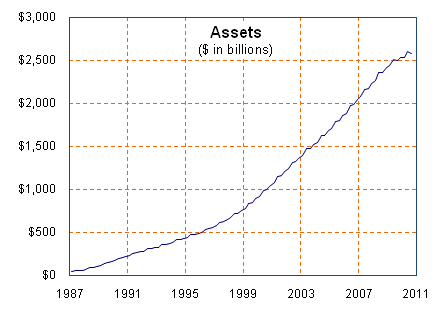
The assets of the Old-Age, Survivors, and Disability Insurance Trust Funds represent the accumulation over time of the difference between income and outgo. The growth of the assets from the end of December 1986 through the end of September 2010 is shown below by calendar quarter.

Assets grew from about $47 billion at the end of December 1986 to about $2,585 billion ($2.6 trillion) by the end of September 2010.

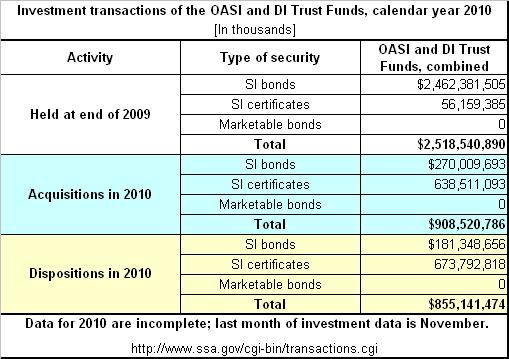
So where’s the money, you ask? Well, to be blunt, there is none. You see, by law, the trust funds are not allowed to hold cash. Instead, they must invest their money into what are known as, non-marketable, special issue (SI), government securities. That’s right! The whole $2.6 trillion “surplus” has been mandatorily invested in the U.S. Treasury. That would be the same Treasury which is currently $14,025,215,218,708.50 in debt. Through 12/31/2010, the Treasury owed a total of $9,390,476,088,043.35 on marketable public securities, and another $4,634,739,130,665.17 on intergovernmental debt (including the amount owed to Social Security). In other words, the government owes the Social Security Trust Fund $2.6 trillion, other governmental agencies $2.0 trillion, and the public another $9.4 trillion.

So where’s the money, you ask? As I said before, there is none; it has already been spent. Yet these special-issue securities are miraculously able to both earn and pay interest at the same time; that is if you can call issuing new debt to the public “earnings”, and paying with IOU’s “interest income”. Interest on these non-marketable special-issue investments is paid (i.e. accrued) semi-annually, at the end of June and the end of December. “Because the trust funds hold no cash, investments are redeemed each month to pay for benefits and administrative expenses. When investments are redeemed, interest is paid. The amount of interest paid is used to offset the amount of investment redemptions.”

In other words, the Treasury pays interest to the Social Security Trust Fund, but not in the form of cash, rather in the form of additional special-issue securities. (Huh?) Interest is only physically paid out when money is needed for benefits and other costs.” And where does the money come from to pay the interest? You guessed it! It comes from income taxes, which you also pay. That’s right! The government requires you to pay 6.2% of your wages into a mandatory retirement plan, and then taxes you on the same income again to pay the interest which your investment is earning. Does this sound like a shady business practice yet?

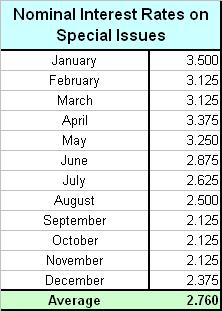
For example, let’s say that John Q is 50 years old and has $250,000 in a 401K plan. Now let’s say that he devises a scheme whereby he is able to borrow and spend the entire $250,000, and pay it back with interest over time. Let’s also say that he is allowed to pay back simple interest of 2.8%, by merely issuing additional promissory notes. By the time John Q retires at age 65, he will have amassed a retirement fortune of $355,000 (on paper that is). As far as where his first retirement check will come from, why that would be from himself. As John Q’s retirement plan begins to make payments it will need to redeem a portion of the promissory notes issued by John Q. Since John Q is no longer working, and no longer has income with which to pay the debt, he’s out of luck. Perhaps John Q would have been better off by investing real money into a legitimate investment vehicle.

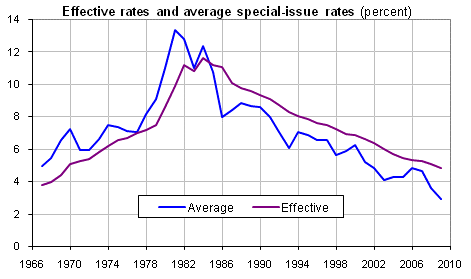
Why in God’s name would anyone make an investment which required them to cover the return on the same out of their own pocket? And worse yet, why would anyone do this when the initial investment and earnings are used to pay for other people’s retirement first? Won’t the “fund” be broke by the time you retire? Yeah, that’s the point. And to make matters worse, our return on investment appears to be crashing; which is good in the sense that we are the ones paying the interest, and bad in the sense that the return on our retirement savings is plummeting. (Huh?)

Diversification 101“Never put all your eggs in one basket.” It looks like the federal government has violated this rule in requiring that federal agencies invest only in federal government securities (special ones at that). The federal government can’t even balance a budget, let alone return a surplus; so why in the world would anyone invest their sacred retirement money in an entity which is currently $14 trillion in debt, and will not be able to earn a surplus, let alone breakeven for the foreseeable future? The truth is that if given a choice, most American’s wouldn’t. The problem is that we don’t think that we have a choice. Why don’t we have a choice? Who does this country belong to? Whose money is at stake? Perhaps it’s time to revisit privatization?

Photo Credit: http://www.johncrabtreephotography.com/

References:

http://www.ssa.gov/oact/ProgData/newIssueRates.html

http://www.treasurydirect.gov/NP/BPDLogin?application=np

http://www.ssa.gov/cgi-bin/transactions.cgi