Upside Down In America

~ By: Larry Walker, Jr. ~

Obama’s economic theory appears to be a hodgepodge of both supply-side and demand-side theory based primarily on a belief that if the government rewards special interest groups who vote for the chief executive’s political party, then said party will get re-elected.

In other words, Obamanomics is nothing more than a selfish power play. Missing from its objectives are the goals of economic growth and wealth creation. Inherent in its objective is the idea that there is already enough wealth in the nation to divide many times over until everyone is on an equal playing field. Once met, this objective will lead to the end of all economic activity in the United States.

Obamanomics is a theory that works best if the employees of an automaker are its only customers. It also works well if unionized school teachers are the only taxpayers within their respective school districts. In other words, Obamanomics works if the same money earned by an entity’s employees is reinvested in full back into the same entity. If giving incentives to employees is better than giving them to employers, then Obamanomics has nailed it. One can only wonder why those gosh darned employees aren’t hiring more workers.

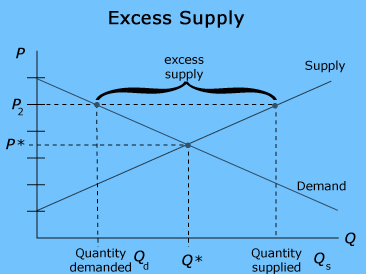
For example, the Obamanomics version of auto industry bailouts was made with the assumption that if the government helped automakers, then they would produce more and better quality cars which someone would buy, thus returning the industry to profitability. What the theory failed to consider was that the reason American automakers were facing bankruptcy was due to the lack of demand, not supply. It wasn’t that U.S. automakers weren’t producing enough, or the right cars, it was that no one was buying them. And why did the demand for automobiles suddenly come to a screeching halt?

Upside Down

There’s a lot of talk these days about the decline in housing prices, but what does that really mean at a personal level? What are its effects on the economy as a whole? I’ll tell you how I feel about it.

Every waking day, I feel as though I’m mortgaged to the hilt, which is, through no fault of my own, a fact. It’s not a good feeling knowing that it will take many, many years, if ever, for the value of my home to return anywhere close to the amount I owe. What this does to me psychologically is make me not want to spend a dime on anything other than bare necessities.

Everything is basically on hold until my personal debt-to-equity ratio returns to a healthy level. This spills over into decisions I make for the business. ‘If it ain’t broke, don’t fix it.’ That means purchasing a new vehicle, new equipment, new appliances, or for that matter anything related to the house is out of the question.

Wants are out of the question; needs are the priority. They say, “Cheer up, live a little, go out and spend some money and don’t worry about it so much.” I say, ‘Mind your own blanking business.’ For me, until this situation is corrected I will continue to live below my means, and if you mess with me, you do so at your own risk.

Meanwhile, the U.S. government continues to spend us all into oblivion, thus assuring that if I ever do get my head above water again, the government will be there to make sure I drown. What politicians don’t realize is that none of their spending has done anything to improve the personal debt-to-equity ratio of any American, but has rather destroyed that of the entire nation.

As politicians from both major parties stare hopelessly into the abyss on a daily basis, none of them seem to have a clue as to how to fix the real problem. Some politicians have become so discouraged that they have resorted to exhibitionism, while others have convinced themselves that the way back is through incurring more debt. It doesn’t get any more delusional than, “We have to spend more to keep from going broke.” While many have chosen the path of insanity, that’s not the way for me.

Let’s face facts, when the amount of ones debt exceeds a healthy level (a debt-to-equity ratio of 0.5 to 1.5 being deemed healthy) there are only two ways out. (A) Reduce all unnecessary expenditures to a bare minimum applying the savings toward debt reduction. (B) File for bankruptcy and make a fresh start.

Some have chosen the latter, while I choose the former. Others don’t own a home and thus have no idea what I’m even writing about, which is the dilemma of most politicians. Most politicians don’t feel as though they own the national debt, and they plan on being long gone before any tough decisions have to be made. However, most of them will find themselves long gone by November of next year, if a serious effort isn’t undertaken soon.

It doesn’t take three years to solve America’s most pressing problem. I made my decision as soon as the crisis hit. There are only two options: A or B. No. Increasing income taxes on an upside down citizenry, increasing the amount of government regulations upon them, and imposing new health insurance mandates will not solve the real problem.

It’s time to fix the problem of this era. It’s time to pass a budget. It’s time to pay down the national debt. It’s time to reduce the size of government. It’s time to end excessive government regulation. It’s time to overthrow an unconstitutional government mandate. It’s time to make a decision, or get out of Dodge.

“If you’re not part of the solution, you’re part of the problem.”

Obama on Jobs: Created 0, Lost 2.5 Million

Jobs Created, Saved, Recovered or Just Lost?

~ By: Larry Walker, Jr. ~

Hours after the White House received a disappointing jobs report, Barack Obama told autoworkers at a Chrysler Fiat Plant in Ohio that, “Even though the economy is growing, even though it’s created more than 2 million jobs over the past 15 months, we still face some tough times. We still face some challenges. There are still some headwinds that are coming at us. Lately, it’s been high gas prices that have caused a lot of hardship for a lot of working families. And then you have the economic disruptions following the tragedy in Japan.”

So his latest excuses are high gas prices, and the tragedy in Japan, neither of which were a problem for Obama when the March and April jobs reports were more favorable. First of all, Japan was hit with a tsunami on March 11, 2011, and the crisis over there has nothing to do with job creation or economic growth in the United States. Secondly, gasoline prices have been on the rise since February of 2009, primarily due to a decline in the value of the dollar. And the decline in the value of the dollar is primarily due to the federal government’s padding of the money supply to cover its out-of-control spending.

On the same day, the Italian automaker Fiat SpA agreed to purchase the U.S. Treasury’s remaining 6 percent interest in Chrysler for $500 million. This gives Fiat a 52 percent stake, otherwise known as the controlling interest, in Chrysler. Although Obama has spoken negatively of US companies that open plants overseas, he just sold the taxpayer bailed-out automaker to Italy. Nice going chief.

Even more troubling is Obama’s statement regarding jobs. He said that the economy has “created more than 2 million jobs over the past 15 months”. Which economy was that, the global economy, or the U.S. economy? According to data provided by the U.S. Bureau of Labor Statistics, the economy has lost nearly 7 million jobs since the recession began in December of 2007, and 2.5 million of those jobs have been lost since February of 2009. Did I miss some sort of fundamental transformation of the definition of words, or something?

A more appropriate statement by Obama would have been to say to autoworkers at the old Chrysler Plant that, “I’m sorry I sold you guys out to an Italian automaker, but what can I say, we needed the money. The economy has shrunk further under my presidency. Even though the recession officially ended in June of 2009, the economy has lost around 2.5 million jobs since I became president, which brings the total number of jobs lost since the recession began, in December of 2007, to around 7 million. I now understand that I have been leading this nation in the wrong direction, so my plan is to bring in a new group of advisors who have a better understanding of how the American economy works.” But instead, what we heard was more of the same.

Perhaps Obama would do well to heed the words of Abraham Lincoln who once stated, “I am a firm believer in the people. If given the truth, they can be depended upon to meet any national crisis. The great point is to bring them the real facts.” Obama has yet to bring us the real facts. Everything he says is biased in a way to make it appear as though he has accomplished something great, when in reality his policies are not even capable of fostering economic growth.

Created, Saved, or Recovered?

The word ‘created’ means to originate. Jobs are created when new jobs are added on top of existing ones. After a jobs market goes into recession (a period of sustained job losses), it enters into a state of recovery in which jobs that were lost are recovered. Once the jobs that were lost have been recovered then any additional jobs added are considered to have been created.

The word ‘saved’ means to preserve or guard from injury, destruction, or loss. Jobs are saved when they are prevented from being lost such as through the automotive industry bailouts. If one can prove that (x) number of jobs would have been lost but for some kind of intervention, then one can make the case that those jobs were indeed saved.

Then we come to that elusive word ‘recovered’. The word recovered means to get back, regain, or to return to a normal condition. Since the Great Recession began in December of 2007, the U.S. economy has lost nearly 7 million jobs. Once those 7 million jobs have been recovered, and only then, can Obama, or any other politician, start talking to us about the number of jobs created.

The Real Facts

To be precise, since the recession began, we have lost 6,493,000 according to the Bureau of Labor Statistics (BLS) Household Data, or 6,940,000 according to BLS Establishment Data. And that’s including Obama’s alleged creation of “more than 2 million jobs in the last 15 months”. In reality, the economy has merely recovered 1,081,000 jobs in the last 15 months according to BLS Household Data, or 1,797,000 according to BLS Establishment Data, neither of which exceeds 2 million. And further, since February of 2009, the month after Obama’s inauguration, the economy has lost a total of 2,422,000 per BLS Household Data, or 2,520,000 per BLS Establishment Data. In other words, we are a long way from a jobs recovery, and a lot further away from job creation.

From Employment Statistics May 2011

As indicated in the chart below, per BLS Table A-1, when the recession began in December of 2007, there were 4,659,000 American workers not counted as part of the labor force who wanted jobs, and another 7,664,000 who were counted as part of the labor force and unemployed, bringing total number of unemployed persons to 12,323,000. As of May of 2011, there were 6,227,000 American workers not counted as part of the labor force who wanted jobs, and another 13,914,000 who were counted as part of the labor force and unemployed, bringing total number of unemployed persons to 20,141,000. That means there are 20,141,000 Americans, or 7,818,000 more than the pre-recession level, literally sitting on the sidelines waiting for “change you can believe in”.

From Employment Statistics May 2011

As indicated in the chart below, per BLS Table B-1, at the beginning of the recession 137,963,000 Americans were employed. By February of 2009, the number had fallen to 132,837,000. When the recession ended, in June of 2009, the number had fallen further to 130,493,000. As of May of 2011, the preliminary number of employed Americans stands at 131,043,000. No matter how you slice it, not one job has been created during the Obama presidency. Although it’s true that some jobs have been recovered since the trough, the number of jobs has declined by 2,520,000 since Obama’s inauguration.

From Employment Statistics May 2011

References:

Images, Data 2, Data 3

Point of No Return | National Debt Tops Personal Income

Warning - No Return

~ By: Larry Walker, Jr. ~

For the first time since World War II, the National Debt of the United States has exceeded personal income, on a per capita basis. The point of no return was breached in 2010, during Barack Obama’s second year in office, and the derangement continues to spin hopelessly out of control. This means that every dollar earned by an American citizen is now owned by the federal government, and then some. That’s right, the average annual income of most working-class Americans now belongs to the federal government. The warning of Thomas Jefferson has come to pass, “A government big enough to give you everything you want, is big enough to take away everything you have.”

Meanwhile, no senators voted for Barack Obama’s 2012 budget when it came up for a vote in the Senate on Wednesday. A procedural vote to move forward on the president’s plan failed 0 – 97, proving that Obama is basically a lame duck president, with no viable plan for resolving the government-manufactured fiscal crisis.

Historical Per Capita National Debt, Personal Income and GDP

In the year 1929, per capita personal income was $697, while each citizen’s portion of the national debt was $139. The federal government’s debt represented just 16.3% of gross domestic product, and 19.9% of personal income. Although not incurring any national debt at all would have been ideal, the percentage of debt to personal income was at least somewhat bearable back in the day; but this was about to change for the worse.

From Point of No Return

The point where a citizen’s per capita share of the national debt exceeded personal income first occurred at the height of World War II. In 1944, per capita personal income was $1,199, while each citizen’s share of the national debt reached $1,452. At the time, the national debt represented 91.5% of gross domestic product and 121.1% of personal income, on a per capita basis. Per capita national debt would continue to exceed personal income through the end of 1950, five years after the end of the war.

From Point of No Return

The point of no return was decisively breached in the year 2010 (see chart above). Although per capita personal income had grown to $40,441, each citizen’s portion of the national debt soared to $43,732. The national debt represented 92.5% of gross domestic product and 108.1% of personal income, on a per capita basis. The situation has worsened through the end of the first quarter of 2011 with per capita personal income of $41,486, versus per capita national debt of $45,782. Through March of 2011, the national debt now represents 95.1% of gross domestic product and 110.4% of personal income, on a per capita basis.

[In contrast, at the end of 2008 per capita personal income stood at $40,469, while each citizen’s share of the national debt was $32,886. In 2008, the national debt represented 69.8% of GDP and 80.9% of personal income, on a per capita basis. Although the United States government was dangerously close in 2008, it had not yet surpassed the point of no return.]

This might not be as big of a deal if the United States ever paid down its debt, but I can only find six years since 1929 where this actually occurred – 1930, 1947, 1948, 1951, 1956, and 1957. There is no chance of fiscal recovery with a president who, in the face of financial disaster, dares to submit a budget containing multi-trillion dollar per year deficits into the future. Until the right leadership is in place, you, I, our children and our grandchildren can look forward to living in a nation which basically owns us. Is this the same Republic that we inherited from our forefathers? I think, not.

Barack Obama has taken this nation in precisely the wrong direction; he has taken us beyond the point of no return. Yet there is still hope, but such hope, of necessity, lies beyond the realm of partisan politicians. Faith without works is dead. This isn’t World War II. It’s time to dramatically reduce the federal government’s footprint. It’s time to cut government spending. It’s time to lower (not raise) the debt ceiling. Tomorrow will be too late.

References:

Rejected! Senate Votes Unanimously To Ignore Obama’s Budget

Treasury Direct: Historical Debt Outstanding – Annual

Treasury Direct: Debt to the Penny through 3/31/11

Bureau of Economic Analysis: Table 7.1. Selected Per Capita Product and Income Series in Current Dollars (A)

Data Tables:

From Point of No Return

Link to All Data Tables and Charts

Link to Original Excel Spreadsheet

Jobs, Jobs, Overthrow Libya

BLS: Jobs Growth

The Summer of Plan B

~ By: Larry Walker, Jr. ~

The summer of 2010 was supposed to have been the ‘Summer of Recovery’, but since that failed the Obama Administration has moved on to Plan B, the ‘Summer of Death and Destruction’. Notice how quickly the Obama Administration changes the topic when its achievements go awry. It’s almost like they thought, “Hey our economic policies are failing, so let’s turn to some controversial international topic to divert attention.” “I know, let’s bomb Libya, and point the finger at other allies.” Or, “Hey Osama’s been laid up in that Pakistani safe house long enough, let’s go over there and shoot him to take attention away from our failed economic policies.” But not so fast, let’s stick to tracking the success or failure of the Obama Administration’s economic policies. We’ll review his international policy mishaps later, when its fruits come to bear.

Jobs Growth since the End of the Great Recession

According to the National Bureau of Economic Research, the Great Recession, the longest of any recession since World War II, began in December of 2007 and ended in June of 2009. So where are we today?

From Jobs April 2011

When the recession ended in June of 2009, the American economy had a total of 130,493,000 jobs, and through the end of last month had a total of 131,028,000. That’s an increase of 535,000 jobs over the last 22 months, or average growth of just 24,318 jobs per month since the ‘recovery’ began. It can also be said that the economy has added 768,000 jobs since December of 2010, when the “Tax Relief, Unemployment Insurance Reauthorization, and Job Creation Act of 2010” was signed into law on December 17, 2010. In effect, an average of 192,000 jobs per month have been added since Conservatives won back the House of Representatives, effectively derailing the Obama Administration’s failed economic policies.

Analytically, any and all jobs growth realized by the American economy since the end of the great recession has come since the December 2010 legislation was signed into law. Thus, all of the Obama Administration’s efforts prior to December of 2010 amount to nothing more than a waste of time and trillions of dollars in deficit-financed government spending. All the jobs growth added since the end of the Great Recession can be attributed directly to conservative economic policies. But we’re not quite out of the woods.

Looking backwards, the American economy had a total of 131,660,000 jobs at the end of April of 2000, versus 131,028,000 in April of 2011. Thus, Americans currently have 632,000 fewer jobs than we had eleven years ago. In addition, since the number of jobs peaked at 137,996,000 in January of 2008 (a record high), we are currently 6,968,000 jobs shy of the pre-recession level. Under the conservative growth rate of 192,000 jobs per month, the jobs market would recover to pre-recession levels within 36 months; while under the Obama Administration’s growth rate of 24,318 jobs per month, recovery would take 24 years. With the U.S. population growing at an annual rate of 1%, or by roughly 3 million per year, you can see that we have a long way to go.

To conclude, conservative economic policies are at least on the right track, although they need to be ratcheted up. Meanwhile the Obama Administration has in effect admitted its domestic economic policy failures and has resorted to bombing a former third-world ally into oblivion. It’s a good diversion, but it won’t win the ill-advised Obama a second term. It’s time to finish the job. It’s time to send Obama packing.

Sources:

Business Cycle Dating Committee, National Bureau of Economic Research

Establishment Data, Bureau of Labor Statistics

Link to Original Spreadsheet

Real Per Capita GDP Declines on Obama’s Watch

slacker

~ By: Larry Walker, Jr. ~

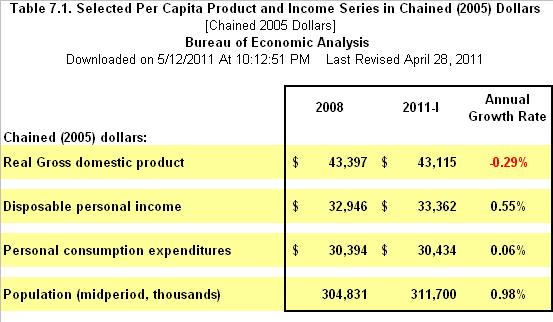
According to the latest report from the Bureau of Economic Analysis, real gross domestic product increased at an annual rate of 1.8% in the first quarter of 2011. But by now most of us understand that this is merely calculated by measuring an increase of roughly 0.45 percent from the fourth quarter of 2010 to the first quarter of 2011, and then multiplying the result by four (.045 * 4 = 1.8). That’s all well and good, but it doesn’t necessarily tell us the truth. What most of us really want to know is the annual rate of GDP growth since Obama’s policies were implemented, and how that compares to the previous administration. To arrive at the answer, one must first measure the annual rate of GDP growth from the time Obama took ownership of the economy, and then compare this to the previous rate. In terms of real (i.e. inflation-adjusted) per capita (i.e. population-adjusted) GDP, the U.S. economy has declined at an annual rate of -0.29% since 2008, as compared to an annual growth rate of 1.15% during the eight-years prior. That’s a decline of 396.5% for the mathematically inclined.

Real Gross Domestic Product: 2009 through 2011-1

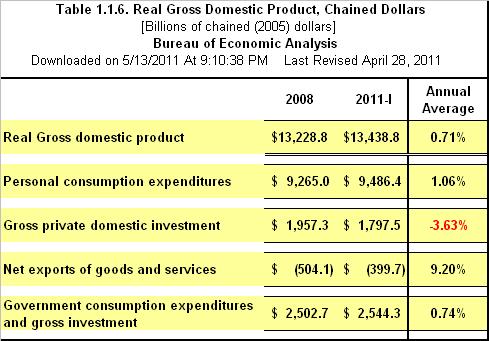
The table below shows that real GDP grew at an annual rate of 0.71% from the end of 2008 through the first quarter of 2011. During the same period, personal consumption increased at an annual rate of 1.06%, private investment declined at an annual rate of -3.63%, net exports increased at an annual rate 9.2%, and government consumption increased at an annual rate of 0.74%.

Real Gross Domestic Product: 2001 through 2008

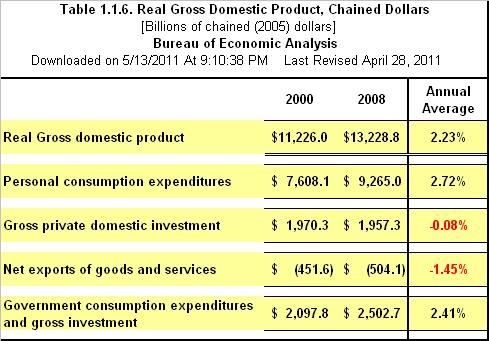
As the next table reveals, real GDP grew at an annual rate of 2.23% from the end of 2000 through 2008. During the same period, personal consumption increased at an annual rate of 2.72%, private investment declined at an annual rate of -0.08%, net exports declined at an annual rate -1.45%, and government consumption increased at an annual rate of 2.41%.

Definitions and Comparisons

Real Gross Domestic Product (GDP)

Gross Domestic Product is comprised of four components, personal consumption, gross private investment, government expenditures, and net exports [GDP = C + I + G + (X – M)]. Under Obama’s policies, real GDP has grown at an annual rate of 0.71% as compared to an annual rate of 2.23% during the previous eight-year period. In other words, GDP grew 214.1% faster in the eight-years before Obama. During the previous administration, an annual growth rate of 2.23% wasn’t bad considering the economy went through one of the worst recessions since the Great One. So exactly how can an annual growth rate of 0.71% be called a recovery? Now let’s compare all four components of GDP.

Personal Consumption (C)

Personal consumption is the largest component of GDP. Personal expenditures fall under one of the following categories: durable goods, non-durable goods, and services. For example, expenditures on rent, food, clothing, tobacco, alcohol, jewelry, gasoline, computers, cellular phones, and medical expenses are included, while the purchase of a new home is not. Real personal consumption is currently slumping along at an annual growth rate of 1.06% versus 2.72% before Obama. In other words, personal consumption was growing 156.6% faster before Obama’s fundamental transformation. All of the federal governments deficit-financed spending on unemployment benefits and food stamps doesn’t appear to be doing the trick after all.

Gross Private Investment (I)

Gross private investment includes business investments such as construction of new facilities, purchases of software, and purchases of machinery and equipment. Personal spending on new homes is also included. Real gross private investment has declined at an annual rate of -3.63% under Obama’s leadership, versus a marginal decline of -0.08% previously. In other words, real gross private investment has slowed by -4,437.5% since Obama implemented his vision for America. What does that tell you? It tells me that the business community lacks confidence in the direction our nation is heading. For example, Obama’s policies of hindering new oil drilling, and seeking to end tax deductions which encourage expansion of the U.S. oil and gas industry won’t exactly translate into any improvement in private investment for the near future.

Government Consumption Expenditures and Gross Investment (G)

Government spending is the sum of government expenditures on final goods and services such as salaries of public servants, purchases of weapons for the military, and any investment expenditure by the federal, and state or local governments. It does not include transfer payments, such as social security, welfare, food stamps or unemployment benefits. Real government consumption is presently growing at an annual rate of 0.74% as compared to an annual rate of 2.41% before Obama. In other words, although the Obama administration has added almost as much to the national debt in the last two-and-a-quarter years as was added in the previous eight, government spending under the previous administration actually added 225.7% more towards economic growth. Perhaps it’s not how much government spends, but rather what it buys. The numbers don’t lie. It’s clear that Obama’s idea of government investment is not the kind that adds anything to our economy.

Net Exports (X – M)

Net exports are the difference between gross exports (what our nation produces in goods and services for other nations’ consumption), and gross imports (what our nation purchases in goods and services from other nations). Imports are subtracted from exports since imported goods are already included in C, I, and G. The only component of GDP with a more favorable result under Obama’s policies is real net exports, which is growing at an annual rate of 9.2% versus a decline of -1.45% in the previous eight years. However, this grand improvement has only added $104.4 billion to real GDP, representing just 0.78% of the total.

Real Per Capita GDP

Of course the best measurement of GDP is found in real per capita results, after all the economy is not static. The effects of population growth combined with inflation can weigh heavily on the economy. The U.S. population has continued to grow at an annual rate of 1.0% since 2000; meanwhile inflation has grown from nearly 0.00% to 3.16% since January of 2009. So let’s see how this combination has affected GDP, disposable personal income, and personal consumption.

As you can see in the tables below, real per capita GDP has declined at an annual rate of -0.29% under Obama’s policies, compared to an annual growth rate of 1.15% in the 8-years prior. Secondly, real per capita disposable personal income has grown at an annual rate of 0.55% versus 1.75% under the previous administration. Finally, real per capita personal consumption has grown at an annual rate of 0.06% versus an annual rate of 1.60% previously. Yet they call this a recovery.

To summarize, real per capita GDP is presently declining at an annual rate of -0.29% versus a positive growth rate of 1.15% under the previous administration. Would you call this an economic expansion? Not hardly. So what’s wrong with the present administration? It acts like it has accomplished something by putting more Americans on unemployment, welfare, and food stamps than ever. It acts like it won’t be satisfied until the last U.S. oil company is run out of business, or until every last local bank, Wal-Mart or McDonald’s franchise is shut down. What will real per capita GDP look like if Obama’s policies are allowed to continue? It’s time to get serious about the matter of peaceful domestic regime change. It’s time for this slacker and his court jesters to go.

Note: Chained-dollar estimates can be used to compute “real” (i.e. inflation-adjusted) rates of growth. However, comparisons of two or more different chained-dollar series must be made with caution, because the prices used as weights in the chained-dollar calculations usually differ from the prices in the reference period, and the resulting chained-dollar values for detailed GDP components usually do not sum to the chained-dollar estimate of GDP or to any intermediate aggregate. In other words, the columns in chained-dollar GDP component columns do not necessarily add up to total GDP, due to rounding differences.

References:

Gross Domestic Product, 1st quarter 2011 (advance estimate)

Bureau of Economic Analysis, Table 1.1.6, Real Gross Domestic Product, Chained Dollars

Bureau of Economic Analysis, Table 7.1, Selected Per Capita Product and Income Series

Inflation reaches 3.16% in April

Obama on Oil | Living a Lie

Trust The Lies

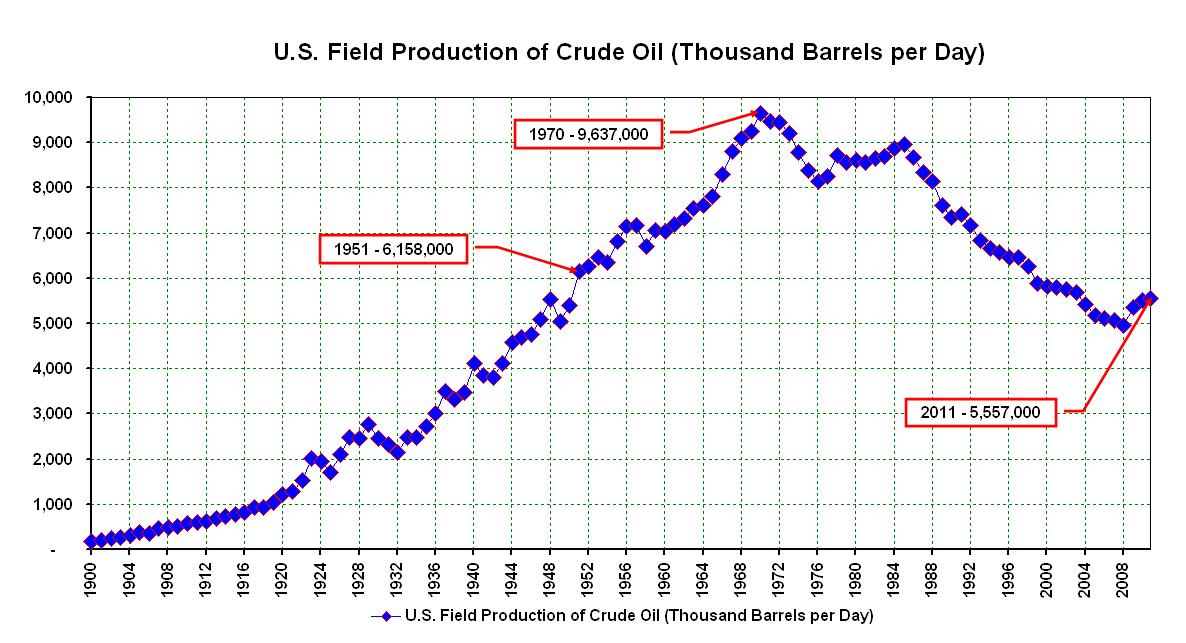
“We’re actually producing more oil here than ever.” ~ Barack Obama (05/06/2011) ~

The truth: We are producing fewer barrels of oil here than we did in 1951. ~

Obama would be correct, if our nation was founded in the year 2003. But of course anyone born before 2003 knows that Obama’s statement is – in fact – not true. For those more interested in truth, than in the shallow words of lying politicians, we are actually producing fewer barrels of oil today than we produced in the year 1951, and 42.3% fewer than we produced in 1970.

It’s time to start drilling, and time to stop lying. If Obama won’t do it, then let’s find someone who will.

References (Check the facts):

http://tonto.eia.doe.gov/dnav/pet/hist/LeafHandler.ashx?n=PET&s=MCRFPUS2&f=A

http://www.eia.doe.gov/totalenergy/data/monthly/pdf/sec3_3.pdf

Unequally Yoked | Social Security and the Working Class

Liberty?

Public vs. Private Sector Inequities

~ By: Larry Walker, Jr. ~

Did you know that most state and local government employees are exempt from Social Security taxes? Millions of Americans who are covered by state or local retirement plans do not pay into the Social Security system. If Social Security is such a great plan, then why are 17,738,156 [1] state and local government workers exempt? Why does the federal government continue to legally bind the rest of us to a sinking ship? This isn’t 1933 anymore. The time for change is now. Social Security is the biggest fraud in American history.

There is no retreat but in submission and slavery! Our chains are forged! ~ Patrick Henry

Teachers Retirement System of Georgia vs. Social Security

For example, teachers in the state of Georgia are covered by the Teachers Retirement System (TRS). Following are some of the differences between teachers covered by TRS and private sector workers covered by Social Security.

  1. Although Georgia teachers are required to contribute 5.0% of their pay into the TRS, the contribution is considered a pre-tax deduction. Workers covered by Social Security must contribute 6.2% of their pay on an after-tax basis.

  2. Georgia public employers pay a matching contribution of 9.24% into the TRS. Private sector employers pay a 6.2% match to the Social Security Administration (SSA).

  3. TRS contributions are invested in stocks, bonds and other liquid investments earning interest, dividends and the chance for appreciation in value. Social Security contributions are used to pay the benefits of current recipients. Any surplus is borrowed and spent by the federal government which is currently $14.3 trillion in debt.

  4. The normal retirement age for Georgia teachers is 60 years of age. Normal retirement for Social Security recipients is age 65, 66, 67 or greater.

  5. Georgia teachers may retire at any age after 25 years of service. Social Security recipients may not retire until they reach the age of 62 (with reduced benefits).

  6. The amount of benefits received by Georgia teachers is based on the two highest years of compensation. The benefits paid by Social Security are based on the average amount of earnings over a 35 year period.

  7. Georgia teachers become vested in their retirement benefits after 10 years of service. Upon separation from service they may either take a lump-sum distribution or rollover their contributions into an IRA. After the vesting period, Georgia Teachers may also take a lump-sum distribution or rollover the employer contributions into an IRA. Social Security recipients are vested after working 40 quarters, or 10 years, but have no rights to lump-sum distributions or rollovers.

  8. Upon separation of service or retirement, Georgia teachers may either take a lump-sum distribution or rollover their benefits into an IRA account. Georgia teachers may also elect to have their remaining benefits paid to their beneficiaries. Social Security recipients do not have any contractual right to take lump-sum distributions, make rollovers, or to pass benefits on to their heirs.

  9. The maximum amount of annual retirement benefits paid to Georgia teachers is determined by multiplying the average of their top two years’ salary by the number of years of service, and then by 2%. Thus an employee who earned $50,000 in their top two years, with 30 years of service, would receive an annual pension of $30,000 per year, or $2,500 per month [50,000 * (.02 * 30)]. The average amount of benefits paid to Social Security recipients is $14,088 per year, or $1,174 per month. The maximum Social Security benefit for a worker retiring in 2011 is $28,392 or $2,366 per month based on earnings at the maximum taxable amount for every year after the age of 21. The maximum taxable amount of Social Security wages in 2009/2010 is $106,800. [2,3]

Wisconsin Retirement System vs. Social Security

As a second example, teachers in the state of Wisconsin are covered by the Wisconsin Retirement System (WRS). Following are some of the differences between teachers covered by WRS and private sector workers covered by Social Security.

  1. Although Wisconsin teachers are supposed to contribute 5.0% of their pay into the WRS, the contribution is actually paid by their employer (i.e. amounts designated as employee contributions for accounting purposes are actually paid by the employer). [1 (pages 15-17)] WRS employees may also make additional tax deferred contributions to their WRS accounts. Workers covered by Social Security must contribute 6.2% of their pay on an after-tax basis.

  2. Wisconsin public employers pay a matching contribution of 4.5% into the WRS, but since they also pay the employees portion, their total contribution is 9.5%. Private sector employers pay a 6.2% match to the Social Security Administration (SSA).

  3. WRS contributions are invested in stocks, bonds and other liquid investments earning interest, dividends and the chance for appreciation in value. Social Security contributions are used to pay the benefits of current recipients. Any surplus is borrowed and spent by the federal government which is currently $14.3 trillion in debt.

  4. The normal retirement age for Wisconsin teachers is 65 years of age, or 57 with 30 years of service. Normal retirement for Social Security recipients is age 65, 66, 67 or greater.

  5. Wisconsin teachers may retire as early as the age of 55 (with reduced benefits). Social Security recipients may not retire until they reach the age of 62 (with reduced benefits).

  6. The amount of benefits received by Wisconsin teachers is based on an average of the three highest years of compensation. The benefits paid by Social Security are based on the average amount of earnings over a 35 year period.

  7. Wisconsin teachers become vested in their retirement benefits immediately and may either take a lump-sum distribution or rollover the employer contributions into an IRA upon separation. Social Security recipients are vested after working 40 quarters, or 10 years, but have no rights to lump-sum distributions or rollovers.

  8. Upon separation of service or retirement, Wisconsin teachers may either take a lump-sum distribution or rollover their benefits into an IRA account. Wisconsin teachers may also elect to have their remaining benefits paid to their beneficiaries. Social Security recipients do not have any contractual right to take lump-sum distributions, make rollovers, or to pass benefits on to their heirs.

  9. The maximum amount of annual retirement benefits paid to Wisconsin teachers is determined by multiplying the average of their top three years’ salary by the number of years of service, and then by 1.6%. Thus an employee who earned $50,000 in their top three years, with 30 years of service, would receive an annual pension of $24,000 per year, or $2,000 per month [50,000 * (.016 * 30)]. The average amount of benefits paid to Social Security recipients is $14,088 per year, or $1,174 per month. The maximum Social Security benefit for a worker retiring in 2011 is $28,392 or $2,366 per month, based on earnings at the maximum taxable amount for every year after the age of 21. The maximum taxable amount of Social Security wages in 2009/2010 is $106,800. [2,3]

Unequally Yoked

When it comes to retirement, not all Americans are treated equally. State and local government workers have great advantages over private sector employees. Not only does the private sector pay the salaries of state and local government workers through income and property taxes, and not only do we contribute towards their retirement, but we allow them to have better retirement plans than ourselves. As most of us sit, chained to the broken and antiquated Social Security system, state and local government employees continually bargain for more and more. Here are the major inequities in a nutshell.

  • Most state and local government employees contribute less towards their retirement plans than those covered by Social Security but receive back more in benefits. Wisconsin public employees contribute nothing towards their retirement yet receive back more in benefits than comparable working class peons.

  • State and local government employees have portable retirement accounts which actually exist. Americans who are covered by Social Security don’t have any portability of savings, nor have their funds been set aside or invested in any manner.

  • State and local workers have greater options for early retirement based on age and the number of years of service, while Social Security patrons must wait until the age of 62 to receive a reduced amount of benefits.

  • The age of full retirement for those covered by Social Security continues to be pushed back due to the lack of funds, while state and local employees are allowed to quit their jobs and take their savings with them at any time.

  • State and local employees are paid retirement benefits based on an average of their top 2 or 3 years of earnings, while Social Security benefits are calculated using an average of 35 years of earnings.

  • Social Security benefits are limited to $28,392 per year, in 2011, no matter how much is earned in a lifetime. The benefits paid to most state and local plan recipients are for the most part unlimited.

Not all workers in the United States are covered by Social Security, so why don’t the rest of us have a choice? Since state and local retirement plans are required to invest contributions in a fiduciary capacity, why doesn’t Social Security? What makes state and local government employees better than the average American? Wouldn’t privately owned and managed retirement accounts be an improvement for all Americans? It’s time to end Social Security. It’s time for all American workers to be treated equally. The ‘Nanny State’ has failed. The era of big government is over. Give me liberty, or give me death!

Sources:

[1] WISCONSIN LEGISLATIVE COUNCIL – 2006 COMPARATIVE STUDY OF MAJOR PUBLIC EMPLOYEE RETIREMENT SYSTEMS

[2] Social Security Administration – Answers

[3] Your Retirement Benefit: How It Is Figured

Other References:

Teachers Retirement System of Georgia – 2010 Annual Financial Report

Wisconsin Department of Employee Trust Funds – 2009 Annual Financial Report

Wisconsin Retirement System (WRS) Benefit Summary

Links:

Chile's Private Accounts Turn 30 – Investors.com

Bill Baar's West Side: NBC LA: A New Party Within a Party? Labor-Skeptic Democrats

Obsolete Government Programs, Part 2 | Medicare

Personal Responsibility

You Paid How Much For Medicare?

~ By: Larry Walker, Jr. ~

Medicare is a social insurance program administered by the United States government, providing health insurance coverage to people who are aged 65 and over, or who meet other special criteria. Some say that Medicare operates similar to a single-payer health care system, but with one key exception: Medicare Part A, the part that we pay for all of our working lives, only provides hospital insurance, and it doesn’t kick in until after the age of 65. Thus, Medicare is more akin to an excessively expensive, mandatory, long-term health care plan than anything else. Although there is a health insurance aspect to Medicare, known as Part B, it’s not free either. Medicare Part B requires the payment of additional monthly premiums upon retirement of between $96.40 and 308.30 per month, depending on the recipient’s level of income at the time.

Medicare is partially financed through payroll taxes imposed by the Federal Insurance Contributions Act (FICA) and the Self-Employment Contributions Act of 1954. In the case of employees, the tax is equal to 2.9% (1.45% withheld from the worker and a matching 1.45% paid by the employer) of the wages, salaries and other compensation in connection with employment. Until December 31, 1993, the law provided a maximum amount of compensation on which the Medicare tax could be imposed each year. But, beginning January 1, 1994, the compensation limit was removed. A self-employed individual must pay the entire 2.9% tax on self employed net earnings, but may deduct half of the tax from income in calculating income tax. Beginning in 2013, the 2.9% hospital insurance tax rises to 3.8% on earned income exceeding $200,000 for individuals and $250,000 for married couples filing jointly. [1]

Times Have Changed: Medicare is Obsolete

In the 1960s, Medicare was introduced to rectify the following problems: health care for the elderly and health care for the non-elderly with pre-existing conditions. The FICA tax was increased in order to pay for this expense. Both problems are listed below, followed by modern day private-sector solutions meant to address the same.

  • The U.S. had no federal-government-mandated health insurance for the elderly; consequently, for many people, the end of their work careers was the end of their ability to pay for medical care.

  • The U.S. had no federal-government-mandated health insurance for all those who are not elderly; consequently, many people, especially those with pre-existing conditions, have no ability to pay for medical care.

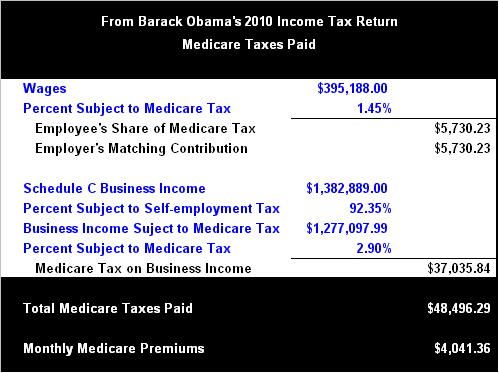
Most Americans would be able to afford real health insurance, or better plans, were we not forced to pay huge sums out of our current pay, for benefits that some will never see. For example, Barack Obama paid a total of $48,496.29 in Medicare taxes in 2010 alone. This means he paid $4,041.36 per month for long-term hospital insurance benefits that he won’t realize until he turns 65. A portion of the $48,496.29, namely $5,730.23 was actually paid by his employer, which would be you and I. Could Mr. Obama perhaps find a better deal in the private-sector? I would hope so. Would you pay $4,041.36 per month for long-term hospital insurance coverage if you had a choice? “AFLAC… AFLAC… AFLAC”!

Obama's Medicare Tab

Medicare Benefits

Medicare has four parts: Part A is Hospital Insurance. Part B is Medical Insurance. Medicare Part D covers prescription drugs. Medicare Advantage plans, also known as Medicare Part C, are another way for beneficiaries to receive their Part A, B and D benefits. All Medicare benefits are subject to medical necessity. The original program was only Parts A and B. Part D was new in January 2006; before that, Parts A and B covered prescription drugs in only a few special cases.

Medicare Premiums

Most Medicare enrollees do not pay a monthly Part A premium, because they (or a spouse) have had 40 or more 3-month quarters in which they paid Federal Insurance Contributions Act taxes. Medicare-eligible persons who do not have 40 or more quarters of Medicare-covered employment may purchase Part A for a monthly premium of:

  • $248.00 per month (in 2011) for those with 30-39 quarters of Medicare-covered employment, or

  • $450.00 per month (in 2011) for those with less than 30 quarters of Medicare-covered employment and who are not otherwise eligible for premium-free Part A coverage.

All Medicare Part B enrollees pay an insurance premium for this coverage; the standard Part B premium for 2009 is $96.40 per month. A new income-based premium schema has been in effect since 2007, wherein Part B premiums are higher for beneficiaries with incomes exceeding $85,000 for individuals, or $170,000 for married couples. Depending on the extent to which beneficiary earnings exceed the base income, these higher Part B premiums are $134.90, $192.70, $250.50, or $308.30 for 2009, with the highest premium paid by individuals earning more than $213,000, or married couples earning more than $426,000. In September 2008, CMS announced that Part B premiums would be unchanged ($96.40 per month) in 2009 for 95 percent of Medicare beneficiaries. This would be only the sixth year without a premium increase since Medicare was established in 1965.

Medicare Part B premiums are commonly deducted automatically from beneficiaries’ monthly Social Security checks. Part C and D plans may or may not charge premiums, at the programs’ discretion. Part C plans may also choose to rebate a portion of the Part B premium to the member. While private-sector health insurance premiums are deducted from employees’ paychecks on a pre-tax basis, Medicare taxes are confiscated from employees on an after-tax basis. Is that fair? Upon retirement, if one wishes to pay for Medicare Part B, the premiums are conveniently deducted from retirees Social Security checks on an after-tax basis. Is that fair?

Still Clueless?

Three-quarters of all taxpayers pay more in payroll taxes than income taxes. Do you get it now? It’s time for this to change. It’s time to stop confiscating money from today’s payroll checks to cover tomorrow’s health care needs. It’s time to give American citizens more of our own money so that we may provide for our current needs. All that we ever hear from the Democrats is how many Americans can’t afford health insurance. Did it ever dawn on any of them that maybe the reason we can’t afford health insurance is because we are being robbed blind by a 15.3% payroll tax? Out of every American paycheck, 15.3% is being literally looted and squandered by the federal government. We are being robbed by a 1933 law which has outlived its usefulness. It’s time to end Medicare and Social Security. All past obligations of Medicare must be immediately privatized through legitimate private-sector insurance companies.

References:

[1] http://www.ssa.gov/OACT/ProgData/taxRates.html

http://en.wikipedia.org/wiki/Medicare_(United_States)

Obsolete Government Programs, Part 1 | FICA

My Roots, circa 1918

“Free at last! Free at last! Thank God Almighty, we are free at last!” ~ MLK, Jr.

~ By: Larry Walker, Jr. ~

Are Social Security Benefits an Inalienable Right? ~

The Federal Insurance Contributions Act (FICA) is codified at Title 26, Subtitle C, Chapter 21 of the United States Code. The FICA tax is a United States payroll (or employment) tax imposed by the federal government on both employees and employers to fund Social Security and Medicare —federal programs that provide benefits for retirees, the disabled, and children of deceased workers. Social Security benefits include old-age, survivors, and disability insurance (OASDI); Medicare provides hospital insurance benefits. The amount that one pays in payroll taxes throughout one’s working career is indirectly tied to the social security benefits annuity that one receives as a retiree. Some folks claim that the payroll tax is not a tax because its collection is tied to a benefit. The United States Supreme Court decided in Flemming v. Nestor (1960) that no one has an accrued property right to benefits from Social Security. [1]

There has been a temptation throughout the program’s history for some people to suppose that their FICA payroll taxes entitle them to a benefit in a legal, contractual sense. That is to say, if a person makes FICA contributions over a number of years, Congress cannot, according to this reasoning, change the rules in such a way that deprives a contributor of a promised future benefit. Under this reasoning, benefits under Social Security could probably only be increased, never decreased, if the Act could be amended at all. Congress clearly had no such limitation in mind when crafting the law. Section 1104 of the 1935 Act, entitled “RESERVATION OF POWER,” specifically said: “The right to alter, amend, or repeal any provision of this Act is hereby reserved to the Congress.” Even so, some have thought that this reservation was in some way unconstitutional. This is the issue finally settled by Flemming v. Nestor. [1]

In this 1960 Supreme Court decision Nestor’s denial of benefits was upheld even though he had contributed to the program for 19 years and was already receiving benefits. Under a 1954 law, Social Security benefits were denied to persons deported for, among other things, having been a member of the Communist party. Accordingly, Mr. Nestor’s benefits were terminated. He appealed the termination arguing, among other claims, that promised Social Security benefits were a contract and that Congress could not renege on that contract. In its ruling, the Court rejected this argument and established the principle that entitlement to Social Security benefits is not a contractual right. [1]

So did you think that Social Security Benefits were an inalienable right? Think again.

Times Have Changed: Social Security is Obsolete

The Center on Budget and Policy Priorities states that three-quarters of taxpayers pay more in payroll taxes than they do in income taxes. The FICA tax is considered a regressive tax on income (with no standard deduction or personal exemption deduction) and is imposed (for the years 2009 and 2010) only on the first $106,800 of gross wages. The tax is not imposed on investment income (such as rents, interest and dividends). As a side note, the Earned Income Credit was enacted in 1975 to “offset the burden of social security taxes and to provide an incentive to work”. More recently the Making Work Pay Credit of 2010 and the 2% Payroll Tax Cut of 2011 were enacted with a redundant goal: “to offset the burden of social security taxes”. Why are Social Security taxes deemed to be so over-burdensome?

Perhaps Social Security has outlived its usefulness. In the 1930s, the New Deal introduced Social Security to rectify the following three problems: retirement, injury-induced disability, or congenital disability. It introduced the FICA tax as the means to pay for Social Security. Following are some of the difficulties that existed for working-class Americans prior to the Great Depression, countered with modern day private-sector innovations meant to address the same.

  • The U.S. had no federal-government-mandated retirement savings; consequently, for those people who had not voluntarily saved money throughout their working lives, the end of their work careers was the end of all income.

But times have changed. Prior to the Great Depression there weren’t many incentives in place to encourage saving towards retirement, nor were there as many options available as there are today. Nowadays employers, employees and the self-employed can choose between numerous retirement plans not limited to the following:

  1. Defined-Benefit Plans

  2. Defined-Contributions Plans

  3. 401(k) Plans

  4. 403(b) Plans

  5. Individual Retirement Accounts (IRAs)

  6. Roth IRAs

  7. Qualified Insurance Annuities

  8. Simplified Employee Pension’s (SEP)

  9. Savings Incentive Match Plan for Employees (SIMPLE)

This isn’t 1933 anymore. The time to end Social Security is now. Since we are able to choose between so many pre-tax options which result in the deferral of income taxes until the funds are withdrawn, why are we still stuck on pouring good money down a bad hole? By now, everyone knows that any surplus once heralded by the Social Security Trust Fund has been confiscated and comingled into the government’s general fund. And we all know that the government’s general fund is more than a whopping $14 trillion in the hole. If working folks and their employers weren’t chained by the bonds of mandatory contributions to Social Security we would be living on easy street.

If we were not forced to pay this mandatory tax of 6.2% (12.4% for the self-employed) on earned income up to the limit of $106,800, we would be able to save a greater portion of our own money into the modern retirement vehicles mentioned above. Loosing employers from burdensome payroll taxes will likewise allow them to provide a greater portion of benefits to employees. However, with government-run Social Security literally robbing us of our retirement savings, and ‘investing’ it in the abyss of debt and irresponsibility, known as Washington, DC, there is little leftover for most Americans to save. In fact, if every dollar of Social Security tax paid on my behalf since I began working had instead been invested in the S&P 500 Index; I would now be a millionaire. But since I haven’t had any choice in the matter, I may just have to settle for the paltry poverty level rations offered by Social Security. What’s worse is that thanks to Social Security, on the day that I die the government-squandered fruit of my labors will go with me.

  • The U.S. had no federal-government-mandated disability income insurance to provide for citizens disabled by injuries (of any kind—work-related or non-work-related); consequently, for most people, a disabling injury meant no more income (since most people had little to no income except earned income from work).

Nowadays, most employers offer mandatory and voluntary disability insurance plans through legitimate insurance companies. Likewise, all employers are required to provide Workers Compensation. Many of us would be able to afford our own portable disability insurance plans were we loosed from the bands of the FICA Act.

  • There was no federal-government-mandated disability income insurance to provide for people unable to ever work during their lives, such as anyone born with severe mental retardation.

Nor is there any such government-mandated disability income insurance today, the key word being insurance. Who in their right mind believes that the federal government provides insurance? If the federal government wants to provide real insurance for persons in need, then the responsible thing to do would be to pay for private-sector insurance policies, on behalf of those in need.

Social Security is an idea that has outlived its usefulness. It’s time for the United States to begin weaning itself off of Social Security. Let’s stop pretending that we are living in 1933. We have options in the 21st Century that didn’t exist in the 20th, but our options are severely constrained by the bonds of old stale ideas. Although it’s doubtful whether Social Security ever served its original purpose, it is indisputable that times have changed. In the 1930’s Americans had no safety net, today we know that we must provide for our own retirement security. However, the amount we are able to save is limited by the amount of money being confiscated from our earnings to cover past obligations. Get a clue. Three-quarters of all taxpayers pay more in payroll taxes than income taxes. Do you get it? It’s time for this to change. It’s time to phaseout Social Security. The age of federal government mandated retirement looting is over.

References:

[1] http://www.ssa.gov/history/nestor.html

http://en.wikipedia.org/wiki/Federal_Insurance_Contributions_Act_tax#cite_note-4

We Are All Billionaires Now

Big Words Small Mind

Tax Breaks for Millionaires and Billionaires ~

“But we cannot afford $1 trillion worth of tax cuts for every millionaire and billionaire in our society.” ~ Barack Obama

~ By: Larry Walker, Jr. ~

The Class Warfare Instigator in Chief (CWIC) has been railing against wealth. People who have saved up for retirement, or who were fortunate enough to acquire assets which have appreciated substantially are not impressed. Anyone with half a brain knows that a millionaire (or billionaire) is an individual whose net worth is equal to or exceeds one million (or one billion) units of currency. Net worth refers to an individual’s net economic position. It is calculated by adding the value of all of ones assets minus the value of all of their liabilities. Being a millionaire or billionaire has nothing to do with an individual’s annual taxable income. So when politicians, such as Obama, speak of tax breaks for millionaires and billionaires, do they even know what they’re talking about?

In the United States of America, we don’t pay income taxes based on the value of our net worth. We pay income taxes based on the amount of income earned or produced annually. So where exactly are these so called tax breaks for millionaires and billionaires? I contend that they don’t exist, namely because as I just stated; individuals are not taxed based on their net worth.

At the last count, there were just 412 billionaires in the United States. So the next time Obama refers to “billionaires”, it would be more appropriate for him to refer to them as “the 412 billionaires”. When one studies the IRS’ Statistics of Income reports, the top 400 annual incomes reported on tax returns in 2007 averaged just under $138 million, far short of a billion. Word twisting politicians, namely Obama, would have us believe that there are people making billions of dollars per year, but that’s simply not true. In reality, only 400 households were fortunate enough to report average annual incomes of around $138 million. And as stated, only 412 Americans have a net worth of over a billion dollars. According to the Spectrum Group there were 7.8 million millionaires in the United States in 2009. However, according to a Taylor Nelson Sofres report, half of all millionaire households in the US are headed by retirees.

Good luck to Democrats in first identifying tax breaks that benefit people with net worth’s of over $1 million (or $1 billion). They don’t exist. And secondly, since more than half of millionaire households are headed by retirees, most likely the only taxable income they receive is from pensions and investment income (a healthy chunk of that being tax-exempt). So does Obama want to raise taxes on grandpa? You mean to say that when people work hard all their lives and save up more than a million dollars for retirement, now that they have become millionaires they are evil and deserve to pay higher taxes? Get out of town, literally.

So is Obama talking about increasing taxes on investment income? Is he talking about doing away with tax-exempt interest? Does he want to get rid of the favorable capital gains rates? Does he intend to impose a tax based on unearned income (the amount of equity a citizen has in assets on a given date)? Or is he talking about re-imposing confiscatory death taxes? Say what you mean, and mean what you say, otherwise shut the hell up. It’s time to stop inciting envy, strife and class-warfare. On the other hand, if all Obama is trying to say, and rather poorly, is that he wants to lower the top tax bracket down to $250,000 and raise marginal tax rates to 39.6% above that amount (i.e. return to the 1993 tax rate schedules), then he should just continue to say that like a broken record until his demise.

I think I understand what Obama is really saying. What he’s saying to me is that since $250,000 is to $1 billion as $25,000 is to $100 million, if you make $25,000 per year, you’re a billionaire. Got it? That seems to be how Obama, sleepy Joe, and the 143 Democrats in Congress see it. With 535 members of Congress, and only 143 of them Democrats, how are they controlling this conversation anyway? After all, there are 311,174,158 citizens, only 412 billionaires, 7.8 million millionaires, and a mere 145 delusional Democrats in DC. Perhaps one of these 145 simpletons can list for the public all of the alleged tax breaks for millionaires and billionaires. I will attempt to identify a few of them presently.

Alternative Minimum Tax (reference)

The Alternative Minimum Tax attempts to ensure that anyone who benefits from certain tax advantages pays at least a minimum amount of tax. The AMT provides an alternative set of rules for calculating your income tax. In general, these rules should determine the minimum amount of tax that someone with your income should be required to pay. If your regular tax falls below this minimum, you have to make up the difference by paying alternative minimum tax.

Tax laws provide tax benefits for certain kinds of income and allow special deductions and credits for certain expenses. These benefits can drastically reduce some taxpayers’ tax obligations. Congress created the AMT in 1969, targeting higher-income taxpayers who could claim so many deductions they owed little or no income tax. Because the AMT is not indexed for inflation, a growing number of middle-income taxpayers are discovering they are subject to the AMT.

You may have to pay the AMT if your taxable income for regular tax purposes plus any adjustments and preference items that apply to you are more than the AMT exemption amount.

The AMT exemption amounts are set by law for each filing status. For tax year 2010, Congress raised the AMT exemption amounts to the following levels:

  • $72,450 for a married couple filing a joint return and qualifying widows and widowers;

  • $47,450 for singles and heads of household;

  • $36,225 for a married person filing separately.

  • The minimum AMT exemption amount for a child whose unearned income is taxed at the parents’ tax rate has increased to $6,700 for 2010.

Do the AMT exemption amounts (above) look like they’re targeting millionaires and billionaires to you? It doesn’t look that way to me. Not unless, like I said from the beginning, “we are all billionaires”. So just what kind of items can trigger the AMT? Here are a few.

Personal Exemptions – What? Believe it or not, personal exemptions contribute to AMT liability. The exemptions you claim for yourself, your spouse and your dependents are not allowed when calculating alternative minimum tax. It’s pretty rare (though not impossible) to see a tax return where someone had to pay AMT solely because of their exemptions, but the more exemptions you claim, the more likely it is that you’ll have AMT liability.

Standard Deduction – What? Some 70% of American taxpayers claim the standard deduction (rather than itemizing). The standard deduction isn’t allowed under the AMT. Usually this isn’t a problem because the AMT generally hits people with higher incomes, and these people are more likely to claim itemized deductions. Yet it’s worth noting that a deduction that’s so widely used can contribute to AMT liability.

State and Local Taxes – What? If you itemize, there’s a good chance you claim a deduction for state and local tax, including property tax, income tax and sales tax. These deductions are not allowed under the AMT. If you live in a place where state and local taxes are high, you’re more likely to be subject to the alternative minimum tax.

Interest on Second Mortgages – The AMT allows a deduction for interest on mortgage borrowings used to buy, build or improve your home. If you borrowed against your home for some other purpose, the interest deduction isn’t allowed under the alternative minimum tax.

Medical Expenses – The AMT allows a medical expense deduction, but it’s more limited than the deduction under the regular income tax. If you claim an itemized deduction for medical expenses, part or all of it will be disallowed when you calculate your alternative minimum tax.

Miscellaneous Itemized Deductions – Certain itemized deductions are available if your total deductions in this general category add up to more than 2% of your adjusted gross income. Among the items here are unreimbursed employee expenses, tax preparation fees and many investment expenses. You can’t deduct these items under the AMT, though. A large deduction in this category could lead you to pay alternative minimum tax.

Various Credits – Some of the credits that are allowed when you calculate your regular income tax aren’t allowed when you calculate your AMT. The more credits you claim, the more likely it is that you’ll end up paying alternative minimum tax. Fortunately, Congress has extended relief for the “personal credits” in recent years.

Well, the AMT certainly doesn’t constitute a tax break for millionaires and billionaires. Heck, we’ve barely breached the $75,000 mark if married ($50,000 if single) and most of the main tax breaks have already dissipated. Next!

Retirement Contributions Credit Limitation (reference)

You may be eligible for a tax credit if you make contributions to an employer-sponsored retirement plan or to an individual retirement arrangement. If you make eligible contributions to a qualified IRA, 401(k) and certain other retirement plans, you may be able to take a credit of up to $1,000 or up to $2,000 if filing jointly. The credit is a percentage of the qualifying contribution amount, with the highest rate for taxpayers with the least income. However, income limits apply to individuals with a filing status and income of the following amounts:

  • Single, married filing separately, or qualifying widow(er), with income up to $27,750

  • Head of Household with income up to $41,625

  • Married Filing Jointly, with incomes up to $55,500

So if you’re single and make more than $27,750 you can forget about this tax credit. It doesn’t appear that we’ve tapped into those elusive tax breaks for millionaires and billionaires yet. So let’s try again.

Earned Income Tax Credit Limitation (reference)

The Earned Income Tax Credit or the EITC is a refundable federal income tax credit for low to moderate income working individuals and families. Congress originally approved the tax credit legislation in 1975 in part to offset the burden of social security taxes and to provide an incentive to work. When EITC exceeds the amount of taxes owed, it results in a tax refund to those who claim and qualify for the credit.

Tax Year 2010 maximum credit:

  • $5,666 with three or more qualifying children

  • $5,036 with two qualifying children

  • $3,050 with one qualifying child

  • $457 with no qualifying children

Earned Income and adjusted gross income (AGI) must each be less than:

  • $43,352 ($48,362 married filing jointly) with three or more qualifying children

  • $40,363 ($45,373 married filing jointly) with two qualifying children

  • $35,535 ($40,545 married filing jointly) with one qualifying child

  • $13,460 ($18,470 married filing jointly) with no qualifying children

  • Investment income must be $3,100 or less for the year.

So much for tax breaks for millionaires and billionaires. There don’t appear to be many real breaks for folks making even $50,000 per year. Shall we try again?

Mortgage Interest Limitation (reference)

Interest deductions on home mortgages are limited. The law allows taxpayers to deduct interest on two categories of indebtedness secured by their residences. Acquisition indebtedness is used to acquire, construct, or substantially improve a residence, and cannot exceed $1,000,000. Home equity indebtedness is any debt other than acquisition indebtedness and cannot exceed $100,000.

So if you are lucky enough to be able to borrow more than $1 million on a mortgage, you cannot deduct any mortgage interest for the amount above $1 million. And if you have a home equity loan of more than $100,000, the amount of interest you can deduct is not allowed for the amount above $100,000. This doesn’t look like a tax break for millionaires and billionaires either. Surely there must be a humongous tax break for rich folks with children.

Child Tax Credit Limitation (reference)

The Child Tax Credit is for people who have a qualifying child under the age of 17. It is in addition to the earned income credit, if you even qualify for that. The maximum amount you can claim for the credit is $1,000 for each qualifying child. However, you must reduce your child tax credit if your modified adjusted gross income (AGI) is above the amount shown below for your filing status.

  • Married filing jointly – $110,000.

  • Single, head of household, or qualifying widow(er) – $75,000.

  • Married filing separately – $55,000.

So if you’re married with children and have income of more than $110,000, you don’t get the full $1,000 child tax credit. Oh well, this isn’t a tax break for so called millionaires and billionaires. Maybe if you borrow a ton of money to invest in a graduate degree you’ll get a huge tax break.

Student Loan Interest Limitation (reference)

You can claim up to $2,500 of student loan interest you paid as an above-the-line tax deduction on Form 1040. What? Does the government even have any idea that some people are paying upwards of $4,000 – $10,000 in student loan interest per year? And do they understand that an above-the-line tax deduction on $2,500 can at the most save an individual or couple 25-28% of the maximum amount? So if you’re married and pay $7,000 in student loan interest, you’ll receive a tax break amounting to between $250 and $700 depending on your tax bracket.

But if your income is too high, you won’t get any break at all. You can take this deduction only if your modified adjusted gross income (AGI) is less than: $75,000 if single, head of household, or qualifying widow(er); or $150,000 if married filing jointly. Oh well, we could go on and on, but so much for that theory.

Conclusion

No one pays income tax based on their net worth. We pay income taxes based on the amount of income we earn or produce each year. The simplistic act of raising the top marginal tax rate from 35% to 39.6%, and lowering the top tax bracket down to $250,000 won’t bring in an extra dime from millionaires and billionaires. Although it will take some money out of the pockets of small businesses, families and other hard working Americans, it will leave true millionaires and billionaires unscathed. There’s a dearth of tax breaks for anyone making more than $75,000 per year, and marginal tax rates are already way too high across the board, so Obama’s comments are simply absurd. Perhaps one of the other 144 Democrat Party simpletons in DC can list for us all of the alleged tax breaks for millionaires and billionaires. But until then, I’m going to have to ask you to muzzle it. Otherwise, prepare to give up your remaining 145 seats.

It’s not the 412 billionaires that worry me; it’s the federal government, $14 trillion in debt, with its hand in my pocket. That makes me queasy.