U.S. Debt Ceiling | World War Infinity

Excerpt from: GAO: “No Opinion” on U.S. Financial Audit

– By: Larry Walker II –

World War Infinity ::

“Prior to 1917, the Congress approved each debt issuance. In 1917, to facilitate planning in World War I, Congress established a dollar ceiling for Federal borrowing. With the Public Debt Act of 1941 (Public Law 77-7), Congress and the President set an overall limit of $65 billion on Treasury debt obligations that could be outstanding at any one time. Since then, Congress and the President have enacted a number of debt limit increases. Most recently, pursuant to the Budget Control Act (BCA) of 2011, the debt limit was raised by $400 billion in August 2011 to $14.694 trillion, by $500 billion in September 2011 to $15.194 trillion, and by $1.2 trillion to $16.394 trillion in January 2012.”

Let’s make this clear. Prior to 1917, Congress approved each and every debt issuance request made by the Treasury Department. It was with the outbreak of the 1st World War that a debt ceiling was first established. This gave the Treasury some latitude in keeping the government afloat without impairing wartime activities. So it would make sense that after the end of World Wars I and II, Congress would resume its role of approving each debt issuance. But instead, the U.S. government has morphed into a permanent war mentality.

Now, a small minority of borderline insane pundits are actually advocating for complete removal of any form of debt ceiling. It’s World War Infinity, they surmise. Like spoiled little children, they have conned themselves into believing that the role of government is to borrow and spend our way into a Utopian entitlement paradise. Where are the adults?

Reference:

GAO: “No Opinion” on U.S. Financial Audit

Give Up 300,000 Federal Workers… and then we’ll talk.

U.S. Government Shutdown: Negotiation 101

– By: Larry Walker II –

“Treasury Secy. Jack Lew warns the country will run out of money later this month. Actually, that’s another lie. The country ran out of money $17 trillion ago. It’s all borrowed since then, much of it by this administration.” ~ Andrew Malcolm *

The United States federal government shutdown of 1995 and 1996 was the result of conflicts between Democrat President Bill Clinton and the Republican Congress over funding for Medicare, education, the environment, and public health in the 1996 federal budget. The government shut down after Clinton vetoed the spending bill the Republican Party-controlled Congress sent him. The federal government of the United States put non-essential government workers on furlough and suspended non-essential services from November 14 through November 19, 1995 and from December 16, 1995 to January 6, 1996, for a total of 28 days. The major players were President Clinton and Speaker of the U.S. House of Representatives Newt Gingrich.

According to the U.S. Bureau of Labor Statistics, in November of 1995, near the beginning of the shutdown, there were 2,152,900 federal government employees, excluding postal workers. By January 1996, at the end of the shutdown, this number had been trimmed by 110,300, to 2,042,600. After the parties reached an agreement, the number of federal workers was further slashed, by an additional 184,900, falling to it’s lowest point in more than 30 years, all the way to 1,857,700 by October of 2000 (see chart below).

Looking back a bit farther, there were 2,309,200 federal employees in December of 1992, so the number had already been slashed by 254,600 from the time Bill Clinton entered office until the shutdown. All in all, the federal government was able to rid itself of 451,500 non-essential employees between the years 1993 and 2000. Simply amazing!

Unfortunately, since October of 2000, the number of federal employees has grown by 291,200, reaching 2,148,900 by August of 2013. How quickly we forget. But the situation today is even more dire. According to the Cato Institute, “Total wages and benefits paid to executive branch civilians will be about $248 billion in 2013, indicating that compensation is a major federal expense that can be trimmed. During the last decade, compensation of federal employees rose faster than compensation of private-sector employees. As a consequence, the average federal civilian worker now earns 74 percent more in wages and benefits than the average worker in the U.S. private sector.” What’s up with that?

Keeping in mind that the only time the federal budget has balanced in our lifetimes was between the years 1996 and 2000, and putting aside partisan B.S. for a moment, what does that tell you? Was it just a coincidence that balancing the federal budget during this time-frame entailed slashing the number of federal workers to the lowest level in more than three decades? No it wasn’t.

The Bottom Line: What this should tell us is that among the 900,000 (or so) non-essential federal workers just placed on furlough, at least 300,000 need to be sent packing – permanently. There’s no way the federal budget will ever balance again, until the federal government takes serious measures to reduce its own size. The private sector is not the problem; government is the problem. Now is not the time to add new entitlement programs, and ever more federal employees, rather like 1995 it’s time to slash and burn. Give up 300,000 federal workers, then, and only then, may we engage in an adult conversation regarding the remainder of the federal budget.

References and Related:

Chart: Overpaid Federal Workers – Cato Institute

If 900,000 federal workers can be furloughed as ‘non-essential,’ why employ them? – Investor’s Business Daily

Make the Shutdown of Undesirable Federal Departments and Agencies Permanent: A Continuing Resolution is an abomination. – Ideal Taxes Association

U.S. Government Manufactures 469,000 Jobs – Natural Born Conservative

Watcher’s Council Nominations – Storming The Barrycades Edition – Watcher of Weasels

U.S. Government Manufactures 469,000 Jobs

Phony Current Employment Statistics (CES)

“How many legs does a dog have if you call the tail a leg? Four. Calling a tail a leg doesn’t make it a leg.” ― Abraham Lincoln

– By: Larry Walker, Jr. –

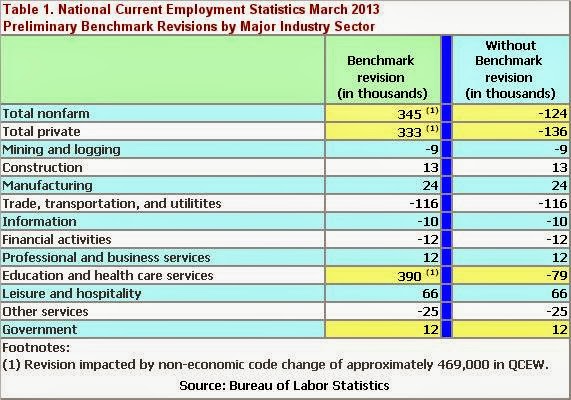
According to the U.S. Bureau of Labor Statistics (BLS), via its September 26th CES Preliminary Benchmark Announcement, the number of Private Sector Jobs reported in March 2013 was overstated by 136,000, and the number of Government jobs was understated by 12,000. But not to be outdone by a deteriorating economic reality, the BLS eliminated this bad news through a major change in its reporting methodology. After the change, instead of an overstatement of 124,000 nonfarm jobs (-136,000 + 12,000), the BLS will instead be reporting a net gain of 345,000 jobs on its January 2014 employment situation report. It’s magic!

Here’s what the BLS said (emphasis mine), followed by the translation in plain English.

“Each year, employment estimates from the Current Employment Statistics (CES) survey are benchmarked to comprehensive counts of employment for the month of March. These counts are derived from State Unemployment Insurance (UI) tax records that nearly all employers are required to file. For National CES employment series, the annual benchmark revisions over the last 10 years have averaged plus or minus three-tenths of one percent of Total nonfarm employment. The preliminary estimate of the benchmark revision indicates an upward adjustment to March 2013 Total nonfarm employment of 345,000 (0.3 percent). This revision is impacted by a large non-economic code change in the Quarterly Census of Employment and Wages (QCEW) that moves approximately 469,000 in employment from Private households, which is out-of-scope for CES, to the Education and health care services industry, which is in scope. After accounting for this movement, the estimate of the revision to the over-the-year change in CES from March 2012 to March 2013 is a downward revision of 124,000.”

What this means in plain English is that the BLS has once again changed the rules of the game, this time adding an estimated 469,000 Private Household Employees to its accounting of private sector jobs. So what’s wrong with that? Aren’t private household employees considered part of the private sector? The answer is no. Private household employees have never before been considered part of the private sector. The main reasons they have not been are as follows: (1) the BLS has no way of knowing how many household employees really exist, (2) no idea how many are considered full-time, part-time or temporary, and (3) will have virtually no way of tracking changes in the number of such employees on a monthly basis (i.e. its reports are issued monthly).

Unlike private sector businesses, which are surveyed monthly and file quarterly employment reports, private households are not surveyed in the same manner and only file employment reports on an annual basis. According to the Internal Revenue Service (IRS), although household employees are most commonly associated with child care providers, such as nannies, private household employees also include service providers such as gardeners, cleaning personnel or maids, babysitters, housekeepers, private nurses or home health aids and drivers or chauffeurs. Since such employees have never been included in private sector reporting in the past, the federal government’s employment statistics after January 2014 will be forever inconsistent with every prior period.

The table above, courtesy of the BLS, shows the March 2013 preliminary benchmark revisions by major industry sector. I have added a second column showing the changes without the addition of the newly concocted 469,000 private household employees. As you can clearly see, consistent with all prior CES statistics, there are actually 124,000 fewer nonfarm jobs than previously reported.

The bottom line: The number of private sector jobs reported in March 2013 was overstated by 136,000. The number of government jobs reported for the same period was understated by 12,000. That’s reality. Those are the facts. Just like the Bureau of Economic Analysis has been overstating Gross Domestic Product due to changes in its reporting methodology, the BLS has been following suit. As the U.S. economy continues to crumble, aside from QE3, the only tool the federal government has left to combat this new reality is to lie through its teeth. Changing the rules midstream in order to paint a rosy economic scenario through phony statistical reporting is not only dishonest, but reprehensible. The problem with lying is that eventually reality catches up. When there are no longer any warning signs, yet the national economy collapses, who will you blame?

Related:

2013 GDP Growth Rate Closer to -1.75% ― Phony Government Statistics: GDP

Black Unemployment Rate Closer to 37.9% ― Phony Government Statistics, Detroit and Black Americans

Entertainment R&D Boosts Federal GDP Calculation Following Formula Changes

The new GDP methodology: What you need to know: U.S. economy over $500 billion larger due to new definitions

Government Economic Reports: What You’ve Suspected but Were Afraid to Ask.

2013 GDP Growth Rate Closer to -1.75%

Phony Government Statistics: GDP

– By: Larry Walker, II –

“There are six things that the Lord hates, seven that are an abomination to him: haughty eyes, a lying tongue, and hands that shed innocent blood, a heart that devises wicked plans, feet that make haste to run to evil, a false witness who breathes out lies, and one who sows discord among brothers.” ~ Proverbs 6:16-19 ~

Gross Domestic Product (GDP) is one of the broader measures of economic activity and is the most widely followed business indicator reported by the U.S. government. But according to Economist Walter J. Williams of Shadow Government Statistics, “Upward growth biases built into GDP modeling since the early 1980’s have rendered this important series nearly worthless as an indicator of economic activity… With reported growth moving up and away from economic reality, the primary significance of GDP reporting now is as a political propaganda tool and as a cheerleading prop for Pollyannaish analysts on Wall Street.”

On August 29, 2013, the Federal Government reported that Real Gross Domestic Product — the output of goods and services produced by labor and property located in the United States — increased at an annual rate of 2.5 percent in the second quarter of 2013 (that is, from the first quarter to the second quarter), according to the “second” estimate released by the Bureau of Economic Analysis (BEA). In the first quarter, real GDP increased 1.1 percent. (The BEA will release its final number for the second quarter 2013 on September 26, 2013, at 8:30 A.M. EDT.)

However, this GDP headline number refers to the most-recent quarter’s annualized quarter-to-quarter rate of change (what that quarter’s percent quarter-to-quarter change would translate into if compounded for four consecutive quarters). This can mean that the latest quarter can be reported with a positive annualized growth rate, while the actual annual rate of change is negative, as was the case for the 3rd quarter of 2009. So is the economy really growing or not?

Note: The chart above, courtesy of ShadowStats.com, shows Annual Growth (Year-to-Year Percent Change). This is not the annualized quarterly rate of change that serves as the headline number for the series.

Shadow GDP

According to Shadow Government Statistics, the annual growth percentage change in GDP for the second quarter 2013, based on Official BEA data, was a mere 1.64%. However, when the aforementioned upward biases, inserted into GDP since 1984, are removed, the annual growth percentage change for the second quarter 2013 was actually more like -1.75%.

In fact, if you study the chart above, in conjunction with source data courtesy of Shadow Government Statistics, other than an anemic growth rate of less than 0.51% for the first, second, and third quarters of 2004, based on pre-1984 methodology, annual GDP growth has been negative ever since the second quarter of 2000.

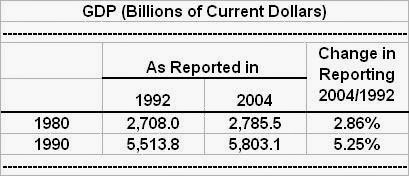
Even worse, every time the BEA makes a new Pollyannaish change in its GDP reporting methodology, all prior data is restated back to the year 1929. For example, according to Shadow Government Statistics, methodological changes made in 2004 led to increases in previously reported GDP of 2.86% for 1980, and 5.25% for 1990 (see table below).

Unless this nonsense is reigned in, I suspect that in the near future, the Great Depression will be referred to as the Booming 30’s. Should you wish to study this topic further, please take a few moments to read the series authored by Walter J. “John” Williams, “Government Economic Reports: Things You’ve Suspected But Were Afraid To Ask!

The Bottom Line: Nearly every key statistic reported by the Federal Government is a lie. Virtually every word emanating from Washington, DC is a lie. Although the American people may be exceptional, the Government of the United States, as it stands today, has strayed so far from the mark that there will be none other to blame as it seals its own demise.

Related:

Black Unemployment Rate Closer to 37.9%: Phony Government Statistics, Detroit and Black Americans

Entertainment R&D Boosts Federal GDP Calculation Following Formula Changes

The new GDP methodology: What you need to know: U.S. economy over $500 billion larger due to new definitions

Directed Sunrise

Fire in the Sky, Bomb in the Sound

– Lights, Camera, Action… –

Tybee Island, Atlantic Ocean — September 2, 2013 ::

On February 5, 1958 the US Air Force lost a 7,600-pound Mark 15 hydrogen bomb in the waters off Tybee Island near Savannah, GA. The Air Force had been running practice exercises at about 2 AM that morning when the B-47 bomber carrying the bomb collided in midair with an F-86 fighter plane.

The F-86 pilot ejected before the collision but the B-47 remained airborne. The pilot requested permission to jettison the bomb to reduce weight and prevent the bomb from exploding during an emergency landing. Permission was granted and the bomb was jettisoned at 7,200 feet while the bomber was traveling about 200 knots. When the bomb struck the sea, no explosion was seen. The B-47 safely landed at the nearby Hunter Air Force Base.

A recovery effort began on February 6, 1958, for what is now known as the Tybee Bomb. The Air Force 2700th Explosive Ordnance Disposal Squadron and 100 Navy personnel equipped with hand held sonar and galvanic drag and cable sweeps mounted a search. On April 16, 1958, the military announced that the search efforts had been unsuccessful.

The Tybee Bomb, allegedly, remains buried here unto this day.

Reference: 1958 Tybee Island Mid-air Collision

Black Unemployment Rate Closer to 37.9%

“I am a firm believer in the people. If given the truth, they can be depended upon to meet any national crisis. The great point is to bring them the real facts.” ~ Abraham Lincoln ~

Phony Government Statistics, Detroit and Black Americans

– By: Larry Walker II –

One way the federal government could help reduce Black-on-Black crime and address the nation’s poverty crisis would be to start telling the truth about unemployment. The U.S. Bureau of Labor Statistics (BLS) publishes a set of completely phony statistics each and every month, in order to convince the public that our economic condition is rosier than it appears. However, if the economy is doing so well, then why has the number of Americans living in poverty recently spiked to levels not seen since the mid-1960s? What’s up with that? Could it be that the employment situation and more specifically Black unemployment is far worse than government statistics portend?

For example, in December 2009, the BLS estimated that the official unemployment rate in Detroit, Michigan was 27.0%. However, at the same time, Detroit Mayor Dave Bing stated that the city’s official unemployment rate was as believable as Santa Claus, proffering that it was instead closer to 50.0%. Considering that less than four years later, Detroit would file the largest municipal bankruptcy in U.S. history, he was probably on the right track. So how did Mayor Bing come up with his figure?

Well, the BLS estimated that for the year ending September 2009, the State of Michigan’s official unemployment rate was 12.6%, but according to its broadest definition of unemployment, the state unemployment rate was 20.9%, or 66.0% higher than the official rate. Therefore, since the City of Detroit’s official unemployment rate for October 2009 was 27.0%, applying the broader rate meant the city’s rate was really as high as 44.8% (27.0 * 1.66). Since Mayor Bing’s estimate was more in the ballpark than the BLS, it might be a good idea to apply this same logic nationwide, especially when it comes to Black Americans, who as a whole have traditionally sustained the nation’s worst levels of unemployment.

Real Unemployment

Every month, the BLS publishes its official U-3 unemployment rate, a headline number that almost everyone is familiar with, but also releases the lesser known U-6 unemployment rate, its broadest measure of unemployment. U-6 includes short-term discouraged and other marginally-attached workers as well as those forced to work part-time because they cannot find full-time work. When we compare current BLS statistics, which are based on a flawed methodology only in place post-1993, against its pre-1994 methodology, we discover that the official U-3 rate is really closer to 12.8%, not the 7.4% figure published on August 2, 2013, and that the broader U-6 rate is really closer to 23.3%, rather than 14.0%.

There is actually an alternative to the federal government’s phony reporting. A private organization, Shadow Government Statistics, publishes a more accurate measure of unemployment, which is based on pre-1994 BLS methodology. The seasonally-adjusted SGS Alternate Unemployment Rate reflects current unemployment reporting methodology adjusted for SGS-estimated long-term discouraged workers, who were defined out of official existence in 1994. In other words, the SGS Alternate Rate adds millions of long-term discouraged workers back to the BLS estimate, which only includes short-term discouraged workers.

In case you didn’t catch that, allow me to clarify. What this means is the BLS has eliminated long-term discouraged workers (i.e. those who have been without a job for so long, they haven’t bothered to look for more than 12 months) from official unemployment statistics since 1994, thus distorting the real employment situation. And herein lies the problem: If you knew that a U.S. city was battling an unemployment rate of 27.0%, while the federal government was busy creating jobs in Egypt, China and everywhere else but that city, what would that tell you? Would it have made any difference if you knew that city’s unemployment rate was really 44.8% or greater? What do you think millions of long-term discouraged workers are up to, just sitting around laughing, joking and waiting on a government handout? Not likely, for an idle mind is the devil’s workshop.

To get a better idea of what’s really going on in America, we will begin by analyzing the federal government’s broadest measure of unemployment (U-6). Then we will compute the difference between U-6 and Shadow Government Statistics Alternate Unemployment Rate (Real U-6). Next, we’ll analyze the government’s official U-3 unemployment rate, then use the difference between U-6 and Real U-6 to extrapolate the real official unemployment rate (Real U-3). Finally, we will focus on unemployment among Black Americans, and using the same formula, project the real unemployment rate for Black Americans.

What’s the point? The first step in solving any problem is to define it. My mission today is to better define the problem, not necessarily solve it. There’s not a person in this nation, with the exception of those who still believe in Santa Claus, who truly believes the official unemployment rate is 7.4%, as of August 2, 2013, or that the total unemployment rate is just 14.0%. Nor is there any way on earth that Black folks, especially those in or around inner-cities, believe the Black unemployment rate is just 12.6%. So let’s get real. With that, here we go.

U-6 – Total Unemployment

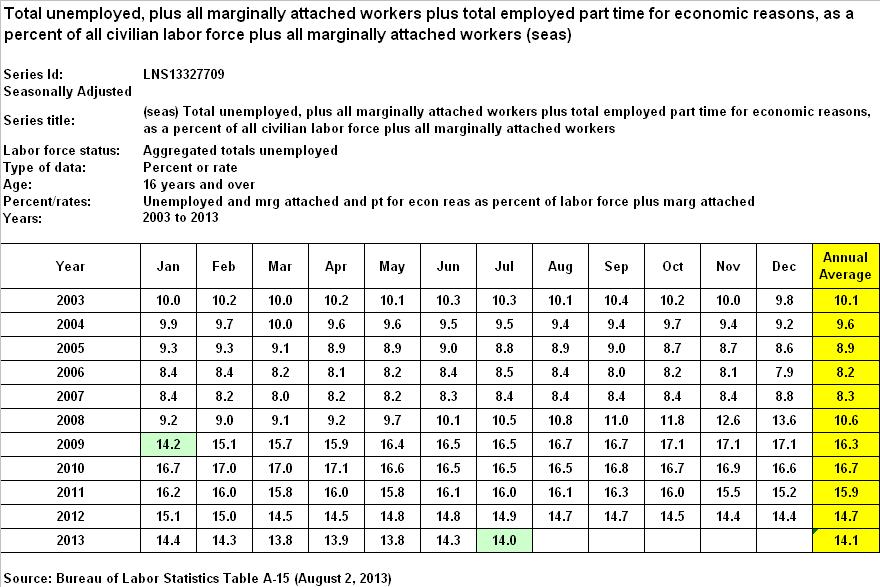
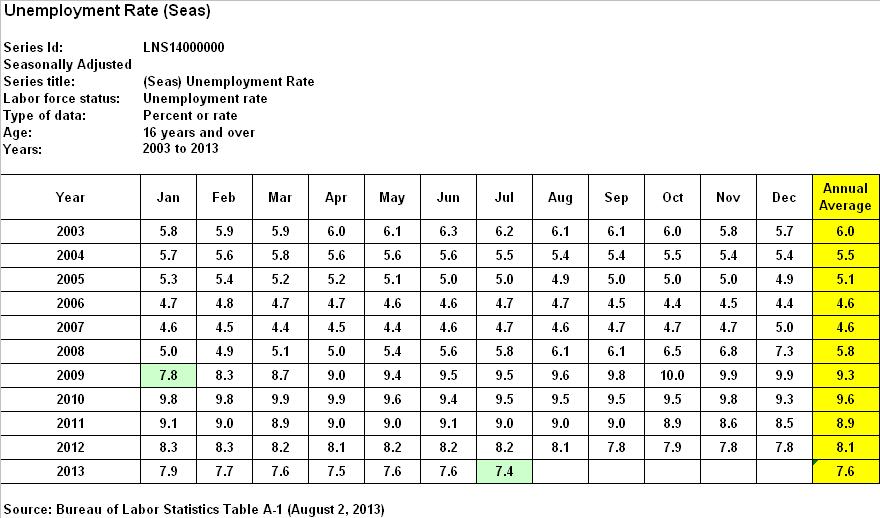
When it comes to the federal government’s broadest measure of unemployment, U-6, according to the BLS the rate was 14.2% for January 2009, peaked at 17.1% in October through December of 2009, once again in April of 2010, and has since declined to 14.0%, as of July 2013. A closer look reveals the following annual averages, since 2003:

By comparison, U-6 averaged between 8.2% and 10.6% in the six years prior to the Great Recession, including 2008, the first full year thereof, but since the end of 2008 has averaged between 14.1% and 16.7%. What does that tell you? It tells me that notwithstanding the fact that the Great Recession ended in June of 2009, a solid four years ago, the total unemployment rate in 2013 is averaging 33.0% higher than in it did at the end of 2008 ((14.1 – 10.6) / 10.6), the first full year of the recession.

In other words, U-6 has grown 33.0% worse, since Potus 44 took the reigns, and that’s going by the government’s most optimistic estimates, based on a set of phony statistics which fail to count the number of long-term discouraged workers. Well, that’s not very encouraging.

SGS Alternate Unemployment Rate

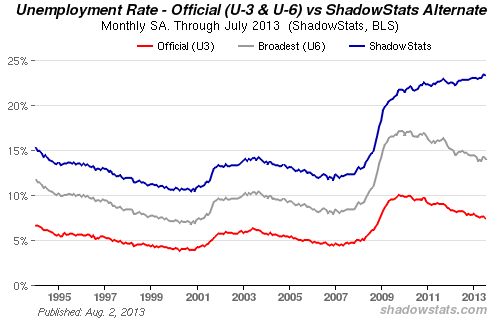
According to Shadow Government Statistics, the BLS has defined a certain segment of society, long-term discouraged workers, out of existence since 1994. It kind of sounds like the old three-fifths of a man theory, only now millions are counted as zero-fifths of a person, at least when it comes to official unemployment statistics. Oh you can vote alright, but if you’re poor, unemployed and haven’t searched for work in more than 12 month’s, you don’t really matter. Thus, the real unemployment rate is far worse than what the federal government would have us believe. The chart that follows is the latest from Shadow Government Statistics.

As you can see visually, and according to data from Shadow Government Statistics, for January 2009, instead of the federal government’s phony unemployment rates, U-3 of 7.8% and U-6 of 14.2%, real total unemployment (Real U-6) was actually 18.3%. But even more stunning is the fact that since January of 2009, instead of both rates peaking in 2009-2010 before declining to current BLS levels, Real U-6 has never declined, but has rather increased from 18.3% to 23.3%.

Summary Conclusion 1: The U-6 unemployment rate is really closer to 23.3%. When compared to the BLS U-6 rate, Real U-6 was 28.8% higher for January 2009 than we were led to believe ((18.3 – 14.2) / 14.2). Also, instead of declining, Real U-6 has since increased by an additional 27.3% ((23.3 – 18.3) / 18.3). In other words, Real U-6 is currently 64.0% worse than the BLS reported for January 2009 ((23.3 – 14.2) / 14.2). Got that?

U-3 – Official Unemployment

According to BLS, the official U-3 unemployment rate was 7.8% for January of 2009, peaked at 10.0% in October of 2009, and has since declined to 7.4% as of July 2013. A closer look reveals the following annual averages, since 2003:

By comparison, U-3 averaged between 4.6% and 6.0% in six years prior to the great recession, including 2008, the first full year thereof, but since the end of 2008 has averaged between 7.6% and 9.6%. Keeping in mind that the Great Recession officially commenced in December 2007 and ended in June of 2009, what does that tell you? It tells me that undeterred by the federal government’s phony statistics; U-3 is worse off today, on average, than after the first 13 month’s of the recession, which only lasted a total of 19 months.

In other words, in contempt of the fact that the Great Recession ended in mid-2009, just over four years ago, the average U-3 unemployment rate in 2013 is 31.0% worse than at the end of 2008 ((7.6 – 5.8) / 5.8). Although bad enough on its lonesome, remember that this is based on the federal governments most optimistic estimates, steeped in the same phony methodology mentioned above. So then what is the real unemployment rate?

Summary Conclusion 2: As shown in Summary Conclusion 1, the Real U-6 unemployment rate is currently 64.0% higher than the BLS reported for January 2009. Therefore, I contend that the real official unemployment rate (Real U-3) is also 64.0% greater than the government’s January 2009 figure. Since U-3 was said to be 7.8% for January 2009, Real U-3 is closer to 12.8% today (7.8 * 1.64). Are you still with me? Good. Now let’s look at the unemployment rate for Black Americans.

Black Unemployment

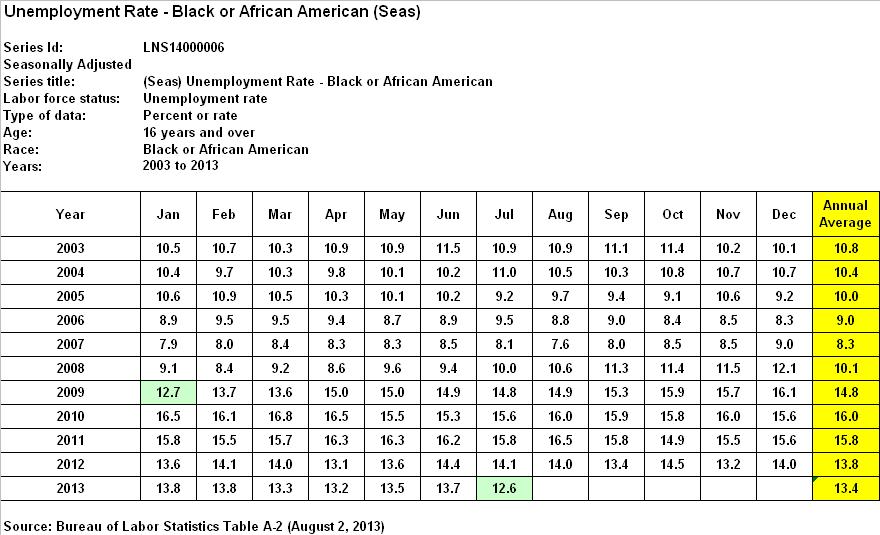
According to BLS, the official unemployment rate for Black Americans was 12.7% for January 2009, peaked at 16.8% in March of 2010, and is currently 12.6%, as of July 2013. A closer look reveals the following annual averages, since 2003:

By comparison, the official unemployment rate for Black Americans averaged between 8.3% and 10.8% in the six years prior the Great Recession, including 2008, the first full year thereof, but since the end of 2008 has averaged between 13.4% and 16.0%. Again, what does that tell you? It tells me that even though the Great Recession ended in mid-2009, more than 48 months ago, the average annual unemployment rate for Black Americans is now 32.6% worse than at the end of 2008 ((13.4 – 10.1) / 10.1).

In other words, the official Black unemployment rate has grown worse by 32.6%, since Potus 44 took the reigns. Yet again, I remind you that these are the federal government’s most optimistic estimates, based on phony BLS methodology, as mentioned above. [It’s worth noting that the unemployment rate for Black Americans more closely mimics the U-6 rate, and is currently 70.2% higher than the official U-3 rate ((12.6 – 7.4) / 7.4).] So even after reducing millions of Blacks to zero-fifths of a person, for unemployment purposes, the Black unemployment situation is completely unacceptable.

Summary Conclusion 3: As shown in Summary Conclusion 1, the Real U-6 unemployment rate is currently 64.0% higher than the BLS reported for January 2009. Therefore, I contend that the official unemployment rate for Black Americans is also 64.0% greater than the government’s January 2009 figure. Since the Black unemployment rate was reported to be 12.7% for January 2009, the official unemployment rate for Black Americans is really closer to 20.8% today (12.7 * 1.64), or 65.0% higher than BLS reported on August 2, 2013. But that’s not the end of the story.

Now we must take into consideration Detroit Mayor Dave Bing’s 2009 assessment of Detroit’s real unemployment rate. When we apply Mayor Bing’s formula to the nation as a whole, we can draw the following conclusion.

Conclusion: The official U-3 unemployment rate is really closer to 12.8%, as shown in Summary Conclusion 2. The total U-6 unemployment rate is really closer to 23.3%, as shown in Summary Conclusion 1, or 82.0% higher than Real U-3 ((23.3 – 12.8) / 12.8). Therefore, I contend that the total unemployment rate for Black Americans is also 82.0% higher than the figure shown in Summary Conclusion 3. Applying the broader measure means the unemployment rate for Black Americans is actually as high as 37.9% (20.8 * 1.82).

The Wrap

The first step in solving any problem is to define it. Publishing phony employment statistics is just one of the many games slick talking Washington politicians play to hide the truth. By masking reality since 1994, the U.S. government has been outright lying to itself and the general public for at least two decades. So what else are they lying about? What about inflation, GDP, the money supply, and carbon dioxide levels in the atmosphere, to name a few?

According to the federal government, as of July 2013, the official U-3 unemployment rate was 7.4%, U-6 total unemployment was 14.0%, and the official rate for Black Americans was 12.6%. But these are phony estimates, which fail to include the number of long-term discouraged workers. When we include those who should matter the most, those currently counted as zero-fifths of a person, we find that Real U-3 is 12.8%, Real U-6 is hovering at 23.3%, and the unemployment rate for Black Americans is really closer to 37.9%.

  • Real U-3: 12.8% (vs. 7.4%)

  • Real U-6: 23.3% (vs. 14.0%)

  • Black Unemployment: 37.9% (vs. 12.6%)

Not only has the unemployment rate grown 64.0% worse since January 2009, for all Americans, but the unemployment rate for Black Americans is really closer to 37.9% nationwide. However, within more problematic, high-crime, urban areas across the nation, such as Detroit, Black unemployment is now deathly critical. If you want to know the real unemployment rate in your city, state or locality, take the federal government’s official rate from January 2009, multiply it by 1.64, then take the result and multiply it again by 1.82, and you’ll have a more accurate figure.

When Potus 44 starts throwing around words like phony, as he prances around waving a golf club and berating folks for locking their car doors, he should be mindful that the very core of the government, over which he so arrogantly presides, may in fact be built on a lie. If Potus 44 truly believes the unemployment rate for Black Americans is 12.6%, then he should probably just take another nap, play another round of golf, give another incoherent speech, and then take another vacation. But if he believes the real unemployment rate for Blacks is closer to 37.9%, and construes it to be the main culprit behind poverty levels not seen since the mid-1960s, and a reason why 93% of Blacks are being murdered by other Blacks, then he should act accordingly.

However, race-baiting, raising the minimum wage, hiking income taxes, regulating the coal industry out of existence, delaying the Keystone XL Pipeline, and mandating that every American buy health insurance are all policies which lead to fewer job opportunities, not more. So perhaps the solution to our problem lies not in government doing more, but in government undoing much of what it has already done. My mission today was not to solve America’s problems, but rather to help define them. It’s high time the federal government starts giving us the truth. Now here’s a riddle: Detroit has fallen! Detroit has fallen! How long before the United States faces bankruptcy?

References:

Shadow Government Statisticshttp://www.shadowstats.com/alternate_data/unemployment-charts

Confounded InterestThe Daunting Gap In Unemployment and Homeownership By Race – Blacks In Last Place.

Now Locking Your Car Doors Is Racist

“There are very few African-American men who haven’t had the experience of walking across the street and hearing the locks click on the doors of cars. That happens to me, at least before I was a senator.” ~ Potus 44

Don’t Patronize Me Bro

– By: Larry Walker, II –

Whatever you do, don’t listen to anything Potus 44 says, period. The truth is that there are very few Black men who haven’t experienced an auto theft, or an attempted carjacking. Both have happened to me, twice in my early 20’s and again in my late 30’s.

This past week, diving headlong into Bizarro World, Potus 44 fabricated a story berating the clicking sound of car doors locking as somehow hurtful to the feelings of Black folks. No, seriously. And although it may not have been his intent, in so saying, he affirmed that he really didn’t know what he was doing when he took the job of President, and that there is really no need to take anything he says seriously ever again.

I don’t know who he thinks he is, or what glass bubble he’s been living in, but leaving your car doors unlocked, giving the benefit of the doubt to an approaching stranger, regardless of the age, race or sex of that stranger, is advice only a person completely devoid of common sense would fathom. The impression that the clicking sound of car doors locking is (or ever has been) in any sense racist must rank among the top 10 dumbest notions any Potus has uttered to date.

True racist experiences that I haven’t faced on my own, I have been taught by my father, who grew up in Harlem in the 40’s and 50’s, and lived in Detroit in the late 50’s and early 1960’s. I don’t have any use for the race-baiting rhetoric of Potus 44, who appears to know very little about the Black experience. It’s like listening to an alien, from a Galaxy light-years in the past, trying to explain to me what it’s like to be human. Sometimes I just have to shake my head and wonder whether this guy even believes himself.

Now I don’t know how your car doors operate, but in every car I’ve owned for nearly the last two decades the locks have engaged automatically, either when all the doors are shut, upon ignition or when placed into gear, and fortunately so. I say fortunately because of an incident I experienced in my own life.

An Average Day in 1997

The year was 1997, and the incident which follows occurred inside of the Atlanta Metropolitan Area. I had just gotten off work and decided to stop at the corner gas station to fill up. After filling the tank, in an afterthought, I decided to get something from inside to carry me through the meeting I was headed to. Not wanting to hog up space at the pump, I decided to park at the back of station and walk to the store. After the purchase, I returned to my car, got inside and sat for a couple of seconds, a thousand thoughts racing through my head. Then suddenly, a suspicious person emerged from the bushes at the front of the car, and passed by the passenger side. I gave the benefit of the doubt that this was just some harmless guy heading to the store from some sort of shortcut. But I was wrong.

As I observed through the rearview mirror, instead of heading into the store, this lunatic headed straight for my rear passenger door and proceeded to pull the latch two or three times. I literally couldn’t believe it was happening, especially in broad daylight. Luckily the door was locked. But then, before I could even react, my mind still half engaged in where I was coming from and where I was headed, he quickly moved to the front passenger side door and started tugging at the latch. Fortunately that door was locked as well.

I had no idea who this man was, but it was clear he represented an imminent threat. When he couldn’t open that door he scurried around the back of the car, heading for the driver’s side doors. That’s when my survival instincts kicked in. I fired up the engine and jolted the car backwards attempting to scare him away. I didn’t want to run the guy over, because that would have only led to my detainment at the very least, and possibly jail time. After backing up just enough, I shifted into drive and sped off, frantically, tires screeching. As I did so, like a zombie this fool was still grasping for my door latch.

Can you imagine what you would do if some violent looking, drugged-up, crack zombie, without warning suddenly jumped into your backseat? I didn’t know whether this guy had a gun or a knife or what his intentions were which is precisely why I fled the scene. I wanted to run into the store and warn them, but the perpetrator was standing in between, with that I don’t give a damn look on his face. He looked like he didn’t have a care in the world, like he was just going to help himself to whatever he wanted, whenever he wanted it, and when he couldn’t get to me, he simply headed towards the next unsuspecting victim.

Exiting into the street, I made a right turn and headed for an auto repair shop two blocks away to call the police. Cellular phones were uncommon at the time, so if you needed to make a call you normally had to find a pay phone, but I didn’t have time for that. I raced into the shop and told them to hurry and call the police, because some lunatic just tried to jack my car and was still out there, just down the street. The manager promptly dialed 911 and handed me the phone. I explained to the operator what happened and provided a description of the suspect.

After the call we all went outside to see what was happening. We could see the same guy, a tall thin Black male in his 30’s or 40’s wearing a white t-shirt and dark pants, out in the middle of the street walking from car to car trying to enter vehicles that were stopped at the traffic light in front of the gas station. People were backing up, turning sideways, running the red light and doing whatever they could to get away from him. It was too surreal.

Well, the police finally arrived, zeroing in on the suspect from all directions. I spoke briefly to one officer while the others took care of the miscreant.

The Lesson

When I was just a child, my father taught me that when heading to your vehicle, always have the keys in your hand ready to insert straight into the lock, open the door quickly, get inside quickly and close and lock the doors. Some lessons a father teaches should never be forgotten. Fortunately I listened, and have practiced this method ever since I started driving. I hope that anyone who hasn’t heard this before will get the message and do the same. Stay safe; keep your windows up and your doors locked, especially in crime-ridden, progressive-run, urban areas; and whatever you do don’t listen to Potus 44.

Word to the Race-Baiter in Chief

Don’t patronize me. It wouldn’t have mattered whether the individual in my story was male or female; black, white, brown, yellow or red; that’s not the point. Now this may hurt your feelings, and the feelings of fellow race-baiting rabble rousers, but that little lecture you gave the other day was the dumbest, sorriest, most pathetic waste of breath I have ever heard in my entire life. As Potus, you have a responsibility to promote the general welfare, but when you stray from your true purpose, as you so egregiously have, and begin sharing your own fears, insecurities and paranoia, which may just be byproducts of your own warped upbringing, as though all of America should be able to identify, you not only make yourself look like a fool, but complicit in the needless loss of young lives.

So here’s a suggestion for you. Since you don’t have any earthly idea what you’re talking about, you would do well to just keep your big mouth shut. As for me and my house, unless and until you come up with a solution for reducing Black-on-Black murder, and the Black crime rate in general, absolutely nothing you mutter about race, or anything else for that matter, will be taken seriously.

Photo via Fox5 San Diego: Two Men Accused of Carjacking Mustang Arrested

Related: Trayvon’s Fatal Mistake

Trayvon’s Fatal Mistake

Don’t make the same mistake once.

Word to my son

– By: Larry Walker II –

A police officer once explained to me, as he poked his finger into my chest, “If you so much as touch another person, like this, without their consent, you have committed simple battery, and if that person calls the police you will be arrested.”

Since the law is undisputed, then isn’t the act of walking up to a total stranger, punching him in the face, and then attempting to inflict as much bodily damage as humanly possible also a crime? Certainly, and although this may be painful for race-baiting rabble-rousers, had Trayvon Martin (T) survived the infamous brawl, which he himself commenced, he would have certainly been charged with a crime. Let us face the facts; T is the one who assaulted George Zimmerman (Z), as the evidence proved.

Unbeknownst to a tiny segment of the population, roughly 0.2% (700,000 petition signers out of a population of more than 313,000,000), watching a suspicious person in your neighborhood and reporting them to the police is not a crime. Lord only knows how many times I’ve done that, White, Black, Hispanic or whatever, and the police generally say they appreciate it. Most of the crimes that happen around here occur when least expected, in the middle of the night when no one is looking out, so it’s wise to keep a watch, especially in your own neighborhood.

In my early 20’s I worked as a security guard for a short time. One of my jobs involved guarding a large industrial facility, all alone, from the middle of the night until the wee hours of the morning. Among my duties was to periodically get out of the car and physically walk every square inch of the grounds. So I have an idea just how dangerous keeping watch can be. Luckily there were no incidents in my day, but it was kind of scary at times wondering what may lie around the next corner, and at the same time, the thought of being the one who might break up some major crime was rather exhilarating. It so happens that patrolling your own neighborhood in the same manner isn’t a crime at all.

Getting out of your vehicle to see where a suspicious person may have gone isn’t a crime either, although it may be dangerous. But even your grandfather, who’s now around 76 years old, is commissioned to drive around his neighborhood as part of the neighborhood watch crew. That man never ceases to amaze me. But they’ve had a lot of thefts in that area, so everyone in the neighborhood knows one another and they have made a commitment to keep their eyes open. While keeping watch on your own neighborhood is not a crime, assaulting another human being is.

Who called the cops?

When it comes to assault and battery, intent is an essential element. Under the laws of most of the States, it is only necessary to have the intent to commit the act that causes the harm. In other words, the assault must be voluntary. Did T intend to assault Z? Well, let’s think about that for a minute. Which one called the cops? Common sense dictates that a person about to commit a criminal act generally doesn’t stop and call the police a forehand. According to the evidence most of us saw and heard, it was Z who called the police, not T.

The way I understand it, T is the one who confronted Z, stepping out of nowhere and asking him if he had a problem. When Z said no, T told him he had one now and then proceeded to punch him in the face and bash his head repeatedly against a concrete sidewalk. As I alluded to earlier, inflicting physical harm on anyone for any reason is generally a crime, that is, unless it’s done in self-defense or in the middle of a boxing ring where there is mutual consent. Did T assault Z? Apparently so, as the bloodied nose and wounds on the back of the latter’s head would later testify. So as I stated above, had T survived the gunshot wound, he would most certainly have been charged with a crime.

The lame excuse that Z, who turned out to be the neighborhood watch captain, was following him and reporting him to the police, doesn’t hold water as far as justification for an assault. Initially, T may have been a kid carrying a bag of candy and an iced tea trying to get home, but at some point his actions became those of a NWAA (“n-word” with an attitude), hell bent on ambushing a stranger and cracking his skull open. Unfortunately for T, he chose the wrong “cracka” (a 19th Century southern slave owner). Some people don’t play like that son. I don’t play like that. I’m too old to be street brawling with some juvenile delinquent with a chip on his shoulder. I don’t blame Z for fighting back with what he had at his disposal, in this case a gun.

So what was T thinking? What was his plan? To kill Z and dispose of the body? To knock him unconscious and then run home hoping to never see him again? To cripple Z, so he could never testify against him? What exactly was T’s plan? That is the question. I don’t care what injustice you may imagine someone has committed against you, if they haven’t touched you physically and you decide to lay your hands on them suddenly, in a violent and vicious manner, and they perceive that you are trying to take their very life, survival instincts will kick in, and somebody will wind up dead, justifiably you.

The lesson: If you step up on a stranger, with the intent of unleashing bodily harm, for whatever reason, then you should know that it may be the last act you ever commit.

Does your life show enough evidence?1

Once in my early 20’s I impulsively traveled to Houston, Texas (long story) where I became stranded after a group of Mexican gang members stole my car and my money. I felt ashamed, embarrassed and disgraced. I called the police and they came out, but they didn’t believe me because I had nothing to prove to them that I even owned a car, since I wasn’t a resident. As I walked through the streets aimlessly, wondering what to do, I started to notice that I was being followed. If I went a couple of blocks to the left or to the right, the same car full of Mexicans would reappear, wantonly staring me down. As nightfall approached, I began to get scared because I had nowhere to go, and didn’t know a soul in that city. So what did I do?

I gave up. I didn’t have the answer. So I began to pray, right there on the street, “God please get me out of this, and I promise I will never stray again.” Then a pay phone appeared, so I placed a collect call to your grandfather (the only other person next to God who really cared about me). I explained my dilemma, and he told me to call the police again and ask them to get me out of that area, and then call him back when I was safe. So I ran across the street to a fast food restaurant and asked the manager to please call the police because I was being followed and feared for my life. He did and the police came. Although a little reluctant, they decided what they could do was drive me a couple of miles down the road and then I was on my own.

To make a long story short, the police dropped me off at a hotel where I was able to call your grandfather back, and he was able to wire some money so I could buy a bus ticket and get the heck out of that awful city. I would submit this to you son, if you think someone is following you, and you feel uncomfortable about it, your first act should be to call on the Lord. But you should know that by now. Then if you can get to a phone or happen to have one in the palm of your hand, call the police and let them handle it. T had choices to make and he chose wrong. Not knowing how to handle the situation, he decided to take the immature route, like many young men do these days. He assumed that Z was a creepy looking person who was following him and therefore deserving of a T-style beat down.

What could T have done differently?

What did T do when he thought he was being followed? Did he call the police? No, instead he chose to take matters into his own hands. So he ambushed Z, and delivered the first blow. Now that’s a good way to get yourself killed son, because you never know what kind of weapon your victim is carrying. Thus, I’m not surprised by the outcome.

  1. He could have simply walked up to Z and asked him who he was, whether or not he was following him, and if so, why. For all T knew, Z could have been an undercover cop, a security guard, or a member of the neighborhood watch patrol. How would he know without asking, and why would he not ask since he had just as much right to be there as anyone else?

  2. Since T had already gotten away from Z, who lost sight of him for around 4 minutes, he could have simply ran home, or continued hiding until Z left the area. Had he done so, the police would have eventually arrived and found out what was really going on.

  3. If T was really concerned for his own safety, he could have simply dialed 911, instead of squandering valuable phone-time describing the situation to his lady-friend. Had he done so, the police would have promptly phoned Z and told him that T was just a kid who lives in the neighborhood.

Conclusion

If I had a son would he look like Trayvon? Well, in my case I don’t have to speculate, because I am blessed to have a son, and to me he doesn’t look anything like Trayvon. Some say he looks like me when I was younger, but he’s really a cross between his mother and me. But that’s not the point. Looks are deceiving. What matters most is the content of your character.

I pray to God son that you never choose to act out like T. Please don’t handle your affairs in that manner. If something is going down, and you’re not sure how to handle it, please call me. I have learned some of life’s more bitter lessons and may be able to offer at least a tiny smidgen of advice. And if I’m not around, hide yourself if you can, and then call the cops. I beg of you, if at all possible, don’t take matters into your own hands. If a bird lands on your head, you don’t have to let it build a nest.

Do these three things and you will not fail: Resist evil with good, lay hands on no man suddenly, and do unto others as you would have them do unto you. T’s fatal mistake came the moment he decided to physically assault Z. It wasn’t so much the act itself, but rather the decision to commit the act that matters. Here’s a word for you son, “Think it all the way through.” Whenever you have a crazy thought, just ask yourself this question: “And then what?” That is the beginning of wisdom, and all wisdom is from the Lord.

For reference: Evidence, (page 16)1

Replacing Coal with Solar Energy — Let Me Count the Costs

“Suppose one of you wants to build a tower. Won’t you first sit down and estimate the cost to see if you have enough money to complete it?” ~ Luke 14:28 (NIV)

– By: Larry Walker, II –

During his 2011 State of the Union address, Potus announced a new U.S. energy target: Produce 80 percent of electricity from clean energy sources by 2035. Just this past week, two and a half years later, he announced that the centerpiece of his proposal involves deploying the EPA in a new war on the coal industry. But according to Rep. Tim Murphy (R-Allegheny), the House Chairman of the Energy and Commerce Oversight Committee, “This Administration has already closed one-fifth of US coal-fueled plants in the last four years and has made no secret about its anti-coal agenda.”

Although the topic has sparked an abundance of rhetoric from the lips of Potus, there’s been no mention of the cost to American households, to taxpayers at the federal and state levels, no hint of opportunity cost (the value of the best alternative forgone), nor of any economic benefits, but merely an odd discourse involving a man-made solution for regulating the Earth’s temperature, namely through taxing and regulating our largest source of electricity, coal fired power plants, out of existence. The unanswered questions surrounding Potus’ latest craze are as follows: How much is it going to cost? Who’s going to pay for it? And, how will it benefit America?
I recently came across an interesting article on Climate Central entitled, “Replacing Coal With Clean Energy — Let Me Count the Ways” (July 2011). The author, Alyson Kenward, ponders where all the new “clean energy” will come from after Potus destroys the coal industry. She explains that coal and natural gas produce about 70 percent of our electricity, nuclear power around 20 percent, renewable sources like wind and hydro-power roughly 10 percent, and how this ratio would need to change.

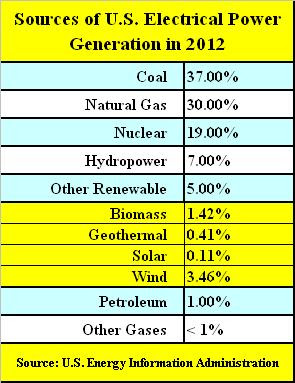
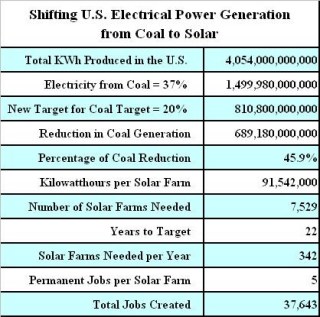
According to Potus, natural gas counts as clean energy, because even though it produces CO2, its emissions per kilowatt-hour (KWh) generated are only half as much as coal. Thus, if we were to leave all the current natural gas fired power plants in place, and not build any new ones, hitting the 80 percent target means that roughly 46% of the nation’s coal production would need to be replaced. As Ms. Kenward explained, and I concur, this won’t be a simple task, since coal alone currently provides 37% of America’s electricity.

Ignoring the costs, Ms. Kenward came up with six ways the U.S. could achieve Potus’ objective. Counting the costs, I have slightly revised and modified Ms. Kenward’s analysis, while maintaining its integrity, focusing on just one of her six possible ways, which I will call Method Number 4. After weighing the costs and benefits, we will be able to decide for ourselves whether or not Potus’ idea is feasible.
Method Number 4

We could build 7,529 solar energy farms — but each one would have to be the size of Nevada’s Copper Mountain solar array.

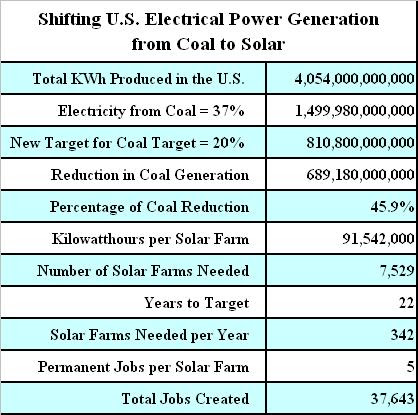
The U.S. produces just over 4 trillion KWh of electricity each year, of which coal is responsible for 1.5 trillion KWh, or 37%. In order to reduce the ratio of electricity produced from coal to 20% would require a substitute capable of generating roughly 689 billion KWh per year. Nevada’s Copper Mountain solar farm produces around 92 million KWh a year. So to reach Potus’ target would require building 7,529 similar solar farms over the next 22 years, or 342 per year.

The Sempra Copper Mountain facility is a 55-megawatt solar farm, in Nevada, which spans 380 acres and contains 775,000 solar panels. Built between January and December of 2010, it was at the time the largest PV solar plant in the United States. One of its claims to fame was that it allegedly created 350 temporary construction jobs, yet the Las Vegas Sun pointed out some of its more glaring flaws:

  • Solar power coming to Nevada: 0. Zip.

  • Parts manufactured in Nevada: 0. Zilch.

  • Permanent jobs created: 5. That’s not a typo.

  • State incentives developer Sempra Generation received: $12 million. That’s not a typo, either.
Costs

According to the Los Angeles Times, “Capturing a free and clean source of energy is not cheap. Solar is the Cadillac of energy, with capital costs and other market factors making it three times more expensive than natural gas or coal. Ratepayers’ bills will be as much as 50% higher for renewable energy, according to an analysis from the consumer advocate branch of the state Public Utilities Commission.”

So not only will solar power cost more than three-times as much as coal to implement and produce, but when it’s all said and done our power bills will likely be more than 50% higher, as ratepayers’ pass their costs on to consumers. This fact alone should disqualify solar energy as a viable alternative for our electric power needs.

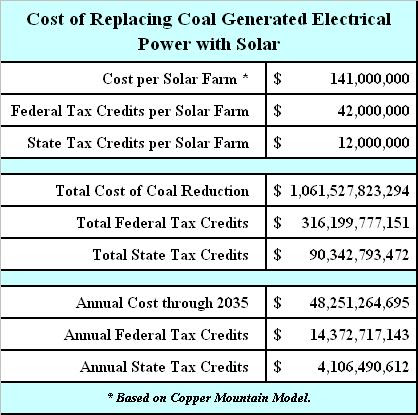
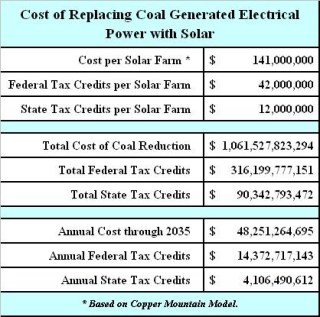
The Nevada Economic Development Commission said the project cost $141 million. The federal government gave Sempra Generation about $42 million in tax credits, 30 percent of the price tag for Copper Mountain. When we include the $12 million in state incentives, mentioned above, we find that 38% of its total cost was provided by federal and state tax dollars. That’s all well and good, except for the fact that we would have to replicate the process 7,529 more times in order to reach Potus’ target.

Using simple math puts the total cost of Potus’ grand scheme at around $1,061,527,823,294 ($141,000,000 times 7,529). That’s $1.1 trillion, with potentially $316 billion subsidized by the federal government, and $90 billion by state governments. Although over a 22-year period this only amounts to around $48 billion per year, with $14 billion subsidized by the federal government and another $4 billion by the states, we must next weigh the economic benefits?

In the matter at hand, a politician defending costs, without considering benefits, is akin to the federal government regulating the level of mercury emissions in the atmosphere, while simultaneously forcing every household in America to install mercury laced light bulbs. Frankly, I would rather have mercury way up in the atmosphere, than in the light fixture next to my bed. In other words, if the costs outweigh the benefits, a project may ultimately do more harm than good.
Short-Term Economic Benefits

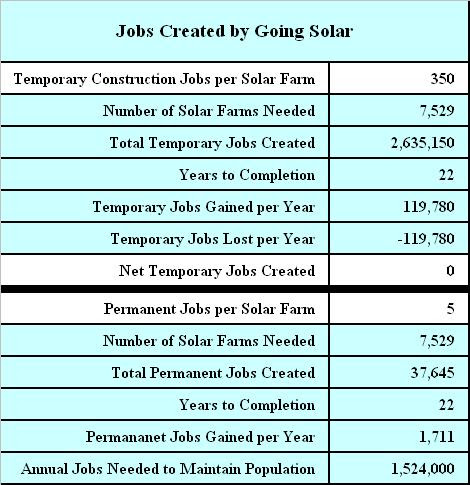
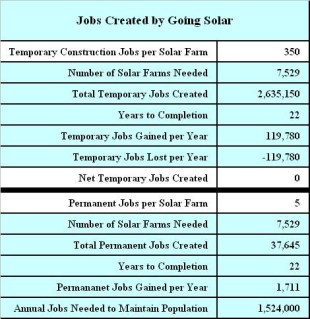
Construction of the Copper Mountain plant created 350 temporary jobs, which theoretically lasted about a year, although we don’t know how that was calculated. There could have been high turnover (i.e. 175 jobs filled by 350 persons). However, if 7,529 similar plants were to be built, in raw terms, it may result in the creation of as many as 2,635,150 temporary construction jobs, over a period of 22 years. Although that sounds great, it only amounts to 119,780 temporary jobs each year, or 9,981 jobs per month.

The catch is that because these jobs are temporary in nature, lasting perhaps a year at most, theoretically the same crew would be moving around from job to job. The net result is that only a total of 119,780 jobs are created over the entire 22-year period. How’s that you say? Well, as next year’s 119,780 jobs are created, last year’s 119,780 jobs come to an end. So in terms of temporary construction jobs, at best only 119,780 are created through the year 2035, at which point they disappear entirely. Although one might presume any amount of jobs growth a positive, because the U.S. needs to create roughly 127,000 jobs each and every month, just to keep pace with population growth, in the near-term, going solar adds virtually nothing to our ailing economy.

Long-Term Economic Benefits

According to Speaker of the House John Boehner, the coal industry is responsible for 760,000 good paying permanent jobs. If that’s correct, then Potus’ goal of reducing the coal industry by 46% would result in a loss of perhaps 349,600 good paying permanent jobs, assuming the entire industry doesn’t collapse in the process. And remember, Copper Mountain created just 5 permanent jobs (that’s not a typo). So once Potus’ scheme is fully realized, after 22 years and $1.1 trillion are squandered, the U.S. will have created just 37,645 permanent jobs (5 * 7,529).

In the long run, Potus will have replaced 349,600 (or more) permanent full-time jobs with just 37,645, for a net loss of 311,955 jobs, an 80% reduction. Brilliant! By the year 2035, assuming we haven’t plunged into the Dark Ages, we will have higher cost electricity, something we already had at a much lower cost, and the nation will have achieved a greater level of unemployment with evermore people dependent on government aid. Well, so much for the economic benefits of Method Number 4. But at least the planet will be healed, right?

Environmental Trade-Offs

Construction of an additional 7,529 Copper Mountain sized solar power plants would involve converting some 2,860,855 acres of land into solar farms (380 * 7,529). That equals an area of 4,470 square miles.

Although this may sound like a lot, according to the USDA Economic Research Service, the United States has a total land area of nearly 2.3 billion acres. In 2007, the major land uses were forestland at 671 million acres (30 percent); grassland pasture and range-land at 614 million (27 percent); cropland at 408 million (18 percent); special uses (primarily parks and wildlife areas) at 313 million acres (14 percent); miscellaneous uses (like tundra or swamps) at 197 million acres (9 percent); and urban land at 61 million acres (3 percent).

Since the Mojave Desert, which spans parts of California, Nevada, Utah, and Arizona, comprises an area of 22,000 square miles, a sufficient amount of land is not a problem. The only issues are ironically environmental. With all the CO2 hysteria these days, we won’t likely know of the negative effects of pointing thousands of square miles of polycrystalline, monocrystalline and amorphous silicon panels directly at the sun until something bad happens. After all, we’re just finding out that wind turbines aren’t all they were cracked up to be: “Rare bird last seen in Britain 22 years ago reappears – only to be killed by wind turbine in front of a horrified crowd of birdwatchers.” Not that environmentalist’s care about the needless slaughter of wildlife.

And, you may recall that it was only after implementing the corn, sugarcane and soybean ethanol fads that we discovered the concept of carbon debt – that large amounts of trapped carbon are released into the atmosphere when vegetation burns or decays as land is cleared, and that this up-front carbon debt could take centuries to break even with emissions gradually avoided by substituting bio-fuels in place of fossil fuels. Oops!

What would happen if every other nation across the planet were also to implement Potus’ program, turning several hundred thousand square miles of the Earth’s surface into a gigantic silicon light reflector? Would the atmosphere fry? Would people go blind? Would an ice age ensue? Would the number of violent storms, tornadoes and hurricanes escalate? Would the Sun explode? Are unknown negative effects of solar panels already having an impact on Planet Earth, and we’re just unaware? Is global warming propaganda really just a self-fulfilling prophecy?

Industrial-scale solar development is well underway in California, Nevada, Arizona, New Mexico, Colorado and Utah. The federal government has furnished more public property to this cause than it has for oil and gas exploration over the last decade — 21 million acres, more than the area of Los Angeles, Riverside and San Bernardino counties put together. And even if only a few of the proposed projects are built, thousands of square miles of wild land will be scraped clear, and several thousand miles of power transmission corridors will be created. But many of these power plants will fail, as new technologies render older models like Copper Mountain obsolete, and the desert will be scarred well beyond a human life span. In fact, according to scores of federal and state environmental reviews, no amount of mitigation will repair it. But isn’t solar power the most efficient use of Earth’s resources?

Capacity Factors

Capacity factor is a general term for all power generating systems and refers to the difference between what a system can achieve at continuous 100% output (its power rating) versus what it actually achieves under normal (less than 100%) operating conditions.

The capacity factor for solar panels varies between 15% and 40%. This means, if a solar panel has a capacity factor of 25% its average energy output will be 25% of what it was designed to achieve. For example, a 100 watt solar panel with a capacity factor of 25% has an average energy output of just 25 watts. Thus, if you need 100 watts of power, you’ll need to install four 100 watt solar panels. Well, so much for efficiency!

The capacity factor of a power station is the ratio of average output power to peak power that the station could deliver. Due to fluctuations in the availability of the primary energy source and outages due to maintenance of the equipment, the capacity factor is never 100%. In fact, for renewable energy sources, it is mostly below 50%. The capacity factors of solar power plants are particularly low, mainly because the sun is only above the horizon half of the time. This matters, because electric power plants are more cost efficient when they can be run at high capacity, with less fluctuation.

At full capacity, the 55 MW Copper Mountain plant would produce around 482 gigawatt-hours (GWh) of electricity (55 MW times 8,760 hours, where 8,760 equals 24 hours times 365 days). But since PV solar plants in that part of the country only have a capacity factor of around 19%, actual output is reduced to around 92 GWh. In other words, it’s not a 55 MW plant, it’s at best effectively a 10 MW power station (55 MW times 19%). With that in mind, according to the U.S. Energy Information Administration (a) and other references (b), in 2009, the capacity factors for the various sources of electrical power were as follows:

  • Photovoltaic solar in Massachusetts – 13% to 15% (b).

  • Photovoltaic solar in Arizona – 19% (b).

  • CSP solar in California – 33% (b).

  • Wind farms – 20% to 40% (b).

  • Natural Gas – 10% to 42% (a).

  • Oil – 7.8% (b).

  • Hydroelectric – 39.8% (a).

  • Coal – 63.8% (a).

  • Nuclear – 90.3% (a).

Since coal has a capacity factor of 63.8% versus solar energy’s 13% to 33%, when Potus speaks of replacing 46% of coal generated electrical plants with solar, what he really proffers is to replace our second most efficient source of electricity with the second worst. If efficiency were the goal, then it seems to me investing more towards nuclear power would be the best use of our resources. But what do I know?

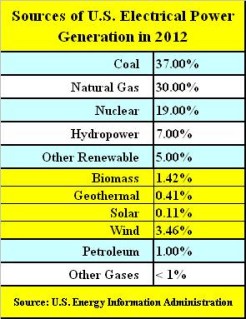
Nuclear power plants produce electricity 90.3% of the time, which trumps all other sources of electrical power. But sadly, per the table near the top, the U.S. only produces 19% of its electricity from nuclear, compared to 37% from coal, 30% from natural gas, 7% from hydro-power and just 0.11% from solar. What gives? Are we at war with efficiency too?

Considering capacity factors, since there are 24 hours in a day, solar farms in the U.S. can at best deliver power for 8 hours out of 24 (33% of the time), and at worst for just 3 hours per day (13%). On the other hand, coal delivers power 15 continuous hours per day (63.8%), natural gas 7 hours a day (30%), and nuclear energy for 22 out of every 24 hours (90.3%). I don’t know about you, but I’ve grown accustomed to the convenience of electricity 24/7 (twenty four hours a day, seven days a week). Sorry, but going backwards isn’t a viable option.

Summary

Today, 37% of our electricity comes from coal and just 0.11% from solar. Replacing 46% of coal fired power plants with solar, as Potus presupposes, would necessitate building approximately 7,529 Copper Mountain sized power plants at a cost of around $1.1 trillion, with potentially $316 billion subsidized by the federal government, and another $90 billion by the states. It would also require scraping and clearing 2,860,855 acres of land (4,470 square miles) for conversion to solar plants, and several thousand miles more for power transmission corridors to deliver the product to market, irreparably damaging to the planet.

As far as benefits, on the one hand, we’ll have electricity, something we already had, so nothing is gained. On the other hand, since solar electricity costs three times as much to implement and produce as coal, unlucky consumers living in solar districts can expected to see at least a 50% hike in energy costs, and that’s on top of the additional taxes and fees all of us (including unborn generations) will be forced to pay in order to subsidize the scheme.

And although as many as 119,780 temporary solar construction jobs will be created and lost over the 22 year cycle, when it’s all said and done, only 37,645 permanent jobs will remain, while some 349,600 good paying coal industry jobs are destroyed. Finally, we will have reduced by 46% our second most efficient source of electricity, coal, which has a capacity factor of 63.8%, shifting reliance towards solar, which is at best only reliable 13% to 33% of the time. So the net economic benefits of going solar are less than zero (zilch minus).

But at least the Earth’s temperature will theoretically drop by a fraction of a degree in a thousand years or so, unless it turns out that mankind really doesn’t control nature (i.e. solar activity). For all we know the Earth’s temperature could vary wildly, between several degrees warmer or cooler, depending on the effects of converting thousands of square miles of the planet into a gigantic silicon light reflector.

Conclusion

But then there’s this: If coal is so horrible, then why not just eliminate its use entirely? Well, one reason might be that we need a reliable source of electricity in order to make the more than 5.8 billion solar panels required to pull off Potus’ scheme (775,000 times 7,529). And if the goal really is the elimination of coal as a natural resource, then just take my figures above, multiply them by 2.18, and you’ll have a good approximation of the costs and benefits. What you will discover is that in order to eliminate coal entirely, we would need to build approximately 16,386 solar farms, covering an area of more than 9,729 square miles, at a cost of more than $2.3 trillion. Anyone have an extra $2.3 trillion lying around?

Just like all other brilliant recommendations emanating from the mouths of crony politicians, solar energy turns out to be the most expensive, the least economically beneficial and the least efficient means to an end. An end which in their minds is just another way to game the system and cash in on the ignorance of the masses. Fortunately, just as the corn ethanol boondoggle of the last decade has now faded, this solar power fad too shall pass. If our goal is a return to the inefficiencies of the 19th Century, then perhaps we should follow the dictates of Potus, but if we are really serious about cleaning up the environment and producing reliable, efficient and abundant electrical power, it seems to me we should be moving towards Thorium (nuclear energy without the waste).

Other References:

Helpful Energy Comparisons, Anyone? A Guide to Measuring Energy – Climate Central

Total Electric Power Industry Summary Statistics, 2013 and 2012 – U.S. Energy Information Administration

Sacrificing the desert to save the Earth – Los Angeles Times

Energy from Thorium – Nuclear Energy without the waste!

Photo Credit: Homeowner Robert Phipps Says Neighbor’s Solar Panels Are Blinding