Real Financial Reform, Part I: The Option ARM

click to enlarge

Compiled by: Larry Walker, Jr.

While Progressives, both left and right, feign anger arguing the merits of criminalizing Goldman Sachs, one of the most profitable companies remaining in the United States, folks on Main Street are contemplating the real cause of the economic crisis of 2007. At least, that’s what I’m pondering.

For example, in reviewing the Office of Inspector General’s report regarding the fall of Downey Savings and Loan Association (Downey) it is clear to me that firms like Goldman Sachs were not the source of the problem. Punishing Goldman Sachs for profiting from a ‘crummy deal’ does not get to the root of the problem, nor will it prevent the next crisis. Where Senator Carl Levin fell short was in that, he failed to investigate the origination of the ‘crummy deals’ which continue to run rampant from coast to coast. But that’s what happens when you let amateur government workers have too much power.

_________________________________

Downey was taken over on November 21, 2008 by the FDIC at a cost of $1.4 billion. This placed it into the top ten most expensive institutions taken over by the FDIC during this crisis. It is revealing to note that in the report, we are told that the primary cause of Downey’s collapse was its high concentration of option adjustable rate (ARM) loans and its lack of documentation in loans:

“The primary causes of Downey’s failure were the thrift’s high concentrations in single-family residential loans which included concentrations in option adjustable rate mortgage (ARM) loans, reduced documentation loans, subprime loans, and loans with layered risk; inadequate risk-monitoring systems; the thrift’s unresponsiveness to OTS recommendations; and high turnover in the thrift’s management. These conditions were exacerbated by the drop in real estate values in Downey’s markets.”

The OTS made constant recommendations to the bank but of course, the OTS was stripped to the very minimum because of bank lobbying over the past decade. The policy implication here becomes radically clear that if we are to have a legitimate oversight board, it must have the power to enact regulations on the books. That is probably one thing many people fail to understand right now. Many of the regulations necessary are already on the books. Yet the bodies governing these policies are so weak and pathetic, that banks were able to ramrod legislation that essentially made them shells with no ability to enforce the laws.’

Downey by the end of 2005 at the height of the bubble had 91 percent of its single family home loan portfolio in option ARMs. They basically went 100 percent with this toxic product. 73 percent of Downey’s option ARMs had negative amortization potential which of course did occur and imploded the bank. Just take a look at this stunning chart:
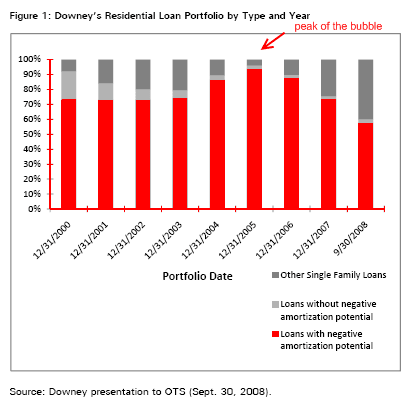
As the chart shows, Downey was in the game early on. Thus, their recast of 5 years on their typical option ARM started imploding much earlier and led to their demise in 2008 even before the major wave of option ARMs will swarm the market in 2010 through 2012. The disturbing facts also come out regarding teaser introductory rates which artificially allowed people to buy more home than they could afford. With the availability of “no-doc” loans anyone with a desire to get a loan got one. The fact that 91 percent of their SFR loan portfolio is option ARMs is appalling. Institutions in California basically created a casino with housing even though agencies knew of the longer term implications. In regards to policy, this gives us clear implications:

  1. Do not bailout any mortgage product that is an option ARM.
  2. Government agencies overseeing these institutions must have teeth to act and stop companies before things get out of hand. Imagine the police with no power to enforce the laws on the book.
  3. Clearly these products had no life outside of the bubble. They should be labeled as such and any institutions engaging in these products goes forward at their own risk. No bailouts ever.

_________________________________

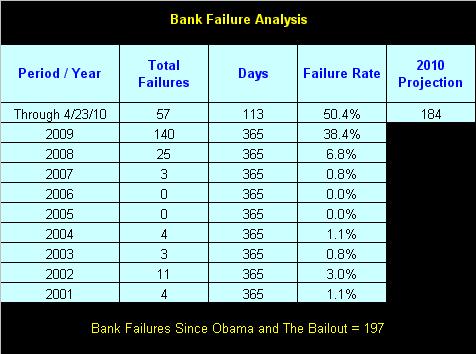
The bottom line, in Part I, is that Goldman Sachs was not in the loan origination business, and thus had nothing to do with the root cause of the financial crisis of 2007. Most of the culprits, banks who originated crummy deals, have already gone out of business. From January of 2009, through April 23rd of this year, there have been 197 bank failures. Of a certainty, there will be many more. The real questions should be (1) who legalized Option ARM’s?, and (2) who was responsible for regulating them? Try starting there and get back to me when you have a serious solution to a serious governmental failure.

Definitions:

Option ARMs
An “option ARM” is typically a 30-year ARM that initially offers the borrower four monthly payment options: a specified minimum payment, an interest-only payment, a 15-year fully amortizing payment, and a 30-year fully amortizing payment.

These types of loans are also called “pick-a-payment” or “pay-option” ARMs.

When a borrower makes a Pay-Option ARM payment that is less than the accruing interest, there is “negative amortization”, which means that the unpaid portion of the accruing interest is added to the outstanding principal balance. For example, if the borrower makes a minimum payment of $1,000 and the ARM has accrued monthly interest in arrears of $1,500, $500 will be added to the borrower’s loan balance. Moreover, the next month’s interest-only payment will be calculated using the new, higher principal balance.

Option ARMs are often offered with a very low teaser rate (often as low as 1%) which translates into very low minimum payments for the first year of the ARM. During boom times, lenders often underwrite borrowers based on mortgage payments that are below the fully amortizing payment level. This enables borrowers to qualify for a much larger loan (i.e., take on more debt) than would otherwise be possible. When evaluating an Option ARM, prudent borrowers will not focus on the teaser rate or initial payment level, but will consider the characteristics of the index, the size of the “mortgage margin” that is added to the index value, and the other terms of the ARM. Specifically, they need to consider the possibilities that (1) long-term interest rates go up; (2) their home may not appreciate or may even lose value or even (3) that both risks may materialize.

Option ARMs are best suited to sophisticated borrowers with growing incomes, particularly if their incomes fluctuate seasonally and they need the payment flexibility that such an ARM may provide. Sophisticated borrowers will carefully manage the level of negative amortization that they allow to accrue.

In this way, a borrower can control the main risk of an Option ARM, which is “payment shock”, when the negative amortization and other features of this product can trigger substantial payment increases in short periods of time.

The minimum payment on an Option ARM can jump dramatically if its unpaid principal balance hits the maximum limit on negative amortization (typically 110% to 125% of the original loan amount). If that happens, the next minimum monthly payment will be at a level that would fully amortize the ARM over its remaining term. In addition, Option ARMs typically have automatic “recast” dates (often every fifth year) when the payment is adjusted to get the ARM back on pace to amortize the ARM in full over its remaining term.

For example, a $200,000 ARM with a 110% “neg am” cap will typically adjust to a fully amortizing payment, based on the current fully-indexed interest rate and the remaining term of the loan, if negative amortization causes the loan balance to exceed $220,000. For a 125% recast, this will happen if the loan balance reaches $250,000.

Any loan that is allowed to generate negative amortization means that the borrower is reducing his equity in his home, which increases the chance that he won’t be able to sell it for enough to repay the loan. Declining property values would exacerbate this risk.

Option ARMs may also be available as “hybrids,” with longer fixed-rate periods. These products would not be likely to have low teaser rates. As a result, such ARMs mitigate the possibility of negative amortization, and would likely not appeal to borrowers seeking an “affordability” product.

References/Sources:
My Budget 360

Obama’s Scattershot: Works without Faith

By: Larry the Tishbite :

Definition: Scattershot – covering a wide range in a haphazard way (indiscriminating, undiscriminating – not discriminating)

Obama’s philosophy – Tell the people what they want to hear. Make it sound fabulous. Bend and stretch the truth when necessary. Convince the masses that everyone should agree with him. Demonize any opposing view points, because no one else could possibly have a solution. Make a broad range of neo-reforms and hope that something sticks. Because, after all, progress means getting stuff done, whether it’s the right stuff or not is irrelevant.

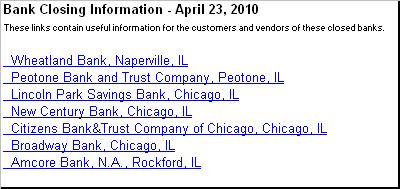
First, there was the financial bailout which was meant to save us from “the worst financial crisis since the seven year famine of Genesis 41:54“. [Boy am I tired of hearing that line.] The fact that, from the time Obama took over through April 23rd of this year, 197 banks have failed, including the 7 Illinois banks that failed on that day, is not even mentioned. Instead of admitting failure and going back to the drawing board, Obama, and his worshipers, continue to blame the ‘too big to fail’ entities for the crisis of 2008, and seek ways to prevent ‘that crisis’ from ever happening again. It seems like progress, but Obama is actually ignoring the fact that the original problem has yet to be resolved. When things seem to be improving, Obama will take credit, and when the situation worsens, Obama will blame the seers, bloggers, or anyone other than himself, or his policies.

Then there was the famous economic stimulus which was going to cap the unemployment rate at 8% and add 2 million and some-odd jobs in short order. Well, since that didn’t happen, Obama came up with a new measurement: ‘jobs created or saved’. Thus, if you saved one job you somehow could claim to have created six, or some nonsense. Once again, instead of admitting defeat and going back to square one, the obamanists, claimed victory and now say everything is fine. (That reminds me of the true definition of F.I.N.E.) Never mind the fact that the published unemployment rate was 10.2% at the end of March of 2010 and much higher if you count all of those who have permanently left the workforce. As is his custom, if the latest statistics seem favorable, Obama will take credit, and if things are not looking favorable, he will blame bloggers, Glenn Beck, Fox News or anyone other than himself or his socialist entourage.

And last but not least, there was Obamacare which was supposed to reduce deficit spending by $138 billion in the first decade, and then knock off another $1.2 trillion long after Obama could possibly be in office. Well for one thing, it looks like there may not be any savings in the first decade, and Obamacare may actually add to the deficit. But then there’s the real catch-22: How can one have the audacity to claim that Obamacare will reduce deficit spending by $138 billion during the same decade that deficit spending is actually being increased by more than $10 trillion? Maybe it’s just me, but that doesn’t equal any kind of savings whatsoever. If I put $1,000 in my savings account this year, but actually wind up adding $10,000 of credit card debt, am I not really worse off by $9,000? I think so.

I could name dozens of other Obama policies that follow the same pattern. Whether it’s nuclear defense, foreign policy, education, financial reform, climate change, energy, you name it, it’s just one big scattershot. The story is the same. Shoot a scattershot and hope that something sticks, take credit for any positive outcomes, pass blame for any negative results.

Oh, and then there’s that little quirk regarding the fact that the greatest benefits of any Obama policy don’t occur until long after he has been expelled from office. What’s up with that? That’s a neat way to CYA when none of your plans make any sense, and when everyone knows it. That way, Obama can blame the next administration for repealing his mistakes prematurely. In the end, this will only work to ensure that Obama goes down in history as the worst president since James Earl Carter.

I have made a few costly mistakes in my life, and I learned some valuable lessons. It never helped to sit around blaming everyone else for my mistakes, and I didn’t need some 3rd party changing the rules to prevent me from making the same mistake. I messed up, I paid the price, and I will never make those same mistakes again. I have also learned that the scattershot technique doesn’t work. I have learned to focus my energies on my personal areas of expertise, and to promptly concede what I don’t know.

In my world, we slay one dragon at a time. In Obama’s world, he seems to slay his own credibility one policy at a time.

The seven years of plenty ended in July of 2007.

29 There will be seven years of great plenty in all the land of Egypt. 30 After that, there will be seven years of famine, and all the good years will be forgotten, because the famine will ruin the country. 31 The time of plenty will be entirely forgotten, because the famine which follows will be so terrible. 32 The repetition of your dream means that the matter is fixed by God and that he will make it happen in the near future. 33 “Now you should choose some man with wisdom and insight and put him in charge of the country. 34 You must also appoint other officials and take a fifth of the crops during the seven years of plenty. 35 Order them to collect all the food during the good years that are coming, and give them authority to store up grain in the cities and guard it. 36 The food will be a reserve supply for the country during the seven years of famine which are going to come on Egypt. In this way the people will not starve.” 37 The king and his officials approved this plan,…

Obama’s Bank Failures | Too Busy To Care

Through April 23, 2010, there have been 57 bank failures. That’s 57 in 113 days, or a failure rate of 50.4%. In 2009 there were 140 bank failures at a failure rate of 38.4%. So it’s been more than a year since the problem was ‘solved’, and the rate of bank failures has actually increased. In contrast, there were only 25 bank failures in 2008, 3 in 2007, none in 2005 or 2006, and only 22 from 2001 through 2004.

Wow, seven banks in his own back yard. We’ll see if he cares now, or whether he maintains the ‘quo’. Perhaps another round of golf is the cure!

Obama says he wants “…to get a better idea of what our options are…”. Well, here you go: (1) Crash and Burn, (2) Drastically Cut Government Borrowing and Spending, or (3) Burn and Crash. It’s not rocket science. Make an executive decision.

Reference:

FDIC Failed Bank List

Obama’s Bank Failures | Too Little to Save

By: Larry Walker, Jr.

After decades of failed government policies, from James Earl Carter, Jr. (Jimmy), to Barack Hussein Obama, II (Barry), it appears that policy makers haven’t learned a thing. After pouring billions of taxpayer dollars down the drain to fix the credit crisis, over a year has passed, and the problem isn’t fixed. While Obama and his minions now focus on controlling the Big financial institutions, the little guys, like the ones in your community are failing at the rate of one every other day.

And what is Obama’s solution to the destruction of capital occurring in our communities?

  1. To Add more than $10 trillion to the National Debt over the next 10 years, thus hogging up capital badly needed by community banks, and leading to higher interest rates.

  2. To tell citizens that they should be grateful, to him, that they got a $400 annual tax credit, paid for by higher taxes, and to just be quiet. – ‘Don’t patronize me.’

  3. To dole out $8,000, and $6,500 refundable home buyer tax credits, not realizing that it’s actually very difficult to get a home loan from failing banks. Not to mention impossible for the 10-20% of the workforce who are unemployed.

  4. To extend unemployment benefits, which doesn’t lead to job creation.

  5. To sit back, give an occasional pep rally to his constituency, make deals with America’s enemies, and alienate fellow Americans who have the solution.

In other words, he doesn’t have a solution. The only solution that a problem can have is to eliminate itself. Obama and his big government, ‘welfare state’ philosophy is the current problem. The only solution is to eliminate the problem. Everyday that Obama borrows and spends, borrows and spends, borrows and spends, pushes us that much farther from a solution, and thrusts us deeper and deeper into the problem.

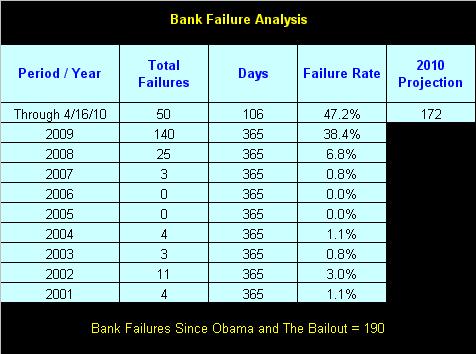
Through April 16, 2010, there have been 50 bank failures. That’s 50 in 106 days, or a failure rate of 47.2%. In 2009 there were 140 bank failures at a failure rate of 38.4%. So it’s been more than a year since the problem was ‘solved’, and the rate of bank failures has actually increased. In contrast, there were only 25 bank failures in 2008, 3 in 2007, none in 2005 or 2006, and only 22 from 2001 through 2004.

click to enlarge
Failed Bank List - Click to Enlarge

References: FDIC Failed Bank List

2009 GDP | The Bottom Line

Click to Enlarge

2009 GDP

Real GDP decreased 2.4 percent in 2009 (that is, from the 2008 annual level to the 2009 annual level), in contrast to an increase of 0.4 percent in 2008.

The decrease in real GDP in 2009 primarily reflected negative contributions from nonresidential fixed investment, exports, private inventory investment, residential fixed investment, and personal consumption expenditures (PCE) that were partly offset by a positive contribution from federal government spending.

So now it’s time for a huge tax increase, right?

Couple the worst GDP results in decades along with unemployment hovering around 10%, then add to that 4.5 million foreclosure filings expected in 2010, and mix in personal incomes falling by an average of 1.7% in 2009, and you will begin to understand Obamanomics.

Time to end this nightmare! Vote them out.

By: Larry Walker, Jr.

References:

http://www.bea.gov/newsreleases/national/gdp/gdpnewsrelease.htm

Obamacare: The 2nd Decade (Fiction)

A Fictional Account –

by: Larry Walker, Jr. –

We are now in the 2nd decade after the passage of what many Americans deemed to be comprehensive health care reform, Obamacare. The creator of Obamacare, Barack Hussein Obama, died shortly after it’s passage in the year 2010 of unknown causes. Nancy Pelosi and Harry Reid have long since passed. All of the Congressional leaders from the year 2010 are now deceased.

Obamacare did not work out as promised. From the moment it was signed into law it increased the U.S. budget deficits each and every month. Medicare and Social Security became insolvent in the year 2012. All of the surpluses in these programs were borrowed and spent on Obamacare. Millions of Americans lost their health insurance as soon as the bill was passed. Nearly 50% of private practitioners closed their practices almost immediately.

Through the law of supply and demand, with the increased demand for medical services and the lower supply of practitioners, health care costs skyrocketed. Health insurance premiums increased by 100% on average each year until no one in the country could afford it. Income and excise taxes, fines and fees were imposed, but people were unable to pay these levies and their living expenses. Unemployment continued to rise as employers, being overburdened with taxes and regulations began to fail.

The national debt had actually reached the point of no return just before the passage of Obamacare, but only a handful of people knew it at the time. The only way for the government to reverse the negative effects of this erroneous legislation was to print more money. As the Federal Reserve began to print money in 2011, the rate of inflation went off the charts. Inflation reached 17% by the year 2012. The cost of gasoline soared to $10 per gallon in 2012. States began to declare bankruptcy and the most fiscally sound States began to acquire the weaker ones.

The Republic of Texas now consists of the entire southern half of the old United States, stretching from Southern California to Virginia. The old United States now consists of only a few states in the Northeast. The others declared themselves to be sovereign republics in the year 2013. The Republic of Texas seceded from the Union in the year 2013. This time there was no civil war, and the issue was not slavery.

The city of Washington, DC was destroyed in the year 2013 by a nuclear missile attack launched by Iran. No one came to the rescue. No one cared. The blight had been removed. The culprits were dead. The problem had been solved.

Now I tell the story from the year 2030. I am one of the survivors. I saw it coming. I tried to warn others. Most wouldn’t listen. They believed that big government was the solution. They relied upon government entitlements for their health and well being. Now they are simply wards of the old country, for all practical purposes, slaves. The United States of America is no more. And it all came to a crashing halt, in the year 2010.

See the Factual Account at: Final: Obamacare | The Macro View

Did GDP Fall by 2.4% in 2009?

More B.S. from D.C.

By: Larry Walker, Jr.

According to the Bureau of Economic Analysis (BEA’s) second release regarding – the 4th quarter 2009 GDP, issued earlier today, GDP increased at an annual rate of 5.9% in the 4th quarter of 2009. That is the rate of increase from the 3rd to the 4th quarter, expressed as an annualized percentage rate. The BEA also stated that, in the 3rd quarter, real GDP increased 2.2%. Sounds good, right? Woo-hoo!

“Real gross domestic product — the output of goods and services produced by labor and property located in the United States — increased at an annual rate of 5.9 percent in the fourth quarter of 2009 (that is, from the third quarter to the fourth quarter) according to the “second” estimate released by the Bureau of Economic Analysis. In the third quarter, real GDP increased 2.2 percent.”

But if you read down a little further into the report, the part where the BEA re-enters the atmosphere, you will discover that real GDP fell by (2.4%) in 2009. That is the rate of decline from the 2008 level to the 2009 level. So, is this good, or bad?

[2009 GDP] “Real GDP decreased 2.4 percent in 2009 (that is, from the 2008 annual level to the 2009 annual level), in contrast to an increase of 0.4 percent in 2008.”

Like I said in a previous post, it’s like telling me that my IRA account grew at an annual rate of 5.9% in the 4th quarter, but when I look at my statement I find that my account balance has actually declined by (2.4%) from 2008. So am I better off? No. Are you?

The next time Obama & Company start boasting about 4th quarter 2009 GDP, I wish someone would stand up and say, “but, sir, GDP actually fell by 2.4% under your watch”. Put that in your tea and drink it!

Click to Enlarge

Reference:

http://www.bea.gov/newsreleases/national/gdp/gdpnewsrelease.htm

Debt & Taxes: Obama’s Rate of Change

Obama’s Rates of Change

By: Larry Walker, Jr. [Revised]

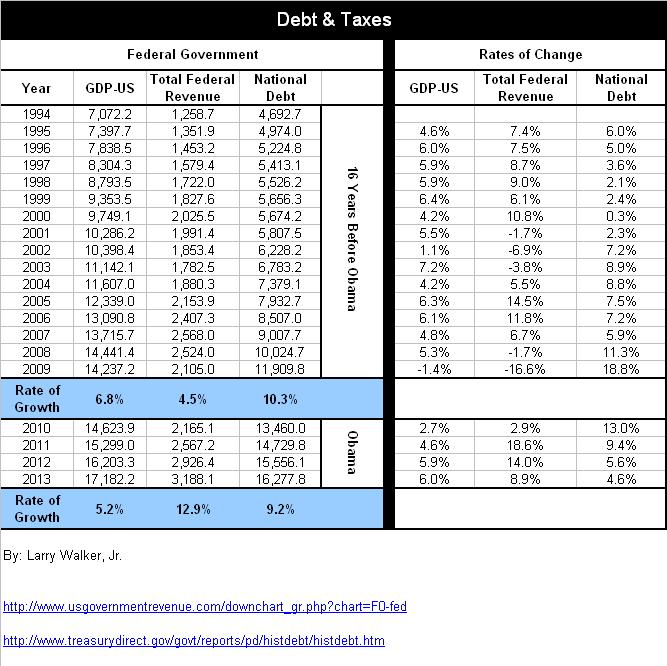
Today I am observing the rates of change embedded in Barack Obama’s budget projections. My objective is to determine whether Obama represents ‘change you can believe in’, and whether or not his policies are in line with his rhetoric. I will compare Obama’s 4 year budget projections during his first (and only) term, to the previous 16 year period. An observance of rates of change can provide assurance that the course charted is the one navigated. Here are a few observations.

  1. During the 16 year period ending with fiscal year 2009, GDP achieved an average annual growth rate of 6.8%, while government revenues (taxes) grew at 4.5%, and the national debt grew at 10.3%. Summary: The national debt outpaced economic growth, while tax revenues lagged the economy.

  2. In following Obama’s budget projections for the four year period ending in fiscal year 2013, GDP will grow at an average annual rate of 5.2%, while government revenues (taxes) will grow at 12.9%, and the national debt will grow at 9.2%. Summary: Tax revenues will more than double the pace of economic growth, while the national debt will continue to grow faster than the economy.

Click to Enlarge

“Tax revenues will more than double the pace of economic growth, while the national debt will continue to grow faster than the economy.”

After decades of reckless government spending, the change I would have expected, and could have believed in, would have led to an increase in GDP, a reduction in income taxes, and a dramatic reduction in government spending. Instead, it appears that the change I will get will be as follows:

  1. GDP will grow at an annual rate which is 23.5% slower than what we experienced over the last 16 years. This means that our wealth will be diminished.

  2. Income taxes will increase by 186% over the next 4 years. Taxes will consume more of a shrinking economy.

  3. Although the National Debt will grow at a slightly slower pace, it will: (a) grow 77% faster than GDP, and (b) continue to grow in spite of massive tax increases.

Conclusion: The course Obama has charted, is not the one being navigated. Obama talks about controlling the debt and deficits, cutting taxes for 90% of working families, and building a new foundation for economic growth. The only problem is that by following his budget, we will experience an increase in the national debt, higher income taxes, and lower economic growth. This is ‘change’, but it is the kind of change that I cannot, do not, and will never believe in.

Sources:

http://www.usgovernmentrevenue.com/downchart_gr.php?chart=F0-fed

http://www.treasurydirect.gov/govt/reports/pd/histdebt/histdebt.htm

Death Spiral: Obama’s Progressive Debt

By: Larry Walker, Jr.

Piercing Obama’s Echo Chamber

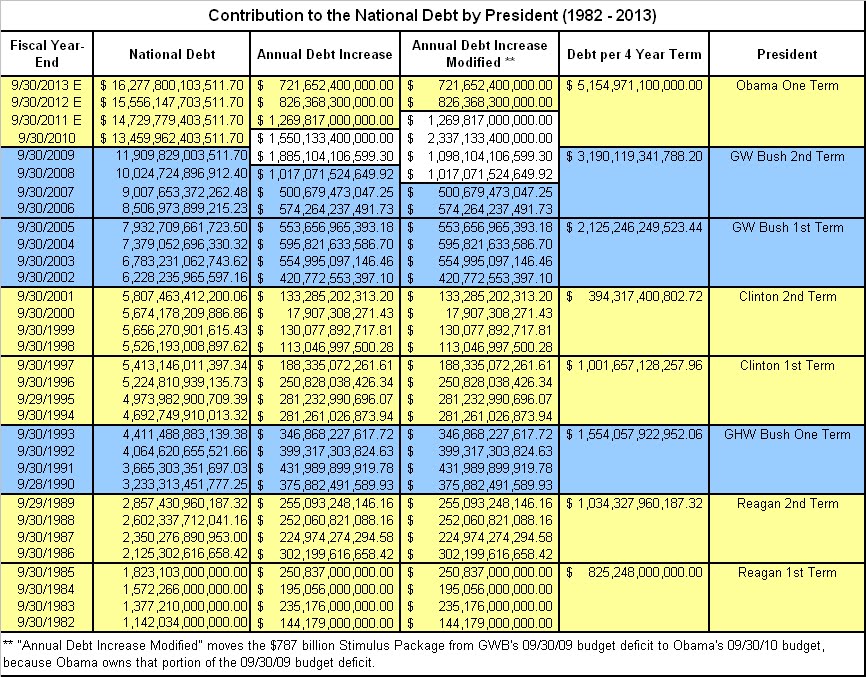
In analyzing the contribution to our National Debt by President (see table below), my initial idea was to determine the actual cost of each annual budget deficit, over time, by utilizing the Rule of 72, along with current and future interest rates. Since our debt has traditionally never been repaid, the future value of each deficit doubles roughly every 18 years, using an average interest rate of 4.0%. Although I found this to be sickening enough, what’s even more striking is the progressive pattern of reckless spending under the last five administrations.

Chart 1, Click to Enlarge

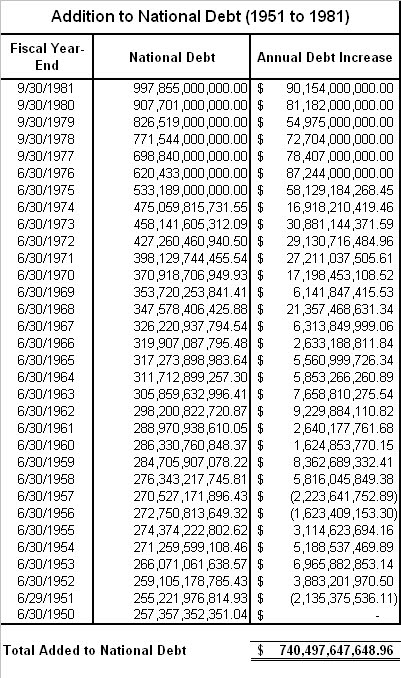
What’s striking is the fact that only a total of $740.5 billion was added to the Debt between fiscal years 1951 through 1981 (see table below).

Chart 2, Click to Enlarge

Contrast that with the following:

  1. Although I consider myself to be a Reagan conservative, his record on deficit spending was horrible. During his two terms in office, Ronald Reagan is partly responsible for adding $1.86 trillion to the Debt.

  2. George H. W. Bush, as a one-term president, was partially responsible for adding $1.55 trillion to our Debt. H.W. nearly surpassed Reagan in half the time.

  3. Bill Clinton is often touted as having run budget surpluses during his second term in office, however, this is mostly attributable to a Republican lead Congress. But even Bill Clinton overspent, and in the end would run up the Debt by $1.39 trillion during his eight year term.

  4. George W. Bush exploded the Debt by $5.31 trillion over 8 years. Although I would come to trust GWB with my life, I wouldn’t trust him with my wallet. To be fair, I have deducted Obama’s fiscal year 2009 addition of $787 billion for his failed Stimulus program, and I added it to Obama’s 2010 deficit. I would also attribute $2.1 trillion of Bush’s $5.31 trillion in red ink to Nancy Pelosi, and the majority Democrat Congress.

  5. Then we come to Barack Obama. Obama is projected to advance the National Debt by $5.15 trillion in his first (and last) term in office. Obama will go down in history as the most fiscally reckless president of all time, adding as much to the Debt in 4 years as Bush did in eight. Why would anyone even consider a 2nd term for Obama?

Barack Obama represents not only ‘more of the same’, but Obama has earned the nickname, ‘Double Bush’. That’s right, in fiscal matters Obama is twice as reckless as George W. Bush, not to mention twice as dangerous in terms of national security. The American people are too smart and too unforgiving to ever consider giving Obama a second chance. Sorry Barry, you blew it.

What really irks me about the first table is the addition of $5.72 trillion to the Debt between the fiscal period beginning October 1, 2007 and ending September 30, 2011 (highlighted in white). This can be mostly attributed to the current Democrat Congress led by Nancy Pelosi. Sorry Nancy but you’re gone. And sorry to most of you coming up for re-election in 2010, but you’re done too. Those who realized the error of their ways have wisely dropped out of the race. To those of you who are complicit, and still trying to hang around for another term, my only advice is to spare yourself the embarrassment.

Where was it that the buck stops again? So there you have it, I have pierced Obama’s ‘echo chamber’ once again, in hopes of exposing his insular ‘death spiral’. My goal is to inspire you to elect more responsible politicians in all of the upcoming races.

Sources:

http://www.treasurydirect.gov/govt/reports/pd/hist debt/histdebt.htm

www.whitehouse.gov/omb/budget/fy2011/assets/hist01z2.xls

More Government = Fewer Jobs

Obama’s Tax Fallacy

By: Larry Walker, Jr. [Updates in Red]

Barack Obama – “I gave 95% of all Working Families a tax cut…”

Really?

First of all 43.4% of Americans don’t pay any income taxes. That leaves the rest of us. So did 95% of the 56.6% who actually pay income taxes get a tax cut? I doubt it, but even if that were true, it’s not 95% of all Americans (or ‘working families’, whatever that means) [see Tax Fallacy II: 95% B.S. for more on this].

Is a refundable tax credit the same as a tax cut?

But the real fallacy lies in the fact that refundable tax credits are not tax cuts, but rather, they are subsidies. Subsidies are paid for by taking money from some Americans and giving it to others. This is also known as ‘spreading the wealth around’.

I’m not very cheery knowing that while I have been faithfully paying my mortgage, people are buying foreclosed houses down the street for $110K less than what I owe. And not only that, but the Government is giving them an $8,500 subsidy out of my tax dollars. It’s as if the $110K of potential equity wasn’t enough of a subsidy. Also, when the government refunds a person $8,500 to buy a house, it only applies to those who bought houses, not to 95% of all Americans.

The $400 ($800 for joint filers) Making Work Pay Credit is also a refundable tax subsidy. It is however only available in full to those (a) who made less than $75,000 ($150,000 for joint filers), (b) is reduced if income exceeds these amounts, (c) and it is not available at all for those making over $95,000 ($170,000 for joint filers) in 2009. Is it possible that 95% of Americans who actually pay income taxes made less than $95K ($170K for joint filers) and will get the full credit? Not when the top 50% of wage earners pay 96% of income taxes.

The earned income credit is a well known tax subsidy. If you made $10,000 and have a child, you will pay no taxes and will get back a $4,043 tax subsidy ($3,043 earned income credit, plus $1,000 child tax credit). This is not a tax cut, but rather a 40.43% bonus awarded for not trying very hard.

Non-refundable tax credits represent true tax cuts, as they can only be used to reduce the amount of tax actually owed, with the balance being lost. The child care credit is an example of a non-refundable tax credit, and has not changed in years. The retirement savings credit would be a good way to cut taxes, but unfortunately if you made over $27,750 ($55,500 for joint filers), you don’t qualify. The education credit used to be a way to cut taxes, yet it is already $2,500 per year, so nothing new was stated by Obama when he said he will give out a $10K credit over 4 years. Uh, we already have that, sir. [What is new, however, is that as of 2009, now 40% of the education credit has become a refundable tax subsidy.]

Another tidbit, right now, all three of my kids are in college. I’m divorced and they live with their mother out of state. I am paying part of the way for one while the other two have full scholarships. Because I don’t claim any of them as dependents, I am not allowed any credit for the tuition that I’m paying. I wonder how many others are in the same boat. It’s not that I want anything from the Government, but just want to let you know that there are cracks in the real world.

Capital Gains Tax Cut for Small Business?

Finally, Obama wants to give a Capital Gains Tax Cut for Small Business Investment. What does that mean? A capital gains tax cut only applies if someone has an appreciated asset to sell, which they have held for more than one year. So, first you have to have an appreciated asset. Then you have to either have a small business that buys and sells appreciated long-term assets, or would need to sell your business in order to benefit. The only problem with what Obama said is that the lower Capital Gains Tax rate that we already have, which is currently 0% for those in a 15% or lower tax bracket, already applies. Nothing new here.

As a small business owner I haven’t quite figured out how anyone can really use this one. And what kind of tax rate are we talking about anyway? He didn’t say anything specific. The only way I could use it is if I sold my business. But I don’t want to sell the business. And if I did sell my business I would already benefit from the Section 1244 exclusion or the low capital gains rate.

While you are applauding Obama’s words, you should stop and think about how a capital gains tax cut can benefit a small business. If anyone can explain it to me, I’ll be glad to listen, but to me, it’s just rhetoric.

In conclusion, all I heard from Obama tonight, regarding taxes, was the same class warfare, wealth redistribution rhetoric that I heard in 2008 when I cast my ballot for the other guy.

___________________________________________________

References:

http://www.taxpolicycenter.org/numbers/displayatab.cfm?Docid=2276&DocTypeID=7