Progressive Regression | Gulf Oil Disaster

Government Regulation vs. Self-Regulation

– By: Larry Walker, Jr. –

The Progressive Obama Administration’s magical solution for all problems American is more government regulation. But is government regulation really better than self-regulation?

Companies like BP have a direct interest in the safe, efficient drilling and harvesting of oil. Would it benefit a private oil company like BP to carelessly blow up its own oil well and lose millions of gallons of the precious black gold into the sea? No. Did it benefit Exxon to crash the Valdez and leak millions of gallons of oil off the coast of Alaska? No. So every company has a direct interest in self-regulation.

Sure, accidents will happen. And when accidents happen, private companies will pay the price under applicable Federal and State laws. Many private sector executives have even found themselves behind bars when laws were violated. But what happens when government regulators screw up?

On May 27, 2010, Elizabeth Birnbaum, the former head of the Minerals Management Service (MMS), which is charged with monitoring and regulating offshore drilling, simply resigned.

On May 17, 2010, Chris Oynes, the associate director of Offshore Energy and Minerals Management at the Minerals Management Service simply announced that he was moving up the date of his retirement to May 31, 2010.

On May 11, 2010, Frank Patton, an unlicensed Minerals Management Service (MMS) engineer, who approved the plans for the Deepwater Horizon’s blowout preventer just four days before the blowout, admitted that he did so without ever seeing the blowout preventer plans. He further admitted that he has never seen any such documents on the more than 100 approvals his office issues each year. MMS regulation 250.416(e) requires would-be drillers to submit proof that the blowout preventer they are using to shut off the well will have enough power to shear a drill pipe in case of an emergency, but Patton was apparently unaware of this particular regulation. As far as we know, Patton will keep his job, and will probably get a promotion.

In September of 2006, Interior Department Inspector General, Earl Devaney told a House panel that the Minerals Management Service failed to include price triggers in leases signed with oil companies in 1998 and 1999. The Government Accountability Office estimated that the total cost to taxpayers during the two year period was over $10 billion, yet government officials once again were able to pass the buck.

The point is that U.S. taxpayers have been paying billions of dollars (that we don’t have) annually, for more and more government regulation, yet when it comes time to hold the government accountable we find that they are not.

Barack Obama, and his Progressive minion’s solution to every problem American is more government regulation. I see this cowardly pat answer as just another way of passing the buck. Should we feel confident when Obama, who’s on his way to going down as the worst president in American history, boldly declares that ‘the buck stops with him’? Obama, like his predecessor’s, will be long gone when it is discovered just how badly he screwed up.

In reality, and in general, all that government regulation does is to increase taxes in many forms (income, excise, fees, fines), which in turn makes products and services more expensive for all American consumers; and it creates a layer of unaccountable bureaucrats, who ultimately make us all less safe, secure and prosperous.

Progressive Obama worshippers say that we need more government regulation. I say we need less. It would benefit all Americans to begin dismantling our huge governmental bureaucracy. Increasing the size and scope of government regulation has not historically benefited a single soul, and it never will.

Less Government regulation leads to lower taxes, lower consumer prices, greater accountability, more freedom, and more wealth creation opportunities. What exactly did we get for all the money spent on regulating oil drilling in the Gulf of Mexico?

An Unlicensed MMS Engineer and The Gulf Disaster

We Don't Need No Stinking License

By: Larry Walker, Jr.

Frank Patton is the name of the unlicensed Minerals Management Service (MMS) Engineer who approved the Deepwater Horizon Disaster. No, that’s not his picture to the left. That’s another matter for another day.

Funny, but I can’t find Tony Hayward’s name on any of those, smoking gun, internal emails being touted around by the House Oversight and Investigations Subcommittee, but I do see Frank Patton’s name. Yep, on April 16, 2010 – ‘Approved By’ – Frank Patton.

From the trial (or hearing) the other day, you would think it was Congress’ job to oversee and investigate private businesses. I somehow don’t think that was part of the original plan. What I would like to see is a subcommittee investigating why federal workers are not required to maintain credentials equal to, or greater than, those whom they regulate.

Who’s regulating the regulators? Unlicensed engineers are approving plans submitted by licensed engineers. When are we going to have a trial about stuff that really matters?

According to licensed Professional Engineer (PE), and whistleblower, Joe Carlson, the Minerals Management Service (MMS), just as other federal agencies, does not require their Engineers to be professionally licensed. Instead, federal agencies have invoked a special ‘exemption’ whereby unlicensed federal workers are above reproach. In other words, “We don’t need no stinking license.” You’ve got to be kidding me!

As one who holds two professional licenses (not in engineering), each with its own rigorous set of ongoing requirements, I have nothing but contempt for the federal government, the Congress, and our feckless POTUS, in this matter. There are no excuses. How is an unlicensed ‘engineer’ supposed to have the ability, training, and the professional integrity to review and approve plans designed by professionally licensed engineers?

What’s worse is the fact that Frank Patton can’t be blamed, fired, reprimanded or fined. Why not, you say? Because, remember, Frank Patton is not even licensed. But Congress can go around blaming Tony Hayward, who is also not licensed, and whose name is curiously not found on any of those damning internal emails. I do however see the names: Brian Morel, Mark Hafle, and Richard Miller. Perhaps they are licensed and should be brought up on charges by the appropriate engineering licensing board. And as for Frank Patton, I just wonder how many safety awards are hanging in his office?

Following are a few excerpts from Joe Carlson:

Frank Patton is the unlicensed MMS engineer who approved the BP drilling plan. During his May 11, 2010 testimony (see pages 252-314) to the Deepwater Horizon Joint Investigation, he admitted, (see pages 274-76), that he failed to ensure the BP Drilling Plan complied with federal regulation at 30 C.F.R. §250.416(e), because it did not contain the required information about the design and performance adequacy of the blow-out preventer. The New Orleans Times-Picayune, which live-blogged the hearing, described his testimony here.

If MMS required its engineers to be PE’s, then Mr. Patton would have been required to “blow whistles,” publicly if necessary, to prevent BP’s inadequate drilling plan from being approved. This could well have resulted in his being fired or otherwise discriminated against at MMS, given widespread, longstanding, MMS corruption. However, had MMS required Mr. Patton to be a PE, then anyone could now file a professional misconduct complaint against him with the Louisiana Professional Engineering Licensing Board, for his professional negligence/incompetence in approving a plan that failed to comply with federal regulation. If he lost his PE license as a result, then MMS could fire him. If he had been a PE, Frank Patton would have made sure the BP drilling plan contained the required information about its blowout preventer and perhaps this unprecedented disaster is averted….

The federal government has a duty to protect American health and safety, at work and elsewhere, including our environment. PE’s, by law, must “hold paramount the health, safety and welfare of the public in the performance of professional duty.” That federal agencies exempt their engineers from having the legal obligations of PE’s is nonsensical and a contributing cause to the Gulf disaster and many other accidents and disasters, such as the recent Upper Big Branch mine disaster which killed 29 in West Virginia.

Here is a formula we can all live with:

Federal PE licensure + reformed federal whistleblower protection = much improved workplace and public health and safety in America.

Read More at the Source: Whistleblowers Protection Blog

Health Care Expenditures vs Income

Click to Enlarge

A Fiscal Conservative Opines: Where is all the excess?

By: Larry Walker, Jr.

I am once again attempting to overlay data upon data from different sources, not being certain whether any of them are accurate, yet they are all so called ‘reputable’. There are some who will look at the table, above, and think that health care expenditures are out of control. I look at it and my take is that the lack of growth in real incomes is the problem.

In fact, health care expenditures have been on the decline since 2003. Granted I was not able to find the rate of change for 2009, even if there was no increase, health care expenditures have grown faster than incomes, the consumer price index, and GDP. This doesn’t tell me that there is necessarily a problem with health care expenditures. What it tells me … is that there is a problem with the economy.

Over the past ten years, consumer prices have risen by 25% while incomes have only risen by 9%. Does this mean that prices are out of control? Not to me. To me it means that our incomes are not keeping pace with inflation.

GDP is growing slower than prices. GDP is only growing at an average of 1.9% per year. For the past decade, GDP grew by 19% while prices grew by 25%. So again, is the problem with prices, or with GDP?

Let’s be real. Unless prices rise, incomes will not. How can a business provide raises for employees every year unless the business is also raising its prices? One way would be to keep prices static and to increase productivity, which generally means doing more with less employees. Everyone expects to get a cost of living increase each year, however, in order to receive one, your employer must generally raise its prices in line with the consumer price index. Yet, if that was reality, then incomes would be rising as fast as inflation. Yet, prices have risen nearly three times as fast as incomes. So where is all the excess?

My suspicion is that the problem lies more in the area of manufacturing, international trade, unionization, and the growth of government. We don’t make things anymore in America, we have become a service economy. Most of the products that we buy are imported from other countries. Unions are constantly demanding higher wages and better benefits. The number of government employees is growing as is their pay and benefits. The end result is that our Federal and State governments are going broke, jobs are being lost to emerging market economies, and the incomes of non-governmental and non-union employees are going down.

So the question is how do we improve the growth prospects for our economy? The answer lies in finding ways to increase exports and decrease imports, to lower income taxes and reduce the size of government, and to remove the restraints currently being imposed upon the free market. Our economy doesn’t need more controls, but rather less.

You say rising health care costs are at the center of all of our problems. I say, you’re focusing on the wrong statistic. If a man or woman has no way to earn their livelihood, then what good is a government run health care program. You will have your health care, but you will live in poverty. You will be taxed, but you will lack the wherewithal to pay your taxes. The poor will remain poor. The middle class will cease to exist. The government will continue to spend more than it can tax until even it falls by the wayside.

You cannot fix a problem, until you have identified one. So where is all the excess?

If the price of say automobiles rises, yet most of the autos are purchased from Japan, then there’s your answer. Sure, some jobs were provided in America, but the excess (also known as profit) has left the country.

If the price of health insurance has risen, yet most of the insurance is purchased from domestic providers, then where is all the excess? The answer is in a broken governmental system. The government (federal and state) spends nearly twice as much on health care as does the private sector. The government gets its revenue by taxing those who are viable and paying for the health services of those who are not. The government pays less for services than does the private sector which in turn, means prices will rise for everyone to compensate for the shortfall created by government providers. Thus, prices rise, but incomes do not.

A major reason why incomes are not rising is because the cost of income taxes, social security taxes, and medicare taxes are set to rise every year. It’s not that the rates have necessarily changed, but that the income ceilings have. So you work hard to make more than the social security cap, but by the time you reach that goal, the government has raised the bar (or removed it completely). This is not a progressive tax system, it’s a progressive annual tax increase. It’s a system designed to keep our economy in chains.

So where is all the excess? One need only look at our national debt. If there were excess, the United States Federal government would not be $13 trillion in debt. So there is no excess.

The problem lies not in price controls but rather in wealth creation. Wealth is not created through price controls. In fact, wealth is restrained by controlling prices. If prices did not rise, then neither would wealth. Yet, when wealth is not rising along with prices there is a breach.

If every American either worked for the government, or received government services, how would the government be able to continue as a going concern? The answer is that it would not. So then part of the solution, which is ingrained in your soul, is that bigger government is not the answer. On the other hand, if everyone worked in the private sector, and if everyone were able to sustain themselves, what would be the role of government? Most likely the role that was intended by our founders. So once again we can conclude that government is not the solution to our problems, government is the problem.

Message to uncle Sam, “get out of my way, and get off my back.”

End of rant….

References:

http://www.ers.usda.gov/Data/macroeconomics/Data/HistoricalRealPerCapitaIncomeValues.xls

http://stats.bls.gov/cpi/

http://www.cms.hhs.gov/NationalHealthExpendData/downloads/tables.pdf

http://www.bea.gov/national/txt/dpga.txt

Other Links and Solutions:

http://citizenownership.blogspot.com/2010/02/every-citizen-owner.html

http://citizenownership.blogspot.com/2010/02/expanded-capital-ownership-now.html

http://www.aipnews.com/talk/forums/thread-view.asp?tid=12453&posts=3#M33855

http://www.freerepublic.com/focus/f-bloggers/2460284/posts

Not Accountable – It’s Your Government

By: Larry Walker Jr

The United States Government Accountability Office says major impediments are preventing GAO from rendering an opinion on the federal government’s financial statements, the federal government did not maintain effective internal controls over financial reporting and compliance with significant laws and regulations due to numerous material weaknesses, and financial management system problems continue to hinder federal agency accountability. I’m just wondering whether the situation is improving as we trudge down Obama’s disastrous path.

My view is that it’s unwise to radically increase the size of any enterprise, which has an unsound and unreliable financial infrastructure. In my opinion the federal government is on an unsustainable path. I strongly question the federal governments ability to continue as a going concern. If the federal government were a publicly traded corporation, its CEO would be in prison. Just imagine the auditors of Bank of America, or AIG stating that they are unable to render an opinion because the entire financial structure is not accountable.

Here is what the GAO found in its latest July 8, 2009 report, followed by a link to the full report:

FISCAL YEAR 2008 U.S. GOVERNMENT FINANCIAL STATEMENTS

What GAO Found

For the second consecutive year, GAO rendered an unqualified opinion on the Statement of Social Insurance; however, three major impediments continued to prevent GAO from rendering an opinion on the federal government’s accrual basis consolidated financial statements: (1) serious financial management problems at the Department of Defense, (2) the federal government’s inability to adequately account for and reconcile intragovernmental activity and balances between federal agencies, and (3) the federal government’s ineffective process for preparing the consolidated financial statements. In addition, as of September 30, 2008, the federal government did not maintain effective internal controls over financial reporting and compliance with significant laws and regulations due to numerous material weaknesses. Moreover, financial management system problems continue to hinder federal agency accountability.

The federal government still has a long way to go, but over the years, progress has been made in improving federal financial management. For example, audit results for many federal agencies have improved; federal financial system requirements have been developed; and accounting and reporting standards have continued to evolve to provide greater transparency and accountability over the federal government’s operations, financial condition, and fiscal outlook. In addition, the federal government issued a summary financial report which is intended to make the information in the Financial Report of the U.S. Government more understandable and accessible to a broader audience.

The federal government’s response to the financial markets crisis and economic downturn has created new federal accountability, financial reporting, and debt management challenges. Such challenges will require utmost attention to ensure (1) that sufficient internal controls and transparency are established and maintained for all market stabilization and economic recovery initiatives; (2) that all related financial transactions are reported on time, accurately, and completely; and (3) these initiatives are effectively and efficiently financed. moreover, while policymakers are currently understandably focused on efforts directed toward market stabilization and economic growth, once stability in financial markets and the economic downturn are addressed, attention will have to be turned with the same level of intensity to the serious longer-term challenges of addressing the federal government’s large and growing structural deficits and debt.

Finally, the federal government should consider the need for further revisions to the current federal financial reporting model to recognize its unique needs. A broad reconsideration of issues, such as the kind of information that may be relevant and useful for a sovereign nation, could lead to reporting enhancements that might help provide the Congress and the President with more useful financial information to deliberate and monitor strategies to address the nation’s long-term fiscal challenges.

http://www.gao.gov/new.items/d09805t.pdf

Gross Domestic Product (GDP) Mumbo Jumbo

Give me a break!

by: Larry Walker, Jr.

Worthless Government Statistics

It was just back on November 3rd when the Bureau of Economic Analysis (BEA), a division of the U.S. Commerce Department, declared that Gross Domestic Product grew at an annual rate of 3.5% during the 3rd quarter of 2009. Then on November 23rd, the Bureau declared that the revised rate of growth for the 3rd quarter was only 2.8%. The question that came to mind, right away, was: What exactly does this mean?

Click to Enlarge

First of all what it does NOT mean is that the economy grew at the rate of 2.8% during the 3rd quarter of 2009. The rate of 2.8% is derived by taking the rate of increase from the 2nd quarter to the 3rd quarter of 0.70% and assuming that this will stay constant for the next 3 quarters (0.70% times 4). Why is this a bogus way of measuring the economy?

When I open my quarterly 401K statement and it reads that my portfolio has increased by 8.0% during the recent period, I don’t automatically assume that my annual rate of return is 32.0% (8.0% times 4). No, on the contrary, I look at the past four quarters to determine my annual return. If I lost 8.0% in the previous three quarters combined, and then gained 8.0% in the most recent quarter, then I am close to breaking even. But have I broken even? No.

To demonstrate, let’s assume my portfolio was valued at $100,000 at the end of the previous fiscal year. After declining by 8.0% in the succeeding three quarters, the value had dropped to $92,000 ($100,000 times 0.92). Now, after gaining 8.0% in the most recent quarter, the value of my portfolio has increased to $99,360 ($92,000 times 1.08). You will note that I have yet to break even. I am in fact still down by 0.64% ($640 divided by $100,000) having started with $100,000 and declined to $99,360 over the past four quarters. So much for growth. Now back to GDP.

GDP has declined by 1.42% over the past four quarters

Now when it comes to GDP, a more reasonable way to look at our present rate of growth, similar to measuring an investment portfolio, is to look at the past 4 quarters. Since the BEA only publishes figures in annual terms, I will approach this by using their figures, but keep in mind that the quarterly GDP figures are shown as annual amounts (in billions).

  • 4th Quarter 2008 – $14,347.3

  • 1st Quarter 2009 – $14,178.0

  • 2nd Quarter 2009 – $14,151.2

  • 3rd Quarter 2009 – $14,266.3

Dividing the above by four, the average GDP over the past four quarters is $14,235.7 billion. The final GDP figure for all of 2008 was $14,441.4. So GDP has dropped by $205.7 billion ($14,441.4 minus $14,235.7) over the past four quarters. That equals a percentage drop of 1.42% ($205.7 divided by $14,441.4) since 2008.

GDP has declined at the rate of 1.21% since 2008

An even more accurate way to look at this is to start with the 2008 total GDP of $14,441.4 billion and to measure the decline over the next three quarters. In this respect GDP declined by 1.82% in the 1st quarter of 2009, by another 0.19% in the 2nd quarter of 2009, and then improved by 0.80% in the 3rd quarter of 2009. Overall GDP has declined by 1.21% since 2008. This is the statistic that’s most meaningful to me.

GDP has declined at the rate of 1.21% since 2008. In dollar terms that’s $175.1 billion per year in lost production in our economy. That’s the equivalent of losing 3.5 million jobs paying $50,000 per year. That’s more meaningful to me than the BEA’s mumbo jumbo.

GDP growth averaged 4.93% per year from 2003 to 2008

While we are at it, you will note on the chart above that GDP was $11,142.1 billion in 2003 and grew to $14,441.4 billion in 2008. That’s an increase of 29.6% over the six-year period, or an average of 4.93% per year. It also represents an increase of $3,299 billion in U.S. production over the period. That’s the equivalent of an increase of around 65.9 million jobs paying $50,000 per year.

So wake me up when Obama’s economy killing policies have created 65.9 million jobs, or when GDP reaches $18,490.7 billion (an increase of 29.6% from today’s level), whichever comes first, but don’t bother me with meaningless government statistics.

Sources:

http://www.bea.gov/newsreleases/national/gdp/gdpnewsrelease.htm

http://www.bea.gov/newsreleases/national/gdp/2009/xls/gdp3q09_2nd.xls

Health Insurance Co-Ops vs. Government-Run Health Insurance

* More Honest Debate *

By: Larry Walker, Jr. –

What is a Cooperative (Co-Op)? *

A Cooperative is a business organization owned and operated by a group of individuals for their mutual benefit. A cooperative may also be defined as a business owned and controlled equally by the people who use its services or who work at it.

There are many types of Co-Ops in the United States. I will attempt to address some of the most common cooperatives. If you belong to a credit union, you are already a member of a Co-Op. My electric and natural gas utility company is an EMC, another word for Co-Op. In the insurance industry, Co-Ops are called Mutual Companies, or Mutual Legal Reserves.

Credit Unions are owned by their members. When you join, you must establish a share account and maintain a minimum balance. Your share account is your capital investment in the company. You are paid ‘dividends’ on your savings and checking accounts. Dividends are your share of the Credit Union’s profits. A Credit Union offers benefits for its members such as preference on home and automobile loans.

An Electric Membership Corporation (EMC) is a service cooperative owned by those who receive its services. There are nearly 1,000 electric cooperatives in the United States. When the EMC makes a profit, those profits are shared with customers through credits to their electric bills, or lower rates.

Health Insurance Co-Ops

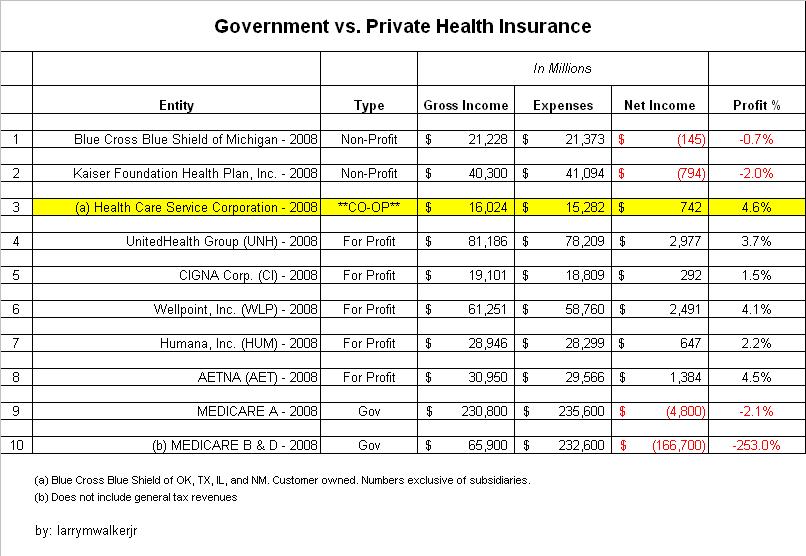
Health Care Services Corporation (HCSC) is the largest customer owned health insurer in the United States.

  • HCSC operates the Blue Cross and Blue Shield plans in Illinois, New Mexico, Oklahoma and Texas, employing 17,000 people and serving more than 12.4 million members – 38% in national employer plans, 32% in large local employer plans, 10% in small employer plans, 10% in individual plans and 10% in government plans.

  • HCSC is the fourth largest health insurance company in the United States and the largest customer-owned health insurer. In 2008, the company’s gross revenue totaled $39.9 billion (considering all subsidiaries which are not included in the chart below in accordance with GAAP).

  • HCSC is the most financially secure health insurer in the United States, with a rating of AA- (Very Strong) from Standard and Poor’s, Aa3 (Excellent) from Moody’s and A+ (Superior) from A.M. Best Co.

  • HCSC retains full or joint ownership of a number of subsidiary companies, including Fort Dearborn Life Insurance Co., Dental Network of America, MEDecision, Availity, Prime Therapeutics and RealMed.

If the HCSC model is the type of Health Insurance Co-Op being discussed in Congress, then I am a fan. Yes. Here is an idea that would have strong bi-partisan support. We can agree on Health Insurance Co-Ops. In my opinion Co-Ops are in line with the purest sense of Capitalism. On the other hand, if Congress is talking about some kind of partially Government owned, or Government controlled entity, then I am not in favor.

In fact, I would like to join HCSC, or a similar Co-Op, but unfortunately it only operates in 4 states, and none of the health insurers in my state are co-ops. Fostering increased competition by allowing insurers to operate in all states would be an improvement.

The Plan

So if America wants to convert its health insurance industry to Co-Ops, the question is how? Obviously, it would be unfair, and foolish, to force the existing insurers out of business, so how do you get them to convert?

I am a proponent of Binary Economics. Under Binary Economics, the only role of Government in private enterprise is to offer interest-free loans through its central bank. Existing publicly traded insurers will need to buy back all of their stock in order to make the conversion to mutual companies. Interest free loans from the Government will facilitate this conversion. The loans will be paid back over the long-term out of the profits of the insurers. Once the loans have been paid, the insured will be able to participate in a larger share of company profits. Profits will be shared with policy holders either in the form of dividends, or lower insurance rates.

Interest free loans are not hand-outs, or bailouts. The money gets paid back. Granting interest free loans would be a much better use of taxpayers money than the current foolishness being promoted by certain ‘linear’ thinkers (right and left). The World is not flat. In fact, most good ideas come from outside of the box.

Reforms I can believe in:

  1. Conversion of the Health Insurance Industry to Co-Ops

  2. Tort Reform

  3. Fostering Interstate Commerce for increased competition

  4. No denial for preexisting conditions

  5. Tax Incentives for those paying higher premiums due to preexisting conditions

  6. Tax incentives for purchasing health insurance

  7. Portability of policies

Reforms I don’t believe in:

  1. Making health insurance mandatory

  2. Taxing employers who don’t offer insurance

  3. Expanding Government-Run health care

  4. Excessive Government Regulation

  5. Triggers

click images to enlarge

Sources:

http://www.hcsc.com/about-hcsc/overview.html

http://www.investopedia.com/terms/m/mutualcompany.asp

http://en.wikipedia.org/wiki/Co-op

http://www.waltonemc.com/mycoop/

https://blackandcenter.blog/2009/09/02/government-run-vs-private-health-insurance/

Government-Run vs. Private Health Insurance

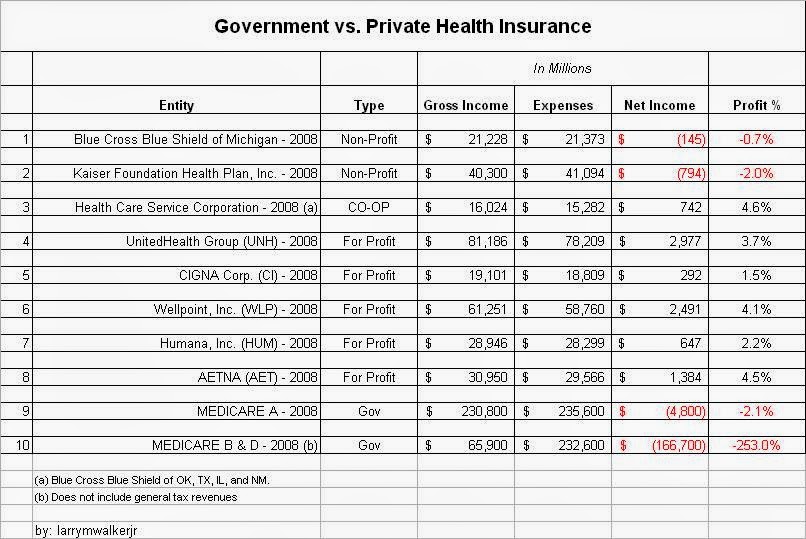
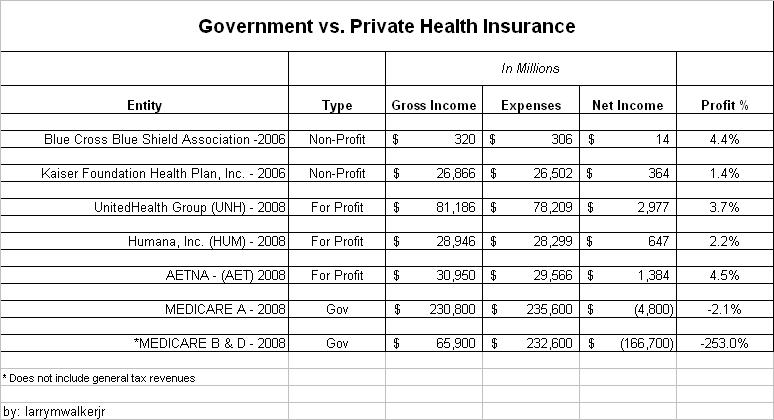
The table above was revised on 08/30/09.

click image to enlarge

Government-Run vs. Private Health Insurance

More Honest Debate

First of all, 60% of private sector health insurance providers are non-profits who must by law disclose their records to the public. You can find their tax returns online including information about programs, and compensation.

Most of the remaining companies are publicly traded and by law must file 10K and 10Q reports with the SEC. Their financial information and compensation information is also available online on various websites.

Information on government-run health insurance programs (i.e. The Public Option) may also be found online. The Social Security Administration issues an annual Trust Fund report. (Note: Both public trustee positions are still vacant.)

In comparing the three types, it is clear that something is wrong with the federal government. I have to disclose that I did not include the funds that Medicare obtains from general government revenues, above, because this money comes directly from income taxes.

Medicare Part A is funded primarily by payroll taxes assessed on an individual’s total wages. Medicare B and D is funded primarily by premiums charged to Social Security recipients (which I might add is kind of redundant).

To be brief: For-profits are by necessity in the black. On the other hand, government-run insurance is in the tank. In fact, Medicare is projected to exhaust it’s assets by 2017 according to the 2009 Annual Trustees Report.

So I ask this question. Who is better qualified to manage health insurance: ‘government workers’ in Washington, DC or the Private Sector? I think you know the answer.

Solution: With proper regulation and oversight, turn over Medicare, and Social Security to the Private Sector. Bigger government is not the solution, it’s the problem.

[Update: Expanded table and updated sources on 08/30/09]

Sources:

  1. http://www.bcbsm.com/home/bcbsm/annual_report.shtml

  2. http://www.redorbit.com/news/health/1639322/kaiser_foundation_health_plan_inc_and_kaiser_foundation_hospitals_report/

  3. http://www.hcsc.com/about-hcsc/finance.htm

  4. http://www.marketwatch.com/investing/stock/unh/financials

  5. http://www.marketwatch.com/investing/stock/ci/financials

  6. http://www.marketwatch.com/investing/stock/wlp/financials

  7. http://www.marketwatch.com/investing/stock/hum/financials

  8. http://www.marketwatch.com/investing/stock/aet/financials

  9. http://www.ssa.gov/OACT/TRSUM/index.html

  10. http://www.ssa.gov/OACT/TRSUM/index.html