2009 GDP | The Bottom Line

Click to Enlarge

2009 GDP

Real GDP decreased 2.4 percent in 2009 (that is, from the 2008 annual level to the 2009 annual level), in contrast to an increase of 0.4 percent in 2008.

The decrease in real GDP in 2009 primarily reflected negative contributions from nonresidential fixed investment, exports, private inventory investment, residential fixed investment, and personal consumption expenditures (PCE) that were partly offset by a positive contribution from federal government spending.

So now it’s time for a huge tax increase, right?

Couple the worst GDP results in decades along with unemployment hovering around 10%, then add to that 4.5 million foreclosure filings expected in 2010, and mix in personal incomes falling by an average of 1.7% in 2009, and you will begin to understand Obamanomics.

Time to end this nightmare! Vote them out.

By: Larry Walker, Jr.

References:

http://www.bea.gov/newsreleases/national/gdp/gdpnewsrelease.htm

Revised: Obamacare | The Macro View

Catch 22 –

By: Larry Walker, Jr. –

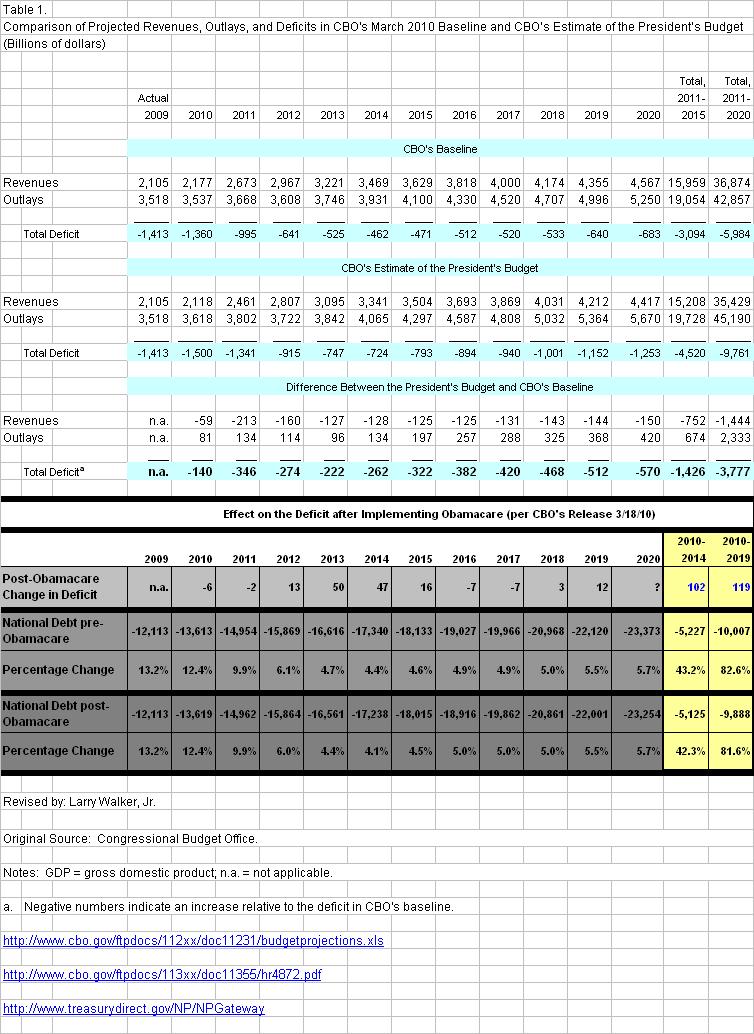
Point #1 – As I pointed out previously here, and as you can see in the top portion of the table below, Mr. Obama has outlined a budget which contains deficit spending of $-3.7 trillion more than the CBO’s Baseline Budget, between the years 2011 and 2020. The CBO’s Baseline Budget was already $-5.9 trillion in the red for the budget years 2011 through 2020. If you start with fiscal year 2010, the CBO’s Baseline Budget deficit was already $-7.3 trillion. The CBO’s estimate of the President’s budget calls for total deficit spending of $-11.2 trillion beginning with fiscal year 2010 and ending in fiscal year 2020. (Note: The baseline budget total is for 2011-2020, so you have to add 2010 to get this figure.) Now if you add the President’s budget deficit of $-11.2 trillion to our National Debt which was $-12.1 trillion at the end of 2009, then the national debt will reach $-23.3 trillion by the year 2020.

Table 1 - Click to Enlarge

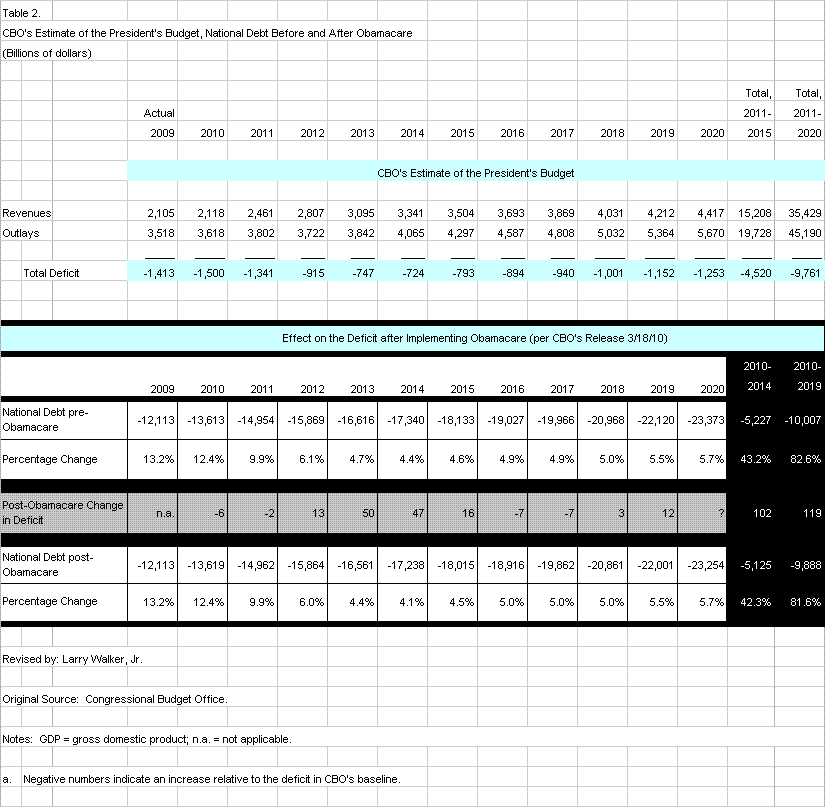
Point #2 – You will note in the bottom half of the table above (re-posted below), that the National Debt, which was $-12.11 trillion at the end of 2009, is projected to grow to $-22.12 trillion by the year 2019. (Note: The totals on this table end with fiscal year 2019 to correspond with the scoring of Obamacare.) This represents a percentage increase of 82.6% over the 10 year period. So before Obamacare, the President was already on target to increase our National Debt by 82.6% over the present decade.

Point #3 – Also in the table below, you will note that after implementing Obamacare, if one adds in the savings projected by the CBO of $119 billion over the first decade, then the National Debt is projected to grow to just $-22.00 trillion, or a percentage increase of 81.6% over the decade. This means that Obamacare will decrease the rate of growth of the national debt by just 1.0% in the first decade (82.6% vs 81.6%). In other words, by the year 2019, the National Debt will either be $-22.00 trillion with Obamacare, or $-22.12 trillion without it. (Note: I omitted the other $19 billion of savings which the CBO projected because I do not believe it to be attributable to Obamacare, however this is diminimus.)

Table 2 - Click to Enlarge

Point #4 – You will note that the CBO projects the savings from Obamacare to be $102 billion over the first five years, and only $17 billion over the second five, for a total of $119 billion in the first decade. The greatest savings appear in the years 2013 and 2014, $50 billion and $47 billion respectively. Why would anyone believe that there would suddenly be savings of over $1 trillion in the second decade, when the rate of savings decreases so dramatically in just the second five year period? If you study the numbers closely, the rate of savings from Obamacare declines by 83% from the first five years to the second. Yet, we are expected to believe that the rate of savings will suddenly jump by 740% (to over $1 trillion) during the second decade. This is simply unrealistic. Not to mention, unreliable, because the CBO calculated the savings rate in the second decade as a percentage of GDP. What we don’t have from the CBO is a projection of the Federal Budget that far out. If budget deficits continue to soar during the second decade after Obamacare, then any savings projected will be nullified.

Point # 5 – With government spending so out of control – with the national debt projected to grow to either $-22.12 trillion without, or $-22.00 trillion with Obamacare by 2019 – with the national debt projected to grow by either 82.6% without Obamacare, or 81.6% with it – it’s as if Obama and his Progressive colleagues have chosen to stick their heads in the sand, and to ignore the problem. The problem being the inability to pay for current federal programs. They are giddy and claiming victory because they think they have finally come up with a deficit neutral program, but what have they really done?

What have they done? – The term ‘deficit neutral’ implies that a program is implemented in a way that will not add to the deficit. But what does it mean for us as relates to Obamacare? What does it mean when government spending is already out of control? It means that the government will raise around $500 billion in new taxes, fees and fines in order to pay for a new entitlement program, Obamacare. It’s one thing to raise revenues in order to begin to balance the existing budget, but entirely another to ignore the debt, and to take more money out of our pockets for a new program. Meanwhile, the National Debt continues to grow at essentially the same rate. Obamacare solves nothing. By the year 2020, the national debt will be nearly twice the amount of our current GDP. If we don’t take the debt crisis seriously, then by the year 2020 there will be no Obamacare, no Social Security, no Medicare, no Education, no Defense, and possibly not even a United States of America. Obamacare and its sister entitlement programs are not the solution to our problems, Obamacare and its sister entitlement programs are the problem.

Sources:

http://www.treasurydirect.gov/NP/NPGateway

http://www.cbo.gov/ftpdocs/113xx/doc11355/hr4872.pdf

http://www.cbo.gov/ftpdocs/112xx/doc11231/budgetprojections.xls

Obamacare: A Fiscal Point of View Updated!

Obamacare: The 2nd Decade (Fiction)

A Fictional Account –

by: Larry Walker, Jr. –

We are now in the 2nd decade after the passage of what many Americans deemed to be comprehensive health care reform, Obamacare. The creator of Obamacare, Barack Hussein Obama, died shortly after it’s passage in the year 2010 of unknown causes. Nancy Pelosi and Harry Reid have long since passed. All of the Congressional leaders from the year 2010 are now deceased.

Obamacare did not work out as promised. From the moment it was signed into law it increased the U.S. budget deficits each and every month. Medicare and Social Security became insolvent in the year 2012. All of the surpluses in these programs were borrowed and spent on Obamacare. Millions of Americans lost their health insurance as soon as the bill was passed. Nearly 50% of private practitioners closed their practices almost immediately.

Through the law of supply and demand, with the increased demand for medical services and the lower supply of practitioners, health care costs skyrocketed. Health insurance premiums increased by 100% on average each year until no one in the country could afford it. Income and excise taxes, fines and fees were imposed, but people were unable to pay these levies and their living expenses. Unemployment continued to rise as employers, being overburdened with taxes and regulations began to fail.

The national debt had actually reached the point of no return just before the passage of Obamacare, but only a handful of people knew it at the time. The only way for the government to reverse the negative effects of this erroneous legislation was to print more money. As the Federal Reserve began to print money in 2011, the rate of inflation went off the charts. Inflation reached 17% by the year 2012. The cost of gasoline soared to $10 per gallon in 2012. States began to declare bankruptcy and the most fiscally sound States began to acquire the weaker ones.

The Republic of Texas now consists of the entire southern half of the old United States, stretching from Southern California to Virginia. The old United States now consists of only a few states in the Northeast. The others declared themselves to be sovereign republics in the year 2013. The Republic of Texas seceded from the Union in the year 2013. This time there was no civil war, and the issue was not slavery.

The city of Washington, DC was destroyed in the year 2013 by a nuclear missile attack launched by Iran. No one came to the rescue. No one cared. The blight had been removed. The culprits were dead. The problem had been solved.

Now I tell the story from the year 2030. I am one of the survivors. I saw it coming. I tried to warn others. Most wouldn’t listen. They believed that big government was the solution. They relied upon government entitlements for their health and well being. Now they are simply wards of the old country, for all practical purposes, slaves. The United States of America is no more. And it all came to a crashing halt, in the year 2010.

See the Factual Account at: Final: Obamacare | The Macro View

Obamacare: A Fiscal Point of View | Updated!

Obamacare: A Fiscal Conservative’s Point of View

– By: Larry Walker Jr. –

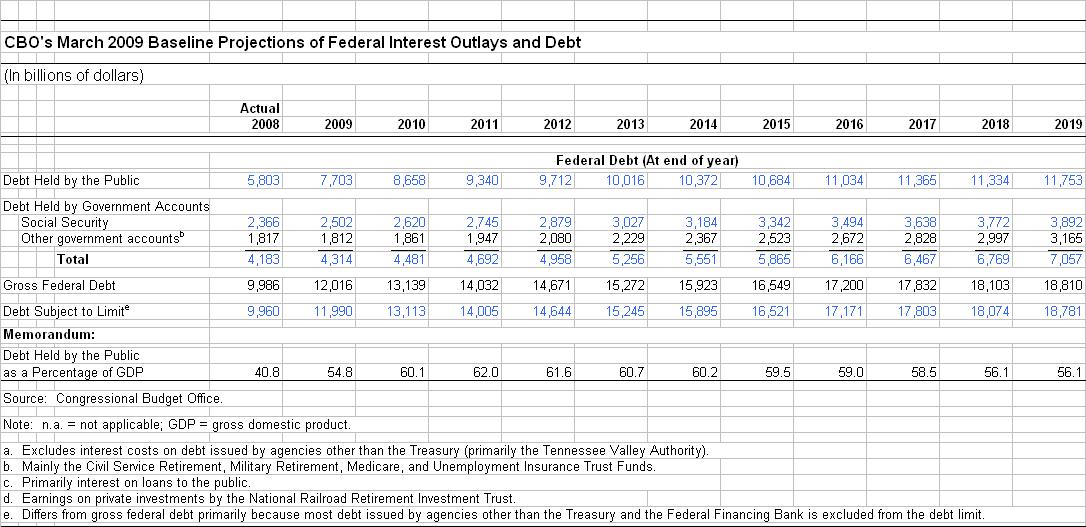
Paying for Obamacare, which we can not afford, sounds like the same strategy used to grant people their other Government given right, the right to buy a home, even if they couldn’t afford one. With housing, the Government made lenders come up with scams like interest only loans, variable interest rate loans, and other devices to make a home affordable ‘today’, with hopes that things would work themselves out in the future. That plan caused millions of people to lose their homes and nearly bankrupted the entire global financial industry. That’s the danger. Now the facts.

Click to Enlarge

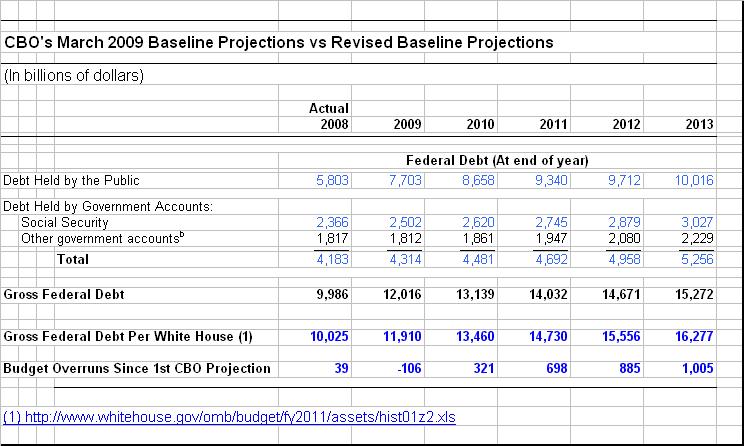
The table above reveals the Congressional Budget Office’s March 2009 Baseline Projections which were used around the time the Senate’s health care bill was scored. Nothing new here. The United States Federal Government has a problem with out of control spending. The National debt is out of control and at that time was projected to reach $18.7 trillion by the year 2019.

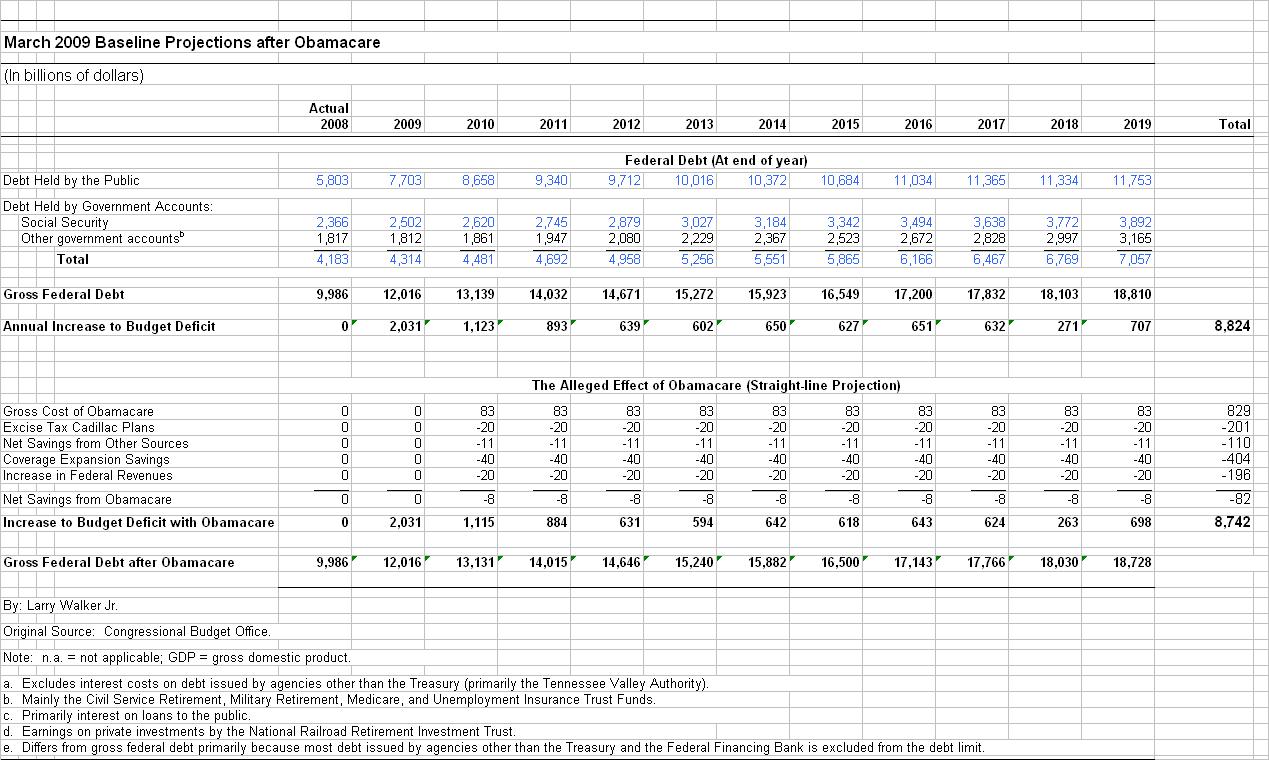
Click to Enlarge

The above table attempts to show you the effect of Obamacare on the National Debt. Since Obamacare is projected to save $82 billion through 2019, I have simply applied the CBO’s initial scoring of the Senate Bill on a straight-line basis (an equal amount for each year). I used straight-line because no one really knows how they come up with this stuff. So after Obamacare, we would save $82 billion over 10 years, right. Well, actually, since the Government was already projected to overspend by $8,824 billion ($8.8 trillion for the math weary) over the rest of the decade, this only represents a savings of 0.93%. And remember, that’s a savings of the amount of deficit spending, not a reduction to the National Debt. Deficit spending is deficit spending in my view.

Click to Enlarge

The final table (above) reveals the revised debt projections as published by the White House. As you can see, just through the year 2013, the Government is already projected to spend $1 trillion more than what was projected in March of 2009. So Obama will already spend $1 trillion more than he projected, and now he’s proposing to knock that down by a whopping $82 billion over 10 years, by destroying the health care industry. And we’re supposed to be happy?

Conclusion: The President is very sincere in his efforts to justify Obamacare as a means of fiscal responsibility. However, he fails to address the main problem – Out of Control Government Spending. Obama himself is projected to spend over $1 trillion more than he projected a year ago. The Federal Government will have a National Debt of $16.2 trillion by the year 2013. Although Obamacare may save 0.93% of Obama’s own, out of control, deficit spending (a percentage which is declining every second) over the next decade, it fails in that:

  1. It will not stop the deficit spending.
  2. It will not pay down the National Debt.
  3. It will not provide health coverage for all Americans.
  4. It will not reduce the cost of health insurance.

And then there’s the question of what’s going to happen after the first decade. Not even the CBO can legally answer that question. In my opinion, Obamacare is nothing but a token bill designed to stroke Obama’s ego. It will have virtually no effect from a fiscal standpoint, and could trigger many negative side effects. So I ask, what’s the point?

__________________________________________________________

Update 3/18/10

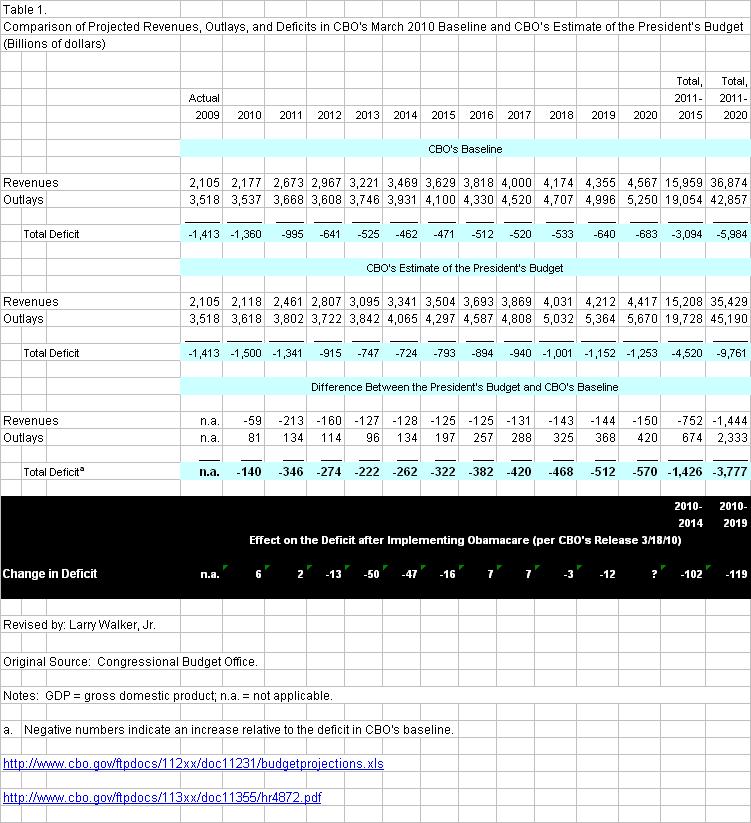
The top section of the following table is from the CBO’s March 2010 Baseline and CBO’s Estimate of the President’s Budget here. For the fiscal years 2011 through 2020, the President’s budget came out $3.777 trillion more in the red than CBO’s baseline, resulting in total deficit spending by Obama of $9.761 trillion between 2011 and 2020, or $11.2 trillion from 2010 through 2020.

I overlaid the lower section with the CBO’s stated effect of Obamacare on the deficit, from Table 1 (page 6) of their scoring report, which was released on 03/18/10 here.

Click to Enlarge

So it’s even worse than I stated yesterday. Obama will overshoot the baseline budget by $3.777 trillion, and will add $11.2 trillion to the National Debt between 2010 and 2020. And he thinks that by passing Obamacare and destroying the US Health Care Industry in the process, that it is worth it, in order to save $119 billion (or $138 or whatever) over the first 10 years. If you ask me $119 billion (or $138 or whatever) in savings looks pretty pathetic when Obama and Congress are already on course to increase the national debt by $11.2 trillion in reckless spending.

This makes Democrats giddy? The whole borrow and spend fest makes me mad as hell. And as far as the second decade goes, I don’t see any compelling evidence in the CBO report that would guarantee that the deficit would continue to fall. And even if the deficit would fall by $1 trillion in the second decade, this would only partially offset an additional $10 trillion (or more) of reckless deficit spending if Washington continues on it’s present disastrous path.

And by the way, the report doesn’t say that the deficit will fall by $1 trillion in the second decade. It does, however, mention that the savings generated by the education provisions would outweigh the costs related to the health care provisions. In otherwords, by fundamentally ‘destroying’ the education system, they can justify destroying the health care system, but this only works for ‘giddy’, power grabbing, debt laden, incumbent Democrats.

Sources:

http://www.cbo.gov/ftpdocs/112xx/doc11231/budgetprojections.xls

http://www.cbo.gov/ftpdocs/113xx/doc11355/hr4872.pdf

Cost Analysis Health Care Bill

http://www.whitehouse.gov/omb/budget/fy2011/assets/hist01z2.xls

Obama’s Big Lie at Today’s Rally: "Your Employer Would See Premiums Fall By As Much As 3000 Percent"

Obamacare Rally in Strongsville, Ohio

March 15, 2010

“How many people are getting insurance through their jobs right now, raise your hands, a lot of those folk, your employer, it’s estimated would see premiums fall by as much as 3000 percent so they could give you a raise.”

More lies and desperation from Obama. He fools these poor suckers in Strongsville, Ohio into believing that under his health care plan, employer’s health insurance premiums will fall by as much as 3,000%. And they just soaked it up, until one of them fainted. Poor suckers.

I guess by the time Obama get’s done, we’ll all be getting paid to have health insurance. What a moron.

Just vote no today and we’ll settle it in November.

Kudos to: Hot Air Pundit, and Town Hall

Obama’s Illogical Health Care Act

Random Thoughts from an Independent Fiscal Conservative

  1. If the insurance industry does away with preexisting conditions, then health insurance costs will go down. Yeah, unless those people really get sick, and then health insurance costs will skyrocket.
  2. If younger workers who don’t want health insurance are forced to buy it, then health insurance costs will go down. Except, of course, for those who don’t pay for health insurance now.
  3. If everyone had health insurance then the quality of care would improve? Unless, of course, we don’t address the quality of health care.
  4. If we had passed Obamacare the Federal government’s monthly budget deficit would have only been $210 billion instead of $220 billion, in February. What a noble achievement. And what about the other $210 billion? Do we perhaps have bigger fish to fry?
  5. If 30 million people who can’t afford to pay one extra dime for health insurance are forced to buy it, then health insurance costs will go down. Except for those individuals who were not paying and now have to pay, and the rest of the population who will have to make up the difference.
  6. We got the Stimulus wrong, but we will get health care right. Fool me once, shame on you. Fool me twice, shame on me.
  7. The reason health insurance costs are rising is because of publicly traded, and (mostly) non-profit health insurance companies greed. Of course it couldn’t be related to the fact that Medicare and Medicaid undercut payments to doctors and hospitals, which makes insurance costs rise for the privately insured.
  8. Nobody complains about Medicare. And why would they? I mean it’s practically free, it’s completely insolvent, and it’s the cause of most of our national debt.
  9. We must pass Obamacare by March 18th. A more noble goal would be to draft a final bill first, then get public feedback, discuss it, debate it, and then vote. Is this deja vu?
  10. The American people want Obamacare to pass. No. The American people want Congress to start over and to calmly and rationally pinpoint the more pressing problems of the day, and to address those with logical and coherent solutions. Solutions that everyone would agree upon. In reality, there are only a few purple shirts out there who are being paid $15 per hour to act like they want it passed. The rest of us (unpaid and under appreciated) are willing to wait for the next Congress and the next president. Hopefully, a president who’s not all tanked up on Nicorette gum. And preferably a Congress who is less concerned with bribes and racketeering, and more concerned with facing facts with logical, non-political solutions.

End of Random Thoughts………

Obama’s Tax Fallacy II: Updated

By: Larry Walker, Jr.

[Updated]

Tax Fallacy II, 95% B.S.

According to the Tax Policy Center, there were 151 million tax units in 2009 (excluding dependents of other tax units). Out of those 151 million tax units, 65.6 million, or 43.4% had zero or negative tax liabilities here. This confirms that only 56.6% of those who file income tax returns actually pay income taxes. But that’s not the end of the story.

According to the IRS Statistics of Income Report here, at the end of 2008, there were 9.2 million tax units who filed tax returns with additional taxes due. At the end of 2008, although $28.4 billion had been collected, the balance still owed by these 9.2 million tax units was $94.4 billion.

Also according to the same IRS Statistics of Income Report here, at the end of 2008, there were 3.4 million tax units who had open delinquency investigation cases. The net amount of taxes owed by these taxpayers was $24.9 billion. Although $3.8 billion was collected when such returns were filed, the difference of $21.1 billion was still outstanding.

So far we have one report which reveals that there are a total of 151 million tax units within the United States. We also have proof that only 85.4 million (56.6%) of these pay income taxes, while 65.6 million (43.4%) pay none. Next we have statistics from the IRS which tell us that out of the 85.4 million who pay income taxes, 12.6 million (9.2 + 3.4) actually haven’t paid, and in fact, they still owe $115.5 billion ($94.4 + $21.1). Are you with me so far?

So out of the 85.4 million who pay income taxes, 12.6 million actually haven’t paid what they owe. This means that only 72.8 million out of a total of 151 million tax units actually file their tax returns on time, and pay their share of income taxes. Thus, in real terms, only 72.8 million out of 151 million tax units, or 48.2% pay income taxes, while 51.8% do not.

This makes moot the following quote: “I gave 95% of working families a tax cut.”

Although I admit the rhetoric sounds good, when one considers the national debt which is heading towards $19 trillion, one has to wonder whether this is even such a good idea. When one considers an unemployment rate of 10% to 19%, depending on who you believe, one has to wonder what that segment of society thinks about the “95% Fallacy”. Shall we subtract the unemployed from those who pay taxes and add them to those who don’t, or just leave well enough alone?

However you want to look at it, there is no way on earth that 95% of working families received a tax cut. In reality, roughly 51.8% don’t pay any taxes to cut. And between 10% to 19% received a cut alright, but it wasn’t a tax cut. What it works out to, in reality, is more akin to an additional tax burden on the ever shrinking 48.2% who actually do pay income taxes. I’m still waiting for the proof behind those grandiose words. Prove it!

Update:

And now we have news that 100,000 federal civilian employees owe just about $1 billion in unpaid federal income taxes. When you tack on retirees and military personnel, the number jumps to 276,000 who owe more than $3 billion. Oh for crying out loud, fire them all starting at the top. Where was it that the buck stops again?

See: Fire Fed Workers Who Don’t Pay Taxes

__________________

References:

IRS Statistics of Income

Tax Policy Center

TaxFoundation.org

Did GDP Fall by 2.4% in 2009?

More B.S. from D.C.

By: Larry Walker, Jr.

According to the Bureau of Economic Analysis (BEA’s) second release regarding – the 4th quarter 2009 GDP, issued earlier today, GDP increased at an annual rate of 5.9% in the 4th quarter of 2009. That is the rate of increase from the 3rd to the 4th quarter, expressed as an annualized percentage rate. The BEA also stated that, in the 3rd quarter, real GDP increased 2.2%. Sounds good, right? Woo-hoo!

“Real gross domestic product — the output of goods and services produced by labor and property located in the United States — increased at an annual rate of 5.9 percent in the fourth quarter of 2009 (that is, from the third quarter to the fourth quarter) according to the “second” estimate released by the Bureau of Economic Analysis. In the third quarter, real GDP increased 2.2 percent.”

But if you read down a little further into the report, the part where the BEA re-enters the atmosphere, you will discover that real GDP fell by (2.4%) in 2009. That is the rate of decline from the 2008 level to the 2009 level. So, is this good, or bad?

[2009 GDP] “Real GDP decreased 2.4 percent in 2009 (that is, from the 2008 annual level to the 2009 annual level), in contrast to an increase of 0.4 percent in 2008.”

Like I said in a previous post, it’s like telling me that my IRA account grew at an annual rate of 5.9% in the 4th quarter, but when I look at my statement I find that my account balance has actually declined by (2.4%) from 2008. So am I better off? No. Are you?

The next time Obama & Company start boasting about 4th quarter 2009 GDP, I wish someone would stand up and say, “but, sir, GDP actually fell by 2.4% under your watch”. Put that in your tea and drink it!

Click to Enlarge

Reference:

http://www.bea.gov/newsreleases/national/gdp/gdpnewsrelease.htm

Health Care Expenditures vs Income

Click to Enlarge

A Fiscal Conservative Opines: Where is all the excess?

By: Larry Walker, Jr.

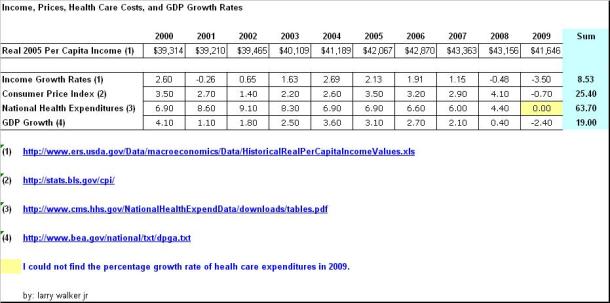
I am once again attempting to overlay data upon data from different sources, not being certain whether any of them are accurate, yet they are all so called ‘reputable’. There are some who will look at the table, above, and think that health care expenditures are out of control. I look at it and my take is that the lack of growth in real incomes is the problem.

In fact, health care expenditures have been on the decline since 2003. Granted I was not able to find the rate of change for 2009, even if there was no increase, health care expenditures have grown faster than incomes, the consumer price index, and GDP. This doesn’t tell me that there is necessarily a problem with health care expenditures. What it tells me … is that there is a problem with the economy.

Over the past ten years, consumer prices have risen by 25% while incomes have only risen by 9%. Does this mean that prices are out of control? Not to me. To me it means that our incomes are not keeping pace with inflation.

GDP is growing slower than prices. GDP is only growing at an average of 1.9% per year. For the past decade, GDP grew by 19% while prices grew by 25%. So again, is the problem with prices, or with GDP?

Let’s be real. Unless prices rise, incomes will not. How can a business provide raises for employees every year unless the business is also raising its prices? One way would be to keep prices static and to increase productivity, which generally means doing more with less employees. Everyone expects to get a cost of living increase each year, however, in order to receive one, your employer must generally raise its prices in line with the consumer price index. Yet, if that was reality, then incomes would be rising as fast as inflation. Yet, prices have risen nearly three times as fast as incomes. So where is all the excess?

My suspicion is that the problem lies more in the area of manufacturing, international trade, unionization, and the growth of government. We don’t make things anymore in America, we have become a service economy. Most of the products that we buy are imported from other countries. Unions are constantly demanding higher wages and better benefits. The number of government employees is growing as is their pay and benefits. The end result is that our Federal and State governments are going broke, jobs are being lost to emerging market economies, and the incomes of non-governmental and non-union employees are going down.

So the question is how do we improve the growth prospects for our economy? The answer lies in finding ways to increase exports and decrease imports, to lower income taxes and reduce the size of government, and to remove the restraints currently being imposed upon the free market. Our economy doesn’t need more controls, but rather less.

You say rising health care costs are at the center of all of our problems. I say, you’re focusing on the wrong statistic. If a man or woman has no way to earn their livelihood, then what good is a government run health care program. You will have your health care, but you will live in poverty. You will be taxed, but you will lack the wherewithal to pay your taxes. The poor will remain poor. The middle class will cease to exist. The government will continue to spend more than it can tax until even it falls by the wayside.

You cannot fix a problem, until you have identified one. So where is all the excess?

If the price of say automobiles rises, yet most of the autos are purchased from Japan, then there’s your answer. Sure, some jobs were provided in America, but the excess (also known as profit) has left the country.

If the price of health insurance has risen, yet most of the insurance is purchased from domestic providers, then where is all the excess? The answer is in a broken governmental system. The government (federal and state) spends nearly twice as much on health care as does the private sector. The government gets its revenue by taxing those who are viable and paying for the health services of those who are not. The government pays less for services than does the private sector which in turn, means prices will rise for everyone to compensate for the shortfall created by government providers. Thus, prices rise, but incomes do not.

A major reason why incomes are not rising is because the cost of income taxes, social security taxes, and medicare taxes are set to rise every year. It’s not that the rates have necessarily changed, but that the income ceilings have. So you work hard to make more than the social security cap, but by the time you reach that goal, the government has raised the bar (or removed it completely). This is not a progressive tax system, it’s a progressive annual tax increase. It’s a system designed to keep our economy in chains.

So where is all the excess? One need only look at our national debt. If there were excess, the United States Federal government would not be $13 trillion in debt. So there is no excess.

The problem lies not in price controls but rather in wealth creation. Wealth is not created through price controls. In fact, wealth is restrained by controlling prices. If prices did not rise, then neither would wealth. Yet, when wealth is not rising along with prices there is a breach.

If every American either worked for the government, or received government services, how would the government be able to continue as a going concern? The answer is that it would not. So then part of the solution, which is ingrained in your soul, is that bigger government is not the answer. On the other hand, if everyone worked in the private sector, and if everyone were able to sustain themselves, what would be the role of government? Most likely the role that was intended by our founders. So once again we can conclude that government is not the solution to our problems, government is the problem.

Message to uncle Sam, “get out of my way, and get off my back.”

End of rant….

References:

http://www.ers.usda.gov/Data/macroeconomics/Data/HistoricalRealPerCapitaIncomeValues.xls

http://stats.bls.gov/cpi/

http://www.cms.hhs.gov/NationalHealthExpendData/downloads/tables.pdf

http://www.bea.gov/national/txt/dpga.txt

Other Links and Solutions:

http://citizenownership.blogspot.com/2010/02/every-citizen-owner.html

http://citizenownership.blogspot.com/2010/02/expanded-capital-ownership-now.html

http://www.aipnews.com/talk/forums/thread-view.asp?tid=12453&posts=3#M33855

http://www.freerepublic.com/focus/f-bloggers/2460284/posts

Debt & Taxes: Obama’s Rate of Change

Obama’s Rates of Change

By: Larry Walker, Jr. [Revised]

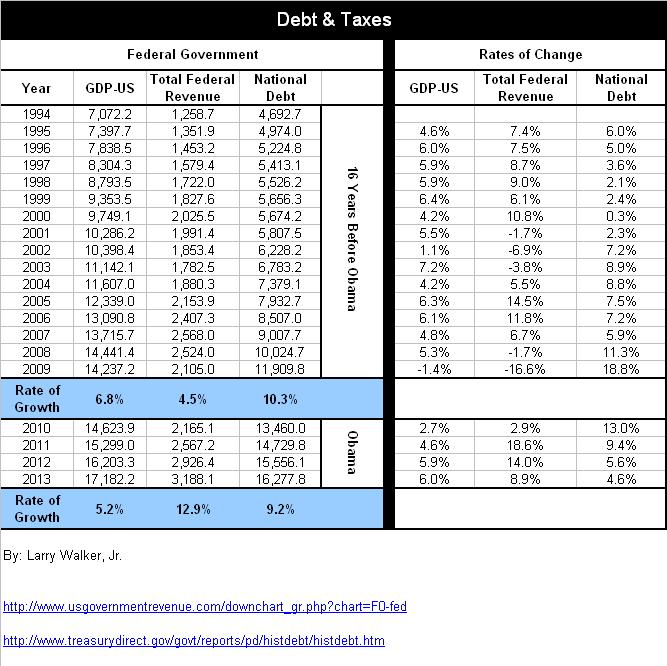
Today I am observing the rates of change embedded in Barack Obama’s budget projections. My objective is to determine whether Obama represents ‘change you can believe in’, and whether or not his policies are in line with his rhetoric. I will compare Obama’s 4 year budget projections during his first (and only) term, to the previous 16 year period. An observance of rates of change can provide assurance that the course charted is the one navigated. Here are a few observations.

  1. During the 16 year period ending with fiscal year 2009, GDP achieved an average annual growth rate of 6.8%, while government revenues (taxes) grew at 4.5%, and the national debt grew at 10.3%. Summary: The national debt outpaced economic growth, while tax revenues lagged the economy.

  2. In following Obama’s budget projections for the four year period ending in fiscal year 2013, GDP will grow at an average annual rate of 5.2%, while government revenues (taxes) will grow at 12.9%, and the national debt will grow at 9.2%. Summary: Tax revenues will more than double the pace of economic growth, while the national debt will continue to grow faster than the economy.

Click to Enlarge

“Tax revenues will more than double the pace of economic growth, while the national debt will continue to grow faster than the economy.”

After decades of reckless government spending, the change I would have expected, and could have believed in, would have led to an increase in GDP, a reduction in income taxes, and a dramatic reduction in government spending. Instead, it appears that the change I will get will be as follows:

  1. GDP will grow at an annual rate which is 23.5% slower than what we experienced over the last 16 years. This means that our wealth will be diminished.

  2. Income taxes will increase by 186% over the next 4 years. Taxes will consume more of a shrinking economy.

  3. Although the National Debt will grow at a slightly slower pace, it will: (a) grow 77% faster than GDP, and (b) continue to grow in spite of massive tax increases.

Conclusion: The course Obama has charted, is not the one being navigated. Obama talks about controlling the debt and deficits, cutting taxes for 90% of working families, and building a new foundation for economic growth. The only problem is that by following his budget, we will experience an increase in the national debt, higher income taxes, and lower economic growth. This is ‘change’, but it is the kind of change that I cannot, do not, and will never believe in.

Sources:

http://www.usgovernmentrevenue.com/downchart_gr.php?chart=F0-fed

http://www.treasurydirect.gov/govt/reports/pd/histdebt/histdebt.htm