Postal Service OIG Discovers $75 Billion Overpayment, Again

Government-Run

Will Obamacare Go Up In Flames Too?

– By: Larry Walker, Jr. –

“You’ve got a lot of private companies who do very well competing against the government — UPS and FedEx are doing a lot better than the Post Office.” ~ Barack Obama (Aug. 2009)

According to an article posted on federalnewsradio.com, on June 28, 2010, the United States Postal Service, Office of Inspector General (OIG) discovered that the Postal Service had made a $75 billion overpayment to the Civil Service Retirement System (CSRS). However, the same problem had already been reported by the OIG back in April of 2004. Apparently nothing was done to correct the problem in 2004, and it doesn’t appear that anything has been done about it to date. (If this has since been resolved, please comment below, and point me to your reference.) Following is an excerpt from the aforementioned article:

In what could be the best game of Monopoly™ ever, Postmaster General John Potter may have just drawn a card that reads “Inspector General finds error in your favor. Collect $75 billion dollars.”

The Inspector General for USPS took a closer look at the Civil Service Retirement System and found massive overpayments dating back decades.

Michael Thompson, Director of Capital Investments for the Postal Service Office of Inspector General, explained for Federal News Radio, “the Postal Service, since 1972, has overfunded by $75 billion its share of civil service retirement and the reason for that is because the methodology that’s used is not comparable to the methodologies that’s used for all the other federal retirement funds.”

Thompson said the Office of Personnel Management, in deciding how much the Postal Service should pay into the CSRS, is currently using a different method developed in 1974. They’ve said they aren’t going to change unless Congress tells them to, according to Thomson.

“The money is sitting in the civil service retirement fund. It’s not as though the money is not there. It is there. It’s just that the Postal Service has continually paid more than it should have paid.”

All it would take, according to Thompson, is for either the OPM to make the change or for Congress to legislate it. That might seem simple enough, but with so much money involved, no one’s getting off the dime, literally.

http://www.federalnewsradio.com/index.php?nid=15&sid=1990598#

The article mentioned above is in line with a memo issued by the OIG on June 18, 2010 (excerpt below). I’m just wondering if anyone has “gotten off the dime” as of yet? I mean I know it’s only $75 billion, but one has to wonder just how many unresolved $75 billion overpayments are floating around Washington D.C., with its $14 trillion in debt and all. Where was it that the buck was supposed to stop again?

June 18, 2010

JOSEPH CORBETT
CHIEF FINANCIAL OFFICER & EXECUTIVE VICE PRESIDENT

SUBJECT: Management Advisory Report – Civil Service Retirement System Overpayment by the Postal Service (Report Number CI-MA-10-001)

This report presents the results of our review of the Civil Service Retirement System (CSRS) Overpayment by the U.S. Postal Service (Project Number 10YO036CI000). This report discusses the $75 billion CSRS overpayment by the Postal Service in fiscal years (FY) 1972 through 2009. The objective of this review was to assess the facts concerning this overpayment and identify any possible solution(s) to correct the overpayment to the benefit of the Postal Service. This review addresses financial risk.

http://www.uspsoig.gov/foia_files/CI-MA-10-001.pdf

Now if you look back through the records of the OIG, you will discover that a similar memo was issued back in April of 2004 (excerpt below). The 2004 memo stated that the Postal Service was making overpayments to the CSRS, and implied that the problem had been corrected. In fact, the memo states that, “Had the overpayments continued, the Postal Service would have overpaid its obligation by over $100 billion.” Well, apparently the problem wasn’t resolved, because a little over six years later the Postal Service had in fact, overpaid the CSRS by $75 billion. I wonder what happened to the other $25 billion!

April 9, 2004

MEMORANDUM FOR JOHN E. POTTER, POSTMASTER GENERAL, CHIEF EXECUTIVE OFFICER

FROM: /s/ (Scott Wilson for) David C. Williams, Inspector General

SUBJECT: Postal Service’s Funding of the Civil Service Retirement System (Product Number FT-OT-04-002)

This memorandum presents our opinion on the issues surrounding the Postal Service’s funding of the Civil Service Retirement System (CSRS) (Project Number 03XD009FT005). The objective was to analyze the outstanding issues pertaining to the Postal Civil Service Retirement System Funding Reform Act of 2003 (Public Law 108-18) and to provide our perspective on how the legislation affects the Postal Service and its stakeholders. We have included the differing viewpoints and positions that have been generated by affected groups, including the Department of the Treasury (Treasury), the Office of Personnel Management (OPM), the General Accounting Office (GAO), the Postal Rate Commission, the President’s Commission on the United States Postal Service (the President’s Commission), mailers, competitors, and the Postal Service.

GAO discovered that the Postal Service’s amortized payments to OPM for its CSRS liability were too large. Had the overpayments continued, the Postal Service would have overpaid its obligation by over $100 billion.

http://www.uspsoig.gov/foia_files/FT-OT-04-002.pdf

It looks like the federal government is just bleeding money on all fronts. Where government backed entities, like the Postal Service, should be turning a profit, instead we find, as the Washington Examiner reported in April of 2010, that “without serious reform [the Postal Service] was set to lose $7 billion in 2010 and $238 billion over the next 10 years…” Perhaps it’s time to end the era of government-sponsored, government-owned, and government-backed entities? One has to wonder, at this point, just exactly what they are backed by – an unlimited ability to incur debt? The time to repeal Obamacare is now. The time to cap the debt ceiling is now. Enough is enough.

Photo Credit: KRTV.com

Other References: Will Obama create the Post Office of health care?

Obama’s Scattershot: Works without Faith

By: Larry the Tishbite :

Definition: Scattershot – covering a wide range in a haphazard way (indiscriminating, undiscriminating – not discriminating)

Obama’s philosophy – Tell the people what they want to hear. Make it sound fabulous. Bend and stretch the truth when necessary. Convince the masses that everyone should agree with him. Demonize any opposing view points, because no one else could possibly have a solution. Make a broad range of neo-reforms and hope that something sticks. Because, after all, progress means getting stuff done, whether it’s the right stuff or not is irrelevant.

First, there was the financial bailout which was meant to save us from “the worst financial crisis since the seven year famine of Genesis 41:54“. [Boy am I tired of hearing that line.] The fact that, from the time Obama took over through April 23rd of this year, 197 banks have failed, including the 7 Illinois banks that failed on that day, is not even mentioned. Instead of admitting failure and going back to the drawing board, Obama, and his worshipers, continue to blame the ‘too big to fail’ entities for the crisis of 2008, and seek ways to prevent ‘that crisis’ from ever happening again. It seems like progress, but Obama is actually ignoring the fact that the original problem has yet to be resolved. When things seem to be improving, Obama will take credit, and when the situation worsens, Obama will blame the seers, bloggers, or anyone other than himself, or his policies.

Then there was the famous economic stimulus which was going to cap the unemployment rate at 8% and add 2 million and some-odd jobs in short order. Well, since that didn’t happen, Obama came up with a new measurement: ‘jobs created or saved’. Thus, if you saved one job you somehow could claim to have created six, or some nonsense. Once again, instead of admitting defeat and going back to square one, the obamanists, claimed victory and now say everything is fine. (That reminds me of the true definition of F.I.N.E.) Never mind the fact that the published unemployment rate was 10.2% at the end of March of 2010 and much higher if you count all of those who have permanently left the workforce. As is his custom, if the latest statistics seem favorable, Obama will take credit, and if things are not looking favorable, he will blame bloggers, Glenn Beck, Fox News or anyone other than himself or his socialist entourage.

And last but not least, there was Obamacare which was supposed to reduce deficit spending by $138 billion in the first decade, and then knock off another $1.2 trillion long after Obama could possibly be in office. Well for one thing, it looks like there may not be any savings in the first decade, and Obamacare may actually add to the deficit. But then there’s the real catch-22: How can one have the audacity to claim that Obamacare will reduce deficit spending by $138 billion during the same decade that deficit spending is actually being increased by more than $10 trillion? Maybe it’s just me, but that doesn’t equal any kind of savings whatsoever. If I put $1,000 in my savings account this year, but actually wind up adding $10,000 of credit card debt, am I not really worse off by $9,000? I think so.

I could name dozens of other Obama policies that follow the same pattern. Whether it’s nuclear defense, foreign policy, education, financial reform, climate change, energy, you name it, it’s just one big scattershot. The story is the same. Shoot a scattershot and hope that something sticks, take credit for any positive outcomes, pass blame for any negative results.

Oh, and then there’s that little quirk regarding the fact that the greatest benefits of any Obama policy don’t occur until long after he has been expelled from office. What’s up with that? That’s a neat way to CYA when none of your plans make any sense, and when everyone knows it. That way, Obama can blame the next administration for repealing his mistakes prematurely. In the end, this will only work to ensure that Obama goes down in history as the worst president since James Earl Carter.

I have made a few costly mistakes in my life, and I learned some valuable lessons. It never helped to sit around blaming everyone else for my mistakes, and I didn’t need some 3rd party changing the rules to prevent me from making the same mistake. I messed up, I paid the price, and I will never make those same mistakes again. I have also learned that the scattershot technique doesn’t work. I have learned to focus my energies on my personal areas of expertise, and to promptly concede what I don’t know.

In my world, we slay one dragon at a time. In Obama’s world, he seems to slay his own credibility one policy at a time.

The seven years of plenty ended in July of 2007.

29 There will be seven years of great plenty in all the land of Egypt. 30 After that, there will be seven years of famine, and all the good years will be forgotten, because the famine will ruin the country. 31 The time of plenty will be entirely forgotten, because the famine which follows will be so terrible. 32 The repetition of your dream means that the matter is fixed by God and that he will make it happen in the near future. 33 “Now you should choose some man with wisdom and insight and put him in charge of the country. 34 You must also appoint other officials and take a fifth of the crops during the seven years of plenty. 35 Order them to collect all the food during the good years that are coming, and give them authority to store up grain in the cities and guard it. 36 The food will be a reserve supply for the country during the seven years of famine which are going to come on Egypt. In this way the people will not starve.” 37 The king and his officials approved this plan,…

Final: Obamacare | The Macro View

The Endgame

Catch 22 –

By: Larry Walker, Jr. –

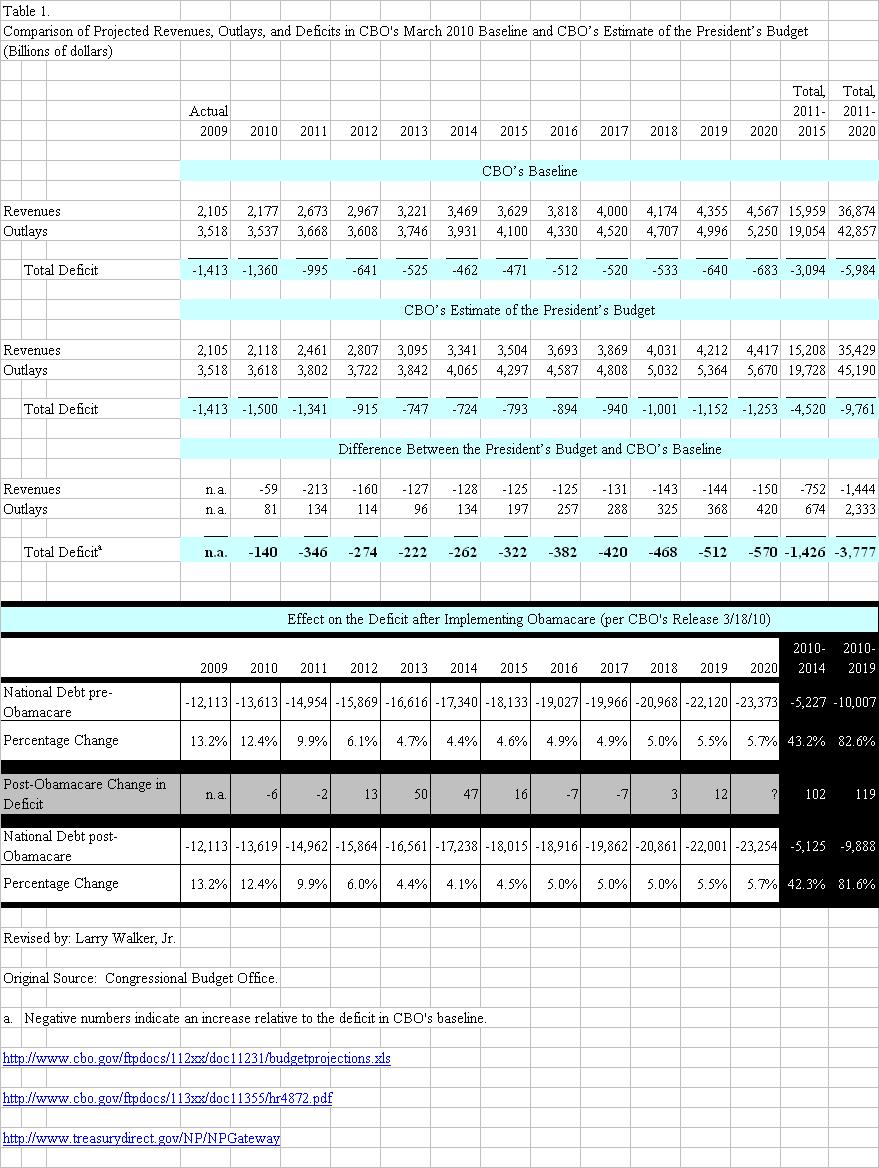
Point #1 – As I pointed out previously here, and as you can see in the top portion of the table below, Mr. Obama has outlined a budget which contains deficit spending of $-3.7 trillion more than the CBO’s Baseline Budget, between the years 2011 and 2020. The CBO’s Baseline Budget was already $-5.9 trillion in the red for the budget years 2011 through 2020. If you start with fiscal year 2010, the CBO’s Baseline Budget deficit was already $-7.3 trillion. The CBO’s estimate of the President’s budget calls for total deficit spending of $-11.2 trillion beginning with fiscal year 2010 and ending in fiscal year 2020. (Note: The baseline budget total is for 2011-2020, so you have to add 2010 to get this figure.) Now if you add the President’s budget deficit of $-11.2 trillion to our National Debt which was $-12.1 trillion at the end of 2009, then the national debt will reach $-23.3 trillion by the year 2020.

Table 1 - Click to Enlarge

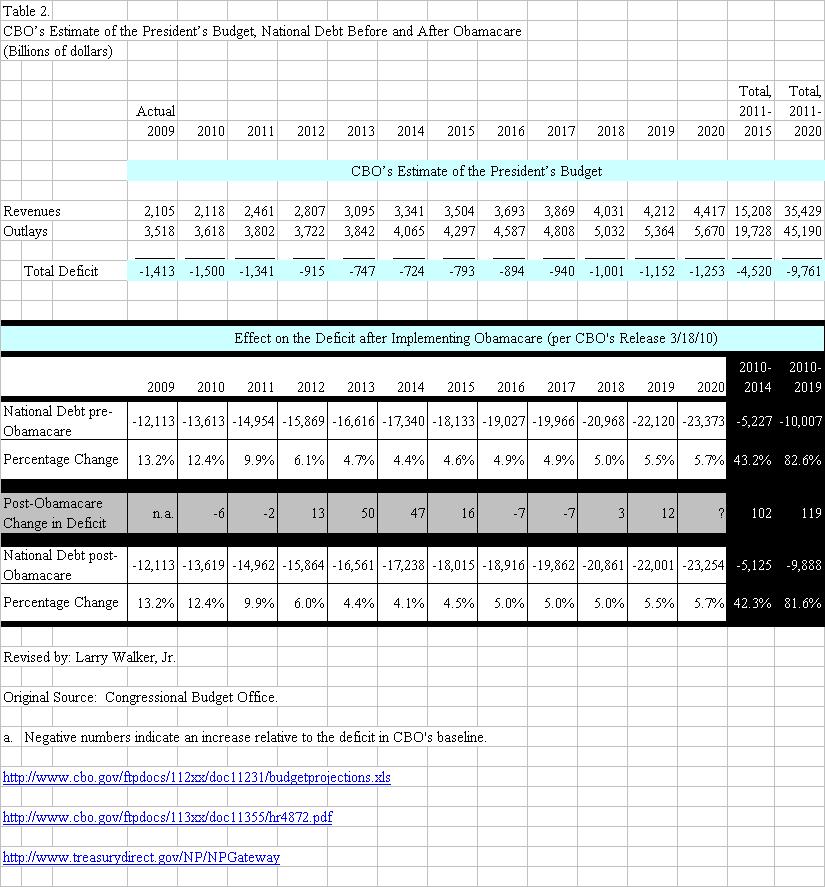
Point #2 – You will note in the bottom half of the table above (re-posted below), that the National Debt, which was $-12.11 trillion at the end of 2009, is projected to grow to $-22.12 trillion by the year 2019. (Note: The totals on this table end with fiscal year 2019 to correspond with the scoring of Obamacare.) This represents a percentage increase of 82.6% over the 10 year period. So before Obamacare, the President was already on target to increase our National Debt by 82.6% over the present decade.

Point #3 – Also in the table below, you will note that after implementing Obamacare, if one adds in the savings projected by the CBO of $119 billion over the first decade, then the National Debt is projected to grow to just $-22.00 trillion, or a percentage increase of 81.6% over the decade. This means that Obamacare will decrease the rate of growth of the national debt by just 1.0% in the first decade (82.6% vs 81.6%). In other words, by the year 2019, the National Debt will either be $-22.00 trillion with Obamacare, or $-22.12 trillion without it. (Note: I omitted the other $19 billion of savings which the CBO projected because I do not believe it to be attributable to Obamacare, however this is diminimus.)

Table 2 - Click to Enlarge

Point #4 – You will note that the CBO projects the savings from Obamacare to be $102 billion over the first five years, and only $17 billion over the second five, for a total of $119 billion in the first decade. The greatest savings appear in the years 2013 and 2014, $50 billion and $47 billion respectively. Why would anyone believe that there would suddenly be savings of over $1 trillion in the second decade, when the rate of savings decreases so dramatically in just the second five year period? If you study the numbers closely, the rate of savings from Obamacare declines by 83% from the first five years to the second. Yet, we are expected to believe that the rate of savings will suddenly jump by 740% (to over $1 trillion) during the second decade. This is simply unrealistic. Not to mention, unreliable, because the CBO calculated the savings rate in the second decade as a percentage of GDP. What we don’t have from the CBO is a projection of the Federal Budget that far out. If budget deficits continue to soar during the second decade after Obamacare, then any savings projected will be nullified.

Point # 5 – With government spending so out of control – with the national debt projected to grow to either $-22.12 trillion without, or $-22.00 trillion with Obamacare by 2019 – with the national debt projected to grow by either 82.6% without Obamacare, or 81.6% with it – it’s as if Obama and his Progressive colleagues have chosen to stick their heads in the sand, and to ignore the problem. The problem being the inability to pay for current federal programs. They are giddy and claiming victory because they think they have finally come up with a deficit neutral program, but what have they really done?

What have they done? – The term ‘deficit neutral’ implies that a program is implemented in a way that will not add to the deficit. But what does it mean for us as relates to Obamacare? What does it mean when government spending is already out of control? It means that the government will raise around $500 billion in new taxes, fees and fines in order to pay for a new entitlement program, Obamacare. It’s one thing to raise revenues in order to begin to balance the existing budget, but entirely another to ignore the debt, and to take more money out of our pockets for a new program. Meanwhile, the National Debt continues to grow at essentially the same rate.

Obamacare solves nothing. By the year 2020, the national debt will be nearly twice the amount of our current GDP. If we don’t take the debt crisis seriously, then by the year 2020 there will be no Obamacare, no Social Security, no Medicare, no Education, no Defense, and possibly not even a United States of America. Obamacare and its sister entitlement programs are not the solution to our problems, Obamacare and its sister entitlement programs are the problem.

Sources:
http://www.treasurydirect.gov/NP/NPGateway
http://www.cbo.gov/ftpdocs/113xx/doc11355/hr4872.pdf
http://www.cbo.gov/ftpdocs/112xx/doc11231/budgetprojections.xls
Obamacare: A Fiscal Point of View Updated!

Revised: Obamacare | The Macro View

Catch 22 –

By: Larry Walker, Jr. –

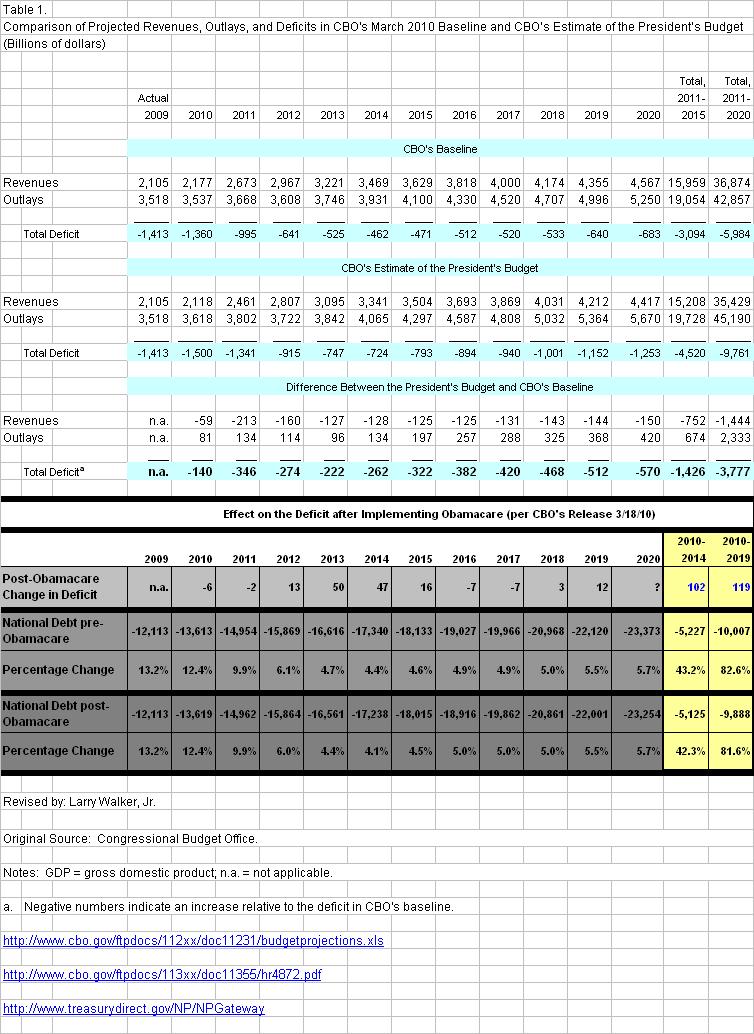
Point #1 – As I pointed out previously here, and as you can see in the top portion of the table below, Mr. Obama has outlined a budget which contains deficit spending of $-3.7 trillion more than the CBO’s Baseline Budget, between the years 2011 and 2020. The CBO’s Baseline Budget was already $-5.9 trillion in the red for the budget years 2011 through 2020. If you start with fiscal year 2010, the CBO’s Baseline Budget deficit was already $-7.3 trillion. The CBO’s estimate of the President’s budget calls for total deficit spending of $-11.2 trillion beginning with fiscal year 2010 and ending in fiscal year 2020. (Note: The baseline budget total is for 2011-2020, so you have to add 2010 to get this figure.) Now if you add the President’s budget deficit of $-11.2 trillion to our National Debt which was $-12.1 trillion at the end of 2009, then the national debt will reach $-23.3 trillion by the year 2020.

Table 1 - Click to Enlarge

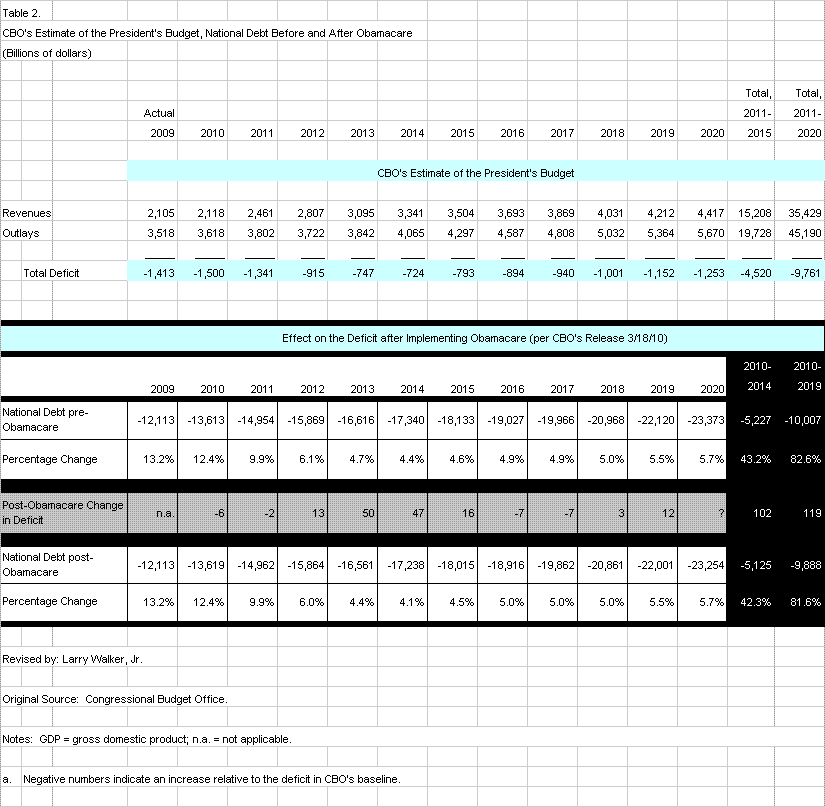
Point #2 – You will note in the bottom half of the table above (re-posted below), that the National Debt, which was $-12.11 trillion at the end of 2009, is projected to grow to $-22.12 trillion by the year 2019. (Note: The totals on this table end with fiscal year 2019 to correspond with the scoring of Obamacare.) This represents a percentage increase of 82.6% over the 10 year period. So before Obamacare, the President was already on target to increase our National Debt by 82.6% over the present decade.

Point #3 – Also in the table below, you will note that after implementing Obamacare, if one adds in the savings projected by the CBO of $119 billion over the first decade, then the National Debt is projected to grow to just $-22.00 trillion, or a percentage increase of 81.6% over the decade. This means that Obamacare will decrease the rate of growth of the national debt by just 1.0% in the first decade (82.6% vs 81.6%). In other words, by the year 2019, the National Debt will either be $-22.00 trillion with Obamacare, or $-22.12 trillion without it. (Note: I omitted the other $19 billion of savings which the CBO projected because I do not believe it to be attributable to Obamacare, however this is diminimus.)

Table 2 - Click to Enlarge

Point #4 – You will note that the CBO projects the savings from Obamacare to be $102 billion over the first five years, and only $17 billion over the second five, for a total of $119 billion in the first decade. The greatest savings appear in the years 2013 and 2014, $50 billion and $47 billion respectively. Why would anyone believe that there would suddenly be savings of over $1 trillion in the second decade, when the rate of savings decreases so dramatically in just the second five year period? If you study the numbers closely, the rate of savings from Obamacare declines by 83% from the first five years to the second. Yet, we are expected to believe that the rate of savings will suddenly jump by 740% (to over $1 trillion) during the second decade. This is simply unrealistic. Not to mention, unreliable, because the CBO calculated the savings rate in the second decade as a percentage of GDP. What we don’t have from the CBO is a projection of the Federal Budget that far out. If budget deficits continue to soar during the second decade after Obamacare, then any savings projected will be nullified.

Point # 5 – With government spending so out of control – with the national debt projected to grow to either $-22.12 trillion without, or $-22.00 trillion with Obamacare by 2019 – with the national debt projected to grow by either 82.6% without Obamacare, or 81.6% with it – it’s as if Obama and his Progressive colleagues have chosen to stick their heads in the sand, and to ignore the problem. The problem being the inability to pay for current federal programs. They are giddy and claiming victory because they think they have finally come up with a deficit neutral program, but what have they really done?

What have they done? – The term ‘deficit neutral’ implies that a program is implemented in a way that will not add to the deficit. But what does it mean for us as relates to Obamacare? What does it mean when government spending is already out of control? It means that the government will raise around $500 billion in new taxes, fees and fines in order to pay for a new entitlement program, Obamacare. It’s one thing to raise revenues in order to begin to balance the existing budget, but entirely another to ignore the debt, and to take more money out of our pockets for a new program. Meanwhile, the National Debt continues to grow at essentially the same rate. Obamacare solves nothing. By the year 2020, the national debt will be nearly twice the amount of our current GDP. If we don’t take the debt crisis seriously, then by the year 2020 there will be no Obamacare, no Social Security, no Medicare, no Education, no Defense, and possibly not even a United States of America. Obamacare and its sister entitlement programs are not the solution to our problems, Obamacare and its sister entitlement programs are the problem.

Sources:

http://www.treasurydirect.gov/NP/NPGateway

http://www.cbo.gov/ftpdocs/113xx/doc11355/hr4872.pdf

http://www.cbo.gov/ftpdocs/112xx/doc11231/budgetprojections.xls

Obamacare: A Fiscal Point of View Updated!

Obamacare: The 2nd Decade (Fiction)

A Fictional Account –

by: Larry Walker, Jr. –

We are now in the 2nd decade after the passage of what many Americans deemed to be comprehensive health care reform, Obamacare. The creator of Obamacare, Barack Hussein Obama, died shortly after it’s passage in the year 2010 of unknown causes. Nancy Pelosi and Harry Reid have long since passed. All of the Congressional leaders from the year 2010 are now deceased.

Obamacare did not work out as promised. From the moment it was signed into law it increased the U.S. budget deficits each and every month. Medicare and Social Security became insolvent in the year 2012. All of the surpluses in these programs were borrowed and spent on Obamacare. Millions of Americans lost their health insurance as soon as the bill was passed. Nearly 50% of private practitioners closed their practices almost immediately.

Through the law of supply and demand, with the increased demand for medical services and the lower supply of practitioners, health care costs skyrocketed. Health insurance premiums increased by 100% on average each year until no one in the country could afford it. Income and excise taxes, fines and fees were imposed, but people were unable to pay these levies and their living expenses. Unemployment continued to rise as employers, being overburdened with taxes and regulations began to fail.

The national debt had actually reached the point of no return just before the passage of Obamacare, but only a handful of people knew it at the time. The only way for the government to reverse the negative effects of this erroneous legislation was to print more money. As the Federal Reserve began to print money in 2011, the rate of inflation went off the charts. Inflation reached 17% by the year 2012. The cost of gasoline soared to $10 per gallon in 2012. States began to declare bankruptcy and the most fiscally sound States began to acquire the weaker ones.

The Republic of Texas now consists of the entire southern half of the old United States, stretching from Southern California to Virginia. The old United States now consists of only a few states in the Northeast. The others declared themselves to be sovereign republics in the year 2013. The Republic of Texas seceded from the Union in the year 2013. This time there was no civil war, and the issue was not slavery.

The city of Washington, DC was destroyed in the year 2013 by a nuclear missile attack launched by Iran. No one came to the rescue. No one cared. The blight had been removed. The culprits were dead. The problem had been solved.

Now I tell the story from the year 2030. I am one of the survivors. I saw it coming. I tried to warn others. Most wouldn’t listen. They believed that big government was the solution. They relied upon government entitlements for their health and well being. Now they are simply wards of the old country, for all practical purposes, slaves. The United States of America is no more. And it all came to a crashing halt, in the year 2010.

See the Factual Account at: Final: Obamacare | The Macro View

Obamacare: A Fiscal Point of View | Updated!

Obamacare: A Fiscal Conservative’s Point of View

– By: Larry Walker Jr. –

Paying for Obamacare, which we can not afford, sounds like the same strategy used to grant people their other Government given right, the right to buy a home, even if they couldn’t afford one. With housing, the Government made lenders come up with scams like interest only loans, variable interest rate loans, and other devices to make a home affordable ‘today’, with hopes that things would work themselves out in the future. That plan caused millions of people to lose their homes and nearly bankrupted the entire global financial industry. That’s the danger. Now the facts.

Click to Enlarge

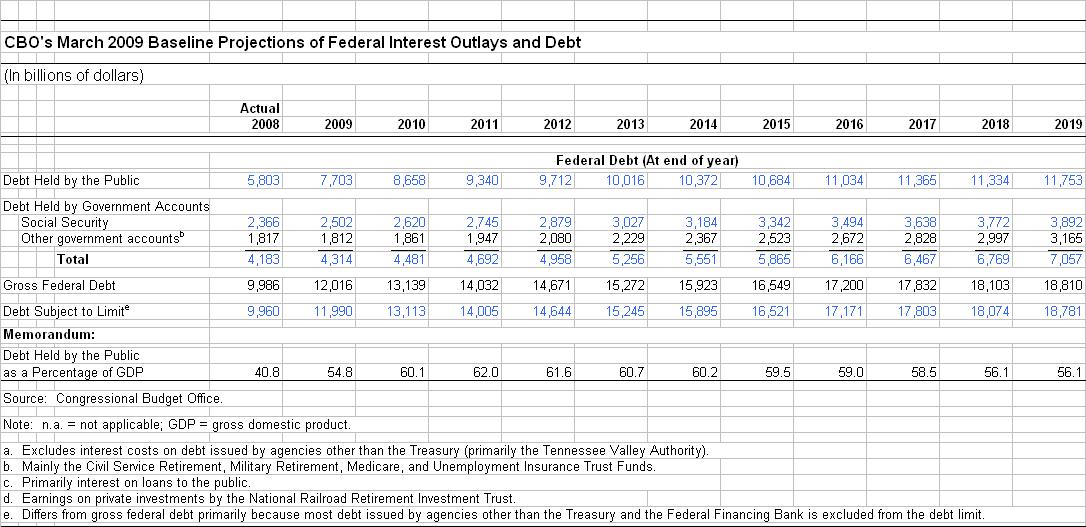
The table above reveals the Congressional Budget Office’s March 2009 Baseline Projections which were used around the time the Senate’s health care bill was scored. Nothing new here. The United States Federal Government has a problem with out of control spending. The National debt is out of control and at that time was projected to reach $18.7 trillion by the year 2019.

Click to Enlarge

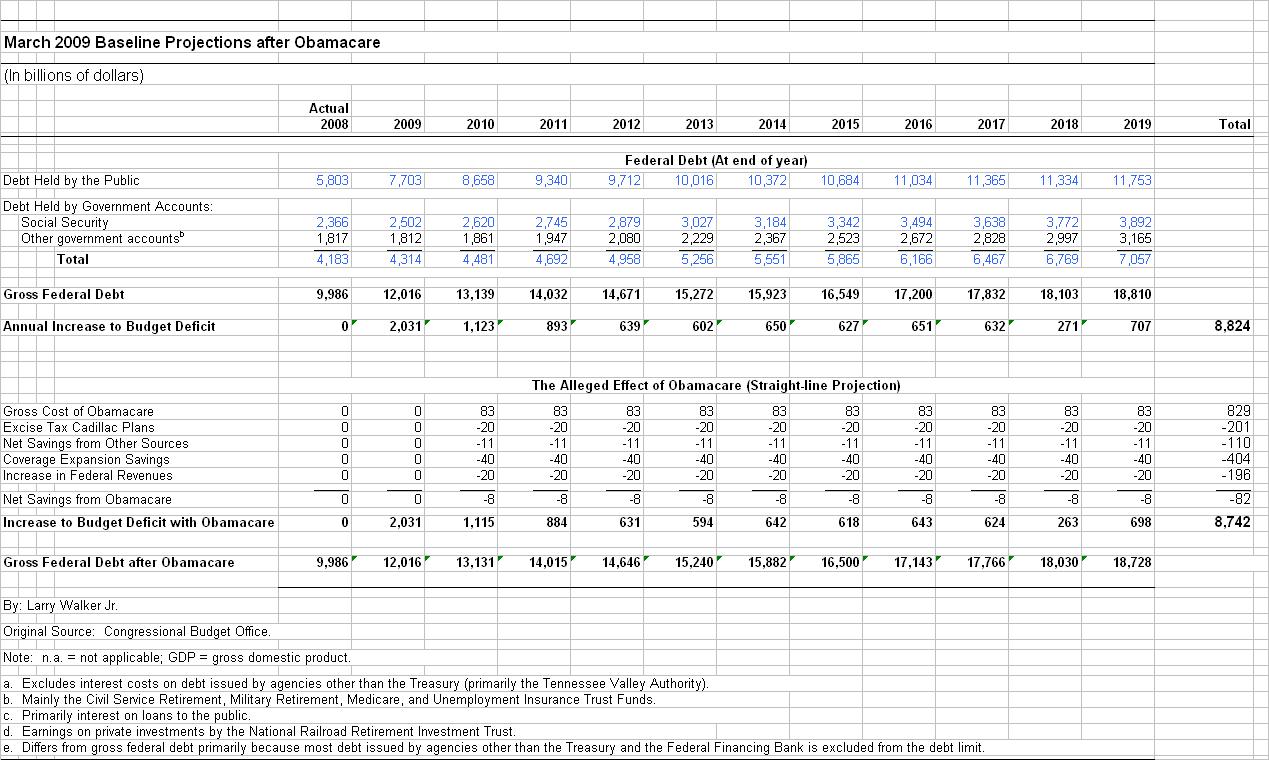
The above table attempts to show you the effect of Obamacare on the National Debt. Since Obamacare is projected to save $82 billion through 2019, I have simply applied the CBO’s initial scoring of the Senate Bill on a straight-line basis (an equal amount for each year). I used straight-line because no one really knows how they come up with this stuff. So after Obamacare, we would save $82 billion over 10 years, right. Well, actually, since the Government was already projected to overspend by $8,824 billion ($8.8 trillion for the math weary) over the rest of the decade, this only represents a savings of 0.93%. And remember, that’s a savings of the amount of deficit spending, not a reduction to the National Debt. Deficit spending is deficit spending in my view.

Click to Enlarge

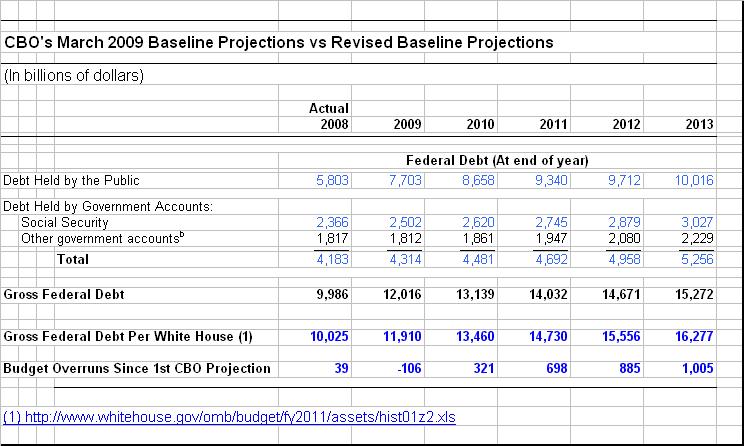
The final table (above) reveals the revised debt projections as published by the White House. As you can see, just through the year 2013, the Government is already projected to spend $1 trillion more than what was projected in March of 2009. So Obama will already spend $1 trillion more than he projected, and now he’s proposing to knock that down by a whopping $82 billion over 10 years, by destroying the health care industry. And we’re supposed to be happy?

Conclusion: The President is very sincere in his efforts to justify Obamacare as a means of fiscal responsibility. However, he fails to address the main problem – Out of Control Government Spending. Obama himself is projected to spend over $1 trillion more than he projected a year ago. The Federal Government will have a National Debt of $16.2 trillion by the year 2013. Although Obamacare may save 0.93% of Obama’s own, out of control, deficit spending (a percentage which is declining every second) over the next decade, it fails in that:

  1. It will not stop the deficit spending.
  2. It will not pay down the National Debt.
  3. It will not provide health coverage for all Americans.
  4. It will not reduce the cost of health insurance.

And then there’s the question of what’s going to happen after the first decade. Not even the CBO can legally answer that question. In my opinion, Obamacare is nothing but a token bill designed to stroke Obama’s ego. It will have virtually no effect from a fiscal standpoint, and could trigger many negative side effects. So I ask, what’s the point?

__________________________________________________________

Update 3/18/10

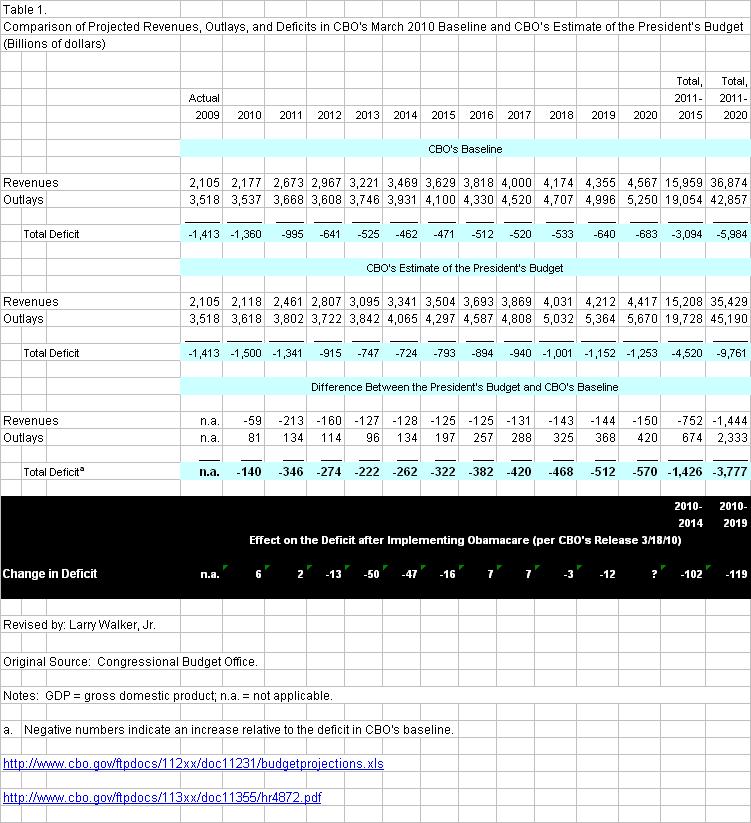
The top section of the following table is from the CBO’s March 2010 Baseline and CBO’s Estimate of the President’s Budget here. For the fiscal years 2011 through 2020, the President’s budget came out $3.777 trillion more in the red than CBO’s baseline, resulting in total deficit spending by Obama of $9.761 trillion between 2011 and 2020, or $11.2 trillion from 2010 through 2020.

I overlaid the lower section with the CBO’s stated effect of Obamacare on the deficit, from Table 1 (page 6) of their scoring report, which was released on 03/18/10 here.

Click to Enlarge

So it’s even worse than I stated yesterday. Obama will overshoot the baseline budget by $3.777 trillion, and will add $11.2 trillion to the National Debt between 2010 and 2020. And he thinks that by passing Obamacare and destroying the US Health Care Industry in the process, that it is worth it, in order to save $119 billion (or $138 or whatever) over the first 10 years. If you ask me $119 billion (or $138 or whatever) in savings looks pretty pathetic when Obama and Congress are already on course to increase the national debt by $11.2 trillion in reckless spending.

This makes Democrats giddy? The whole borrow and spend fest makes me mad as hell. And as far as the second decade goes, I don’t see any compelling evidence in the CBO report that would guarantee that the deficit would continue to fall. And even if the deficit would fall by $1 trillion in the second decade, this would only partially offset an additional $10 trillion (or more) of reckless deficit spending if Washington continues on it’s present disastrous path.

And by the way, the report doesn’t say that the deficit will fall by $1 trillion in the second decade. It does, however, mention that the savings generated by the education provisions would outweigh the costs related to the health care provisions. In otherwords, by fundamentally ‘destroying’ the education system, they can justify destroying the health care system, but this only works for ‘giddy’, power grabbing, debt laden, incumbent Democrats.

Sources:

http://www.cbo.gov/ftpdocs/112xx/doc11231/budgetprojections.xls

http://www.cbo.gov/ftpdocs/113xx/doc11355/hr4872.pdf

Cost Analysis Health Care Bill

http://www.whitehouse.gov/omb/budget/fy2011/assets/hist01z2.xls

Obama’s Big Lie at Today’s Rally: "Your Employer Would See Premiums Fall By As Much As 3000 Percent"

Obamacare Rally in Strongsville, Ohio

March 15, 2010

“How many people are getting insurance through their jobs right now, raise your hands, a lot of those folk, your employer, it’s estimated would see premiums fall by as much as 3000 percent so they could give you a raise.”

More lies and desperation from Obama. He fools these poor suckers in Strongsville, Ohio into believing that under his health care plan, employer’s health insurance premiums will fall by as much as 3,000%. And they just soaked it up, until one of them fainted. Poor suckers.

I guess by the time Obama get’s done, we’ll all be getting paid to have health insurance. What a moron.

Just vote no today and we’ll settle it in November.

Kudos to: Hot Air Pundit, and Town Hall

Obama’s Illogical Health Care Act

Random Thoughts from an Independent Fiscal Conservative

  1. If the insurance industry does away with preexisting conditions, then health insurance costs will go down. Yeah, unless those people really get sick, and then health insurance costs will skyrocket.
  2. If younger workers who don’t want health insurance are forced to buy it, then health insurance costs will go down. Except, of course, for those who don’t pay for health insurance now.
  3. If everyone had health insurance then the quality of care would improve? Unless, of course, we don’t address the quality of health care.
  4. If we had passed Obamacare the Federal government’s monthly budget deficit would have only been $210 billion instead of $220 billion, in February. What a noble achievement. And what about the other $210 billion? Do we perhaps have bigger fish to fry?
  5. If 30 million people who can’t afford to pay one extra dime for health insurance are forced to buy it, then health insurance costs will go down. Except for those individuals who were not paying and now have to pay, and the rest of the population who will have to make up the difference.
  6. We got the Stimulus wrong, but we will get health care right. Fool me once, shame on you. Fool me twice, shame on me.
  7. The reason health insurance costs are rising is because of publicly traded, and (mostly) non-profit health insurance companies greed. Of course it couldn’t be related to the fact that Medicare and Medicaid undercut payments to doctors and hospitals, which makes insurance costs rise for the privately insured.
  8. Nobody complains about Medicare. And why would they? I mean it’s practically free, it’s completely insolvent, and it’s the cause of most of our national debt.
  9. We must pass Obamacare by March 18th. A more noble goal would be to draft a final bill first, then get public feedback, discuss it, debate it, and then vote. Is this deja vu?
  10. The American people want Obamacare to pass. No. The American people want Congress to start over and to calmly and rationally pinpoint the more pressing problems of the day, and to address those with logical and coherent solutions. Solutions that everyone would agree upon. In reality, there are only a few purple shirts out there who are being paid $15 per hour to act like they want it passed. The rest of us (unpaid and under appreciated) are willing to wait for the next Congress and the next president. Hopefully, a president who’s not all tanked up on Nicorette gum. And preferably a Congress who is less concerned with bribes and racketeering, and more concerned with facing facts with logical, non-political solutions.

End of Random Thoughts………

Give Me a Tax Cut, or Give Me Death II

Small Business Tax & Toil

By: Larry Walker, Jr.

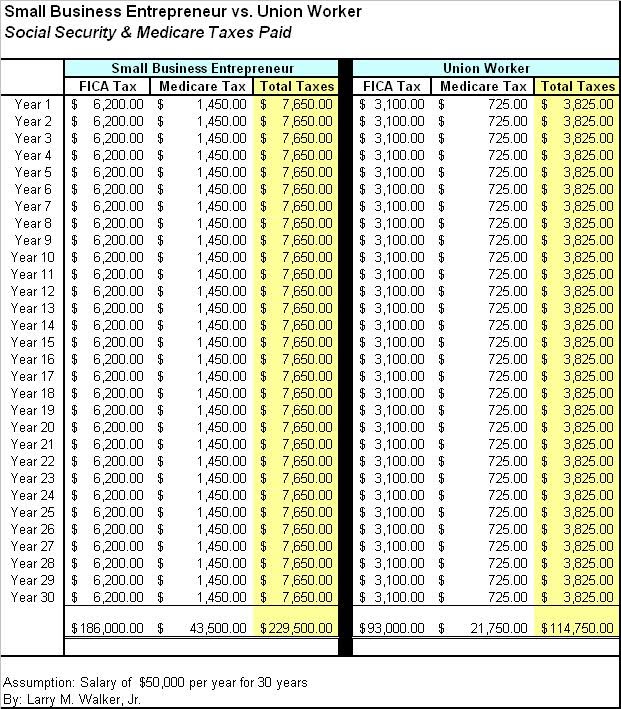
Small business owners, like myself, pay twice as much in Social Security and Medicare Taxes as regular employees. Yet when we ask for a payroll tax cut on our own pay, what we get from the government is a crackdown on regional banks to give us more loans. Aside from the fact that 140 of these banks have failed since January 16, 2009 (here), what Obama’s Cluelessian economists fail to understand is that wealth is not created through amassing debt.

If Obama wants to run the Federal Government based on the myth that wealth is created through debt, that’s one thing, but his attempt to sell this ideal to small business owners like myself makes him look inept. Small businesses are already in debt. Adding more debt does not translate directly into increased sales, but rather into higher monthly principal and interest payments (aka. ‘paying current expenses out of future income’). It’s one thing to borrow money to start a venture, or to secure lines of credit for working capital, but it’s entirely another to pile debt upon debt in a degenerating economy.

Wealth is created by increasing sales of products and services while maintaining or reducing expenses. Bankruptcy is achieved through maintaining or increasing expenses in the face of declining revenue. It is a fact, not a theory, that Obama’s reckless economic policies will lead to the latter.

So what is the Small Business solution? What could possibly help small business owners survive in the face of a colossal governmental failure? A payroll tax cut for one. And what is it that justifies a payroll tax cut for small business owners? As I pointed out in Part I, small business owners pay an unfair burden of Social Security and Medicare Taxes, and we receive nothing in return. By nothing, I mean that we will receive the same benefits as regular workers after having paid twice the amount of payroll taxes (see the chart below).

Click To Enlarge

What we are asking for is fair. What we are asking for is economic justice. We want the Federal Government to stop unfairly burdening small businesses with an unjust burden of payroll taxes with no corresponding benefit. All we want back is some of our own hard earned money, produced from our own toil, in order to improve the future economic outlook of our communities and our nation.

If we get our desired tax cut, what will small business owners do? We will have been aided in paying our bills, in reducing our current debt, in not having to lay off additional workers, and in having survived for another day. And we will have done so with our own money, and not through a government handout.

Who will die? When I say, “give me a tax cut, or give me death”, it won’t be me or my fellow entrepreneurs who die. The first casualty will be the next laid off employee, and eventually the Federal Government. Every employee we lay off leads to negative government revenue, and reduced GDP. Most of us can scale back on spending and survive, but one can only cut so much before creditors are jeopardized. The Federal Government is well on the road that leads to death.

We will survive, but will the Federal Government? Small businesses have been cutting back on spending in the face of the economic decline. The Federal Government, on the other hand, has been increasing its debt. If Obama’s incompetent economic theory leads to the bankruptcy of the United States government, then that is just a natural consequence of spending more than annual revenue, year after year. Eventually the principal and interest payments will surpass revenue. But that’s Obama’s plan and not the road for me. As for me,

Give me a tax cut, or give me death!

Tips: 5 Ways To Manage Business Debt

Obamacare, Obamanomics and Inverse Logic

Do the math

“If an object is a polygon then it is a triangle (false).”

By: Larry Walker, Jr.

You can’t solve a problem until it has been defined. The Federal government, once again, has failed to define the problem. Being led by the novice, Nobel Prize Winning, Barack Obama, the Congress has become another hostage on the road to Socialism. What is the real problem?

The Problem

Firstly, per the Bureau of Labor Statistics, since the start of the recession in December 2007, the number of unemployed persons has increased by 7.6 million to 15.1 million, and the unemployment rate has doubled to 9.8 percent (1).

Secondly, per my research in, “The IRS as Health Insurance Police,” there are currently 12.6 million delinquent taxpayers who owe the Federal Government $115.5 billion (2).

And finally, per my last blog, “Common Sense vs. Obamanomics,” where are the jobs (3)?

The Plan to Nowhere

The Government’s plan: Pass a massive health care bill with the ‘hope’ that (a) the 12.6 million will pay their back taxes along with the new increase for mandatory health care, and (b) the 15.1 million will miraculously find jobs (on their own) to be able to pay for their health care. Sounds to me like a plan going nowhere.

The Real Cost?

Based on my research in, “The Health Insurance Black Hole,” when it’s all said and done and we have Universal Health Care, the cost will be approximately $747 per month for an individual, and $2,990 per month for a family of four. That’s $35,880 per year for a family, and $8,964 for an individual (4). To me this is an outrageous increase from my present rate of $188 per month with an H.S.A. Plan. And according to Congress, this will reduce the deficit (which they have run up with reckless abandon) in the long-term.

I’m sure! Raising every American’s health insurance costs by $6,708 per year should reduce the deficit in the long run, but what does that do for our individual health? It seems to me that health care reform has just become a crafty way of raising taxes by playing on the sympathies of kindhearted American’s. No matter how you frame it, it’s a tax increase.

“If a policy is a tax increase then it is a tax cut (false).”

Questions Unanswered

  1. How will the 15.1 million unemployed American’s pay for their health insurance? Will the employed have to pay more to cover them?
  2. How will the 12.6 million who already owe back taxes be able to pay them while paying for the new health care tax?
  3. If you subtract the 27.7 million who can’t pay for their health insurance, how much will it really cost those who are employed?