Taxing Inflation: Why Americans Invest Overseas

Artificially Raising Taxes Reduces GDP

– By: Larry Walker, Jr. –

“Tax increases appear to have a very large, sustained and highly significant negative impact on the economy.” ~ Christina Romer, just prior to leaving the Obama Administration –

U.C. Berkley Professor and President Obama’s former Chair of his Council of Economic Advisers (CEA), Christina Romer, published a paper in 2010, concluding that a tax increase of 1 percent of GDP, about $160 billion today, reduces output over the next three years by nearly 3 percent, or $480 billion at current GDP figures. And according to the Bureau of Economic Analysis, per capita personal income is currently running at around $37,500. Thus, Barack Obama’s plan to raise taxes on the most productive American citizens would result in a loss of around 12.7 million jobs over the ensuing three-year period. But fortunately, U.S. policy makers aren’t naïve enough to place their trust in the hands of a novice. I wonder what India’s economists think.

In India, GDP is expected to grow by 6.5% this year, and by 7.1% in 2013, or more than 3 times the rate of the U.S. And according to the President of the Confederation of Indian Industry, Adi Godrej, “Artificially raising taxes will reduce GDP.” What he says in the following one minute video should be common sense. To paraphrase Mr. Godrej, ‘The tax to GDP ratio is best increased when GDP growth is good. When GDP growth is good, economic activity, tax collections, and the tax to GDP ratio increase. But it goes exactly the other way when GDP growth slows down. Thus, high rates of taxation are against the interests of the country. Reasonable tax rates with policies designed to increase GDP growth is the best way to increase the tax to GDP ratio.’

U.S. Capital Gains Taxes

In 1997, the Republican-led Congress passed a tax-relief and deficit-reduction bill that was resisted but ultimately signed by President Clinton. One of the things the 1997 bill did was lower the top capital gains tax rate from 28 percent to 20 percent. It was actually the 1997 tax cuts, not the 1993 Clinton tax hike, which produced the boom of the 1990’s. The reduction of capital gains rates encouraged greater investment, which lead to GDP growth, and an increase in both economic activity and tax collections.

The same policy will work today. However, what Barack Obama is proposing is exactly the opposite. Obama’s notion of raising income taxes on some taxpayers, health care taxes on others, and capital gains rates on investors, to name a few, amounts to an artificial tax hike, which most economists agree will result in a reduction of GDP. Thus, Obama’s tax hikes are not in the best interests of the country. But he doesn’t appear to care about our common welfare.

Obama’s policies are admittedly not about economic growth, but rather about furthering his self contrived, yet erroneous, notion of fairness. Yet the truth is that the very concept of taxing capital gains is in itself unfair. The method in which capital gains are calculated in the United States is antiquated, illogical, and actually hinders our ability to reach a full recovery. In order to understand the dilemma, one must put himself in an investors place.

An Example: Let’s say an investor makes a five year commitment to invest $100,000 into a public or private company stock. And let’s say the rate of inflation is averaging 3.0% per year. By the time the investment is sold, what cost $100,000 five years ago, may cost as much as $115,000, due to inflation. So if no gain is realized on the investment, the investor automatically loses $15,000 in purchasing power.

Now let’s assume that five years later the investment has grown from $100,000 to $115,000. Under the current U.S. tax code, upon redemption of the stock, the investor is subject to a 15.0% tax on the gain. A capital gain of $15,000 is calculated by subtracting the amount of the original investment from the sales price ($115,000 – $100,000), and the amount of tax due is $2,250 ($15,000 * 0.15).

So to summarize, an investor made a 5-year investment of $100,000, recognized a long-term capital gain of $15,000, paid a capital gains tax of $2,250, and got to keep $12,750, or 85.0% of the gain. Most people think this is fair enough, but there are a few scoffers out there who think a 15% capital gains tax is too low. So let’s examine the question of fairness.

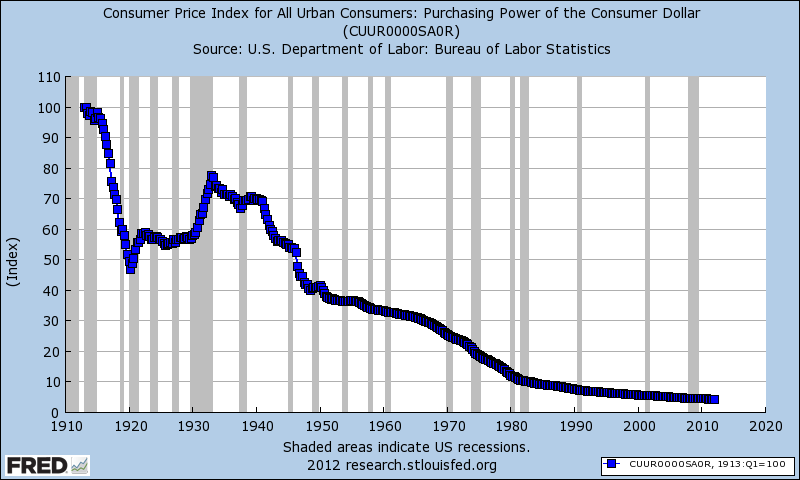
Most of us are aware that the dollar has lost roughly 96% of its value since 1913 (see chart at the top). With that in mind, if instead of investing the $100,000, as in the example, the investor chose to hide it under a mattress, what would happen? For one thing, no taxes would be due. But at the same time, when the money is spent, 5 years later, its purchasing power will have declined by $15,000, again due to inflation. In fact, the reason most people choose to invest their money is to simply maintain the purchasing power of their savings.

In the example, the investment barely appreciated enough to keep pace with inflation. Therefore, no gain was realized. Inflation ate up $15,000 of the investor’s purchasing power, which was merely recovered through appreciation in the stock. But now along comes the U.S. government to lend a helping hand. And because of its antiquated and illogical tax policies, the federal government levies a 15% tax on what, for all practical purposes, isn’t a gain at all. The government then collects what it deems to be its fair share of a gain, but the investor hasn’t actually gained a dime. In fact, once the tax is paid, the investor realizes a loss in purchasing power. Does that sound fair? Who knew that maintaining the value of the currency in ones possession was a taxable event?

Capital Gains in India and Elsewhere

In India, capital gains are computed differently than in the U.S. Under India’s tax law an investor is allowed to increase the cost of the original investment by the annual inflation index, before computing a gain or loss. Had this been done in the example above, the basis of the original investment would have been stepped up to $115,000 before computing a net capital gain of $0 ($115,000 – $115,000). In India, it is considered unfair to tax someone for merely recouping the inflation adjusted value of an investment. It’s unfair because the sales proceeds of an investment are derived from the current value of the currency, whereas its cost was based on a value that existed in the past (five years prior in the example above).

The following countries are even more progressive, they don’t tax capital gains at all: Belize, Barbados, Bulgaria, Cayman Islands, Ecuador, Egypt, Hong Kong, Islamic Republic of Iran, Isle of Man, Jamaica, Kenya, Malaysia, Netherlands, Singapore, Sri Lanka, Switzerland, and Turkey. Other countries, like Canada and South Africa do levy a capital gains tax, but only on 50% of the gain. A few nations even allow their citizens to defer capital gains taxes entirely by allowing them to rollover their gains into a new investment within certain time frames.

One has to wonder why anyone in their right mind would be encouraged to invest in the United States. Considering that inflation doesn’t stop when an investment is sold, while the money is sitting around waiting for the tax to be paid, it continues to lose value. And once the tax is paid, the remainder continues to diminish in value until it is ultimately reinvested. In light of the colossal decline in the value of the U.S. dollar over the past 100 years, the question we should be asking ourselves is not what rate to levy on capital gains, but rather why the tax even exists?

Pro-Growth Tax Policies

No wonder many Americans choose to invest abroad, and in some cases to renounce their citizenship entirely. These days, if you want a fair shot, and if you want to pay your fair share, you might have to set your sights beyond the shores of the United States. The bottom line is that the U.S. Tax Code needs an overhaul. Our tax policies should be upgraded to something more along the lines of reason and common sense. Like India, we should at the very least index the basis of long-term capital investments to inflation, for purposes of determining taxable gains (and deductible losses). This concept should be applied to all forms of capital investment.

If the federal government refuses to implement policies which encourage GDP growth, then how does it expect the economy to grow? When our wealth is being slowly eroded by inflation, and then we’re taxed on the deteriorating value of our currency, it pretty much makes investing in the U.S. futile. If the federal government wants to encourage investment in the U.S., which is what it should do, in order to stimulate GDP growth and create jobs, then our elected officials should stop talking about raising tax rates on both ordinary income and capital gains, and start discussing ways to lower the tax burden and make our system fairer and comparable to more just investment havens.

Here’s some more food for thought. Why is interest income taxed? When a saver is earning less than 1.0% at a domestic bank, while inflation is running at more twice that rate, why is the federal government entitled to any part of what amounts to a decline in purchasing power? What you earn on a bank account these days isn’t interest income; it’s more like a taxable capital loss. What about dividends? Dividends are already taxed once at the corporate level, are not deductible by corporations for tax purposes, and then are taxed again after distribution to the investor (double taxation)? Taxing interest and dividends isn’t fair either, and the practice should therefore be repealed.

No American should ever have to pay a tax on capital, especially when upon its return the inflation adjusted value is the same or less than the original amount. Is the U.S. taxing the eroding value of the dollar because it makes sense, or perhaps because when the tax code was conceived no one anticipated that the dollar would lose 96% of its value over the ensuing 100 years? If you think our current method of taxing interest, dividends and capital gains is fair, then please explain your reasoning. If you think that taxing the deteriorating value of the dollar is a way to foster economic growth, then why has real GDP growth only averaged approximately 1.5% in the United States over the last 12 years?

“Action expresses priorities.” ~ Mahatma Gandhi

References:

India Tax Laws and Tax System 2012

Tax Rates in India

India Mart – Computation of Capital Gains

Nine Million Dollars – Long Term Capital Gains Tax (LTCG) on Property Sale

Heritage Foundation – Tax Cuts, Not the Clinton Tax Hike, Produced the 1990s Boom
Wikipedia – Capital Gains Tax

Economic Dependence vs. Independence, Part 2

* Continued from Part 1 *

School #2 – Higher Income Tax Rates

Within the second school of thought, Barack H. Obama speaks as though something most of us believe in no longer exists, or is at threat of extinction. According to Obama, ‘the idea that if you work hard, you can do well enough to raise a family, own a home, and put a little away for retirement’ is at risk, and that ‘this is the defining issue of our time’. But what he doesn’t understand is that like God, natural rights and divinely inspired ideals never change. The basic ideal Obama is referring to is called freedom. So is our freedom suddenly at risk of extinction? If it were, could it possibly be restored by raising taxes on the most productive members of our society?

“What’s at stake is the very survival of the basic American promise that if you work hard, you can do well enough to raise a family, own a home, and put a little away for retirement. The defining issue of our time is how to keep that promise alive. No challenge is more urgent; no debate is more important. We can either settle for a country where a shrinking number of people do really well, while more Americans barely get by. Or we can build a nation where everyone gets a fair shot, everyone does their fair share, and everyone plays by the same rules. At stake right now are not Democrat or Republican values, but American values – and for the sake of our future, we have to reclaim them.” ~ Barack Obama, January 24, 2012. Blueprint for an America Built to Last.

Newsflash: We are still free. The American Dream has been in existence ever since our Founding Fathers penned the Declaration of Independence. There’s a reason it wasn’t named the ‘Declaration of Dependence’, for that is what we were delivered from. The Declaration of Independence in itself is the only blueprint America will ever need. It doesn’t guarantee anyone success, but it does allow us the freedom to succeed by any means we deem necessary. For those who want to do well enough to raise a family, own a home and put a little away for retirement, lower across the board tax rates are the way to go. But entrusting more of what money one is able to garner to a wicked and lazy servant, such as our current bloated federal government, is of no use towards that end.

Big government is like the servant who was given one talent, except instead of burying and returning it to his master; he spent it, then borrowed another in his master’s name, and spent that as well, returning to his master a bill for two additional talents. Under the second school of thought, we’re taught to take from those who are productive, to throw it away, and then borrow more in their name, eventually turning them from free men into indentured servants. So although no man can take our freedom from us, we can voluntarily give it away. How is an economy supposed to grow when resources are taken away from its most productive members, and squandered?

For this lazy and wicked government, one dollar is too many and a thousand is never enough, so why is it deserving of anything at all? We entrusted the federal government with a $2,600,000,000,000 surplus of Social Security savings, yet where is it today? It’s now part of the $16,000,000,000,000 national debt, the portion of which the government claims to have borrowed from itself. And who will the government get the money from to pay back what it has borrowed from itself? The government will return to those same productive members of the private sector and demand even more. How dare you! It’s time to identify those who are responsible and throw those worthless servants outside, into the darkness!

U.S. taxpayers will have given the current administration over $10,000,000,000,000 during its recent four-year term, and where is that? Did the government return it two-fold? Did we even get back the flaunted $1.79 we were promised for each dollar spent on unemployment benefits and food stamps? No. Not only has the government squandered every dime, but it has handed us a bill for an additional $6,000,000,000,000 in accumulated debt. You know we’re gonna identify and throw each and every irresponsible, lazy and wicked government servant out into the darkness, from the top down.

Conclusion

Under the morally correct theory, tax cuts lead to a smaller government and more private sector freedom, allowing productive men and women of all races and backgrounds to create wealth, by leveraging their own resources. But under the morally bankrupt theory, wealth is never created with resources handed out through redistributive schemes, as redistribution merely keeps its recipients poor and dependent, while robbing society’s most productive members of their capital.

Put another way, every man and woman is endowed by their Creator with certain talents, but not everyone achieves equal results – some produce thirty fold, some sixty, and some one hundred fold. This has been true since the beginning of creation. But then there are those rare birds, who not only squander the talents entrusted to them, but incur huge deficits along the way, some thirty, some sixty and some one hundred fold. Because these wicked and lazy servants seek to drag as many as they can latch onto down with them, they must be cast out.

The radical left thought it could rewrite American history, within a couple of years, by conning us into believing that we had lost something which, in reality, has always been in our possession. But radical left-wingers are severely misguided. Our freedom will not be taken away without a fight. America didn’t need a new blueprint. What we needed four years ago is the same thing we need today, someone to execute the blueprint written by our Founding Fathers 236 years ago. Therefore, the radical left-wing must be expelled. In conclusion, the centre-right philosophy is more in line with what America needs today: lower taxes, less government, and more economic freedom.

“In the last times there will be scoffers who will follow their own ungodly desires. These are the men who divide you, who follow mere natural instincts and do not have the Spirit.” ~ Jude 1:18-19

“He who has ears, let him hear.” ~ Matthew 13:9

Photo Credit: Baruch College Blogs – Remembering What Was Meant To Be Forgotten

Economic Dependence vs. Independence, Part 1

Two Schools of Thought

* By: Larry Walker, Jr. *

“Again, it will be like a man going on a journey, who called his servants and entrusted his property to them. To one he gave five talents of money, to another two talents, and to another one talent, each according to his ability. Then he went on his journey. The man who had received the five talents went at once and put his money to work and gained five more. So also, the one with the two talents gained two more. But the man who had received the one talent went off, dug a hole in the ground and hid his master’s money.” ~Matthew 25:14-18

One interpretation of the Parable of the Talents is that the master is an employer who hired three workers and paid them different amounts according to their ability. The first two workers were productive, doubling their employer’s investment. The third didn’t like the employers pay structure, and chose not to work, giving up a potential paycheck. In the age we live in today, the era of big government, government is the new master. An oversized government takes the eight talents from the employer in taxes, before it can employ anyone, redistributes one talent to each of the unemployed, and then squanders the rest on worthless thingamajigs. In the following year, bloated government returns, and demands of the employer another eight talents to do it all over again. Eventually the employer moves to Costa Rica to get away from its oppressive master, and big government goes bust.

School #1 – Lower Income Tax Rates

In the first school of thought, the words of former President’s John ‘Calvin’ Coolidge, Jr., John F. Kennedy, Ronald W. Reagan, and George W. Bush forever live, reminding us that high income taxes are the single largest barrier to job creation and economic growth. And if we don’t lack job creation and economic growth today, then what do we lack – higher taxes and more social welfare benefits? Perhaps we should listen more to reasoned voices from America’s past, and pay less attention to the failed Western European influenced bloviating of the present.

“There is a limit to the taxing power of a State beyond which increased rates produce decreased revenue. If that be exceeded intangible securities and other personal property become driven out of its jurisdiction, industry cannot meet its less burdened competitors, and no capital will be found for enlarging old or starting new enterprises. Such a condition means first stagnation, then decay and dissolution. There is before us a danger that our resources may be taxed out of existence and our prosperity destroyed.” ~ Calvin Coolidge, January 8, 1920. Address to the General Court beginning the 2nd year as Governor of Massachusetts.

“The largest single barrier to full employment of our manpower and resources and to a higher rate of economic growth is the unrealistically heavy drag of federal income taxes on private purchasing power, initiative and incentive.” ~ John F. Kennedy, Jan. 24, 1963. Special message to Congress on tax reduction and reform.

“We don’t have a trillion-dollar debt because we haven’t taxed enough; we have a trillion-dollar debt because we spend too much” ~ Ronald Reagan – 40th US President (1981-1989)

“He said, tax the rich. You’ve heard that before haven’t you? You know what that means. The rich dodge and you pay.” ~ George W. Bush – 2004

Across the board income tax cuts always deliver results, as they allow productive members of society, from all races and social classes, from the least to the most productive, to earn and keep more of their own money. As this phenomenon occurs, those affected are incentivized to produce, consume, save and invest more. The resultant growth spills over into the broader economy allowing nonparticipants to reenter the workforce, or enter for the first time. This concept was good enough for Coolidge, JFK, Reagan and G.W. Bush, whose across the board tax cuts delivered for each an era of relative growth and prosperity for millions of Americans. So what’s the excuse today? For answers, we return to the Parable of the Talents:

“Then the man who had received the one talent came. ‘Master,’ he said, ‘I knew that you are a hard man, harvesting where you have not sown and gathering where you have not scattered seed. So I was afraid and went out and hid your talent in the ground. See, here is what belongs to you.’ His master replied, ‘You wicked, lazy servant! So you knew that I harvest where I have not sown and gather where I have not scattered seed? Well then, you should have put my money on deposit with the bankers, so that when I returned I would have received it back with interest. Take the talent from him and give it to the one who has the ten talents. For everyone who has will be given more, and he will have an abundance. Whoever does not have, even what he has will be taken from him. And throw that worthless servant outside, into the darkness, where there will be weeping and gnashing of teeth.’” ~ Matthew 25:24-30

The radical left believes that if the servant who was given one talent had instead been given two or five, he might have been as productive as the others. Although some would think this a possibility, it wasn’t likely, for in the parable, each was given an amount according to his ability. The worthless servant simply proved himself to be lazy and wicked. But instead of casting him out into the darkness, the radical left, which has become a bastion of the lazy and wicked itself, believes it is the responsibility of the productive to provide sustenance for those unwilling to work.

The moral of this story is that when the free market is given liberty to place money into the hands of the fruitful, it benefits all who are willing to participate. So politicians who constantly clamor for higher taxes on more productive persons, including corporations, have it backwards. The lesson teaches us that when resource allocators are allowed to direct their own capital at will, jobs are created and the economy grows. It also teaches us that when wicked and lazy people are given an opportunity to succeed, they instead run and hide.

Taxes are too high!

The point is not that we are a nation of wicked and lazy people, but rather that income taxes are still, after all the lessons learned throughout American history, way too high. Yet the government demands more. Today, the minimum income tax rate in the United States is 10%. But add to that 13.3% in mandatory Social Security and Medicare taxes, and lowest rate is really 23.3% (25.3% in normal years) for most Americans. Even the poorest working person in America has 13.3% of their income confiscated from each paycheck (7.65% of which is paid by their employer). Compare this with Coolidge’s bottom tax bracket rate of 1.5% in the mid 1920’s, an era which predated the imposition of Social Security and Medicare taxes, and you begin to understand the dilemma. In fact, the top tax rate in the 1920’s was 25.0%, which is less than the 28.3% paid by most in the middle class today (a 15% income tax, plus 13.3% in Social Security and Medicare taxes).

These days, the American middle class muddles along after handing around 30.0% of its income over to the government, while those who are more productive are forced to give up as much as 45.0%. Yet the government demands more. If you take a moment to contrast the minimum income tax rate of 1.5% in the mid-1920’s with today’s minimum rates of 13.3% to 23.3%, you will understand the real disparity. Looking back through American history, it is clear that we suffer not so much from income disparity, as from an income tax disparity. In other words, we are much poorer than our ancestors.

In the mid-1920’s, our great grandparents worried about paying income tax rates ranging from 1.5% to 25.0%, while today we are forced to contend with taxes ranging from 13.3% to 45.0%. We worry about how much the government will confiscate beyond a virtually guaranteed minimum rate of 13.3% of the first $106,800 in earnings, which is 886.7% higher than our ancestors lowest tier. As things stand today, the government isn’t giving us anything; instead it is taking our talents and burying them under a pile of debt. So by lowering income tax rates across the board, the government won’t be giving anything to anyone, but rather proportionally reducing the amount it already takes from everyone.

The Exxon Mobil Fallacy

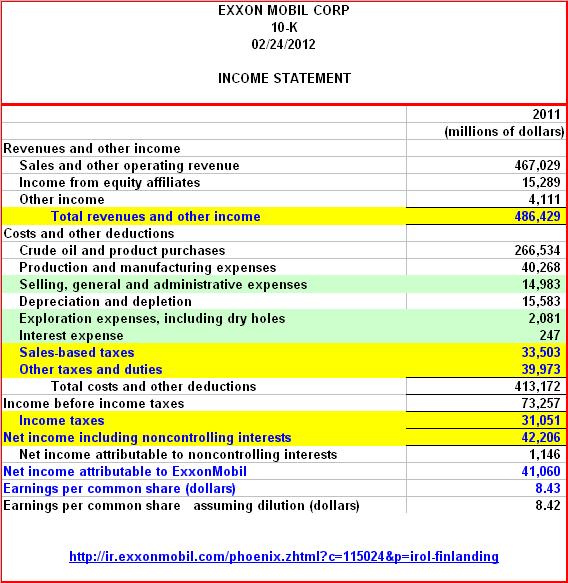
For example, many on the radical left routinely spout off, that since Exxon Mobil Corp made $42 billion in profits last year, more should be taken away from it and given to the government. While it’s true that Exxon Mobil earned net after-tax profits of $42.2 billion in 2011, the company actually made a profit of $146.7 billion before taxes. That is to say, once you deduct out $33.5 billion in sales based taxes, $40 billion in other taxes and duties, and $31 billion in income taxes, it was left with $42.2 billion (see income statement below).

In effect, Exxon Mobil paid 71.2% of its pretax profits, or $104.5 billion, in sales based taxes, other taxes and duties, and income taxes, before it was able to take home 28.8%, or $42.2 billion. If 71.2% isn’t enough for left-wing radicals, then how much is enough? Is profit a dirty word? Exxon Mobil is a producer, and the more leeway granted to the productive, the more wealth is created. If the government takes even more capital away from producers like Exxon, who would radical left-wingers propose it be given to? Is there another entity around that can turn higher profits than Exxon Mobil? Left-wingers have it all backwards.

The radical left surmises that we should take more away from Exxon and give it to the government, so that the government may in turn give a small penance to nonworking, nonproducing members of society, and squander the rest. They propose to take away more of Exxon Mobil’s resources and incentives because the company and its industry return large profits. But the morally correct thing to do is to take more away from the nonproductive, like our debtor-government in Washington, DC, and let companies like Exxon Mobil go gangbusters. Would you rather invest your money in Exxon Mobil’s stock, which is paying a better than $8 per share dividend, or in the U.S. Government, which is currently running a debt per U.S. taxpayer of $139,000 (subject to increase each second)? This should be a no-brainer.

Continued … Economic Dependence vs. Independence, Part 2

Photo Credit: Baruch College Blogs – Remembering What Was Meant To Be Forgotten

Obama’s Economic Fallacy: The Not-To-Do List

Small Business Goals, Rewards and Incentives

* By: Larry Walker, Jr. *

“Contrariwise, if it was so, it might be; and if it were so, it would be; but as it isn’t, it ain’t. That’s logic.” ~ Lewis Carroll *

In his latest weekly address, Mr. Obama outlined a mirage of goals, rewards and incentives which he says Congress ‘must’ act upon immediately. But for the most part, what he proffered are just more of the same tried and failed policies, conjured from the same line of illogical reasoning we’ve heard, time and time again, over the last four years. Therefore, what Mr. Obama coined as a “Congressional To-Do List” should rather be endorsed as the official “Not-To-Do List”. Why? Well, let’s test the logic of just one item on the, so called, ‘To-Do List’.

Mr. Obama said, “Third, Congress should help small business owners by giving them a tax break for hiring more workers and paying them higher wages. Small businesses are the engine of economic growth in this country. We shouldn’t be holding them back – we should be making it easier for them to succeed.”

In order to understand why Mr. Obama’s argument is fallacious, one must understand what an argument is. Very briefly, an argument is an attempt to persuade someone of something, by giving reasons or evidence for accepting a particular conclusion. It consists of one or more premises followed by a conclusion. In a logical argument, the premises support the conclusion. When we place Mr. Obama’s argument in its proper order we arrive at the following:

Premise 1 – Small businesses are the engine of economic growth in this country.

Premise 2 – We (the government) shouldn’t be holding them back – we should be making it easier for them to succeed.

Conclusion – Congress should help small business owners by giving them a tax break for hiring more workers and paying them higher wages.

No one in their right mind would disagree with either premise. Yes, small businesses are the engine of economic growth in the USA. And no, the government shouldn’t be holding us back, but should rather get out of our way, and off of our backs, so that we may succeed. However, the premises Mr. Obama presented do not support his conclusion.

Will the act of offering or failing to offer the reward of tax breaks to small businesses, that hire more workers and pay higher wages, make them any more, or less, the engine of economic growth in America? Will the act of passing additional governmental laws, rules, regulations and loopholes make it any easier for small businesses to succeed?

As a small business owner myself, I can state first hand, that offering my company a reward for hiring more workers and paying them higher wages won’t help my company in the least. That’s because nowhere in my mission statement will you find the stated goals of hiring more workers and paying them higher wages.

How many small business owners do you know that are in business for the purpose of hiring more workers and paying them higher wages? I’m in business to provide a top quality, affordable service, and to hopefully make a profit in the process, not to hire more workers and pay higher wages.

In my world, hiring more workers and paying higher wages are by-products of increased demand. But since demand is still a far cry from where it was in 2007, why would I suddenly alter my goals toward hiring more workers and paying them higher wages? If demand were to suddenly increase, I might be forced to hire more workers and/or offer higher wages, but I would not do so to receive a deficit-financed government reward.

If, and when, I decide to hire another employee, the decision will be solely based on demand. But as long as the economy remains in its present lackadaisical state, if enacted, Mr. Obama’s proposed reward will wind up just like the 17 other so called tax cuts he has offered to small businesses over his failed term – another waste of paper and ink. If anything, what small business owners lack is an incentive to succeed, not more rewards for jumping through narrowly defined governmental hoops.

Goals, Rewards and Incentives

In order to understand how illogical Mr. Obama’s proposal is, one must have an understanding of goals, rewards and incentives. A goal is simply the purpose toward which an endeavor is directed. And while a reward is a positive reinforcement granted after the performance of a desired behavior, an incentive is an expectation of reward, offered in advance, in order to induce action or motivate effort.

Goal: The purpose toward which an endeavor is directed; an objective.

Reward: The return for performance of a desired behavior; positive reinforcement.

Incentive: An expectation of reward that induces action or motivates effort.

In the matter at hand, an incentive would be something offered upfront to motivate small business owners to reach their own goals. But what Mr. Obama has proposed is to reward small business owners after they achieve a government-imposed goal.

According to Mr. Obama, the measure of success for a small business lies in the number of persons it employs. What’s wrong with this theory? The main problem is that it fails to align with the realistic goals of most small businesses. Following is a list of goals for my small business. As you can see, hiring more workers and paying them higher wages isn’t on the list.

  1. Offer top quality services at affordable prices.

  2. Make a profit.

  3. Control costs.

  4. Maintain sufficient demand to remain viable.

  5. Meet all current obligations with current revenue.

  6. Payoff existing debt without incurring more.

  7. Build and maintain a prudent reserve.

  8. Achieve moderate growth, in-line with current resources.

Hiring more workers and paying them higher wages might be Obama’s goal for business owners, but what business has he ever run? Common sense dictates that hiring more workers and paying higher wages are by-products of successful business practices, not primary objectives. It is only when small business owners meet their goals that business activity, hiring and wages increase. So instead of offering a reward for something low on the priority list of small business owners (not even on my list), Congress could do better by offering an incentive to help small businesses reach their true goals. Number one on that list is, indisputably, a reduction of individual income tax rates.

Lower Individual Income Tax Rates

Like me, since most small business owners are taxed at the individual level, lowering individual income tax rates will support small businesses in the following ways:

  1. Helps small businesses keep prices level by not forcing them to raise prices to meet higher income tax obligations.

  2. Enables small companies to maintain the same effective profit margin, in the present unstable economy, without raising prices or slashing expenses.

  3. Makes it easier to control costs without raising prices, or laying-off existing workers.

  4. Helps small companies stay in business in the face of lower demand, which is the by-product of oppressive government taxing and regulatory policies.

  5. Allows small businesses to meet current obligations without incurring additional debt.

  6. Enables small companies to pay down existing debt without incurring more.

  7. Allows small companies to build prudent reserve accounts to meet obligations in the face of future business cycle downturns.

  8. Helps small companies achieve moderate growth in-line with existing resources.

In addition, lowering individual income tax rates will enable increased consumer demand for the products and services offered by small businesses, since a rate cut would apply to everyone across-the-board. Lower income tax rates are therefore a win-win for the economy.

Who asked you anyway?

The only one asking for tax breaks for small businesses that hire more workers and pay them higher wages is Barack Obama. No small business owner that I know has requested any such nonsense. But on the other hand, everyone that I know would benefit from the incentive of lower individual income tax rates. If we can’t agree on this, can we at least agree not to raise individual income tax rates?

Raising tax rates on small business owners on January 1, 2013, which is what’s really on the table, will not help them reach their goals, nor will it achieve Mr. Obama’s fallacious goal. Raising taxes will rather have the opposite effect. Even if the proposed carrot on a stick, tax breaks for those who hire more workers and pay higher wages, is offered, the pending tax hikes will negate that reward, leaving both those who take the bait, and those who don’t in jeopardy.

Arbitrarily hiring more workers and paying higher wages, in a stagnant economy, will force small businesses to raise prices on existing customers, and raising prices, without regard to demand, will have the effect of reducing demand, as customers seek lower cost alternatives. The resulting drop in demand, in the face of higher costs, will lead to further price hikes, in order to meet current obligations. In effect, pursuing the third item on Mr. Obama’s ‘To-Do List’ would land most small businesses – out-of-business – in double-time.

I am frankly sick and tired of all the special interest gimmicks conjured from the illogical mind of an amateur. What Mr. Obama ought to do at this point is simply surrender the keys, and let someone who knows what they’re talking about manage the economy. That’s what I call a logical conclusion.

“Companies are not charitable enterprises: They hire workers to make profits. In the United States, this logic still works. In Europe, it hardly does.” ~ Paul Samuelson

Related:

Picture via: Christ, My Redeemer


Manipulation 401 : U-3 vs Real Unemployment


Another 522,000 left the labor force in April 2012.

April’s Bogus Unemployment Rate

* By: Larry Walker, Jr. *

Now that economists, media pundits, and the Obama administration have weighed in with half-hearted and inaccurate theories respecting April’s decline in the U.S. unemployment rate, it’s time to set the record straight. We learned yesterday, that the official rate declined from 8.2% in March to 8.1% in April, but what’s really beneath the decline? To know, one must have an understanding of how the unemployment rate is calculated, and how to access the appropriate reports. From there it’s just a matter of simple mathematics. After poring through the numbers, I have concluded that the official unemployment rate actually rose to 8.3% in April, while the real unemployment rate ticked up to 11.1%.

According to the U.S. Bureau of Labor Statistics (BLS), as of May 4, 2012, “Nonfarm payroll employment rose by 115,000 in April, and the unemployment rate was little changed at 8.1 percent.” What’s wrong with this pronouncement? The quandary is that nonfarm payroll employment comes from Establishment Data, reported in Table B-1, and has nothing to do with the official unemployment rate. The official unemployment rate is completely derived from Household Data, which is found in Table A-1.

Nonfarm payroll employment and the official unemployment rate are inapposite (one has nothing to do with the other). In fact, if you take a gander at Table A-1, from which the unemployment rate is officially derived, you will notice that the number of employed persons actually declined by 169,000 from March to April of 2012. Does it make sense that establishments reported the creation of 115,000 jobs, while households reported losing 169,000 jobs? Which data set are we to trust? Well, since most of the hoopla surrounds the decline in the unemployment rate, we shall focus on Household Data.

As I outlined in Manipulation 101: The Real Unemployment Rate, the Labor Force is comprised of those who are either Employed or Unemployed, and the Unemployment Rate is calculated by dividing the number of unemployed persons by the size of the labor force, as follows:

[ (A) Total Unemployed / (B) Labor Force = (C) Unemployment Rate ]

Thus, the official unemployment rate of 8.2% in March, as reported by the Bureau of Labor Statistics on April 6, 2012, was calculated as follows:

[ 12,673,000 / 154,707,000 = 8.2% ]

As shown in the table below, at the end of March 2012, 12,673,000 persons were officially unemployed, out of a labor force totaling 154,707,000, equaling an unemployment rate of 8.2%. Got it?

To take it a step further, if 12,673,000 persons were unemployed, out of a labor force of 154,707,000, then it should follow that the remaining 142,034,000 were employed. I found this to be consistent with BLS data and labeled the number of employed as item (D) in the table above. Next, in order to determine whether or not the decline in the unemployment rate is completely bogus, we must take into account some additional statistics from Table A-1, so I included the number of persons “Not in the Labor Force” (E), and the “Civilian Noninstitutional Population” (F). Now we will compare the March statistics to April’s calculation.

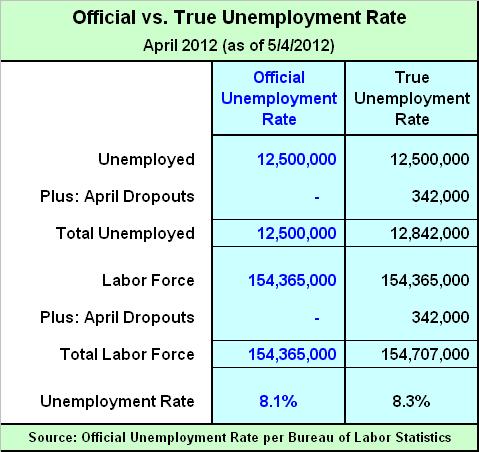
The April Employment Situation Summary concluded that a total of 12,500,000 persons were unemployed, out of a labor force totaling 154,365,000, equaling a decline in the official unemployment rate to 8.1%, from 8.2% in March. So what changed?

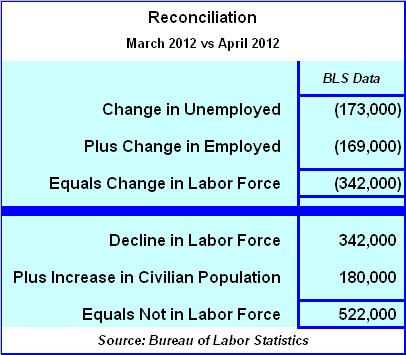
Comparing the monthly changes in the table below, you will note that from March to April, the number of unemployed persons (A) declined by 173,000. This would be a good thing, if they were all able to find jobs, right? So how many found jobs? Well, none. As you can see, according to Table A-1, the number of employed persons (D) also fell by 169,000. Since the number of employed and unemployed persons both declined, where did they go? As you can see the entire labor force declined by 342,000. Is it a coincidence that 173,000 plus 169,000 equals 342,000? No, it’s not.

The number of unemployed persons declined by 173,000, not because they were able to find work, the BLS merely removed them from the labor force. The BLS also removed an additional 169,000 persons from the labor force, who were considered employed just a month prior. Thus, 169,000 persons were ushered directly from a status of employed in March, to completely out of the labor force by the end of April. Does this raise any eyebrows? Also noteworthy are changes in the number of persons “Not in the Labor Forcewhich increased by 522,000, and the “Civilian Noninstitutional Population” which increased by 180,000. How de we reconcile this?

Reconciliation

The table below summarizes the truth behind the decline in the official unemployment rate.

Here’s what happened.

  1. The number of unemployed persons declined by 173,000 in April.

  2. The number of employed persons declined by 169,000 in April.

  3. The labor force declined by 342,000 in April, which is the sum of #1 plus #2.

  4. The 342,000 persons in #3, who officially dropped out of the labor force in April, were added to those considered “Not in the Labor Force”.

  5. The Civilian Noninstitutional Population (working age population) increased by 180,000 in April, but none entered the labor force.

  6. The number of persons counted as ”Not in Labor Force” increased by 522,000 in April, which is the sum of the 342,000 persons who were previously counted as unemployed (173,000) and employed (169,000), plus the 180,000 new working age persons who were swept under the rug.

Sequitur

To sum it up, in April, 342,000 persons dropped out of the labor force, while another 180,000 new entrants fell by the wayside. In effect, a total of 522,000 persons were removed from the labor force. So what would the official unemployment rate have been had the 342,000 April dropouts been instead left in the labor force and counted as unemployed? The answer is 8.3%, as shown below. Thus, the true unemployment rate ticked up by 1 basis point, from 8.2% in March to 8.3% in April, rather than down by 1 basis point as the BLS reported.

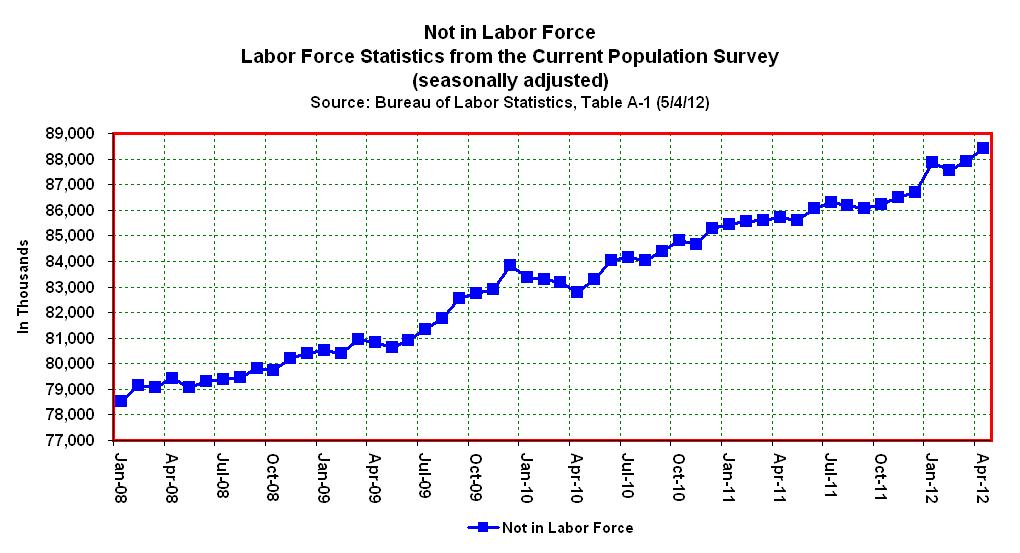
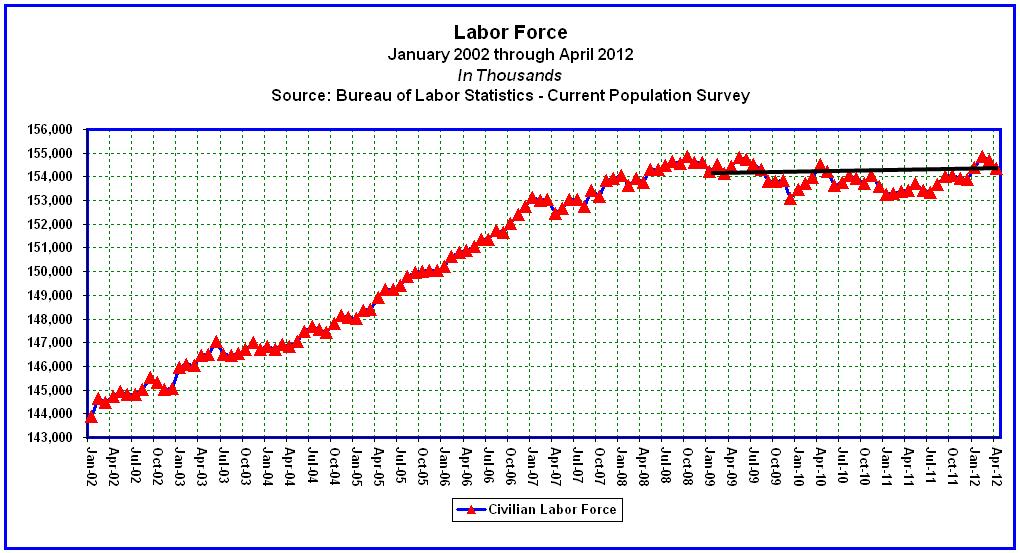
The labor force has historically grown at an annual rate of 1.0% (mirroring population growth), but looking back to December of 2008, it is safe to state that the labor force stopped growing altogether since Obama’s inauguration (see chart below). [Note: The labor force participation rate has likewise declined from 65.8% to 63.6% over the same period, or by 220 basis points.]

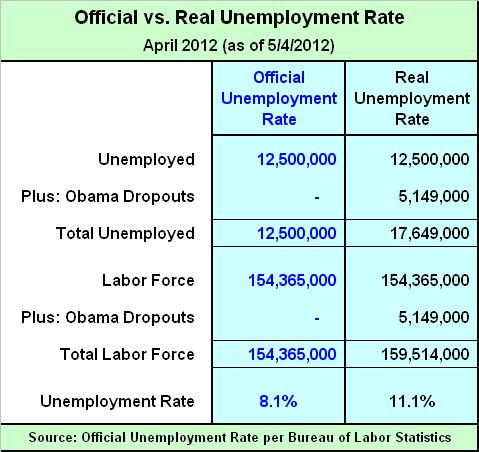
Final question: What would the unemployment rate be if the 1.0% per annum shortfall in the labor force, since January of 2009, was restored? Well, since 40 month’s have passed, the labor force should have grown by 3.33% ((1.0% / 12) * 40). And since the labor force stood at 154,626,000 in December of 2008, it should have grown to 159,775,000 by April of 2012, a difference of 5,149,000. Thus, the real unemployment rate is 11.1%, not 8.1%, as shown below.

Are we really moving the right direction? That depends on ones definition of the word “right”. Is manipulating the truth right?

“Anyone who doesn’t take truth seriously in small matters cannot be trusted in large ones either.” ~ Albert Einstein

Data:

Spreadsheets

Passing the Buck and Taking Names | Obama’s GSA

* By: Larry Walker, Jr. *

“Ultimately the buck stops with me… I’m going to be accountable.” ~ Barack Obama *

What a load of bull! Harry Reid’s U.S. Senate hasn’t passed a budget resolution since April 29, 2009. Barack Obama hasn’t presented a budget, at least not one acceptable to either Democrats or Republicans, since the day he set foot in office. Yet he thinks he should keep his job. But that’s not how it works in America. Obama was given a fair shot; he had his fair share of opportunities, but he chose to pass the buck, running his mouth instead of governing, and now it’s time to give someone else a shot.

U.S. Gross Domestic Product has grown by a mere 7.59% from 2007 to 2011, or at an average annual growth rate of a pathetic 1.90%. But Federal Agency spending has increased by 32.04% over the same period, or at an average annual growth rate of 8.01%. Does the fact that Agency spending outpaced the economy by 322% sound any alarms? Well if we had a chief executive who was paying attention it would. This is an outrageous, hair-raising, mind-boggling, egregious, statistical fact, yet all U.S. taxpayers have heard for the last three plus years are threat after threat of higher taxes.

The Bush tax cuts are out, no they’re in. The payroll tax cut is gone, no it’s back. The AMT Patch is dead, no it’s still breathing.’

And now we have to contend with yet another threat, Taxmageddon. Taxmageddon is a $494 billion tax increase that strikes at the beginning of 2013. This time it’s the largest tax increase in U.S. history, scheduled to hit us smack in the face on January 1, 2013. Under current law, tax policies in seven different categories will expire, including the Bush Tax Cuts, payroll tax cut, the AMT Patch, plus five of the 18 new tax hikes from Obamacare will begin, see Taxmageddon: Massive Tax Increase Coming in 2013.

Unusual uncertainty remains unusually uncertain.

With Taxmageddon looming, the GSA scandal is well-timed. It has undeniably exposed the truth. And the truth is that the federal government has been living large through its discretionary spending, throwing our future to the wind, while we’ve been left sitting on pins and needles. Since the economy is practically at zero growth, where do these morons think the money to pay higher taxes will come from? I find it amazing, simply amazing, that no one has been in charge of the national purse for the last three-plus years. Absolutely no one has kept tabs on how our tax dollars were spent. We deserve better.

With an estimated $6.3 Trillion borrowed and squandered on Obama’s watch, and red flags abounding, it makes me sick to my stomach that politicians are suddenly concerned. You would have to be blind or not paying any attention to federal spending whatsoever to not notice the humongous 6,896.30% increase in the GSA’s expenditures from 2007 to 2011. Why blame the GSA? Blame yourselves, or blame Obama. The buck stops with Obama, right? So fire him. Put Obama on trial.

Maybe if someone wasn’t on the golf course, on vacation, or campaigning every other week (at our expense), and instead actually took time to study the budget “line by line”, and to work with Congress on cutting and capping spending, the GSA incident wouldn’t have occurred. I call it not doing the job you were elected to do. But hindsight is 20/20; foresight is not reelecting someone who has proven he can’t handle the job.

Does the following condensed OMB table, Outlays by Agency, which compares government spending growth from 2007 to 2011, raise any flags? If you ask me, the entire record is a red flag. The General Services Administration is an obvious bell ringer, its expenditures having grown from $27 million in 2007, to over $1.8 billion in 2011, or by 6,896.30%. But it’s not the only agency that should concern us, frankly they all should.

As you scan through the following highlights, keep in mind that the entire U.S. economy grew by a mere 7.59% over the four-year period, or at average annual growth of 1.90%.

  • The Department of Agriculture’s four-year spending growth was 65.11%, with average annual growth of 16.28%. You would think they were actually growing crops or raising livestock, but we know that’s not the case, so why have annual expenditures increased by $54.9 billion? Cut it.

  • The Department of Commerce’s four-year spending growth was 53.36%, with average annual growth of 13.34%. You would think they were actually manufacturing products or providing services, but we know that’s not the case, so why have annual expenditures increased by $3.5 billion? Cut it.

  • The Department of Energy’s four-year spending growth was 55.95%, with average annual growth of 13.99%. You would think they were actually producing electricity, mining coal or drilling for oil, but we know that’s not the case, so why have annual expenditures increased by $11.3 billion? Cut it.

  • The Department of Labor’s four-year spending growth was 177.58%, with average annual growth of 44.40%. You would think they were actually performing job placement services, but we know that’s not the case, so why have annual expenditures increased by $84.4 billion? Cut it.

  • The Department of State’s four-year spending growth was 77.29%, with average annual growth of 19.32%. You would think they were annexing nations and granting Statehood, in order to increase GDP, but we know that’s not the case, so why have annual expenditures increased by $10.6 billion? Cut it.

  • The Department of Veterans Affairs’ four-year spending growth was 74.36%, with average annual growth of 18.59%. Is this sustainable on average annual GDP growth of just 1.90%? Not hardly. So why have annual expenditures increased by $54.1 billion? Cut it.

  • The Corps of Engineers–Civil Works’ four-year spending growth was 158.75%, with average annual growth of 39.69%. You would think they were actually building roads and bridges, but we know that’s not the case, so why have annual expenditures increased by $6.2 billion? Cut it.

  • The Small Business Administration’s four year spending growth was 424.51%, with average annual growth of 106.13%. You would think they were actually making loans directly to small businesses, but we know that’s not the case, so why have annual expenditures increased by $4.9 billion? Cut it.

  • The Social Security Administration’s (On-Budget) four-year spending growth was 182.82%, with average annual growth of 45.70%. On-budget spending isn’t mandated, it’s not the entitlements portion in which Social Security Taxes offset payments to retirees and those with disabilities. No, this is interest and principal repayments of previously looted funds, and coverage of shortfalls due to the payroll tax cut and other gimmicks. You would think they were actually increasing benefit checks or lowering Medicare premiums, but we know that’s not the case, so why have annual expenditures increased by $100.4 billion? Cut it.

  • Total Federal Outlays experienced four-year spending growth of 32.04%, with average annual growth of 8.01%. With that kind of spending, you would think our economy would have grown by more than 7.59% over the four-year period, and achieved far more than average annual growth of 1.90%, but we know that didn’t happen, so why have annual expenditures increased by $874.4 billion? Has the economic stimulus program of 2009 become permanent? Cut it.

  • And last but far from least, the General Services Administration’s four-year spending growth was a whopping 6,896.30%, with average annual growth of 1,724.07%. You would think they were throwing some really wicked parties, or something. Oh, it turns out that was the case! No wonder annual expenditures increased by $1.9 billion. Just cut it.

Our government is spending at a rate which is 322% greater than the underlying economy. We call this “unsustainable”. What do you call it? The egregious growth of the GSA’s expenditures should have been caught long before it became a public scandal. Has anyone in the District of Columbia been paying attention for the past three years? You would think Obama would have caught this with his vast experience running companies, governing States, and all. Oh that’s right, he doesn’t have any experience.

I just gave you $340.2 billion of simple budget cuts, while Obama refuses to acknowledge the problem. If you still don’t get it, here’s the wrap.

The economy isn’t growing. The government is spending at a rate which is 322% greater than its underlying economy. Every additional dollar of tax revenue sucked out of our stagnant economy will cause the economy to decline further, while government continues to live the high life. Since there is no additional revenue to garner, government spending must be cut. The economy was on fire in 2007 on dramatically less government spending. Therefore, returning to the budget of 2007 damages nothing, other than Obama’s plan to bankrupt the nation. If Obama isn’t trying to bankrupt the USA, then what is he doing?

Fire Obama! Cut government spending. Cut the B.S. Cut it big. And cut it now!

References:

Table 4.1—Outlays by Agency: 1962–2017

BEA—Gross Domestic Product and Personal Income

Spreadsheets

Fair Shot, Fair Share and a Glass of Algae

* By: Larry Walker, Jr. *

“Lake Erie is facing its worst toxic algae bloom since the 60’s and somehow it is going unnoticed…” ~ JoeOH111 *

According to Mr. Obama, you don’t have a fair shot right now, and it’s all because millionaires aren’t paying enough income tax. If millionaires would just give the federal government its fair share, then you, I, and everyone else would have a fair shot…, and a glass of algae.

What, pray tell, is a fair shot?

The best definition I can surmise is “a lawful chance at odds.” But don’t we all have this already? For example, the odds of winning the recent $640 million Mega Millions jackpot were 1 in 176 million. In order to guarantee a win, one would have had to spend $176 million buying up every combination. So if some nefarious millionaire had purchased all 176 million combinations, would he or she have had an unfair advantage?

Well, perhaps, but what millionaire would be dumb enough to blow $176 million on lottery tickets? What are the odds of that ever happening? The odds of one person buying all 176 million winning combinations, across multiple States, would probably be 1 in (infinity). In other words, a guaranteed win is impossible, at least when it comes to the Mega Millions lottery. But a fair shot is open to anyone who plays the game. “You gotta be in it to win it.”

According to CBS News, one person purchased $2,600 worth of lotto tickets, and another threw down $55, while the more frugal played their usual dollar or two. Did the one who blew $2,600 have an unfair advantage over $55 and $1 players? I will concede that the $2,600 player had an advantage, but I would hesitate to call it unfair. The poor sap simply had more to lose, yet not a dime more to gain. Not one dime. Now let’s flip over to the Mega Trillions Federal Debt Lotto.

Mega Trillions Federal Debt Lotto

If a taxpayer earns $176 million in taxable income and pays $29.9 million in federal taxes (a rate of 17%), while another earns $50,000 and pays $8,500 in taxes (also a rate of 17%), and yet another earns $25,000 and pays $0, does either have an unfair advantage? Since both the millionaire and the $50,000 wage earner pay the exact same tax rate (17%), the non-taxpayer has an advantage. But is it an unfair advantage? I would say so, especially since in the recent past we all pitched in at every level of income. Yet the one paying $29.9 million in taxes has a lot more to lose than both the $8,500 payer, and the non-taxpayer.

But who wins in this crapshoot? With the federal government borrowing and spending hundreds of billions of dollars, in advance, and squandering it to produce test-tube sewage-fed algae biomass for fuel, while Lake Erie and other U.S. lakes are full of “free” blue-green scum, the answer is no one. You’d have to be an idiot to waste hundreds of billions of dollars manufacturing something that’s sitting right in front of your face, wouldn’t you? Hindsight is 20/20, foresight is priceless.

When it comes to the national debt, those who don’t pay federal income taxes make out like bandits, they have nothing to lose. And those who already pay more than their “fair share” (i.e. taxed enough already) have nothing to gain. It’s not the 2% of top earners that worry me, they generally pay their bills on time, but rather the federal government which has already borrowed more than 100% of our entire economy, an amount estimated to reach $16.3 Trillion by September 30th of this year.

Only a depraved leader would have his nose in other peoples finances while ignoring his own debt laden, broken, overspent, and soon to be bankrupt enterprise. The federal government is not the solution to our problems; it’s the $16.3 Trillion in the hole, deadbeat, money squandering, largest debtor-nation in the Universe, leach, which is forever in the way and constantly on our collective back.

The moral of this story: Never confuse motion with action.

In other words, quit giving speeches and fix the problem. No one is going to vote for a tax increase in the middle of an election cycle, no matter how many speeches are enounced and dribbled. Especially not the one proffered, which in the end will barely cover one day’s worth of current deficit spending. No not a one! We don’t have a revenue problem; no, no, no, what we have is a deadbeat, money squandering, and largest debtor-nation in the Universe, ass-backwards, leach of a federal government problem. Get a clue!

Rather than paying more taxes, or spending multi-millions on lottery tickets to become multi-millionaires all over again, our well-to-do brethren would do better by investing in their own casinos, creating jobs and fair shot opportunities for others. And that leads us back to square one all over again: cut taxes, cut spending, and get out of our way and off our backs.

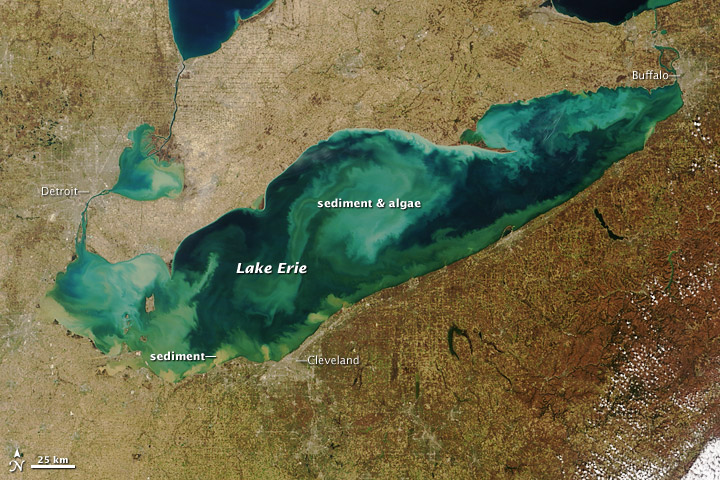
Photo Credit: Lake Erie, Stirred Up | Via: NASA Earth Observatory (March 21, 2012)

The Real Employment Situation – January 2009 through March 2012

* By: Larry Walker, Jr. *

“Our economy’s now created more than 4 million private sector jobs over the past 2 years. And more than 600,000 in the past 3 months alone,” Mr. Obama boasted to a forum at the White House on women and the economy, on Friday (CBS News).

And in related news, on the previous evening, Egan-Jones Ratings Co. cut the U.S.A.’s credit rating one step to AA, the second downgrade in nine months and two levels below its highest grade, with a negative outlook citing the nation’s increasing debt burden (Bloomberg).

Most of us are well aware of the nation’s impending debt implosion, but the real employment situation has been distorted beyond reason. I understand how badly Mr. Obama is fighting against returning to the obscure existence he led prior to 2008, but if he was at all capable, he would at least tell us the truth about where we stand. I’m frankly weary from all the sugarcoating and distortion of facts. So what’s the real employment situation?

The Truth Shall Set You Free!

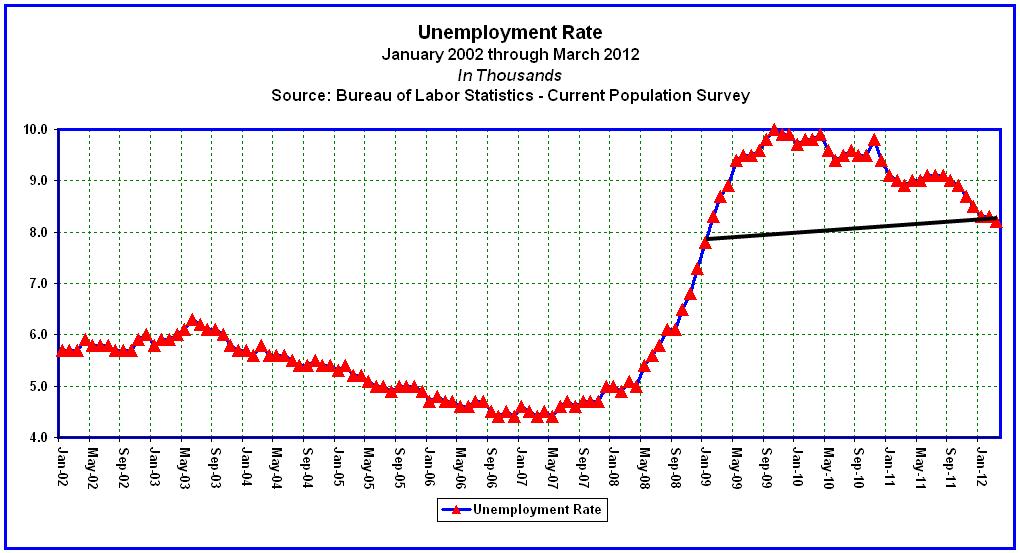
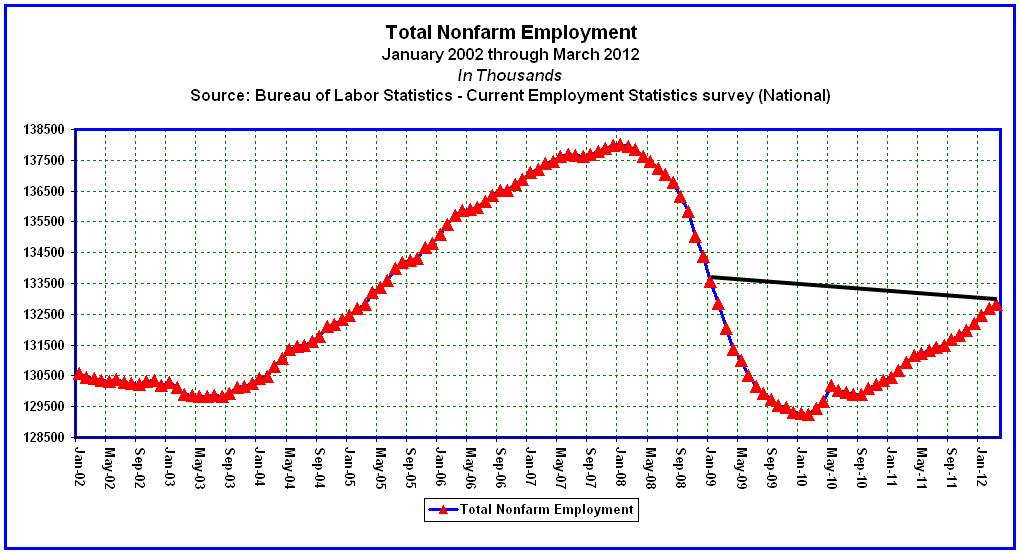
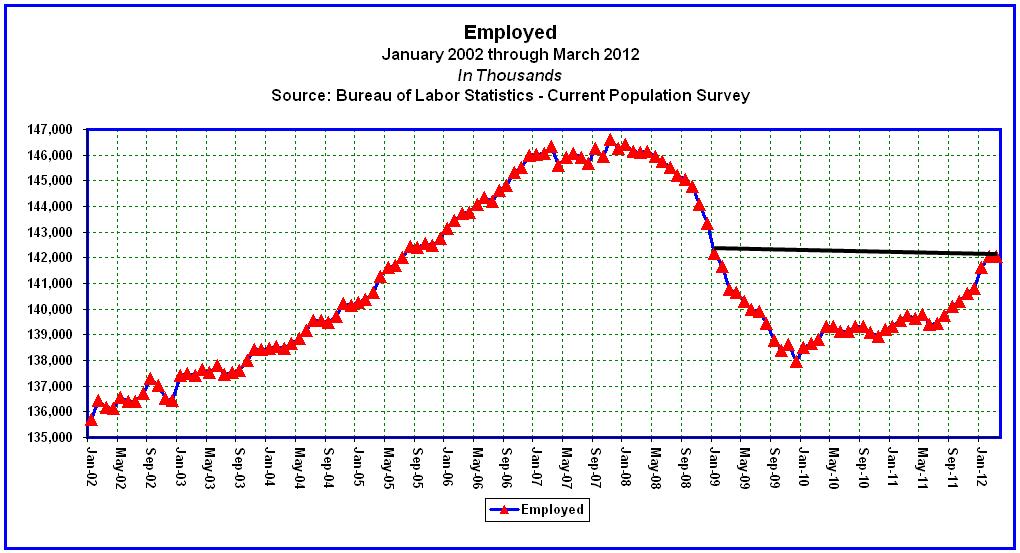
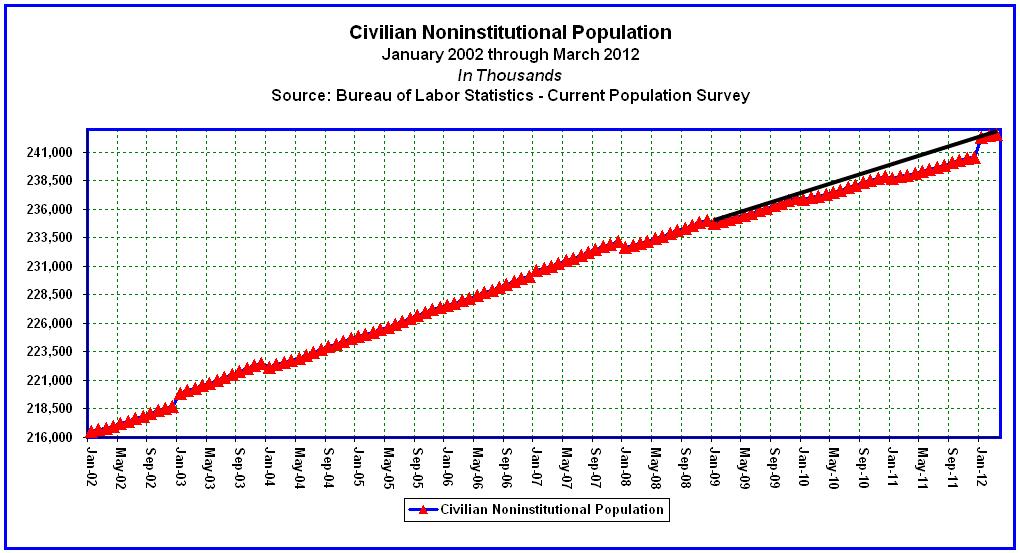
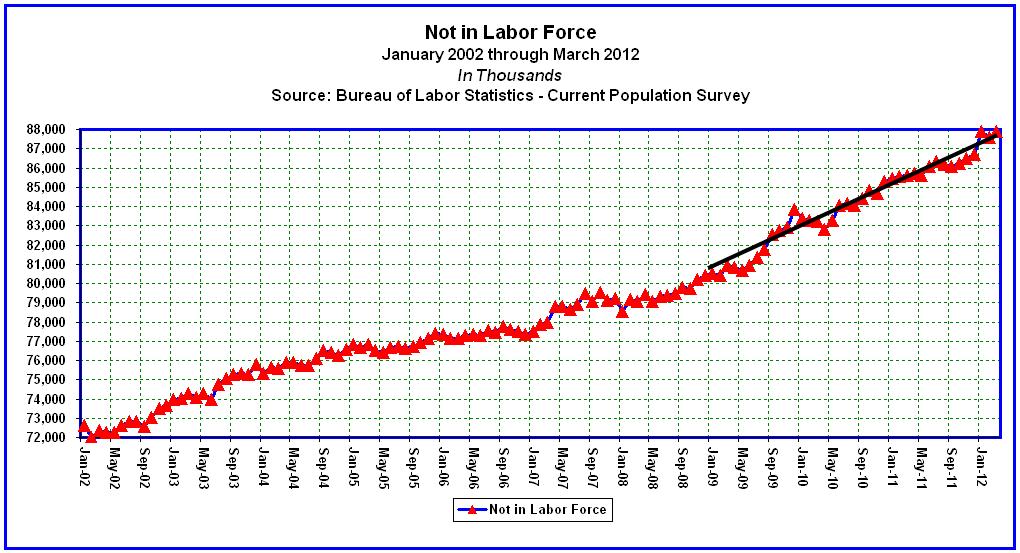
In order to know the truth, we must examine not so much monthly trends in employment, but rather changes which have occurred from the end of January 2009 through March 2012. When we examine the entire record, we find that our economy hasn’t created any jobs at all over the past 3 ¼ years, on a seasonally adjusted basis. Instead the unemployment rate has risen from 7.8% to 8.2%, the number of nonfarm jobs has declined by 740,000, the number of unemployed persons has increased by 624,000, and total employment has declined by 153,000. Meanwhile, the working age population has grown by 7,865,000, while the civilian labor force has only managed an increase of 471,000, causing the number of persons no longer counted in the labor force to balloon by 7,395,000.

The truth is that our economy hasn’t created any new jobs since Obama’s policies took effect. The total number of jobs peaked at an all time high of 146,595,000 in November of 2007, and through March of 2012 the number stands at 142,034,000, more than 4.5 million off the mark. If we had more jobs than existed in November of 2007, then Obama would have something to brag about, although not much. But since the truth is somewhat inconvenient, we are supposed to ignore the fact that we are more than 4 million jobs in the hole, and submit to repeated media brainwashing and succumb to the belief that we have somehow moved ahead by over 4 million. Phooey! Here are the facts.

Unemployment Rate

The unemployment rate rose from 7.8 percent in January of 2009 to 8.2 percent as of March 2012, according to the U.S. Bureau of Labor Statistics (Employment Situation 4/6/2012). (See table A-1 / Seasonally Adjusted)

Nonfarm Employment

Nonfarm payroll employment declined by 740,000 through March of 2012, from 133,561,000 in January of 2009 to 132,821,000. (See table B-1 / Seasonally Adjusted)

Unemployed Persons

The number of unemployed persons increased by 624,000 through March of 2012, from 12,049,000 in January of 2009 to 12,673,000. (See table A-1 / Seasonally Adjusted)

Total Employment

The number of persons employed declined by 153,000 through March of 2012, from 142,187,000 in January of 2009 to 142,034,000. (See table A-1 / Seasonally Adjusted)

Civilian Noninstitutional Population

The Civilian Noninstitutional Population (working age population) increased by 7,865,000 through March of 2012, from 234,739,000 in January of 2009 to 242,604,000. (See table A-1 / Seasonally Adjusted)

Civilian Labor Force

The labor force increased by 471,000 through March of 2012, from 154,236,000 in January of 2009 to 154,707,000. The labor force hasn’t grown at all since October of 2008. (See table A-1 / Seasonally Adjusted)

Not in Labor Force

The number of persons not in the labor force increased by 7,395,000 through March of 2012, from 80,502,000 in January of 2009 to 87,897,000. (See table A-1 / Seasonally Adjusted)

To make the claim of having created more jobs than Mr. Bush, which we all know was Mr. Obama’s insinuation; he must first match Mr. Bush’s all-time-high of 146,595,000. If the number of persons who involuntarily dropped out of the labor force (7.3 million), since Mr. Obama’s policies took effect, had instead been jobs created, Mr. Obama might go down in history as the all-time greatest. However, since we presently have 4.5 million fewer jobs than existed at Mr. Bush’s peak, and since, under the direction of Mr. Obama, 7.3 million new working age persons have been pushed straight into joblessness and generational dependency, Mr. Obama’s policies should perhaps be branded as the most ineffective in U.S. history.

Since employment is a lagging economic indicator, and because economists are calling for recession in 2012, and since the statistics above represent the sum total of Obama’s economic accomplishments, we’re in for serious troubles ahead. To reiterate, Mr. Obama’s policies of Inordinate Stimulus, Undue Debt and Global Warming Foolishness caused the Looming Recession.

Photo Credit: A swarm of Western Toad tadpoles eating algae. Photo: Kristiina Ovaska

Reference: Bureau of Labor Statistics, Employment Situation Summary

Data: Worksheets

The Malaise of 2012 | Part IV

* Inordinate Stimulus, Undue Debt and Global Warming Foolishness Caused the Recession

* By: Larry Walker, Jr. *

“With few exceptions no educated person in the history of Western Civilization from the 3rd Century B.C. onward believed that the earth was flat… No one before the 1830’s believed that medieval people thought that the earth was flat.” ~ Jeffrey Burton Russell (The Myth of the Flat Earth)

Global Warming Foolishness

In an article entitled, “Algae for Waste Water Treatment and BioFuel Production: A Double Winner,” Dr. John Kyndt and Dr. Aecio D’Silva discuss the process known as phycoremediation, which is short for treating waste water with micro algae, for the purpose of producing low cost algae biofuels and other biomass products.

Biofuel is a type of fuel whose energy is derived from biological carbon fixation. The advantage of algae is that it will supposedly consume more CO2 than is released in the process. Unfortunately, and unbeknownst to many, this has not been the case with previous generations of biomass. So how did scientists arrive at the recent pronouncement that algae-biomass is the answer to our future fueling needs?

In 2008, two groups of US researchers independently concluded that most biofuels commonly thought of as solutions for reducing greenhouse gases, turned out instead to increase greenhouse gas emissions. Clearing grassland or forests to plant them released more carbon dioxide than could be saved in the process. The analyses proved that large amounts of trapped carbon are released into the atmosphere when vegetation burns or decays as land is cleared. This up-front ‘carbon debt’ could take centuries to break even with emissions gradually avoided by substituting biofuels in place of fossil fuels. Many studies subsequently arrived at the same conclusion.

For example, sugarcane ethanol grown on the converted Brazilian savannah would need to replace petrol emissions for 17 years just to repay the carbon released when the savannah was converted. Other examples, such as soybean biodiesel from cleared Amazonian rainforest, took centuries to break even. The studies concluded that, only biofuels made from waste products, or grown on abandoned lands would do less harm than good. Thus the algae boom was born. The same line of reasoning eventually lead to the latest craze: treating waste water with algae for biofuel production. A double winner loser!

Ironically, fossil fuels have their origin in ancient carbon fixation, a similar process to that realized through detoxifying sewer water with algae. However, green scientists don’t recognize fossil fuel as a biofuel because it contains carbon that has been out of the carbon cycle for a very long time (which might actually be a good thing). Thus, we have green fuel, manufactured through synthetic carbon fixation, versus black gold, created through naturally aged carbon fixation.

Here’s how the algae fad works. Instead of waiting on Mother Nature to naturally form fossil fuels, mankind is now capable of producing the same effect in a fraction of the time. We have arrived. The idea is that as you flush your toilet, instead of the waste flowing to costly, energy consuming, waste water treatment facilities; it will instead be treated with algae before returning to your tap. In turn, the algae will be converted into biodiesel, green diesel, bio-jet and chemicals. The residual biomass, which is high in proteins and carbohydrates, will be used in aquaculture, animal feed, and food ingredients. Did I say food ingredients? Yes. And that makes algae a triple loser!

In fact, one particular algae biofuel manufacturer, Solazyme, boasts of its ability to create renewable oil – for fuel, and for food. Among its primary inputs are waste streams. When I recently learned that one of my favorite frozen food companies, which I won’t name here, was using the residual biomass from Solazyme in its food-line, I immediately discontinued its use. The thought of diesel fuel, and food coming from the same sewage fed algae-brew was more than I could take, as I alluded to in, Ends of the Green Agenda – Costs of Algae Biofuel.

The U.S. Navy has announced the objective of operating at least 50% of its fleet on clean, renewable fuel by 2020. According to Marine Corps Times, in 2009 the Navy paid $424.00 per gallon for 20,055 gallons of biodiesel made from algae, which set a world record at the time for the cost of fuel. Solazyme was the recipient of this lucrative contract. In the midst of the worst recession since the Great Depression, the U.S. Navy presumed that paying $424.00 per gallon for algae biodiesel (while petroleum based diesel was selling for an average of $2.50 per gallon) was somehow not a foolish waste of taxpayer’s money.

How has the company fared since the stimulus well ran dry? Solazyme (symbol: SZYM) opened on the NASDAQ Exchange at $20.71 in May of 2011, peaked at $27.03 in July of 2011, then tanked to $8.29 by October of 2011. Although it recently closed at $15.05 on March 21, 2012, and its total revenue for the fiscal year ended December 31, 2011 was $39.0 million compared with $38.0 million in the prior year, its fiscal year 2011 GAAP net loss attributable to its common stockholders was $(54.0) million, compared with $(16.4) million in the prior year.

So since Solazyme had $39 million in revenue but wound up losing $54 million in 2011, it appears to be a huge boondoggle. It’s quite a feat for a company to lose more than 100% of its total revenues. Were it not for the government’s inordinate stimulus coupled with undue debt, this foolish endeavor, along with a myriad of others, wouldn’t exist.

Yes, it’s true, global warming foolishness is a major cause of the looming recession. Instead of focusing on root causes of the previous recession, the Obama Administration has gone awhoring after science fiction myths and bowed itself to strange gods. And because of this we must all pay a price.

Economist Raymond Richman of Ideal Taxes sums it up:

The growth of state-subsidized bio-fuels, windmills and solar panels, hybrid vehicles, electric cars, and lithium battery manufacturers has highly negative effects on employment and regressive effects on the distribution of income.

We estimate that about $100 billion in grants and tax credits have been extended by the federal and state governments to the proprietors of those establishments, making many of them rich and eager to take advantage of the free capital and guaranteed loans.

Tax rebates and tax credits do not appear in our federal budget.

American economists are at a loss to explain the continuing high level of unemployment in the face of the $800 billion Recovery Act expenditures, the $1.5 and $1.8 trillion budget deficits in 2010 and 2011, and “green” energy subsidies, federal and state.

Moreover, none of the “global warming” could compete with fossil fuels without huge government subsidies. The states and federal government provided about 60 percent of the capital of the green enterprises and got nothing in return. The government made sure that wind and solar plants got a high enough price for the electricity they produced by requiring electric utilities to buy their electricity output regardless of price. The subsidies are so costly that Spain had to end the wind and solar subsidies to avoid bankruptcy and we shall have to as well.

Recently, while attempting to defend his global warming panic policies, Barack Obama made the following humorous remark, “If some of these folks were around when Columbus set sail, they probably must have been founding members of the flat earth society. They would not believe that the world was round.” Apparently everyone but Obama knows that, with few exceptions, no educated person in the history of Western Civilization from the 3rd Century B.C. onward believed that the earth was flat.

Am I supposed to trust a man who is roaming around the countryside proclaiming that the world will turn into a giant incinerator within a couple of years, unless we start making our food and fuel out of our own feces?

I simply refuse to believe that the World will turn into a ball of fire through our continued, prudent use of natural, God-given, carbon based fossil fuels. However, I do believe that the U.S.A. is headed for a cliff. If this nation keeps on borrowing and spending like it is today, we might be forced into bankruptcy within a couple of years, a concept which is apparently beyond Mr. Obama’s grasp.

The U.S. is sitting on a 200-year supply of oil. If the idea is to break free from our dependence on foreign oil, I’m game, and we can start doing that right now, with our God-given natural resources. But if the idea is some foolish Doomsday notion, based on panic and fear, then Obama should be removed from the White House, and returned to the nearest urban street corner, cardboard sign and all. Global warming foolishness is the third and final element contributing to the Malaise of 2012.

Continued from: The Malaise of 2012 | Part I | Part II | Part III

——————————————————————————————————

Other references:

http://en.wikipedia.org/wiki/Biofuel#cite_note-Science2-51

Unilever’s new Durban plant a model of sustainable savoury dry food production – Well alrighty then!

11 Great Things to Do With Sewage

Algae Meal Performs as Dairy Cattle Feed

The Malaise of 2012 | Part III

* Inordinate Stimulus, Undue Debt and Global Warming Foolishness Caused the Recession

* By: Larry Walker, Jr. *

It is impossible to calculate the effect of deficit-financed government spending on demand without specifying how people expect the deficit to be paid off in the future. ~ The Theory of Rational Expectations

Undue Debt

Obama’s three-point plan for deficit reduction can be summed up in three words, “Spend Baby Spend.” In fact, Obama will have borrowed more than $6.3 trillion during his four-year term, which is more than the first 42 and 1/4 presidents combined. And what do we have to show for it? Nothing! The only thing that his profligate spending has accomplished is to effectively stifle any chance of recovery from the December 2007 recession.

The total debt outstanding, from the inception of the United States through George W. Bush’s second year in office was $6.2 trillion. Since Obama has borrowed $6.3 trillion in four years, that’s more than the total debt incurred in the first 226 years of American history. Now that this is clear, there is really only one question:

Have we recovered yet?

To answer this, all one has to do is look at employment. The number of jobs reached an all-time high of 138,023,000 in January of 2008, but today, we are still 5.3 million jobs short of this mark.

As of the February 2012 Employment Situation Report, employers logged in a total of 132,697,000 jobs. Well great, but that’s only 170,000 more jobs than there were in February of 2001. In fact over the same 11-year period, the civilian non-institutional population grew by 29,692,000 persons. So since the working age population has grown by over 29 million, while the number of jobs has grown by a mere 170,000, the answer to that question is negative. The handwriting is on the wall.

So what was Obama’s three-point deficit plan, again? Step one was to borrow, step two to spend, and step three to repeat step one. As you may recall, “We have to spend more to keep from going broke.” It’s Endless Stimulus! Spend baby spend! As far as when principal repayments will begin, well, even with a second term, that would be never, since Obama failed to produce a budget during his first term.

As we discussed in War on Wealth III | National Debt Review, since the gross public debt as a percentage of GDP has skyrocketed from 69.9% in 2008, to 104.8% in 2012, and is projected to reach 107.8% by 2014, our ability to repeat the mistakes of the Obama administration is over. This means there won’t be a second term. The Era of Obamanomics is over.

Obama prematurely increased spending to DEFCON 1 levels, yet World War III isn’t here yet. And in spite of this undue debt, we are now heading directly into another recession, this year, in 2012. The Economic Cycle Research Institute (ECRI) reiterated its recession call on March 15, 2012, in a detailed report entitled, Why Our Recession Call Stands.

Honey baby, when the federal government borrows and spends $6.3 trillion dollars, as it has done between fiscal years 2009 and 2012, that’s 6.3 trillion fewer dollars the private sector has had access to. Having trouble qualifying for a loan? Did your local bank go belly up while you waited for approval? Small wonder; for even lenders are rational beings.

Shall we lend more money to homeowner’s who are already upside down on their mortgages, to small businesses owners who lack guarantees, or shall we instead lend to the federal government which has a guaranteed ability to repay? A printing press, that is. Undue Debt is the biggest factor contributing to the Malaise of 2012.

“When people do not accept divine guidance, they run wild. But whoever obeys the law is joyful.” ~ Proverbs 29:18

To be continued …

Continued from: The Malaise of 2012 | Part I and Part II